

 Posts
Posts


Mrs McDermott of recent youtube frame is a parent of a child at North Beach Elementary in Seattle. According to this article, McDermott helped lead a math revolution to prevent the schools from adopting TERC or Everyday Math. It seems she is working the PTA as well.
It seems she is involved with "Where's the Math?" a "non-partisan advocacy group of parents, educators, and community members who are working to ensure that Washington State mathematics education standards, curriculum, and assessments are coherent, academically focused, rigorous and comparable to those of top performing nations in the world."
Where's the Math appears to be the originators of the
Math Education: An Inconvenient Truth video.
Another article here.
Saturday, January 20, 2007


what one person can do
I mentioned in the Comments thread to Math Education: An Inconvenient Truth that parent and meterologist M.J. McDermott apparently made the video entirely on her own. Which prompted this reaction from Instructivist:
parent uprising (not)
How much political change one person can bring about, if any?
Good question.
I routinely get emails from parents telling me to hang it up. Routinely!
Your basic parent feels, reasonably, that absent a parent uprising Nothing Will Change.
I don't really have an argument for that.
Actually, it's worse than that; as far as I can tell even a parent uprising isn't a sure thing.
After all, 300 parents signed a petition rejecting the adoption of Math TRAILBLAZERS and what did they get for their efforts?
They were thanked for showing up at the Board meeting and participating in a positive discussion of the issue!
And then of course we had the parent uprising back in the winter of '05 concerning Ms. K and the 6th grade Phase 4 class, led by the then-president of the PTSA and a board member of the IEF.
These two women weren't your everyday ticked-off parents.
No.
These were macher parents. Macher enough to organize and lead a parent uprising.
Which led directly to.....the subsequent tenuring of Ms. K and the decision to have last year's 6th graders taught by her two years in a row instead of just the one.
So.....parent uprisings.
Easily quelled here in Irvington, it seems.
Thank you for your ongoing cooperation and support!
wrong model
It suddenly struck me, writing this post, that parent uprisings might be the exact wrong way to effect political change inside a small school district.
A parent uprising is the exact wrong way because the administration holds all the power.
Parents hold none of the power.
So why would a parent uprising have any chance of succeeding?
All the administration has to do to put down a parent uprising is agree to a meeting, attend the meeting, thank everyone for the input he or she has provided at the meeting, and then go off and do whatever it was they were planning to do in the first place.
wow
I've just stopped feeling guilty for not trying to organize a parent uprising.
listmania
Awhile back I emailed Barry asking whether he knew any good books on how to change your school district.
He didn't.
I figured that was a ludicrous request, but otoh being a writer I naturally think there's a good book on every subject, so there must be a good book on how to change your school district, too. Or at least a good book on how to change something like your school district.
Well, guess what.
There is a book on how to change something like your school district; there are a bunch of books.
John Hoven (pdf file) has a listmania!
He's got a wish list, too.
I've already bought some of the books.
While I'm at it I'm thinking I should probably read the new Counterinsurgency manual.
Maybe the Small Wars Manual, too.
It's inspiring what a determined individual can accomplish. Great technology like the internet now magnifies such efforts thousand-fold and even million-fold if this video goes "viral."We can all fervently hope that "Inconvenient Truth" will go viral, the sooner the better.
parent uprising (not)
How much political change one person can bring about, if any?
Good question.
I routinely get emails from parents telling me to hang it up. Routinely!
Your basic parent feels, reasonably, that absent a parent uprising Nothing Will Change.
I don't really have an argument for that.
Actually, it's worse than that; as far as I can tell even a parent uprising isn't a sure thing.
After all, 300 parents signed a petition rejecting the adoption of Math TRAILBLAZERS and what did they get for their efforts?
They were thanked for showing up at the Board meeting and participating in a positive discussion of the issue!
And then of course we had the parent uprising back in the winter of '05 concerning Ms. K and the 6th grade Phase 4 class, led by the then-president of the PTSA and a board member of the IEF.
These two women weren't your everyday ticked-off parents.
No.
These were macher parents. Macher enough to organize and lead a parent uprising.
Which led directly to.....the subsequent tenuring of Ms. K and the decision to have last year's 6th graders taught by her two years in a row instead of just the one.
So.....parent uprisings.
Easily quelled here in Irvington, it seems.
Thank you for your ongoing cooperation and support!
wrong model
It suddenly struck me, writing this post, that parent uprisings might be the exact wrong way to effect political change inside a small school district.
A parent uprising is the exact wrong way because the administration holds all the power.
Parents hold none of the power.
So why would a parent uprising have any chance of succeeding?
All the administration has to do to put down a parent uprising is agree to a meeting, attend the meeting, thank everyone for the input he or she has provided at the meeting, and then go off and do whatever it was they were planning to do in the first place.
wow
I've just stopped feeling guilty for not trying to organize a parent uprising.
listmania
Awhile back I emailed Barry asking whether he knew any good books on how to change your school district.
He didn't.
I figured that was a ludicrous request, but otoh being a writer I naturally think there's a good book on every subject, so there must be a good book on how to change your school district, too. Or at least a good book on how to change something like your school district.
Well, guess what.
There is a book on how to change something like your school district; there are a bunch of books.
John Hoven (pdf file) has a listmania!
He's got a wish list, too.
I've already bought some of the books.
While I'm at it I'm thinking I should probably read the new Counterinsurgency manual.
Maybe the Small Wars Manual, too.
middle school petition
Christopher just showed me this petition, which is making its way around the middle school.
He doesn't know who wrote it, but he thinks it's a super-smart girl. He signed.
I said, "I love this petition! I want to sign!"
Christopher: "What do you love about it?"
Me: "Doesn't this sound like something I would have written when I was your age?"
Christopher: "Yeah, it does."
Of course, I don't think I would have written it as well.
I can't tell you how happy I am to see this petition.
A new friend of mine, who has a son in 6th grade, told me a couple of months ago that her work regularly takes her to federal buildings. None of these buildings, she says, has "security" at the level of our middle school.
The tight security inside the middle school has been hard on her son, who has become demoralized. He feels like he's living inside a prison, and in a way he is. This is the place Ed and I used to call the Green Zone, after all.
As she put it, "Unless the police have advised them to put in security measures at this level, they need to drop them."
And now here is this petition, written by a child. And she nails it.
She's nailed it for me, too. Life as a parent in Irvington Union Free School District is not free.
One parent with long familiarity of the district says Columbine was a turning point; the district used Columbine to write and impose policies and rules for children without writing or imposing policies and rules for itself.
My own perception is that the district used 9/11 as a justification for taking power, or perhaps I mean access, away from parents.
Not long after 9/11 the district began locking all doors to the buildings; began forcing parents to enter only one door without exception (if a mom happened to be carrying a heavy basket filled with presents for the teachers, that mom couldn't use the door close to her car but had to circle the building to reach the Parent Entrance, staggering under her load); began forcing parents to stand outside in the freezing cold waiting for their children to be released to them after school; began punishing parents who dared to pick their children up in person (we are urged to have our children take the bus) by releasing the bus children from the building first, one classroom at a time, while the in-person parents watched and shivered; began imposing ever-increasing restrictions on parking; began posting guards to enforce these ever-increasing restrictions, etc.
I'm told that the K-3 school has actual lock-downs, 20-minute periods during which no one, including parents, is let in or out of the building.
I can barely believe this, and of course nothing is written down - yet another "practice" as opposed to policy. But this is what a close friend was told one day when she was on her way out of the K-3 school. Someone in the building told her to get out fast because they were going into "lock-down." If she didn't get out before they went into lock-down she wouldn't be allowed out for 20 minutes.
That has to be illegal.
Doesn't it?
Parents are regularly apprised of new rules that come down to us from on high, rules that invariably make life more difficult and limit access to teachers, administrators, and other parents.
Then we are thanked for our cooperation.
Now, of course, we have the union making public threats to sue a parent and being provided the name of "the parent leading the committee to oppose the bond."
Things are wildly out of control.
And now we have a middle school child calling it.
He doesn't know who wrote it, but he thinks it's a super-smart girl. He signed.
I said, "I love this petition! I want to sign!"
Christopher: "What do you love about it?"
Me: "Doesn't this sound like something I would have written when I was your age?"
Christopher: "Yeah, it does."
Of course, I don't think I would have written it as well.
January 2007
To the administration:
We would like to bring to your attention some concerns regarding The Irvington Middle School environment, on behalf of the students.
The simple problem is the amount of freedom that we, as students, receive. There is no clear resolution for the lack of freedom, but there is a cause that can be worked with. Students who don’t respect their education and make bold statements, such as disturbing classes, conducting bomb threats, and stealing, etc. reduce the respect and trust the administration has for the student body. The entire Middle School should not b punished for the actions of the few troublesome kids. In fact, stricter rules encourage more children to do these things, in their haste and displeasure. It should not be necessary for kids to want to make bomb threats simply because they don’t want to endure a few hours in school. The following are examples of some actions taken by the administration that suggest the distrust of students:
- The assignment pad “passport” that limits the amount of times students can use the bathroom
- The necessity of a pass for the library during lunch, sending the wrong message to students in suggesting that reading is only important if a teacher is in the act of forcing children to do so.
- “Indoor recess” where students are not allowed to stand, let alone go to different tables with friends in the crowded cafeteria.
- Restricted time when lockers are accessible.
- Never having or suggesting a space inside where students can “hang out” or spend free time at lunch, especially when the weather is unpleasant (similar to the teachers lounge)
Budget and other factors are understood as reasons as to why these rules are in place, but it should also be understood that the environment for middle school students is becoming increasingly unpleasant with these restrictions. The most important part about middle school is said to be to learn about one’s self in a nonacademic way. For this, there must be an environment that is welcoming and enjoyable for that “self” that is to be discovered.
I can't tell you how happy I am to see this petition.
A new friend of mine, who has a son in 6th grade, told me a couple of months ago that her work regularly takes her to federal buildings. None of these buildings, she says, has "security" at the level of our middle school.
The tight security inside the middle school has been hard on her son, who has become demoralized. He feels like he's living inside a prison, and in a way he is. This is the place Ed and I used to call the Green Zone, after all.
As she put it, "Unless the police have advised them to put in security measures at this level, they need to drop them."
And now here is this petition, written by a child. And she nails it.
She's nailed it for me, too. Life as a parent in Irvington Union Free School District is not free.
One parent with long familiarity of the district says Columbine was a turning point; the district used Columbine to write and impose policies and rules for children without writing or imposing policies and rules for itself.
My own perception is that the district used 9/11 as a justification for taking power, or perhaps I mean access, away from parents.
Not long after 9/11 the district began locking all doors to the buildings; began forcing parents to enter only one door without exception (if a mom happened to be carrying a heavy basket filled with presents for the teachers, that mom couldn't use the door close to her car but had to circle the building to reach the Parent Entrance, staggering under her load); began forcing parents to stand outside in the freezing cold waiting for their children to be released to them after school; began punishing parents who dared to pick their children up in person (we are urged to have our children take the bus) by releasing the bus children from the building first, one classroom at a time, while the in-person parents watched and shivered; began imposing ever-increasing restrictions on parking; began posting guards to enforce these ever-increasing restrictions, etc.
I'm told that the K-3 school has actual lock-downs, 20-minute periods during which no one, including parents, is let in or out of the building.
I can barely believe this, and of course nothing is written down - yet another "practice" as opposed to policy. But this is what a close friend was told one day when she was on her way out of the K-3 school. Someone in the building told her to get out fast because they were going into "lock-down." If she didn't get out before they went into lock-down she wouldn't be allowed out for 20 minutes.
That has to be illegal.
Doesn't it?
Parents are regularly apprised of new rules that come down to us from on high, rules that invariably make life more difficult and limit access to teachers, administrators, and other parents.
Then we are thanked for our cooperation.
Now, of course, we have the union making public threats to sue a parent and being provided the name of "the parent leading the committee to oppose the bond."
Things are wildly out of control.
And now we have a middle school child calling it.
Protocol

Mr. Greenblatt couldn't help but notice that after he heard the sneeze, there were copious amounts of blood on Jose's desk. Jose had somehow bit his tongue while sneezing, and deeply. Fortunately the nurse's office was right across the hall.
"Jose," he ordered, "Go straight to the medical office."
A moment later Jose returned. "She wanth a path, Mithter Greenblatt."
Mr. Greenblatt scoured his bag for the requisite medical pass. He couldn't find one. He quickly scribbled something on a piece of paper and sent Jose back. But a moment later Jose returned, still bleeding.
"She wanth a medical path, Mithter."
Mr. Greenblatt was not happy. He sent Jose across the hall with a note written with his dry erase marker proclaiming the following, in block letters:
PLEASE DO YOUR JOB!
Jenny the nurse (who was actually not a nurse but a paraprofessional) found this beyond the pale. She got up from her desk and went over to give that Greenblatt guy a piece of her mind. Since he had no manners, she figured she'd walk right into his classroom, and that's just what she did.
"How dare you address me like that! In all my years in that office, I've never had anyone speak to me like that. Is it my fault if you can't keep a stock of medical room passes? You should be ashamed of yourself!"
She contemptuously tossed a pad full of passes onto Mr. Greenblatt's desk. Mr. Greenblatt filled one out, sent Jose to the medical office, and moments later Jose was in an ambulance, on his way to get that tongue looked at.
Math Education: An Inconvenient Truth Video
Have you seen this video that presents an introduction to the problems with reform math? It includes specific examples from TERC & Everyday Math. I learned about it from Linda Moran’s Beyond TERC Yahoo group. It’s about 15 minutes long.
http://www.youtube.com/watch?v=Tr1qee-bTZI
I would like to share this with some local parents because I want to inform them of what’s in store for them if our school district decides to adopt TERC (currently being evaluated here). In this era of YouTube appreciation I thought it would grab people’s attention in a positive way. (Although I would have preferred another title.)
Any opinions about this?
Video embedded by Rory:
http://www.youtube.com/watch?v=Tr1qee-bTZI
I would like to share this with some local parents because I want to inform them of what’s in store for them if our school district decides to adopt TERC (currently being evaluated here). In this era of YouTube appreciation I thought it would grab people’s attention in a positive way. (Although I would have preferred another title.)
Any opinions about this?
Video embedded by Rory:
Friday, January 19, 2007
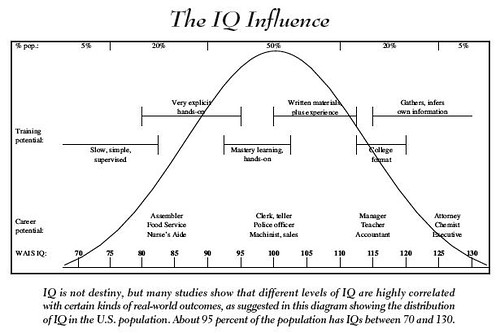
the g Factor curve
The legend reads:
IQ is not destiny, but many studies show that different levels of IQ are highly correlated with certain kinds of real-world outcomes, as suggested in this diagram showing the distribution of IQ in the U.S. population. About 95 percent of the population has IQs between 70 and 130.
The 6 training modes, from left to right, are:
- slow, simple, supervised
- very explicit, hands-on
- mastery learning, hands-on
- written materials, plus experience
- college format
- gathers, infers own information
Schools and the g Factor (pdf file)
The Wilson Quarterly
Summer 2004, page 38
Linda Gottfredson homepage
The General Intelligence Factor (pdf file)
by Linda Gottfredson (1998, Winter)
Scientific American Presents
(9)4, 24-29 1998
___________________
good schools raise IQ, bad schools lower IQ, part 1
good schools raise IQ, bad schools lower IQ, part 2
good schools raise IQ, bad schools lower IQ, part 3
the g Factor curve
good schools raise IQ, bad schools lower IQ, part 3
If and when I actually write part 3, I will be talking about this paper:
Heritability Estimates versus Large Environmental Effects: The IQ Paradox Resolved (pdf file here)
by William P. Dickens and James R. Flynn
detailed summary of "Heritability Estimates"
++++++++++
other:
The Flynn Effect Indiana University
Asian Americans: Achievement Beyond IQ by James R. Flynn
update 2-23-07: done
good schools raise IQ, bad schools lower IQ, part 1
good schools raise IQ, bad schools lower IQ, part 2
good schools raise IQ, bad schools lower IQ, part 3
Seth Roberts on IQ
fuzzy math makes you smarter
IQ quiz
school raises IQ
intelligence is verbal, perceptual, and image rotation
math isn't English
Heritability Estimates versus Large Environmental Effects: The IQ Paradox Resolved (pdf file here)
by William P. Dickens and James R. Flynn
detailed summary of "Heritability Estimates"
++++++++++
other:
The Flynn Effect Indiana University
Asian Americans: Achievement Beyond IQ by James R. Flynn
update 2-23-07: done
good schools raise IQ, bad schools lower IQ, part 1
good schools raise IQ, bad schools lower IQ, part 2
good schools raise IQ, bad schools lower IQ, part 3
Seth Roberts on IQ
fuzzy math makes you smarter
IQ quiz
school raises IQ
intelligence is verbal, perceptual, and image rotation
math isn't English
good schools raise IQ, bad schools lower IQ, part 2
IQ is not a point.
IQ is a range.
I know Charles Murray is aware of this, but I wish he'd make more of it.
___________
good schools raise IQ, bad schools lower IQ, part 1
good schools raise IQ, bad schools lower IQ, part 2
good schools raise IQ, bad schools lower IQ, part 3
Seth Roberts on IQ
fuzzy math makes you smarter
IQ quiz
school raises IQ
intelligence is verbal, perceptual, and image rotation
math isn't English
Aztecs versus Greeks, by Charles Murray
What's Wrong with Vocational School? by Charles Murray
Intelligence in the Classroom by Charles Murray
IQ is a range.
I know Charles Murray is aware of this, but I wish he'd make more of it.
___________
good schools raise IQ, bad schools lower IQ, part 1
good schools raise IQ, bad schools lower IQ, part 2
good schools raise IQ, bad schools lower IQ, part 3
Seth Roberts on IQ
fuzzy math makes you smarter
IQ quiz
school raises IQ
intelligence is verbal, perceptual, and image rotation
math isn't English
Aztecs versus Greeks, by Charles Murray
What's Wrong with Vocational School? by Charles Murray
Intelligence in the Classroom by Charles Murray
endophenotype concept in psychiatry
Now that I've got everyone's attention, endophenotypes are very cool. (pdf file) This article is by Irving Gottesman, who explained "range of reaction" and IQ to me years ago.
from the Irvington Parents Forum
I'd like to share a great website -- www.kids-in-mind.com -- that analyzes that content of films so that you can evaluate whether a particular film is appropriate for your child to view.
What I like about the website is that it doesn't make assertions about whether or not films are appropriate. Rather, it offers detailed information in a completely non-moralistic manner so that you can make the evaluation yourself.
[Here] is the entry for The Devil Wears Prada, which I was considering watching with my 8 year-old. (We decided to watch it and it turned out to be fine for her, altho a little over her head.)
Hope you all find this helpful.
Ricky update
Okay, blogger folks. I finished this and published it, but it appeared on the original date. I found no way to change the date of the post. Is this possible? It should print on the date is was published, not the date it was created.
Anyway, here goes.
Wednesday (a couple of weeks ago now), I had a tutoring session with Ricky, the 8th grader. The topic was limits.
I've learned to look at all of his worksheets first, to see what they're really covering, since their idea of covering a topic is very different from mine. He had three worksheets, all of them with odd little exercises on them that went something like this: "Get a bowl of Hershey's Kisses and take half the Kisses out of the bowl. Keep taking half of the Kisses out of the bowl. When you get down to only one Kiss, cut it in half and take out half. Will you ever empty the bowl? Why or why not?"
Uhm, okay. I see where this is supposed to go, but couldn't they at least give a definition? Even if they wanted to use induction, how about a definition at the end of the third worksheet?
Keep in mind that they haven't done Cartesian geometry yet. No y = mx + b. It's kind of hard to talk about limits in terms of math -- particularly to an 8th grader -- without being able to use a graph as an exemplar. Try it.
This is the first time he has questioned the curriculum. Not directly, but he's been remarkably willing to led the course lead him down the garden path, without questioning where the class is headed, until Wednesday. He appropriately asked me what limits were for.
"Trigonometry. Calculus. Engineering."
"What are we doing to do with them?"
"You'll have to ask your teacher."
And indeed, the boy had a point: What is an 8th grade class going to do with limits?
"You don't know?"
"I have no idea."
"Then why are we doing this?"
Well, one may well wonder. And I understand his mystification. Limits, as they were covering them, don't generate numbers, or seem to an 8th grader to have much to do with mathematics.
It was the following week that Ricky told me what had happened in class -- and I had to laugh a little (silently, of course). To demonstrate limits, the teacher had had all of the students stand on one side of the room. She had then had half of them move to the other side of the room, over and over again.
There is a problem with using discrete objects to demonstrate limits (the same problem was in the Hershey Kiss exercise): You eventually get down to one. So when they got down to one student, Ricky said the teacher told them, "Never mind, let's do this example instead."
When you're teaching, you really need to think things out before you run them in the classroom. Been there, done that.
Next up that week was quadratic equations. To review, let's look at the preceding list of topics: Division, graphs (pie, bar, column, and area, not Cartesian), fractions, limits, quadratic equations. By the time I started this gig, they had already "done" linear equations -- except that they hadn't really, and we covered it.
For the first time, Ricky had an amnesia attack. I'm used to this. Teaching in a two-semester course sequence, you see lots of students the second semester you had the first who seem to have forgotten nearly everything you did the previous semester. But Ricky had a complete blackout. He couldn't solve 50 = 25 + x.
So I gently nudged him by doing it for him, step by step, then writing down another for him to do. Again, blackout.
I have a son, and I also have three younger brothers (well, had: my youngest brother died a couple of years ago). I know what a frustrated adolescent looks like, and he was getting frustrated. I backed off, and suggested I come back the next evening, and in the meantime, told him I'd email him some stuff he could do before I came back to refresh his memory of linear equations.
That worked pretty well, but he's still frustrated, and I can't blame him. Again, I got, "Why can't my teacher explain it like this?" and I have no (ethical) answer to that question, which doesn't help his frustration. He wants me to validate it, and it really wouldn't be appropriate for me to do so, though he's right. The problem is that he's turning his frustration not on the class or his teacher, but on math in general, and that's not good because he's very sharp, and he picks it up very quickly.
So who knows. Maybe I'll be turning into a therapist next. Sigh.
Anyway, here goes.
Wednesday (a couple of weeks ago now), I had a tutoring session with Ricky, the 8th grader. The topic was limits.
I've learned to look at all of his worksheets first, to see what they're really covering, since their idea of covering a topic is very different from mine. He had three worksheets, all of them with odd little exercises on them that went something like this: "Get a bowl of Hershey's Kisses and take half the Kisses out of the bowl. Keep taking half of the Kisses out of the bowl. When you get down to only one Kiss, cut it in half and take out half. Will you ever empty the bowl? Why or why not?"
Uhm, okay. I see where this is supposed to go, but couldn't they at least give a definition? Even if they wanted to use induction, how about a definition at the end of the third worksheet?
Keep in mind that they haven't done Cartesian geometry yet. No y = mx + b. It's kind of hard to talk about limits in terms of math -- particularly to an 8th grader -- without being able to use a graph as an exemplar. Try it.
This is the first time he has questioned the curriculum. Not directly, but he's been remarkably willing to led the course lead him down the garden path, without questioning where the class is headed, until Wednesday. He appropriately asked me what limits were for.
"Trigonometry. Calculus. Engineering."
"What are we doing to do with them?"
"You'll have to ask your teacher."
And indeed, the boy had a point: What is an 8th grade class going to do with limits?
"You don't know?"
"I have no idea."
"Then why are we doing this?"
Well, one may well wonder. And I understand his mystification. Limits, as they were covering them, don't generate numbers, or seem to an 8th grader to have much to do with mathematics.
It was the following week that Ricky told me what had happened in class -- and I had to laugh a little (silently, of course). To demonstrate limits, the teacher had had all of the students stand on one side of the room. She had then had half of them move to the other side of the room, over and over again.
There is a problem with using discrete objects to demonstrate limits (the same problem was in the Hershey Kiss exercise): You eventually get down to one. So when they got down to one student, Ricky said the teacher told them, "Never mind, let's do this example instead."
When you're teaching, you really need to think things out before you run them in the classroom. Been there, done that.
Next up that week was quadratic equations. To review, let's look at the preceding list of topics: Division, graphs (pie, bar, column, and area, not Cartesian), fractions, limits, quadratic equations. By the time I started this gig, they had already "done" linear equations -- except that they hadn't really, and we covered it.
For the first time, Ricky had an amnesia attack. I'm used to this. Teaching in a two-semester course sequence, you see lots of students the second semester you had the first who seem to have forgotten nearly everything you did the previous semester. But Ricky had a complete blackout. He couldn't solve 50 = 25 + x.
So I gently nudged him by doing it for him, step by step, then writing down another for him to do. Again, blackout.
I have a son, and I also have three younger brothers (well, had: my youngest brother died a couple of years ago). I know what a frustrated adolescent looks like, and he was getting frustrated. I backed off, and suggested I come back the next evening, and in the meantime, told him I'd email him some stuff he could do before I came back to refresh his memory of linear equations.
That worked pretty well, but he's still frustrated, and I can't blame him. Again, I got, "Why can't my teacher explain it like this?" and I have no (ethical) answer to that question, which doesn't help his frustration. He wants me to validate it, and it really wouldn't be appropriate for me to do so, though he's right. The problem is that he's turning his frustration not on the class or his teacher, but on math in general, and that's not good because he's very sharp, and he picks it up very quickly.
So who knows. Maybe I'll be turning into a therapist next. Sigh.
more shameless self-promotion
Me on Murray. And Ricky part 2 is coming -- I wanted to wait until more had happened, and it has.
Sigh.
(Fixed the typo. That was embarrassing.)
Sigh.
(Fixed the typo. That was embarrassing.)
Thursday, January 18, 2007
good schools raise IQ, bad schools lower IQ, part 1
from Mind Sculpture by Ian Robertson, pages 154-156
Robertson is also the author of Unilateral Neglect: Brain Damage, Behaviour, and Cognition.
A couple of points.
Robertson works in the fields of rehabilitation and brain plasticity. Obviously specialists in brain plasticity, roughly defined as the ability of the brain to change, develop, repair itself and so on, take a far less deteriministic view of genes and IQ than do people working in genetics and twin studies.
In public debates over IQ, we rarely hear from these people. Instead the claim that IQ can be entirely or substantially affected by environment is invariably put forth as a liberal ideological position that leads directly to "liberal" ("liberal" in the ed-school sense of the word "liberal") efforts to define away differences in intellectual ability through appeals to multiple intelligences, the "leveling" of curriculum, and the like.
The fact is, however, that there exist at least two schools of thought and peer-reviewed research* which hold that the brain is plastic and talent and intellect are the result of expert teaching and practice:
Deliberate Practice and Expert Performance
"Deliberate Practice and Expert Performance," published in 1993, seems to be the central text for the Ericsson school of thought. The paper's abstract makes clear Ericsson's failure to find much role for innate ability in expert performance of any kind:
And here, from an update published in 2000:
And, finally, here is the freakonomics version:
Cambridge Handbooks of Expertise and Expert Performance - TOC & introduction
Cambridge Handbook of Expertise and Expert Performance at Cambridge University Press.
Table of Contents (pdf file)
Part 1: Introduction and Perspective by K. Anders Ericsson
(as pdf file)
____________
good schools raise IQ, bad schools lower IQ, part 1
good schools raise IQ, bad schools lower IQ, part 2
good schools raise IQ, bad schools lower IQ, part 3
Seth Roberts on IQ
fuzzy math makes you smarter
IQ quiz
school raises IQ
intelligence is verbal, perceptual, and image rotation
math isn't English
Aztecs versus Greeks, by Charles Murray
What's Wrong with Vocational School? by Charles Murray
Intelligence in the Classroom by Charles Murray
_____________
* there may be others, of course; these are the fields of which I'm aware
Poor schooling lowers intelligence and handicaps children intellectually for life. In schools that give inadequate education, children may learn so little that they steadily fall behind in academic performance and on tests, when compared to all other children of the same age in their country. In other words, their intelligence is steadily eroded because the synapses in their brain are inadequately tuned and shaped by the planned structured experience that good teachers provide.
This is precisely what happened in some rural school systems in the southern states of America during the 1970s. Education was so poor in some of these systems that intelligence was more badly eroded the longer children stayed in the system. As a result, the IQs of the older children in a family who had been in the school system longer were routinely lower than those of their younger brothers and sisters whose brains had not yet suffered the great synaptic hunger which comes from poor education.
In the 1950s, before desegregation in the southern states of America, poor education of this type was the rule rather than the exception. In one study, black children who had moved from the south to Philadelphia had their IQ scores raised more than half a point for every year they spent in this better school system.
Some prominent academics believe that intelligence is very largely genetically determined. Such a view simply does not fit with this evidence that IQ rises and falls depending upon the type of stimulation to which children’s brains are exposed. But the interactions between genes and environment are so complex that this evidence is not quite conclusive in showing that environment has a major effect on intelligence.
A critical test of the importance of experience and environment would be this. You would have to take babies from poor—low socio-economic status (SES)—families and have them adopted into high SES families. Then you would have to take babies born of high SES families and adopt them into low SES families. In fact, just this study has been done in France, giving the critical piece of evidence to show that intelligence is shaped by environment.
People who argue that genes are the main determinant of intelligence think that poverty and socio-economic status are to a very large extent determined by genetically inherited intelligence. Their prediction for the French adoption study would therefore be that biology should win out in the competition with environment. They would predict that the intelligence of babies born with the ‘good’ genes of the high SES parents would be relatively unaffected by the more impoverished environment provided by the low SES parents adopting them. Similarly, those babies with the ‘less intelligent’ genes would not in their view, benefit particularly from the greater opportunities, stimulation and learning offered in the high SES families.
The French researchers studied two groups of children at around the age of fourteen who fell precisely into these two critical categories—namely, poor natural parents and well-off adoptive parents versus well-off natural parents and poor adoptive parents. In support of the geneticists’ view of things, children of well-off natural parents had a higher IQ at the age of fourteen than those of low SES natural parents.
However, in support of the brain-sculpture environmentalist view, an equally large difference appeared between children reared in well-off versus poor adoptive families—a very significant 12 IQ points. In other words, environment had as big an effect on intelligence as did inherited biology.
[snip]
Think for a moment … about the 10 million words per year spoken to the average middle-class baby for the first three years of life. Contrast this with the 3 million or so words spoken to the average child from the family on welfare. Multiply this number of brain-changing interactions by the number of years of childhood, and you are faced with a staggering shortfall in stimulation to the brain.
[snip]
According to research on teaching methods, individual tutoring produces hugely better academic performance than does general teaching by standard classroom methods.
In fact, the average individually tutored student performs better than 98 per cent of students who are given standard teaching—and this has little to do with prior ability. In the tutored group, what determined success was practice and training, with the pre-existing academic abilities playing a relatively small part. Only when training was rather poor—as is the case in most standard classroom teaching—did prior abilities play a part in predicting who achieved well and who achieved badly.
It is difficult to underestimate the importance of this fact. Take any school subject—algebra, geography, English, for instance. Put 100 children into the standard classroom and measure their achievement after a course of normal classroom teaching. Now take another 100 children of the same average range of abilities and intelligence and give them individual tutoring in the subject. No matter what their abilities at the beginning of the course, the average individually tutored pupil will be better than ninety-eight of the children in the standard classroom group. [ed.: "I should have homeschooled"]
What then is the importance of pre-existing abilities in this kind of tuition? Trivial, according to the researchers. This isn’t terribly good news for parents who think they can sit back and let their children’s genes lift them to high achievement! [ed.: a core belief in my own district] While good genes help, the type of training and teaching a child gets has a huge impact on the development of mental abilities. So what is one supposed to do to unlock this potential?
Robertson is also the author of Unilateral Neglect: Brain Damage, Behaviour, and Cognition.
A couple of points.
Robertson works in the fields of rehabilitation and brain plasticity. Obviously specialists in brain plasticity, roughly defined as the ability of the brain to change, develop, repair itself and so on, take a far less deteriministic view of genes and IQ than do people working in genetics and twin studies.
In public debates over IQ, we rarely hear from these people. Instead the claim that IQ can be entirely or substantially affected by environment is invariably put forth as a liberal ideological position that leads directly to "liberal" ("liberal" in the ed-school sense of the word "liberal") efforts to define away differences in intellectual ability through appeals to multiple intelligences, the "leveling" of curriculum, and the like.
The fact is, however, that there exist at least two schools of thought and peer-reviewed research* which hold that the brain is plastic and talent and intellect are the result of expert teaching and practice:
- researchers studying brain injuries, rehabilitation, and brain plasticity
- resarchers who are studying expertise, such as K. Anders Ericsson
Deliberate Practice and Expert Performance
"Deliberate Practice and Expert Performance," published in 1993, seems to be the central text for the Ericsson school of thought. The paper's abstract makes clear Ericsson's failure to find much role for innate ability in expert performance of any kind:
The theoretical frameworkpresented in this article explains expert performance as the end result of individuals' prolonged efforts to improve performance while negotiating motivational and external constraints. In most domains of expertise, individuals begin in their childhood a regimen of effortful activities (deliberate practice) designed to optimize improvement. Individual differences, even among elite performers, are closely related to assessed amounts of deliberate practice. Many characteristics once believed to reflect innate talent are actually the result of intense practice extended for a minimumof 10years. Analysis of expert performance provides unique evidence on the potential and limits of extreme environmental adaptation and learning.
And here, from an update published in 2000:
When experts exhibit their superior performance in public their behavior looks so effortless and natural that we are tempted to attribute it to special talents. Although a certain amount of knowledge and training seems necessary, the role of acquired skill for the highest levels of achievement has traditionally been minimized. However, when scientists began measuring the experts' supposedly superior powers of speed, memory and intelligence with psychometric tests, no general superiority was found -- the demonstrated superiority was domain specific. For example, the superiority of the chess experts' memory was constrained to regular chess positions and did not generalize to other types of materials (Djakow, Petrowski & Rudik, 1927). Not even IQ could distinguish the best among chessplayers (Doll & Mayr, 1987) nor the most successful and creative among artists and scientists (Taylor, 1975). In a recent review, Ericsson and Lehmann (1996) found that (1) measures of general basic capacities do not predict success in a domain, (2) the superior performance of experts is often very domain specific and transfer outside their narrow area of expertise is surprisingly limited and (3) systematic differences between experts and less proficient individuals nearly always reflect attributes acquired by the experts during their lengthy training.
(quoted by Rebecca Blood on her weblog)
And, finally, here is the freakonomics version:
Ericsson and his colleagues have thus taken to studying expert performers in a wide range of pursuits, including soccer, golf, surgery, piano playing, Scrabble, writing, chess, software design, stock picking and darts. They gather all the data they can, not just performance statistics and biographical details but also the results of their own laboratory experiments with high achievers.
Their work, compiled in the "Cambridge Handbook of Expertise and Expert Performance," a 900-page academic book that will be published next month, makes a rather startling assertion: the trait we commonly call talent is highly overrated. Or, put another way, expert performers — whether in memory or surgery, ballet or computer programming — are nearly always made, not born. And yes, practice does make perfect. These may be the sort of clichés that parents are fond of whispering to their children. But these particular clichés just happen to be true.
Cambridge Handbooks of Expertise and Expert Performance - TOC & introduction
Cambridge Handbook of Expertise and Expert Performance at Cambridge University Press.
Table of Contents (pdf file)
Part 1: Introduction and Perspective by K. Anders Ericsson
(as pdf file)
____________
good schools raise IQ, bad schools lower IQ, part 1
good schools raise IQ, bad schools lower IQ, part 2
good schools raise IQ, bad schools lower IQ, part 3
Seth Roberts on IQ
fuzzy math makes you smarter
IQ quiz
school raises IQ
intelligence is verbal, perceptual, and image rotation
math isn't English
Aztecs versus Greeks, by Charles Murray
What's Wrong with Vocational School? by Charles Murray
Intelligence in the Classroom by Charles Murray
_____________
* there may be others, of course; these are the fields of which I'm aware
wit and wisdom
We can't trust parents to make decisions about educating their kids. They might screw it up. We need ed schools to really screw it up properly.
math panel update
The National Math Panel just posted a bunch of stuff on their website. Transcripts are now available for the November 5th and 6th meeting in Palo Alto, here and here.
Also, there are Progress Reports for task groups from the January meeting in New Orleans. Here are the reports for Conceptual Knowledge and Skills, Learning Processes, Instructional Practices, and Teachers.
Also, there are Progress Reports for task groups from the January meeting in New Orleans. Here are the reports for Conceptual Knowledge and Skills, Learning Processes, Instructional Practices, and Teachers.
CT gets new Commissioner of Education
The big news here in Connecticut is that we finally got a Commissioner -- Mark McQuillan was named our new leader. The local papers are all carrying pretty much the same story, which you can find at the Courant, or the Advocate. So far, the big question seems to be, will there be a required exit exam for HS (like they do in Mass). The new Commissioner is from Massachusetts.
Mass recently revised their elementary math standards. Now they get an A for their math standards, according to the Fordham Foundation. In a recent decision, Mass. will be requiring more math from their teachers before they get an elementary license. Starting in 2008, teachers will have to pass a broader sub-test in math. Sandra Stotsky (on the National Math Panel, and member of the MA Bd of Ed), is quoted as saying "Teachers can't teach what they don't know." This was in a recent Boston article you can find here.
So I wonder whether Mr. McQuillan can bring some of that magic to Connecticut. Any thoughts? I'd love to see new leadership that really addresses the shortfalls in Connecticut's math curriculum standards and CMT tests.
Mass recently revised their elementary math standards. Now they get an A for their math standards, according to the Fordham Foundation. In a recent decision, Mass. will be requiring more math from their teachers before they get an elementary license. Starting in 2008, teachers will have to pass a broader sub-test in math. Sandra Stotsky (on the National Math Panel, and member of the MA Bd of Ed), is quoted as saying "Teachers can't teach what they don't know." This was in a recent Boston article you can find here.
So I wonder whether Mr. McQuillan can bring some of that magic to Connecticut. Any thoughts? I'd love to see new leadership that really addresses the shortfalls in Connecticut's math curriculum standards and CMT tests.
the conspiracy theory
Opinion Journal - Aztecs vs. Greeks: Those with superior intelligence need to learn to be wise, by Charles Murray
Is it just me, or has Charles Murray gone off the deep end?
He starts off innocently enough by stating the obvious.
It might be unpopular, but it's probably true. Not only does our system suck at educating the lowest performers, they also undereducate our average and top performers as well.
But he should have stopped here. Instead he rambles on a bit about how being gifted is a "gift", like high IQ people are some sort of superheros, the saviors of the world. They must acknowledge their awesomeness and use it to guide the lesser mortals.
What really took the cake though is when he started talking about some sort of high IQ cabal that runs our government.
It reminded me of some Orwellian novel. If the average would just accept the leadership of the chosen ones, all would be well in the world.
(Cross posted at the usual place)
Is it just me, or has Charles Murray gone off the deep end?
He starts off innocently enough by stating the obvious.
Combine these groups, and the top 10% of the intelligence distribution has a huge influence on whether our economy is vital or stagnant, our culture healthy or sick, our institutions secure or endangered. Of the simple truths about intelligence and its relationship to education, this is the most important and least acknowledged: Our future depends crucially on how we educate the next generation of people gifted with unusually high intelligence.
It might be unpopular, but it's probably true. Not only does our system suck at educating the lowest performers, they also undereducate our average and top performers as well.
But he should have stopped here. Instead he rambles on a bit about how being gifted is a "gift", like high IQ people are some sort of superheros, the saviors of the world. They must acknowledge their awesomeness and use it to guide the lesser mortals.
What really took the cake though is when he started talking about some sort of high IQ cabal that runs our government.
In short, I am calling for a revival of the classical definition of a liberal education, serving its classic purpose: to prepare an elite to do its duty. If that sounds too much like Plato's Guardians, consider this distinction. As William F. Buckley rightly instructs us, it is better to be governed by the first 2,000 names in the Boston phone book than by the faculty of Harvard University. But we have that option only in the choice of our elected officials. In all other respects, the government, economy and culture are run by a cognitive elite that we do not choose. That is the reality, and we are powerless to change it. All we can do is try to educate the elite to be conscious of, and prepared to meet, its obligations. For years, we have not even thought about the nature of that task. It is time we did. (emphasis mine)
It reminded me of some Orwellian novel. If the average would just accept the leadership of the chosen ones, all would be well in the world.
(Cross posted at the usual place)
Wednesday, January 17, 2007
vocational schools
Opinion Journal - Extra What's Wrong With Vocational School? by Charles Murray
Murray's article was rather lame. It read like an exam paper, hastily done at the the night before it was due.
Having said that, he does hit on one important point. There should be other options for people besides University. College is a ridiculously poor at training people for most jobs in the real world. As Murray points out, college has become little more than a litmus test for employers. My brother who is an electrical engineer for Boeing even admits that he maybe uses 10% of what he learned in college, and he has a Masters degree.
For many many jobs, specific technical schools would probably be a much more cost effective and efficient way to train new employees. Witness the U.S.A.F., that manages to train 18 -21 year old kids to work on multi-million dollar aircraft, with only a few months of formal schooling, and a year of on the job training. In my field, nondestructive inspection, 22 year olds are able to leave the Air Force after four years and get a job in the civilian sector earning $40,000 a year.
Having lived in Europe for 12 years, I think that many European countries take a much more pragmatic approach to post secondary education. For example, the German model has industries working in partnership with government to create Berufsschule's (vocational schools) that provide government certified certificates in over 400 different careers.
Moving to a system like this, or similar, would serve several purposes. Employers would get employee's with specific job knowledge, our college graduation rate should improve, and students without the desire to sit through four year's of irrelevant classes would be able to quickly move into the workforce.
Murray though doesn't do the idea much justice. It's as if he adopted it to make up for the political incorrectness of his research into the IQ gap. Of course, because of Murray's perceived political leanings, his suggestions will be ignored... but good ideas being ignored has become the norm in education policy these days, so why should this idea be any different.
(Cross posted at parentalcation)
Hat Tip: Joanne Jacobs
Murray's article was rather lame. It read like an exam paper, hastily done at the the night before it was due.
Having said that, he does hit on one important point. There should be other options for people besides University. College is a ridiculously poor at training people for most jobs in the real world. As Murray points out, college has become little more than a litmus test for employers. My brother who is an electrical engineer for Boeing even admits that he maybe uses 10% of what he learned in college, and he has a Masters degree.
For many many jobs, specific technical schools would probably be a much more cost effective and efficient way to train new employees. Witness the U.S.A.F., that manages to train 18 -21 year old kids to work on multi-million dollar aircraft, with only a few months of formal schooling, and a year of on the job training. In my field, nondestructive inspection, 22 year olds are able to leave the Air Force after four years and get a job in the civilian sector earning $40,000 a year.
Having lived in Europe for 12 years, I think that many European countries take a much more pragmatic approach to post secondary education. For example, the German model has industries working in partnership with government to create Berufsschule's (vocational schools) that provide government certified certificates in over 400 different careers.
Moving to a system like this, or similar, would serve several purposes. Employers would get employee's with specific job knowledge, our college graduation rate should improve, and students without the desire to sit through four year's of irrelevant classes would be able to quickly move into the workforce.
Murray though doesn't do the idea much justice. It's as if he adopted it to make up for the political incorrectness of his research into the IQ gap. Of course, because of Murray's perceived political leanings, his suggestions will be ignored... but good ideas being ignored has become the norm in education policy these days, so why should this idea be any different.
(Cross posted at parentalcation)
Hat Tip: Joanne Jacobs
Subscribe to:
Posts (Atom)