kitchen table math, the sequel: Megawords
Showing posts with label Megawords. Show all posts

Tuesday, July 7, 2009

Schonell spelling test

In the wake of last night's comeuppance (scroll down to 3rd comment), I decided to give C. the 100-word Schonell spelling test (pdf file) today (here it is without directions - pdf file).*

C. turns 15 at the end of the summer; his "spelling age" today is 13.5 13.8 years.**

words missed:
yoke
cushion
familiar
permanent
sufficient
cemetery
subterranean
apparatus
portmanteau (almost got that one - !)
amateur
miscellaneous
committee

Since I have nothing to compare this to (how would most American 14 year-olds fare on this test?) I'm declaring this a 'perfectly acceptable' performance.

'Perfectly acceptable' meaning: I'm thinking by the time C. graduates high school he will easily have reached Spelling Age 15, which is 100% correct.

The good news: all of his misspellings were phonetically correct, if phonetically correct is the term I'm looking for, which I'm not sure it is. e.g.: He spelled "amateur" amature. That kind of thing.

He starts an intensive 3-year French sequence in the fall, so that should help.


Lousia Moats on the English writing system
In addition, the English writing system reveals the history of the English language. For example, ch pronounced as /ch/, as in chair or chief, appears in Anglo-Saxon or Old English words; the same letter combination ch pronounced as /sh/, as in chef and chauffeur, appears in French words of Latin origin; and ch pronounced as /k/, as in ache and orchid, appears in words borrowed from Greek. Approximately 20 percent to 25 percent of English words are of Anglo-Saxon origin and about 60 percent are of Latin origin (of which 50 percent are directly from Latin and another 10 percent are from Latin through French, as in chef and chauffeur). The
remaining 15 to 20 percent of English words are primarily of Greek origin.

How Words Cast Their Spell by Louisa Moats
American Educator - Winter 2008-2009, pp. 6-16 & 42-43

* posted at the Reading Reform Foundation

** simple arithmetic eludes me (thank you, Michael Weiss) - and, yes, the formula is weird - not sure quite what's to the right of the decimal point

Sunday, July 5, 2009

WTM Forum on spelling programs

They like Megawords (Nick's Mama recommends!), Sequential Spelling,* All About Spelling (Orton Gillingham approach) and Apples and Pears.


department of oldies but goodies (you may need to hit refresh a couple of times)

On being your child's frontal lobes 5-3-2005
Great Moments in World History 5.14.2005
How to Spell 6-14-2005
How to Spell, part 2: Spelling Inquiry 6-14-2005
Megawords saves a reader? 6-14-2005


Speaking of Megawords, C. is finishing Book 6 this summer.

When he started Book 1, C's spelling was psychotic. That was the word that used to pop into my head whenever I caught sight of his spelling: 'psychotic.'

Today he can spell.

He can also pronounce unfamiliar words phonetically. A couple of days ago a copy of the Barron's guide to colleges arrived, and C. started reading the Most Competitive list out loud. He was getting towards the end of the B's when he said, "bou - doin."

Bowdoin.

Pronouncing Bowdoin "bou-din" when you've never seen the word before probably doesn't sound like much, but the fact is: in 5th grade C. could not pronounce a two- or three-syllable nonsense word phonetically. A single-syllable nonsense word: yes. Two syllables: no.

He was two years above grade level in reading, and suddenly, at the beginning of 5th grade, he stopped reading. We didn't know why and neither did he. He just seemed to lose interest.

Not long after he started the Megawords program, he began reading again and hasn't stopped since. I have to think that wasn't a coincidence.


Phonics Page
Don Potter's Education Page


* Ken's post on spelling, with comments about various programs including Sequential Spelling

Saturday, July 4, 2009

summer 2009

In theory, C. is working through these books:

Megawords 6

Analyze, Organize, Write by Arthur Whimbey & Elizabeth Lynn Jenkins (text reconstruction)

Sentence Composing for High School: A Worktext on Sentence Variety and Maturity by Don Killgallon
Grammar for High School: A Sentence-Composing Approach---A Student Worktext by Don Killgallon & Jenny Killgallon
Sentence Combining Workbook by Pam Altman, et. al.

French by Association by Michael Gruenberg
Behind the Wheel French for the car*
ALEKS Geometry

I have no idea whether the Killgallon books 'work,' whether Killgallon's exercises, in and of themselves, improve a person's writing. I don't care. I love them so much I'm insisting C. do them. I'm going to do the college book myself. Here's the Killgallons' web site.

As for the Whimbey/Jenkins book, I take Myra Linden's word for it:

"In a study of ‘before‘ and ‘after‘ papers of students who used text reconstruction, I concluded that text reconstruction was effective in helping students learn to organize their ideas into coherent paragraphs. The most marked improvement in their second samples was in content. Students were able to furnish specific details to support general statements. In addition, students showed consistent improvement in organization and style.

"I believe that this approach works because the constant practice in arrangement of content from the general to the specific provided by the text … fosters the most basic writing skills of presenting specific content and organizing it logically into a cohesive pattern. Students replace their faulty composing patterns with effective ones that become automatic skills. In addition, students who do significant amounts of text reconstruction learn indispensable techniques for effective study skills. It helps note-taking. It aids in learning outlining and summarizing skills, and it teaches the general-specific arrangement of ideas.

Why Johnny Can't Write by Myra J. Linden

* Behind the Wheel Spanish & Spanish by Association for me -- also Fluenz

Tuesday, May 26, 2009

b-ass ackwards

advice for teachers from Four Blocks implementer, Cheryl Sigmon:
All at once, I've been besieged by emails concerning spelling in the Writing Block at upper grades. Nancy, a fourth grade teacher in New York, who's enjoying her move to Four-Blocks wrote, "Cheryl, do you think it's important that we misspell words in our model writing daily? It really makes me cringe every time I misspell something, and I'm worried that my students may begin to pick up bad habits from the misspellings I'm modeling. I don't think I can continue to go against my better judgment to spell words correctly! What do you suggest?" Also, Cathy, a curriculum specialist,1 wrote to ask, "How do you respond to a group of teachers who feel it is of the utmost importance to spell everything correctly when writing in front of the students? These are 4th and 5th grade teachers if it makes a difference."

[snip]

First of all, teachers certainly don't want kids to think they can't spell! Our worst nightmare is that Johnny will go home and tell his parents, "My poor teacher can't spell a lick when she writes in front of the class!" Then, of course, the parents are either on our doorstep the next morning or in the principal's office wanting our teaching certificate revoked! In a minute, we're going to be sure that everyone understands why we model misspellings2 in front of our students.

[snip]

Next, as far as teachers feeling that they must always spell every word correctly in their model writing, I feel that puts unnecessary stress on the teacher and that it might even be counterproductive to what we've trying to accomplish with students as writers. I would never want to give students at any grade level the impression that perfection is a goal of first draft writing. There are many opportunities in later drafts to edit our work. When producing the first draft, fluency in our writing---getting down our ideas---is the objective. I want to model for my students how to "overlook" possible misspellings by putting down my best guess and circling the word. The circling gives students "permission" to keep writing and provides a marker for returning to correct words they've had to guess.

What we're modeling isn't misspellings. We're actually modeling strategies for how to handle misspellings while we're getting our ideas on paper. Just as we teach students what to do when they come to a word they don't know when they're reading, we also teach students what to do when they come to a word they can't spell in their writing. We want them to be cognizant of the high frequency words they know, the many word patterns, and the meaningful word chunks---all of which will help them make a reasonable guess about the spelling of a word they want to use. We don't want to teach students that they should stop and look up words in the dictionary or the thesaurus during rough draft writing. The rough draft stage of writing is not the appropriate time to do so. That's done in later drafts when editing. We also don't want them to ask us how to spell for them. "The teacher won't spell for you" is a steadfast rule made clear to students in the beginning of the school year. It liberates the teacher, who has more important responsibilities, and liberates the students, too!

Sifting and Sorting through the 4-Blocks Literacy Model by Cheryl M. Sigmon


So we've got grade school kids writing & rewriting multiple "drafts" before they can spell.

Typical.

Here's a question.

Do you think there's a writer on the planet who makes his best guess about how to spell a word, writes that down, circles it, and comes back later to figure it out when he is "working on a further draft?"

Even when he's writing by hand?

I don't.

As to teachers who have "more important responsibilities" than telling students how to spell a word, I guess that explains the 5 years my household has now devoted to Megawords.


b-ass ackwards
what do authors do?
Four Blocks by Doug Sundseth
Vlorbik on what authors do
cranberry on the real world
Writing Block
Sifting and Sorting Through the 4-Blocks Literacy Model

1 I'm against curriculum specialists
2 it's not like we don't have numerous studies demonstrating The Negative Impact of Seeing Misspelled Words or anything

Monday, July 14, 2008

things I wish I'd done

With C. headed to high school, it's too late for me to do some of the things I should have done:

  • pay for lessons and/or CD to teach C. a second language to fluency
  • teach C. to write paragraphs

The last two of these are going to have to happen anyway, so the fact that time has run out means only that we'll have to steal time from something else to do them.

Possibly video games.


books

handwriting
Write Now by Barbara Getty & Inga Dubay & Italic Handwriting Series at Portland State

organization
The Organized Student by Donna Goldberg & Jennifer Zwiebel

reading & studying
How to Double Your Child's Grades in School by Eugene M. Schwartz

spelling
Megawords by Kristin Johnson & Polly Bayrd

writing
Analyze, Organize, Write by Arthur Whimbey & Elizabeth Lynn Jenkins
Sentence Combining Workbook by Pam Altman
Writing Skills 2nd Edition by Diana Hanbury King (Susan S's find)
Sentence Composing for Middle School by Don & Jenny Kilgallon (high school & college, too)
Sentence Composing - Don & Jenny Kilgallon's web site


posts from ktm-1

The Organized Student:
getting the call in May
3-hole punch for packet world
accordion file for The Organized Student
Donna Goldberg on children's sense of time

How to Double Your Child's Grades in School:
an approach to reading that really works
an approach to reading that really works (notetaking & outlining)
the 3 building blocks of success

some books that changed Carolyn's life

Sunday, June 29, 2008

Liz Ditz on how to organize summer reading assignments

1. Take the total # of pages required to be read by the start of school.

2. Take the total # of days left in summer vacation.

3. Multiply the total # of days by [0.75 for a compliant kid] or [0.50 for a less compliant kid]

4. Divide #1 by #2

5. Make a chart showing desired progress vs. actual progress

6. Require kid to note actual progress

7. Declare "reading catch-up days" when desired vs. actual lags some unit behind.

8. Reward above-average progress

9. In the case of children who are expected to read more than 2 books, reward completion of each book

10. It is very helpful if one or both parents read the books at the same time as the kid, and invest in discussing plot points, character development, response to the books, etc.

11. Novels with difficult textural features (dialect instead of standard spelling, complex narrative structures) may require extra parental input, such as listening to the book in recorded format, story-board mapping, etc.


Great advice.

I was already doing 1, 2, 3, 4, and 10 -- but I completely forgot the importance of 5 & 6.

Charting your own progress is a long-established principle in behaviorism. Years ago, after I'd gained weight from taking a particular medication I read everything I could find on dieting & discovered that the sole approach to dieting that actually worked was: recording everything you ate. I don't think these studies included charting your progress, but there's no question self-charting is important.

C. is ahead of the game thus far. He has 2,525 to read with 10 weeks to accomplish this feat, and he's read 617 pages with 8 weeks left to go. That's good, because he's reading the easy stuff now. Guns, Germs & Steel, The Odyssey, and the Book of Genesis are going to be a lot more difficult.

A friend of Ed's gave us a great idea. She drove to Ithaca from Washington D.C. and listened to Ian McKellan's reading of The Odyssey along the way. We got the CDs & Chris & I will listen to McKellan while reading along in the book. (He couldn't follow McKellan without the text in front of him.)

We also have to finish Megawords 5 (can't believe we got through an entire school year without finishing the book), and get going on Analyze, Organize, Write by Whimbey and Linden -- a fantastic book. (Amazon has used copies on sale for as low as five bucks at the moment.)

I've also told him he has to spend some time doing ALEKS this summer...

That chart thingie is starting to get complicated.

Tuesday, March 18, 2008

spelling test

I was feeling smug until I got to number 8.

Number 15 threw me, too, though I'm pretty sure I spell that word correctly when I'm writing as opposed to taking a multiple choice test.

sigh

I'm thinking I could use Megawords myself.

DWT Spelling Test

Thursday, March 13, 2008

visual learning

Late yesterday afternoon my Foldables rampage across the internet led to something good: I now possess a starter sense of "visual learning" and what its place in school may be. This is something I've puzzled over for ages, partly because of research Temple and I cited in Animals in Translation concerning verbal overshadowing. Verbal overshadowing is a conflict between visual and verbal representations in memory:
A series of laboratory studies found that memories for a mock criminal's face were much poorer among eyewitnesses who had described what the perpetrator looked like shortly after seeing him, compared with those who hadn't.
source:
Words Get in the Way
by Bruce Bower
Science News
Week of April 19, 2003; Vol. 163, No. 16, p. 250

Temple divides the world into visual and verbal thinkers and from one angle the verbal overshadowing studies seem to say she's right. (I have no doubt she's onto something - Temple really does think in pictures.)

At the same time, probably most of us have the sense that visual memory is more durable than verbal memory no matter what kind of thinkers we are, which is why Ms. Peacock tells her students to form a mental image of the word "vex." She's right: a mental image should allow all of them to remember the word the next time they see it, not just the "visual learners."

Which brings to mind a story. I once went to a friend's 40th birthday party where I didn't know a soul. At the time I'd just finished reading a book on memory so I formed mnemonic images of the names of every person to whom I was introduced -- and then I remembered every name. I was remembering names so accurately that it turned into a party trick; people were gathering 'round to watch me remember names. As well they should have. It was quite a feat.

So: verbal overshadowing on the one hand; mnemonic devices on the other.

I have no idea how these two ideas fit together. Perhaps visual images help memory for verbal material but verbal representations hurt memory for visual material? Don't know.

Don't know and am not going to spend today tracking down the people do know. Here's the post I wrote early yesterday evening:


Karen H pointed me to the Eide Neurloearning blog awhile back:
Several years ago, we experienced an epiphany while meeting with an obviously intelligent blind woman with a thirty-year history of diabetes. "There's probably nothing you can do," she started off saying, "but I still need to ask you if there's anything I can do about my memory. It's gotten so bad now that I'll forget what my daughter's telling me even before she's finished talking." Uh-oh, we thought, sounds bad. We had seen her brain scan before, and it had clearly shown diffuse damage from poorly controlled diabetes. Maybe there was nothing we could do.

We asked her to try to remember a list of numbers, and found to our dismay that she struggled to remember even 2 in a row. When asked to reverse them, she couldn't even keep the second number in mind. It looked pretty hopeless. Words of reassurance seemed empty.

But then we thought of something. We had recently seen an fMRI study which had shown that 'visual imagination' (visually imagining reversing a checkerboard) had a very diffuse distribution in the brain - and thought maybe enough of it could be preserved in this woman so that visual imagery could be used bypass her memory impairments. To our surprise and to hers, when prompted to visually imagine the numbers we read to her, she could now remember 7 digits (the normal limit)! ... [S]he merely needed to be made aware that she should translate 'heard' information into visual images - to go from being totally incapacitated memory-wise to 'normal'.

The fact that public schools are preoccupied with visual learning however defined* reminds me of Horace Mann deciding that hearing children should be taught to read the same way deaf children were taught. High school students have young, healthy brains; they don't need to assign a distinct visual image to each and every unfamiliar vocabulary word they encounter while reading a play by Shakespeare. Not unless they've got diffuse brain damage, which by the time they've spent 16 years playing video games at home and folding Foldables at school, they may have.

The fastest way to teach vocabulary -- I'm pretty sure I'm right about this -- would probably be to produce a "Saxon Math" for prose: a sequence of textbooks with interesting short passages offering distributed practice in the vocabulary to be learned each school year, including homework sets that require students to -- yes -- write sentences using the words.

Based in my own experience as an obsessive child reader, I can tell you that it's possible to acquire a large vocabulary from voracious reading alone. However, no school (or parent) can require students to read obsessively, nor would we want them to. So we need textbooks that go some ways toward distilling and duplicating the critical elements of the natural born bookworm's reading habits; we need quality reading over quantity.

I continue to think Vocabulary Workshop probably does this, by the way. Just wish we were getting through the books faster. C. has spent 2 years on the first book in the series -- Level A -- and still isn't finished. (We continue to plug away at Megawords; we're midway through Book 5 now, with 3 to go.)


visual learning - the books to read

Having poked around Eideneurolearning a bit on the same day that I went looking for a Jeffrey Zacks paper on event segmentation, I've gleaned the following nuggets & reading recommendations:
  • a combination of text with images probably always produces better "retention" - i.e., we remember the material better later on (not sure whether the people who study these things also believe we understand the material better - I think they do)
  • animations are probably a bad idea; stills are preferable
  • the seminal book on the relationship between words and pictures is: Mental representations: a dual coding approach by Allan Paivio
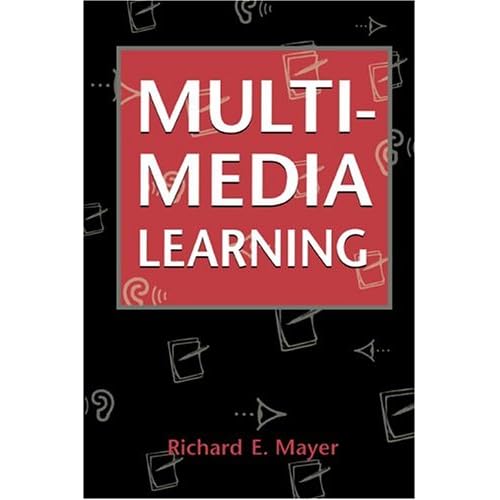
  • the best book on dual coding as it applies to education is Richard Mayer's Multi-Media Learning
I'm sorely tempted to buy both of these books, which can be previewed on Google Book Search, but first I'm going to read all of the Eide posts on visual learning.


*I've seen it defined as "prefers reading to listening"


visual learning

foldables
why lawyers burn out
Independent George re: foldables
your tax dollars at work part 2
my busy day
not your father's formative assessment
remembering key concepts in math with foldables
south of the border
Steve H and palisadesk on foldables
homeschooling convention: no foldables

you may have to hit refresh a couple of times to load these pages:

21st century skills in Singapore
the master plan
horselaughs are heard in Singapore
more horselaughs in Singapore

Monday, February 11, 2008

Syllables, Syllables, Syllabary

Teaching phonics with syllables works a lot faster than regular phonics and allows students to read at high grade levels quickly.

Teaching with syllables, "Johnny" went from reading at the 3rd grade level to reading at the 6th grade level after 6 hours of phonics instruction. (The early version of my online phonics lessons, now 12 hours total instruction.)

Before 1826, children were taught to read with the syllabary. The first part of the syllabary is shown on old hornbooks.


Children taught with Webster's Speller and the syllabary could read this in first grade:

"Now, if you will try to re-mem-ber what I have told you a-bout these si-lent let-ters, I think you will be able to read ver-y well, in a short time; and I suppose you will be ver-y glad when you are a-ble to read pret-ty stories in books.

The si-lent let-ters which are used in spell-ing ma-ny words are ver-y puz-zling to lit-tle boys and girls, when they are learn-ing to read; but I hope that the good lit-tle boy or girl who is now read-ing this les-son will try ver-y hard to rec-ol-lect how all the words are spelt; and that the teach-er will re-quire ev-e-ry pu-pil to be a-ble to spell ev-e-ry word that is read. By so doing, the pu-pil will learn to read much fast-er, and in a short time hard words will cease to trou-ble him." (from Parker's First Reader, 1851)


and this in second grade:
"All persons, who are not deprived by nature or by accident of something which belongs to them by the gift of God, their Creator, have five senses." (from Parker's National Second Reader, 1869)
After teaching my daughter with Webster's, she can read just about anything. She's still 5 (she'll be 6 soon) and can sound out 3 and 4 syllable words she has never seen before. After 4 months of seeing syllables divided like those shown in the 1st grade selection above, she can now divide them on her own. A few months ago, she could read 3 and 4 syllable words only if they were divided for her. You can learn all about how to teach with Webster's and the Syllabary, it's surprisingly easy.

I believe that teaching syllables is a crucial step missing in most phonics programs today. A Beka divides words by syllables, and every child I've seen taught with this program was reading far above their grade level.

Sunday, September 16, 2007

does good spelling help reading?

As far as I can tell, no one knows the answer to this question for sure.

My sense is that people who research spelling expect the answer will be 'yes,' which is what I expect, too.

Much about spelling is puzzling. Our society expects that any educated person can spell, yet literate adults commonly characterize themselves as poor spellers and make spelling mistakes. Many children have trouble spelling, but we do not know how many, or in relation to what standard, because state accountability assessments seldom include a direct measure of spelling competence. Few state standards specify what, exactly, a student at each grade level should be able to spell, and most subsume spelling under broad topics such as written composition and language proficiency. State writing tests may not even score children on spelling accuracy, as they prefer to lump it in with other “mechanical” skills in the scoring rubrics.

Nevertheless, research has shown that learning to spell and learning to read rely on much of the same underlying knowledge — such as the relationships between letters and sounds — and, not surprisingly, that spelling instruction can be designed to help children better understand that key knowledge, resulting in better reading. Catherine Snow et al. summarize the real importance of spelling for reading as follows: “Spelling and reading build and rely on the same mental representation of a word. Knowing the spelling of a word makes the representation of it sturdy and accessible for fluent reading.” In fact, Ehri and Snowling found that the ability to read words “by sight” (i.e. automatically) rests on the ability to map letters and letter combinations to sounds. Because words are not very visually distinctive (for example, car, can, cane), it is impossible for children to memorize more than a few dozen words unless they have developed insights into how letters and sounds correspond. Learning to spell requires instruction and gradual integration of information about print, speech sounds, and meaning — these, in turn, support memory for whole words, which is used in both spelling and sight reading.
How Spelling Supports Reading by Louisa Moats (pdf file)

I briefly told my own story of C. beginning to read again after starting Megawords. Until 4th grade, C. had been a terrific early reader, years ahead of grade level. He was one of those kids who more or less taught himself to read.

Then, going into 5th grade (I think), he had stopped reading, right on schedule. Apparently it's not uncommon for good readers to "lose interest" around that age, or so I had read. Google isn't giving me a reference to good readers experiencing a 4th grade slump, so memory will have to serve; I think I'd read about a "good reader slump" in a book on the subject of making your child into a lifelong reader, or some such.

C. was also, and I don't think this is a coincidence, a terrible speller. Excellent reader, terrible speller.

That is an interesting thing about spelling, btw.

It is possible to be an excellent reader and a poor speller.

It is not possible to be an excellent speller and a poor reader. (I think I have this on the authority of Moats; will have to check.)

Not long after we started work with Megawords, he began to read again.

My guess is that perhaps Megawords helped him focus on decoding syllables instead of letters. He'd just started the series, so he hadn't learned the various syllables, suffixes, prefixes, that Megawords teaches.....which is why I think Megawords may simply have pushed him to start focusing on natural breaks in words. I'm guessing, too, that he was such a good "natural" reader (I feel pretty confident making that statement) that once he'd been told, by Megawords, to look at syllables instead of letters, he picked this skill up quickly.

Fifth grade was also the year he had the brilliant Ms. Duque as his teacher. In class, she had the kids read out loud by syllables. They used their fingers to cover up each syllable in a word as they went along.

So he had Megawords at home, and "syllabic reading" at school..... and he is today, in 8th grade, a good reader.

My feeling about spelling and reading is: better safe than sorry.

If it's even possible spelling may support reading, it's irresponsible of schools not to teach it.

spelling & writing blog

Daily Writing Tips

The most efficient way to learn to spell a word is to approach it phonogram by phonogram, and not letter by letter.

A phonogram is a written symbol that stands for a sound.

The word pal, for example, contains three letters, each of which is also a phonogram: /p-a-l/. The word church , on the other hand, contains six letters, but only three phonograms: /ch-ur-ch/.

Learn to spell by Phonograms, not Letters


Here is How Do I Become a Better Speller:
A college freshman asked me how to spell “valiant” and when I did, he wondered why it was not “-ent”. He asked how I knew that and I had no idea how to respond! All along, I’ve been a terrific speller, even winning some spelling bees in my younger years. But after some thoughtful consideration and reference to my classes on teaching English, I have come up with a few helpful tips:

1. The number one thing that bolsters your spelling ability is reading. The two are so inherently linked that it is almost impossible to be a good speller without being a good reader.

Without knowing anything about this blogger, I'll go ahead and say that I'm sure this is true.

This probably explains why it's possible to teach your own child to spell with nothing beyond Megawords and a child who is able to read fluently.

This makes sense, too:

4. Writing frequently also helps you to spell with more precision. You will quickly learn which words “look right” and if not, never hesitate to consult a dictionary. Once you’ve written a word correctly a few times, you will start to remember this.

Numbers 1 and 4 probably explain me. I've always been good at spelling. I was the kind of kid who won spelling bees, back when teachers were allowed to have spelling bees.

I was also a bookworm, and, as I grew older, I started to write a lot, too.

I didn't write papers; when I went to Wellesley I hadn't written a single paper for a high school class.

I wrote letters.

Wednesday, September 12, 2007

March of the pundits

OK, I have just spent 5 minutes of my life listening to Fordham's weekly podcast.

Subject:
suburban schools

Question:
Suburban schools are doing "fine" (or some such) teaching their white kids.
They are failing to teach their black kids.
Should we or should we not, as a matter of law, insist they teach their black kids, too?

Number one, how is this even a question?

Yes, I understand politics are involved: white parents, the middle class voter, blah blah blah.

What I don't understand: How is this even a question?

Suburban schools should teach all children attending suburban schools.


the white kids aren't doing "fine"

Number two, suburban schools are not doing fine teaching their white kids.

Suburban tutors and parents are doing fine teaching their white kids.

Scratch that.

Surburban tutors and parents are not doing fine, either. Many of us are merely hanging on, averting complete disaster.

This is why we have a Math War. We have a Math War because parents are aware they can't make up for the lousy math education their child is receiving at school.

If it were easy just to teach great math at home, we'd do it and forget about the math war. Or, rather, some of us would forget about the math war. I'd probably join the Math War for the same reason people climb Mt. Everest, because it's there. But that's me.


why don't we have a Spelling War?

If pundits wanted to know why "high-performing" schools are failing to teach disadvantaged students, which they apparently do not, they might ask themselves why we have a Math War in the first place.

Why don't we have, say, a Spelling War?

My own school has failed to teach C. how to spell. When I asked his 3rd grade teacher— a terrific teacher in every other respect, a woman who taught him 3rd grade fractions and made it stick—about his spelling, she laughed and said, "He's not very good, is he?"

Then she said she couldn't spell, either.

When we asked his 4th grade teacher, also an excellent teacher, she shared with us the method she'd ended up using to teach her own kids to spell. (As I recall, she had them write each spelling word 20 times.)

Then his 7th grade teacher told us: "I always tell the kids, if you can't write well nobody's going to care if you can spell,'" or something along those lines. (She, too, was a terrific teacher, an opinion I can probably document. C.'s grammar and usage in written work are very good for his age, and he didn't learn either at home.)

My email to the assistant superintendent in charge of instruction on the subject of a spelling curriculum for middle schoolers went unaddressed.

So: not only did my district not teach C. how to spell, my district routinely conveyed to us the attitude that if we wanted our child to spell, it was up to us.

Question: Do you see me waging a Spelling War here in my district?

Writing a blog about spelling?

Answer: No. You do not.

The reason I am not engaged in a Spelling War is that, as it happens, it has turned out to be possible to teach spelling here at home. I spent a couple of weeks of my life Googling the known universe, trying to figure out what spelling actually was and why people can't do it; I bought a couple of books on the subject, which I have yet to read beyond the first chapter; then I cruised the available textbooks and lit upon Megawords.

C. started the Megawords series in the beginning of 5th grade.*

He is now in 8th grade and is completing the 4th book in the series.

Last week I began testing him on all of the word lists contained in the first 3 books. Result: he's not bad.

"Not bad," in this context, is meaningful. Today his spelling errors are reasonable, as opposed to psychotic, which is what they were when he was 10.

For instance, when I asked him to spell badminton, he said b-a-d-m-i-t-t-e-n.

That is a correct guess.

I have now pulled out all of the words he missed from the first and second books (have yet to review Book 3), and will have him practice them sporadically as he works his way through Book 5. I'll do the same for Book 4 when we finish it this week.

It's clear now—even Ed says so—that by the time he graduates high school he will be proficient in spelling, or close enough.

This is why I am not engaged in a Spelling War. I think it's ridiculous my "high-performing," lavishly funded school district didn't teach my kid to spell.

I also know for a fact that some of the brainiest kids in the school can't spell worth a damn.

But I'm not having a Spelling War.

I'm having a Math War.

I'm having a Math War, not a Spelling War, because I can make up for lousy spelling instruction, but I can't make up for lousy math instruction.

Pundits appear to be singularly uninterested in the existence of a raging Math War across the land. If they spent 5 seconds paying attention to it, they'd realize their core premise where suburban schools are concerned is wrong.

Talk about the answer being right under your nose.


what does an achievement gap in a high-performing district tell you?

When you look at a suburban school and you see the white kids "doing fine," and the black kids not doing fine, what does that tell you about the school's curriculum, pedagogy, and accountability?

It tells you the school doesn't trouble itself with accountability.

The school does what it does; if the kids learn, great; if they don't, they're disadvantaged and what can you expect?

Humbug.


the slow girl track

This reminds me of a story I've probably told before. It appears in Ed's new book (not sure if it's out yet—I'll check).

The book is a collection of essays by French historians talking about why they became French historians.

In one of the stories, a historian who is.....in his 40s maybe?....writes that as a kid, he was a math hotshot here in the U.S. Then he went to France on a student-exchange program, and the French school put him in "the slow girl track."

Meaning: the track was the slowest the school had to offer and it was filled with girls. The slow boy track was faster than the slow girl track.

He was in the slow girl track.

I say: let's pick a high-performing suburban school district, do a student-body swap with a high performing school in Singapore, and see what happens.

Our kids are gonna get stashed in the slow girl track.

That's assuming Singapore even has a slow girl track.

Which it probably doesn't.


the physicist

Speaking of which, I sat by a former director of the Jet Propulsion Laboratory on my flight back from Illinois.

His daughter is now in graduate school, and he's still exercised about the low quality of U.S. public education.

He told me, flat out, that no parent can remediate a bad math education.** He'd said this repeatedly to his own school board, to no avail.

He had actually said, to his school board, "You have them sequestered here 6 hours a day and you're not teaching them anything."

This is a physicist and former head of the JPL.

Saying no parent can remediate a bad math program.

Reasonable conclusion: if the head of JPL can't remediate his daughter's lousy math education, I can't, either.

I wish our pundits would get a clue.

* The books are created to begin in 4th grade, continuing through 11th.
** I think he extended this to reading and writing, but I don't remember what he said specifically.


march of the pundits, part 1
speaking of pundits
march of the pundits, part 2

how to change the system
parents need a union

Independent George on the pundits and their ways
one is a nutjob, twenty five are powerful
first person

#marchofthepundits

Monday, August 6, 2007

Help for the afflicted


Karen A left this comment today:
Yikes! Somebody needs to stop me! (I'm in major procrastination mode--I'm supposed to be writing a paper.)
This is your lucky day, Karen A!

It just so happens that I, too, have been in major procrastination mode for lo these many moons, and I have found the answer:

the Premack Principle

The Premack Principle sounds like something you already know, but it isn't.

Sure, sure, we all know positive reinforcment is a good thing.

We all know we should put first things first.

What we don't know -- what I didn't know, at any rate -- is this whole business about reinforcement hierarchies. To wit: there are tons of things you don't want to do, and a bunch of things you do want to do, and these things can be ranked.

Then, once you've ranked them, you can pick something you don't want to do -- any old thing you don't want to do, not just the one big thing you don't want to do (in my case: stay up all night and write my book) -- do that one thing; then pick something you do want to do and do that.

And here's the miracle: after you've done this for a day or two, you start to want to do the things you don't want to do.

Not only that, but the Premack Principle works with your middle school child, the one who thinks the problem with parents is they constantly threaten to take away rights from their children.

Seriously.

Take it from Jon Bailey and Mary Burch:
Basically the Premack Principle involves setting up the rules in the house so that the preferred behavior (watching TV) is used as a reinforcer for the nonpreferred behavior (helping with chores).
p. 3
Translation: no "break" after school.

The "break" after school has been sacrosanct around here. C. needs a break after school. That's the concept. He's been at school all day; school is hard; he needs a break.

This summer the after-school break made a seamless transition into the after-camp break. C's been hard at work playing tennis all day; he needs a break when he gets home.

Which means C. comes home, plops down on the sofa, and begins playing video games with Christian, leaving me to nag, order, demand, and, yes, threaten to take away rights.

And that's just the beginning. When I finally get him to the table, we have negotiating.

If I do Megawords I'm not doing Vocabulary Workshop
.

If I do decimals I'm not doing word problems
.

Etc.

That's all over now.

Last Tuesday or Wednesday, I squelched the after-camp breaks. By the weekend things were running so smoothly that on Saturday morning C. came into my office at 10:30 a.m., sat down, sighed, and said, "What do I have to do?"

Then he pitched a fit, but still. By noon he had done everything I wanted him to do.

He was amazed. He kept saying to Ed, "I'm done with my work."

And Ed kept replying, "Doesn't it feel good to get it over with?" (great attitude, that!)

Sunday morning I got up and started awarding myself mental points for doing things I didn't want to do. I was banking my points, saving them to spend on doing things I did want to do. This turned things I didn't want to do into things I did want to do (points!) which got a little confusing because if I wanted to do something I didn't want to do because I would get points if I did it, didn't that make it something I did want to do after all and thus something I shouldn't be getting points for doing?

This put me in mind of the possible urban legend about the one-question essay exam some Harvard psych professor was said to have given his class, namely: what is a stimulus?

I decided not to worry about it. I was tearing around the house looking for things I didn't want to do that I could go ahead and do right then and there before we had to get to church. Points!

En route to church I explained the Premack Principle & the point system to C, who took it to heart at once.

Then, in church, we wrangled over how many church points (church being down there with word problems in C's reinforcement hierarchy) he was now losing for rudeness and failure to attend to the sermon.

When we got back home he had one don't-want-to-do facing him, which was to read a page of the Bible. This task is the result of a negotiation we'd had a couple of weeks before, when C. had said he shouldn't have to work on Sundays, and Ed backed him.* So I said, Fine, you don't have to work on Sunday if you read the Bible, and Ed didn't have the nerve to intervene on that one.

C. also needed to mow the lawn, but since he gets paid to do that, and since it was his idea to start mowing the lawn, lawn-mowing was somewhere in the middle of his hierarchy.

He read one page of the Bible practically the instant we got home.

Then he mowed the lawn.

Then he lay down on the sofa, snapped on his video game, fixed me with the wolfy smile of the victorious, and said, "I have all my play points for the rest of the day."

..................................

I will be back tomorrow with Dick Malott & his online book on procrastination.

Chapter 3: "How to Get Yourself to Write."


* Have I mentioned Ed is Jewish and agnostic? People will do anything not to hear middle schoolers fighting with their moms about word problems.


Sunday, August 5, 2007

I love this age

After Barry G had the temerity to mention in a Comment the actual content of C's workbook sentences (parents constantly threaten to take away rights from their children and also let other siblings have televisions in their room, etc.) I was inspired to track down C's recent creations for Megawords.


Megawords 4
Worksheet 22-M
directions: Look at List 22. Choose five words and write them in sentences below.

I need permission to put the politician in a submission hold for having a collision with the musician.


Worksheet 23-D
Remember these exceptions to the spelling generalization above.

damage manage savage

Make up a sentence that includes all three of them.

The savage couldn't manage the damage he did to the explorer


If that doesn't persuade you to pop for 8 years-worth of Megawords texts, then I don't know what.

Saturday, July 14, 2007

summer school 2007

Algebra 1
Skill Builders
ISBN: 1-932210-10-5

Megawords Book 4
ISBN 0-8388-1826-9
Teacher’s Guide and Answer Key 1
ISBN 0-8388-1825-0

Mixed Skills in Math
I started C. on this book after discovering the precision teaching folks and the concept of fluency. I'm using "Mixed Skills" to provide "slices," which I gather are very short blitz-type practice sets. (I don't know what slices are; I'm guessing from context.)
Basically I'm trying to do a form of fluency teaching with zero training and no materials. So we'll see.
ISBN: 1-56822-861-9

Spanish 1
Skill Builders
ISBN-10: 1932210148
ISBN-13: 978-1932210149

Spectrum Math Grade 7
(an instructivist recommendation, as I recall)
We're doing the entire chapter on decimal and percent; then we'll figure out what to do next.
ISBN-10: 0769636977
ISBN-13: 978-0769636979


Vocabulary Workshop Level A
(you don't need a teacher edition)
ISBN: 0-8215-7606-2


Skill Builders: all series
Spectrum: all series

also:
Saxon Math Algebra 1
We're doing all of the "percent bubbles."
Saxon Math 8/7
all of the fraction bar model problems (Saxon uses bar models for fraction problems in 8/7 & possibly in a couple of the other books)


I located Steps to Good Grammar: 169 Lessons, Exercises, and Tests by Genevieve Walbert Schaefer the other day (ISBN-10: 0825128765 ISBN-13: 978-0825128769), and we may start back with it - although I may decide to have C. do the Instructional Fair diagramming workbooks first (Walberg's book teaches diagramming, too):

Better Sentence Structure Through...Diagramming Book 1
by Mark Dressel & Greg Carnevale
ISBN 1-56822-175-4
ISBN-10: 1568221754
ISBN-13: 978-1568221755

Better Sentence Structure Through...Diagramming Book 2
by Mark Dressel & Greg Carnevale
Instructional Fair
ISBN 1-56822-176-2
ISBN-10: 1568221762
ISBN-13: 978-1568221762


I'm thinking about having C. do an Aleks assessment....

Last but not least, we are now doing sentence recombining and text reconstruction exercises.


update 7-15-2007: I just remembered. Saxon Math 8/7 has Fast Facts sheets.


summer supplement time, part 2 (2005)
summer plans 2006 (Carolyn J.)
summer school 2006

Thursday, July 12, 2007

Susan S on her summer writing program

Well, I'll just tell you what I'm using for my 6th grader this summer. Some stuff may be appropriate for your child, but you would have to make the call.

The first thing I ordered this summer that I really like a lot is The Paragraph Book by Dianne Tucker-LaPlount. I got Book 1. It targets structure, but in a clear way (compared to the writing program he has been subjected to over the last couple of years.)

Another book I have been using is Writing Skills by Diana Hanbury King, book 2. It also does a good, quick job of targeting structural problems, but in a creative way.

Both books lend themselves to the after-schooler better than others. I am thrilled that I've found them.

2 big comprehensive ones that I have are the Shurley Method English Made Easy series (I have level 7.) This is a popular homeschooler text. I like it a lot, but my son is actually quite good at grammar so those sections are too redundant for us right now. What I do like at this point (we're only at the beginning) is the number of little paragraphs that he has to edit. It has that "sheet a day" format that is easier for me to assign as a parent.

Another big comprehensive curriculum is the Hake Grammar and Writing Series. I think it starts at grade 6, but a bright 4th or 5th grader would probably do okay.

These are the Saxon people, so if you're familiar with Saxon you know how to skip things that are mastered. The curriculum (homeschool version) also covers journal writing (in a way that makes sense) paragraph/essay structure, and the preparation a kid needs to write bigger assignments like, gulp, research papers. Typical of Saxon, it makes it all so easy. I love those people. They have saved my life.

I love the Grammar and Writing 7 that I'm using right now. It's clearing up a lot of confusion with my one son.

For stict grammar teaching, you can't beat Steps to Good Grammar by Genevieve Walberg Schaefer. Coherent and to-the-point, this book covers diagramming (as does the Hake) and has the answers on the opposite page. Even though the book is pointed towards middle school or older, I've used it with my grade schooler from the beginning. This book is why he is so good with grammar.

For spelling, I highly recommend Megawords. Catherine uses this series also. Megawords teaches kids the rules that your school won't teach. It's also a great after-school book.

Anyway, that's my 2 cents. Hope some of it helps.


Catherine here --

I mentioned in a Comment that I'm concerned Educators Publishing Service may be phasing out Megawords, but I was wrong, thank heavens. Megawords is featured on the phonics page, not the spelling page, which tells you something about the series.

I think it's been a lifesaver for us, though I have no way of knowing this. What I do know is that C's spelling before he started the series (he's finishing Book 4 this summer) was psychotic, and has now progressed to not great. To my knowledge he's had no instruction in spelling in 6th or 7th grades. In fact, one of his ELA teachers said she told the kids, "Being able to spell won't do you any good if you can't write," or something like that. (Why? Why? Why would you tell my kid who can't spell that spelling won't do him any good if he can't write? aaauuggghhh!)

This teacher, btw, did a great job; she taught the kids a lot and even managed to go over and beyond the curriculum. I've reported the spelling lapse because it's funny, not because it's a fatal flaw in her teaching. The school doesn't teach spelling past 5th grade & that's that. (I'm noodging the new assistant super, but so far she's not sounding interested.)

This is one of my beefs with public schools, or perhaps just another variant on the beef: the indifference to results.

We don't teach spelling after 5th grade
.

So if your child hasn't managed to learn to spell by the end of 5th grade, we'll just assume he doesn't need to learn to spell because what he "really" needs to learn is how to write.


update: wrong again (scroll down)

I'm thinking the middle school would be in better standing with parents if it started talking to us about academics and stopped talking to us about character ed and bomb threats.

Or if somebody put up something in the enormous, soaring, two-story foyer taxpayers just built that wasn't a S.A.D.D. poster or a FOCUS word.

Still and all, it's good to know C. spent last year taking spelling tests.

Saturday, May 19, 2007

Do not press send

Straightening up the dining room table this morning (I'm still at it) I found a hard copy of this email to our new Assistant Superintendent for Curriculum and Technology.

I had to post it.

I didn't send this version to the superintendent. I don't remember what I did send, but I hope it was something reasonably short and to the point.


Good evening, G.

Christopher tells us he is to “create an artifact” for Social Studies / ELA at the end of the year.

For instance, he could construct a Civil War sword.

Or a Civil War musket.

Next year he will be expected to write a complicated research paper in 8th grade social studies, so this year he is preparing for that challenge by.... constructing an artifact.

I can’t tell you how violently we object to arts and crafts projects at this point.

Arts and crafts projects have nothing to do with college preparation.

In fact, we would go so far as to say that arts and crafts projects are the opposite of college preparation, Howard Gardner notwithstanding.

We know this because one of us — that would be Ed — is a professor at a major research university.

Ed is a historian.

Remarkably, Ed managed to earn a Ph.D., receive an appointment at UCLA, earn tenure, and publish numerous refereed articles, book reviews, and scholarly monographs without constructing a Civil War sword or musket.

Nor has he ever assigned a Civil War sword or musket construction project to his students.

If real historians don’t have to construct artifacts, we don’t see why our 7th grade son should have to construct artifacts, either.

So we object.

Making matters worse, the middle school will not be providing even a smattering of instruction in how to construct a Civil War artifact. That task falls to us. Again. As we’ve come to expect here in IMS, we are being commandeered to serve as the school’s uncredited and unacknowledged ghost teachers.

As half the district must know by now, we are already teaching math here at home — teaching math and wrangling with the district over the fact that we’re teaching math, which doubles or triples the time involved, not to mention the aggravation.

Math is fun.

Fighting with the district about who’s supposed to be teaching math — us or the school — is not fun.

Since last year we’ve been on the hook for teaching writing, too. We’ve elected not to battle the district on the subject of writing instruction; we’ve just sucked it up and done it, or tried to.

Of course, we’re not making much headway. Our child is too busy constructing Civil War artifacts in social studies, collages in ELA, hand-colored logos in “accelerated” math, and restaurant menus in Spanish to have much time left over to write stuff.

fyi: I’ve counted the books on writing and writing instruction I have sitting beside me, waiting for my attention.

totals:

17 books on writing
1 book on summarizing
2 books on logic
1 anthology of essays to serve as composition models (Norton Sampler)
1 complete 6th grade writing-and-grammar curriculum (Hake)
2/3 of Siegfried Engelmann’s Writing and Reasoning 6-12 middle school writing curriculum. (I’m missing the teacher’s Presentation Book for the simple reason that the Presentation Book costs two hundred dollars and the publisher won’t sell it to me because ----- I'm not a teacher.)

That’s not all.

Joseph Williams’ Style & Grace is on its way, and since I see that a used copy of Mina Schaugnessy’s classic Errors and Expectations: A Guide for the Teaching of Basic Writing is on offer for $9.09 at Amazon Marketplace, I think I’ll hit “Buy now with 1-Click” while I’m at it.

There.

I’ve done it.

A couple of days from now, in addition to not using the aforementioned 22 2/3 books on writing and writing instruction to teach my middle school child how to write because he's too busy constructing artifacts, I will also not be using Mina Schaunessy’s Errors and Expectations.

Then of course we have our vocabulary curriculum (Vocabulary Workshop) and our spelling curriculum (Megawords), since the school doesn’t teach spelling beyond --- what?

Fourth grade?

Fifth?

If a student isn’t spelling by fourth grade, too bad!

So we’re attempting to teach spelling, or, rather we’re attempting to haul a 12-year old boy bodily through a spelling curriculum.

Lucky for us, we’re interested in math and we both happen to be writers. Also, we can spell.

But we have no freaking idea how to “construct an artifact.”

Furthermore we have no interest in learning how to “construct an artifact.”

Nor do we relish the prospect of scouring the Internet and the crafts shops looking for directions on how to construct an artifact and/or a pre-fab Civil War sword or musket kit like the solar system kit everyone bought last year when we had to do the Jason Project.

(also to file under fyi: We attended the Jason Project event held at the middle school last year, where we noticed that three of the papers on display were the exact same paper. What a superb resource the internet is for middle school children!)

If I could download a completed 7th grade arts and crafts Civil War sword from the internet, I would do it.

The budget vote is coming up, and the school year is winding down.

Many of us are exhausted.

I am exhausted.

How about you give us all a break and ask your teachers to stick to reading and writing assignments in reading and writing-based disciplines.

An assignment to construct an artifact isn’t social studies, and it isn’t art.

Catherine Johnson


Upshot: Christopher does not have to construct an artifcat.

This is good!


AND SEE:
"The project method": child-centeredness in progressive education
Business opportunity
Do not press send
the project method
toga party

not very creative