

 Posts


Start at the beginning. A big key is practicing number bonds until you know them so well that the possibilities just pop up automatically when you see a number. The mental math practice is worthwhile too.
Showing posts with label fractions decimals and percent. Show all posts
Showing posts with label fractions decimals and percent. Show all posts
Tuesday, June 29, 2010
lgm on where to start in Singapore Math


Monday, June 21, 2010
msmi 2010 Followup
msmi 2010: Institute on Fractions is now history. YAY!
I'll leave Catherine and any others to talk about their take on it. I'll have some future posts on what I think are the biggest lessons parents and teachers need to help their students understand fractions, but this is just a roundup.
In the course of 5 days, we covered: definition of a fraction, equivalent fractions, decimals, addition, subtraction, multiplication, division, decimals again, and percent. We had more to do, but we couldn't get to it.
Based on the reaction of the teachers, it was a success. I have NEVER had a class of students where so many students worked so hard. No matter what their background, everyone tried to do the problems. Their effort meant that as the week went on, the students were more engaged and more knowledgeable. The teachers also built up their camaraderie with each other.
Based on their personal comments to me and the anonymous survey I gave at the end, their overall impression was quite high. Several teachers told me that this course was the first time anyone had ever explained how to think about fractions. One told me it was "a revelation" to them, another told me this was the first time they'd see a way to visualize multiplication of fractions. Most responded to our survey saying that this material had changed how they would teach permanently. Several teachers had a different kind of revelation, too: that other people in other schools/cities/states knew and felt as they did. They were connecting the dots not only on fractions, but on the state of math education.
Not that everything was perfect. I was terribly out of practice for being a teacher--bad board technique, bad handwriting, bad short hand in my own thoughts and words, instead of being clear, specific and slow.
I made several errors in sizing up my audience too. I assumed that since I had told the principals what to expect, that they had told their teachers. I assumed that teachers, given a pointer to a web site that had, e.g. Wu's CV on it, would have read such.
The biggest complaint was that it was too much material/days too long, and not enough worked out examples. One solution to the latter is to strongly encourage the teachers to read the textbook a day ahead of time. But part of that is the nature of the beast: there is an enormous deficit of knowledge to overcome. Elementary math teachers didn't go into that field because of their stength in fractions. The breadth of math inexperience-experience even for teachers of the same grade was very large, yet being math experienced didn't quite help, because while those teachers probably followed Wu's proofs more easily, applying his ideas to actual math problems was still a new universe to them, and their skill was sometimes a hindrance, because he was asking them to think an entirely different way than they were used to.
Lastly, I'm thrilled to have met all the people involved. Wu is a delight to work with/for, and I'd do this again with him wherever we can. He was personable and charming as well as brilliant. His wife was just as delightful. CassyT, KTMer, is an exemplary woman. She's a brilliant teacher and student of human nature, and her insights into teachers saved me countless mistakes. She shared her expertise with me in countless ways, and the whole thing would have fallen apart if not for her.
So, where to go from here? First, more Wu institutes! Let's bring MSMI to your locale! Second, the really big thing is to help teachers turn what they learned here into changes in their school. That's no small undertaking. I'll talk about that more in the next post. Last, more documents for everyone: condensing of Wu for parents and teachers. I'm sure you'll see work product of that around here shortly...
Friday, June 11, 2010
help desk
If 20 percent of x equals 80 percent of y, which of the following expresses y in terms of x?
(A) y = 16% of x
(B) y = 25% of x
(C) y = 60% of x
(D) y = 100% of x
(E) y = 400% of x
The Official SAT Study Guide 2006
p. 550
I absolutely cannot do this question, and I don't know why.
Tuesday, March 23, 2010
Sunday, August 31, 2008
more percent woes
comment left by Terri W:
comment left by Tex:
A couple of weekends ago, I went to a local garage sale and the kid manning the booth had his EM math journal sitting right on the table next to him ... and couldn't give me change from a 10 for a 6.50 purchase.
comment left by Tex:
The winner on last night’s Teen Jeopardy was unable to give the correct answer to a question that asked how much a dress would cost if it was marked 20% off the original price of $80.Been there, done that.
Saturday, April 26, 2008
another real-world problem
More from the NSF's Algebra Cubed Project:
The Mars company has been lying to us about the ratio of colored skittles?
Using Ratios to Taste the Rainbow (pdf file)
Goal: At the end of the activity, the students will know that the actual ratio of colored skittles is not what the Mars company claims. They will also be able to calculate different ratios and percentages associated with the number of colored skittles given to their group.
KY Standards: MA-7-NPO-S-RP1
Students will apply ratios and proportional reasoning to solve real-world problems (e.g., percents, sales tax, discounts, rate).
The Mars company has been lying to us about the ratio of colored skittles?
Tuesday, April 22, 2008
Math in the late 1800's
Don Potter sent me a link to an interesting 1879 math book in Google Books, "Graded Work in Arithmetic" by S. W. Baird. It has an interesting visual method of showing fractions similar to how they're depicted in Math-U-See. (The unexpected results of web searches, when "Graded Work in Arithmetic" comes up under a search for "phonics charts." There are, of course, ads for phonics charts, McGuffey Readers, and some other books and visual aids at the end of the book.)
Looking through "Graded Work in Arithmetic" prompted me to look up Baird's "American Mental Arithmetic," which was even more interesting. His explanation of fractions for this book used a different method than his 2nd grade book and showed a number line explanation along the lines of Wu.
Also, his preface had the following statement (page 3 in the book, page 5 in google book pages)
Bailey also states,
Looking through "Graded Work in Arithmetic" prompted me to look up Baird's "American Mental Arithmetic," which was even more interesting. His explanation of fractions for this book used a different method than his 2nd grade book and showed a number line explanation along the lines of Wu.
Also, his preface had the following statement (page 3 in the book, page 5 in google book pages)
"Many who have broken the habit, in adding, of saying "6 and 8 are 14 and 6 are 20," are still saying in subtracting, "6 from 10 leaves 4" ; in multiplying, "9 times 8 are 72, and 4 are 76" ; and in dividing, "12 [divided by sign] 5 = 2 and 2 remaining." Special stress is laid upon the improtance, in performing operations, of dropping all unnecessary words, since the mind reaches results much more rapidly without them."Interestingly, Don Potter has told me in the past that his father could multiply with lightning quickness and would always say "five 3's are 15" instead of today's common "five times 3 equals 15." I've only taught Mary a few multiplication facts, but I try to follow the two 5's are 10 pattern when teaching her in case there is something to this...I figure it can't hurt and could be helpful. I still teach what the equals sign is and what it means, but I always have her say the shorter are instead of equals when reciting addition and multiplication facts out loud. (Are may also be less abstract than equals as well as shorter.)
Bailey also states,
"Percentage is taught without rules or formulae, and without the use of the terms base, amount, and difference, although one page is devoted to the after the subject has been completed. The student comes to see clearly that the various exercises in percentage do not need special rules, but are familiar cases slightly modified since the symbol "%" is used instead of hundredths. Interest is taught by the 6% mehtod and by the modification of this method in general use among bankers."His concluding sentence of the preface is,
"Let it be remembered, that he who relies upon thousands of special rules is but a pygmy beside the giant who can apply a score of general principles to millions of particulars."Perhaps we're the pygmies today for throwing all this out with the bathwater without trying to figure out if there were reasons for some of the things that were taught and some of the methods that were used to teach in the past.
Saturday, March 15, 2008
I think I'm coming down with something...
The inability to understand and compute fractions, decimals, and proportions has important real-life implications, and has been linked to poor health outcomes, among other harmful effects.
Report of the Task Group on Learning Processes
Draft 3/6/2008
Thursday, February 14, 2008
the hard kind of percent problem
The hard kind of percent problem is this one:
I imagine this problem is a cinch (cinch?? sp?) for the gifted, but for the non-gifted, this problem is HARD.
I was thinking this problem is an example of a partitive word problem, but now, re-reading Carolyn's original post on the subject, maybe not.
variations on a theme: 3 kinds of percent problems
As far as I can tell, every percent problem comes in three forms. (PLEASE correct me if I'm wrong.)
Problem number 1 is easy.
Making the move to problems 2 and 3 is hard for many students.
But 3 is the killer. (I think.)
If you're having to teach or reteach percent to your children, be sure to include lots of number 3s in the mix.
........................
Do math textbooks call numbers 2 and 3 "work backwards problems" problems these days?
They may.
........................
Liping Ma deals with these problems in her chapter on division by fractions.
She describes asking her group of U.S. elementary teachers to create a word problem representing 1 3/4 ÷ 1/2:
She goes on to say:
The summit of arithmetic!
I love it!
The U.S. teachers didn't fare well.
Tr. Bernadette sounds a little like me trying to do a simple percent change problem the other night. C. and I looked at the same problem last night and we both said: how did we make this so complicated?
That is the $40,000 dollar question.
The $40,000 dollar answer is: failure to transfer.
Ma goes on to discuss the word problems U.S. teachers came up with to represent 1 3/4 ÷ 1/2, and there we see a clean sweep: only one of the 23 teachers produced a correct model of the problem, and that one model was "pedagogically problematic."
I am proud to say that when I read Ma I was immediately able to produce a mathematically correct word problem representing 1 3/4 ÷ 1/2. As I recall my problem went something like this:
Six of the U.S. teachers confused dividing by 1/2 with dividing by 2.
The Chinese teachers created two genres of problems:
Which brings me back to my hard percent problem.
At least, I think it does.
the "measurement" model
The measurement model is more obvious to me. Obvious meaning easy to understand. My own word problem falls in the measurement category: how many 1/2s are in 1 3/4?
How many 1/2s can 1 3/4 be divided into?
How many 1/2-can servings of dog food are there in 1 3/4 cans of dog food?
If I'm measuring the number of 1/2s in 1 3/4, I divide 1 3/4 by 1/2.
1 2/3 ÷ 1/2 = 3 1/2.
I have 3 1/2 servings of dog food.
the "partitive" model
Chinese teachers gave the measurement model short shrift:
After all this time, I still find this passage mystifying.
I was even more mystified when I read the story problem Tr. S came up with:
[isn't this written wrong? shouldn't the numbers be reversed?]
I'm going to reverse them:
Here's another:
For a lot of us, the candy problem will be most obviously similar to the "hard" percent problem.
To solve the candy problem:
let x = original weight
1/2x = 1 3/4
1 3/4 ÷ 1/2 = x
3 1/2 = x
The original box weight 3 1/2 pounds.
The hard percent problem has the same form. We know the final price; we know the tax rate. We need to know the price of the shirt sans tax.
let x = price of shirt
1.05x = 52.50
52.50 ÷ 1.05 = x
50 = x
price of shirt = $50
I have to include this for people like me: the reason you take 1.05x is that it is a shortcut.
I spent years of my life taking 5% of $50 to get the sales tax ($2.50), then adding the sales tax amount to the price of the shirt.
Then C's 5th grade teacher explained to me that instead of doing these two steps I could simply multiply the price of the shirt by 1.05 and get the whole thing over with.
The "1" in the 1.05 ensures that the price of the shirt is part of the final value.
That was a revelation.
are partitive problems harder than measurement problems?
I still don't know what kind of language to use in describing these problems (if I'm not going to use the term "partitive," that is, and for the time being I am not).
Can we say that the shirt problem is a part - part - whole problem in which the whole and a part are known and we have to find the other part?
hmmmm.....
Not exactly.
unknown part: price of shirt
unknown part: sales tax in dollars
part: sales tax rate
whole: final price
I have no idea what to call these problems or even how to describe them.
All I know is that they are difficult for kids to learn, and they don't "come naturally" once a student has learned how to find the price of a shirt given the original price and the sales tax rate.
Any thoughts?
....................................
update (from above)
I'm thinking there is a translation problem with the train problem as printed in Ma's book:
This problem models 1 3/4 x 1/2.
I think the problem should read:
let x = time it takes to go from Station A to Station B
time it takes to go from station B to Station A: 1 3/4 hours
1/2x = 1 3/4
x = 1 3/4 ÷ 1/2
x = 3 1/2
It takes 3 1/2 hours to go from Station A to Station B
John paid $52.50 for a shirt including tax of 5%.
What was the price of the shirt before tax?
I imagine this problem is a cinch (cinch?? sp?) for the gifted, but for the non-gifted, this problem is HARD.
I was thinking this problem is an example of a partitive word problem, but now, re-reading Carolyn's original post on the subject, maybe not.
variations on a theme: 3 kinds of percent problems
As far as I can tell, every percent problem comes in three forms. (PLEASE correct me if I'm wrong.)
price of shirt: $50
tax: 5%
price of shirt including tax: $52.50
1. A shirt sells for $50. Sales tax is 5%. What will the total cost be?
2. A shirt sells for $50. After tax, the shirt sells for $52.50. What is the tax rate?
3. A shirt sells for $52.50 including a tax of 5%. What was the original price of the shirt?
Problem number 1 is easy.
Making the move to problems 2 and 3 is hard for many students.
But 3 is the killer. (I think.)
If you're having to teach or reteach percent to your children, be sure to include lots of number 3s in the mix.
........................
Do math textbooks call numbers 2 and 3 "work backwards problems" problems these days?
They may.
........................
Liping Ma deals with these problems in her chapter on division by fractions.
She describes asking her group of U.S. elementary teachers to create a word problem representing 1 3/4 ÷ 1/2:
Imagine that you are teaching division with fractions. To make this meaningful for kids, something that many teachers try to do is relate mathematics to other things. Sometimes they try to come up with real-world situations or story-problems to show the application of some particular piece of content. What would you say would be a good story or model for 1 3/4 ÷ 1/2?
She goes on to say:
...division by fractions is an advanced topic in arithmetic. Division is the most complicated of the four operations. Fractions are often considered the most complex numbers in elementary school mathematics. Division by fractions, the most complicated operation with the most complex numbers, can be considered as a topic at the summit of arithmetic.
The summit of arithmetic!
I love it!
The U.S. teachers didn't fare well.
Of the 23 U.S. teachers, 212 tried to calculate 1 3/4 ÷ 1/2. Only nine (43%) completed their computations and reached the correct ansewr. For example, Mr. Felix, a beginning teacher, gave this explanation.:
I would convert the 1 3/4 to fourths, which would give me 7/4. Then to divide by 12/2, I would invert 1/2 and multiply. So, I would multiply 7/4 by 2 and I would get 14/4, and then I would divide 14 by 4 to get it back to my mixed number, 3 2/4 or then I would reduce that into 3 1/2.
[snip]
Tr. Bernadette, the experienced teacher who was very articulate about the rationale for subtraction with regrouping, tried a completely incorrect strategy:
I would try to find, oh goodness, the lowest common denominator. I think I would change them both. Lowest common denominator, I think that is what it is called. I do not know how I am going to get the answer. Whoop. Sorry.
Tr. Bernadette sounds a little like me trying to do a simple percent change problem the other night. C. and I looked at the same problem last night and we both said: how did we make this so complicated?
That is the $40,000 dollar question.
The $40,000 dollar answer is: failure to transfer.
Ma goes on to discuss the word problems U.S. teachers came up with to represent 1 3/4 ÷ 1/2, and there we see a clean sweep: only one of the 23 teachers produced a correct model of the problem, and that one model was "pedagogically problematic."
I am proud to say that when I read Ma I was immediately able to produce a mathematically correct word problem representing 1 3/4 ÷ 1/2. As I recall my problem went something like this:
Catherine has two dogs, and each dog eats 1/2 can of dog food every morning. If she has 1 3/4 cans of dog food left, how many servings is this?
Six of the U.S. teachers confused dividing by 1/2 with dividing by 2.
The Chinese teachers created two genres of problems:
- quotitive division, which Ma calls the measurement model
- partitive division - finding a number such that 1/2 of it is 1 3/4
Which brings me back to my hard percent problem.
At least, I think it does.
the "measurement" model
The measurement model is more obvious to me. Obvious meaning easy to understand. My own word problem falls in the measurement category: how many 1/2s are in 1 3/4?
How many 1/2s can 1 3/4 be divided into?
How many 1/2-can servings of dog food are there in 1 3/4 cans of dog food?
If I'm measuring the number of 1/2s in 1 3/4, I divide 1 3/4 by 1/2.
1 2/3 ÷ 1/2 = 3 1/2.
I have 3 1/2 servings of dog food.
the "partitive" model
Chinese teachers gave the measurement model short shrift:
Among more than 80 story problems representing the meaning of 1 3/4 ÷ 1/2, 62 stories represented the partitive model of division by fractions--"finding a number such that 1/2 of it is 1 3/4":
Division is the inverse of multiplication. Multiplying by a fraction means that we know a number that represents a whole and want to find a number that represents a certain fraction of that.
After all this time, I still find this passage mystifying.
I was even more mystified when I read the story problem Tr. S came up with:
My story will be: A train goes back and forth between two stations. From Station A to Station B is uphill and from Station B back to Station A is downhill. The train takes 1 3/4 hours going from Station B to Station A. It is only 1/2 time of that from Station A to Station B. How long does the train take going from Station A to Station B?
[isn't this written wrong? shouldn't the numbers be reversed?]
I'm going to reverse them:
My story will be: A train goes back and forth between two stations. From Station A to Station B is uphill and from Station B back to Station A is downhill. The train takes 1 3/4 hours going from Station A to Station B. It is only 1/2 time of that from Station A to Station B. How long does the train take going from Station B to Station A?update: see below
Here's another:
The mom bought a box of candy. She gave 1/2 of it which weighed 1 3/4 kg to the grandma. How much did the box of the candy originally weight? (Ms. M.)
For a lot of us, the candy problem will be most obviously similar to the "hard" percent problem.
To solve the candy problem:
let x = original weight
1/2x = 1 3/4
1 3/4 ÷ 1/2 = x
3 1/2 = x
The original box weight 3 1/2 pounds.
The hard percent problem has the same form. We know the final price; we know the tax rate. We need to know the price of the shirt sans tax.
let x = price of shirt
1.05x = 52.50
52.50 ÷ 1.05 = x
50 = x
price of shirt = $50
I have to include this for people like me: the reason you take 1.05x is that it is a shortcut.
I spent years of my life taking 5% of $50 to get the sales tax ($2.50), then adding the sales tax amount to the price of the shirt.
Then C's 5th grade teacher explained to me that instead of doing these two steps I could simply multiply the price of the shirt by 1.05 and get the whole thing over with.
The "1" in the 1.05 ensures that the price of the shirt is part of the final value.
That was a revelation.
are partitive problems harder than measurement problems?
I still don't know what kind of language to use in describing these problems (if I'm not going to use the term "partitive," that is, and for the time being I am not).
Can we say that the shirt problem is a part - part - whole problem in which the whole and a part are known and we have to find the other part?
hmmmm.....
Not exactly.
unknown part: price of shirt
unknown part: sales tax in dollars
part: sales tax rate
whole: final price
I have no idea what to call these problems or even how to describe them.
All I know is that they are difficult for kids to learn, and they don't "come naturally" once a student has learned how to find the price of a shirt given the original price and the sales tax rate.
Any thoughts?
....................................
update (from above)
I'm thinking there is a translation problem with the train problem as printed in Ma's book:
My story will be: A train goes back and forth between two stations. From Station A to Station B is uphill and from Station B back to Station A is downhill. The train takes 1 3/4 hours going from Station B to Station A. It is only 1/2 time of that from Station A to Station B. How long does the train take going from Station A to Station B?As it stands, this problem does not model 1 3/4 ÷ 1/2.
This problem models 1 3/4 x 1/2.
I think the problem should read:
My story will be: A train goes back and forth between two stations. From Station A to Station B is uphill and from Station B back to Station A is downhill. The train takes 1 3/4 hours going from Station B to Station A. It is only 1/2 time of [the time it takes to go from] Station A to Station B. How long does the train take going from Station A to Station B?
let x = time it takes to go from Station A to Station B
time it takes to go from station B to Station A: 1 3/4 hours
1/2x = 1 3/4
x = 1 3/4 ÷ 1/2
x = 3 1/2
It takes 3 1/2 hours to go from Station A to Station B
Thursday, December 20, 2007
Sunday, December 16, 2007
still can't do fractions?
Tom Loveless is back:
plus ça change (scroll down)
The 2007 NAEP test results showed small but statistically significant gains in both math and reading. Mathematics scores at fourth and eighth grade continued the steady progress registered since the main NAEP test was first administered in 1990. Both grade levels notched 2 point gains in scale scores. Table 1-1 reports the magnitude of the math gains in scale score points and years of learning. Figure 1-1 illustrates the upward trajectory of the scores. The gains indicate that fourth and eighth graders in 2007 knew more than two additional years of mathematics compared to fourth and eighth graders in 1990. On the face of it, this is an amazing accomplishment. Previous Brown Center Reports have raised questions about such gains. The primary question concerns the content of the NAEP math tests. Students are clearly making progress, but at learning what kind of mathematics? Suffice it to say that students are making tremendous progress on the mathematics that NAEP assesses, in particular, problem solving with whole numbers, elementary data analysis and statistics, basic geometry, and recognizing patterns. NAEP pays scant attention to computation skills, knowledge and use of fractions, decimals, and percents, or algebra beyond the rudimentary topics that are found in the first chapter of a good algebra text. In sum, we know that students are getting better at some aspects of math. But we do not know how American students are doing on other critical topics, including topics that mathematicians and others believe lay the foundation for the study of advanced mathematics. Thus, the years of learning gain must be taken with a grain of salt.
The 2007 Brown Center Report on American Education:
How Well Are American Students Learning
plus ça change (scroll down)
Wednesday, August 15, 2007
birthday & a vacation
Christopher & Andrew turned 13 today.
And tomorrow is vacation.
Tonight, after C. blew out the one candle that was still lit after our wait for Christian to get Andrew (back) to the table, I said that my birthday present would be having Christopher tell me what 10% off twenty-five dollars was.
Christopher started to say, "Irvington," the perseverative in-joke he and Christian swap back and forth 50 or 60 times a night. (The joke is: Jimmy, asked a question, will often answer, "Irvington." What'd you do this weekend, Jimmy? "Irvington!" What day is it, Jimmy? "Irvington! Irvington!" Hence Christopher, when asked What is 10% off twenty-five bucks also answers "Irvington!" which is just as hilarious the 10,000th time he's said it was the it was the first couple thousand.)
Anyway, he started to say, "Irvington," then stopped mid-word. Which is not easy to do. I know this because Georgia Mason's Stereotypic Animal Behaviour: Fundamentals and Applications to Animal Welfare 2nd Edition says so.
Then he said, "It's $2.50, and the price is..... $22.50."
Back on the 25th!
hyperspecificity in autism
hyperspecificity in autism and animals
hyperspecificty in the rest of my life
hyperspecificity redux: Robert Slavin on transfer of knowledge
Inflexible Knowledge: The First Step to Expertise
Devlin on Lave
rightwingprof on what college students don't know
percent troubles
what is 10 percent?
birthday and a vacation
Sunday, August 12, 2007
Just what I wanted to hear!
from Lynn G:
The Primary Mathematics series is the coherent curriculum (pdf file) par excellence. One thing leads to another, and you have problem solving applications from the get-go.
C. has probably done 50 word problems in his entire math-learning career, if that. He has no idea how anything relates to anything else. He's been getting by on brute memory.
Here's how bad it is.
We've been doing the percent lessons in Singapore Math 5A.
That quickly became so "natural" a learning situation that, when I told C. yesterday morning I wanted him to do an entire page of problems, he looked at the page and said, "OK, that looks easy."
And it was easy. He finished in 5 or 10 minutes & got everything right.
The fact is, going back to 3A will probably be fun, especially since the Premack principle is working so brilliantly that yesterday morning (Saturday), at 10 am, C. came into my office, sat down, and said, "What do I have to do today?"
So I think we've got the think-like-a-behavior-analyst aspect of things down, which will free C. to enjoy being able to comprehend, learn, and do 3rd grade math.
That is already happening, in fact.
Yesterday, after he whipped off his one-page problem set, he said, "That Singapore method is really good."
He was referring to finding the percent equivalent of a fraction by multiplying numerator and denominator by the same number.
This is the state of his math education.
Multiplying 6/20 by 5/5 to get 30% is "that Singapore method."
FWIW, we started Primary Math 6A today. Kicking and screaming ensued.That's where I am -- and I can see exactly how this curriculum gets a student to the point of perfect scores on state math exams.
Then we opened yesterday's mail and got a very pleasant surprise. My daughter's CMT scores (CT's state testing) arrived and were very good. She got a perfect 400 in math. Math is not her favorite, or strongest subject, but it's one we've focused on at home at length. I see the score as reflecting the coherence of the Singapore Math system.
After much oooohhing and ahhhing, I was able to get her to start 6A.
Right now, she doesn't seem to have any real weak areas. She's doing pretty good in decimals and fractions, so we're just going to charge ahead with the whole program.
The Primary Mathematics series is the coherent curriculum (pdf file) par excellence. One thing leads to another, and you have problem solving applications from the get-go.
C. has probably done 50 word problems in his entire math-learning career, if that. He has no idea how anything relates to anything else. He's been getting by on brute memory.
Here's how bad it is.
We've been doing the percent lessons in Singapore Math 5A.
That quickly became so "natural" a learning situation that, when I told C. yesterday morning I wanted him to do an entire page of problems, he looked at the page and said, "OK, that looks easy."
And it was easy. He finished in 5 or 10 minutes & got everything right.
The fact is, going back to 3A will probably be fun, especially since the Premack principle is working so brilliantly that yesterday morning (Saturday), at 10 am, C. came into my office, sat down, and said, "What do I have to do today?"
So I think we've got the think-like-a-behavior-analyst aspect of things down, which will free C. to enjoy being able to comprehend, learn, and do 3rd grade math.
That is already happening, in fact.
Yesterday, after he whipped off his one-page problem set, he said, "That Singapore method is really good."
He was referring to finding the percent equivalent of a fraction by multiplying numerator and denominator by the same number.
This is the state of his math education.
Multiplying 6/20 by 5/5 to get 30% is "that Singapore method."
this will give you some idea
When I told Ed I was going to start C. back in 1st semester 3rd grade Singapore Math, he said, "I think that's a good idea."
This brings to mind all those occasions when I wished doctors or special ed teachers would downplay my concerns. Having one's concerns downplayed seems to be a core experience of so many parents of autistic kids, and yet it has never - not once! - happened to me.
No, when I show up with my autistic kids, it's Clear the exits, here they come!
Back when I first started my teach-our-son-math project, Ed was mildly dismissive. He didn't see the big deal; C. was a smart kid; he'd learn math the same way Ed had learned math; etc.
That was irritating.
Ed has become progressively less dismissive as time has gone by, which is also irritating! By last year I was hearing regularly that C. "has no conceptual understanding at all," or "has no idea how to do X," or "doesn't know anything about Y."
I would usually say something like, "He does have some conceptual understanding," or "he does have some idea how to do X," or "he knows something about Y" -- sounding for all the world like a person failing to reflect adequately on her practice.
So, as I say, enough's enough.
I can't keep slicing & dicing it. My son does not know arithmetic, and that's that. (Does not know arithmetic and yet is one point away from "Meets standards with distinction" on the state test. Which is pretty much all you need to know about the NY state math exam.)
speaking of which
I ran across my copy of the New York State Learning Standards for Mathematics 2005 the other day:
I happen to agree with this list.
Not one of them is true of the situation around here.
This brings to mind all those occasions when I wished doctors or special ed teachers would downplay my concerns. Having one's concerns downplayed seems to be a core experience of so many parents of autistic kids, and yet it has never - not once! - happened to me.
No, when I show up with my autistic kids, it's Clear the exits, here they come!
Back when I first started my teach-our-son-math project, Ed was mildly dismissive. He didn't see the big deal; C. was a smart kid; he'd learn math the same way Ed had learned math; etc.
That was irritating.
Ed has become progressively less dismissive as time has gone by, which is also irritating! By last year I was hearing regularly that C. "has no conceptual understanding at all," or "has no idea how to do X," or "doesn't know anything about Y."
I would usually say something like, "He does have some conceptual understanding," or "he does have some idea how to do X," or "he knows something about Y" -- sounding for all the world like a person failing to reflect adequately on her practice.
So, as I say, enough's enough.
I can't keep slicing & dicing it. My son does not know arithmetic, and that's that. (Does not know arithmetic and yet is one point away from "Meets standards with distinction" on the state test. Which is pretty much all you need to know about the NY state math exam.)
speaking of which
I ran across my copy of the New York State Learning Standards for Mathematics 2005 the other day:
Every teacher of mathematics, whether at the elementary, middle, or high school level, has an individual goal to provide students with the knowledge and understanding of the mathematics necessary to function in a world very dependent upon the application of mathematics. Instructionally, this goal translates into three components:
- conceptual understanding
- procedural fluency
- problem solving
I happen to agree with this list.
Not one of them is true of the situation around here.
Plan B
"I stink at teaching percent" wasn't the only result of the 5 to 10 minutes I spent reflecting on my practice.*
my summer and welcome to it
1.
initial plan for the summer: teach C. how to figure percent increase and percent decrease and get a jump on Math A (algebra 1 & geometry) for the fall. Proceed according to advice from Rudbeckia Hirta's dad:
quickly discover C. is nowhere near the point of being able to learn percent increase and decrease. Will have to "firm up" basic percent skills first.
3.
succumb to growing horror as realization that C. does not possess the first clue about percent dawns.
Every lining has its silver cloud
Two nights ago it came to me.
We are going back to the beginning.
As soon as we finish the Primary Mathematics 5B lesson on percent (fantastic!), we're starting page 1 of Primary Mathematics 3A and we're going to work our way straight through to 6B.
Enough's enough.
the pause that refreshes
upon reflection
Plan B
* 5 to 10 minutes because I don't like reflecting on my practice. I prefer to obsess.
my summer and welcome to it
1.
initial plan for the summer: teach C. how to figure percent increase and percent decrease and get a jump on Math A (algebra 1 & geometry) for the fall. Proceed according to advice from Rudbeckia Hirta's dad:
For your summer project, he suggests that you should focus on factoring and anything with fractions. Also multiplying binomials with the distributive law (the infamous FOIL). It's better to get afew basic skills down solidly.2.
quickly discover C. is nowhere near the point of being able to learn percent increase and decrease. Will have to "firm up" basic percent skills first.
3.
succumb to growing horror as realization that C. does not possess the first clue about percent dawns.
Every lining has its silver cloud
Two nights ago it came to me.
We are going back to the beginning.
As soon as we finish the Primary Mathematics 5B lesson on percent (fantastic!), we're starting page 1 of Primary Mathematics 3A and we're going to work our way straight through to 6B.
Enough's enough.
1. Whole Numbers
- Place Values
- Millions
- Approximation and Estimation
- Multiplying by Tens, Hundreds or Thousands
- Dividing by Tens, Hundreds or Thousands
- Order of Operations
- Word Problems
2. Multiplication and Division by a 2-digit Whole Number
- Multiplication
- Division
3. Fractions
- Fraction and Division
- Addition and Subtraction of Unlike Fractions
- Addition and Subtraction of Mixed Numbers
- Product of a Fraction and a Whole Number
- Product of Fractions
- Dividing a Fraction by a Whole Number
- Word Problems
REVIEW A
4. Area of Triangle
- Finding the Area of a Triangle
5. Ratio
- Finding Ratio
- Equivalent Ratios
- Comparing Three Quantities
6. Angles
- Measuring Angles
- Finding Unknown Angles
REVIEW B
the pause that refreshes
upon reflection
Plan B
* 5 to 10 minutes because I don't like reflecting on my practice. I prefer to obsess.
Friday, August 10, 2007
Upon reflection
So I finished reflecting on my practice.
Conclusion: I stink at teaching percent.
That about covers it.
But!
I have a plan.
More anon.
...........................
Haven't read email in days - (Premack says NO! So if there are folks who've sent something I haven't answered, that's why - hoping to get back to Entourage tomorrow.)
the pause that refreshes
upon reflection
Plan B
Tuesday, August 7, 2007
percent problem from Math Notations
A percent problem at Math Notations:
The Comment thread is fantastic, as is the thread on the follow-up post.
And here is Denise, of Let's Play Math, on the subject of percent:
Now she tells me.
As it happens, I agree. Percent problems are he**. That is my final word on the subject. H-e-double hockey sticks.
I am spending my entire summer trying to teach percent to you-know-who, when I had planned to spend my entire summer practicing up on factoring polynomials and such.
Turns out factoring polynomials is child's play compared to decimals, fractions, and percent.
Back to Denise:
Denise's post, which she calls the search for 100%, puts me in mind of Ron Aharoni's book, Arithmetic for Parents (scroll down). Carolyn and I both loved Aharoni's article for American Educator, What I Learned in Elementary School.
Here's his passage on the fifth operation of arithmetic:
I love that!
So, on to our problem. The folks at Math Notations discuss the ambiguities of the English language in percent problems. I found the problem's wording ambiguous myself, and used a bar model to clear it up:
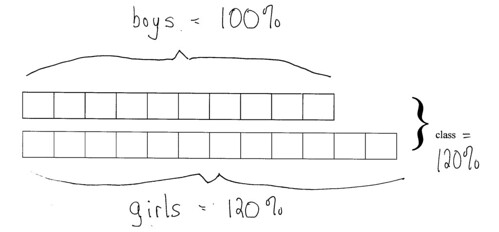
large image here
In the bar model the number of girls is definitely 20% greater than the boys. Plain as day. However confused you may have been by the words, there aren't a lot of different ways to draw the girl bar, assuming you've drawn the boy bar correctly (which you won't have done if you're a middle school student, but never mind).
After you've drawn a 10-square bar model to represent the boys and a 12-square bar model to represent the girls, you see that to get the total class size you're going to have to add 100% to 120%.* There is just no way around it.
Without a bar model (and even with a bar model) this is brutally confusing, because in everyday language "whole" and "all" mean "100%."
It's difficult to break set, as my cognitive psychology professors used to say.
Making boys the "100%" requires big-time set-breaking, because when you're given a problem involving boys and girls in a class at school, you think of the boys as the boy-part of the class and the girls as the girl-part, with the class being everyone, i.e. the whole, i.e. 100%.
The idea of adding 100% to 120% to get a class of 220% is just frankly nuts in terms of everyday language and experience. A class can't be 220%. We know this.
..........................
I wonder if this problem would be more solveable if you wrote it in nonsense words?
None of those words, including "pile," screams out at you: I am always and forever 100%; trifle with me at your peril.
.................................
I walked Christopher through this problem.
Just because I could.
.................................
update from Susan J:
The one encouraging aspect of the two posts at Math Notations was that apparently kids who know algebra pretty well can solve this problem. I assume they use Susan's two equations, but I don't know.
Actually, that was very encouraging.
On a related subject, I'm moving into the Saxon/Dolciani "percent charts," in an effort to bring home the idea that if you have 20% more girls than boys you will have 1.2b -- only I'm starting with a whole of 100% (I wonder if that's a bad idea...)
The charts look like this:
original price 100% $50
discount 10% $5
new price 90% $45
A word problem would be something like this:
Catherine bought a new blouse for $45. It had been reduced by 10%. What was the original price?
original price 100% p
discount 10% $45
new price
The charts help you see that if you're taking 10% off the price, then you're paying 90% of the price (something I didn't realize until two years ago, when I did a percent problem in Saxon).
I'm having a terrible time getting C. to see that we're dealing with proportions here, and that percent problems can always be solved as proportions -- and that the chart is a cool way to show you all the various proportions you can employ to deal with simple problems like these.
Probably time to back up to something simpler.
Tomorrow I'm going to have him do a page of equivalent fractions using percent fractions and non-percent fractions.
e.g.:
75% off $60 means:
25/100 = x/60
I'll try to combine these with the charts and see how that goes. Must re-read Dolciani & Saxon, too.
..................................
Fantastic posts and threads:
The search for 100%
wrong answer: girls are 60% of the class
there are 20% more girls than boys
percent word problems revisited
and, at ktm-1 (you may have to hit refresh a couple of times):
Aharoni article, part 1
Aharonic article, part 2
Ron Aharoni on the 5th operation of arithmetic
Ron Aharoni on teaching fractions
order Arithmetic for Parents
Ron Aharoni's home page
* or 10 to 12, as the case may be
There are 20% more girls than boys in the senior class. What % of the seniors are girls?
The Comment thread is fantastic, as is the thread on the follow-up post.
And here is Denise, of Let's Play Math, on the subject of percent:
Percents are one of the math monsters, the toughest topics of elementary and junior high school arithmetic.
Now she tells me.
As it happens, I agree. Percent problems are he**. That is my final word on the subject. H-e-double hockey sticks.
I am spending my entire summer trying to teach percent to you-know-who, when I had planned to spend my entire summer practicing up on factoring polynomials and such.
Turns out factoring polynomials is child's play compared to decimals, fractions, and percent.
Back to Denise:
The most important step in solving any percent problem is to figure out what quantity is being treated as the basis, the whole thing that is 100%. The whole is whatever quantity to which the other things in the problem are being compared.
Denise's post, which she calls the search for 100%, puts me in mind of Ron Aharoni's book, Arithmetic for Parents (scroll down). Carolyn and I both loved Aharoni's article for American Educator, What I Learned in Elementary School.
Here's his passage on the fifth operation of arithmetic:
In addition to the four classical operations, there is a fifth one that is even more fundamental and important. That is, forming a unit, taking a part of the world and declaring it to be the “whole.”
I love that!
So, on to our problem. The folks at Math Notations discuss the ambiguities of the English language in percent problems. I found the problem's wording ambiguous myself, and used a bar model to clear it up:
large image here
In the bar model the number of girls is definitely 20% greater than the boys. Plain as day. However confused you may have been by the words, there aren't a lot of different ways to draw the girl bar, assuming you've drawn the boy bar correctly (which you won't have done if you're a middle school student, but never mind).
After you've drawn a 10-square bar model to represent the boys and a 12-square bar model to represent the girls, you see that to get the total class size you're going to have to add 100% to 120%.* There is just no way around it.
Without a bar model (and even with a bar model) this is brutally confusing, because in everyday language "whole" and "all" mean "100%."
It's difficult to break set, as my cognitive psychology professors used to say.
Making boys the "100%" requires big-time set-breaking, because when you're given a problem involving boys and girls in a class at school, you think of the boys as the boy-part of the class and the girls as the girl-part, with the class being everyone, i.e. the whole, i.e. 100%.
The idea of adding 100% to 120% to get a class of 220% is just frankly nuts in terms of everyday language and experience. A class can't be 220%. We know this.
..........................
I wonder if this problem would be more solveable if you wrote it in nonsense words?
There are 20% more meps than jeps in the pile. What % of the pile are meps?
None of those words, including "pile," screams out at you: I am always and forever 100%; trifle with me at your peril.
.................................
I walked Christopher through this problem.
Just because I could.
.................................
update from Susan J:
To me the most natural way of doing the original problem is two equations in two unknowns:
Either
g = 1.2 b
g+b = 1
and then convert the answer to per cent or
100 g = 120 b
g+b = 100
The one encouraging aspect of the two posts at Math Notations was that apparently kids who know algebra pretty well can solve this problem. I assume they use Susan's two equations, but I don't know.
Actually, that was very encouraging.
On a related subject, I'm moving into the Saxon/Dolciani "percent charts," in an effort to bring home the idea that if you have 20% more girls than boys you will have 1.2b -- only I'm starting with a whole of 100% (I wonder if that's a bad idea...)
The charts look like this:
original price 100% $50
discount 10% $5
new price 90% $45
A word problem would be something like this:
Catherine bought a new blouse for $45. It had been reduced by 10%. What was the original price?
original price 100% p
discount 10% $45
new price
The charts help you see that if you're taking 10% off the price, then you're paying 90% of the price (something I didn't realize until two years ago, when I did a percent problem in Saxon).
I'm having a terrible time getting C. to see that we're dealing with proportions here, and that percent problems can always be solved as proportions -- and that the chart is a cool way to show you all the various proportions you can employ to deal with simple problems like these.
Probably time to back up to something simpler.
Tomorrow I'm going to have him do a page of equivalent fractions using percent fractions and non-percent fractions.
e.g.:
75% off $60 means:
25/100 = x/60
I'll try to combine these with the charts and see how that goes. Must re-read Dolciani & Saxon, too.
..................................
Fantastic posts and threads:
The search for 100%
wrong answer: girls are 60% of the class
there are 20% more girls than boys
percent word problems revisited
and, at ktm-1 (you may have to hit refresh a couple of times):
Aharoni article, part 1
Aharonic article, part 2
Ron Aharoni on the 5th operation of arithmetic
Ron Aharoni on teaching fractions
order Arithmetic for Parents
Ron Aharoni's home page
* or 10 to 12, as the case may be
Wednesday, August 1, 2007
what is ten percent?
The whole family has gotten into the act on the What is 10% off? issue.
Even Ed is now writing math word problems.
This is serious.
Here are Ed's two from this afternoon:
1.
When you're training for a 10K race, you run a series of 1K laps. Your first lap takes you 4 minutes. Each subsequent lap is 10% slower than the last one.
What is your total time for the 10 laps?
2.
If on average you run 1K in 4 1/2 minutes, how long will it take you to run a 10K race?
I realize these two questions are logically contradictory, but I'm not going to worry about that for now. Ed says sports are a great source of word problems, and he's right.
I decided today to start giving C. the same problem written as a percent & as a fraction.
Then, having fixed on this plan, I decided to throw in a whole-part problem (something he's never done before) to boot:
1.
finding the parts when the whole is given [note: I labeled the problem with these words]
Christopher wants to buy a $50 video game for 20% off.
By what dollar amount is the price reduced? ___________
What will Christopher pay? ___________
Draw and label a bar model of the problem.
Then write the equation and solve it.
2.
finding the parts when the whole is given
Christopher wants to buy a $50 video game for 1/5 off.
By what dollar amount is the price reduced? ___________
What will Christopher pay? ___________
Draw and label a bar model of the problem.
Then write the equation and solve it.
3.
finding the parts when the whole is given
Christopher wants to buy a $50 video game for 1/5 off.
By what dollar amount is the price reduced? ___________
What will Christopher pay? ___________
Draw and label a bar model of the problem.
Then write the equation and solve it.
This is one of those moments where you see exactly how valuable an experienced teacher at the top of his/her game is to kids learning math. Or to kids learning anything.
Because I've worked my way through so much of Saxon, Singapore, & "Russian Math," I have pretty good pedagogical content knowledge. For instance, I now know what "part-whole" versus "whole-part" problems are, a concept I'd never heard of before.
But I still lack "kids-learning-math" knowledge.
I don't have a good sense of the proper use of contrast and comparison in instruction (i.e. having C. do the same problem framed as percent and fraction - good idea or not?); nor do I have a sense of how long it should take for a student C's age to learn these things, which means that when C. doesn't seem to be learning what I'm teaching I can't tell whether he needs more practice or I need to teach differently or both.
I'm making all my mistakes with my own kid.
Still.
By the end of this summer - preferably by the end of tomorrow - he is going to know what 10% off is or I am going to die trying.
hyperspecificity in autism
hyperspecificity in autism and animals
hyperspecificty in the rest of my life
hyperspecificity redux: Robert Slavin on transfer of knowledge
Inflexible Knowledge: The First Step to Expertise
Devlin on Lave
rightwingprof on what college students don't know
percent troubles
what is 10 percent?
birthday and a vacation
Subscribe to:
Posts (Atom)