

 Posts


Email to the teacher:
Hi Mrs. X --
C did not complete her research homework. Unfortunately, her internet research skills are not up to the task of researching the four causes of the Revolutionary War (or the four most important battles fought in New York). Her brother and I did give her four causes and four battles (if she was given that information in class, she did not bring it home), but her attempts to research did not yield much good information.
I did not research for her because I usually try to avoid doing her homework, and I am helping her with her Winn Dixie project today.
I don't know what specific research instruction she has received in class, but clearly this is an area where she needs remedial help. Any ideas you have to help us with this would be appreciated. Maybe I can spend time with her this summer teaching her how to conduct internet research on historical topics.
Thanks again -- Tex
From speaking with a few other parents, it appears that many 4th graders are unable to sit in front of a computer, Google “Revolutionary War battles”, sift through the results and pull out relevant references for their project. No, the parents would be the ones doing this.
I am reminded of Catherine’s idea of a basic principle she would wish for her school:
Persuade the school to give homework assignments all of the kids can do completely on their own with ZERO "assistance" from mom and dad?
Of course, that’s wishful thinking. Schools expect that perfect parent who will support them by helping with homework in any way necessary, but who will never ask hard questions about the curriculum.
I’ve helped C with internet research before, many times. Starting in first grade, she’s had projects that required finding information about insects, history, stories, and more from the internet. I just didn’t feel like doing this time. I’m tired of spending time on these types of assignments.
Instead of formally building internet research into the curriculum, the schools just expect the parents to make sure kids learn it. At least, I think that’s the way it’s done around here. When school starts in September, I will ask C’s teacher what type of internet research instruction my daughter has received and how the school assesses student progress for this skill.
Saturday, June 16, 2007


WOR podcast
Listen to the WOR podcast about reform math and New Jersey's troubles. They allude to religion.
Friday, June 15, 2007
math class in the 1970s
from Robyn:
Robyn is right. Our district just took a "math survey" of K-5 parents. That's a good development, but the questions weren't what I would have wished, including this item:
Ed and I told the new assistant super that this question on the survey shows that the district relies on parents to reteach math at home.
She said it didn't.
I said: "Assist" doesn't mean "give your child a quiet place to work." It means "know math well enough to reteach when necessary."
She didn't agree.
She herself had to hire a math tutor for her son in high school and pointed out that one-on-one teaching is far superior to group teaching.
That observation is a heads-up for all of us.
Is it the case that administrators now universally assume parents are hiring private teachers for math the same way they hire private coaches for soccer? (I'm certain the superintendent believes something of the sort.)
If so, I'm going to have to do a lot of spaced repetition to dispel this notion, which confuses tutorials with tutoring.
The distinction is simple.
tutorials: good
tutoring: bad
If Christopher had spent this year learning algebra 1 from Carol Gambill with zero "help" from me he'd know a lot more algebra.
Yeah, sure, he'd probably know more algebra if Carol Gambill gave him private lessons than if Carol Gambill taught him algebra in her class. But the choice between a good teacher working with a good curriculum and an ineffective teacher working with a bad curriculum remediated by mom is no choice at all.
We did manage to point out that for many, many years kids took math at school and succeeded with no help from parents. We said that Ed took calculus in his high school, then took calculus at Princeton.
He had a tough time of it at Princeton because he was placed in the engineering course which was over his head. Nevertheless, he passed the course.
He did well in his high school calculus course with no help with homework and no tutoring.
on the Today show:
in California
The Today Show post showed up at almost the exact moment I had looked up the CA Mathematics Framework 2005 and found this:
This is remarkable. Here we have the state of California officially telling parents they must:
This is bizarre.
What parent apart from a person working in a math-related field can do this?
And how many parents working in math-related fields can do this? Pedagogical content knowledge is different from domain knowledge.
Next question: are parents expected to be able to do this for every subject their child will be "learning" at school?
I'm obsessed with my child's math education, and I can't do these things. I don't know what C. knows and doesn't know; I don't know how to assess his knowledge or when to assess his knowledge or how frequently to assess his knowledge; I don't understand the wording of the state standards; my ability to reteach math at home may not extend to helping with proofs in geometry (unless I can get there first & teach them to myself well enough to "assist"); barring a miracle I'm not going to be able to reteach calculus at home.
If I can't do these things, there aren't many parents out there who can.
where does this come from?
Why would these paragraphs appear in any state DOE document?
I have to assume we're seeing the effects of the past 25 years of ed school constructivism. This list isn't constructivism; it's the absence of instructivism. When educators spend all of their time in graduate school and professional development learning false theories of human learning..... and it comes time to write a Mathematics Framework..... maybe this is what you get.
Send in the parents.
CA Math Framework: responsibilities of parents
why do we have so many tutors?
parents are the problem
I went to school during the 1970's. Back then, children did not have tutors in elementary school. Parents did not reteach at home. But I learned math and am proficient with everyday math.
Today, suburban schools depend on educated, affluent parents to pick up the pieces from failed curricula.
Robyn is right. Our district just took a "math survey" of K-5 parents. That's a good development, but the questions weren't what I would have wished, including this item:
"I am able comfortably to assist my son/daughter with math homework."
Ed and I told the new assistant super that this question on the survey shows that the district relies on parents to reteach math at home.
She said it didn't.
I said: "Assist" doesn't mean "give your child a quiet place to work." It means "know math well enough to reteach when necessary."
She didn't agree.
She herself had to hire a math tutor for her son in high school and pointed out that one-on-one teaching is far superior to group teaching.
That observation is a heads-up for all of us.
Is it the case that administrators now universally assume parents are hiring private teachers for math the same way they hire private coaches for soccer? (I'm certain the superintendent believes something of the sort.)
If so, I'm going to have to do a lot of spaced repetition to dispel this notion, which confuses tutorials with tutoring.
The distinction is simple.
tutorials: good
tutoring: bad
If Christopher had spent this year learning algebra 1 from Carol Gambill with zero "help" from me he'd know a lot more algebra.
Yeah, sure, he'd probably know more algebra if Carol Gambill gave him private lessons than if Carol Gambill taught him algebra in her class. But the choice between a good teacher working with a good curriculum and an ineffective teacher working with a bad curriculum remediated by mom is no choice at all.
We did manage to point out that for many, many years kids took math at school and succeeded with no help from parents. We said that Ed took calculus in his high school, then took calculus at Princeton.
He had a tough time of it at Princeton because he was placed in the engineering course which was over his head. Nevertheless, he passed the course.
He did well in his high school calculus course with no help with homework and no tutoring.
on the Today show:
This morning on the Today Show there was a special regarding parents hiring Internet tutors from overseas locations due to the fact local tutors were so expensive. One mother was interviewed saying, “I believe teachers should be paid well. I just can’t afford them.” I couldn’t believe my ears. There was no hint of why aren’t the schools teaching our children or why is there this huge need for tutors. Needing tutors was a given. The story was what people are doing to secure tutors. What a nightmare!
in California
The Today Show post showed up at almost the exact moment I had looked up the CA Mathematics Framework 2005 and found this:
Whether students are underachieving, average, gifted, or in need of individual attention, parents should recognize their own and their children’s role in learning mathematics and achieving optimal success. They should know the specific academic standards their children are to meet at each grade level, and they should be able to monitor their children’s performance and provide extra help when needed. Parents should be responsible for obtaining information regarding their children’s progress and know how to interpret that information appropriately. Above all, they should encourage a positive attitude toward mathematics.
Parents are their children’s first teachers. A child’s early experiences with mathematics at home can provide an important foundation for learning the content standards for kindergarten (Saxe, Guberman, and Gearhart 1987). Parents and other family members can nurture and stimulate mathematics development in their children and, for many children, will need to be involved in their children’s mathematics program at all grade levels (Stevenson et al. 1990).
However, schools must take greater responsibility to support the early mathematics development of children who are less fortunate and do not benefit from an educated, supportive family environment. Such support may require after-school homework, transportation services to bring children to school early for extra tutoring, extended tutoring support, and similar kinds of programs.
(Chapter 7: Responsibilities of Teachers, Parents, Administrators)
This is remarkable. Here we have the state of California officially telling parents they must:
- "know" the specific standards for each grade level
- "monitor" their children's math performance
- "provide extra help when needed"
- be "responsible" for getting info from the school about how their child is doing (hah!)
- "know how to interpret" that information
- be prepared to do this until he graduates from high school
This is bizarre.
What parent apart from a person working in a math-related field can do this?
And how many parents working in math-related fields can do this? Pedagogical content knowledge is different from domain knowledge.
Next question: are parents expected to be able to do this for every subject their child will be "learning" at school?
I'm obsessed with my child's math education, and I can't do these things. I don't know what C. knows and doesn't know; I don't know how to assess his knowledge or when to assess his knowledge or how frequently to assess his knowledge; I don't understand the wording of the state standards; my ability to reteach math at home may not extend to helping with proofs in geometry (unless I can get there first & teach them to myself well enough to "assist"); barring a miracle I'm not going to be able to reteach calculus at home.
If I can't do these things, there aren't many parents out there who can.
where does this come from?
Why would these paragraphs appear in any state DOE document?
I have to assume we're seeing the effects of the past 25 years of ed school constructivism. This list isn't constructivism; it's the absence of instructivism. When educators spend all of their time in graduate school and professional development learning false theories of human learning..... and it comes time to write a Mathematics Framework..... maybe this is what you get.
Send in the parents.
CA Math Framework: responsibilities of parents
why do we have so many tutors?
parents are the problem
Anne Dwyer on teaching the game without the technique
Here's a comparison to playing soccer: it's like teaching the players how to kick the ball and then having them always play games. They don't necessarily learn the proper technique. And techniques that work when you are 9 and quick, doesn't necessarily work at 15 when the game gets very physical. Meanwhile, the players who have practiced proper technique have passed you by (Kumon anyone?) and you can't catch up.
Invented multiplication algorithims that work fine in 3rd grade will hold you back when you have to add (non standard) fractions in middle school.
When I get to it, I'll post the passage in Martin Brooks' book advocating giving students wholes they must disassemble into parts.
The idea that disassembling a huge, steaming mass of undifferentiated material into component steaming parts would be a riveting activity for K-12 students is nuts.
It's beyond nuts.
It's bizarre.
would you move to Ridgewood?
I would!
Actually, I wouldn't move from Irvington to Ridgewood, because Ridgewood has TERC (CMP or Core Plus t/k?) and Irvington has Math TRAILBLAZERS, & Irvington isn't making any moves to dig in deeper. I don't see any more fuzzy math coming to town.
Irvington, as far as I can tell, is innately conservative when it comes to progressive education. The curriculum committee document spelling out what the school was looking for in a math program said that the new curriculum:
a) had to be constructivist
b) had to teach kids their math facts and how to do computations
That's Irvington. (I think.) The district will trail alongside the ed school parade, but they won't be leading it, and they won't be twirling the batons.
Of course, this has the effect of causing us to adopt progressive programs and practices at the precise moment everyone else is dumping them, but I suppose that's the price you pay.
HOWEVER, if Irvington WERE twirling the batons, I'd be thinking about Ridgewood.
11D explains why.
(thank you, Amy P)
question
The postings at the Ridgewood Blog are a lot of fun to read. Things are still hopping in Ridgewood! The whole thing is making me feel as if Irvington, by comparison, is a sleepy little village in a Lord Peter Whimsey story.
Here's a question, though.
One of the commenters has said, twice, that it's not possible to change a monopoly from within — and that history shows this.
Seeing as how I was educated by wolves, I have no idea whether or not this is true or even whether it could be true; nor do I have the faintest idea what particular history this Commenter is alluding to.
Which means, contrary to constructivist doctrine (you knew I'd get that in there somewhere, didn't you?) I can't look it up.
Help.
Lynn G & Steve H on calculators & efficiency
Now, adults needing to perform calculations quickly and accurately have electronic tools that are both more accurate and more efficient than those procedures.
Why is that constructivist are only concerned about efficiency when it relates to calculators?
Why are they so anti-efficiency when it comes to pencil and paper computation?
Catherine speaking: Good question.
...........................
and from Steve H
Used properly, calculators should make math more difficult, not less. Instead of focusing on data sets that have only 5 numbers, they can ask the students to find the average of 50 numbers. They are so concerned about real-world examples, but they don't have the kids work with lots of numbers.
This is what happened for me when calculators took over sliderules in college. The techniques we learned became much more complicated and required many more calculations. However, in lower schools, calculators are used to avoid work.
When you get to algebra, one can use a graphing calculator. It may be a nice tool to quickly see shape changes in varying lines, parabolas and ellipses, but they are avoiding the development of symbolic algebraic manipulation skills. What happens if the calculator (black box program) can't do the job?
This is math for students who won't have a technical career when they grow up. The problem is that using this approach in the early grades guarantees that the students won't have a technical career.
a step in the right direction
from Eclectic Educator:
From MyCommunity: Ridgewood
TERC Parents
I want to emphasize in this blog that comments made by the board regarding the unfortunate and disappointing incident of Dr. Brooks resignation and my quote in the NY times article published today are in no way directed towards any parent that respectfully voiced their opinions, either at board meetings, via email or by phone.
Most parents like Mrs Elizabeth Gnall, Mrs. Joan O’Keefe, Mrs. Sarah Kate Maskin and Mrs. Linda Moran have been always respectful and insightful in voicing their opinions and we will make every attempt to address their concerns in the near future. Please respect their right to publicly voice their concerns.
The board needs to move forward to address the issue of hiring a interim superintendent by June 30. In addition, with the help of an independent facilitator find the best way to address the parents concerns about the math program.
thanks, Joe
from Robyn:
This is from the 1996 New Jersey Math Framework, which Joseph G. (Joe) Rosenstein reportedly had a hand in writing:
The 1996 NJ Framework also says this:
Thanks Joe! This is why I've got my kids in Kumon.
and from Anonymous:
Ed took one look at Rosenstein's homepage and said, "He's deadwood."
That he is. Any scholar who stopped doing scholary research in 1982 is deadwood. What astounds me — what should astound all of us — is that Rosenstein publicly proclaims his deadwoodery on his webpage.
We need public disclosure of grants and consultation fees.
I don't object to professors collecting consulting fees from publishers (at least I don't think I do); I don't object to professors winning grants from the NSF-EHR, though I wish they wouldn't.
But we need disclosure. Joseph (Joe) Rosenstein's webpage should include an accounting of all grants and fees awarded him for study and advocacy of K-12 educational programs.
Joseph G. (Joe) Rosenstein homepage
Joseph G. (Joe) Rosenstein at ktm-2
thanks, Joe
This is from the 1996 New Jersey Math Framework, which Joseph G. (Joe) Rosenstein reportedly had a hand in writing:
"The widespread availability of computing and calculating technology has given us the opportunity to reconceive the role of computation and numerical operations in our third and fourth grade mathematics programs. Traditionally, tremendous amounts of time were spent at these levels helping children to develop proficiency and accuracy with paper-and-pencil procedures. Now, adults needing to perform calculations quickly and accurately have electronic tools that are both more accurate and more efficient than those procedures. "
The 1996 NJ Framework also says this:
"The major shift in the curriculum that will take place in this realm, therefore, is one away from drill and practice of paper-and-pencil procedures with symbols and toward real-world applications of operations, wise choices of appropriate computational strategies, andintegration of the numerical operations with other components of the mathematics curriculum."
Thanks Joe! This is why I've got my kids in Kumon.
and from Anonymous:
Hey Joe .. you forgot to mention your NSF grant money ...
Its why I got my kids in Kumon too.
Ed took one look at Rosenstein's homepage and said, "He's deadwood."
That he is. Any scholar who stopped doing scholary research in 1982 is deadwood. What astounds me — what should astound all of us — is that Rosenstein publicly proclaims his deadwoodery on his webpage.
We need public disclosure of grants and consultation fees.
I don't object to professors collecting consulting fees from publishers (at least I don't think I do); I don't object to professors winning grants from the NSF-EHR, though I wish they wouldn't.
But we need disclosure. Joseph (Joe) Rosenstein's webpage should include an accounting of all grants and fees awarded him for study and advocacy of K-12 educational programs.
Joseph G. (Joe) Rosenstein homepage
Joseph G. (Joe) Rosenstein at ktm-2
thanks, Joe
Thursday, June 14, 2007
Vicky S on the old ways
“They want their children’s education to resemble their education because they are successful,” he explained. “They say, ‘It worked for me, why won’t it work for them?’ ”
Actually, I'd like to know what's wrong with this argument. Lots of kids in my school (1970's) went on to math/science careers (including me), and I'd wager even those who didn't enter those careers have a better understanding of math than most kids in today's reform math programs.
If the criticism of the "old ways" stems from the observation that most math/science types of my generation were/are white men, my answer to that is that the problem was a lack of opportunity. It had nothing to do with curriculum or instructional methods. I was a girl who was given the opportunity, and I thrived with the traditional methods.
And by the way, there was plenty of "conceptual understanding" back then. I would like to know who started the myth that there wasn't.
A logical, sequential, comprehensive math curriculum that is available to all children will equalize the playing field. This is what educators should be striving to achieve.
Reform math pushes us in exactly the opposite direction. Only the most privileged children (whose parents spend the time, energy and money to reteach the subject) will be ready for the high tech careers of the future.
Joseph G. Rosenstein
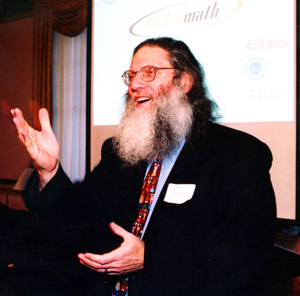
“They want their children’s education to resemble their education because they are successful,” [Rosenstein] explained. “They say, ‘It worked for me, why won’t it work for them?’ ”
source:
Battle Over Math in New Jersey Drives off a New Schools Chief
............................
Joseph G. (Joe) Rosenstein
I have been a member of the Mathematics Department of Rutgers University, New Brunswick, for the past 37 (!) years.
(The photograph was taken at the launch of the MetroMath Center in November 2003; it looks like I was directing a performance of the MetroMath anthem, but I was just speaking enthusiastically about the Center's vision and goals. MetroMath is described later on this page.)
In the research portion of my career, I wrote a number of articles and published a research monograph Linear Orderings (Academic Press, 1982) in textbook form.
For nearly 20 years I have been heavily involved in K-12 education. This came about as a result of my serving as Director of the Undergraduate Program in Mathematics. (Details are in my vita.) In recent years, I have been involved in the following five major kinds of enterprises that are described in more detail below:
- organizing and directing professional development programs for K-12 teachers of mathematics,
- strengthening mathematics education in New Jersey through developing the NJ Mathematics Curriculum Framework,
- directing the New Jersey Mathematics Coalition,
- organizing and serving as founding director of the MetroMath Center, and
- writing instructional materials for K-12 teachers focused on discrete mathematics.
(In another arena, I have developed and published a new prayerbook for the morning service of Shabbat and festivals entitled Siddur Eit Ratzon; it is available for review and purchase at www.newsiddur.org.)
............................
And see: Beyond TERC
Joseph G. (Joe) Rosenstein homepage
Joseph G. (Joe) Rosenstein at ktm-2
thanks, Joe
Steve H reads the TIMES
“You have to question how much further they’d be willing to go to advance their cause,” Mark Bombace, the school board president, said in an interview. “And that is very disturbing to someone who has spent his life trying to do the right thing for children.”And the other side is NOT trying to do the right thing for children? If these parents cared only about their own kids, they would keep quiet, tutor their kids, and laugh all the way to the SAT test.
"...the parents flooded the Internet"Boy, there are a lot of parents who apparently don't want to do the right thing for children.
“They want their children’s education to resemble their education because they are successful,” he explained. “They say, ‘It worked for me, why won’t it work for them?’ ”Stupid or arrogant. They like to view the problem as what was done long ago versus what is done today, rather than Investigations versus Singapore Math. The real issue is low expectations versus high expectations.
“We’re trying to move this to a problem-solving process rather than having a fight or a battle,”
Why wasn't it a problem-solving process from the beginning? Could it be that the board didn't think there was a problem? Why did the battle begin in the first place?
Battle Over Math in New Jersey Drives Off a New Schools Chief
how it's done
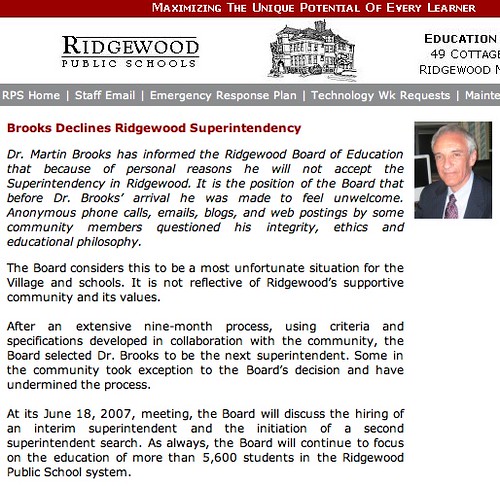
I'm not feeling any too happy with the Ridgewood situation at the moment.
One of the issues is this page on the school website.
The board's statement (anonymous phone calls...not reflective of Ridgewood's supportive community and its values...) should not be there. It is inappropriate in every conceivable way and then some.
Some of you may remember the fields vote here in Irvington. Each member of our school board spent two years of his or her life putting the fields proposal together, dealing with the resulting conflict (neighboring homes with drainage problems, questions about costs), substantially scaling the proposal back, and finally campaigning for the bond when it came to a vote.
The bond's defeat was unexpected—for me, at least—and terribly disappointing to board members, all the more so because they took a tremendous amount of heat from 'yays' and 'nays' alike. Their experience had to be excruciating.
How did they respond?
Here's how:
As I am sure you are all aware, the final result of the December 20 vote on the Fields Improvement bond referendum was 845 against and 798 for. As everyone had predicted, the election was close and number of votes high. The referendum was the topic of discussion in all corners of our community. There was a spirited debate as the proposition and its merits were debated in the bagel store, on our fields, at the IEF Gala and on-line. In the end, there were many reluctant “no” votes, but there were also many “yes” votes with reservations.
Today the key question is: “What’s next?” We were asked “What’s the plan, now” only minutes after the vote results were announced. On the train platform in the morning and in town, we hear the same question. Community members on both sides of this issue have contacted us to offer their assistance in promoting a different solution, to help to find a way to address our athletic field needs.
So during the Winter break, the Board thought about how we could address the issues that arose during the community discussion surrounding this proposition.
This is what leadership looks like.
Leadership and grace.
Why we hate it . . .
 Okay, so maybe this isn't the only reason, or even the best reason, for disliking reform math, but I think this graphic is a really good reason to hate it.
This graphic appeared along with a New York Times article about the recent turmoil in Ridgewood, New Jersey.
The caption notes that this was a 3rd grade assignment and the correct answer is 2450 (not 2550).
I see this assignment as a huge missed opportunity. Sure a kid could get the right answer by drawing 25 boxes (instead of 26) and skip counting her way to the right answer.
But if she only had some basic 3rd skills in multiplication and subtraction, this type of assignment could lead to a fantastic lesson on order of operations, something most kids struggle with. Instead, it is a drawing and counting assignment.
I just can't see how this leads to "conceptual understanding" or "higher order thinking skills." The child is counting and drawing and completely missing the conceptual aspect -- when do you multiply, when do you subtract, how do you know when to use each operation?
Wednesday, June 13, 2007
Congratulate me
I just ordered the 4th grade Singapore Math textbooks and workbooks (4a and 4b) from ebay. I intend to have my two soon to be 4th graders go through them this summer.
Any advice?
the KNOWING diagram
favorite bubble on the KNOWING diagram:
Is there something to find out?
...............
Then there is this: The goal of education is understanding rather than performance.
Certainly true of the Irvington math department.
Unfortunately, while understanding is the stated goal of math teaching here in our middle school, rapid and accurate performance remains the goal of math testing.
Which would explain why I have several hundred dollars-worth of math workbooks lying around my office.
what is the question?
From a response to Why Minimal Guidance During Instruction Does Not Work, which Ken discussed awhile back, one of the most pointed and useful statements of the constructivist take on content vs skills I've seen.
Useful as Exhibit A, I mean.
number one: Apparently these people have never met a middle-school aged child in person.
number two: The words parents, taxpayers, broader public, mathematicians, scientists, etc. do not appear in this article. That's too bad, because parents, taxpayers, the broader public, mathematicians, and scientists, etc. may have thoughts about what to teach America's children, possibly involving the importance of remembering stuff.
number three: The future, as imagined by constructivists, reminds me a bit of the old Future, the 1960s Future of Disneyland, G.E., and the Weekly Reader: spiffy, new, generic. In Professor Kuhn's 21st century, people will not have jobs or professions that require them to remember stuff. Jobs will be obsolete, and citizens will devote their lives to inquiring into and arguing about the issues of the day.
So I guess everyone will have a blog.
Center for Cognitive Technology
Education for Thinking Project
Useful as Exhibit A, I mean.
[M]y argument is that the concerns [with instructional effectiveness] of Kirschner et al.... are misplaced and that the most pressing concern facing educators and challenge to educational reformers is not in fact how to teach students but rather what to teach them. In other words, whether or not they have a correct answer, Kirschner et al. do not address the most pressing question.
WHAT DO WE WANT CHILDREN TO LEARN?
[snip]
Traditional answers to the question of what schools should teach children have become increasingly hard to justify. Beyond basic literacy and numeracy, [ed.: basic?] it has become next to impossible to predict what kinds of knowledge people will need to thrive in the mid-21st century. Like knowledge acquisition, another traditional goal—education for citizenship—is far from straightforward to characterize or implement. Examples across the world illustrate the dangers of ideological teaching that narrows students’ perspectives to the point of accepting only their own “right” way of understanding human affairs. [ed.: good point! let's forget the character ed & spend the time saved teaching the liberal arts]
A resolution has been in the direction of undertaking to teach not simply knowledge itself but the skills of knowledge acquisition—skills that will equip a new generation to learn what they need to know to adapt flexibly to continually changing and unpredictable circumstances (Anderson, Greeno, Reder, & Simon, 2000; Bereiter, 2002; Botstein, 1997; Kuhn, 2005; Noddings, 2006; Olson, 2003).
[snip]
After examining possible alternatives, I make the case that the only defensible answer to the question of what we want schools to accomplish is that they should teach students to use their minds well, in school and beyond (Kuhn, 2005). The two broad sets of skills I identify as best serving this purpose are the skills of inquiry and the skills of argument. [ed.: also remembering stuff] These skills are education for life, not simply for more school (Anderson et al., 2000). They are essential preparation to equip a new generation to address the problems of the day. [ed.: unless it turns out you have to remember stuff to address the problems of the day]
We have only a brief window of opportunity in children’s lives to gain (or lose) their trust that the things we ask them to do in school are worth doing. [ed.: like remembering stuff; remembering stuff is worth doing] Activities centered on inquiry and argument enable students to appreciate the power and utility of these skills as they practice them. [ed.: they're pulling your leg] They learn for themselves what they are good for, without having to be told, and become committed to them as tools for lifelong thinking and learning. [ed.: snort]
[snip]
Meanwhile, science educators have moved increasingly to the view that the most important thing children have to learn about science is to recognize science as a way of knowing the world, one that distinguishes it from other kinds of knowing and serves as a powerful tool for understanding (see Lehrer & Schauble, 2006, for review). [ed.: I guess you can pretty much accomplish that in a semester or two...]
[snip]
As for the claim that engaging in problem-solving produces cognitive overload, isn’t problem-solving, often unstructured, exactly what students need to become equipped to do? [ed.: you have to remember stuff to solve unstructured problems] Surely a steady diet of “worked examples” cannot possibly prepare today’s students for what they will face in the 21st-century world.
source:
Is Direct Instruction an Answer to the Right Question?
Deanna Kuhn
Teachers College
Columbia University
number one: Apparently these people have never met a middle-school aged child in person.
number two: The words parents, taxpayers, broader public, mathematicians, scientists, etc. do not appear in this article. That's too bad, because parents, taxpayers, the broader public, mathematicians, and scientists, etc. may have thoughts about what to teach America's children, possibly involving the importance of remembering stuff.
number three: The future, as imagined by constructivists, reminds me a bit of the old Future, the 1960s Future of Disneyland, G.E., and the Weekly Reader: spiffy, new, generic. In Professor Kuhn's 21st century, people will not have jobs or professions that require them to remember stuff. Jobs will be obsolete, and citizens will devote their lives to inquiring into and arguing about the issues of the day.


So I guess everyone will have a blog.
Center for Cognitive Technology
Education for Thinking Project
I've conquered getting on this blog!
I'm so excited. Solving a problem that's been bugging me for days--no matter how insignificant it is to others--is a natural high for me. Now that I can submit and comment to this blog, all you folks may REALLY be sorry-- 'cause I'm retired now and have SO much more time to offer viewpoints!
Niki
Subscribe to:
Posts (Atom)