kitchen table math, the sequel

Saturday, March 15, 2008

turning lead into gold

Well, at least the Wright Group/McGraw Hill, publisher of Everyday Math, is attempting to clean up their own mess. On the same day the National Math Advisory Panel was busy making their report available to the public, Wright Group was introducing Pinpoint Math.


CHICAGO, March 13 /PRNewswire/ -- Wright Group/McGraw-Hill (News) has published a new math intervention curriculum, Pinpoint Math. The supplemental program, with both online and print components, was designed for students in Grades 1-7 who are one to two grade levels behind in mathematics.

Pinpoint Math can be used successfully with any basal mathematics program. It incorporates the three essential elements necessary for improvement of mathematics performance among struggling students:

-- Diagnostic Assessment: Identify areas of weakness for individual students.
-- Targeted Instruction: Provides content in an individual Student Action Plan that meets the needs of the student with both print and animated tutorials.
-- Progress Monitoring: For ongoing assessment of students' advancement on individual topics in both formal and informal formats.
Of course, it will come at a pretty penny to districts who buy the supplemental program. The Wright Group has a nice customer base to tap into considering the 175,000 classrooms they've wriggled their way into. That's a whole lot of potential sales.

Conveniently, Pinpoint Math "can be used successfully with any basal mathematics program." That way, schools can help those struggling students "who are one to two grade levels behind in mathematics."

So first you sell schools a math curriculum that results in a significant population of struggling students, and then you sell them a scaffolding tool to remediate the problem you created in the first place. Nice job Wright Group/McGraw-Hill. Way to keep the stockholders happy.

That's just wrong on so many levels, I don't even know where to begin.

I think I'm coming down with something...


The inability to understand and compute fractions, decimals, and proportions has important real-life implications, and has been linked to poor health outcomes, among other harmful effects.

Report of the Task Group on Learning Processes
Draft 3/6/2008

You can lead a horse to water ...

A presidential panel said yesterday that America's math education system was "broken," and it called on schools to ensure children from preschool to middle school master key skills.

...

F. Joseph Merlino, project director for the Math Science Partnership of Greater Philadelphia, which runs a research program involving 125 schools in 46 school districts, said that while he agreed with the finding that "you can't teach so many topics that you aren't able to get into depth," he disagreed with the report's focus on improving algebra instruction as central to better math education for all students.

He said he favored tailoring math instruction to the learning styles of students more than the report does. (emphasis added)


Philadelphia Inquirer, Panel: Math education is 'broken' The presidential panel called for ways to improve teaching and fight "math anxiety."

Bear in mind that in 2005, only 15.8% of black 11th graders in Philadelphia performed at the proficient level or above on the state math test. This placed them 2.61 standard deviations below the mean pass rate of 52.8% in Pennsylvania. This places these students below the first percentile.

See here.

I guess they haven't found the right learning style for these students yet.

Friday, March 14, 2008

Natl Math Panel: increase algebra in 8th grade

All school districts should ensure that all prepared students have access to an authentic algebra course—and should prepare more students than at present to enroll in such a course by Grade 8. The word authentic is used here as a descriptor of a course that addresses algebra consistently with the Major Topics of School Algebra (Table 1, page 16). Students must be prepared with the mathematical prerequisites for this course according to the Critical Foundations of Algebra (page 17) and the Benchmarks for the Critical Foundations (Table 2, page 20).

FINAL REPORT
p. xviii

Table 1: Major Topics of School Algebra
Symbols and Expressions
  • Polynomial expressions
  • Rational expressions
  • Arithmetic and finite geometric series
Linear Equations
  • Real numbers as points on the number line
  • Linear equations and their graphs
  • Solving problems with linear equations
  • Linear inequalities and their graphs
  • Graphing and solving systems of simultaneous linear equations
  • Quadratic Equations
  • Factors and factoring of quadratic polynomials with integer coefficients
  • Completing the square in quadratic expressions
  • Quadratic formula and factoring of general quadratic polynomials
  • Using the quadratic formula to solve equations
Functions
  • Linear functions
  • Quadratic functions—word problems involving quadratic functions
  • Graphs of quadratic functions and completing the square
  • Polynomial functions (including graphs of basic functions)
  • Simple nonlinear functions (e.g., square and cube root functions; absolute value;
  • Rational functions; step functions)
  • Rational exponents, radical expressions, and exponential functions
  • Logarithmic functions
  • Trigonometric functions
  • Fitting simple mathematical models to data
Algebra of Polynomials
  • Roots and factorization of polynomials
  • Complex numbers and operations
  • Fundamental theorem of algebra
  • Binomial coefficients (and Pascal’s Triangle)
  • Mathematical induction and the binomial theorem
  • Combinatorics and Finite Probability
  • Combinations and permutations, as applications of the binomial theorem and Pascal’s Triangle

Recommendation: Proficiency with whole numbers, fractions, and particular aspects of geometry and measurement should be understood as the Critical Foundations of Algebra. Emphasis on these essential concepts and skills must be provided at the elementary and middle grade levels.
Recommendation: The coherence and sequential nature of mathematics dictate the foundational skills that are necessary for the learning of algebra. The most important foundational skill not presently developed appears to be proficiency with fractions (including decimals, percents, and negative fractions). The teaching of fractions must be acknowledged as critically important and improved before an increase in student achievement in algebra can be expected.

Table 2: Benchmarks for the Critical Foundations

Fluency With Whole Numbers
1) By the end of Grade 3, students should be proficient with the addition and subtraction of whole numbers.

2) By the end of Grade 5, students should be proficient with multiplication and division of whole numbers.
Fluency With Fractions

1) By the end of Grade 4, students should be able to identify and represent fractions and decimals, and compare them on a number line or with other common representations of fractions and decimals.

2) By the end of Grade 5, students should be proficient with comparing fractions and decimals and common percents, and with the addition and subtraction of fractions and decimals.

3) By the end of Grade 6, students should be proficient with multiplication and division of fractions and decimals.

4) By the end of Grade 6, students should be proficient with all operations involving positive and negative integers.

5) By the end of Grade 7, students should be proficient with all operations involving positive and negative fractions.

6) By the end of Grade 7, students should be able to solve problems involving percent, ratio, and rate and extend this work to proportionality.
Geometry and Measurement

1) By the end of Grade 5, students should be able to solve problems involving perimeter and area of triangles and all quadrilaterals having at least one pair of parallel sides (i.e., trapezoids).

2) By the end of Grade 6, students should be able to analyze the properties of two-dimensional shapes and solve problems involving perimeter and area, and analyze the properties of threedimensional shapes and solve problems involving surface area and volume.

3) By the end of Grade 7, students should be familiar with the relationship between similar triangles and the concept of the slope of a line.

Source:
FINAL REPORT, 2008.

cat wakes human


Having done a number of interviews with cat owners, I can tell you that cat-waking-owner stories are legion.

Comments on Chisanbop (Chisenbop) or Finger Math, Anyone?

Chisenbop is a method of computation using the fingers like an abacus.

Here's a tutorial.

www.cs.iupui.edu/~aharris/chis/chis.html


I think it was popular in the early 1980s, but fell out of favor.

There were a couple of books published:

The Complete Book of Chisanbop : Original Finger Calculation Method (ISBN: 0-442-27568-4)

Complete Book of Fingermath (ISBN-10: 0070376808)

Comments on the value or lack thereof?

kindred spirit

Fantastic new blog!

Out in left field

In a post on the subject of grade deflation and extended response math tests, he writes:

The Pennsylvania Math Standards on which the Philadelphia public schools base their grades, in fact, include numerous non-mathematical factors: explaining in words, drawing pictures, manipulating objects. Perhaps my daughter's explanations and drawings aren't as elaborate as some of her peers'. Perhaps she doesn't complete hands-on tasks as quickly as others do. And perhaps her shyness and passivity keep her from making oral contributions that "demonstrate superior understanding of concepts, skills and strategies" and from "independently explor[ing] ideas and topics:" two of her report card's benchmarks for grades of 4.

It's of course way too early to say just how strong my daughter's mathematical talents are. But I can't help wondering how many math buffs are being lost in the new system, and what this means for both their future, and that of this country.

This worries me, too.

I went back and found this post Barry G made to the old ktm:

Here's a problem that appears in IMP for 9th grade It is known as the "Haybaler Problem"

“You have five bales of hay. For some reason, instead of being weighed individually, they were weighed in all possible combinations of two: bales 1 and 2, bales 1 and 3, bales 1 and 4, bales 1 and 5, bales 2 and 3, bales 2 and 4 and so on. The weights of each of these combinations were written down and arranged in numerical order, without keeping track of which weight matched which pair of bales. The weights in kilograms were 80, 82, 83, 84, 85, 86, 87, 88, 90 and 91. Find out how much each bale weighs. In particular, you should determine if there is more than one possible set of weights, and explain how you know.”

David Klein, a mathematics professor at California State University at Northridge comments on the problem. “The process of solving this problem made me resentful of the stupidity and pointlessness of it. There is nothing ‘real world’ about it. It is completely inappropriate for kids who likely have not been taught how to solve simultaneous linear equations, or exposed at most to two equations in two unknowns. If I had been given such problems at that age, I think that I would have hated math.”

Consistent with much of the philosophy of “real life math”, the goal of the exercise is to explore strategies and to be able to write about it. This is made apparent by the “student guide” that accompanies the problem. It is essentially a scoring sheet, containing categories, with points awarded for each, such as “Restate the problem in your own words” (4 points); describe all the methods you tried before reaching your solution(s) (4 points); describe the process that lead to your solution(s) (4 points); describe all assistance provided and how it helped you (2 points); state the solution (2 points); describe why your solution(s) is correct, include all supporting data (6 points). Out of a total of 50 points, only 2 are given for the solution. In fact more points are given for describing why the solution is correct.


Be sure to read his post explaining Why teach fractions?

Thursday, March 13, 2008

In a fraction fix

Today in their final report, the National Math Advisory Panel said:

Difficulty with the learning of fractions is pervasive and is an obstacle to further progress in mathematics and other domains dependent on mathematics, including algebra. It also has been linked to difficulties in adulthood, such as failure to understand medication regimens. Algebra I teachers who were surveyed for the Panel as part of a large, nationally representative sample rated students as having very poor preparation in “rational numbers and operations involving fractions and decimals” (see Panel-commissioned National Survey of Algebra Teachers, National Mathematics Advisory Panel, 2008). The Final Report of the National Mathematics Advisory Panel, p. 30
Today in the blogosphere, a student teacher said:

Today I taught a lesson about fractions from Everyday Mathematics. Fractions were not something I was good at in school, so I was nervous about teaching it. It went okay, but some of the students gave answers that were not correct, and I was having trouble explaining why they were correct. Luckily my master teacher was in the classroom so she was able to help me give an explanation on why that students answer was not correct.
Houston, we have a problem.

Lockhart's Lament

Lockhart's Lament via Devlin's Corner

The low down:

A PhD Mathematician teaching school age children suggests that since kids aren't really learning anything as it is in drill and kill math class, let's stop the pretense altogether and teach them "real" math.

And I'm all for "real" math, I really am.

It's not that he doesn't bring up some good points, but I'm not for playing chess and calling it math, like he suggests. And I'm also pretty sure that no matter how interesting of problems that he can come up with he's not going to get everyone excited. If kids thought that mankind's struggle to measure curves was really exciting you'd see more video games and movies about it.

And I also suspect that before one can appreciate all this poetic beauty, artistry, creativity, and finger snapping, that a student, even in pure math, might need to have mastered a few basic techniques and have memorized some definitions and axioms first. However, this too seems to be dismissed by Lockhardt as so much mindless formalism and dispensed with. Is it possible that instead of serving up a dose of "real" math, he is serving up math appreciation?

With all the references in that article to aesthetic appreciation Jacque Barzun's chapter on Occupational Disease: Verbal Inflation came to mind.

Then again, maybe I've just got a bad case of sour grapes. I spent an entire afternoon working on proving that the max of two different sets was the same by showing that the max of one set was less than or equal to the max of the other set and then showing that the max of the other set was less than or equal to the max of the first. There was nothing "charming" about it.

I can't do charming proofs. I can barely do ugly ones.

Ridgewood School District board election

Ridgewood School District

Take a look!

Homeschooling Conventions: no foldables here

I have attended the Northern Virginia Homeschooling Convention (NOVA Conference) and a Homeschool Curriculum Fair in Maryland. There were no sight words or whole word reading programs to be seen, no fuzzy math, and no foldables. Actually, the only thing even close to a foldable was a locally produced phonics flip chart that made a variety of different words to sound out as you flipped it around.

Disclaimer: while I don't really "know" the people in charge of the NOVA Conference, through a series of e-mails, I gave them permission to use a quote I had previously written about their conference, and they let me purchase some of their old data DVDs to send to friends (both school teacher friends and homeschooling friends) as Christmas presents.

Here's some of their workshops (If you're interested, you can buy the DVD-ROM of all the workshops for $40, but you won't get it until a month or two after the conference ends in July):

Algebra Alcatraz!
Why not just break out of Algebra prison and study some practical subjects? If you’ve ever felt this way, you owe it to yourself to invest just 50 minutes to find out whether this Algebra stuff is right for you. (Oh, by the way, bring Mom or Dad with you to this seminar! They need answers, too!)

Homeschooling Through High School
Can it possibly be a good idea to homeschool all the way through high school? Can homeschooled teens get into college? What about teaching advanced math and science? This encouraging seminar is designed to reassure parents (and teens) that it’s not only possible to homeschool through high school, but that it is a wonderful choice. Learn how other families have made it through the high school years, and how you can too!
Seeing Fractions is Understanding Fractions
Four out of five people don't understand fractions! With one hands-on model, Steve demonstrates how to do the basic operations and see where the formulas come from. The grand finale is how to convert a fraction to a decimal to a percent.

Spelling and the Brain
Many children (and some adults) have difficulty learning to spell, but the difficulty may not be with the student so much as with the method of presentation. Find out in this workshop how spelling information is most efficiently stored in the brain, and why. With a greater insight into the nature of spelling and neurological function presented in this workshop, the parent/teacher will be well-equipped to meet the needs of all their children, not just the “naturally” good spellers.
Teaching Boys & Other Children Who Had Rather Be Making Forts All Day


This one was very interesting! He talked about the differences between boys and girls and how each learns best and how to keep their interest. He's very funny, too.

The Good Reader
An overall plan for teaching reading to children. Includes the development of good language skills, starting at birth; tips on pre-reading instruction; appropriate phonics instruction for ages three, four, five, and older; reviews of a number of phonics programs along with recommendations; beginning reading lists; suggestions for remedial reading; and a discussion on encouraging reluctant readers. Jessie Wise has over thirty years' experience in reading instruction and has field-tested many of the reading programs now on the market.

There's a lot more, you can see all the workshops online.

By the way, the top 3 choices in a survey of homeschoolers for math in a homeschooling magazine I subscribe to were Math-U-See, Saxon, and Singapore Math.

If you just want some good ideas about how to better teach your children and some great resources, a homeschooling convention is an interesting and fun place to learn about learning, no matter what type of schooling you choose for your children.


visual learning

foldables
why lawyers burn out
Independent George re: foldables
your tax dollars at work part 2
my busy day
not your father's formative assessment
remembering key concepts in math with foldables
south of the border
Steve H and palisadesk on foldables
homeschooling convention: no foldables

you may have to hit refresh a couple of times to load these pages:

21st century skills in Singapore
the master plan
horselaughs are heard in Singapore
more horselaughs in Singapore

multiple choice vs. constructed response

The Panel first examined whether constructed-response formats measure different aspects of mathematics competency in comparison with the multiplechoice format. Many educators believe that constructed-response items (e.g., short answers) are superior to multiple-choice items in measuring mathematical competencies and that they represent a more authentic measure of mathematical skill. The Panel examined the literature on the psychometric properties of constructed-response items as compared to multiple-choice items. The evidence in the scientific literature does not support the assumption that a constructed response format, particularly the short-answer type, measures different aspects of mathematics competency in comparison with the multiple-choice format.

National Mathematics Advisory Panel FINAL REPORT
p 60

This comes at a timely moment as I'd been planning to put up a post asking for opinions on the "explain your answer" items on last year's NY state 8th grade test.

e.g.:
Zach earns $160 per week at a local market. He makes a payment of $12 per week for a new bike. He spends $75 each week on food and entertainment. Zach deposits the rest of his money in a savings account. Zach estimates that he deposits about 25% of the $160 into his savings account each week.

Is Zach's answer correct?

On the lines below, explain how you determined your answer.

How much of his weekly earnings would Zach need to deposit in order to save 40%?

source:
NYSED 2007 tests
Mathematics Test Book 3
Grade 8
March 12-16, 2007


To me, this looks like an opportunity for kids who don't know how to solve the problem to gain a point or two because they "understand" the concept. (This item is worth 3 points, the highest possible on any items on the test.)

By the same token, it is also an opportunity for kids who do know how to solve the problem to lose a point or two because their verbal explanation was incoherent.

The extended response item as equalizer.

visual learning

Late yesterday afternoon my Foldables rampage across the internet led to something good: I now possess a starter sense of "visual learning" and what its place in school may be. This is something I've puzzled over for ages, partly because of research Temple and I cited in Animals in Translation concerning verbal overshadowing. Verbal overshadowing is a conflict between visual and verbal representations in memory:
A series of laboratory studies found that memories for a mock criminal's face were much poorer among eyewitnesses who had described what the perpetrator looked like shortly after seeing him, compared with those who hadn't.
source:
Words Get in the Way
by Bruce Bower
Science News
Week of April 19, 2003; Vol. 163, No. 16, p. 250

Temple divides the world into visual and verbal thinkers and from one angle the verbal overshadowing studies seem to say she's right. (I have no doubt she's onto something - Temple really does think in pictures.)

At the same time, probably most of us have the sense that visual memory is more durable than verbal memory no matter what kind of thinkers we are, which is why Ms. Peacock tells her students to form a mental image of the word "vex." She's right: a mental image should allow all of them to remember the word the next time they see it, not just the "visual learners."

Which brings to mind a story. I once went to a friend's 40th birthday party where I didn't know a soul. At the time I'd just finished reading a book on memory so I formed mnemonic images of the names of every person to whom I was introduced -- and then I remembered every name. I was remembering names so accurately that it turned into a party trick; people were gathering 'round to watch me remember names. As well they should have. It was quite a feat.

So: verbal overshadowing on the one hand; mnemonic devices on the other.

I have no idea how these two ideas fit together. Perhaps visual images help memory for verbal material but verbal representations hurt memory for visual material? Don't know.

Don't know and am not going to spend today tracking down the people do know. Here's the post I wrote early yesterday evening:


Karen H pointed me to the Eide Neurloearning blog awhile back:
Several years ago, we experienced an epiphany while meeting with an obviously intelligent blind woman with a thirty-year history of diabetes. "There's probably nothing you can do," she started off saying, "but I still need to ask you if there's anything I can do about my memory. It's gotten so bad now that I'll forget what my daughter's telling me even before she's finished talking." Uh-oh, we thought, sounds bad. We had seen her brain scan before, and it had clearly shown diffuse damage from poorly controlled diabetes. Maybe there was nothing we could do.

We asked her to try to remember a list of numbers, and found to our dismay that she struggled to remember even 2 in a row. When asked to reverse them, she couldn't even keep the second number in mind. It looked pretty hopeless. Words of reassurance seemed empty.

But then we thought of something. We had recently seen an fMRI study which had shown that 'visual imagination' (visually imagining reversing a checkerboard) had a very diffuse distribution in the brain - and thought maybe enough of it could be preserved in this woman so that visual imagery could be used bypass her memory impairments. To our surprise and to hers, when prompted to visually imagine the numbers we read to her, she could now remember 7 digits (the normal limit)! ... [S]he merely needed to be made aware that she should translate 'heard' information into visual images - to go from being totally incapacitated memory-wise to 'normal'.

The fact that public schools are preoccupied with visual learning however defined* reminds me of Horace Mann deciding that hearing children should be taught to read the same way deaf children were taught. High school students have young, healthy brains; they don't need to assign a distinct visual image to each and every unfamiliar vocabulary word they encounter while reading a play by Shakespeare. Not unless they've got diffuse brain damage, which by the time they've spent 16 years playing video games at home and folding Foldables at school, they may have.

The fastest way to teach vocabulary -- I'm pretty sure I'm right about this -- would probably be to produce a "Saxon Math" for prose: a sequence of textbooks with interesting short passages offering distributed practice in the vocabulary to be learned each school year, including homework sets that require students to -- yes -- write sentences using the words.

Based in my own experience as an obsessive child reader, I can tell you that it's possible to acquire a large vocabulary from voracious reading alone. However, no school (or parent) can require students to read obsessively, nor would we want them to. So we need textbooks that go some ways toward distilling and duplicating the critical elements of the natural born bookworm's reading habits; we need quality reading over quantity.

I continue to think Vocabulary Workshop probably does this, by the way. Just wish we were getting through the books faster. C. has spent 2 years on the first book in the series -- Level A -- and still isn't finished. (We continue to plug away at Megawords; we're midway through Book 5 now, with 3 to go.)


visual learning - the books to read

Having poked around Eideneurolearning a bit on the same day that I went looking for a Jeffrey Zacks paper on event segmentation, I've gleaned the following nuggets & reading recommendations:
  • a combination of text with images probably always produces better "retention" - i.e., we remember the material better later on (not sure whether the people who study these things also believe we understand the material better - I think they do)
  • animations are probably a bad idea; stills are preferable
  • the seminal book on the relationship between words and pictures is: Mental representations: a dual coding approach by Allan Paivio
  • the best book on dual coding as it applies to education is Richard Mayer's Multi-Media Learning
I'm sorely tempted to buy both of these books, which can be previewed on Google Book Search, but first I'm going to read all of the Eide posts on visual learning.

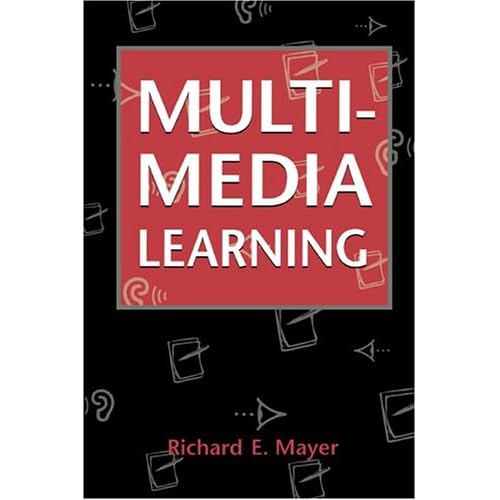


*I've seen it defined as "prefers reading to listening"


visual learning

foldables
why lawyers burn out
Independent George re: foldables
your tax dollars at work part 2
my busy day
not your father's formative assessment
remembering key concepts in math with foldables
south of the border
Steve H and palisadesk on foldables
homeschooling convention: no foldables

you may have to hit refresh a couple of times to load these pages:

21st century skills in Singapore
the master plan
horselaughs are heard in Singapore
more horselaughs in Singapore

National Mathematics Advisory Panel Releases Final Report

On March 13, 2008, the National Mathematics Advisory Panel presented its Final Report to the President of the United States and the Secretary of Education. Copies of these ground-breaking reports, rich with information for parents, teachers, policy makers, the research community, and others, are provided below.

Foundations for Success: Report of the National Mathematics Advisory Panel

Final Report PDF (851 KB) Word (1 MB)

I ranted and raved about the Math Panel's report over at Mindless Math Mutterings.

Wednesday, March 12, 2008

Don't Mess with Texas

I had no idea that Chuck Norris had a syndicated column. Apparently, he does.

In this week's entry he speaks out against the recent California homeschool ruling.

Our twins are homeschooled. That is the present educational option we have chosen for them and us. It is our right to do so as parents and American citizens. But, increasingly across this union, private academic alternatives are coming under attack, being legally stripped of their value and even being labeled unconstitutional and illegal.

[snip]

If academic corruption is easily conceived in California, how long will it take to crawl to your state line?

My warning to such creeping companies of corruption is this: Best not to test Texas. If you thought we fought hard for the Alamo, wait until you see what we can do for academia. You can hide your sleaze behind No. 2 pencils, but our branding irons will find your tail sides.

On a non-Norris note, California Homeschool Network is a good source for updated information on the California homeschool ruling situation. This week's TIME Magazine has an interesting piece on the case as well.

21st century skills, part 2

Independent George is on a roll today:

So in the interest of visual learning, we've managed to take all the math out of math, and the words out of English...

In ten years, schools will consist of nothing but finger-painting. Which might have been fine twenty years ago, but completely inappropriate for the crayola-based skills needed to compete in the 21st century.

My thoughts exactly!

Call me crazy, but I don't think the visual arts going to be getting easier in the 21st century.

palisadesk & Steve H on foldables & inclusion

from palisadesk:
This stuff has been around forever -- well since the early 90's, anyway. This Dinah person may have co-opted the term "foldables" but the activity was already out there in full bloom by 1992. That's the date on a resource book I have entitled Alternatives to Worksheets

I got it back in my former school where most of my seventh grade students read at a third grade level or lower (the top kids were at a fourth grade level).

I tried some of those activities, like the flip books and the lift-the-flap things and various shape books and whatnot in an effort to get the student to produce something -- anything -- related to the curriculum for the grade. Having them write essays or do research was clearly out of the question because their skills were so weak (their self-esteem, however, was sky-high -- interesting).

It was only partially successful. A few kids, mainly girls, liked doing these things, but most did not. AT my current school the emphasis with middle grade kids seems to be to get them to use a computer to produce something. [Catherine here: true at our middle school, which has just purchased Clay-Mation & Virtual Reality software.] At least the computer can read to them and they may learn something.

I think one major reason these things have taken off is because of "radical inclusion." If you have students who are 4-8 grades below grade level and can't read or write independently (and this is not unusual in many places), what are you going to get them to do to "show their learning?" You need a "product." This stuff takes tons of time, keeps kids busy and "engaged," the student may end up with something that "looks nice," and everyone is happy. Have they learned anything? Who knows. Does this go any distance towards boosting their weak skills? Not at all.

However, consultants and administrators oooooh and aaaaah over these things, I kid you not.

BTW, I posted that link about wakawaka but Blogger got ahead of me and posted it before I filled in my handle and clicked POST.


from Steve H:
I'm beginning to see the educational world as a hot market for add-on products, especially if you include seminars. All you have to do is come up with a unique angle or hook. It's good if you can somehow claim that less is really more; that lower expectations can produce more results; that their ed school ideas really can work. Talk in generalities and gloss over the details.

"radical inclusion."

I think our town qualifies for this term, but they just call it full inclusion. It continues mostly through sixth grade, but it's still there in seventh and eighth.

Our town is known for this. People move to our town for its emphasis on the learning disabled. People write letters to the editor about how wonderful it is. I met another parent this past weekend who told me she moved to our town specifically for her autistic son. She loves the idea that he is fully integrated with the other kids and doing the same(?) work. LD kids and their families move in and more kids get sent to private school.

The school claims that with differentiated instruction they can make this work. They can't. My sixth grade son is doing very little writing and direct reading comprehension. Posters, cards, dioramas, artifacts, and anything that produces a "product" that isn't anything like a book report or test. In fact, outside of his seventh grade math, he doesn't get any tests.

I've talked in the past about how they want it both ways, but it doesn't work. Parents complain that they want more for their kids, but all they get is enrichment and not acceleration.

My son got low marks on one assignment because he didn't know quite what to do with a girl on his team who just wanted to cut up tiny pieces of construction paper and complain. They like the social idea of these kids working together, but they give them no instruction on how to do it.

This is a very touchy subject. Twenty to twenty-five percent of our kids go to other schools, but many think that the parents just want an elite education. I've seen both sides. Some in town feel very satisfied that my son is back in the public schools. One teacher's aide commented to me that my son's public school is so good!

The principal is very nice. We have talked about kids who go to or come from private schools. She understands why, but she still thinks that kids "can" get a good education in the public schools. Unfortunately, it's up to parents to make sure that their kids make the transition from very low expectaion K-8 schools to high expectation honors classes in high school.

Their idea of education is much fuzzier than mine. It's the only way they can make full inclusion work. They know there are limitations and they know why kids get sent to private schools, but they say that they have concerns that private schools don't have to deal with. They say that private school kids are "pre-selected". It's a tacit admission that they should, but can't do more.

Full inclusion is more important than academics, and they redefine education to cover this up.

This is an interesting take, and I'm sure it's true.

I also think there's more to it. My friend told me that her child's high school English Honors teachers recently assigned a paper with two options:

  • 5-page paper
  • 3-page paper illustrated with drawings

That's Honors English, which is quite selective.

My niece, also a high school freshman, recently had to spend 2 days drawing an animal in biology class. Two days. With no instruction whatsoever.

I don't know how many of you have ever sat down and tried to draw an animal "from scratch." I have, and it's not pretty. As far as I know, the only people who can draw without instruction are autistic savants and people with frontotemporal dementia.


drawings of horses by typical 4-year olds


drawing by 3-year old autistic girl

I'm encountering two things:
  • "visual learning" incorporated into all subjects across the board [update: having looked into the research on multimedia learning, I think that done right this may be a good idea when the instructor, not the student, creates the visuals]
  • a complete and total absence of any instruction whatsoever in how to create things visual
I wonder whether there is an "absence of instructivism" effect here. Because ed schools teach only constructivism, new teachers presumably haven't learned much if anything about learning theory, memory, distributed practice, etc.

The result -- and I've seen this, at times, in my own district -- is that when students absolutely must commit material to longterm memory, teachers fall back on the memory tricks we all know, e.g. direct memorization and the creation of mnemonic devices. That's what Ms. Peacock is talking about in the WordPOP! videos. She is talking about having students come up with visual images that will help them remember unfamiliar words such as "vex."

Mnemonic devices work, but you don't need a high school teacher to pass out worksheets and tell you to make some up.

You can just buy the book.


visual learning

foldables
why lawyers burn out
Independent George re: foldables
your tax dollars at work part 2
my busy day
not your father's formative assessment
remembering key concepts in math with foldables
south of the border
Steve H and palisadesk on foldables
homeschooling convention: no foldables

you may have to hit refresh a couple of times to load these pages:

21st century skills in Singapore
the master plan
horselaughs are heard in Singapore
more horselaughs in Singapore

south of the border

Dinah Zike's Teaching Science with Foldables
reviewed by Paloma Varela, Bridges, Mexico

When a friend of mine showed the materials that a publisher had sent her, my eyes gleamed like a leprechaun's eyes before his pot of gold. As I looked into the bag and glanced at the bounty my friend was sharing with me, I saw a title that caught my attention: Teaching Science with Foldables. When I opened it I noticed that, in fact, it was aimed at teaching not English, but science through Foldables. That was something extra that I was not expecting but I thought would certainly enhance the already positive values of the book. All at once, two main thoughts came to my mind: "Would it be easy to learn how to make them?" and "How can I use any of them in my day-to-day teaching?"

[snip]

In this book you will find a general tips for creating and using Foldables. Dinah Zike is an award-winning author, educator, educational consultant, and inventor, known internationally for these three-dimensional manipulatives made of everyday paper, glue, and scissors.

[snip]

Research has proven that students learn in different ways,* so by using these three-dimensional materials the senses are brought into learning: students can touch and move objects to make visual representations of concepts. Manipulatives provide the student with new ways of exploring a topic.

* Research has proved no such thing.


visual learning

foldables
why lawyers burn out
Independent George re: foldables
your tax dollars at work part 2
my busy day
not your father's formative assessment
remembering key concepts in math with foldables
south of the border
Steve H and palisadesk on foldables
homeschooling convention: no foldables

you may have to hit refresh a couple of times to load these pages:

21st century skills in Singapore
the master plan
horselaughs are heard in Singapore
more horselaughs in Singapore

students against words

Reading and learning occur every day. For those who have the building blocks, this learning can be very meaningful and powerful. However, most often, we spend very little time gathering the powerful words and vocabulary concepts that we need to build understanding.

Unfortunately, many of the teachers who do teach vocabulary are still using the out-dated and ineffective method looking up words in a dictionary/glossary and writing them in sentences Research shows that not only does this not help students learn important concepts, but it actually turns them against words.

source:
WordPOP!

Unfortunately, as we see from this example, some teachers are still using the word "teachers" to refer to educators and "students" to refer to learners.

Ms. Peacock teaches the word "vex"

Margaret Peacock, a high school teacher of English and Language Arts, uses the VVWA to preview important vocabulary within Romeo and Juliet.

video length: 8:29

Eight minutes & twenty-nine seconds to teach "vex."

"We do this because not everyone is a verbal learner."

..................

VVWA template (pdf file)