

 Posts


Which States Have World-Class Standards and Which Do Not
New York gets a C+.
8th grade standards in reading are declining, which makes sense, I think. I remember reading a while back that 8th grade standards were the only "hard" standards, which I know is the case here in New York. The former assistant superintendent told parents that the reason our 8th graders weren't doing well on the 8th grade ELA test was that the test was "unnecessarily difficult."
You can probably see the 8th grade jump in difficulty for the top states here. The 4th grade tests get lower grades than the 8th grade tests.
Prior to NCLB being enacted, states were required to test students in the 4th & 8th grades. There were no penalties for students failing these tests, which were strictly informational.
I assume that once NCLB was passed states in some way "kept" their old 4th and 8th grade tests, while writing new tests for the rest of the grades. The problem was that NCLB testing was high stakes; there were consequences attached.
So the 8th grade tests are being brought in line with the easier NCLB-era tests.
That's my suspicion, at any rate.
Saturday, July 12, 2008


authoritative parenting and smoking
Background: Research on adolescent cigarette smoking has attempted to measure the role of parents in preventing smoking experimentation and uptake. However, aspects of parental influence have often been limited to parental smoking behavior or antismoking socialization. Only a limited number of studies considered the hypothesis that the influence of parenting on adolescent current cigarette smoking may extend beyond parental behavior and antismoking socialization to consider broader measures of the parent–child relationship, such as parenting style.
[snip]
Results: Authoritative parenting was associated with a reduction in the odds of adolescent current cigarette smoking...
Discussion: Interventions may want to educate parents about authoritative parenting, which includes the importance of having appropriate and routine conversations with their children, requiring chores, and implementing general rules and boundaries.
Understanding the Association Between Authoritative Parenting and Adolescent Smoking
Friday, July 11, 2008
Eureka
Ed had a blinding revelation yesterday morning.
I'd gotten out Laurence Steinberg's Beyond the Classroom, which I hadn't looked at in several years, and was reading his descriptions of authoritative versus permissive parents of teens. That section hadn't left much of an impression on me 4 years ago. More on that anon.
Authoritative parents are:
Permissive parents are:
When you put these things together you get a familiar pattern.
Ed listened to that paragraph and said, "That's the schools."
It is.
Permissive parenting = discovery learning in the home.
The permissive parent focuses on emotion, facilitates growth by staying out of the way, frowns on parent "over-involvement," and believes that children need to make their own decisions and discover the consequences. This includes decisions about whether to drink, use drugs, and do homework.
The authoritative parent thinks all of this is hooey.
The authoritative parent thinks all of this is hooey because the authoritative parent believes in instruction. The authoritative parent is a natural-born instructivist; he (or she) possesses knowledge he intends to spend his parenting years conveying to his children.
What the authoritative parent does not believe in is allowing his child to learn hard lessons via trial and error (hands-on!). You will never hear an authoritative parent suggest that it's good for children to be allowed to make bad decisions so they can discover that bad decisions are bad by living with the results.
This is why the reading wars and the math wars and the edu-wars in general are about so much "more" than just a reading war or a math war or an edu-war in general. The schools are in loco parentis, but the parenting "style" in so many of them is wildly wrong for authoritative parents (not to mention authoritarian parents, but that's another story). If you're an authoritative parent sending a child to a school led by permissive and/or authoritarian educators -- we've experienced both -- you're going to feel that not only is your child being badly taught, he's being badly parented, too.
Meanwhile, permissive white parents* believe the same things progressive educators do:
There's no way to reconcile these positions. Authoritative parents want authoritative teachers. Permissive parents want progressive educators. Never the twain shall meet.
Of course, given the reality of the standards movement and No Child Left Behind, it seems likely that neither group is getting what they want.
It's not relative....
Instructivist parents
*see In Low-Income Schools, Parents Want Teachers Who Teach
Romancing the Child by E.D. Hirsch
in which I swear off permissive parenting
I'd gotten out Laurence Steinberg's Beyond the Classroom, which I hadn't looked at in several years, and was reading his descriptions of authoritative versus permissive parents of teens. That section hadn't left much of an impression on me 4 years ago. More on that anon.
Authoritative parents are:
- High on warmth and acceptance
- High on firmness: Parents who are high on this dimension have clearly articulated the rules that the child is expected to follow, and they make demands on the child to behave in a mature and responsible fashion. Children raised in this way know what their parents expect of them and know that there are consequences for violating their expectations. (p. 107)
- High on "autonomy support": Parents who are high in support for psychological autonomy solicit their child’s opinions, encourage their child to express himself or herself, and, in adolescence, enjoy watching their child develop into a separate and autonomous individual. Children who grow up with parents who are high in autonomy support feel that self-expression is a valued trait, that their parents’ love and respect for them is not contingent on their having the same opinions and ideas as their parents, and that it is important for a person to speak up for what he or she believes. (p. 107)
Permissive parents are:
- High on warmth & acceptance
- Low on firmness
- High on autonomy support
When you put these things together you get a familiar pattern.
Permissive parents ... view their main responsibility as [1] making sure that their child is happy and that his or her needs are gratified.... [P]ermissive parents believe that children are basically good, and that parents should support children in their natural inclinations. Permissive parents are not there to control the child, but to [2] facilitate growth by staying out of the way as much as possible. In fact, these parents [3] worry about the risk of excessive control—that the child’s creativity, curiosity, and inquisitiveness will be stifled by too much emphasis on authority. The acknowledge that children can make bad choices, but [4] they believe that the beneficial learning that takes place as a result of making mistakes outweighs the negative consequences of these errors. [numbers added] (p. 113)
Ed listened to that paragraph and said, "That's the schools."
It is.
Permissive parenting = discovery learning in the home.
The permissive parent focuses on emotion, facilitates growth by staying out of the way, frowns on parent "over-involvement," and believes that children need to make their own decisions and discover the consequences. This includes decisions about whether to drink, use drugs, and do homework.
The authoritative parent thinks all of this is hooey.
The authoritative parent thinks all of this is hooey because the authoritative parent believes in instruction. The authoritative parent is a natural-born instructivist; he (or she) possesses knowledge he intends to spend his parenting years conveying to his children.
What the authoritative parent does not believe in is allowing his child to learn hard lessons via trial and error (hands-on!). You will never hear an authoritative parent suggest that it's good for children to be allowed to make bad decisions so they can discover that bad decisions are bad by living with the results.
This is why the reading wars and the math wars and the edu-wars in general are about so much "more" than just a reading war or a math war or an edu-war in general. The schools are in loco parentis, but the parenting "style" in so many of them is wildly wrong for authoritative parents (not to mention authoritarian parents, but that's another story). If you're an authoritative parent sending a child to a school led by permissive and/or authoritarian educators -- we've experienced both -- you're going to feel that not only is your child being badly taught, he's being badly parented, too.
Meanwhile, permissive white parents* believe the same things progressive educators do:
- Learning is personal and emotional
- Learning is "growth"
- Learning is natural; the grownup's role is to facilitate by staying out of the way
- Parental over-involvement is common and destructive
- Parents shouldn't run interference with the school on their children's behalf; parents should allow their children to "self-advocate"
There's no way to reconcile these positions. Authoritative parents want authoritative teachers. Permissive parents want progressive educators. Never the twain shall meet.
Of course, given the reality of the standards movement and No Child Left Behind, it seems likely that neither group is getting what they want.
It's not relative....
Since the late 1950s, literally hundreds of studies have been conducted that examine acceptance, firmness, and autonomy support and their consequences for the child’s development. The gist of these studies has been remarkably consistent: children develop in more healthy ways when their parents are relatively more accepting, relatively firmer, and relatively more supportive of the child’s developing sense of autonomy.
[snip]
The consistency with which findings on the benefits to children of acceptance, firmness, and autonomy support have appeared in research studies is really quite remarkable, especially since scientists have used all sorts of methods and sources of information. More important, the consistency of this research argues against the widely held notion that good parenting is all relative. In the past four decades of concerted, scientific study, no research has ever suggested that children fare better when their parents are aloof than when they are accepting, when their parents are lenient rather than firm, or when their parents are psychologically controlling rather than supportive of their psychological autonomy. p. 106-110
Instructivist parents
…teenagers who had been raised in authoritative homes—homes in which parents are accepting, firm, and supportive of their child’s psychological autonomy—fare significantly better than their peers from other types of households. Psychologically, authoritatively reared adolescents are more confident, more poised, more persistent, more self-reliant, and more responsible. They are less likely to use or abuse drugs or alcohol, and less likely to be involved in delinquency or in more minor forms of misbehavior, such as cheating on school tests or cutting classes. Adolescents from authoritative homes report less anxiety, less depression, and fewer psychosomatic problems, such as insomnia or problems controlling their appetite. And not surprisingly, adolescents from authoritative homes do best in school, as measured by their grades, their attitudes toward schoolwork, and the time they invest in their studies. (p. 116-117)
*see In Low-Income Schools, Parents Want Teachers Who Teach
Romancing the Child by E.D. Hirsch
in which I swear off permissive parenting
Thursday, July 10, 2008
how to grow an athlete
I still haven't read this story, but this paragraph caught my eye:
I should probably go post that in the Comments on Concerned Parent's blog.
the "naturals"
Speaking of how to grow an athlete, I learned yesterday, while spending FOUR HOURS out on in a CVS out on Long Island trying to get Andrew's prescription medications labeled in compliance with state law for autistic kids attending 7 days of summer camp for the first time EVER, that there's a fellow in Switzerland who may be able to distinguish between the "naturals" and the "works hards." (You can get a lot of magazines read waiting 4 hours in a CVS.)
I wish to heck Psych Today had the print story posted online. The neuroscientist was an aspiring chess grandmaster who worked his tucchus off, was sent to special schools, etc. He finally gave up when he was beaten by an amateur player who "just liked to play."
Here's the blurb they do have posted.
The difference he's seeing has to do with memory, but I haven't figured it out yet.
If I gave in to the uncontrollable Ericssonian urge to put Spartak's success into a formula, it would read something like:
Intense Parents + Young Kids + Rigorous Technique + Toughness = Talent
How to Grow a Super-Athlete
by Daniel Coyle
NY Times Magazine
March 4, 2007
I should probably go post that in the Comments on Concerned Parent's blog.
the "naturals"
Speaking of how to grow an athlete, I learned yesterday, while spending FOUR HOURS out on in a CVS out on Long Island trying to get Andrew's prescription medications labeled in compliance with state law for autistic kids attending 7 days of summer camp for the first time EVER, that there's a fellow in Switzerland who may be able to distinguish between the "naturals" and the "works hards." (You can get a lot of magazines read waiting 4 hours in a CVS.)
I wish to heck Psych Today had the print story posted online. The neuroscientist was an aspiring chess grandmaster who worked his tucchus off, was sent to special schools, etc. He finally gave up when he was beaten by an amateur player who "just liked to play."
Here's the blurb they do have posted.
The difference he's seeing has to do with memory, but I haven't figured it out yet.
Tuesday, July 8, 2008
open letter to Barack Obama
from John Dewey:
Obama & McCain ed advisors at AEP
CEMSE works to reverse negative trends in science, math education
Jeanne Century on "sustainability"
Math Underground on Jeanne Century
CEMSE isn't loading at the moment.
I am very distressed to learn about your selection of Jeanne Century as one of your education advisors. She is director of the science program of University of Chicago's Center for Elementary Mathematics and Science Education (CEMSE), an organization which has been heavily involved with a horrificly lacking mathematics program called Everyday Mathematics—in fact, one of the co-directors of CEMSE was one of the developers of the program.
You will do what you do, I'm sure, but I truly hope that in formulating your positions on education, you take seriously the recommendations of the Presidentially appointed National Mathematics Advisory Panel. I also hope that you put aside partisan differences in judging such report and read it for what it is: an honest examination of what is the content that students must learn and master in elementary school in order to be prepared for algebra in 8th grade. The report also recommends what should be in such an algebra course.
[snip]
I'd like to make you aware of a report, of which Ms. Century is listed as one of the authors.The report was published online in 1999 and is called "The Principals (sic) of Educational Reform: Supporting Mathematics and Science Teaching in your School. A Handbook for Elementary and Middle School Principals." (pdf file) I found the following passage in the report particularly disturbing:
"You may have teachers in your school who are not at all interested in exploring ways to change their practice. If you have such resisters, it is important to do everything you can to persuade them to participate.Listen to their concerns, give them the professional development and materials necessary, and provide them with encouragement. There will always be people who are simply shut down to change. But the change can happen without them. Don't focus too much of your energy on these individuals, for you don't want to neglect those who are ready and willing. The reluctant ones will eventually need to come on board but at the beginning it is more important to make sure support is available for those who want it. Still, if you think resistant teachers are going to actively undermine your progress, you may wish to consider exploring ways to remove them from your school. You may find that the teacher is just as happy to leave the school as you may be to see him/her go." (Emphasis added)
[snip]
I would hope that you will not advance policies that continue the disservice that has been perpetrated on our children for the better part of two decades. On the other hand, I believe Lisa Keegan, (McCain's advisor) are much more aligned with how teaching should be conducted. Her ideas on education would be a change that I and many others (Democrats included) would welcome--something to which you might want to give some serious thought seeing as how you seem to be quite big on change.
In the spirit of non-partisanship, I remain,
Faithfully yours,
John Dewey
Published July 2, 2008
Obama & McCain ed advisors at AEP
CEMSE works to reverse negative trends in science, math education
Jeanne Century on "sustainability"
Math Underground on Jeanne Century
CEMSE isn't loading at the moment.
Monday, July 7, 2008
Sunday, July 6, 2008
LaSalle High School and "kindness"
Vicky's post about the Kindness Project reminded me that I never got around to posting "La Salle High School's" approach to character and kindness, which I vastly prefer to the standard FOCUS-word approach.
"character ed" through academics
If character education programs (and Kindness Projects) elsewhere are anything like character education here, I vote no.
Good character, inside a school, is about doing your work and striving to excel. When a student is not doing his work and striving to excel, that should be the school's center of attention, not "FOCUS" words scotch-taped all over the front window of the foyer.
Eyes on the prize.
"La Salle High School" - tracking, placement, accountability
from Chapter 8
One Kind of Excellence: Ensuring Academic Achievement at La Salle High School
...La Salle High School (a fictional name but not a fictional school) was chosen for study because the graduates of that high school well exceeded expectations as to academic success in their freshman year of college. Considering the relatively high socioeconomic status of La Salle’s population, its graduates were predicted to do well in college, but they did even better than graduates of other schools similarly situated....
...advocates of educational reform agree that a rigorous curriculum accompanied by high standards should be part of what we mean by an excellent school..... Simply asserting [high standards] or even requiring them by imposing dire penalties does not in itself ensure success. La Salle High School did not simply stipulate academic excellence as a standard; it instituted procedures and structures that were aimed at providing the support that such high expectations required. No school is a perfect school, but the way in which La Salle High School was organized provides one way to approach the problem of providing academic excellence for all.
"character ed" through academics
Our impression, relative to programs in other high schools being observed, is that at La Salle the mandate for academic excellence has become the medium through which the staff communicates with students. This is a distinctly different emphasis from that taken by programs that focus more directly on aspects of social development or on adolescent problems. The La Salle administrators perceive that the academic focus provides a more benign environment with respect to negative labeling than would a direct attack on students' problems in terms of emotional and social adjustment.
In some respects, the academic focus tends to mitigate negative labeling because it generally is restricted to dealing with specific student behaviors as opposed to identifying personal character traits; for example, there is a significant difference between, on the one hand, telling a student that his or her absences are affecting the quality of schoolwork and, on the other, suggesting that those absences reflect a pattern of avoidance or are indicative of an emotional disorder. The relationship between absence and failure to achieve well academically can be seen by the student as temporary and subject to correction, while the labeling of the same behavior as abnormal suggests a serious and even permanent condition. In this way, the focus on academics may serve to avoid at least some potentially destructive labels. In general, the formal system of authority that prevails at La Salle is premised on encouraging students' attention to academic tasks and not on putative emotional disorders.
The formal structure of authority also prescribe general procedures aimed at groups of students. All students in their junior year, for example, take a test designed to measure general mathematics competence. Those students who do not pass this test at least at an 80% level of proficiency are required to take a mathematics refresher course. (This constitutes about 25% of the junior class.) Up to this point, this process ma be perceived as simply an examination-driven approach to ensuring that La Salle students have achieved a prescribed level of competence. However, even after the mathematics refresher course, a few students still will not have demonstrated 80% proficiency on the skills tested, and it is for this small group that new mechanisms are set in motion. Rather than leaving these students to their own devices for developing mathematical competence, each of the students is further required to attend a mathematics laboratory at which individual problems with mathematics are diagnosed and treated on a case-by-case basis. These cases ranged from a simple lack of skill development to dealing with psychological phenomena such as reducing the effects of test anxiety and even developing means for teaching certain geometric functions to a blind student. (This meant producing teaching devices as no commercial devices were available.)
In instances such as these, it is highly significant that, while the formal structure of authority imposes high expectations on all students, it also provides extensive support services and requires students to use those services. the proficiency requirement in mathematics would in itself be virtually meaningless unless a regular screening process existed to identify those students having difficulties and, more important, involved a carefully delineated procedure for correcting them. It is in this sense that la Sale's approach differs from the more common "standard raising" approach to achieving academic excellence. Frequently, schools, school districts, and state departments of education seek to achieve excellence simply by testing alone, by raising minimum requirements on such tests, or by simplistic mechanisms such as incrasing graduation requirements. Because support systems for students are lacking or inadequate in some of these cases, excellence is not actually advanced, only proclaimed.
In spite of La Salle's general success in using academic development as a medium for maintaining authority in the school setting, the school goes to considerable lengths to deal with the problems presented by certain students who simply do not accept the school's authority structure as being legitimate. The major burden for dealing with problems of discipline and truancy falls on the two building co-principals, who are "the court of last resort" at La Salle. The principals report that in general their official approach is to take a hard line with both students and parents ("the student will have to shape up or get out") but in practice, they tend to work behind the scenes to keep the students in school. The behind-the-scenes work mahy include intervention and student advocacy with the student's teachers and establishing contact with local employers to attempt to secure a job for a student. (The job can then become a part of the negotiation process--"If we got you an afternoon job, would you be willing to remain in school during the mornings?") It is common for one of the two co-principals to send a student to the other when he or she feels unable to deal effectively with a particular case.
Thus, it appears that the formal and highly visible authority structure co-exists with a somewhat hidden and informal, but reasonably effective, informal authority structure. In other words, there is a human face behind some of the formal procedures.
Changing Course: American Curricular Reform in the 20th Century
by Herbert Kliebard (chapter 8 coauthored with Calvin R. Stone)
p. 119-120
If character education programs (and Kindness Projects) elsewhere are anything like character education here, I vote no.
Good character, inside a school, is about doing your work and striving to excel. When a student is not doing his work and striving to excel, that should be the school's center of attention, not "FOCUS" words scotch-taped all over the front window of the foyer.
Eyes on the prize.
"La Salle High School" - tracking, placement, accountability
Wimbledon
oh my god
what was that?
4 1/2 hours?
Nearly 5?
Unbelievable.
I want to spend the rest of my summer taking tennis lessons.
Sad to see Federer lose, though. I've been watching him win the Open every year since 2004.
Saturday, July 5, 2008
Kindness Project
1.2 million federal dollars for a Kindness Project in a 4500 pupil district where the "schools [are] struggling on state-mandated reading and math tests."
I'm speechless. What if this money had been spent on tutors? Decent math curriculum? History and science classes?
The West St. Paul-Mendota Heights-Eagan school district has won $1.2 million in federal dollars to teach its kids how to get along.
Under the federal grant, part of a national effort to improve schools' climates, the district will hire one counselor for each of its five elementary schools this fall.
The mission of the "Kindness Project"? To create welcoming and safe schools.
"It's incredible for a small district to get this big of a grant," Superintendent Jay Haugen said. "It's great recognition for our schools."
The counselors' responsibilities range from teaching lessons on kindness and providing individual counseling to surveying families about school climate and helping students transition to middle school.
School officials received additional details this week after learning last month they were one of 53 school districts across the country to receive the grant, which will bring in $400,000 each year for three years, if federal authorities give approval after periodical [sic] monitoring of the district's program.
***
[W]ith the increased diversity and schools struggling on state-mandated reading and math tests under the federal No Child Left Behind Act, some community members believe minority students "have eroded the quality of our schools," officials wrote in the district's grant application.
The Kindness Project will enable the new counselors to work with students, and this "can only help boost achievement," Haugen said.
***
"(The federal grant) really shows that we have put a lot of thought into this," said Reine Shiffman, school board chair. "They believe we can make a difference."
I'm speechless. What if this money had been spent on tutors? Decent math curriculum? History and science classes?
Friday, July 4, 2008

stagnation at the top, part 2
Here’s a simple principle: at the least, schools should be expected to help all students make a year’s worth of progress over the course of a year—even students that start school in September two or three grade levels above. And we should reserve our greatest praise (and perhaps rewards) for schools that accelerate the progress of all of their students and help each one reach his or her full potential. And that principle should apply to all of our children, regardless of the color of their skin, the size of their parents’ pocketbook, or their zip code. Anything else strikes me as unfair, unkind—and politically unsustainable.
Are public schools for all kids, or just some kids?
and, from the Heartland Institute:
Clowes: Is there any reason why students in schools with high concentrations of poverty should learn any less than students in an affluent district?
Sanders: Interestingly, I've caught the most political heat from some of the schools in affluent areas, where we've exposed what I call "slide and glide." One of the top-dollar districts in the state had always bragged about its test scores, but our measurements showed that their average second-grader was in the 72nd percentile. By the time those children were sixth-graders, they were in the 44th percentile. Under our value-added scheme, the district was profiled in the bottom 10 percent of districts in state. They were not happy. You'd think I had nuked the place.
With our value-added approach, we can demonstrate that our measure of school effectiveness is totally unrelated to traditional socioeconomic indicators. We have more than 1,300 elementary schools in this state; their effectiveness is totally unrelated to the racial composition of the school or the percentage of children in the federal free and reduced-price lunch program. That's looking at measures of progress, not at raw test scores.
You shouldn't hold teachers and principals of school districts accountable for things over which they have no control. You should hold them accountable for those things they do have control over. Schools and teachers don't have control over the achievement level when children walk in the door, but they do have control over how much that level is raised during the year.
If that is sustained over time, it becomes like compound interest, and what you see is populations of children constantly rising to higher and higher levels of achievement in later grades, regardless of where they started.
interview with William Sanders
Thursday, July 3, 2008
summer reading chart
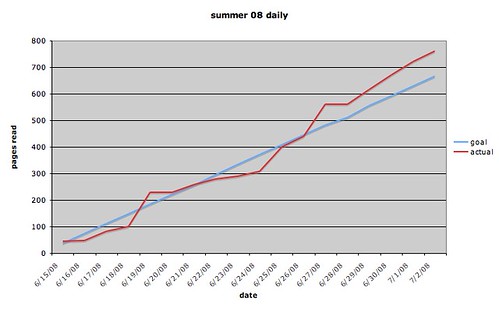
Paul B suggested I make a graph for C's summer reading & I just did -- this is perfect. Highly motivating (to me, at least).
Haven't shown it to C yet as he appears to be avoiding me.
Possibly because we got started on Analyse, Organize, Write and Sentence Combining Workbook yesterday.
4th of July
The NY Times asked Ed to write an op ed piece for the Fourth of July!
The editing was amazing: a variant of this British writing assignment. (Here's dr. pion on precis writing.) The editor cut the original piece in half, losing only one detail everyone was sorry to see go.
I learned something. When I read the editor's version, I was disappointed in the lead paragraph, which was flat. I finished reading the piece & was blown away by the editing, especially seeing as how C. and I didn't get too far in our own efforts to edit an already-tightly written passage last July. So I re-read, thinking maybe I was wrong about the lead. But no. It was flat.
Ed raised the issue with the editor, who told him that a lead paragraph, to be interesting, must have details. When you make cuts as deep as they do for the op ed page, she said, you often end up with flat beginnings -- I assume because the details in most writers' first paragraphs are the least essential to the piece and are thus the ones most likely to be cut, although she didn't say so.
She's absolutely right. Ed fixed the problem by inserting the words "my first since the sixth grade" into the first sentence. That's all it took.
Writing is a mystery.
For me, this lead is boring:
ON a recent visit to the Statue of Liberty, I was struck by how many French people were at the site.
This one works:
ON a recent visit to the Statue of Liberty, my first since the sixth grade, I was struck by how many French people were at the site.
Why should that be?
ON a recent visit to the Statue of Liberty, my first since the sixth grade, I was struck by how many French people were at the site. Why more French than others from abroad? The answer may lie in the statue’s history. After all, it was conceived nearly 150 years ago almost as much for France as for the United States.
The idea for the monument stemmed from a French struggle for freedom that began in 1852, when Louis Napoleon Bonaparte, having overthrown France’s democratic republic, declared himself emperor. In the summer of 1865, after enduring 13 years of Napoleon III’s near-dictatorial rule, Édouard de Laboulaye, a historian, hosted a dinner for a small group of French liberals to celebrate the North’s victory in the American Civil War. To Laboulaye, the restoration of orderly liberty in the United States put his own government to shame.
Over brandy and cigars, he and his guests, who included Frédéric-Auguste Bartholdi, the prominent sculptor, decided to organize a public campaign to commemorate American liberty with a grand gift to the United States. But the gift would double as an implicit critique of Napoleon III.
Bartholdi later envisioned a mammoth statue of the kind of ancient Roman goddess that since 1789 had symbolized liberty and the Republic. The French revolutionary tradition actually produced two goddesses: one sported the “liberty cap” and appeared in ardent motion, her breasts often bared, a fierce expression on her face. Her counterpart stood erect and still, her body modestly draped, her expression calm and serene.
Bartholdi chose the second, unthreatening icon to have his “Liberty Enlightening the World” depict the stability that French liberals saw in the United States and wanted for their own turbulent land.
By the time construction began in the mid-1870s, Napoleon III had been removed from power and his opponents had created a moderate republican regime. France had escaped the twin perils of revolution and reaction that had characterized its political life for nearly a century. Now, Bartholdi’s statue could stand for both the French and the American republics......
A Gift from France, to France
The editing was amazing: a variant of this British writing assignment. (Here's dr. pion on precis writing.) The editor cut the original piece in half, losing only one detail everyone was sorry to see go.
I learned something. When I read the editor's version, I was disappointed in the lead paragraph, which was flat. I finished reading the piece & was blown away by the editing, especially seeing as how C. and I didn't get too far in our own efforts to edit an already-tightly written passage last July. So I re-read, thinking maybe I was wrong about the lead. But no. It was flat.
Ed raised the issue with the editor, who told him that a lead paragraph, to be interesting, must have details. When you make cuts as deep as they do for the op ed page, she said, you often end up with flat beginnings -- I assume because the details in most writers' first paragraphs are the least essential to the piece and are thus the ones most likely to be cut, although she didn't say so.
She's absolutely right. Ed fixed the problem by inserting the words "my first since the sixth grade" into the first sentence. That's all it took.
Writing is a mystery.
For me, this lead is boring:
ON a recent visit to the Statue of Liberty, I was struck by how many French people were at the site.
This one works:
ON a recent visit to the Statue of Liberty, my first since the sixth grade, I was struck by how many French people were at the site.
Why should that be?
Tuesday, July 1, 2008
Somewhat OT: Global Autism Project
Via Larry Welkowitz's Asperger's Conversations, I discovered an organization new to me, the Global Autism Project
I wonder what we can learn from other countries in this regard.
In the United States, a child is diagnosed with autism every 20 minutes. In developing countries, we have no way of knowing the national situations. Dr. Eben Badoe is one of only thirty pediatricians in Ghana, a country of 19.4 million people. He is the only one diagnosing autism. He recently told us, “right now, I diagnose children and then I lose them in a way.”
The Global Autism Project is working hard to change this.
We bring research-proven methodologies of autism intervention to developing countries. A commitment to a balance of scientifically sound interventions and cultural sensitivity is integral to our work.
I wonder what we can learn from other countries in this regard.
say better
The New Yorker profile of Irene Pepperberg is available online!
I know I've mentioned before that I came out of Animals in Translation thinking birds are as smart as we are or smarter.
to do
I need to get hold of the paper on the model/rival technique and autistic kids:
I believe this.
Years ago, on our annual family vacation back to Illinois, we rented a van to drive from Springfield to Chicago. On the road, C. and Andrew (who is autistic) got into a HORRIBLE fight. Now, Andrew is very autistic. He couldn't talk at all at the time, and he probably couldn't understand much, either.
But he had no problem understanding a fight with his brother in the car. We'd separated the two boys, putting Jimmy (big brother - also autistic) with C. in the middle seat and Andrew in the way-back, but they got into it anyway. I no longer remember how it started, though it may have begun with Andrew touching his brother. I do remember, vividly, the fight in full bloom. C. would scream, "I hate Andrew!" and, hearing this, Andrew, who in theory did not understand a word of English or any other language, would shriek with rage, lunge forward, and hit his brother -- hard -- on the back of the head. Then C. would scream in pain and fury and let loose with another "I hate Andrew!", and A. would shriek and hit him again, and so it went.
I'm pretty sure I was in there somewhere, too, shouting "Stop saying that!" at C.
We finally had to pull off the road and take the boys out of the car to separate them. We bought them junk food, put them back in the car, and drove off. They were beaming at their chips and candy, and at each other.
After that I used to say that every single part of an autistic child's brain has been messed up in some fashion except for the part that says "Hit my brother in the car."
So: model/rival. I can see it working with autistic kids.
Especially the rival part.
to track down:
Pepperberg, I.M. and Sherman, D. V. (2000). Proposed use of two-part interactive modeling as a means to increase functional skills in children with a variety of disabilities. Teaching and Learning in Medicine, 12(4), 213-20.
Pepperberg, I.M. and Sherman, D.V. (2002) Use of two-part interactive modeling as a potential means to engender social behavior in children with various disabilities. International Journal of Comparative Psychology, 15, 138-5.
Pepperberg, I.M. and Sherman, D.V. (2004) Use of two-part interactive modeling as a potential means to engender empathy in children within the autistic spectrum. IMFAR conference, Sacramento, CA.
Pepperberg told me that Alex also made spontaneous remarks that were oddly appropriate. Once, when she rushed in the lab door, obviously harried, Alex said, “Calm down”—a phrase she had sometimes used with him. “What’s your problem?” he sometimes demanded of a flustered trainer. When training sessions dragged on, Alex would say, “Wanna go back”—to his cage. More creatively, he’d sometimes announce, “I’m gonna go away now,” and either turn his back to the person working with him or sidle as far away as he could get on his perch. “Say better,” he chided the younger parrots that Pepperberg began training along with him.
I know I've mentioned before that I came out of Animals in Translation thinking birds are as smart as we are or smarter.
to do
I need to get hold of the paper on the model/rival technique and autistic kids:
As it happens, the model/rival method may have some utility for another species: humans. Diane Sherman, who works with autistic children in Monterey, California, has had some preliminary success in encouraging speech in her clients using Pepperberg’s protocol. In an article published in The International Journal of Comparative Psychology, Sherman and Pepperberg say that, in two studies of children in Sherman’s private practice, the model/rival method led to “significant gains” in the children’s “communication and social interaction with peers and adults.” (Behavioral changes were measured by reports from parents and teachers, and included criteria like demonstrations of empathy, improved eye contact, saying hello to people, and speaking in sentences.)
I believe this.
Years ago, on our annual family vacation back to Illinois, we rented a van to drive from Springfield to Chicago. On the road, C. and Andrew (who is autistic) got into a HORRIBLE fight. Now, Andrew is very autistic. He couldn't talk at all at the time, and he probably couldn't understand much, either.
But he had no problem understanding a fight with his brother in the car. We'd separated the two boys, putting Jimmy (big brother - also autistic) with C. in the middle seat and Andrew in the way-back, but they got into it anyway. I no longer remember how it started, though it may have begun with Andrew touching his brother. I do remember, vividly, the fight in full bloom. C. would scream, "I hate Andrew!" and, hearing this, Andrew, who in theory did not understand a word of English or any other language, would shriek with rage, lunge forward, and hit his brother -- hard -- on the back of the head. Then C. would scream in pain and fury and let loose with another "I hate Andrew!", and A. would shriek and hit him again, and so it went.
I'm pretty sure I was in there somewhere, too, shouting "Stop saying that!" at C.
We finally had to pull off the road and take the boys out of the car to separate them. We bought them junk food, put them back in the car, and drove off. They were beaming at their chips and candy, and at each other.
After that I used to say that every single part of an autistic child's brain has been messed up in some fashion except for the part that says "Hit my brother in the car."
So: model/rival. I can see it working with autistic kids.
Especially the rival part.
to track down:
Pepperberg, I.M. and Sherman, D. V. (2000). Proposed use of two-part interactive modeling as a means to increase functional skills in children with a variety of disabilities. Teaching and Learning in Medicine, 12(4), 213-20.
Pepperberg, I.M. and Sherman, D.V. (2002) Use of two-part interactive modeling as a potential means to engender social behavior in children with various disabilities. International Journal of Comparative Psychology, 15, 138-5.
Pepperberg, I.M. and Sherman, D.V. (2004) Use of two-part interactive modeling as a potential means to engender empathy in children within the autistic spectrum. IMFAR conference, Sacramento, CA.
the $100 distraction device
New research by economists Ofer Malamud and Cristian Pop-Eleches provides an answer: For many kids, computers are indeed more of a distraction than a learning opportunity. The two researchers surveyed households that applied to Euro 200, a voucher distribution program in Romania designed to help poor households defray the cost of buying a computer for their children. It turns out that kids in households lucky enough to get computer vouchers spent a lot less time watching TV—but that's where the good news ends. "Vouchered" kids also spent less time doing homework, got lower grades, and reported lower educational aspirations than the "unvouchered" kids.
Why giving poor kids computers doesn't improve scholastic achievement
Every school district in Westchester County now pays an administrator to purchase and "integrate" technology into our kids' schools.
Then, once your district has loaded up on technology, you have to pay someone to "coordinate" the technology. So that's two administrative positions. One person to buy and integrate, one person to coordinate.
Next year the computer science teacher at the high school will no longer teach. He will coordinate.
I wonder how much we're spending on repair and maintenance. Last year I read a Financial Times estimate saying that the price of purchase is 10% of the total cost of IT.
When Ed and I made our whirlwind tour of elite private schools last winter, we found very little technology, although we did see 3 schools where all the kids had laptops and all assignments and course materials were posted online.
The Dalton School, one of the most elite private schools in the country, doesn't have SMART Boards. Their money has gone into photography studios, darkrooms, carpentry shops, dance studios -- amazing.
See also: The Computer Delusion and High-Tech Heretic.
Sunday, June 29, 2008
Liz Ditz on how to organize summer reading assignments
1. Take the total # of pages required to be read by the start of school.
2. Take the total # of days left in summer vacation.
3. Multiply the total # of days by [0.75 for a compliant kid] or [0.50 for a less compliant kid]
4. Divide #1 by #2
5. Make a chart showing desired progress vs. actual progress
6. Require kid to note actual progress
7. Declare "reading catch-up days" when desired vs. actual lags some unit behind.
8. Reward above-average progress
9. In the case of children who are expected to read more than 2 books, reward completion of each book
10. It is very helpful if one or both parents read the books at the same time as the kid, and invest in discussing plot points, character development, response to the books, etc.
11. Novels with difficult textural features (dialect instead of standard spelling, complex narrative structures) may require extra parental input, such as listening to the book in recorded format, story-board mapping, etc.
Great advice.
I was already doing 1, 2, 3, 4, and 10 -- but I completely forgot the importance of 5 & 6.
Charting your own progress is a long-established principle in behaviorism. Years ago, after I'd gained weight from taking a particular medication I read everything I could find on dieting & discovered that the sole approach to dieting that actually worked was: recording everything you ate. I don't think these studies included charting your progress, but there's no question self-charting is important.
C. is ahead of the game thus far. He has 2,525 to read with 10 weeks to accomplish this feat, and he's read 617 pages with 8 weeks left to go. That's good, because he's reading the easy stuff now. Guns, Germs & Steel, The Odyssey, and the Book of Genesis are going to be a lot more difficult.
A friend of Ed's gave us a great idea. She drove to Ithaca from Washington D.C. and listened to Ian McKellan's reading of The Odyssey along the way. We got the CDs & Chris & I will listen to McKellan while reading along in the book. (He couldn't follow McKellan without the text in front of him.)
We also have to finish Megawords 5 (can't believe we got through an entire school year without finishing the book), and get going on Analyze, Organize, Write by Whimbey and Linden -- a fantastic book. (Amazon has used copies on sale for as low as five bucks at the moment.)
I've also told him he has to spend some time doing ALEKS this summer...
That chart thingie is starting to get complicated.
Saturday, June 28, 2008
politically incorrect
from Measuring Up: What Educational Testing Really Tells Us by Daniel Koretz --
Daniel Koretz is Professor of Education at Harvard.
Harvard.
Where 75% of the entering class scores 700 or above on SAT reading, writing, and/or math.
I don't think we'll be seeing GATE programs staging a comeback any time soon.
As one colleague once put it simply, in politically incorrect terms, "Smart kids do well on tests."
p. 126
Daniel Koretz is Professor of Education at Harvard.
Harvard.
Where 75% of the entering class scores 700 or above on SAT reading, writing, and/or math.
I don't think we'll be seeing GATE programs staging a comeback any time soon.
the homework gap
from Measuring Up: What Educational Testing Really Tells Us by Daniel Koretz --
There is a phenomenal amount of tutoring going on in affluent school districts. Phenomenal. One of the tutors working in my town told a friend of mine that she estimates half of the kids in Scarsdale are tutored.
I believe it. When I met with the assistant admissions director at one of the local private schools, she told me she had been a Scarsdale tutor for several years. She along with many others.
I've come to think it was inevitable that matters would develop in this way.
First of all, public schools are built to provide inputs, not outputs: instruction, not achievement.
That may not have been so deadly when schools grouped kids homogeneously. With homogeneous grouping the classroom teacher probably had a decent chance of knowing where the kids were and of being able to teach to their level.
Along comes the de-tracking movement, and now you've got heterogeneously grouped classrooms with kids all over the map in terms of readiness. The inputs model hasn't changed, so teachers are told to teach to the middle, or they're told to differentiate instruction, and when teaching to the middle or differentiating instruction work for some of the kids but not all of the kids, you assume the problem is the kid, not the school. After all, the school's job is to provide opportunities to learn, and as long as you've put PowerPoints on the SMARTBoard, you've done that.
Then add to this set-up school districts in which the vast majority of parents are college-educated and affluent enough to hire tutors, and what do you get?
You get "high-performing" schools where the kids are being retaught by parents and tutored by tutors.
can a parent sue for educational malpractice?
Galen Alessi's "Diagnosis Diagnosed"
...these critics usually miss the flip side of the coin: ignoring noneducational causes of variations in scores--that is, assuming that scores are a direct indication of school quality--lets some high-scoring schools off the hook. Some schools have high test scores because of the students they serve rather than the quality of the education they offer, but those who are convinced that scores most reflect educational quality consider them good schools regardless. My own children attended some of the highest-scoring schools in our state. They did indeed have some truly superb teachers, but they also had some mediocre ones and a few I thought should not have been allowed to teach at all, including one English teacher whose grammatical and vocabulary errors during parents' visiting day were so egregious that they sparked repeated and audible protests from the parents sitting in the back of the room. Test scores were nevertheless always high, a reflection in part of the very high education level in the community, which was full of attorneys, physicians, academics, economists, foreign diplomats, biomedical researchers, and the like...Not only did these parents provide--on average--environments highly conducive to academic achievement, but many also provided supplementary instruction, either by reteaching material themselves or by paying for the services of neighborhood tutoring firms.
A concrete example: when my son was in seventh grade, took a math class that was not well taught. (I went and watched, to confirm my hunch.) One evening he told me that he was confused by his math homework, which was part of an introduction to probability and statistics. I first tried to clarify the homework, but I soon realized that he was missing a few key notions. I asked him for his class materials, looked them over, and retaught him some of the core concepts, and after that he was able to handle the homework. I went back to the kitchen to clean up from dinner, but he soon called me upstairs again. He had just auditioned successfully for the school's jazz band, and he was having trouble counting out rhythms in the piece he was supposed to practice. I counted them out for him, but he still found them confusing (as I had too, many years earlier, when I first tried playing jazz). So I fetched my own horn and played the music at about half tempo while he counted it out. That worked. As I resumed scrubbing pots, my wife turned to me and said, "There you have it: social class differences in educational achievement."
[snip]
Disappointing scores can mask good instruction, and high scores can hide problems that need to be addressed.
p. 119-120
There is a phenomenal amount of tutoring going on in affluent school districts. Phenomenal. One of the tutors working in my town told a friend of mine that she estimates half of the kids in Scarsdale are tutored.
I believe it. When I met with the assistant admissions director at one of the local private schools, she told me she had been a Scarsdale tutor for several years. She along with many others.
I've come to think it was inevitable that matters would develop in this way.
First of all, public schools are built to provide inputs, not outputs: instruction, not achievement.
That may not have been so deadly when schools grouped kids homogeneously. With homogeneous grouping the classroom teacher probably had a decent chance of knowing where the kids were and of being able to teach to their level.
Along comes the de-tracking movement, and now you've got heterogeneously grouped classrooms with kids all over the map in terms of readiness. The inputs model hasn't changed, so teachers are told to teach to the middle, or they're told to differentiate instruction, and when teaching to the middle or differentiating instruction work for some of the kids but not all of the kids, you assume the problem is the kid, not the school. After all, the school's job is to provide opportunities to learn, and as long as you've put PowerPoints on the SMARTBoard, you've done that.
Then add to this set-up school districts in which the vast majority of parents are college-educated and affluent enough to hire tutors, and what do you get?
You get "high-performing" schools where the kids are being retaught by parents and tutored by tutors.
can a parent sue for educational malpractice?
Galen Alessi's "Diagnosis Diagnosed"
Subscribe to:
Posts (Atom)