kitchen table math, the sequel

Saturday, July 10, 2010

projects we have known and loved

The numbers are imprecise, but according to a 1988 report by the National Council of Teachers of English, her novel, "To Kill a Mockingbird," was required reading in three-quarters of America's high schools. Since its publication 50 years ago this summer, it probably ranks just behind "The Adventures of Huckleberry Finn," with American high-school students not only required to read the book but to tackle related projects. These range from drawing the courthouse where Tom Robinson, a black man accused of raping a white woman, was defended by Atticus Finch, to writing articles for the Maycomb Tribune recounting the trial, and recasting the movie with contemporary actors. (In 2006 my daughter, attending a public high school in New Jersey, cast Kevin Kline as Atticus and Abigail Breslin as his young daughter, Scout.)
What 'To Kill a Mockingbird' Isn't
By ALLEN BARRA
JUNE 24, 2010

Thursday, July 8, 2010

score inflation in NY

Over the last few years, student performance has soared on math and English tests across New York State, with the most dramatic improvements evident in urban districts such as Buffalo, leading many to celebrate the progress.

But now, state education officials say the progress may not have been quite what it seemed.

Weaknesses in the state’s testing and scoring systems over the last several years created what Education Commissioner David M. Steiner equates to systemic “grade inflation.”
  • Students who score at the “proficient” level in middle school math, for instance, stand only a 1-in-3 chance of doing well enough in high school to succeed in college math, he said.
  • Students begin getting “inflated” test scores before they hit high school, state officials said. A student who scores a 3 on a state math test — which is considered “proficient” on the scale of 1 to 4 — stands only a 30 percent chance of getting an 80 on the high school Regents math exam, they said.
  • ...a student who scored at the proficient level on a state test in 2006 was in the 45th percentile on the national test, meaning that 55 percent of students in the country scored better. In 2009, the same score on the state test would land a student in the 20th percentile on the national test, meaning that 80 percent of students nationwide scored better.

The state Education Department recently asked a group of experts, led by Harvard University’s Daniel M. Koretz, to determine how closely eighth-grade scores correlate to high school Regents exam scores — and how well those Regents exam scores correlate to success in college.

Flawed tests distort sharp rise in scores by students
By Mary B. Pasciak
Updated: July 06, 2010, 11:42 pm / 19 comments
Published: July 07, 2010, 6:35 am

Monday, July 5, 2010

The Tension...

I've posted something to another blog that I thought might also be appropriate for KTM. This community has always felt very comfortable to me, but also challenges me to think! Posters and commenters have focused on educational issues [SteveH just nailed it!] rather than "politics"...

Anyway, HERE it is!
Have a wonderful day!

ps-Catherine, I'm not sure how to tag it, so please feel free to do so if you wish.

Forget Grade Levels?

I saw this in our paper yesterday.

Forget grade levels

It's interesting to see how ed school thought can be spun any which way.

"The current system of public education in this country is not working" said Superintendent John Covington. "It's an outdated, industrial, agrarian kind of model that lends itself to still allowing students to progress through school based on the amount of time they sit in a chair rather than whether or not they have truly mastered the competencies and skills."


Students progress through school only if they allow them to progress. When I grew up, kids were held back or had to go to summer school. Apparently, since then, they've moved to an "industrial, agrarian kind of model". This is really stupid thinking.

With this new model, are they going to continually keep kids in second grade if they don't pass the proficiency test? Speaking of which, I assume that these are minimal grade level state tests. However, it might force schools to actually try to get kids to pass the exam and not just "trust the spiral". It will force them to deal with the issues sooner rather than just pass the problems along and then blame the kids or parents or poverty.


"This system precludes us from labeling children failures," Covington said. "It's not that you've failed, it's just that at this point you haven't mastered the competencies yet and when you do, you will move to the next level."

What about the 12 year old who still hasn't gotten past the 2nd grade material? What about differentiated learning? That's not a "factory model". However, both models have the same core philosophy. The onus for learning is on the kids and there is no direct teaching. At least the approach descrbed here allows kids to accelerate out. I don't know what they are accelerating to or around, but it at least forces schools to define what is required knowledge and skills for each grade. Unfortunately, we know what those standards are.


"Greg Johnson, director of curriculum and instruction for the Bering Strait School District in Alaska, recalled that before the switch there were students who had been on honor roll throughout high school then failed a test the state requires for graduation."


Incompetence. How is that going to change with the new model? They will show kids the state tests for each grade and leave it up to them to meet the low cutoffs. Then they will have kids who meet the low state graduation requirements when they are 14. What next? They will have kids stuck as sophomores. What next?

Will they have low and high grade level standards, not just pass/fail cutoffs? What will high grades mean for kids? Will they properly map the math required (and test grades) for algebra in 8th grade back to Kindergarten?

At least this model forces schools to deal with these issues. With differentiated instruction, their heads are completely in the sand - or somewhere else.

Saturday, July 3, 2010

full stop

Our school system has solved their efficiency problem by not only slowing gifted students but seemingly requiring them to stop all forward momentum. No acceleration and no 'enrichment' either. If you're done with an assignment alphabetize folders or tutor another student.

-Lisa


Same here. When full inclusion came six years ago, enrichment and in-class ability grouping were totally canceled in the elementary. Nothing above grade level can be offered. The old practice of going to a different class or grade to join an appropriate reading group was ended. If the student is done, s/he can read, draw, or navel gaze.

-lgm

My own district replaced the SRA math series with Math Trailblazers 6 years ago, eliminating achievement grouping as part of the package. Since Trailblazers moves more slowly than SRA, this meant that the advanced students were doubly decelerated. They lost their accelerated curriculum and they were now learning less in the regular curriculum than the non-accelerated kids had learned in the past.

Recently the superintendent told the school board that Trailblazers is built for and depends upon heterogeneous grouping; if you're going to have Trailblazers you can't have grouping and if you're going to have grouping you can't have Trailblazers.

So naturally she's committed to Trailblazers.

Friday, July 2, 2010

testing

ok, I'm writing a blog post about a book sold on Amazon: Driven by Data: A Practical Guide to Improve Instruction by Paul Bambrick-Santoyo.

hmmm

Interesting.

my thoughts exactly


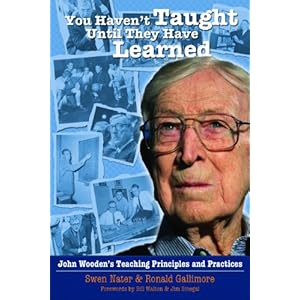
You Haven't Taught Until They Have Learned: John Wooden's Teaching Principles and Practices
by Swen Nater, Ronald Gallimore, Bill Walton (Foreword), Jim Sinegal (Foreword)

basic skills

BEDFORD, Ohio — Factory owners have been adding jobs slowly but steadily since the beginning of the year, giving a lift to the fragile economic recovery. And because they laid off so many workers — more than two million since the end of 2007 — manufacturers now have a vast pool of people to choose from.

Plenty of people are applying for the jobs. The problem, the companies say, is a mismatch between the kind of skilled workers needed and the ranks of the unemployed.

[snip]

Here in this suburb of Cleveland, supervisors at Ben Venue Laboratories, a contract drug maker for pharmaceutical companies, have reviewed 3,600 job applications this year and found only 47 people to hire at $13 to $15 an hour, or about $31,000 a year.

The going rate for entry-level manufacturing workers in the area, according to Cleveland State University, is $10 to $12 an hour, but more skilled workers earn $15 to $20 an hour.

All candidates at Ben Venue must pass a basic skills test showing they can read and understand math at a ninth-grade level. A significant portion of recent applicants failed, and the company has been disappointed by the quality of graduates from local training programs. It is now struggling to fill 100 positions.

Factory Jobs Return, but Employers Find Skills Shortage
By MOTOKO RICH
Published: July 1, 2010

Here's Tyler Cowen:
Currently political debate is focused on the short-run employment issue, but a lot of the problem is probably long-run in nature.

One simple hypothesis is that a lot of workers weren’t producing much value, but firms were willing to carry them in good times. When bad times came, firms cut them loose and also took greater trouble to identify them in the first place.

Stimulus alone won’t give those workers jobs because, as it stands now, their labor simply isn’t worth very much. The longer-term issue is how to improve the American educational system. This includes creating a culture where more parents value education, school choice is more available to bypass dysfunctional local systems, and teachers are more subject to incentives to encourage effectiveness.

President Obama does want to make progress on all those fronts, but it’s not a battle which can be won mainly at the federal level. We need to have a culture which simply does not tolerate bad local school districts. We’re a long way from that, so we need to focus on more than just the short-term alone.

June 24, 2010, 6:20 pm
Can Obama Create More Jobs Soon?
By THE EDITORS


I'd love to see that test.

I wonder if they're using Accuplacer?


The Race Between Education and Technology

momof4

It doesn't say anything good about ed school that only one basic science course is required. BTW, as first-graders in the mid-50s, my class learned parts of plants, plant nutrition, photosynthesis, heliotropism etc. Why am I not surprised that global warming is part of this curriculum? I also agree with the last comment about the inefficiency of this approach, but efficiency seems to be fighting with mastery for last place in the pantheon of ideas that concern the ed system.
I love that: efficiency fighting with mastery for last place.

In my experience it's no contest. Mastery is last and efficiency isn't even in the running.

Public schools are almost anti-efficiency at all levels: in hiring and spending as well as teaching and learning.

That's why public schools are happy to slow the progress of gifted students by substituting enrichment for acceleration.

Thursday, July 1, 2010

edspeak

At other times, the board is moved to the front of the room, and students take turns solving math problems, sorting items into groups and matching words with their meanings.

letter to the editor quoted in:
The Great Whiteboards Debate Rages On
Anthony Reborda
Education Week
In my world, the set consisting of students who spend class time "solving math problems" does not intersect with the set consisting of students whose teachers ask them to "sort items into groups."

Wednesday, June 30, 2010

Google search

how they do it

definition

constructivist classroom: A classroom in which the teacher uses pedagogical methods that are based on the constructivist theory of learning. The constructivist theory holds that the student is the center of learning, and the teacher should act as a facilitator of the student's learning, not as an instructor. The constructivist classroom takes many forms, but at heart it is based on the belief that the student is the one who does the learning and therefore must take responsibility for his or her own learning.
EdSpeak: A Glossary of Education Terms Phrases, Buzzwords, and Jargon
by Diane Ravitch
p. 58


constructivism
Constructivist theory posits that children build new information onto preexisting notions and modify their understanding in light of new data. In the process, their ideas increase in complexity and power. Constructivist theorists dismiss the idea that students learn by absorbing information through lectures or repeated rote practice.
Education Week Guide to K-12 Terminology
p. 23
In the public schools: constructivism.

In the great charter schools: Lemov's Taxonomy.

TERC

Candace Chick is the first to admit that she’s not an expert in science. Far from it, the teacher at the Samuel W. Mason Pilot Elementary School in Roxbury, Mass., only took one basic science class during her undergraduate and graduate studies and, until recently, quaked at the idea of teaching the properties of matter to her fifth-grade students. “I have always been insecure about science,” she says. “It is not one of my strengths.”

But now, she is positively ebullient about the progress both she and her students have made in the subject. Her class has been investigating molecular change, conducting hands-on experiments, and watching computer simulations. The students’ knowledge has grown deeper than simply being able to define terms like “condensation” and “evaporation.” They readily discuss their ideas and frequently engage in polite, intellectual arguments that influence each others’ learning. “Their knowledge isn’t, ‘Oh, there is a puddle on the sidewalk and when the sun comes out it evaporates and goes magically into a cloud and then it comes down again when it rains,’’’ Chick explains. “They understand how those molecules start to move and bounce around like mad as they evaporate. They really understand this in a way that they didn’t before.”

Chick’s class just completed the third year of a research endeavor called The Inquiry Project, a partnership between teachers, TERC, and Tufts University that teaches concepts like weight, volume, and density in grades 3–5 to lay the foundation for later introduction to molecular theory. In third grade, students begin exploring materials and then move on to investigating weight and volume, using density cubes and balance scales, among other tools. They proceed from comparing the “felt weight” of cubes made from different materials to measuring actual weight on a balance scale. They ask questions along the way. Can two objects of the same size weigh different amounts? Does a tiny piece of clay have weight? The students are asked to discuss their findings at every step: the goal of this “productive talk” is to lead to deeper understanding.

Chick worked with an Inquiry Project coach, who not only helped her overcome her inhibitions about science but also encouraged her to lead productive class discussions.

[snip]

The goal is to shift the students’ way of thinking from what Anderson calls “force-dynamic reasoning” to what he terms “scientific discourse.” Force-dynamic reasoning, typical in elementary school, is a way of viewing the world in terms of “actors” with purposes. For instance, the main purpose of a tree (the “actor”) is to grow, and in order to grow, it needs water, air, sunlight, and soil. However, the scientific explanation is that the tree uses the sun as an energy source to convert carbon dioxide and water into glucose, which is the building block of the tree. “The scientific story is one of transformation of matter and energy,” Anderson explains. “If we are interested in preparing kids to think about carbon in our atmosphere and in our various environmental systems and how it effects global warming, we have to make the transition from force-dynamic reasoning to scientific reasoning, where they are thinking about matter and energy.”

The fourth-grade curriculum outlines a pathway toward that transition in thinking. It’s not about memorizing definitions of, say, photosynthesis, but about actually transforming how students think. Students begin by watching time-lapse videos of plants growing. They then grow plants under different conditions—with or without water and light. They measure the results over time and ultimately determine that plants need water, air, and light to grow. They then examine plants on a microscopic level and learn about their cellular makeup, which leads to an exploration of how plants make their own food and where they store it.

Through tending the plants and watching them grow, students can begin to view the plants not as actors, but as part of an ecosystem. Anderson and his colleagues are still generating data on what works, but the goal is for the students to understand basic underlying principles of science, such as conservation of matter and energy. “Facts alone,’’ he says, “are not enough.’’

Learning Progressions in Science
By PATTI HARTIGAN
Harvard Education Letter
Volume 26, Number 4
July/August 2010

I'm wondering what exactly these 4th grade students know about photosynthesis at the end of the school year.

Cheryl on the Khan Academy

I l-o-o-o-v-e Khan Academy. I teach 4th grade, and I have my students use it for differentiated reinforcement of concepts that they need extra help/practice with. We have 1-1 netbooks, so it's easy to do.

Lsquared on math knowledge and teachers

... I believe that studies have shown that math knowledge positively correlates with teaching ability for secondary teachers, but not necessarily for elementary teachers.

On the other hand, as someone who teaches math to future elementary teachers, there are some who I'm convinced will make better teachers of elementary math than others, and often (though not always) they are good at math in general. Of the ones that I privately think to myself--I would be delighted for my child to be in his/her class, maybe 1/3 of them are math minors, as opposed to maybe 1/8 of a typical class being math minors...And there are a few mathematicians (not at the university where I teach now) who I'm not sure should be teaching math to college students, much less elementary students, because they have no talent or interest in figuring out how learners think.
I'm surprised to learn that 1/8 of students taking Lsquared's class are math minors.

Tuesday, June 29, 2010

listmania

Have I mentioned that I collect Listmanias?

Well, I do.

This week's find: best listmania on SAT prep I've seen thus far.

Thanks to Tertullian, I've spent the past two days reading The Talent Code and Arvin Vohra. Arvin Vohra's book is a revelation, especially the part where he advises parents to use Everyday Math after explaining the importance of a coherent, hierarchically organized curriculum and extensive memorization of math facts and formulas from an early age.

Say what?

The Asian Method

Math Mammoth

Crimson Wife recommends the Math Mammoth books.

lgm on where to start in Singapore Math

Start at the beginning. A big key is practicing number bonds until you know them so well that the possibilities just pop up automatically when you see a number. The mental math practice is worthwhile too.

Number2.com

I'm beginning to think there may be something to the disruptive technology argument.

First the Khan Academy ("my goal is to cover everything") and now Number2.com, which C. found while I was in Minneapolis, attending msmi2010.
Number2.com is the only website that offers students access to comprehensive free online test preparation courses for the SAT, ACT, and GRE. How do we do it? Number2.com earns revenue from sponsorships and licensing.

The company was founded by professors and graduate students who wanted to make high quality test preparation universally accessible. In 1999 Eric Loken and Josh Millet were graduate students studying for their PhDs at Harvard University when they began teaching free SAT prep classes in the Boston area. Seeking to expand their services to the Internet, they teamed up with Vincent Crespi, a professor of physics at Pennsylvania State University, who had created a test prep website called Number2.com in 1995. With the help of a great technologist, Filip Radlinski, they launched a new version of the site in September, 2000. Eric and Josh now also run an employee testing company.

Since 2000, over 2 million students have enrolled in Number2.com's online courses, and the web site now receives over 50 million hits per month. In 2002 Number2.com was acquired by Xap Corporation....

about Number2

C. likes it because when he can't solve a problem, Number2 gives him a hint instead of the answer.

In theory, the text prep books could do that, too, but they don't.

Khan Academy

Westchester Laura put me onto the Khan Academy - wow.

Apparently Salman Khan has been working on his been working on his website full-time since September 2009, but I'm just hearing tell.

Here he is on the question of how he knows the Khan Academy is effective:
My background is in math, computer science, and investment management, so I think you can imagine that no one is more obsessed with data and analytics than me. The chart to the right is provided by YouTube. It can be used to determine if and/or when viewers' attention falls off at a certain point of a video. I can then go back and try to identify (and possibly fix) what happened at that point in the video. This next chart shows the average (black line) progress of a cohort of 30 rising 8th graders on the Khan Academy software over a 6-week period. The horizontal axis is "days working on the site" and the vertical axis is "modules completed." The green lines show one standard deviation above and below the mean. This chart exemplifies both the level of data we are capturing and also highlights the importance of individualized, self-paced instruction and real-time assessment. The purple line shows a student who may have been deemed "slow" by traditional assessments because she was more than one standard deviation below the class average after working on the site for a few days. The reality is that she just needed more time ramping up on negative numbers than the other students in the cohort. Once she was given the chance to become proficient on that concept, she raced forward and ended up being one of the top students in the cohort.

More than the data, however, it is the anecdotal evidence from users that has convinced me to quit my job and make this the focus of my life. I receive hundreds of letter and comments a week. Many are simply notes of strong appreciation, but several reach the level of being genuinely inspiring. Here is a letter I received from a YouTube user in September 2009 (I bolded some of the text):

Mr. Khan,

No teacher has ever done me any good--this may sound harsh but I mean it quite literally. I was force fed medication to keep me from talking and chastised for not speaking out when called on. Where I am from blacks are not welcomed with open arms into schools--my mother and her sisters had to go to a small shack two hours from home when they went to school. About five years ago my family collected enough money to move from where i was born, so that I could have a chance at having an education and living a real life. But without a real mastery of elementary math I was slow to progress.

I am now in college and learning more than I ever have in my life. But an inadequate math background has been holding me back. I found the Kahn Academy in June of 2009, right after I completed Math 141 ( a college algebra course). I have spent the entire summer on your youtube page. And I just wanted to thank you for everything you are doing. You are a Godsend. Last week I tested for a math placement exam and I am now in Honors Math 200. No question was answered incorrectly. My placement test holder was so impressed by the breadth of my knowledge of math that he said I should be in Linear algebra.

Mr. Khan, I can say without any doubt that you have changed my life and the lives of everyone in my family.

I wish you and the Khan Academy the best of luck,

How did you get started?

My uncle's family visited me in Boston after my wedding in the summer of 2004. At some point during the trip, my Aunt told me that her daughter (my cousin) was having trouble with "unit conversion" which was not allowing her to be placed in the more advanced math track for 7th grade. Nadia was clearly a very bright girl, so I made a deal with her. I'd remotely tutor her for an hour after work as long as she was willing to do any extra work I gave her.

I began remotely tutoring Nadia in August of 2004. She was in New Orleans--where I also grew up-- so we used a telephone to talk and Yahoo Doodle as a shared notepad. Nadia ended up catching up and getting ahead of her class so I started tutoring her brothers, Arman and Ali, as well. Eventually, word got around and I was remotely tutoring and handful of cousins and family friends. Scheduling around my work, their soccer practice, and the different time zones became a little ridiculous, so I started to make YouTube videos for them to watch in their own time, at their own pace.

It didn't take long to see that other students (including adult learners) were hungry for videos like these so I kept going!

Even before I made the videos, I started writing simple Javascript problem generators so that my cousins would never run out of practice problems. I wanted to know when and how they were doing the problems, so I added a database to track usage. 70 modules and 10,000 lines of code later (much of which has made the software adaptive) , it has morphed into the adaptive math program on our site.

How did you have the time to do this while working full-time?

My wife was doing her residency--in internal medicine-- from 2005 to 2008, so there were many nights/weekends where she was working and I would have felt guilty doing anything less productive. I also try to watch very little television. On top of that, I was working at an investment fund that had me working 5am to 2pm (we were working East Coat hours from California) so my afternoons were free (although I did go to bed at 9).

How are you funding/making money off of this?

I quit my day job as of September 2009 to work on this full-time and was digging into my savings until recently. In May, some generous individuals have given large enough gifts for me to take a salary for the time being. I could be aggressive with advertising on the site, but I don't want to do that until I have to. I am speaking to some foundations that might enable Khan Academy to get to the next level. If you know of potential partner foundations who would agree that there is no better way to educate and enlighten the world, they shouldn't hesitate to email me (sal 'at' khanacademy 'dot' org) :)

Khan Academy is a IRS-recognized 501c3 not-for-profit organization. My goal is to make it self-sustaining in the next five years.

Are you interested in turning this into a business? Maybe with some VC funding?

I've been approached several times, but it just didn't feel right. When I'm 80, I want to feel that I helped give access to a world-class education to billions of students around the world. Sounds a lot better than starting a business that educates some subset of the developed world that can pay $19.95/month and eventually selling it to some text book company or something. I already have a beautiful wife, a hilarious son, two hondas and a decent house. What else does a man need?

With that said, if you are a social venture capitalist and are looking to deploy capital with the highest possible social return per dollar invested, we should talk. I think you'll find that there is no more measurable, scalable and high impact way to educate the world.

Did you do all of the videos?

As of today (6/10/2010), yes. All 1400+ videos have been made by me. Volunteers have begun to translate the videos into other languages. Here is the Khan Academy en espanol. Hope to have other channels in the not-too-far-off future!

What topics do you plan to cover?

My goal is to cover everything. Yes, everything! Most of k-12 math has already been done (although I do need to make 20 or 30 more elementary math videos). My goal really is to keep making videos until the day I die (which will hopefully not be for at least another 50 or 60 years). Should give me time to make several tens of thousands of videos in pretty much every subject.

What is the long-term goal for the Khan Academy?

I see Khan Academy becoming the world's first free, world-class virtual school where anyone can learn anything--for free.

The videos are just part of the vision. We hope to build out the adaptive software to cover all the topics that the videos cover. We also intend to develop simulation games to give more nuanced and applied understanding of concepts.

SAT prep, too
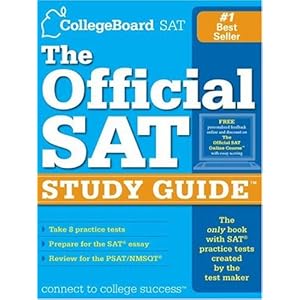
We have done all 8 math practice tests (432 problems) in "The Official SAT Study Guide" by the College Board (which you should buy) in the 100+ videos below.

We recommend that you buy the book and take at least one practice test (3 math sections) per week during each of the 8 weeks prior to the exam. In the earlier weeks, you should focus on comprehending and working on every problem. In the second four weeks, you should focus on speed and eliminating careless mistakes (although you should still try to do any problems that you didn't get to). After grading each of your exams, watch the corresponding video below.

If you have the self-discipline to take the practice tests, review your problems and watch the videos, we think you will be as prepared as anyone. You should view these videos as your on-demand personal tutor.

If you need to review (or learn) underlying mathematical concepts covered on the SAT, we have over 800 videos on general math topics in our video library.

SAT Preparation

I just watched the solution to question 17 on page 412 and had a major duh moment.

Which is exactly what I should be having -- but am not having with the SAT prep books, which frequently make simple problems seem more complex, at least to me.