kitchen table math, the sequel: excellence
Showing posts with label excellence. Show all posts

Friday, September 4, 2009

Can we clone her?

Excerpts from an article entitled "Head of the Class" by long-time science teacher, principal and college professor Louse Butler, author of Beating the Bell Curve, in the August 2009 Mensa Bulletin (emphasis--and any typos--mine):

On entering education:
The politics of education was a disappointment and a shock to me. Our boards of education are purely political entities, state boards of education even more so. The two largest teachers groups, the National Education Association and the American Federation of Teachers, are nothing but political organizations. Throw in the colleges of education [which] are populated by frighteningly political professors, and you have lots of people in power with plenty of axes to grind, many of which bear only tangentially on education. Our schools should be places where barriers are removed and doors of opportunity are opened through the common denominator of knowledge, but they should never be tools of social engineering.

On science education in the US:
There are too many people in education who think that science and math are elite subjects. They think they are too difficult for the average student and therefore are not to be emphasized in curriculum or in practice. These people are wrong. Science and math not only provide essential information, but they give us a logical and critical way of thinking. Science is a process of thought as much as it is a body of knowledge Science and math should be part of all instruction, enhance all instruction, and clarify all instruction. Sadly, the same people who want to reserve science for the few are the same people who don't want us to teach phonetic reading, civics, or geography.

Right. Science and math, as disciplines and over time, promote the development of critical thinking. Critical thinking cannot be taught in a vacuum.

And essential information to boot!

Where would she like science curriculum to go?
I can tell you where [it] shouldn't go. The consolidation of science curriculum into general science instead of its component disciplines is nothing more than a dilution of scientific knowledge to accommodate the shortage of qualified science teachers. We saw the same think happen when "social studies" was substituted for the real disciplines of history, geography, civics, and economics [ed: right, Catherine?]. And look what a mess that has turned out to be!

On the state of education in the US in general:
The drop out rate of first-year teachers is ridiculously high. The children don't seem to want to learn, and their behavior runs from difficult to outrageous. Our schools have, frankly, fed their students a load of manure. At the very least, the first-year teacher feels that their training doesn't reflect the real world. They become disillusioned, frustrated, and angry with themselves and the system and they quit. It is a terrible waste of time and talent. Show me a teacher who went into education just because they love children, and I'll show you a person who will be found bound, gagged, and abandoned in her closet by a group of third graders some time in mid-September. What you have to love is knowledge.

Bingo.
I see school systems that seem to have decided their first and only function is educating their students in a rigorous and challenging curriculum, and those systems are beacons of light in a dark night. It is interesting that these positive changes seem to be all in small and isolated spots. There aren't any "big course" corrections coming out of our colleges of education.

On why education in the US has slipped:
Part of the problem is teacher preparation. Another problem is our decision to excuse poor performance instead of correcting it. Starting in the 1970s, there was a "feel good" movement that pushed for a mea culpa for the world's ills by giving students a pass on anything that might make them feel challenged. What we got was a generation that was very comfortable with failure. We are having a hard time recovering from that, because the students who grew up with that are now teaching the next generation of teachers.

That's the most concise synopsis of the main problem I've ever seen.

On what the next generation of children can expect:
If we are going to compete with students in the emerging nations, especially in Asia, we are going to have to stop using schools for social experimentation and return to using them for education. We are going to have to accept that students must be reading fluently by third grade. They must be ready for algebra in eighth grade.

On how to reach students in mixed ability classrooms:
Many theorists in the educational community will be shocked to hear me say that I reached all of my students by teaching to the top of the class. You put in plenty of safety nets to catch the students who need extra help, but the forward direction of the class should always be the top. By doing that, you make sure you reach the students who will return the biggest bang for the buck, and you make success the standard. The key is to assume that most of your students can achieve the same standard. You help everyone, but hold no one back. . . Not that my class was a democracy. I was in charge, and any one who doesn't think that children need a leader hasn't tried to organize so much as a rock fight.

Wow. If we had 100,000 Louise Butlers, just imagine where US education would be!

Thursday, June 19, 2008

stagnation at the top

Fordham's report on "High-Achieving Students in the Era of NCLB" is out. I've read only 10 pages or so, but it's tremendously interesting: interesting and suggestive. (report here - pdf file)

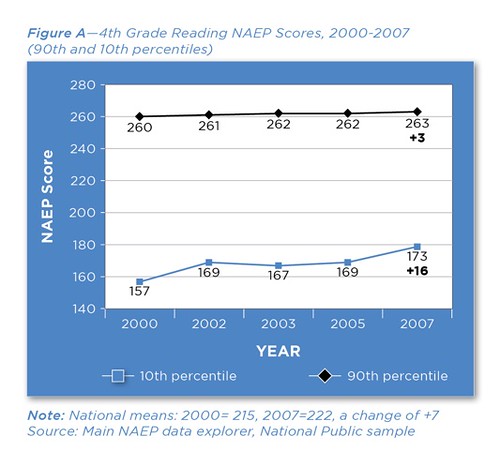
The report doesn't establish causality (and doesn't claim to), but the authors clearly think that NCLB and the standards movement in general is working: working in the sense that the bottom 10% on NAEP are steadily improving their achievement:


This is the first time I've seen the idea that NCLB is working supported by data.

It's also the first time I've heard that it's the bottom scorers, not the "bubble children" who are benefiting from NCLB.

A couple of things for now.

The report doesn't seem to mention the 1995 recentering of SAT scores or the fact that the decline in SAT scores was concentrated at the top. The report practically invites readers to shrug off the "needs" of the top 10% -- if they're already on top, how can they go higher?

Beyond this, I'm somewhat disturbed by the universal acceptance of the idea that "excellence" and "equity" are two separate things. Apparently the policy world is prepared to recognize only two conceivable positions:

  • you can have equity or you can have excellence, but you can't have "both"
  • you can have equity and you can have excellence; you can have "both"

The possibility that equity and excellence are flip sides of a coin isn't on the menu.

What I've seen, time and again, that if a school isn't doing a good job teaching the bottom 10%, it isn't doing a good job teaching the top 10%, either. It may look like it's doing a good job. But once you factor out the parent reteaching & the tutors, you see that ineffective teaching is ineffective teaching. Period.

I had started to wonder about this in terms of athletic programs. Often people think of athletics and academics as either/or -- and when you're talking about athletics and academics at the highest level of individual achievement, of course they are either/or.

But when you're looking at a school, what goes with what?

Good academics with poor athletics?

Good athletics with poor academics?

I'm coming to the conclusion that's not the case.

No time to give my various "data points" at the moment, so I'll content myself with just one.

Two weeks ago I attended the Sports Orientation Night at C's new school. The place was mobbed. The principal spoke first. Toward the end of this talk he said that 10 or 12 years ago, the school had decided to raise its admission standards. The one thing he regretted at the time, he told his wife, was that the school had always been known for its strong athletic programs. Once they started admitting more academically oriented kids with higher scores, their win-loss records would suffer.

But that's not what happened. Instead, the wins show up; in one year alone the school won 3 more citywide championships than they had in the preceding 7 years. The principal and the athletic director both said they still don't understand why that happened.

To me, it made sense. I'd been noticing that great high schools, academically speaking, tend to have great teams.

A school that's on the march is on the march. They're not on the march here, but phoning it in there. When you're on a mission, you're on a mission.

I understand that trade-offs exist, opportunity costs are real, etc. But I don't think "trade-offs" and "opportunity costs" capture the way a high-performing organization functions.

In fact, I'm sure of it.

Back later.

stagnation at the top

Fordham's report on "High-Achieving Students in the Era of NCLB" is out. I've read only 10 pages or so, but it's tremendously interesting: interesting and suggestive. (report here - pdf file)

The report doesn't establish causality (and doesn't claim to), but the authors clearly think that NCLB and the standards movement in general is working: working in the sense that the bottom 10% on NAEP are steadily improving their achievement:


This is the first time I've seen the idea that NCLB is working supported by data.

It's also the first time I've heard that it's the bottom scorers, not the "bubble children" who are benefiting from NCLB.

A couple of things for now.

The report doesn't seem to mention the 1995 recentering of SAT scores or the fact that the decline in SAT scores was concentrated at the top. The report practically invites readers to shrug off the "needs" of the top 10% -- if they're already on top, how can they go higher?

Beyond this, I'm somewhat disturbed by the universal acceptance of the idea that "excellence" and "equity" are two separate things. Apparently the policy world is prepared to recognize only two conceivable positions:

  • you can have equity or you can have excellence, but you can't have "both"
  • you can have equity and you can have excellence; you can have "both"

The possibility that equity and excellence are flip sides of a coin isn't on the menu.

What I've seen, time and again, that if a school isn't doing a good job teaching the bottom 10%, it isn't doing a good job teaching the top 10%, either. It may look like it's doing a good job. But once you factor out the parent reteaching & the tutors, you see that ineffective teaching is ineffective teaching. Period.

I had started to wonder about this in terms of athletic programs. Often people think of athletics and academics as either/or -- and when you're talking about athletics and academics at the highest level of individual achievement, of course they are either/or.

But when you're looking at a school, what goes with what?

Good academics with poor athletics?

Good athletics with poor academics?

I'm coming to the conclusion that's not the case.

No time to give my various "data points" at the moment, so I'll content myself with just one.

Two weeks ago I attended the Sports Orientation Night at C's new school. The place was mobbed. The principal spoke first. Toward the end of this talk he said that 10 or 12 years ago, the school had decided to raise its admission standards. The one thing he regretted at the time, he told his wife, was that the school had always been known for its strong athletic programs. Once they started admitting more academically oriented kids with higher scores, their win-loss records would suffer.

But that's not what happened. Instead, the wins show up; in one year alone the school won 3 more citywide championships than they had in the preceding 7 years. The principal and the athletic director both said they still don't understand why that happened.

To me, it made sense. I'd been noticing that great high schools, academically speaking, tend to have great teams.

A school that's on the march is on the march. They're not on the march here, but phoning it in there. When you're on a mission, you're on a mission.

I understand that trade-offs exist, opportunity costs are real, etc. But I don't think "trade-offs" and "opportunity costs" capture the way a high-performing organization functions.

In fact, I'm sure of it.

Back later.