kitchen table math, the sequel: dyslexia
Showing posts with label dyslexia. Show all posts

Tuesday, January 21, 2014

"Sluggish attentional shifting" in dyslexia

Have just come across this paper in my travels today:
Apart from their reading difficulties, dyslexic subjects often suffer from a variety of subtle sensory and motor deficits.Whether these deficits have a causal relationship to the reading disorder, form additional risk factors, or are totally independent of the reading problem, is under vivid debate. In this article, we review the evidence and suggest that ‘sluggish attentional shifting’ (SAS) can account for the impaired processing of rapid stimulus sequences in dyslexia. Within this novel framework attention-related prolongation of input chunks is decisive for many small deficits found in dyslexic subjects.

Impaired processing of rapid stimulus sequences in dyslexia
Riitta Hari and Hanna Renvall
TRENDS in Cognitive Sciences Vol.5 No.12 December 2001
For years now I've been hoping to find time to dig into the literature on dyslexia.

One of these days.

Hari & Renvall open with an arresting observation by Scott Adams:
‘It might seem impossible for you to convey that time doesn’t always march in one direction, bringing with it a perfectly ordered sequence of causes and effects, but it is not hard for me to imagine it, because I’m dyslexic. When I hear a phone number spoken quickly, I hear all the numbers but don’t have any impression in what order they were spoken. It’s as if they came in all at once.’
Scott Adams in The Dilbert Future (2000), Boxtree, p. 233.
The authors remark that:
This description from the famous cartoonist fits nicely with findings on dyslexic adults who seem to have a prolonged ‘cognitive window’ (or ‘time or input chunk’1) within which the temporal order of successive items is easily confused 2–4.

Wednesday, June 20, 2012

IQ & dyslexia

ABSTRACT:
The Brain Basis of the Phonological Deficit in Dyslexia Is Independent of IQ

Although the role of IQ in developmental dyslexia remains ambiguous, the dominant clinical and research approaches rely on a definition of dyslexia that requires reading skill to be significantly below the level expected given an individual's IQ. In the study reported here, we used functional MRI (fMRI) to examine whether differences in brain activation during phonological processing that are characteristic of dyslexia were similar or dissimilar in children with poor reading ability who had high IQ scores (discrepant readers) and in children with poor reading ability who had low IQ scores (nondiscrepant readers). In two independent samples including a total of 131 children, using univariate and multivariate pattern analyses, we found that discrepant and nondiscrepant poor readers exhibited similar patterns of reduced activation in brain areas such as left parietotemporal and occipitotemporal regions. These results converge with behavioral evidence indicating that, regardless of IQ, poor readers have similar kinds of reading difficulties in relation to phonological processing.

The Brain Basis of the Phonological Deficit in Dyslexia Is Independent of IQ
Hiroko Tanaka, Jessica M. Black, Charles Hulme, Leanne M. Stanley, Shelli R. Kesler, Susan Whitfield-Gabrieli, Allan L. Reiss, John D. E. Gabriell and Fumiko Hoeft
Psychological Science
Vol. 22, No. 11 (NOVEMBER 2011) (pp. 1442-1451)
Page Count: 10

Saturday, August 28, 2010

reading on iPhones and Kindles

Speaking of dyslexia and visual deficits, I never got around to posting this link:

My iPhone has revolusionised my reading

A friend of mine tells me that her child, who has dyslexia, reads much more easily on the Kindle.

dyslexia is visual not phonological - ?

A few years ago, when I asked Daniel Willingham what journal I should read on the subject of cognitive science, he recommended Trends in Cognitive Sciences.

Yesterday, as I was trawling the journal for articles on habit learning, I came across an article from January 2010:  Dyslexia: a deficit in visuo-spatial attention, not in phonological processing by Trichur R. Vidyasagar and Kristen Pammer.
Developmental dyslexia, a specific difficulty in reading despite adequate learning opportunities, affects from 5 to 10 per cent of the population [1], but there are many manifestations of reading failure (Box 1). The etiology of dyslexia itself has been hotly debated for a long time. Theories have ranged from the reading disorder being a high-level learning disability, to a visual perceptual defect. Although it is generally recognized that a majority of poor readers have severe problems in phonological awareness [2,3], it is still an open issue whether the causal deficit in dyslexia is necessarily phonological. The debate is particularly timely in light of recent reevaluations – especially in the USA, Australia and UK – of how children learn to read.

In this paper, we present evidence for an alternative possibility, namely that a fundamental defect in the visual pathways, with or without a corresponding defect in the auditory system, can potentially cause a cascade of effects that can ultimately manifest as a reading problem, including phonological impairments. Understanding the mechanisms underlying dyslexia allows better informed policy making with regard to teaching and remedial intervention.

[snip]

Pre-reading phonological skills predict later reading failure, and phonological interventions have been demonstrated to be successful [2]. However, there are a number of reasons why poor phonological coding might not be the whole story, or even be an etiological factor in dyslexia. Some cases of dyslexia are clearly not phonological, for example where the reading errors are for irregular words, not non-words, and impairments in reading non-words are not always matched by deficits in phonological awareness [4,5]. There are reports of children [5,6] and adults with brain damage [7,8], who have difficulties in non-word reading but nevertheless exhibit good phonological awareness. Such evidence should, at the very least, lead us to question the causal link between a phonological deficit and dyslexia.

[snip]

Misordering of letters and reversal of letters in a word are common complaints from dyslexic readers, and sensitivity to spatial sequencing of the constituent components of text-like object arrays predicts reading in adults [12] and children [13]. Such difficulties in ascertaining the sequence of letters in words cannot be easily explained by phonological deficits. Studies of neurophysiological bases of pattern and object recognition indicate that such sequencing of letters is a non-trivial problem for the brain.

Trends in Cognitive Sciences Vol.14 No.2


reading on iPhones and Kindles

Saturday, April 10, 2010

iPhones for dyslexia?

in the Guardian:
I was hopeless at school, messy and terrible at spelling. And although the term dyslexia was not something I came across until much later in life, when I did I understood immediately that I had a number of its symptoms. My writing often had a jumbled logic. The advent of computers, of course, brought spell-checkers, but even so my word blindness can carry such conviction that I sometimes find myself staring incredulously at the red line underneath words, before finally realising that "during" does not begin with a "J".

[snip]

Recently, at the age of 57, I got an iPhone. Like many, I spent the first few hours loading up apps, including a Classics book app. Some weeks later, while mending a client's computer, waiting for the blue line to progress slowly across the screen, I began reading. The first thing I noticed was that, while familiar with many of the books on the app, having seen a film version or been read them as a child, I had not myself read a single one. Books which would have been part of many a youthful literary diet had passed me by. Alice in Wonderland, Treasure Island, Tom Sawyer – I hadn't read any of them (but I have now).

The first title I selected was The Count of Monte Cristo. I raced through this on my iPhone in just over a week, my wife asking why I was continually playing with my iPhone. When I'd finished I enjoyed the story so much that I went to buy a copy for a friend. In the bookshop I was amazed. It was more than 1,000 pages! Had I been presented with the book in this form I would never have read it. It would have been too much like climbing a mountain.

So why I had found it easier to read from my iPhone? First, an ordinary page of text is split into about four pages. The spacing seems generous and because of this I don't get lost on the page. Second, the handset's brightness makes it easier to take in words. "Many dyslexics have problems with 'crowding', where they're distracted by the words surrounding the word they're trying to read," says John Stein, Professor of Neuroscience at Oxford University and chair of the Dyslexia Research Trust. "When reading text on a small phone, you're reducing the crowding effect."

I was so impressed that I contacted the Dyslexia Society, where Sue Flohr, herself dyslexic, recounted how her iPhone had changed her life.

My iPhone has revolutionised my reading
by Howard Hill
Guardian April 6, 2010

Wednesday, March 24, 2010

Please Take This Dyslexia Survey

(cross posted at I Speak of Dreams)

The UK site Dyslexic Brian have written a survey and would like to have responses from all over the English-speaking world.

The survey is up at SurveyMonkey and consists of ten questions. The survey should take less than 5 minutes to complete.

Click here:http://www.surveymonkey.com/s/TMJT27Z

to be taken to the survey.

Thanks!

note: I agreed to help publicize the survey but I am not responsible for the questions. It's part of a social-media experiment.

Tuesday, July 21, 2009

with good instruction & curricula, how many kids still have reading problems?

from palisadesk:

Well, I don't know but I'll chime in with some citations anyway. My guess is that the rate of incidence is dependent on a number of other variables. Thus, you would expect to see a higher incidence in some populations than others.

The evidence is mixed on this topic. Frank Vellutino is one of the major contributors to this line of research. Studies in several US states done by Vellutino (Albany, NY), Torgesen (Fla), someone in Texas -- I forget who-- and elsewhere came up with fairly consistent findings that explicit instruction in reading, including code knowledge, blending and advanced phonics skills reduced the number of students with decoding disabilities to under 10%. (The range was 3%-10%).

Vellutino's studies, and some others, did not include children with IQ's below 90. Decoding difficulties, per se, are not correlated with IQ.

Different programs were used, as well as ad-hoc instruction that drew on various sources and materials but was focused and explicit. No particular program or approach clearly surpassed others -- some were more suited to 1:1 instruction, others to group instruction.

Gough and others published a large-scale study that showed more than 95% of children in first and second grades could be taught effectively enough to score above the 25th percentile, which is considered in the average range.

One problem with all these studies, however, is that they lack longitudinal data. Children who successfully master basic decoding skills and are reading well in first and second grade may fall behind later for a variety of reasons (no single cause). Some continue to struggle with decoding skills at higher levels, others with syntax, language comprehension (including, but not limited to, vocabulary), fluency, auditory and working memory, and more. While poor readers in second grade rarely end up as outstanding readers in fifth grade, the opposite can happen: the good reader in second grade can be a failing reader in fifth and beyond.

Some of Vellutino's articles:

Vellutino, F. R., Scanlon, D. M., Sipay, E.R., et al. (1996). "Cognitive profiles of difficult-to-remediate and readily remediated poor readers: Early intervention as a vehicle for distinguishing between cognitive and experimental deficits as basic causes of specific reading disability." Journal of Educational Psychology 88(4): 601-638.

Vellutino, F. R., Scanlon, D. M., Snowling, M. J., & Fletcher, J. M. (2004). "Specific reading disability (dyslexia): What have we learned in the past four decades?" Journal of Child Psychology Psychiatry 45(1): 2-40.

Scanlon, D. M., & Vellutino, F. R. (1997). A comparison of the instructional backgrounds and cognitive profiles of poor, average, and good readers who were initially identified as at risk for reading failure. Scientific Studies of Reading, 1, 191- 215.

Vellutino, F. R., Scanlon, D. M., and Tanzman, M. S. (1994). Components of reading ability: Issues and problems in operationalizing word identification, phonological coding, and orthographic coding. In G. R. Lyon (Ed.), Frames of reference for the assessment of learning disabilities: New views on measurement issues (pp. 279-329).

Other sources make the point that low-achievers (who may find reading difficult for varying reasons) need much more instructional time -- at least twice as much, sometimes 3 times as much, and in a more intensive, fast-paced, interactive milieu. This is rarely provided and probably not even possible in most public school settings. The only longitudinal accounts of such success are from the UK, and the details of what was done and when and how in both the Clackmannanshire and W. Dunbartonshire studies are sketchy.

Nothing similar has taken place on this side of the Atlantic; the best overall results have been from DI schools, but even there, population mobility, staff turnover and limitations on instructional time lower the ceiling for student achievement.


Accelerating Reading Attainment: The Effectiveness of Synthetic Phonics by Joyce E. Watson and Rhona S. Johnston (pdf file)
One Man's Quest to Eliminate Illiteracy
West Dunbartonshire's Literacy Scheme

Monday, March 16, 2009

welcome Susan!

Susan Godsland is a new member of kitchen table math. I had discovered her terrific web site -- dyslexics.org.uk -- two months ago and now here she is!

Sunday, November 16, 2008

Not a Book Club, But an Article Club? Shall we All Read and Discuss?

One of the good parts of graduate work is group discussions of scholarly articles.

Anyone interested in reading and discussing this article? (I haven't read the whole article yet -- just the abstract). I think I can get a PDF of the whole article, which I'd share with anyone interested in participating. The discussion would be in the form of comments on a blog post.

If this idea appeals, it can be a regular feature here.


Annu Rev Psychol. 2008;59:451-75.

The education of dyslexic children from childhood to young adulthood.
Shaywitz SE, Morris R, Shaywitz BA.

Department of Pediatrics, Yale University School of Medicine, New Haven, Connecticut 06510, USA. sally.shaywitz@yale.edu


Abstract

The past two decades have witnessed an explosion in our understanding of dyslexia (or specific reading disability), the most common and most carefully studied of the learning disabilities. We first review the core concepts of dyslexia: its definition, prevalence, and developmental course. Next we examine the cognitive model of dyslexia, especially the phonological theory, and review empiric data suggesting genetic and neurobiological influences on the development of dyslexia. With the scientific underpinnings of dyslexia serving as a foundation, we turn our attention to evidence-based approaches to diagnosis and treatment, including interventions and accommodations. Teaching reading represents a major focus. We first review those reading interventions effective in early grades, and then review interventions for older students. To date the preponderance of intervention studies have focused on word-level reading; newer studies are beginning to examine reading interventions that have gone beyond word reading to affect reading fluency and reading comprehension. The article concludes with a discussion of the critical role of accommodations for dyslexic students and the recent neurobiological evidence supporting the need for such accommodations.


PMID: 18154503 [PubMed - indexed for MEDLINE]

====

Sunday, November 9, 2008

Why McGuinness is Mistaken: Some Reading Problems ARE Biologically Based

In the post called "Why English-Speaking Children Can't Read", CJ quotes Dianne McGuinness, who baldly asserts that there is no biological basis to reading difficulties--it's all bad teaching.

While I respect and admire Professor McGuinness's contribution to education and her approach to the teaching of reading, her assertion is not supported by findings from cognitive neuroscience, particularly findings from functional magnetic resonance imaging (fMRI) studies comparing cognitive patterns of good readers and poor readers.

Further, reading and writing are complex, subtle biological activities -- crudely put, the eye must see, the brain must make sense of the visual stimuli; the brain must order the hand to perform a precise series of actions. A sophisticated and nuanced understanding of the neurocognitive nature of the processes, when they perform well, will bring us to understand where the breakdowns occur and how to remediate them.

I believe that Professor McGuinness's assertion is made without a full understanding of what fMRI studies have revealed abou the structure of the reading brain.

The researcher who has done the most to make the cognitive neuroscience accessible to lay readers is Marianne Wolf. I will quote from several sources to illustrate her findings:

From a Tufts University interview with Wolf:
According to Wolf, the brain never evolved to read. Rather, reading reveals how the brain "rearranges older structures devoted to linguistic, perceptual and cognitive regions to make something new." Children with dyslexia have a range of difficulties that prevent this.
Children of the Code interview with Maryanne Wolf --

Dr. Maryanne Wolf: The history of reading disabilities, (I'll use the word dyslexia - some people use it, some people don't), is such a fascinating one because it's like a case study in science patterns, the desire for parsimony among scientists and the refusal of the human brain to be typed in one way. What you see in this history is one researcher after another seizing on what is in front of them and saying, "Ah, that's what dyslexia is. That's what causes it." And it's really the most over-worked and even platitudinous analogy in the world. But the blind men and the elephant describe the history of dyslexia research.

David Boulton: And the Sufi key Story.

Dr. Maryanne Wolf: Exactly. If you look and put together even only the names of dyslexia, you'll see one hypothesis is visual, one is memory, one is verbal, one is auditory. You just go down the list. Well, if you put them all together, or if, as I'm doing this in a book now [Proust and the Squid], I just put those names on the brain and you see a crude cartography of reading. In other words, if it can go wrong it does. And at one point in the history of dyslexia each has been called the major explanation for dyslexia. Now, the modern history has been punctuated by really different, very technologically sophisticated approaches including neurosciences and also including a lot of wonderful work done in an area called psycholinguistics.

In the 1970’s there was a great set of researchers at Haskins Lab at Yale and they were really beginning a whole new approach to understanding dyslexia by looking at the linguistic foundations of reading breakdown. That began one of the single best hypotheses we've ever had which is that the phonological system in language, that is, our ability to hear, to discriminate the smallest sounds called phonemes in words is a fundamental necessity in learning to read and a fundamental source of why some children can't learn to read. That began what is called the phonological deficit hypothesis, which has really been the most successful of explanations to date.

Rapid Naming, Phonemic Awareness and Speed of Processing:

Dr. Maryanne Wolf: My research began while that hypothesis was in its zenith. At the same time I was equally influenced by neurosciences, which was then called neurological or neuropsychological studies. We were beginning to see that there was this one very odd phenomenon that children who were going to become dyslexic were always exhibiting, whether they were five or six or seven, and that was a failure to be able to name, it’s so simple, to name things they saw at the same speed that other children could.

Well, naming seems very simple but it's actually a very difficult set of underlying processes
. So, my mentor, Martha Denckla and her mentor, a neurologist, Norman Geschwind, were responsible for really getting the field to think differently, if you will. In the beginning, people said, "Well, naming speed is just another kind of phonology. You need to be able to retrieve a phonological label." And, for a while that satisfied me. Then, I began to see kids who had no phoneme issues in other areas and yet they had this....

David Boulton: You mean in terms of their ability to articulate themselves on the fly they would demonstrate that they had good phoneme processing but they couldn't name, which has an association component?

Dr. Maryanne Wolf: Well, that's really close. I'll just give you a slightly more technical explanation by saying that when we did all our tests we had explicit measures of these phoneme awareness skills that everybody says were the most important ones and we were seeing that some kids didn't have that but they had naming speed issues. Well, if they're both the same, they should have both. And they weren't exhibiting that and that began us thinking that there are so many issues beyond the phoneme, which includes the visual system and the retrieval system. It includes the speed with which the brain puts its systems together.

That was what we got fixated on. That's not the same as phoneme awareness. So, we then began to really get in-depth understandings of naming speed and the speed with which not only that you name but the speed with which you read and how that fluency in reading is really important not for speed as speed, but for the brain's ability to do those easy processes fast enough to allocate time to comprehension.

David Boulton: Right. So, those lower levels are operating efficiently and there's sufficient bandwidth to be reflective and comprehensive.

Dr. Maryanne Wolf: Perfect. That's what we were beginning to understand. So, this tiny little innocuous naming speed test opened up a world of understanding about how important all of these individual processes are that go beyond the phoneme and how important reading fluency is for comprehension. So, that puts you into, literally, a different ball park from the implication of the phonological deficit, which is that you work on words and phonemes and you get the kids to be able to recognize words and read, decode them and everything else is going to happen naturally. Well, it isn't that simple.

Double-Deficit Hypothesis and Interventions:

Dr. Maryanne Wolf: My colleague, Pat Bowers, and I, and others, (we weren't the only two), advanced our hypothesis in the early nineties. Back then we were kind of John the Baptist-types. It was a little hard going there for a while. Then people started thinking, we know they're right. We still believe it's phonology but there is no doubt that there are these kids. Here is where what we call the double-deficit hypothesis comes in: there are these kids who have single deficits in phoneme awareness, single deficits in naming speed without phoneme, and then double-deficit kids who have both. The kids who have both reading fluency and comprehension issues have different reasons for reading failure than the kids who have only phoneme awareness issues.

David Boulton: And therefore, need different interventions to differentiate their way through what’s obstructing their processing.

Do go read the rest of the interview.

More:
Excerpt from Proust and the Squid

Brain Science Podcast: Interview with Maryanne Wolf

California Literary Review: Proust and the Squid

Podcast: Moira Gunn Interviews Maryanne Wolf: Evolution of the Reading Brain

Guardian Review of Proust and the Squid

Link to description of the RAVE-O reading comprehension program and to description of one RAVE-O training program.

Saturday, November 8, 2008

"Why English-Speaking Children Can't Read"


Why English-Speaking Children Can’t Read

As the universal-education movement began gathering momentum, educators broke ranks with nineteenth-century traditions. Reading instruction got so far off track that the twentieth century will go down in history as the century of the demise of the English alphabet code. The final reckoning of an unceasing attempt on its life came in the 1990s. For the first time, properly conducted national testing, international reading surveys, cross-cultural studies, and classroom research pointed to the inescapable conclusion hat reading instruction in English-speaking countries is a disaster. The functional illiteracy rate for American 9-year-olds is 43 percent (Mullis, Campbell, and Farstrup 1993; Campbell et al. 1996).

International reading surveys carried out by Statistics Canada brought dismal news (Organization for Economic Cooperation and Development, 1995, 1997). In six English-speaking nations, the proportion of functionally illiterate/very poor readers among 16- to 65-year olds ranged from a low of 42 percent in Canada to a high of 52 percent in the United Kingdom. These figures were in stark contrast to those of many European nations. The comparable figure for Sweden was 28 percent. Sweden’s functional illiteracy rate for 16- to 25-year-olds (level 1 of 5 levels) is 3.8 percent. This rate is nearly three times higher in Canada (10.7 percent), and six times higher in the United States (23.5 percent).

In 1993, an astonishing report came in from Austria. Heinz Wimmer set out to study poor readers and initiated a citywide search. He asked 60 second-to fourth-grade teachers in Salzburg to refer their worst readers for special testing. They identified 120 children, about 7-8 percent of the school population. Imagine Wimmer’s surprise when the worst readers in the city scored close to 100 percent correct on a test of reading accuracy and did nearly as well in spelling. Clearly, none of these children had any difficulty with the German alphabet code. It turned out their problem was reading too slowly. But slow is a relative term. How slow is slow?

To find out, Wimmer collaborated with an English researcher (Wimmer and Goswami 1994) to compare normal 7- and 9-year olds from Salzburg and London. The results were startling. The Austrian 7-year olds read comparable material as rapidly and fluently as the English 9-year-olds, while making half as many errors. Yet the Austrian 7-year olds had had 1 year of reading instruction, while the English 9-year olds had been learning to read for 4 or 5 years. Equal speed and half the errors in one-quarter of the learning time is an eightfold increase in efficiency!

Wimmer and his colleagues (Lander, Wimmer, and Frith 1997) got the same extraordinary results when they compared their worst readers (incredibly slow) with English children identified as “dyslexic” (incredibly inaccurate). The children were asked to read text consisting of nonsense words. The so-called Austrian slow readers were no only more accurate than the English “dyslexics,” but they read twice as fast. The average Austrian “slow reader” would be able to read a 500-word passage in about 10 minutes, misreading only 7 percent of the words. The average English “dyslexic” would read only 260 words in this time, and misread 40 percent of the words. It seems the expression “worst reader” is relative as well.

An even more dramatic study was reported from Italyy. Cossu, Rossini, and Marshall (1993) tested Down’s syndrome children with IQs in the 40s (100 is average) on three difficult reading tests. They scored around 90 (100 is average) on three difficult reading tests. They scored around 90 percent correct, breezing through Italian words like shaliare and funebre. However, they could not comprehend what they read, and they failed miserably on tests of phoneme awareness, the skill that is supposed to be essential to decoding.

What is going on?

The answer is simple. European countries with high literacy rates have a twofold advantage. First, they have a transparent alphabet code, a nearly perfect one-to-one correspondence between each individual sound (phoneme) in the language and a visual symbol—a letter or letter pair (digraph). For languages with more sounds than letters in the alphabet (English has 40+ sounds), this problem was handled sensibly. When a letter or digraph is reused to represent more than one sound, it is marked by a special symbol (a diacritic) to signal a different pronunciation. In German, an umlaut distinguishes the vowel sound in Baume (boimeh). And while a sound can occasionally be spelled more than one way, there is never more than one way to read a letter or digraph. The English spelling system suffers from both afflictions: multiple spellings for the same phoneme, and multiple ways to decode letters and letter sequences. This is the definition of an “opaque” writing system.

Reading instruction is the second part of the equation. To a great extent, reading instruction is a function of the complexity of the spelling code. Teaching a transparent writing system is far easier than teaching an opaque one, because it is obvious (transparent) how it works. Teaching can be streamlined and proceeds at a rapid pace. In Austria, children are taught the sounds of the German language and which letter(s) represents each sound. Reading and spelling are integrated at every step, which reinforces the code nature of a writing system—that is, the fact that the operations are reversible, involving both encoding and decoding. No clutter or noise clogs the process, such as teaching letter names or lots of sight words. Because basic reading instruction is fast and pretty well guaranteed, it can begin late – at 6 in most countries (age 7 in Scandinavian countries) –and early (after 1 year or less) Parents sleep soundly in their beds, safe in the knowledge that their child will be reading and spelling by the of the first year of school. (This is not to say that inappropriate teaching methods cannot mollify the advantages of a transparent alphabet.)

The cross-cultural comparisons reveal that the source of English-speaking children’s difficulties in learning to read and spell is the English spelling system and the way it is taught. These comparisons provide irrefutable evidence that a biological theory of “dyslexia,” a deficit presumed to be a property of the child, is untenable, ruling out the popular “phonological-deficit theory” of dyslexia. For a biological theory to be accurate, dyslexia would have to occur at the same rate in all populations. Otherwise, some type of genetic abnormality would be specific to people who learn an English alphabet code and be absent in people who live in countries with a transparent alphabet, where poor readers are rare. A disorder entirely tied to a particular alphabetic writing system is patently absurd and has no scientific basis. English-speaking children have trouble learning to read and spell because of our complex spelling code and because of current teaching methods, not because of aberrant genes.

Early Reading Instruction: What Science Really Tells Us about How to Teach Reading
by Diane McGuinness, pages 1-3
It's always worse than you think.

(I've asked Liz Ditz to weigh in on the question of what biologically-based reading and/or learning disabilities are.)

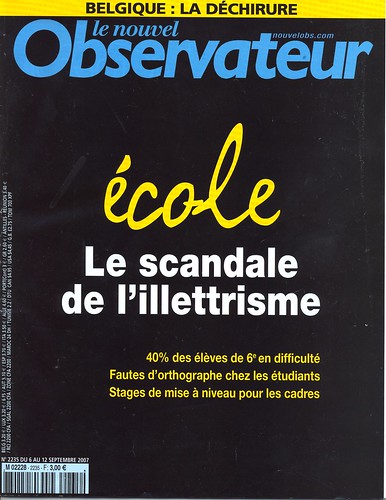
Le scandale de l'illetrrisme (nouvel obs: the scandal of illiteracy)
dyslexie, vraiment? ) (nouvel obs: true dyslexia? - whole language in France)
Comment en est-on arrivé là? (nouvel obs: How did we get here?)
French spelling

Why English speaking children can't read

Lucy Calkins on teaching children to write
Becky C on starting at the top

instructional casualties in America
curriculum casualties: figures
forcing hearing children to learn as deaf children must
Rory: I frickin' hate whole language!

thank you, whole language

Wednesday, May 7, 2008

UK version of reading first, UK reading links

I have recently joined the UK Reading Reform Foundation (RRF) discussion forum. You may see some names you recognize there! One of their commentors also has a very interesting dylsexia website that I like. ("School-Proof your child.")

There is a ton of good information on the RRF website, especially this list of links; however, they don't think you should teach the alphabet first, only letter sounds. I happen to be a firm believer in both the alphabet names and sounds, and also syllables, which have not been popular since 1826. (Although syllables are currently taught in some French and Spanish phonetic reading programs, but syllables in words, not taught first in an isolated syllabary.) A
ccording to many researchers, "knowing the letter names is the best predictor of beginning reading achievement." (Marilyn Adams, 1990, Beginning to Read, Thinking and Learning about Print.)

The Brits evidently have their own Reading First type of program which is also meeting resistance, "
The details above reveal nothing less than slight-of-hand by government ministers and the Reading Recovery people. "

You can also find some good comments about our Reading First program on their forum.


Tuesday, March 18, 2008

Picture Overshadowing—are Sight Words overshadowing phonics skills?

Catherine’s Visual Learning Post got me thinking about my “picture overshadowing” theory of sight words.

I have a lot of theories about sight words (theories are at the end of the post.) All of my remedial students had problems with wildly guessing at words. From my survey of hundreds of children in schools which taught with varying emphasis on sight words, I found that the more sight words used and the longer the student was exposed to them, the harder it was to break out of these guessing habits and focus on sounding out words from left to right. I also found that more sight words resulted in more reading problems. In my sight word case study post, I examine the case of a girl who after learning the 220 Dolch sight words (this girl was not one of my students)
The skill of sounding out simple words, that she had been able to do shortly after she turned three, had been completely lost. If she didn't know a word by sight, she was stuck. [snip] ; even if a word was in her spoken vocabulary, she couldn't recognize it on the page if she hadn't seen it before in print, even if it was totally phonetically regular, with all short-vowel sounds. And when she came to these words she didn't recognize, she would try to guess…
While most of my students had not completely lost their ability to sound out words, it was like swimming through molasses to get them to sound out words. And, the more sight words taught, the thicker the molasses.

I had a theory about sight words and picture overshadowing already, but did not have a good explanation for how spelling fit in. I knew that spelling was helpful for my students, but spelling, like sight words, seemed to be dealing with wholes as well, at least on the surface. While I intuitively believed that spelling was different, I was not able to explicitly explain the difference.

Providentially, the article Catherine linked to, Words Get in the Way, provided the missing spelling explanation:
For instance, in a 1995 study, Schooler reported that verbal descriptions disrupted white volunteers' memories for the faces of white but not black individuals. He proposed that thanks to their extensive experience in looking at white faces, white volunteers used rapid, nonverbal perception to evaluate each such face as a unified entity. In contrast, volunteers spent more time studying individual features of the less-familiar black faces. Subsequent written descriptions were more consistent with the features that white participants remembered about the black faces than with the unified images they had stored for the white ones, Schooler concludes.
This led me to see how spelling could fit nicely into the picture overshadowing theory of sight words. While you do examine the whole word to learn it for spelling, you are also studying the individual features (letters) of the word.

Charles Perfetti’s article The role of discourse context in developing word form representations: A paradoxical relation between reading and learning states,
In our experiments, children attempted to read words they could not previously read, during a self-teaching period, either in context or in isolation. Later they were tested on how well they learned the words as a function of self teaching condition (isolation or context). Consistent with previous research, children read more words accurately in context than in isolation during self-teaching; however, children had better retention for words learned in isolation.
In my remedial work, I’ve found that students learn better when taught words in isolation. I try not to introduce any outside reading material until all phonics skills have been over-learned. When teaching my daughter to read, I found that she also did better when taught words in isolation, just like my remedial students. Moreover, she did even better when we switched to Webster’s Speller, learning spelling and syllables in isolation. Don Potter has found that his students (both beginning and remedial students) learn better when taught words in isolation as well. He is sharing a method for teaching phonics words in isolation with his nationwide campaign to get a free copy of Blend Phonics to every elementary teacher in America.

The article Words get in the Way states,
In one study, conducted by Kim Finger of Claremont (Calif.) Graduate University, participants who wrote a description of a man's face after studying the face for 5 minutes suffered no memory loss if they were then nudged back into a perceptual frame of mind. To do this, Finger asked them either to solve a printed maze or to listen to 5 minutes of instrumental music. Both strategies yielded face memory equal to that of volunteers who didn't provide a written description.
I’ve found that my students also do better when I get them switched back from “guessing mode” (visual) to “sounding mode” (verbal.) To switch them out of “guessing habits,” and into “sounding out habits,” I found the use of nonsense words helpful, especially if I announced up front that the upcoming words were nonsense words. Some of my students who had been exposed to sight words for years were very hard to break of their guessing habits. They would even try to guess at nonsense words—unless warned that the word was a nonsense word and that there was no way they would ever be able to guess it because it was not a real word. Repeated nonsense words would usually switch them from “guessing mode” to “sounding mode” and allow me to begin phonetic teaching work on regular words.

So, I now have a more complete theory of sight words and “picture overshadowing.” Sight words are processed on the visual side of the brain (pictures). Words taught with phonics are processed on the verbal side of the brain (sounds.) People with dyslexia (organic or induced by sight words) have been shown to improve their reading abilities and have changes in brain activity consistent with this picture overshadowing theory. [See note 2 below] This "picture overshadowing" explains the molasses effect I saw with sight words and my students' impaired ability to sound out words.

I believe that guessing at words from pictures or context can also switch students into this visual “guessing mode,” while reading words in isolation forces students to focus on the letters and sounds of the word, the verbal “sounding mode.”

In my informal survey of hundreds of children, those who read the best were those taught with phonics methods that used very few sight words.

You can determine if someone is suffering "picture overshadowing" from too many sight words by giving the Miller Word Identification Assessment, or MWIA, available for free download from Don Potter. It measures the speed at which a student reads sight words verses less frequent phonetic words. Anyone reading the phonetic words more than 10% slower than the holistic words should consider a good phonics program with no sight words.

Blend Phonics is a good program that uses no sight words, and does not teach words in context, which I also believe leads students to switch over from the verbal to the visual mode. Don Potter also has developed a Blend Phonics Reader which has words of similar configuration (bed, bid, bat, bit, etc.) next to each other to help the student learn to see and overcome visual configuration guessing habits.

Webster’s Speller is another very good phonics program that uses no sight words. Its use of spelling may also help prevent dyslexia by teaching students to sound out and spell words and syllables before they read them in context, making sure that they have a firm letter by letter mental image of the word before they attempt to read them in context. It also teaches using syllables via a syllabary, which may be helpful for preventing dyslexia. Syllables were also a very powerful reading method for my students and for Catherine’s son, resulting in rapid reading grade level improvements.

My free online phonics lessons also use syllables and teach no sight words. The first several lessons have now been switched to all uppercase to prevent guessing from visual configuration.

Richard G. Parker warned of the dangers of reading words you hadn’t yet learned to spell (and sound out, see note 3) in 1851:
I have little doubt will be found true, and that is, that it is scarcely possible to devote too much time to the spelling book. Teachers who are impatient of the slow progress of their pupils are too apt to lay it aside too soon. I have frequently seen the melancholy effects of this impatience. Among the many pupils that I have had under my charge, I have noticed that they who have made the most rapid progress in reading were invariably those who had been most faithfully drilled in the spelling book.
When I taught my daughter to read using a variety of phonics programs and only 2 sight words, I found that she would occasionally guess at words when reading stories. After learning to spell and sound out syllables and words using Webster’s Speller, she no longer guesses at words when reading them in context.

Note 1: all but 2 of the most commonly taught 220 sight words can be taught phonetically.

Note 2: I disagree with Flowers’ statement that this confirms that dyslexia is biologically based. While some forms of dyslexia probably have a genetic component, sight word teaching could be the cause of many of these brain differences, and parents who do not know phonics cannot teach their children to sound out words at home, which could account for the seeming genetic pattern of transmission. I was taught with a bit of phonics, then with whole word methods using sight words. My parents sounded out words for me when I struggled with words at home. A parent who did not know phonics would not be able to provide this kind of help for their children. My dyslexia page has more information about dyslexia, including links to articles and presentations about the brain changes that occur when dyslexic students are taught phontic reading and spelling.

Note 3: Spelling Books in the 1700's and early 1800's were used for both phonics and spelling purposes, and were used to teach children to read. Noah Webster himself explains this in his 1828 American Dictionary of the English Language. The entry for spelling-book reads, "n. A book for teaching children to spell and read."

Wednesday, February 13, 2008

Sight Words, A Case Study

Don Potter just e-mailed me this post describing how a family used one of his free online phonics methods to fix their sight word induced problems.

The father explains their sight word foray and its unfortunate results (excerpts from the post follow, read the whole thing, there is a lot more and the comments are also interesting.):

Shortly after she turned three, I started trying to get her to sound out simple words, from street signs ("Bump" was one of our favorites) and from books like Dr. Seuss' Hop On Pop. She was able to sound out simple, phonetically regular words by age three-and-a-half.

Now, at this point I made a decision that, if I had to do over again, I would not do [snip]

So I looked up the "Dolch List": ... We got pretty good at making long sentences using nothing but these 220 cards, and the Fairy rather enjoyed playing with them. And by the time she was four, she also became very adept at reading most sentences that contained these words. Truth be told, the Dolch words do make up a big chunk of our everyday vocabulary--this sentence alone contains more than a dozen of them. And she had them down cold.

But...

As I later came to understand, when I was finally exposed to the contorversy between the Whole Word and Phonics approaches to learning reading, I was actually teaching my little girl some bad habits that would come back to bite us. We had made it very easy for our girl to recognize common words; she didn't have to do any phonetical decoding to read these words. Phonetical decoding takes work, and she (like most kids who just turned four) didn't want to have to put in any hard-core analysis to get what she wants. The words are supposed to come easily! I should just be able to look at the words and have them pop into my mind!

The skill of sounding out simple words, that she had been able to do shortly after she turned three, had been completely lost. If she didn't know a word by sight, she was stuck. [snip] ; even if a word was in her spoken vocabulary, she couldn't recognize it on the page if she hadn't seen it before in print, even if it was totally phonetically regular, with all short-vowel sounds. And when she came to these words she didn't recognize, she would try to guess, coming up either with nonsense words or with words that were similar-looking (same starting and ending letter, totally different middle), or with a synonym that bore no visual resemblance to the correct word on the page.

[snip]

Here's the way I understand it: A reader who has been trained to read phonetically, and a reader who has been trained to read words by sight-recognition (See-and-Say or Whole Language), use their brains in totally different ways. In the brain of the sight-recognition reader, reading activates the part of the brain used in visual recognition--the same parts that recognize faces, for example. In the phonetic reader's brain, reading activates the parts of the brain that are used in analysis, and in the processing of sound (even if the person is reading silently). What goes on in the two readers' brains is completely different. When they make mistakes, they will tend to make different kinds of mistakes. And it's very difficult for a person thoroughly trained in one method to make the switch and start using the other kind of method--especially as the student gets older.

[snip]

So, how is my daugter doing? Well, after finding Mr. Potter's website, we decided to try using Hazel Loring's phonetical method on our newly-turned four-year-old. When we had gone through that completely, we started through the McGuffey's Readers, being careful to make sure that she sounded out every unfamiliar word she came upon. She finished the primer and the First Eclectic Reader earlier this year, and rather enjoyed them. We've also started Level A Spelling Workout, from Modern Curriculum Press (Recommended in The Well Trained Mind), on the theory that learning a phonics-based spelling curriculum will strengthen her phonetical reading skills.

[snip]

We think it's all working. While the Pillowfight Fairy still tends to guess at big words instead of sounding them out, she's doing it a little less often; and it may only be because she hasn't yet learned how to break the big words down into syllables--something that the spelling curriculum will hopefully cure. But aside from that, she's gotten very good at reading new material that includes words that I've never seen her read before, so I think we must be doing something right.


I've seen the exact same thing with the many students I've tutored. Just change the names, and make it 10 times harder to fix for every additional year the sight words get pounded into their heads. The younger the student and the fewer sight words taught, the easier the remediation process. It's really hard to believe until you see it, there is something going on with those sight words that makes it incredibly difficult to get them reading from left to right and sounding out words without guessing. Nonsense words are helpful, and so are syllables. With some of my older students, I've had to cover up all but the syllable we were working on to keep them from trying to guess the whole word at once. It's a very trying process that takes a lot of patience. Guessing habits are very hard to break. However, the results are very rewarding! I love watching my students learn to love reading and learn to sound out "hard" multiple syllable words on their own.

There are several theories out there to explain this: Don Potter explains the reading traingle theory, I have several theories on my dyslexia page: eye movement theories and brain location theories:

Sight words do not promote left to right reading because when memorizing words as a whole, the eye jumps all around the word. Too many words taught as wholes by sight encourages the development of dyslexia. [5] Moreover, pictures and words are processed on different sides of the brain. Not only do sight words encourage incorrect eye movements, they also confuse the brain, which research has shown reads words sound by sound.

The brains of dyslexics can be retrained with phonics. While this is easier with young children, it is even possible with adult dyslexics. [2] You can see brain changes from phonics training in the seventh slide of this online presentation by Dr. Jack M. Fletcher. [3]

and there is even a spelling brain connection different from the reading brain connection (I'm pretty sure it was different, the spelling brain pictures were very small. However, it seemed to be different areas of the brain than the reading areas):

A recent study found that dyslexics that were taught spelling in this orthographic manner improved their spelling. The study also found that this type of teaching "can actually change their brains' activity patterns to better resemble the brains of normal spellers."

And Dr. Hilde L. Mosse has a conditioned reflex theory:

To show a child a group of letters and to tell him that this means "house"--as is done in those kindergartens and first grades where children are introduced to reading with so-called "sight words"--confuses them, interferes with the formation of conditioned reflexes, and teaches them a lie. The letter sequence h o u s e stands for the word "house" and not for the house they see; pictures do that, but not letters.

Whatever the cause, I'm pretty sure that Sight Words are a Root of all Reading Evil.

Tuesday, February 12, 2008

Can the method cause dyslexia?

As I alluded to in my sight word post, I believe the answer is yes, the method used to teach reading can cause dyslexia.

As I said in my sight word post,
I give reading grade level tests to all my friends who have children, and through our moves have tested (directly and indirectly) hundreds of children from several different states. In my informal survey, I have found that the more sight words taught in a school, the higher the percentage of children who are reading below grade level.
I also found that schools that taught with completly whole word methods fared even worse in my informal assessment. And, the better the phonics program used and the less sight words taught in that phonics program, the better the percentage of students that were reading above grade level. I haven't found a single child taught with A Beka or with whatever phonics program the local Catholic school uses who was not reading above grade level. I thought I had found one student at the local Catholic school who was the exception to that rule but I later found out that she had transferred into the Catholic school from an out of state public school that used whole word teaching methods.

Several of my remedial students were supposedly "dyslexic," yet I have not yet found a single "dyslexic" student who learned to read phonetically. However, I find it best not to argue with people who think they have dyslexia--the methods used to remediate someone are the same regardless of how they obtained their dyslexia, and they are more willing to be helped if you do not argue with them. After teaching them for a while, I just mention the fact that all of my "dyslexic" students came from some kind of sight word or whole word background and that, while they probably do exist, I have not yet found a single "dyslexic" student from a low-sight word phonics background.

My dyslexia page goes into more detail about how teaching methods can cause dyslexia, and also explains the nature of sound and how to remediate dyslexia (both organic and method induced.) Here again are some excerpts:

According to Dr. Robert Myers of the Child Development Institute in his web page about Dyslexia & Reading Problems, "Children who have an average or above IQ and are reading 1 1/2 grades or more below grade level may be dyslexic. True dyslexia affects about 3 to 6 percent of the population yet in some parts of the country up to 50% of the students are not reading at grade level. This means that the reason for most children not reading at grade level is ineffective reading instruction. The dyslexic child often suffers from having a specific learning disability as well as being exposed to ineffective instruction."

Dr. Reid Lyon, in his article "Reading Disabilities: Why Do Some Children Have Difficulty Learning to Read? What Can Be Done About It?" talks about phonics training and the prevention of reading failure through proper training:

On the other hand, the early identification of children at-risk for reading failure coupled with the provision of comprehensive early reading interventions can reduce the percentage of children reading below the basic level in the fourth grade (i.e., 38%) to six percent or less....

These studies strongly suggest that such programs [systematic phonics] if implemented appropriately, could reduce the number of children who fail to learn to read well below the 38 % rate currently observed nationally. [6]

In France, it was proven that schools that taught with phonics produced less dyslexic students than schools that taught with whole word methods. Acording to Geraldine E. Rodgers,

However, the true sight-word method was generally discredited in Europe by the 1970's. Change was brought about by such things as those reported in a 1950 Enfance article. In France, 2% of dyslexic children were discovered in schools that used the phonics approach, but 20% of dyslexic children were discovered in schools that used the global [whole word] approach. [7]

Unfortunately, like us, the French have not learned from their history of education and keep repeating the same kinds of mistakes. According to several people I know, Global [whole word] and "mixed" (I assume the equivilent of "balanced literacy") methods are back in force in France today. This website, Lire-ecrire, is a website promoting the return of syllable-based phonics methods in France and warns of the dangers of Global methods and how to prevent them by teaching syllable-based phonics at home. (At least, that's what I thought from my auto-translation, I could be wrong!)

As I explain in my dyslexia page, I think that Webster's Speller is probably the best method for remediating dyslexic students. Through its focus on spelling, it may also help prevent dyslexia even more than regular phonics methods. If you can write and spell a word correctly, there should be less chance of reversing or confusing it.

There is also a teaching explanation to explain away some of the genetic connection for dyslexia. If your parents can't sound out words and you are taught with whole word methods, your parents can't sound out words for you when you're confused by poor teaching methods which have not clearly and explicitly taught you letter sounds and how to sound out words. I got a tiny bit of phonics in Kindergarten, then whole word methods in first grade. My parents would sound out words for me when I didn't know them. Parents who don't have a clear knowledge of the sounds in words and how to teach with phonics can't do this.

(This lack of explicit, complete phonics instruction left me a good reader but a poor speller. After learning the phonetic spelling rules and the sound/spelling patterns of phonics, I am now a pretty good speller, although not as good of a speller as people I know who were trained with a good phonics program from the beginning.)

..........................

Catherine here, diving into Elizabeth's post. Here's the link to Ed's translation of the brief Nouvel Observateur article on the increase in dyslexia amongst French schoolchildren.


Le scandale de l'illetrrisme (nouvel obs: the scandal of illiteracy)
dyslexie, vraiment? ) (nouvel obs: true dyslexia?)
Comment en est-on arrivé là? (nouvel obs: How did we get here?)

Lucy Calkins on teaching children to write

instructional casualties in America
curriculum casualties: figures
forcing hearing children to learn as deaf children must
Rory: I frickin' hate whole language!

thank you, whole language

Sight Words: a root of all reading evil

There are other roots, but sight words are a big one.

I give reading grade level tests to all my friends who have children, and through our moves have tested (directly and indirectly) hundreds of children from several different states. In my informal survey, I have found that the more sight words taught in a school, the higher the percentage of children who are reading below grade level.

A search for "sight words" on Google produced 1.26 million hits, "Dolch sight words," 41,200. Chances are your school is teaching some.

The
Wikipedia entry for "Dolch Word List" states:

The Dolch Word list is a list of frequently used words compiled by Edward William Dolch, Ph.D. The list was originally published in his book "Problems in Reading", the Garrard Press, 1948.

Dolch compiled the list based on children's books of his era. The list contains 220 "service words" that have to be easily recognized in order to achieve reading fluency. The compilation excludes nouns, which comprise a separate 95-word list.

Many of the 220 Dolch words can't be "sounded out" and have to be learned by sight. Hence the alternative term "Sight Words".

I requested Dolch's "Problems in Reading" through Interlibrary Loan and found that Dolch used 3 existing lists of the most frequent words to develop his list of 220 words. He took words that were common to the Child Study Committe of the International Kindergarten Union (2,596 words), the first 500 words of the Gates list, and the 453 words on the Wheeler and Howell list. He then added in 27 words on only one or two of the lists which he deemed improtant or which completed a group (for example, stop was on all 3 lists, but start wasn't, so start was added to the list.)

The idea that the Dolch sight words are phonetically irregular and therefore must be taught by sight is a commonly believed idea that is just not true. My sight word page explains this, here are some excerpts (but do go read the whole thing, it's pretty short and also has a link to a pdf file arranging the Dolch words by their phonetic patterns.) Better yet, print it out along with copies of the pdf file and give it to everyone you know whose children are being subjected to unnecessary whole word sight word teaching.

Of the 220 most commonly taught sight words (called dolch sight words), 150 are completely phonetic and can be easily learned by sound. For the other 70 words, 68 conform to simple patterns of exceptions and can be taught phonetically. Sight words should not be taught at all in a pure phonics program that teaches by sound. They should merely be taught phonetically along with other words.

Here are some of these 150 phonetic "sight words:"
be, he, me, she, we
an, can, ran
got, hot, not

ate, make, take

see, green, keep, sleep, three
My remedial students who were sight word victims required much retraining, it generally takes a lot of nonsense words to break their guessing habits. The most difficult words to break their guessing habits were those on the Dolch word list which they were exposed to repeatedly. I had one 33 year old female student who never did learn the difference between than, then and them or there and their. She would sound them out for a while and then after a few weeks revert back and randomly guess the wrong one. I eventually got her sounding out most words, but those specific Dolch sight words were too difficult to overcome. I did manage to improve her reading grade level from 3rd grade to 8th grade before I had to move to another state.

Another excerpt from my sight word page, a bit of a table from Laurita's article "Basic Sight Vocabulary--A Help or a Hinderance?": (You'll want to see the full article.)

This table contains words selected from the Dolch Basic Sight Vocabulary List which have configurational similarity and have the potential to contribute to the development of visual response patterning which is unreliable and confused.

is-in-on-no-an-or
come-came-can
full-fall-fell
he-her-here-where-were
they-then-them-there-their

One of the problems with the way the sight words are taught is that the words are commonly separated alphabetically and across grade levels. For example, "can" is taught in a preprimer list, but "an" in first grade. "Not" is taught at the preprimer level, but students are not expected to be able to learn "got" until third grade. Students are apparently ready for "when," which includes the diagraph wh, by First Grade, but not the phonetically regular and simple "ten" until Third Grade. This method of listing and teaching "sight words" hides their phonetic pattern and reinforces the idea that they cannot be learned phonetically.

68 of the 70 words on the Dolch list do have some degree of phonetic irregularity, but can be easily taught by teaching a few phonics rules. Here are a few examples from my sight word page:

Words with ve at the end. Words in English will not end in v, so words with ve at the end may be either short or long:
give, live, have (Live can be pronounced either long or short depending on its usage.)

Words with consonant pair substitutions (z sound for s, v sound for f). If you say each of these sounds, you’ll note that they are very close sounds. They are pronounced with the mouth in the same position, but the first of each pair is voiced and the second is unvoiced.
as, has, is his, use, does, of (does also has the vowel sound mushed to uh)

This word has a schwa sound of uh and a consonant pair substitution of z for s:
was

This word is regular with its long e sound before words beginning with vowels. Before words beginning with consonants, the e sound will mush to the schwa sound of uh:
the (long e in the end, uh sound in the bears)

I have sight-word phobia. I have seen the harm they do to students and have spent countless hours undoing the damage they have done to my remedial students.

I have only taught a single sight word to my daughter. (The word "one." Then, I taught her the word "once" as following its pattern. The other 218 words on the list, I just taught her phonetically along with other words. For the 68 that are slightly irregular, I taught them in groups following that pattern of exception. She learned "eye" on her own somehow, probably as a sight word. It's not on the Dolch word list, but it, like "one," has no phonetic explanation suitable for a 5 year old. There actually are linguistic explanation for both one and eye, they are just very complex.)

Monday, February 11, 2008

Syllables, Syllables, Syllabary

Teaching phonics with syllables works a lot faster than regular phonics and allows students to read at high grade levels quickly.

Teaching with syllables, "Johnny" went from reading at the 3rd grade level to reading at the 6th grade level after 6 hours of phonics instruction. (The early version of my online phonics lessons, now 12 hours total instruction.)

Before 1826, children were taught to read with the syllabary. The first part of the syllabary is shown on old hornbooks.


Children taught with Webster's Speller and the syllabary could read this in first grade:

"Now, if you will try to re-mem-ber what I have told you a-bout these si-lent let-ters, I think you will be able to read ver-y well, in a short time; and I suppose you will be ver-y glad when you are a-ble to read pret-ty stories in books.

The si-lent let-ters which are used in spell-ing ma-ny words are ver-y puz-zling to lit-tle boys and girls, when they are learn-ing to read; but I hope that the good lit-tle boy or girl who is now read-ing this les-son will try ver-y hard to rec-ol-lect how all the words are spelt; and that the teach-er will re-quire ev-e-ry pu-pil to be a-ble to spell ev-e-ry word that is read. By so doing, the pu-pil will learn to read much fast-er, and in a short time hard words will cease to trou-ble him." (from Parker's First Reader, 1851)


and this in second grade:
"All persons, who are not deprived by nature or by accident of something which belongs to them by the gift of God, their Creator, have five senses." (from Parker's National Second Reader, 1869)
After teaching my daughter with Webster's, she can read just about anything. She's still 5 (she'll be 6 soon) and can sound out 3 and 4 syllable words she has never seen before. After 4 months of seeing syllables divided like those shown in the 1st grade selection above, she can now divide them on her own. A few months ago, she could read 3 and 4 syllable words only if they were divided for her. You can learn all about how to teach with Webster's and the Syllabary, it's surprisingly easy.

I believe that teaching syllables is a crucial step missing in most phonics programs today. A Beka divides words by syllables, and every child I've seen taught with this program was reading far above their grade level.

Who am I?

I’m a former Air Force statistician who has been promoted to Mom. My husband is still in the Air Force, and we’ve moved 5 times in the last 6 years. We’ve seen a lot of school districts! I’ve been tutoring with phonics since 1994, so have observed the schools everywhere we’ve lived with interest since then. I gave my life to Jesus Christ in 1997.

I wanted to be a volunteer math tutor, but it was not to be. I have tutored a few students in Algebra through the years, but when I signed up to tutor inner-city students in San Antonio, the Air Force moved us to another city. This large city had no math tutoring programs, only a volunteer literacy organization. I signed up—I had always liked to read. I figured I could try that for a while.

The local literacy organization used whole word methods and language experience stories, and made this seem exciting and like the best thing since sliced bread. They raved about the wonders of teaching this way. I bought it and was excited to teach my student to read. After a month of tutoring, she had learned 3 words, and there seemed to be no pattern to her progress or lack thereof. I called my dad, a public school teacher and a very smart man. He said, "teach her phonics."

All I could find at the time (This was 1994, the internet had just barely started, and bookstores were not selling any phonics products) was an old teacher's copy of Hay and Wingo's Reading With Phonics. It seemed too juvenile to me, so I made up my own lessons from the concepts in it, starting with 2 and 3 syllable words from the first lesson. I later found she didn't mind working from 1st grade texts as long as she was learning, but I didn't know that at the time, and I'm glad I decided to make my own lessons. (By the way, she learned more in her first lesson than in that month of sight words, and I made a few mistakes with sounds at the beginning, I myself had a limited phonics background and had just picked up reading after being taught a few letter sounds. I did not, however, pick up spelling, although I have always been a prolific reader. My spelling improved after tutoring with phonics and learning the associated spelling rules and syllable division rules.)

With small children and frequent moves, I could no longer teach many students to read. I put all my phonics lessons online a little over 3 years ago while pregnant with our second child—a difficult pregnancy, the online work was accomplished only through God’s strength, I had no strength of my own.

About a year ago I added spelling lessons. They teach spelling rules, syllable division rules, and everything you need to know to teach someone to read with phonics.

Shortly after starting my website, I “met” Don Potter. He had similar experiences tutoring remedial students, but had taught even more students than I had and also had insight into what they were doing in the public schools. He has a great website with a lot of phonics information. He also convinced me of the power and utility of the MWIA, a test to determine if someone has been harmed by too many sight words.

About 2 years ago, I also “met” Geraldine Rodgers. Her book “The Case for The Prosecution is an eye opener. Even better is her “History of Beginning Reading,” available in e-book format for $8.95 from Author House.

While I had always used syllables and spelling in my lessons, reading Rodgers’ works made me even more convinced of their importance, and led me to teach my daughter using syllables and spelling with Webster’s Blue-Blacked Speller. The results have been amazing, to say the least. I’ll leave that for another post.