kitchen table math, the sequel: Writing to the Point by Kerrigan
Showing posts with label Writing to the Point by Kerrigan. Show all posts

Friday, September 28, 2012

Revolutionary writing instruction that is 'an old idea done better'

Here's another case of everything old is new again.  A New York City school finds that returning to fundamentals like explicit grammar instruction and formulaic writing has succeeded in turning around the dismal performance of high poverty students.  No iPads were required.

The problems at New Dorp High School were similar to many that afflict other lower-income public schools.
... students from poor and working-class families. In 2006, 82 percent of freshmen entered the school reading below grade level. Students routinely scored poorly on the English and history Regents exams....
Students’ inability to translate thoughts into coherent, well-argued sentences, paragraphs, and essays was severely impeding intellectual growth in many subjects....
... the students’ sentences were short and disjointed.
... These 14- and 15-year-olds didn’t know how to use some basic parts of speech. With such grammatical gaps, it was a wonder they learned as much as they did. “Yes, they could read simple sentences,” but works like the Gettysburg Address were beyond them—not because they were too lazy to look up words they didn’t know, but because “they were missing a crucial understanding of how language works.
This writing skills problem is widespread.
According to the Nation’s Report Card, in 2007, the latest year for which this data is available, only 1 percent of all 12th-graders nationwide could write a sophisticated, well-­organized essay. Other research has shown that 70 to 75 percent of students in grades four through 12 write poorly. ... for decades, achievement rates in writing have remained low.
There appears to be a massive failure in learning writing skills.  What type of writing instruction is used in most public schools?
... elementary-­school students ... today mostly learn writing by constructing personal narratives, memoirs, and small works of fiction ...
... pedagogical pendulum that has swung too far, favoring self-­expression and emotion over lucid communication....
For most of the 1990s, elementary- and middle-­school children kept journals in which they wrote personal narratives, poetry, and memoirs and engaged in “peer editing,” without much attention to formal composition....
The explicit instruction of previous times has morphed into discovery learning, where students are encouraged to figure it out themselves, to "construct" their own learning.  Being creative has become more important than following formal rules.
... Fifty years ago, elementary-school teachers taught the general rules of spelling and the structure of sentences. Later instruction focused on building solid paragraphs into full-blown essays....  About 25 years ago, in an effort to enliven instruction and get more kids writing, schools of education began promoting a different approach. The popular thinking was that writing should be “caught, not taught,” explains Steven Graham, a professor of education instruction at Arizona State University. Roughly, it was supposed to work like this: Give students interesting creative-writing assignments; put that writing in a fun, social context in which kids share their work. Kids, the theory goes, will “catch” what they need in order to be successful writers. Formal lessons in grammar, sentence structure, and essay-writing took a back seat to creative expression.
Low-income students have particularly suffered from the current approach.
The catch method works for some kids, to a point... Kids who come from poverty, who had weak early instruction, or who have learning difficulties, he explains, “can’t catch anywhere near what they need” to write an essay....
New Dorp High School tried something different.

Education schools don't spend much time on how to teach writing, so it's not surprising that New Dorp teachers were unaware of their own teaching failures.  They blamed the students' poor performance on poverty, low intelligence, or laziness.  The school tried 'innovative' methods, like small learning communities and special after-school programs.  Nothing worked, until they carefully explored the missing skills and took specific steps to address the gaps.  Deirdre DeAngelis, the school principal, learned of the acclaimed writing program used by principal Judith Hochman of the Windward School, a private school for learning disabled children.

The way Catholic schools used to teach, using explicit instruction and a writing "formula"
The Hochman Program, as it is sometimes called, would not be un­familiar to nuns who taught in Catholic schools circa 1950. Children do not have to “catch” a single thing. They are explicitly taught how to turn ideas into simple sentences, and how to construct complex sentences from simple ones... It is, at least initially, a rigid, unswerving formula. “I prefer recipe,” Hochman says, “but formula? Yes! Okay!”
... “The thing is, kids need a formula, at least at first, because what we are asking them to do is very difficult. So God, let’s stop acting like they should just know how to do it. Give them a formula! Later, when they understand the rules of good writing, they can figure out how to break them.”
... Teachers stopped giving fluffy assignments such as “Write a postcard to a friend describing life in the trenches of World War I” and instead demanded that students fashion an expository essay describing three major causes of the conflict.
The successful results of the back-to-basics (revolutionary) writing program at New Dorp
... This spring, the graduation rate is expected to hit 80 percent, a staggering improvement over the 63 percent figure that prevailed before the Writing Revolution began.
... newfound ability to write solid, logically ordered paragraphs about what she’s learned, citing examples and using transitions between ideas.
Reading comprehension also improved.
As her understanding of the parts of speech grew, Monica’s reading comprehension improved dramatically. “Before, I could read, sure. But it was like a sea of words,” she says. “The more writing instruction I got, the more I understood which words were important.”
More schools should try this '"old" way of instruction.
The Hochman Program being used at New Dorp High School is writing instruction that offers direct and precise guidance incorporated into a systemic process, along with explicit grammar instruction and a strong focus on sentence  composition.  This is very similar to the Kerrigan method of Writing to the Point, a personal favorite of mine.  I strongly believe this type of instruction would benefit most types of students, offering better preparation for college or career than the fluffy free-for-all type of writing instruction now popular in many public schools.  Perhaps this New Dorp success story will help fuel a change with more schools following in their footsteps.

(Cross-posted at Cost of College)

Related:

Wednesday, March 14, 2012

a difficult passage - & terrific advice

[Terri] LeClercq offers a very helpful technique to check for coherence in a multi-paragraph text: As you edit your rough draft, separate each topic sentence from your text and examine each one to make sure it is a strong introduction to the main idea of that paragraph. Then examine the coherence of the topic sentences as they relate to the overall thesis set-up by seeing whether the topic sentences form a coherent paragraph.
“Writing Good Paragraphs with Topic Sentences.” Legal Writing Tips 1.8 (2005). Print. Web. 14 March 2012.
My students had trouble with this passage today. They understood the first and second sentences (the 2 independent clauses linked by the colon), but they stumbled over the last one.

I'm not crazy about the last sentence myself: reading it, you have to keep too much information lit up in working memory until you finally get to the most important bit, which is at the very end. The end is where the most important bit usually should be, but still. There's an awful lot to hang on to until you get there.

I don't mean to sound harsh. That last sentence is perfectly serviceable, and impressive in its way. It's nicely linked to its partner sentence, the one that comes just before it, and it manages to pack a great deal of information into a small space, which is not easy. You'd have to be an experienced writer to write it.

Nevertheless, if it were my sentence, I would keep on writing it before I stopped. I would revise.

Teaching basic composition, I've come to realize how important it is for college students to be able to read prose I wouldn't advise any of them actually to write. A fair portion of academic and professional prose is not very good, and some of it is god-awful. But students have to read it.

Of course everyone knows this, but I hadn't thought about the implications until now. College students have to be able to read bad writing. Not just difficult writing, not just sophisticated writing, not just writing with a lot of big words. College students have to be able to read all those things, but they also have to be able to read difficult, sophisticated writing with a lot of big words that is bad.

So how do they acquire this skill?

Composition textbooks come stocked with dozens of heavily copy-edited essays written by journalists and originally published in popular books and magazines: these are works that have been professionally engineered to be maximally swift, cohesive, and clear. They make sense as models for writing, but they're useless for reading. They're so well written they practically read themselves.*

Where are the composition texts featuring 100s of pages of dense and mystifying academic prose, I ask?

And how does one teach students to read badly-written prose?

Is it different from teaching students to read well-written prose?

I'm thinking it might be.

Last but not least, speaking of bad and good prose, I think LeClercq's advice is brilliant. It's an amazing fit for William Kerrigan's X-1-2-3s.

X-1-2-3

* I don't remotely believe that well-written prose practically reads itself. Certain genres, however, are written to be effortlessly readable, and that's the writing that appears in college composition texts.

Sunday, December 11, 2011

More posts up on Kerrigan 'Writing to the Point'

I've completed two more assignments in my project to work my way through the Kerrigan Writing to the Point method of writing instruction.
I continue to appreciate how the Kerrigan method teaches writing by systematically moving through a hierarchy of skills.

Here's my original post in this series.

Saturday, November 26, 2011

Latest installment on Kerrigan 'Writing to the Point' project - using CONCRETE words

Use words that are not abstract; that can be seen, touched, smelled, tasted, felt, weighed, measured, lifted, dropped, moved, etc.
Examples:  child, chair, pencil are concrete; freedom, justice, bravery are not
Read more at Cost of College:  Step 4 of the Kerrigan method of ‘Writing to the Point’ –being CONCRETE

Friday, November 18, 2011

Learning more about 'Writing to the Point' - Kerrigan's approach to writing instruction

I first learned about the William J. Kerrigan's Writing to the Point from Catherine.  She had high praise for this book on writing instruction, calling it "brilliant" and attracting my attention with this.
I'm pretty sure a parent can use Kerrigan's book to turn any writing assignment into an OK assignment or even good one.
After years of letting the book collect dust on a shelf, I finally decided to read it and learn the Kerrigan method in detail.  I'm almost halfway through this project, becoming more convinced with each assignment that this approach would work for many students who struggle with writing.  The precision and clarity of the Kerrigan method is refreshing, especially after observing so many different variations on writing instruction that often appeared confusing and distracting.  (Venn diagrams, cloud-charts, math journals and three-page rubrics - I'm looking at you.)

I'm blogging about my journey through Writing to the Point over at Cost of College, and here are the first three installments.

The Kerrigan method of ‘Writing to the Point’
Step 3 of the Kerrigan method of ‘Writing to the Point’

Step 4 of the Kerrigan method of ‘Writing to the Point’ – being SPECIFIC

I welcome any feedback from KTM readers as I stumble along in my project, hoping to learn more about effective writing instruction and to improve my own writing.

Monday, November 26, 2007

Kerrigan & test prep

Speaking of test prep, Kerrigan is superb test prep for the essay portion of a standardized test. Amazing.

C. wrote two practice test essays yesterday using the X-1-2-3 set-up for both. The first was pretty bad, but he improved dramatically on the second.

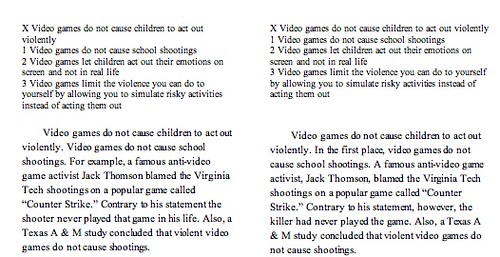
Bonus points: X-1-2-3 results in mini-essays that can be easily typed up and edited by the parent/teacher, like so:


C's version is on the left; our lightly edited version is on the right. Ed says it helps tremendously to see your work edited and I think he's right.

I wonder whether a teacher would find it faster and easier to edit student's mini-essays rather than comment on them? (Teachers could copy-edit/revise just one paragraph or one aspect of the essay, etc.....)


C's X-1-2-3 sentences

X People who rescue animals from bad conditions are heroes.
1. They give animals a second chance at a good life.
2. They punish people who are cruel to animals.
3. They provide people with a new pet to love.

X Video games do not cause children to act out violently.
1. Video games do not cause school shootings.
2. Video games let children act out their emotions on screen and not in real life.
3. Video games limit the violence you can do to yourself by allowing you to simulate risky activities instead of acting them out.

truc

Some of you will remember back when we coached C., then age 10 I think, to answer all open-ended math questions with the words:

I used a strategy of guess and check and then I looked for a pattern.


Yesterday we were frantically trying to teach C. how to write in time for him to take the ISEE test next Saturday, and we came up with two sure-fire trucs:

  • The final paragraph should being with the word "Finally."
  • The concluding sentence or paragraph should begin with the words "For all of these reasons."

It works.

Friday, November 16, 2007

finding the basic principle


What about teachers? Were there teachers who were pretty important to you?

Nora Ephron: Yes. I had a couple of great, great teachers. The teacher who changed my life was my journalism teacher, whose name was Charles Simms. I always tell this story. I love it. I had already decided that I was going to be a journalist. I didn't know why exactly, except that I had seen a lot of Superman comics. Lois Lane and all of those major literary characters like that, but Mr. Simms got up the first day of class, and he went to the blackboard, and he wrote "Who, what, where, why, when, and how," which are the six things that have to be in the lead of any newspaper story. Then he did what most journalism teachers do, which is that he dictated a set of facts to us, and then we were all meant to write the lead that was supposed to have "who, what, where, why, when, and how" in it.

He dictated a set of facts that went something like, "The principal of Beverly Hills High School announced today that the faculty of the high school will travel to Sacramento, Thursday, for a colloquium in new teaching methods. Speaking there will be Margaret Mead, the anthropologist, and two other people." So we all sat down at our typewriters, and we all kind of inverted that and wrote, "Margaret Mead and X and Y will address the faculty in Sacramento, Thursday, at a colloquium on new teaching methods, the principal announced today." Something like that. We were very proud of ourselves, and we gave it to Mr. Simms, and he just riffled through them and tore them into tiny bits and threw them in the trash, and he said, "The lead to this story is: There will be no school Thursday!" and it was this great epiphany moment for me. It was this, "Oh my God, it is about the point! It is about figuring out what the point is." And I just fell in love with journalism at that moment.

I just fell in love with the idea that underneath, if you sifted through enough facts, you could get to the point, and you had to get to the point. You could not miss the point. That would be bad. So he really kind of gave that little shift of mind a major push. I just fell in love with solving the puzzle, figuring out what it was, what was the story, what was the truth of the story.

interview, Nora Ephron

Ed told me that when his first wife was learning to do radio journalism her boss kept telling her she was "backing into the story." Ed remembers being fascinated by that: backing into the story.

Print journalists call it burying the lede.

She would go into the radio booth and read the text she'd written; then the guy would tear it apart.

Temple has a wonderful way of talking about not backing into stories and not burying the lede and such. She calls what she learned to do in college find the basic principle. Temple figured this out on her own. She would have a mass of facts, figures, and concepts she had to master for a course and her working memory was too limited to hold more than a couple of them at the time, so she had to find a work-around.

Her workaround was to find the basic principle, the one idea from which all the other ideas flowed logically. Then that one idea would work as a cue, helping her to remember all the other ideas.

Of course, everyone's working memory is severely limited. The idea used to be that working memory could hold "the magical number 7 plus or minus 2" items. But these days people are saying the magical number is closer to 3 or 4.

I don't think Temple's working memory is any more limited than a typical person's; I think the real problem is that her working memory is slower. She told me once that the reason she can't do mental math is that if she's adding 12 to 29, say, by the time she's able to close the 9+2 "window" in her mind's eye (another term for working memory), she's forgotten 10+20. If she does manage to retrieve 10 + 20, she's forgotten 2+9, carry 1.

I back into my story all the time. Then some editor will tell me to fix it and I do. This has happened enough times that these days, after finishing a draft, I try to figure out how much introductory stuff has to go. It's not easy.

It's gotten easier since I discovered William J. Kerrigan's Writing to the Point. Which reminds me. I have to scan some more of Kerrigan's book and get it posted.

Judging by the essay Concerned Parent's 9-year old daughter just wrote, I'd say Hake's Grammar and Writing the closest thing we've got in print to Kerrigan. Hake wrote the Saxon Math books 5/4 through 8/7, then decided to write a "Saxon Grammar," too.


The Magical Number 4 in Short Term Memory: A Reconsideration of Mental Storage Capacity
by Nelson Cowan, 2001


William J. Kerrigan and Allan A. Metcalf
Paperback: 192 pages
Publisher: Harcourt; 4th Ed edition (January 1987)
Language: English
ISBN-10: 015598313X
ISBN-13: 978-0155983137


Thursday, September 20, 2007

advice from William J. Kerrigan

concerned left this in a Comment:

"You don't go to school to learn to be vague and inaccurate, you know; you could learn that anywhere.

When you go into your other college courses, study before each class; always turn your work in on time; make one statement or ask one serious question in class every day; cooperate with your instructor; and you'll succeed in those classes as you have in this one."

Review: Glenn Matott
College Composition and Communication, Vol. 28, No. 1 (Feb., 1977), pp. 69-71

This calls to min WJK's exhortation on the subject of learning calligraphy.

It's grand.

how to salvage your child's really, really, really bad writing assignment

What is a really, really, really bad writing assignment, you ask?

This one (grade 8):

We will begin the year with the Quote Project in which each student creates a mobile that illustrates a meaningful quote, writes a short personal narrative, and then shares his/her findings in an oral presentation.

Writing to the Point is the answer.

I'm pretty sure a parent can use Kerrigan's book to turn any writing assignment into an OK assignment or even good one. More on my first afterschool outing with WJK anon.


how to use Writing to the Point without reading the book

First of all, I think you should read the book, if you possibly can. I am studying every word.

But if you can't study every word, you can probably make do with this much.

1.

I've taken to calling Kerrigan's approach the X-1-2-3 method.

Just so you know.


2.

the six steps

Kerrigan's method has six steps, which he requires his students to commit to memory, word for word. (I have memorized the first two; am halfway there on number 3).

The Six Steps

STEP 1. Write a short, simple declarative sentence that makes one statement. (Chapter 1, page 6)

STEP 2. Write three sentences about the sentence in Step 1—clearly and directly about the whole of that sentence, not just something in it. (Chapter 2, page 18.)

STEP 3. Write four or five sentences about each of the three sentences in Step 2—clearly and directly about the whole of the Step 2 sentence, not just something in it. (Chapter 3, page 31.)

Step 4. Make the material in the four or five sentences of Step 3 as specific and concrete as possible. Go into detail. Use examples. Don’t ask, “What will I say next?” Instead, say some more about what you have just said. Your goal is to say a lot about a little, not a little about a lot. (Chapter 4, pages 43-44.)

STEP 5. In the first sentence of each new paragraph, starting with Paragraph 2, insert a clear reference to the idea of the preceding paragraph. (Chapter 8, page 105).

STEP 6. Make sure every sentence in your theme is connected with, and makes a clear reference to, the preceding sentence (Chapter 11, page 123.)


3.

Remember:

• A sentence is a paragraph is a chapter is a book.

• A thesis is a sentence. A paper, essay, or book must have a thesis to be good.

• A sentence has a subject and a predicate. A thesis is always a sentence, which means a thesis has a subject and a predicate.

• A topic is a subject without a predicate.

• Almost always, topics come first. Creating, inventing, shaping, and discovering your thesis comes second. There's no law on this; it's just the way things usually go.

• Write a lot about a little, not a little about a lot. This is what people mean when they tell you to “pare your topic down,” “tighten your subject or writing,” etc.


4.

X-1-2-3

The first step requires you to write a short, simple declarative sentence that makes one statement. This is sentence X.

The second step requires you to write three sentences about the sentence in Step 1—clearly and directly about the whole of that sentence, not just something in it. These are sentences 1-2-3.

for example:

X Studying requires teaching yourself.
1. Studying requires setting a schedule for yourself.
2. Studying requires explaining the lesson to yourself.
3. Studying requires self-testing.


extremely important, and tricky, too:

X-1-2-3 sentences possess parallel thought and grammatical structure
:

X Studying ] [ requires teaching yourself.
1. It ] [ requires setting a schedule for yourself.
2. It ] [ requires explaining the lesson to yourself.
3. It ] [ requires self-testing.

X Power corrupts.
1. It corrupts the powerful.
2. It corrupts the powerless.
3. It corrupts every relationship between the two.

(source: Kerrigan, Writing to the Point)

Writing to the Point by Kerrigan Table of Contents


Writing to the Point Fourth Edition
William J. Kerrigan
Allan A. Metcalf
New York: Harcourt Brace Jovanovich, Inc., 1987
ISBN-10: 015598313X
ISBN-13: 978-0155983137

Writing to the Point intro up

The entire introduction is posted here.

To the Instructor

Writing to the Point Fourth Edition
William J. Kerrigan and Allan A. Metcalf
p. vii

Moreover, the Kerrigan method doesn’t get dull. Each set of sentences X, 1, 2, and 3 is a stimulating intellectual challenge for the instructor as well as the student: a triumph if all the sentences stay on the point, an exercise in revision if they do not. Each theme is a similar exercise in virtuosity. The method is simple, but its application to the actual matter of writing is endlessly challenging, and the visible development of students into sure practitioners is a recurring satisfaction. And Kerrigan’s book itself offers challenges to conventional nostrums about teaching writing, challenges that stimulate thinking anew each time the instructor guides a class through the Kerrigan experience.


He's right.

I've done 10 X-1-2-3 sentence sets, as Kerrigan directs.

Result: I now have a formal thesis statement that captures the whole of Temple's & my new book.

This book is gold.


ISBN numbers and editions

I think there were at least 4 different editions of Writing to the Point, maybe more.

Here are ISBNs for three:

Writing to the Point Fourth Edition
William J. Kerrigan and Allan A. Metcalf
New York: Harcourt Brace Jovanovich, Inc., 1987
ISBN-10: 015598313X
ISBN-13: 978-0155983137

Writing to the Point: Six Basic Steps
William J. Kerrigan
Harcourt Brace Jovanovich; 2d ed edition (1979)
ISBN-10: 0155983113
ISBN-13: 978-0155983113

Writing to the Point: Six Basic Steps
by William J. Kerrigan
Publisher: Harcourt Brace Jovanovich (1974)
Language: English
ISBN-10: 0155983105
ISBN-13: 978-0155983106


Writing to the Point Fourth Edition Table of Contents
Amazon review Kerrigan & home program
Writing to the Point, first installment
William J. Kerrigan and the sentence
writing and swimming: pp 1 & 2 Kerrigan
To the Instructor

Saturday, September 8, 2007

swimming and writing: William J. Kerrigan

from Kerrigan’s first chapter:

Chapter 1

STEP 1

Step 1 is simple. But before we begin with Step 1, I’d like to say something helpful about the method in this book. It is a method, a step-by-step method—and that is what makes this book different from others you from others you may have used. The book itself, as you’ll see at once, talks directly and familiarly with you, instead of formally to your instructor; so it is not so much a book as a conversation.

Now the method taught in this book has proved useful to everyone from grade school students to graduate students in English. (As a matter of fact, one excellent writer, the head of a college English department, told me gratefully that he had learned some things of value from it.) But what you’ll really like to hear is that out of the thousands of college students who have studied this method, not one has failed to learn to use it. And after learning it, not one has failed to write themes that, as both the student and the instructor could see, were quite acceptable—better than the student imagined possible. You too, at this point, can’t imagine how much more impressive and effective your writing will become after you put this simple method to work.

I suspect that what lies behind this method is my experience with swimming. Efforts to teach me to swim, beginning back in my grade school days, had time after time proved utter failures. In crowded municipal pools, in small private pools, and in swimming holes in rural creeks, my friends told me to do this and do that, gave me one piece of advice and then another, held me up as I waved my arms and legs, put water wings on me, demonstrated for me again and again. No use. I couldn’t learn to swim a stroke or to keep myself up in the water for one second.

But one day when I was in my twenties and was paddling my hands in the water in the shallow end of a pool—while other people swam—a friend of mine got out of the water and said, “Walk out there ten or fifteen feet, and turn and face me on the deck of the pool here. OK. Now raise your hands above your head, take a deep breath and hold it, close your eyes if you want to, and just lie face down in the water. You absolutely can’t sink. Then, when you’re out of breath, stand up again.”

I followed his directions and, to my surprise, I didn’t sink.

“Now,” he said, “when you lie down again in the water, just kick your feet up and down. You’ll come right to me at the edge of the pool.”

I did as he told me. When my hands met the side of the pool and I stood up again, I realized that after years of vain effort, I had—in less than five minutes—learned how to swim.

It was the simplest kind of swimming, to be sure; and I need not take you through the steps that followed, in which I moved my arms, lifted my head to breathe, and developed various strokes. Let me say only that today I have an acceptable swimming technique.

When it came to teaching theme writing, then, I wanted a method like that—a method that was going to work for all students, good, fair, and indifferent. What was needed was a set of simple instructions that any and every student could follow, that would lead—like “lie face down in the water”—to automatic success. Other writing textbooks contained plenty of good advice, but not a method of organizing the advice so that it would lead step by step to a successful theme. So I had to figure out the instructions myself. The foolproof method I developed is fully contained in this book.

But before turning to that method, I have a few more helpful words. First, remember that it guarantees that you will write acceptable themes. That is because it is automatic: it relies not on any special skill of yours, but on what you already must know if you are able to read and write. it does not depend on your having good ideas, a good vocabulary, or good expression. For that reason, it cannot guarantee that the themes you produce will be literature. (To produce literature you would ordinarily need to have done a lot of reading and writing, besides, of course, having been born with unusual gifts.)

But after all, what call will there ever be for you to write literature?…

[snip]

Some of you, however, will protest that you do intend to write literature later on. Good for you! If so, you will find this book a solid foundation for it. Meanwhile, if we are all to achieve the modest goal of this book, you will have to do some work—though I must keep assuring you that it will be work that you, whoever you are, can do, if you can read these words. Remember that the fundamental secret of swimming was revealed to me by my friend in a flash. But I did not immediately become a decent swimmer! No, it required hours of practice in the pool. We learn to swim by—and only by—swimming; we learn to skate by skating; and you—as you don’t recall but I’m sure believe—learned to walk by walking. It should not surprise you, then, that we learn to write by writing.
pp. 1-2

Writing to the Point Fourth Edition by William J. Kerrigan
Fourth Edition
William J. Kerrigan
Allan A. Metcalf
ISBN: 0-15-598313-X
New York: Harcourt Brace Jovanovich, Inc., 1987


Kerrigan taught composition at the University of Iowa in the 1950s.

Apparently you have to go back that far to find a writing instructor with a method.

That's not quite true; the text reconstruction people, who appear to have enjoyed a brief heyday in the 1980s before the process tsunami swept them away have a method I think is terrific thus far. (Will get around to posting my results with Analyze Organize, Write by Arthur Whimbey and Elizabeth Jenkins. ISBN-10: 0805800824 ISBN-13: 978-0805800821)

But Kerrigan's method is the whole package, start to finish, including choosing a topic and creating a thesis.


Writing to the Point Fourth Edition Table of Contents
Amazon review Kerrigan & home program
Writing to the Point, first installment
William J. Kerrigan and the sentence
writing and swimming: pp 1 & 2 Kerrigan
To the Instructor

William J. Kerrigan & the sentence

Copying my comment from the earlier post on Kerrigan:

Kerrigan's book is life-altering.

His fundamental insight is:

the sentence

A sentence is a paragraph is a chapter is a book.

Brilliant.

His book has altered my way of thinking about writing -- and it's making my book-writing better and easier. Thanks in part to Kerrigan's book I now have a thesis sentence; I can state a fairly complex thesis in a single, declarative sentence.

Before reading the first 20 pages of Kerrigan, I was coming to a thesis for Temple's & my new book; I had an implicit thesis.

Kerrigan's insights told me an implicit thesis wasn't enough.

I needed to be able to write one sentence that stated the thesis of our new book.

And I did!

Incredible.


Step 1.

Kerrigan's method has six steps, which he asks his students to memorize. Step 1 is:

Write a short, simple declarative sentence that makes one statement.


Writing to the Point Fourth Edition Table of Contents
Amazon review Kerrigan & home program
Writing to the Point, first installment
William J. Kerrigan and the sentence
writing and swimming: pp 1 & 2 Kerrigan
To the Instructor

Friday, September 7, 2007

Writing to the Point by William J. Kerrigan (intro)

I wish I could remember, now, the path that took me to William J. Kerrigan's Writing to the Point. I suspect it started with a precision teaching web site somewhere, but then again, maybe not.

I don't know.

[update: I remember now. I found a reference to Kerrigan's book in Why Johnny Can't Write: How to Improve Writing Skills by Myra J. Linden & Arthur Whimbey, and looked it up on Amazon. The review posted there, which I believe is accurate, sold me.]

What I do know is that Writing to the Point is the single most brilliant book I've read on the subject of what writing is and how to teach it I've ever seen, second only to Why Johnny Can't Write: How to Improve Writing Skills by Myra J. Linden and Arthur Whimbey.

Naturally, Kerrigan is out of print. Lucy Calkins is earning untold millions suppressing childhood imagination and marching children lockstep through one memoir after another. (As my friend's son said in 8th grade, when asked to "write a memory of an afternoon,": I'm running out of memories.) But Kerrigan, the anti-Calkins, is out of print and unavailable.

Well, not for long.

As it turns out, my editor on Temple's and my sequence works for Harcourt, the house that published Kerrigan. So it will be easy to find out who owns the rights, if anyone; I may be able to persuade her to look into a reissue.

In the meantime I've begun typing the manuscript in full. I'll post it on the blog as I go.

Parents, students, and teachers need this book.


first installment

To the Instructor

It really works.

That is the lesson those of us in the English department at MacMurray College learned, more than a decade ago, when we took the first edition of Writing to the Point into our freshman composition classes.

There were seven of us in the department at that time, with widely differing backgrounds and approaches. Some were traditionalists, some innovators, some liked to lecture on grammar, others encouraged students to talk about their feelings; some emphasized mechanics, others structure, the reading of literature, or creative expression. We met weekly, as we still do, to argue for our respective emphases and to reach some understanding of what everyone else was doing.

But when Writing to the Point came along, we were amazed. Unlike the other attractive texts we had used for a year or two and then discarded, it actually made a difference in our students’ writing—a palpable difference.

With Writing to the Point, we saw our students—good, fair, and indifferent—making a point and generally adhering to it; supporting that point with usually relevant particulars; and, most of the time, making clear connections from paragraph to paragraph and sentence to sentence. Moreover, we found ourselves able to talk about writing with a consensus and precision previously impossible, not just with students but also with colleagues.

In the first year or two, we were still suspicious. Our initial inclination was to quarrel with the dogmatic certainty and authoritarian persona we found in the book, even as we instructed our students to follow along. We knew there were many different ways to write well and many competing theories about the teaching of writing. How could Kerrigan presume to know?

But he did. The evidence mounted, year after year: in testimonials from students, like one who took the course in 1977 and recently said, “That book saved me in college” (she went on to get A’s in later courses); and in papers written by transfer students, who turned out to be far behind our Kerrigan-trained students in simple expository writing. We the faculty, too, found ourselves consciously improving our own writing through one or another of Kerrigan’s lessons, as we had never done when using other writing books. And so we took Kerrigan to heart.

New faculty as they joined us went through the same initiation. At first came the shock of having to follow a stern and unfamiliar method Then followed the shock of seeing students learn it. And finally, after a year or two, came the realization that the Kerrigan method is unusual only in its approach and style,not in its content. What it teaches is what anyone would want in expository writing: unity, coherence, detail.

The approach of Writing to the Point is holistic. But it is holistic in a far different sense than the approach in those textbooks which simply offer chapters on the word, the sentence, the paragraph in the belief that the parts will somehow add up to the whole. In marked contrast, Writing to the Point has an organic unity. Each element intimately relates to the whole; in fact, the book begins with the whole (the thesis of the theme) and then shows how to develop the whole so that every detail relates to it.

And we gradually learned that, despite its insistence on a very specific method, Writing to the Point offers both instructor and student room for individuality and creativity, even while ensuring that any student who can write a sentence (the starting point) will both learn and appy the basic principles of expository writing.

The flexibility is such that no instructor need abandon techniques that have worked in the past. Those who value prewriting will find ample opportunity to call for it, especially with Steps 1 and 4; those who favor rewriting will find occasion at every step, but especially in the chapter on “Correcting the Theme.” (Kerrigan calls it “correcting,” a term less daunting and more familiar to the students than “revising”; but the chapter requires, and demonstrates exactly how to undertake, thorough revision.) Sentence combining, though not treated at length, has a moment of special emphasis in this book. Grammar and style may be incorporated as the instructor wishes at many appropriate points of connection. Readings of fiction or nonfiction will be grist for the mill.

What makes this book different, then? What makes it work? The answer to both questions is the same. Kerrigan set out, not to make a textbook, but to teach writing. A man of much practical as well as academic experience (as the autobiographical vignettes scattered through the book will attest), he hit upon the first steps of his method while struggling to make the principles of exposition clear to composition classes at Iowa State in the 1950s. For two decades, there and at Fullerton College, he improved on the method, and finally in the early 1970s, at the suggestion of a student, wrote it as a book.

Writing to the Point, then, is an actual course written down—a course actually taught to students like yours and mine, good, fair, and indifferent. Consequently, its style is deliberately and strikingly oral: not just making use of “I,” “you,” and contractions, but also with emphasis supplied by italics and repetitions not usually found in writing. The result is a book that students can read; even as Kerrigan teaches them how to write (and read) the kind of formal prose with which they are less familiar.

Furthermore, because it reflects actual teaching, Writing to the Point has a structure quite different from that of a textbook that proceeds from an idea; it meets the psychological needs of students, not just their logical needs. It has the pacing of an actual course. So instead of chapters of equal size devoted to each of the six steps, Kerrigan makes some short, some long, according to the need of the student and the place in the course. He puts Step 1 in a short, simple chapter, to provide a confident start. Step 2, which needs much attention, requires a chapter three times as long. Immediate relief follows in the short, simple chapter on Step 3; that is succeeded by the longest chapter of all, on Step 4, which appropriately emphasizes the importance of going into detail. Then, instead of continuing with the last two steps, Kerrigan interpolates three chapters, two shorts and a long, to exemplify and review Steps 1 through 4. Psychologically, the student comes to realize that the earlier steps must be thoroughly learned before the mystery of Steps 5 and 6—those that do the most to make a student’s writing look professional—can be revealed. In practical terms, these chapters give the student time to write a few themes incorporating Steps 1 through 4 before going on to 5 and 6.

Finally, after Steps 5 and 6, four chapters remain. They contain further exemplification and practice for those last two steps, just as Kerrigan provided for the earlier steps after introducing Step 4. But these last chapters also do more. They complete the incremental, almost unnoticeable stages of development from the amazing simplicity of the early lessons to the complexity of writing an argumentative theme or a research paper. Thus, at the end, by sure degrees, the making of an effective expository writer is complete. And the lesson will not be forgotten.

If the book is an actual course, what is left for the instructor to do? The question answers itself in the reading. At each stage the student needs practice in doing the steps—in class discussion as well as in homework. The instructor is needed to provide intelligent, precise criticism of the student’s writing, just as Kerrigan provides for the examples in the book. Step 1, for instance, asks students to write a sentence of a certain kind. The class needs discussion of many such sentences so that students will have a sure sense of which ones work.

One of the virtues of Writing to the Point is that it has no pointless, supernumerary exercises. For the most part, the students’ assignments are simply to write themes or parts of themes, or to improve on themes already written. If there is opportunity for further assignments, the instructor can then simply ask for more of the same, because the way to learn writing is by writing.

Moreover, the Kerrigan method doesn’t get dull. Each set of sentences X, 1, 2, and 3 is a stimulating intellectual challenge for the instructor as well as the student: a triumph if all the sentences stay on the point, an exercise in revision if they do not. Each theme is a similar exercise in virtuosity. The method is simple, but its application to the actual matter of writing is endlessly challenging, and the visible development of students into sure practitioners is a recurring satisfaction. And Kerrigan’s book itself offers challenges to conventional nostrums about teaching writing, challenges that stimulate thinking anew each time the instructor guides a class through the Kerrigan experience.

This book does not attempt everything. It does not attempt to teach grammar, style, or the research paper, for example. Students who have trouble writing a grammatical sentence, or wish to improve the flow of their prose, or need the rules of research documentation, will have to turn to books designed for those purposes. But important lessons on all three topics appear in Writing to the Point just where experience shows students are most ready for them.

To Kerrigan’s own years of teaching, this Fourth Edition adds the wisdom of more than a decade of using all three earlier editions at MacMurray College. Those at MacMurray who helped me in this revision included both new and experienced instructors, with a combined 54 years of teaching Writing to the Point. Equally helpful were five reviewers from other institutions, who gave the draft of this revision the painstaking scrutiny it needed—and the benefit of their similarly long experience with the Kerrigan way. The result is a far better edition than any solitary reviser could have produced.

Yet this Fourth Edition will not at first glance seem different. My intent was not to make a new or different book, but to help an already excellent book live up to its fullest potential. There are changes, sometimes many changes, on almost every page, but my aim is simply to bring out the true Kerrigan that was already latent there.

In preparing this edition, I was assisted by MacMurray colleagues Richard McGuire and Philip Decker, with whom I have shared Kerrigan since the first printing of the First Edition; Elizabeth Crowley and Robert Seufert, who joined us during the Second Edition; and Ulrike Jaeckel, who came along for the Third. Eugene Laurent, who had also been with us for the first, died just before work began on the Third Edition that is incorporated here. At MacMurray Colllege, much-appreciated help has come at crucial times from Jeff Decker, Edwin Ecker, Richard McFate, and Teri Metcalf. At Harcourt Brace Jovanovich, my special thanks go to Paul Nockleby, who brought us all together, and to Bruce Daniels and Merilyn Britt, who guided the book into its final shape.

Finally and happily, I acknowledge the help of the man who started it all, William J. Kerrigan. This is my own revision, but it remains quintessentially his book. It has been a great pleasure to make the acquaintance of a person who is almost as fascinating as the persona of the book, a man who might be called the Nikola Tesla of English composition. After you read the book (and Chapter 9), you’ll know what I mean.

Allan Metcalf


excerpt from:
Writing to the Point
Fourth Edition
William J. Kerrigan
Allan A. Metcalf
ISBN: 0-15-598313-X
New York: Harcourt Brace Jovanovich, Inc., 1987


1990 edition:
Lawrence Erlbaum, 1990
ISBN-10: 0805808531
ISBN-13: 978-0805808537


Writing to the Point Fourth Edition Table of Contents
Amazon review Kerrigan & home program
Writing to the Point, first installment
William J. Kerrigan and the sentence
writing and swimming: pp 1 & 2 Kerrigan
To the Instructor