kitchen table math, the sequel

Saturday, December 8, 2007

fresh horses

It is a profoundly erroneous truism, repeated by all copy-books and by eminent people making speeches, that we should cultivate the habit of thinking of what we are doing. The precise opposite is the case. Civilization advances by extending the number of operations which we can perform without thinking about them. Operations of thought are like cavalry charges in a battle—they are strictly limited in number, they require fresh horses, and must only be made at decisive moments.

A.N. Whitehead, An introduction to mathematics, 1911 New York: Holt, p. 41


He makes this observation while discussing mathematical symbolism:

One very important property for symbolism to possess is that it should be concise, so as to be visible at one glance of the eye and to be rapidly written.

Friday, December 7, 2007

Two Million Minutes


Two Million Minutes

THE DOCUMENTARY
Regardless of nationality, as soon as a student completes the 8th grade, the clock starts ticking. From that very moment the child has approximately

…Two Million Minutes until high school graduation…

Two Million Minutes to build their intellectual foundation…Two Million Minutes to prepare for college and ultimately career…Two Million Minutes to go from a teenager to an adult.

How a student spends their Two Million Minutes - in class, at home studying, playing sports, working, sleeping, socializing or just goofing off -- will effect their economic prospects for the rest of their lives.

How do most American high school students spend this time? What about students in the rest of the world? How do family, friends and society influence a student's choices for time allocation? What implications do their choices have on their future and on a country's economic future?

school for horses


Working on the horse chapter has been unnerving.

Arguably the number one animal welfare problem where horses are concerned is poor teaching. Horses are in the same predicament as U.S. children; many trainers use ineffective techniques while ignoring the techniques that actually work. Not surprisingly, the techniques that work for horses are the same techniques that work for children. Direct instruction based in learning theory.

For horses, success in school is a matter of life and death, as a horse who can't be ridden will likely be euthanized. One study in France found close to 2/3 of all domestic horses being euthanized for reasons other than ill health. (source: Equine Behaviour by Paul McGreevy A terrific book.) "Reasons other than ill health" means one of two things or both:

  • horse can't be ridden
  • horse has behavior problems

These outcomes are, in most cases, training failures although they are blamed on the horse. The parallel to children, who can also fail in two ways (failure to learn; failure to behave) is haunting.

brain melt

My brain is officially fried.

Dogs, cats, horses.....and on to cows:

It is now well established that domestic animals construct responses to their environment that depend on experience and on integration of several features of the environment, including social partners.

source:
Ontogeny of social awareness in domestic herbivores
I. Veissier a,), A. Boissy a, R. Nowak b, P. Orgeur b,
P. Poindron
Applied Animal Behaviour Science 57 1998.233–245

Tuesday, December 4, 2007

Why I Don't Assign Homework

Liz Ditz left a link to Dy/Dan's blog.

I love this guy!


the homework problem

Here's what I love about Dy/Dan's post on not assigning homework.

First and foremost, not only has he thought out his position, he's researched it for a Master's thesis. The research is icing on the cake; the fact that he is so closely scrutinizing and adapting his "practice"* in response to his students' achievement is what makes me long to have a kid in his class.

Ed and I have been talking about the homework issue lately, mostly because C's social studies teacher told Ed he has students who never do their homework. We were both surprised to hear this though we shouldn't have been.** Kids not doing homework is a chronic issue for teachers everywhere.

Here's a Phi Delta Kappan article on the subject:

I tried to figure out why promising students in my own geometry classes persistently failed. Every year students entered my classes not fully prepared for the large body of new concepts, vocabulary, skills, and logical principles that are central to a college-prep geometry course. With rare exceptions, the deficiencies were surmountable, provided that these students accepted the need to study and work on sample problems outside of class. But, despite a claimed orientation toward college, many of them failed geometry, in large part because of "homework resistance" that seemed rooted in early elementary school and shaped by adolescent identity pressures.

Occasional missed geometry assignments weren't a big deal in my classes. After all, an unknowable but surely substantial portion of completed homework involved copying from classmates. An additional portion consisted of "homework simulations" with correct answers to odd-numbered problems (which have answers in the back of the book) embellished with jottings that gave the appearance of work. So, like most of my colleagues, I gave credit for homework but based most of a student's grade on tests, quizzes, and in-class projects. Class time was an intense geometry experience for all but the most tuned-out. But since test questions looked remarkably similar to those covered in homework, students who didn't do the homework had trouble passing tests or participating fully in class.

At year's end, out of 90 geometry students in three sections, 38 had completed less than 60% of the assignments. Of these 38, two quite talented students managed to earn a semester grade of C, another three earned D's, and the remaining 33 all earned F's. In contrast, all but a handful of the students who had completed 80% or more of the assignments passed with grades of C or better.

The puzzle. Why would so many students willingly waste a year sitting through geometry class and earn zero credits toward graduation? All had managed to pass algebra, and many even had good attendance in my class. Most had the requisite mathematical ability and would have passed had they spent 40 to 50 minutes daily outside of class on the homework. Free tutoring and homework help were available at lunch and after school, but no one showed up more than once or twice; most never came at all. What were they thinking? Countless frustrating conversations convinced me that most students in this situation can't tell you the teal reasons for their behavior, because they themselves don't know. They offer a charming variety of excuses, evasions, defensive maneuvers, mea culpas, and doleful expressions, many well practiced from prior confrontations with parents or counselors. Almost all say that to succeed they would need to start doing all their homework. They further insist that they want to be successful. So what's going on that students can't explain to us - or to themselves?

Homework Inoculation and the Limits of Research
Bruce Jackson
Phi Delta Kappan Sep 2007 Vol. 87, Iss. 1 pg. 55


Jackson's idea is that the practice of having kids do largely pointless homework assignments in K-5 in order to build "good homework habits" leads instead to homework refusal when kids reach middle school age and begin to assert themselves. Homework inoculation.

So....the cure for h.s. kids not doing homework is to get rid of homework K-5.

I'm sure that will work.

This is the kind of thing that makes me want to send this fellow a link to Karen Pryor's web site. Pryor makes short shrift of such motive mongering. She doesn't care to learn why a dog is behaving badly; she doesn't want to hear his history:

Karen helped me learn to read Ben's canine signals accurately, unhindered by my own emotion....She was the one, who during one of Ben's fits in class, came over, gently put her hand on my arm and calmly said, "Emma, it is only behavior."

"Only behavior?" I gasped. Could it be so simple? This "behavior" had caused me so much grief in my life, both personally and professionally. It had become a source of tension in my marriage and almost caused me to lose several friendships....I had allowed Ben's aggression to balloon into a problem that took over our lives. I found hope that night in class, with Karen's calm words: "It's only behavior." After all, through positive reinforcement, behavior--any behavior--can be changed.

Click to Calm Healing the Aggressive Dog
by Emma Parsons

Animal behaviorists make a useful distinction between ethology and psychology.

You do need to know ethology (how does this species act & think?)

You don't need to know much about psychology (how does this particular animal act and think, and why?)

When it comes to students not doing their homework, all you really need to know is that procrastination is a core human behavior that is not going to be conquered any time soon and certainly not by high school students. Asking students what they are thinking when they fail to spend 50 minutes a night doing geometry homework is absurd. They're not thinking about geometry one way or the other. That's the point.

This teacher needs to forget about what students are thinking and ask the school to send a behavior analyst to his class to change the incentives. A mere amateur like myself can spot some major de-motivators in his data.

If he can't round up a professional, he should read a book on behavior analysis and figure it out himself. ***

The "homework situation" appears to be an unholy mess. Setting aside the question of homework quality, I would like to see schools adopt policies of supervised homework like the one in place at La Salle High School. If a student is not getting homework done at home, I would assign him to a supervised homework study hall where he would get it done because a responsible adult would see to it. And I would make this a positive experience, not negative.

If I had my druthers, our schools would drop-kick the many state-mandated character-ed implementations over the stadium wall and replace them with school-wide positive behavior plans devised by the Bob and Lynn Koegels of this world.

Or else just hire a whole lot of teachers like Dy/Dan.


* hate that word, but it's correct in this context
** I have no business being surprised by any failure to complete assigned work...
*** I'm starting with Karen Pryor's Don't Shoot the Dog, which I will be using for my kids and for me.

US Students Do Worse in Science and Math

This just in.

U.S. students are lagging behind their peers in other countries in science and math, test results out Tuesday show.
The test, the Program for International Student Assessment, was given to 15-year-olds in 30 industrialized countries last year. It focused on science but also included a math portion.
The 30 countries, including the United States, make up the Organization for Economic Cooperation and Development, which runs the international test.
U.S. students ranked 24th in math.

I hate projects

My fifth grader came home recently with a “Global Warming” handout that included these proclamations:

Do your share, show you care. . . .
If you don’t do your part:
- everyone will die
- the Earth will burn
- there will not be any community in the world
It turned out this was prepared by a fellow student as part of her project on the topic of global warming. All students have been assigned similar projects, and the theme seems to be environmental causes. I think we all know the drill. Take a huge topic. Assign an elementary student to research the Internet. Make a poster along with dioramas, poems, songs or puzzles. Present to class. Yuck!!

Having watched my kids progress through the public school system being assigned numerous time-wasting projects that teach very little practical academic content or skills, I have developed an abhorrence for most of these. Additionally, I’ve observed the alarmist, unscientific message about global warming that seems to pervade much of the curriculum.

However, this particular example sent me over the edge a bit.

(Of course, I don’t fault the child or even the teacher in this case. In fact, my observation is that this student is unusually bright and probably completed this project without much parental help. Good for her!)

Monday, December 3, 2007

farewell to the baby boomers

pension plans and the 55-year old retiree

it's going to get worse before it gets better

from the May 2007 issue of Phi Delta Kappan, international world headquarters of constructivist fuzzery (subscription required):

THE MATH classroom is, and probably always will be, a center of controversy. Teachers, mathematicians, and researchers may never come to agreement on exactly how their beloved subject is to be represented in school. That said, aren't we all making some obvious mistakes? I contend that there are some practices, common to nearly all math classrooms, that we can all agree simply must be done away with. Here are my four prime candidates.

1. Forty problems a night. Most of my mathematician friends and I are only able to solve about two problems a year - if we're lucky! Tell a mathematician you've solved even five problems in a single day, and the first thing she will think is, "They must not have been very interesting problems." Outside of mathematics, does anyone you know ever get 40 things done in a day? [ed.: Everyone I know gets 40 things done in a day.]
2. The third-person czars of math problems. A strange, anonymous set of people are constantly referred to in math classrooms. We frequently hear teachers and students ask such questions as "What do you think they mean in problem number 4?"...Who are these people?...If we decide, as we often do, that our classrooms are going to be guided by the mathematics of the past, then let's at least talk about real people - not mythical ones. [ed.: Perhaps math textbooks could include a photograph of Skip Fennell.]

3. Teachers give problems; students give answers. If only mathematics were that easy! A mathematician would arrive at her desk to find that her problems were all there, waiting for her in a list. The reality is that the largest challenge in mathematics is finding a good problem to solve or theorem to prove - a single conjecture that is both interesting and approachable...[Y]ou would be hard pressed to find a classroom where the students regularly face the challenge of finding a good problem.

4. Suppose a student still "doesn't get it" by the end of a math class, and the teacher decides not to set him straight for the time being. Many people would label such a decision as "immoral," fearing that it would endanger the student's academic future. Because of the high stakes we attach to learning math in school, we seem to lose our perspective on these matters. Do we really think that mathematical learning is that simple and straightforward? Might a student have a richer mathematical experience if he is allowed to fumble around with a misconception for a few days than if he is steered promptly to the "truth"? [answer: Having now watched my own child fumble around with a misconception concerning the distributive property for the last 2 1/2 years, I would prefer America's math teachers stick to the business of clearing up misconceptions not fostering them. Alternatively, if fumbling around is to be the goal, let's knock off giving students grades of C, D, and F on tests due to fumbled answers, shall we?]

We must deemphasize answers and correctness as the only worthy goals in mathematics. Sure, "right answers" are an important part of math, but they aren't always the bottom line. Instead of always asking, "What's the right answer?" we should also wonder, "What's the right question?" and "What's the most interesting way to the answer?" Mathematics is about bold, adventuresome ideas, and the history of the subject is therefore fraught with mistakes, contusion, and invalid convictions. Let's make the classroom a bit more like the discipline and allow our students to revel in the "wrong" while they pursue the "right." [ed.: Reveling in the wrong is incompatible with being graded on a curve. You'd think a person majoring in math education would know this.]

source:
Four Practices That Math Classrooms Could Do Without
Nick Fiori
Phi Delta Kappan May 2007 Vol. 88, Issue 9, p. 695
author bio: NICK FIORI is a doctoral candidate in mathematics education at Stanford University, Stanford, Calif.

Here is our situation, demographically speaking. Ed schools stopped teaching the methods of direct instruction in the second half of the 1980s. Teachers who earned Masters degrees in education in 1980 are now in their mid-50s which is retirement age in my district (and, I gather elsewhere, too). They are leaving the profession in droves.

Nearly all certified teachers under the age of, say, 45 have been taught constructivism and constructivism alone. And while Robert Slavin claims that a new back-to-basics movement is brewing inside ed schools, I'm skeptical. (If others have seen a shift, let me know.) The fact that a doctoral candidate in Stanford's school of education would assume that "we can all agree" on these four propositions tells me that as yet there has been no challenge to the orthodoxy.

This means that ed schools are still producing constructivist teachers who will teach for 25 years before retirement benefits kick in. Many if not most of these new teachers will not be mentored and overseen by baby-boom era teachers trained in direct instruction as earlier cohorts of constructivist-trained teachers were.

They will be mentored and overseen by 40-year old constructivists.

Suncast Powerblade


best snow shovel on the planet

You can use it as a hand snowplough. Amazing!

Sunday, December 2, 2007

My latest rant

Chi-square in high school?

What we are up against

Math isn't what it used to be

This isn't an article it's an advertisement for Everyday Mathematics. There isn't even a single mention in the article of the possibility that some parents, teachers, and schools might not like it.

Some selected quotes:
The curriculum is designed to integrate strategies such as algebra, probability, geometry and statistics into the lessons for students as young as kindergarten and first grade. Also through the lessons, students are taught several different techniques to solve problems, while traditionally, students were only taught one way.
...
Fremgen said another benefit is that most of the math ideas spiral through the curriculum throughout the year, so if students don't understand a method or concept the first time, it will come around several other times for them to try again.
...
The program's success also may be because of the curriculum's real-life applications that allow students to use what they learn in everyday experiences, Fremgen said.
This reporter didn't even need to get out of bed to write this article. All she had to do was have the textbook creators fax in the article to her editor.

Saturday, December 1, 2007

"Teachers Swamp a Parley on Preschool"

from the Sun:

At least 10 Upper East Side nursery schools are closing their doors today to make time for a conference on an Italian teaching philosophy that is challenging American methods.

Nearly 900 people will crowd the 92nd Street Y to learn about Reggio Emilia — named after the small Italian town, population 140,000, where the approach was developed and that is known for its fine wines and parmigianas — and hundreds more are scheduled to tune in to the 92nd Street Y's first major Internet broadcast of a conference.

Unlike many foreign countries, Italy does not outscore America on standardized tests (its children score about the same), but its approach to teaching 4- and 5-year-olds has captivated educators across this country. They say the philosophy elicits more from the young children than ever seemed possible.

Reggio eschews traditional lesson plans and instead encourages 4- and 5-year-olds to develop their own projects.

About 500 Americans visit Reggio schools in Italy every year to marvel at these projects, and a traveling exhibit of the projects has been making its way across the country. The U.S. liaison to the nonprofit Reggio Children group that organizes the exhibit, Lella Gandini, said interest appears to have grown "immensely" in the past several years, especially in New York.

The director of All Souls School on the Upper East Side, Jean Mandelbaum, one of the school directors who allowed children to skip a day so staff could attend the conference, said that when she first visited Reggio she was astonished to see the quality of work produced by the schools' method. "It looks like they're geniuses, but they're not geniuses. These Italian kids who are wonderful are no more wonderful than our American kids," she said.

By giving children more time to do longer projects and allowing them to dictate their own curriculum, the Reggio method brings out the best in them, she said. At her school, she said, children have created a life-size penguin; several robots, and a model of the 79th Street cross-town bus — all through their own ingenuity. Through the process, teachers make sure to pass on certain skills. They also push students to revisit projects, making them months-long endeavors rather than the fancy of just a few hours.

"The idea is not to just splash something off and bring it home to mommy. Rather, most of the work is considered work in progress," she said.

etc.

Oh yes. Yet another "challenge" to American teaching methods. Nobody here in America has ever heard of the project method.

It's hopeless.

We're all going to have to band together and start charter schools to teach the liberal arts disciplines via direct instruction. We'll hire Siegfried Engelmann and the precision teaching folks to oversee.

We'll also recruit a disciplinary specialist or two to see to it we're teaching the actual disicplines as they exist in the real world, not the fantasy interdisciplinary world of the American ed school.

When it comes to the liberal arts disciplines, the "real world" is the world of the professors and researchers who produce the knowledge our schools are supposed to teach.


the liberal arts disciplines:

  • mathematics
  • English
  • science
  • philosophy
  • history
  • foreign languages
  • music
  • art

Ed says many colleges include the social sciences as a liberal arts discipline.

Ed speaking:

Each discipline has a corresponding set of skills that emerge from the discipline. In mathematics you have quantitative reasoning; in science you have the scientific method; in history you have historical analysis. Some form of competency in writing is usually attached to English.

Ed thinks it's important to have the disciplines "first" and the skills second, because it's too easy to get into "interdisciplinary mush" when it's the other way around. If your requirement is "social scientific reasoning" as opposed to history, then a student can take a smorgasbord of courses in anthropology, sociology, etc, without taking a history course, thus missing a fundamental discipline in the liberal arts canon.

Ed again:

There's no question there are social scientists who would disagree with this, but it's not for nothing that public and private schools both require history not social science. That's true because most people see history as a fundamental liberal arts discipline. Most people also make the rightful assumption that every citizen needs to know something about the history of his own country to exercise his citizenship rights effectively. The social studies movement agreed with this premise, but got rid of the study of history and kept the study of citizenship.

Friday, November 30, 2007

Rubric Burn

My wife and I just got back from our 15 minute parent-teacher meeting. We might have seemed rude, but we couldn't chitchat. We dived right into our biggest concern - making sure that our son gets the rubric before working on the assignment, knowing the exact due date, and getting the results and grade back in a timely fashion so that we can go over them with our son. These things haven't been happening. Many assignments don't have rubrics. Our son can take some of the blame, but there needs to be a process that is designed to make it easy for us parents. They expect involved parents, but they have to give us the tools.

The big issue was about rubrics for individual assignments and for overall grades. Our rubrics go from 1 - 5. I don't think anyone gets a 1 and kids only get 5s if, well, I don't know why and his teacher couldn't really explain when or why. I told her that 5s seem to something like an A+. She said it was more than that. The kids have to show how their assignment is somehow related or integrated with other subjects in an abstract way. Of course, the school doesn't teach them about this or show them how to do this. Some rubrics do tell the students what they have to do to get a 5, but there is always the proviso that there has to be something more. What that more is, they never say. I told the teacher that kids want to get 5s but they aren't taught how. She really didn't have much to say other than (in so many words) "That's the point".

A 3 indicates that the student is meeting state expectations. I told her that I have seen the state expectations and tests and consider a 3 to be a 'C' grade. She seemed surprised to hear me say that. I'm not sure why. A 2 grade indicated (in a very broad sense) that there is a problem that needs to be fixed. A 2 is a 'D' grade.

That leaves the 4 grade to cover the range of 'B' to 'A'. Some teachers have suggested that rubrics are just another form of grading like A, B, C, and D. They aren't. They are non-linear and very poorly defined. Kids struggle to get 5s because they think that it's an 'A'. My son can't always explain why he gets a 3, 4, or 5 on an assignment or test. Grades are supposed to give students some sort of feedback to help them with future assignments. This is not happening.

Even math tests are translated into rubric grades of 1 - 5. My son hasn't had enough graded assignments for me to plot rubric grade against percent correct on his tests. I'm betting that the relationship is nonlinear. The math teacher doesn't allow the test to go home. It has to go into their portfolio and stay at school. Don't they think these things through? I'd like to give them a rubric.

Thursday, November 29, 2007

New Elementary Algebra

I think I'm going to take tonight off and spend my time raiding the Comments for new posts.

from Myrtle:

I've only recently discovered this feature on Google. For example, I've been using this book for supplemental word problems in Algebra:

New Elementary Algebra (1879)

Word problems start on page 139 and go on and on and on.

and:

Fifty Famous Stories Retold for free in Google Books


I've spent my share of time pouring over Google Books these past few weeks. Sometimes they decide I've abused my privileges & they cut me off.


a farmer and his sheep

A farmer has in his pasture 63 head of cattle, consisting of cows, calves and sheep. There are twice as many calves as cows, and twice as many sheep as calves; how many has he of each sort?

Ans. 9 cows; 18 calves; 36 sheep.
New Elementary Algebra

p. 139

logarithms shmogarithms

When I get my life back, I am going to conquer logarithms.

Thanks to Myrtle (lots of cool stuff at Myrtle's blog - I need to get out more), I have two sources outside my Saxon/Dolciani/Foerster stash here:

nominally high performing, part 2 ...

Mindless Math Mutterings posts the passage from Richard Elmore that has given me a formal term for the kind of affluent school district William Sanders calls slide and glide:

nominally high performing

One of the huge fallacies of performance-based accountability systems is the misconception that nominally low-performing schools don't know what they are doing and that nominally high-performing schools have something to teach them.

[snip]

Most high-performing schools in our highly segregated society have gotten there not by knowing a great deal about instructional practice or improvement but by getting and holding on to students in high socioeconomic groups. The practice in most nominally high-performing schools is emphatically not about improvement but about maintenance of a certain level of confidence with the surrounding community. When I speak about improvement with people in these schools, they often look at me as if it had nothing to do with them. Most of the knowledge about improvement is in the schools where improvement is occurring, and most of those schools are, by definition, schools with a history of low performance.

A Plea for Strong Practice
Richard Elmore

The funny thing is that inside a high-performing district everyone "knows" the schools are high-performing because of the families. The families know it; the school knows it. It's an open secret.

But while people know this, they don't ask what value the school is adding to what the students brought with them to school. Instead the schools is assumed to be high-performing because the students are high-performing (and student performance is never seen in comparison to private or international schools).

Can't remember whether I've mentioned our middle school principal's Back-to-School-Night skit performed in the fall of 2006 a few short weeks after he'd taken his position here.

It was a skit inspired by No Child Left Behind.

"I don't like No Child Left Behind," he said. "But it does have one good idea, which is evaluating the quality of your school. It's a good idea to evaluate the quality of your school. So I'm going to tell you the 4 characteristics that determine the quality of a school."

Off to the side were standing 4 middle school girls holding poster boards flat against their legs.

"The first characteristic in evaluating the quality of your school," the principal said, "is the school."

Girl number 1 turned her poster over revealing characteristic number 1: School.

"But if you're putting it all on the school," the principal continued, "that's too much."

In retrospect, that was the moment I should have started sending away for applications to Catholic schools. That I didn't see this at the time can probably be attributed to the fact that I was curious to discover what other characteristic one could use to evaluate the quality of one's school besides the quality of the school.

"The second characteristic you can use to evaluate the quality of your school," the principal said, "is the quality of the students."

The second girl from the left turned her poster board over.

Students

"The third characteristic is quality of the parents."

Poster board: Parents

"The fourth characteristic is quality of the community."

Community

"You have a quality community," the principal said. "I've been driving around your town admiring all the nice lawns with the beautiful grass. In my old school, one day I was walking a student home and there were some boys standing in the street and one of them said, 'Principal, do you want to buy some drugs?'"

And there we left it. Proof positive that we have a high-quality middle school because we have high-quality students, high-quality parents, and a high-quality community.

All of which it is possible to determine by the quality of our lawns.

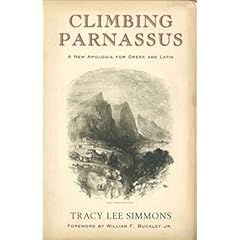
Climbing Mt. Parnassus


I had never heard of this book until Myrtle left this comment:

Tracy Lee Simmons "Climbing Parnassus" is even more divergent. It traces the history of classical education throughout the centuries and chronologically speaking should be read before Diane Ravitch's "A Century of Failed School Reforms" which picks up about in 1900 where Simmons leaves off.

The difference between Simmons and Wise Bauer is that Simmons gives you the "whys" of classical education and Wise-Bauer gives the "hows." I would summarize her hows as being for non-expert parents. Her area of expertise is writing and English, not physics and math and while her recommendations in those areas certainly won't send anyone into an educational death spiral, they also aren't nearly as clever and insightful as what she has to say about English, composition, history, and foreign language.


and here is an excerpt from Well-Trained Mind: left by Concerned Parent:

The Parrot Years:

Houses rest on foundations. Journalists gather all the facts before writing their stories; scientists accumulate data before forming theories; violinists and dancers and defensive tackles rely on muscle memory, stored in their bodies by hours of drill.

A classical education requires a student to collect, memorize, and categorize information. Although this process continues through all twelve grades, the first four grades are the most intensive for fact collecting.

This isn't a fashionable approach to early education. Much classroom time and energy has been spent in an effort to give children every possible opportunity to express what's inside them. There's nothing wrong with self-expression but when self-expression pushes the accumulation of knowledge offstage, something's out of balance.

Young children are described as sponges because they soak up knowledge. But there's another side to the metaphor. Squeeze a dry sponge, and nothing comes out. First the sponge has to be filled.

[snip]

So the key to the first stage of the trivium is content, content, content. In history, science, literature, and, to a lesser extent, art and music, the child should be accumulating masses of information: stories of people and wars; names of rivers, cities, mountains, and oceans; scientific names, properties of matter, classifications; plots, characters, and descriptions. The young writer should be memorizing the nuts and bolts of language-- parts of speech, parts of a sentence, vocabulary roots. The young mathematician should be preparing for higher math by mastering the basic math facts."


If you haven't noticed yet, Amazon has a dandy new rotating-books carousel feature that lets you scroll through all the other related books people who purchased the book you're looking at purchased. What a fantastic research shortcut. If I know a book is good -- or, more importantly, that it's considered good by the experts whose work I'm writing about* --- I can instantly learn what other books are in its category.

I found Animals in Translation in the carousel for The Psychology of Learning and Behavior by Barry Schwartz, which is causing me to contemplate purchasing it just to find out what the connection is specifically.

Back to Mt. Parnassus; the carousel there has one book I own and like very much: The Laurel Wreath and Harp: Poetry and Dictation for the Classical Curriculum.

Another 3 I'm interested in:


* make that trying to write about

School performance info - your predictions?

I wanted to share information on an interesting experiment going on in Sumner County, Tennessee, and solicit predictions.

One of my clients, an organization called the Education Consumers Foundation, has been doing a lot of work with value-added data in Tennessee. (For those unfamiliar with value-added, it basically allows you to isolate and measure schools' contribution to student learning, regardless of the socioeconomic, etc. characteristics of their students.) Tennessee has the most advanced value-added system in the country and has been collecting data since the early 90s, so there's a rich pool of good data available from the state here.

While Tennessee offers great information on the performance of its elementary and middle schools, we've found that almost no one is aware of this data or understands what it means. So we've launched a pilot initiative to see what happens once parents and other community members are given this information.

Last Monday, we sent a package of information to every household in Sumner County - 55,300 pieces in all - containing an introductory letter and a brochure with school-by-school information on their value-added performance rankings, TCAP proficiency rates, and free/reduced lunch rates (a proxy for poverty). I've posted these materials in PDF format: you can download the letter here and the brochure here.

IMHO, I think this is powerful stuff, but we're just at the very beginning stage of the pilot. I'd like to think it's going to make a huge impact, but it's entirely possible that it will be ignored.

I'd love to hear thoughts on this initiative from other KTM folks, and your predictions for what will happen in Sumner County. Will the community at large ignore this? Is it likely to create a significant conversation in the community? Will people push their local schools to improve?

Essentially - is this the path to real school improvement, or is this mailing going to fall on deaf ears?

If anyone's interested, I'll share updates as we go along - as I mentioned, the mailing just dropped last week, so it will take a while for this to all play out.

(For clear and complete disclosure purposes, I'll repeat that ECF is a client, but I don't feel any conflict of interest in posting about this initiative - they're a nonprofit group and have nothing to gain from this. If there are any issues, I'll trust in Catherine to remove this post.)

Wednesday, November 28, 2007

brute memorization

Terrific post from Instructivist on the subject of memory and memorization.

This is something I've struggled with: how to distinguish "brute memorization" (my term for it) from "natural memorization" or, in instructivist's phrase, "thoughtful memorization."

Constructivist philosophy defines the word "memorization" as most folks do: the student sits down with a set of flash cards and commits material to memory.

I assume (don't know) that the flash card approach is essential in some realms: foreign language courses, law school, med school.....yes?

But "brute memorization," generally speaking, probably isn't the best way to go about acquiring knowledge, and is not the method a knowledge-focused curriculum like Saxon Math employs.

Unfortunately, we don't have a term for the kind of memorization Saxon Math induces.

Saxon Math produces memorization via spaced repetition, which is, I believe, the way everyday life produces memorization.

Here is my sense of the way in which natural memorization works:

  • content to be committed to memory is broken into the smallest meaningful units
  • the smallness of the units allows each unit to be held in working memory (or consciousness) in its entirety

  • in time the units being practiced naturally enter long-term memory

This seems to be the way most material enters long-term memory in the day to day. One repeatedly encounters and/or practices an idea or skill until one simply "has it."

Example.

I'm going to guess that quite a few ktm readers and commenters now possess a usable or at least semi-usable definition of the term working memory.

Did you acquire this by sitting down with a flash card and rotememorizing it?

No.

You acquired a usable knowledge of working memory by repeatedly encountering the term in posts and comments until you remembered it.

This process is natural, and it is inevitable. Memory is a core function of the brain; people who don't remember things have brain disorders. Bad ones.

Constructivist antipathy to memory and remembering is quite perverse -- it is unnatural, as a matter of fact -- but it is consistent with constructivist antipathy to knowledge.

The brain naturally acquires knowledge. Yes, I know the brain does not naturally acquire knowledge of algebra absent a good textbook and teacher ( ! )

However, if you have a good textbook and/or teacher it is entirely natural to acquire knowledge of algebra whether you give a damn about algebra or not. As a matter of fact, it's entirely natural to acquire some knowledge of algebra even with a mediocre textbook and a so-so teacher. Repeated practice causes us to remember what we've practiced, period.

If you don't want students acquiring knowledge, you're going to have to oppose memory and memorization.

.....................................

As to direct memorization and its place in formal education or in any training program, my sense is that it is often the fastest route to remembering. From time to time Saxon will tell the student, "Memorize this." His meaning is always: You're going to need this, you're going to use this, just go ahead and memorize it.

Direct memorization is a shortcut.

I think.

.....................................

hmmm...

Direct memorization
probably isn't a bad term for the kind of simple, straightforward, put-it-on-a-flashcard-and-practice-it memorization constructivists call "rote."