

 Posts
Posts


Susan Boyle
second place
She reminds me of Temple. (Amazon has a wonderful video of her.)
Saturday, May 30, 2009


"almost by happenstance"
Third time I'm posting this passage from Atul Gawande's The Cost Conundrum, but it bears repeating:
A couple of years ago, I spent several days [at Mayo Clinic] as a visiting surgeon. Among the things that stand out from that visit was how much time the doctors spent with patients. There was no churn—no shuttling patients in and out of rooms while the doctor bounces from one to the other. I accompanied a colleague while he saw patients. Most of the patients, like those in my clinic, required about twenty minutes. But one patient had colon cancer and a number of other complex issues, including heart disease. The physician spent an hour with her, sorting things out. He phoned a cardiologist with a question.“I’ll be there,” the cardiologist said.
Fifteen minutes later, he was. They mulled over everything together. The cardiologist adjusted a medication, and said that no further testing was needed. He cleared the patient for surgery, and the operating room gave her a slot the next day.
The whole interaction was astonishing to me. Just having the cardiologist pop down to see the patient with the surgeon would be unimaginable at my hospital. The time required wouldn’t pay. The time required just to organize the system wouldn’t pay.
The core tenet of the Mayo Clinic is “The needs of the patient come first”—not the convenience of the doctors, not their revenues. The doctors and nurses, and even the janitors, sat in meetings almost weekly, working on ideas to make the service and the care better, not to get more money out of patients. I asked Cortese how the Mayo Clinic made this possible.
“It’s not easy,” he said. But decades ago Mayo recognized that the first thing it needed to do was eliminate the financial barriers. It pooled all the money the doctors and the hospital system received and began paying everyone a salary, so that the doctors’ goal in patient care couldn’t be increasing their income. Mayo promoted leaders who focussed first on what was best for patients, and then on how to make this financially possible.
No one there actually intends to do fewer expensive scans and procedures than is done elsewhere in the country. The aim is to raise quality and to help doctors and other staff members work as a team. But, almost by happenstance, the result has been lower costs.
THE COST CONUNDRUM by Atul Gawande THE NEW YORKER JUNE 1, 2009
This is a case of unintended consequences working for us instead of against us.
freakonomics blurbs the most expensive health care in the world
here
Unfortunately, they leave out Gawande's central claim, which is that good health care costs less because good health care organizations place the needs of the patient first. Above the needs of the doctors, nurses, administrators, & c.
I would like to know how true this is of health care, broadly speaking, and I would particularly like to know how true this is of education.
If the needs of students were more important than the needs, wishes, and desires of the adults, would public education cost less than it does?
I think the answer is yes.
in a nutshell
Unfortunately, they leave out Gawande's central claim, which is that good health care costs less because good health care organizations place the needs of the patient first. Above the needs of the doctors, nurses, administrators, & c.
I would like to know how true this is of health care, broadly speaking, and I would particularly like to know how true this is of education.
If the needs of students were more important than the needs, wishes, and desires of the adults, would public education cost less than it does?
I think the answer is yes.
in a nutshell
- Rochester, Minnesota, where the Mayo Clinic dominates the scene, has fantastically high levels of technological capability and quality, but its Medicare spending is in the lowest fifteen per cent of the country—$6,688 per enrollee in 2006, which is eight thousand dollars less than the figure for McAllen.
- Two economists working at Dartmouth, Katherine Baicker and Amitabh Chandra, found that the more money Medicare spent per person in a given state the lower that state’s quality ranking tended to be.
- The core tenet of the Mayo Clinic is “The needs of the patient come first”—not the convenience of the doctors, not their revenues. The doctors and nurses, and even the janitors, sat in meetings almost weekly, working on ideas to make the service and the care better, not to get more money out of patients. I asked Cortese how the Mayo Clinic made this possible. THE COST CONUNDRUM by Atul Gawande THE NEW YORKER JUNE 1, 2009
iConverse
For years we've been looking for an assistive communication device for Andrew that a) talks and b) doesn't cost several thousand dollars. The Dynamo, which Andrew used for 3 years, was impossible. He understood it, we didn't.

These days at home & abroad Andrew uses either an old AlphaSmart or a new Neo, but neither can speak. (For various reasons, I believe talking devices help an autistic person learn to 'hear' and to talk.)

We need something that doesn't cost many thousands of dollars and does talk. (Also: I want something with information architecture I am able to comprehend because it is intuitively obvious not because I spent hours reading the instruction manual and engaging in deliberate practice.)
Looks like the iTouch apps people just produced what I'm looking for: iConverse.
Costs ten bucks.

Of course, I'd hate to lay odds on just how long an Andrew owned and operated iTouch would last. This morning he left his AlphaSmart on a hot burner.
It's still working.

These days at home & abroad Andrew uses either an old AlphaSmart or a new Neo, but neither can speak. (For various reasons, I believe talking devices help an autistic person learn to 'hear' and to talk.)

We need something that doesn't cost many thousands of dollars and does talk. (Also: I want something with information architecture I am able to comprehend because it is intuitively obvious not because I spent hours reading the instruction manual and engaging in deliberate practice.)
Looks like the iTouch apps people just produced what I'm looking for: iConverse.
Costs ten bucks.

Of course, I'd hate to lay odds on just how long an Andrew owned and operated iTouch would last. This morning he left his AlphaSmart on a hot burner.
It's still working.
Friday, May 29, 2009
3 to 1
GROVER J. “RUSS” WHITEHURST: One of the points, Jane, that's made is that if we had linked data systems, we would be able to have a fair accounting of what works and what doesn't. My bias is it's a lot harder than just having the data systems. But you’re an expert on this.
JANE HANNAWAY: [W]e were focusing on in particular was value-added measures of teachers. Teachers, I think, are arguably, and there is evidence to show the most important in-school factor affecting student achievement, number one.
Number two, there’s huge variability across teachers and how productive they are, a three to one ratio in terms of teachers who are at the low end of the distribution and teachers at the high-end of the distribution.
[snip]
Determining which of those teachers are indeed the most productive ones is a difficult technical task that we're working on. I think the bottom line, where we are right now, is that we can estimate these differences fairly well, not perfectly.
FACING THE FUTURE: FINANCING PUBLIC SCHOOLS
Monday, December 1, 2008
JANE HANNAWAY: [W]e were focusing on in particular was value-added measures of teachers. Teachers, I think, are arguably, and there is evidence to show the most important in-school factor affecting student achievement, number one.
Number two, there’s huge variability across teachers and how productive they are, a three to one ratio in terms of teachers who are at the low end of the distribution and teachers at the high-end of the distribution.
[snip]
Determining which of those teachers are indeed the most productive ones is a difficult technical task that we're working on. I think the bottom line, where we are right now, is that we can estimate these differences fairly well, not perfectly.
FACING THE FUTURE: FINANCING PUBLIC SCHOOLS
Monday, December 1, 2008
Luxembourg & me
GROVER J. “RUSS” WHITEHURST: One is just on the expenditure side you've heard that we spend a lot. You get a sense of how much if you look at the OECD data.
For the primary grades, the U.S. is an outlier. Only Luxembourg spends more than we do. And our outlier position has been going up every year.
So we’re spending a lot. On international assessments, our results are mediocre at best. So we're spending a lot. We're getting mediocre results.
FACING THE FUTURE: FINANCING PUBLIC SCHOOLS
Monday, December 1, 2008
Vlorbik on what authors do
"sit at the typer and open a vein"
works for me; this appears to be
an exercise for *experts*.
b-ass ackwards
what do authors do?
Four Blocks by Doug Sundseth
Vlorbik on what authors do
cranberry on the real world
Writing Block
Sifting and Sorting Through the 4-Blocks Literacy Model
works for me; this appears to be
an exercise for *experts*.
b-ass ackwards
what do authors do?
Four Blocks by Doug Sundseth
Vlorbik on what authors do
cranberry on the real world
Writing Block
Sifting and Sorting Through the 4-Blocks Literacy Model
house
One of the questions in my mind this year, with C. attending Hogwarts, has been: why is the place so happy?
Somehow, the school motivates the kids to work hard and strive, and yet the winner-take-all burnout culture that often exists in high-performing public high schools doesn't exist there.
Why is that?
I don't know the answer, although I think it has to do with the fact that the kids develop a group identity the first day they arrive, when they attend a formal induction ceremony held in a nearby chapel.
In the ceremony a senior escorts each of the new boys up the center aisle of the sanctuary to the chancel, where a priest holding a mace blesses him and presents him with a freshman pin he is to wear on his jacket. Then he joins his mentor group standing off to the side.
I assume the mentor groups are related to the house system in British boarding schools:
the house system
If I were starting a charter school I'd want it to have a House system.
how to create a virtual culture
Anonymous on competition & "positive compulsions"
Somehow, the school motivates the kids to work hard and strive, and yet the winner-take-all burnout culture that often exists in high-performing public high schools doesn't exist there.
Why is that?
I don't know the answer, although I think it has to do with the fact that the kids develop a group identity the first day they arrive, when they attend a formal induction ceremony held in a nearby chapel.
In the ceremony a senior escorts each of the new boys up the center aisle of the sanctuary to the chancel, where a priest holding a mace blesses him and presents him with a freshman pin he is to wear on his jacket. Then he joins his mentor group standing off to the side.
I assume the mentor groups are related to the house system in British boarding schools:
the house system
Can competition and camaraderie coexist? They do in Highlands Latin School’s house system.
At first it may seem that competition and camaraderie are at odds, and sometimes they probably are. But in Highlands Latin School’s house system, they seem to go together quite well. A traditional fixture of many British schools, the “house” system has enabled Highlands to accomplish a number of goals that can be elusive for many schools.
The Origins of the “House” System
The house system is widely used in British schools and schools that model themselves after the British system in countries with past British colonial ties, such as Australia, Canada, Hong Kong, India, and Singapore. The system began in boarding schools, where students actually ate, drank, and slept in individual houses during school terms. The house system still operates this way in prestigious British boarding schools, such as Harrow, Eton, and Winchester College.
But, perhaps because of its obvious merits, the system is now used even in day schools, where the term ‘house’ refers simply to groupings of pupils, with no buildings involved. The houses are usually named after Christian saints or for famous persons historically connected with the school.
[snip]
At Highlands Latin School in Louisville, Kentucky, the advantages of the house system have been manifold. The houses provide not only an increased sense of identity and belonging, they also provide students with a sense of tradition. Leadership opportunities also abound in the house system.
Highlands, which is an outgrowth of the work of Cheryl Lowe, founder of Memoria Press, has seen a marked change in the attitude of students as a result of the establishment of the houses. “Because of the competition and the identification of each student with a house,” says Martin Cothran, a Highlands instructor and a co-director of the school, “there are constant opportunities to cheer your fellow students on. The positive attitudes of students toward one another and toward the school have been quite amazing since we started our program.”
The sense of tradition is palpable too. The Highlands house system, which is only a year old, already has about it the sense of history.
[snip]
The feature of the houses most popular with students is the competitions. At Bingley Grammar School in West Yorkshire, England, houses compete on the basis of academics, attendance, and sports. Sports competition includes cross country, netball, rugby, and table tennis. At Highlands, students compete in academics, community service, and sports, including dodgeball, soccer, ultimate frisbee, kickball, and volleyball. They also compete in chess and Latin Scrabble.
Academic competition is based on GPA. Houses are given points on the basis of how house teams perform in academic quick recall competitions. Community service points might be given on the basis of which house turned out the most members to sing at a rest home.
House
If I were starting a charter school I'd want it to have a House system.
how to create a virtual culture
Anonymous on competition & "positive compulsions"
Anonymous on competition & "positive compulsions"
Competition used to be a regular part of school: posting the perfect scores on weekly spelling tests, who can get the most math problems done correctly in a given amount of time etc. Then someone decided that was bad, because if there are winners, there are losers. Of course, I'm sure that mainstreaming and heterogeneous grouping were heavily involved in that decision.
BTW, as the parent of several full-time elite athletes, I have observed that when kids get to a certain level they provide their own motivation; the coach's role is to help them increase their fitness, skills and tactics. I have frequently seen this in kids under 12; once instructed by the coach, the kids do significant conditioning and skills work outside of practices. However, athletes are given status and recognition not offered to outstanding students. Unfortunately.
I'm intrigued by this observation.
It relates to something I've been kicking around in my mind: how did I come to be a highly motivated student?
I often wonder whether I would have survived the constructivist schools we have now, and I tend to think the answer is 'no.'
I think the answer is 'no' because a constructivist project-based school wouldn't have given me the steady supply of positive reinforcement my traditional school did. I was a straight-A student & all assignments were what today we called "short timeline." I was positively reinforced so often that studying and all forms of school work became what Eric Hollander calls a "positive compulsion."
more anon
update 3:28 pm
[T]hey don't NECESSARILY have the motivation from the beginning; some do, some don't. If they don't have/acquire it, they don't last long at the elite level. If they don't work on their own, they drop in relation to the kids who do and they get cut from the team. That bothers some people, but not everyone has the same interests. There's a finite amount of time and kids have different priorities. Someone who drops from an elite team to a less-competitive one, so he can spend more time on band/orchestra (or anything else) is making a perfectly rational decision to spend most of his extracurricular time on the activity he likes most. I don't see that as a problem, although some do.
BTW, I have never seen a situation where parents were pushing the kid into a sport he didn't want to do, or to do on at a full-commitment level, that lasted more than short term. You can't make kids get up at 4:00 am two or three days a week for swim practice for very long. Or make a young soccer player work on skills for at least half an hour a day, even if there is practice.
When I taught for Johns Hopkins CTY, we were told that this kind of intrinsic motivation is the hallmark of gifted children. Parents don't force gifted children to practice for hours; the children want to do it.
incentivizing, charting & kids in differentiated instruction classrooms
re: Allison's post "How to Incentivize Them," I'm digging out from under & have just come across a study of coaches using self-charting to incentivize a swim team. The kids on the team were ages 16 to 19.
The little girl who went on strike because they took away the charts raises a question for me.
Do kids in differentiated instruction classrooms get enough feedback / positive reinforcement?
applications of behavior analysis to human performance in various sports
The present study was composed of two experiments aimed at solving the problems of competitive swimming coaches who described their team's attendance and work rates as poor and irregular. ...All behavioral applications were conducted in the on-going environment by the coaches themselves.
Attendance at training was poor and irregular. Apart from not attending, swimmers sometimes arrived late and left early and in some instances did not enter the water. ...The coaches had attempted to enforce rules of attendance and participation in training. These were implemented by simply stating the rule conditions. ...These attempts failed to improve swim-practice attendance.
The coaches were also concerned with the effect and amount of swimming being done in practices where traditional coaching methods were employed. For the most part, swimmers followed identical programs of work and were directed and encouraged in their efforts by the verbal commands of the coaches. Quite often, swimmers were subjected to arbitrary delays while they waited for further direction. These delays severely reduced the swimmers' work loads and gave them time to behave inappropriately by leaving the water, interfering with others, etc. These behaviors further reduced the productivity of the training session.
The traditional coaching procedures also seemed to reduce the effectiveness of the coaches. They were required to function as directors and supervisors who regulated the swimmers' pool usage. Attempts were made to control inappropriate behaviors. As a result, the coaches were forced to spend less time in more suitable roles, such as improving stroke techniques and attending to individual demands.
Self-administered reinforcing systems appear to possess behavior maintenance possibilities (Glynn, 1970; Malott, 1971). Self-recording techniques modified classroom studying and talking-out behaviors (Broden, Hall, and Mitts, 1971) and academic achievement (Glynn, 1970). In normal subject applications, self-reinforcement procedures have generally been shown to be as effective as experimenter-determined contingencies (Bandura and Perloff, 1967; Kanfer and Duerfeldt, 1967; Marston, 1967). Two studies appear to have direct bearing on the problems involved in this investigation. Hall, Christler, Cranston, and Tucker (1970) demonstrated that being on time for class contingent upon the posting of names on the classroom bulletin board effectively reduced the number of late arrivals in a required classroom situation to almost zero. Rushall and Pettinger (1969) reported that self-recording on "program boards" increased the work output of competitive swimmers in training as much as did deliberate coaching procedures aimed at inspiring greater productivity.
Santogrossi, O'Leary, Romanczyk, and Kaufman (1973) reported that self-evaluation procedures failed to reduce disruptive behaviors in adolescent boys from a psychiatric hospital school. They indicated that the supportive studies for the value of self-reinforcing contingencies generally have used normal subjects and have been conducted only over brief periods of time. Their investigation was undertaken over a longer period than the above referenced studies, and they cautioned about generalizing the evidenced short-term effects of self-reinforcement to longer-term situations. Since the present study attempted to provide permanent solutions to two behavior problems, this caution could be clarified by the evidenced outcomes.
[snip]
This study involved the use of publicly self-recording attendance to reduce attendance problems in a competitive swimming team.
[snip]
The members of the Shannon Heights Sharks competitive swimming team from Dartmouth, Nova Scotia, Canada served as subjects. The team, composed of 16 boys and 16 girls, whose ages ranged between 9 and 16 yr, practised eight times per week in a 25-yard pool.
[snip]
A large waterproof display board was constructed, on which each swimmer could indicate his/her cumulative attendance at practice. Spaces were also provided for the recording of each swimmer's present and best attendance records. Prominent spaces were reserved for the posting of the names of those who had the best records. During the experimental conditions, each swimmer indicated attendance at practice by entering a check-mark in the appropriate space. A swimmer who did not satisfy the conditions for attendance had his/her total accumulated checkmarks removed.
[snip]
The measurements were the number of absentees, number of late arrivals, and the number of swimmers leaving early. All interobserver reliabilities were 100%.
[snip]
Under attendance board conditions, the number of absentees was reduced by 45%,. Late arrivals were reduced by 63%, and early departures were completely suppressed. Post checks indicated that the attendance board remained effective in controlling the problems of attendance.
[snip]
DISCUSSION
The attendance board conditions were effective in the overall reduction of the problem behaviors associated with attending swimming training. The group as a whole was enthusiastic about the use of the boards. Many swimmers who had valid excuses for being absent attempted to arrange substitute practices on Sundays and early mornings. After 11 months of use, the record number of consecutive attendances was in excess of 130.
[snip]
The swimmers recorded their own attendance. Two senior squad members supervised the board and its use. Apart from the initial introduction of each experimental condition, the coaches were required to do little in the experiment. Occasionally, after practice they remarked on the progress of individuals. They were relieved of the bothersome task of checking attendance. The procedures demanded that the swimmer focus his/her attention on the task of self-recording. This served as a form of knowledge of progress as the number of consecutive attendances accumulated. The recording procedure was always undertaken with the team in close proximity. The possibility for vicarious reinforcement existed. The various performances of individuals drew a number of reactions from the gathered members. Peer and coach reactions were primarily positive approval and recognition. It was not possible to locate one single event as the reinforcer in this situation.
[snip]
EXPERIMENT II
This study involved the use of publicly self recording training-unit completion to increase work output in a competitive swimming team.
[snip]
A number of reactions to the program boards were gathered. Most of the swimmers in the club appeared to prefer the use of the program boards to the previous coach-directed form of control. One girl, however, stated: "I don't like them. They make me work too hard." A striking incident demonstrated another girl's preference for using the boards. During the reversal procedure, when the board had been removed from her pool lane, she demanded to swim where there was one. When this request was refused, she left practice and did not return for two days.
[snip]
After 12 months, the contingencies were still in effect and the behaviors generated in the study still evident. It would seem that the characteristics of publicly self-recording performance progress in both work output and attendance is a durable reinforcing process.
EFFECTS OF SELF-RECORDING ON ATTENDANCE AND PERFORMANCE IN A COMPETITIVE SWIMMING TRAINING ENVIRONMENT
THOMAS L. MCKENZIE AND BRENT S. RUSHALL1
JOURNAL OF APPLIED BEHAVIOR ANALYSIS
1974, 73,199-206 NUMBER 2 (SUMMER 1974)
The little girl who went on strike because they took away the charts raises a question for me.
Do kids in differentiated instruction classrooms get enough feedback / positive reinforcement?
applications of behavior analysis to human performance in various sports
Thursday, May 28, 2009
How to Incentivize Them
The quality of patient care when focused on the patient, the unresponsive school district, Precision Teaching, business acumen, and Don't Shoot the Dog. The connection is
Incentives Matter.
We need to Incentivize the behaviors we want to see more of.
Behavioral Science has shown us that We Improve What We Measure. Positive Reinforcement works best by measuring successes and rewarding them. But even just charting the results with no other reward improves the outcome for what's measured.
So we better measure the right things.
What outcomes do we want to incent?
Often, we're talking about this at the student level. But what if we turned it around, and instead of using e.g. Precision Teaching just on students, we did it to the teachers? The principal? The School Board?
Seriously, if we want transparency from the school board, can we chart it? What if we kept a celeration chart on the web showing the District' Response Time to a parent's request for data? Just KNOWING the chart is publicly available should have an effect.
Or how about keeping a chart showing number of conversations board members have per week with non ed-speak people? ie.e parents or students?
Or a chart showing the number of conversations had without a lawyer present in the room?
Or a chart showing how many parent suggested curricula/materials/ideas were adopted?
Any other suggestions for what behaviors we want to incentivize? Any suggestions for the metrics to do it?
How about in the classroom, by the teacher? How about at the principal level?
Any chance we could get a school board to adopt putting the celeration chart for their principals/teachers/etc on their web site? That would really make a difference.
Incentives Matter.
We need to Incentivize the behaviors we want to see more of.
Behavioral Science has shown us that We Improve What We Measure. Positive Reinforcement works best by measuring successes and rewarding them. But even just charting the results with no other reward improves the outcome for what's measured.
So we better measure the right things.
What outcomes do we want to incent?
Often, we're talking about this at the student level. But what if we turned it around, and instead of using e.g. Precision Teaching just on students, we did it to the teachers? The principal? The School Board?
Seriously, if we want transparency from the school board, can we chart it? What if we kept a celeration chart on the web showing the District' Response Time to a parent's request for data? Just KNOWING the chart is publicly available should have an effect.
Or how about keeping a chart showing number of conversations board members have per week with non ed-speak people? ie.e parents or students?
Or a chart showing the number of conversations had without a lawyer present in the room?
Or a chart showing how many parent suggested curricula/materials/ideas were adopted?
Any other suggestions for what behaviors we want to incentivize? Any suggestions for the metrics to do it?
How about in the classroom, by the teacher? How about at the principal level?
Any chance we could get a school board to adopt putting the celeration chart for their principals/teachers/etc on their web site? That would really make a difference.
how to create a virtual culture
Why do people actually study when they go to college? Why do they complete any assignment? Why in the world does delaying real life for several years while they are young to spend time in serial windowless rooms with tiny desks seem normal? It's not even so much that it's important, because there's little evidence at the time that it's Important enough to forego other activities for several years when those other activities have immediate knowable rewards. Humans simply aren't built to be rational in that way, able to weigh competing hypotheses with accurate probabilities. They need immediate reinforcement and rewards, and the long term rewards of career or salary have little to do with it. The medium term rewards of encouragement, respect, and pride from loved ones is also too far off to have much to do with it.
The (housed-near-campus) university system works, largely, by creating a kind of group delusion that what you're doing in school right now is normal. It works because the majority of your peers are doing the same thing: going to class, going to coffee or the library to study, going home to repeat until done. Breaking out of that cycle would cause concern or worry on your behalf by many; shame or humiliation could come. The system keeps reinforcing as long as a critical mass of people all believes the same way.
Telepresence can't create this. Remote distance learning can't create this. What structures can create enough social capital that someone would do the studying/work necessary to succeed? Family can, especially if the children are housed at home. But if you are on your own, what else can create this level of reinforcement? Of positive reinforcement for studying, and negatively reinforcing punting?
Someone suggested an idea to me, and I thought of another. Both are based on competitions (does this work better for men than women?)
The first is a team, led by a coach that competes against other teams.
The second is a set of individual competitions.
I still see that the second one is more difficult to work on; you need something to force you to buy into the peer group you are competing against. But the first idea has promise.
No one maligns the use of drills in competition sports. But the more interesting aspect is what you owe each other. You wouldn't want to let your team down, so you do the drill. If you don't, your coach benches you. Your individual strengths are pushed, and still you're expected to support each other rather than rest on the other members' skills. Both the intra-team competition and inter-team competition can really motivate, if you really buy into the notion that you're a team.
Now, to me, teams succeed or fail based on their coach. What skills do coaches have that teachers should have but often don't?
Without a coach, though, I think this system fails--it too easily becomes gamed by the students replacing real competition with their own "fake" competition. Someone needs to prevent everyone from just defaulting, and someone needs to reinforce shame and pride when appropriate.
Of course, there's nothing limiting this model only to virtual schooling. Even in real classrooms, team competition could help create a culture of success. How many competitions happen inside a KIPP school?
The (housed-near-campus) university system works, largely, by creating a kind of group delusion that what you're doing in school right now is normal. It works because the majority of your peers are doing the same thing: going to class, going to coffee or the library to study, going home to repeat until done. Breaking out of that cycle would cause concern or worry on your behalf by many; shame or humiliation could come. The system keeps reinforcing as long as a critical mass of people all believes the same way.
Telepresence can't create this. Remote distance learning can't create this. What structures can create enough social capital that someone would do the studying/work necessary to succeed? Family can, especially if the children are housed at home. But if you are on your own, what else can create this level of reinforcement? Of positive reinforcement for studying, and negatively reinforcing punting?
Someone suggested an idea to me, and I thought of another. Both are based on competitions (does this work better for men than women?)
The first is a team, led by a coach that competes against other teams.
The second is a set of individual competitions.
I still see that the second one is more difficult to work on; you need something to force you to buy into the peer group you are competing against. But the first idea has promise.
No one maligns the use of drills in competition sports. But the more interesting aspect is what you owe each other. You wouldn't want to let your team down, so you do the drill. If you don't, your coach benches you. Your individual strengths are pushed, and still you're expected to support each other rather than rest on the other members' skills. Both the intra-team competition and inter-team competition can really motivate, if you really buy into the notion that you're a team.
Now, to me, teams succeed or fail based on their coach. What skills do coaches have that teachers should have but often don't?
Without a coach, though, I think this system fails--it too easily becomes gamed by the students replacing real competition with their own "fake" competition. Someone needs to prevent everyone from just defaulting, and someone needs to reinforce shame and pride when appropriate.
Of course, there's nothing limiting this model only to virtual schooling. Even in real classrooms, team competition could help create a culture of success. How many competitions happen inside a KIPP school?
help desk: Dolciani Algebra 2
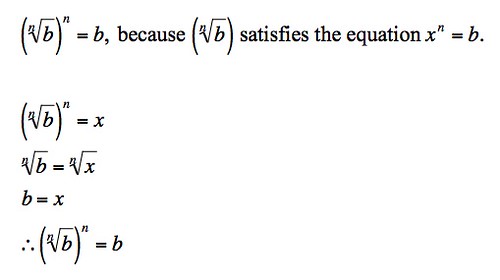
I don't follow Dolciani's statement at the top.
At all.
update 5.29.2009
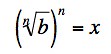
This equation doesn't follow from Dolciani's equation; I wrote it to see whether I would understand Dolciani's statement once I solved it.
Of course, I don't know whether I solved it. It seems to me I've got a problem with cases in which the exponent is an even number - ?
status quo la-la-la
....This makes sense when one considers the basic motive people have to defend and justify the status quo. People have a need to believe in a ‘‘just world’’ that is orderly and predictable and in which people get what they deserve (Lerner, 1980). According to system justification theory, people are motivated to view existing social arrangements as legitimate, even when this justifies their own disadvantaged position (e.g., Jost et al., 2004; Jost & Hunyady, 2002). In fact, those with the least power in a system are sometimes the most likely to support and defend that system (Henry & Saul, 2006; Jost et al., 2003). Research reveals that people actively perform their own cognitive and ideological work to preserve their sense that the status quo is desirable and just (e.g., Haines & Jost, 2000; Kay, Jimenez, & Jost, 2002).These researchers are looking at blacks and women, etc. I'm curious whether they would find similar phenomena in parents whose children are attending public schools.
There are psychological benefits to accepting the status quo. System-justifying beliefs and ideologies are palliative in that they decrease negative affect and increase positive affect as well as satisfaction with one’s situation (Jost & Hunyady, 2002; Jost et al., 2003). Wakslak and colleagues (2007) demonstrated that system justification leads to a significant reduction in emotional distress, both in general and with regard to moral outrage, guilt, and frustration.
Legitimacy Crisis? Behavioral Approach and Inhibition When Power Differences are Left Unexplained
Pamela K. Smith Æ John T. Jost Æ Ranjini Vijay
Soc Just Res (2008) 21:358–376
tactics used to maintain the status quo
Diagnosis Diagnosed by Galen Alessi
on a certain arrogance
inputs & outputs
a rare victory
code of silence
code of silence, part 2
Civil Politics .org
I've just found out about Jonathan Haidt's website, Civil Politics, which is mentioned in a Nicholas Kristof column. The resources page looks interesting.
In keeping with my small-l libertarianism, such as it is, I generally take an all's fair in love and war attitude towards "hyperpartisanship." I figure, let 'er rip.
On the other hand, I don't enjoy hyperpartisanship, especially....
Anyway, it looks interesting.
update 1:37pm
from the site:
Anything by E.D. Hirsch, anything by Siegfried Engelman, "Work Hard. Be Nice.," maybe even John Taylor Gatto.
In keeping with my small-l libertarianism, such as it is, I generally take an all's fair in love and war attitude towards "hyperpartisanship." I figure, let 'er rip.
On the other hand, I don't enjoy hyperpartisanship, especially....
Anyway, it looks interesting.
update 1:37pm
from the site:
To help liberals understand (and be civil to) conservatives:
- Read this paper on the psychological foundations of morality and ideology, by Jon Haidt and Jesse Graham.
- Read Ch. 9 of The Happiness Hypothesis, on the psychological dimension of divinity, which tries to explain what many religious people find objectionable about a purely secular culture.
- Read this book on the moral world of a "religious right" community, interpreted by a sympathetic sociologist (Spirit and Flesh, by James Ault).
- Read this book, one of the founding works of modern conservative thought. (The Conservative Mind: From Burke to Eliot. By Russell Kirk).
- Read this article on the lack of ideological diversity in psychology, and why the exclusion of conservatives harms the scientific and pro-social missions of psychology: Redding, R.E. (2001). Sociopolitical diversity in psychology: The case for pluralism. American Psychologist, 56, 205-215.
- Read this essay: What Makes People Vote Republican, by Jonathan Haidt, on Edge.org.
To help conservatives understand (and be civil to) liberals:
- Read this book on how diverse modern societies can keep some of the richness of traditional ways and identities while avoiding the ugliness of identity politics. (Cosmopolitanism: Ethics in a world of strangers. by Anthony Appiah).
- [we need more here: what essays can transmit the essential insights and compassion of liberalism in a way that conservatives will "get" and not be turned off by? Please send suggestions to haidt at virginia.edu]
Anything by E.D. Hirsch, anything by Siegfried Engelman, "Work Hard. Be Nice.," maybe even John Taylor Gatto.
Teambuilding
OK, next!
I have to sign a form to allow (everyone has to go) my son to go to a one-day adventure/team building camp which will challenge their "own inner strength". "Participants will be exposed to leadership and teamwork concepts through the use of mental and physical training." This will be using a "Low Ropes and/or High Ropes Course" at a National Guard facility. I don't know a thing about these people or what the program is, but I have to sign a form that says it's OK if my son comes home dead or paralyzed.
I suppose it wouldn't be so bad if they gave me a detailed description of what they will be doing, but I have nothing. When I talked to someone at the school, she said that she thought there might be a reaction to the "scary" forms. It's my problem, apparently. She did say that it was only going to be the "Low Ropes Course", but that's not what the paperwork says.
So, here we have a program that will try to push kids physically and mentally and to trust others. Kids will feel pressured to not trust their own judgment. Amazingly, this is actually part of a "Counterdrug Program". I'm being pushed mentally and pressured to trust them when I would rather
"just say no."
I have to sign a form to allow (everyone has to go) my son to go to a one-day adventure/team building camp which will challenge their "own inner strength". "Participants will be exposed to leadership and teamwork concepts through the use of mental and physical training." This will be using a "Low Ropes and/or High Ropes Course" at a National Guard facility. I don't know a thing about these people or what the program is, but I have to sign a form that says it's OK if my son comes home dead or paralyzed.
I suppose it wouldn't be so bad if they gave me a detailed description of what they will be doing, but I have nothing. When I talked to someone at the school, she said that she thought there might be a reaction to the "scary" forms. It's my problem, apparently. She did say that it was only going to be the "Low Ropes Course", but that's not what the paperwork says.
So, here we have a program that will try to push kids physically and mentally and to trust others. Kids will feel pressured to not trust their own judgment. Amazingly, this is actually part of a "Counterdrug Program". I'm being pushed mentally and pressured to trust them when I would rather
"just say no."
Wednesday, May 27, 2009
cranberry on the real world
We also don't want them to ask us how to spell for them. "The teacher won't spell for you" is a steadfast rule made clear to students in the beginning of the school year. It liberates the teacher, who has more important responsibilities, and liberates the students, too!
That once meant that the students were to look up the word in the dictionary. Now, everyone's busy with "more important responsibilities."
Just once in such writings, I'd love to see the glimmerings of the concept that perhaps parents are right when they implore schools to teach proper spelling, grammar, and traditional algorithms. Many teachers progress from college straight into the classroom, without a sojourn in the "outside" world. In the world outside the classroom, spelling, grammar, and penmanship count. Courtesy, good manners, perseverance and punctuality count too. The parents who are able to function in the professions, by and large, would prefer that their children leave school with these old-fashioned skills, because these skills are important.
b-ass ackwards
what do authors do?
Four Blocks by Doug Sundseth
Vlorbik on what authors do
cranberry on the real world
Writing Block
Sifting and Sorting Through the 4-Blocks Literacy Model
That once meant that the students were to look up the word in the dictionary. Now, everyone's busy with "more important responsibilities."
Just once in such writings, I'd love to see the glimmerings of the concept that perhaps parents are right when they implore schools to teach proper spelling, grammar, and traditional algorithms. Many teachers progress from college straight into the classroom, without a sojourn in the "outside" world. In the world outside the classroom, spelling, grammar, and penmanship count. Courtesy, good manners, perseverance and punctuality count too. The parents who are able to function in the professions, by and large, would prefer that their children leave school with these old-fashioned skills, because these skills are important.
b-ass ackwards
what do authors do?
Four Blocks by Doug Sundseth
Vlorbik on what authors do
cranberry on the real world
Writing Block
Sifting and Sorting Through the 4-Blocks Literacy Model
Four Blocks by Doug Sundseth
Real-author first-draft technique:
1) Stare at the blank page until drops of blood form on your forehead.
2) Dip your finger in the blood and write a sentence.
3) Repeat until done.
BTW, can somebody recommend a product that will remove blood from a monitor?
8-)
b-ass ackwards
what do authors do?
Four Blocks by Doug Sundseth
Vlorbik on what authors do
cranberry on the real world
Writing Block
Sifting and Sorting Through the 4-Blocks Literacy Model
1) Stare at the blank page until drops of blood form on your forehead.
2) Dip your finger in the blood and write a sentence.
3) Repeat until done.
BTW, can somebody recommend a product that will remove blood from a monitor?
8-)
b-ass ackwards
what do authors do?
Four Blocks by Doug Sundseth
Vlorbik on what authors do
cranberry on the real world
Writing Block
Sifting and Sorting Through the 4-Blocks Literacy Model
more is less
What a Texas town can teach us about health care: Costlier care is often worse care.
When the needs of the patient come first, medical care costs less.
Judging by the amount of money charter & parochial schools spend to educate children, compared to the amount public schools spend to not educate children, I'd say that principle will turn out to be true of schools, too.
McAllen [Texas] has another distinction, too: it is one of the most expensive health-care markets in the country. Only Miami—which has much higher labor and living costs—spends more per person on health care. In 2006, Medicare spent fifteen thousand dollars per enrollee here, almost twice the national average. The income per capita is twelve thousand dollars. In other words, Medicare spends three thousand dollars more per person here than the average person earns.
[snip]
I gave the doctors around the table a scenario. A forty-year-old woman comes in with chest pain after a fight with her husband. An EKG is normal. The chest pain goes away. She has no family history of heart disease. What did McAllen doctors do fifteen years ago?
Send her home, they said. Maybe get a stress test to confirm that there’s no issue, but even that might be overkill.
And today? Today, the cardiologist said, she would get a stress test, an echocardiogram, a mobile Holter monitor, and maybe even a cardiac catheterization.
“Oh, she’s definitely getting a cath,” the internist said, laughing grimly.
[snip]
Between 2001 and 2005, critically ill Medicare patients received almost fifty per cent more specialist visits in McAllen than in El Paso, and were two-thirds more likely to see ten or more specialists in a six-month period. In 2005 and 2006, patients in McAllen received twenty per cent more abdominal ultrasounds, thirty per cent more bone-density studies, sixty per cent more stress tests with echocardiography, two hundred per cent more nerve-conduction studies to diagnose carpal-tunnel syndrome, and five hundred and fifty per cent more urine-flow studies to diagnose prostate troubles. They received one-fifth to two-thirds more gallbladder operations, knee replacements, breast biopsies, and bladder scopes. They also received two to three times as many pacemakers, implantable defibrillators, cardiac-bypass operations, carotid endarterectomies, and coronary-artery stents.
[snip]
Rochester, Minnesota, where the Mayo Clinic dominates the scene, has fantastically high levels of technological capability and quality, but its Medicare spending is in the lowest fifteen per cent of the country—$6,688 per enrollee in 2006, which is eight thousand dollars less than the figure for McAllen. Two economists working at Dartmouth, Katherine Baicker and Amitabh Chandra, found that the more money Medicare spent per person in a given state the lower that state’s quality ranking tended to be.
[snip]
That’s because nothing in medicine is without risks. Complications can arise from hospital stays, medications, procedures, and tests, and when these things are of marginal value the harm can be greater than the benefits. In recent years, we doctors have markedly increased the number of operations we do, for instance. In 2006, doctors performed at least sixty million surgical procedures, one for every five Americans. No other country does anything like as many operations on its citizens.
[snip]
I talked to Denis Cortese, the C.E.O. of the Mayo Clinic, which is among the highest-quality, lowest-cost health-care systems in the country. A couple of years ago, I spent several days there as a visiting surgeon. Among the things that stand out from that visit was how much time the doctors spent with patients. There was no churn—no shuttling patients in and out of rooms while the doctor bounces from one to the other. I accompanied a colleague while he saw patients. Most of the patients, like those in my clinic, required about twenty minutes. But one patient had colon cancer and a number of other complex issues, including heart disease. The physician spent an hour with her, sorting things out. He phoned a cardiologist with a question.
“I’ll be there,” the cardiologist said.
Fifteen minutes later, he was. They mulled over everything together. The cardiologist adjusted a medication, and said that no further testing was needed. He cleared the patient for surgery, and the operating room gave her a slot the next day.
The whole interaction was astonishing to me. Just having the cardiologist pop down to see the patient with the surgeon would be unimaginable at my hospital. The time required wouldn’t pay. The time required just to organize the system wouldn’t pay.
The core tenet of the Mayo Clinic is “The needs of the patient come first”—not the convenience of the doctors, not their revenues. The doctors and nurses, and even the janitors, sat in meetings almost weekly, working on ideas to make the service and the care better, not to get more money out of patients. I asked Cortese how the Mayo Clinic made this possible.
“It’s not easy,” he said. But decades ago Mayo recognized that the first thing it needed to do was eliminate the financial barriers. It pooled all the money the doctors and the hospital system received and began paying everyone a salary, so that the doctors’ goal in patient care couldn’t be increasing their income. Mayo promoted leaders who focussed first on what was best for patients, and then on how to make this financially possible.
No one there actually intends to do fewer expensive scans and procedures than is done elsewhere in the country. The aim is to raise quality and to help doctors and other staff members work as a team. But, almost by happenstance, the result has been lower costs.
“When doctors put their heads together in a room, when they share expertise, you get more thinking and less testing,” Cortese told me.
[snip]
The Mayo Clinic is not an aberration. One of the lowest-cost markets in the country is Grand Junction, Colorado, a community of a hundred and twenty thousand that nonetheless has achieved some of Medicare’s highest quality-of-care scores. Michael Pramenko is a family physician and a local medical leader there. Unlike doctors at the Mayo Clinic, he told me, those in Grand Junction get piecework fees from insurers. But years ago the doctors agreed among themselves to a system that paid them a similar fee whether they saw Medicare, Medicaid, or private-insurance patients, so that there would be little incentive to cherry-pick patients. They also agreed, at the behest of the main health plan in town, an H.M.O., to meet regularly on small peer-review committees to go over their patient charts together. They focussed on rooting out problems like poor prevention practices, unnecessary back operations, and unusual hospital-complication rates. Problems went down. Quality went up. Then, in 2004, the doctors’ group and the local H.M.O. jointly created a regional information network—a community-wide electronic-record system that shared office notes, test results, and hospital data for patients across the area. Again, problems went down. Quality went up. And costs ended up lower than just about anywhere else in the United States.
Grand Junction’s medical community was not following anyone else’s recipe. But, like Mayo, it created what Elliott Fisher, of Dartmouth, calls an accountable-care organization. The leading doctors and the hospital system adopted measures to blunt harmful financial incentives, and they took collective responsibility for improving the sum total of patient care.
The Cost Conundrum
by Atul Gawande
June 1, 2009
The New Yorker
When the needs of the patient come first, medical care costs less.
Judging by the amount of money charter & parochial schools spend to educate children, compared to the amount public schools spend to not educate children, I'd say that principle will turn out to be true of schools, too.
indentured service
a reader left this comment:
Hogwarts has some service trips that are fantastically fun, I'm told: especially the summer trip to Tennessee, where I think the kids help build houses.
I don't begrudge a Catholic school having a service requirement -- it's a Catholic school, after all. It's supposed to have a service requirement. The Jesuit motto is "Men for others," and that is what they teach.
One of the things I like about the service requirement in a Catholic school is that often a student's service is given to the school. In a wealthy public school that might get on my nerves, but in a Catholic school operating on a shoestring, I like it.
I live in the area of the Webster Magnet School. Although my kids do not attend that school, I have had a snootful of service learning projects assigned to my kids throughout the years. We have partnership schools in the suburbs where kids get together to "make friends" with kids in other areas of the city. I'm all for Feed the Children, but my daughter's class has been working on this project for the last 3 weeks, taking a field trip to the center. "Let's not teach history or proper English, let's teach service." The kids miss a lot of instructional time doing these projects. No wonder my husband and I are so tired. We have to teach them school subjects after they get home from school.
I feel I can't say anything negative about these programs because it is just not politically correct. Teachers love them. The principal loves them. Parents love them. "They are soooo good for the students and the community. A good way to build community in the school." I think it turns kids off to volunteerism.
Hogwarts has some service trips that are fantastically fun, I'm told: especially the summer trip to Tennessee, where I think the kids help build houses.
I don't begrudge a Catholic school having a service requirement -- it's a Catholic school, after all. It's supposed to have a service requirement. The Jesuit motto is "Men for others," and that is what they teach.
One of the things I like about the service requirement in a Catholic school is that often a student's service is given to the school. In a wealthy public school that might get on my nerves, but in a Catholic school operating on a shoestring, I like it.
Subscribe to:
Posts (Atom)