kitchen table math, the sequel

Saturday, February 24, 2007

your brain on bar diagrams

Somebody really did do a study on this. MRI of brain on bar diagram vs. traditional algebra.

"In Singapore schools, algebraic word problems are taught using two methods: formal algebra and model. The latter depicts relevant quantitative relationships between unknowns in a pictorial format. In this study, we used fMRI to investigate whether the two methods are subserved by different cognitive processes. "


It would have been more interesting to see this study done on children rather than adults. I'm guessing it would have turned out more like this:


teen brain - Jay Giedd

Adolescent Brain Development: Views from Structural Magnetic Resonance Imaging
Jay N. Giedd, MD
National Institute of Mental Health
see abstract

  • Magnetic resonance images show that the brain's gray matter thickens during adolescence—peaking around age 11 in girls and 12½ in boys—owing to an increase in connectivity, and then "prunes," or thins down as adulthood approaches.
  • Although the brain then has more choices of pathways through which to send signals, those pathways are not necessarily faster, making some processing inefficient.
  • White matter increases linearly during adolescence, while the cerebellum also grows in volume.
  • Adolescence is the most efficient time for motor learning, when teens can aptly take on such activities as sports, drawing, and instrumental music.
  • Links between MRI data and behavior cannot yet be made, but that is the goal of these studies.

peaking around age 11 in girls and 12½ in boys

So I'm thinking that basing decisions about admittance into accelerated & honors courses in maturity might be a tiny bit discriminatory, you think?

As might be a policy of teaching accelerated and honors courses only the most mature teen can handle.

see: the girl show


this part is cool

Adolescence is the most efficient time for motor learning, when teens can aptly take on such activities as sports, drawing, and instrumental music.

RedKudu: Saturday Circular

RedKudu: Saturday Circular

I am an education blog surfing fool. It's actually pretty pitiful since I actually do have a real job which has nothing to do with education. I continually run across new blogs though, and recently came across RedKudu, an english teacher with an attitude in Texas.

Though I doubt that I get much traffic that hasn't read her, just in case I want to point y'all over there to check him/her out, especially her Saturday Circulars.

Also check out her post entitled "Teacher Makes Students Cry"
Last week, I began a Stanford Experiment-inspired activity with my seniors, who are reading "Lord of the Flies." It was my intent to introduce to them the concept of group mentality, and the effects of unchallenged rumor and unquestioned leadership - all leading (hopefully) to a greater understanding of the behavior of the boys on the island. Friday I assigned them a simple project, a pamphlet about survival skills which I am later going to use to pave the way to their major research projects next six weeks (it's undoubtedly artsy, but it will have far-reaching impact). Then I allowed them the period to read silently, and begin working on the project.

Near the end of class, I removed a small group of students I’d been observing who had worked consistently all period, took them out in the hall, and told them I wanted them to go back and tell their friends that I had told them they didn’t have to do the project. But I warned them I wasn’t going to tell the other students anything about it. They all willingly agreed to be a part of the plan. (Note, none of the other students had behaved badly, but some had been off-task for some portion of time, and some had turned secretly to other homework. I knew they would later pinpoint this as the reason they were excluded.)

I’d intended for them to wait until they were outside of class, but didn’t time it quite right. A few of them asked their friends quietly what had happened out there, and they were told. The tension (and rumor) rocketed around the room as I pretended to be completely unaware behind my desk. When the bell rang, there were some choice words for me muttered under breaths, which I pretended not to hear.
You will need to click over to read the rest of the story, but it was quite an experiment. It also a perfect example about how to challenge students minds, open them up to new ideas, and instill critical thinking skills. If only we had more teachers like RedKudu.

writing prompt from Tex

Tex asked a great question:

Reading through your efforts, especially this week, to bring Christopher up to speed in order to perform well on his upcoming test, leads me to ask the question:
In hindsight (20/20), what would you have done differently over the last few years? I imagine this is not an easy question to answer because, from what I recall, you’ve “discovered” many things along the path to today. “It’s always worse than you think.”

I'd love to hear from everyone else on this one.

Ed and I talk about this because we're pretty sure that "accelerating" Christopher was a mistake.

I got going on all of this because of Wayne Wickelgren, who said that if you wanted your child to be on par with his peers in Europe and Asia you had to get him into the accelerated math track.

Which I then proceeded to do, aided and abetted by the folks at ktm-1.

Wickelgren was right, of course, but he wasn't looking at our situation here in Irvingtonland, where "Phase 4" math has traditionally been taught as a wash-out course.

On the bus the other day a friend of Christopher's said, "Ms. U. [legendary middle school math teacher, now retired] was a great teacher. She flunked people out of the course if they couldn't do the math. She got rid of them."

Ms. U. is the teacher who told a very large gathering of irate parents that she could take the top students in the district, put them in a room together, and still eke out a bell curve.

Ms. K was told, when she came to the district, to "hold down the number of As." I assume Ms. U. was the person who told her to do so, Ms. U. being chair of the department. Naturally parents were not apprised of this policy.

So....."accelerated" math in Irvington, which means algebra in 8th grade, isn't accelerated math.

It's a Darwinian reality show. In math. In 6th grade.

If we think constructivism is bad when it comes to relieving teachers of responsibility for student learning, a washout course has taken several giant steps down the road towards open sabotage of student learning.

e.g. you're a kid in this class, you're never shown how to do word problems in class, you're never assigned word problems on homework, you do your first word problems ever on the test and those word problems are multi-step!

When Ed and I ask ourselves what we would have done differently, item number one on the list is forget about "accelerated" math, take the Phase 3 course, and teach algebra to mastery on the side using the Saxon books.

At the same time.....on the principle of that which does not destroy me makes me strong I'm not completely persuaded that I would move Christopher to Phase 3 if I had it to do over again.

He's learned something about persistence and politics, and the district has taken heat it richly deserves. (Question: has any disadvantaged child taken Phase 4 math? Ever? I'm guessing the answer is 'no,' and I'm guessing that subject is going to be coming up.)

That question wouldn't be moving up the agenda if we hadn't had the radicalizing experience of Phase 4 math ourselves.

But that doesn't answer Tex's question.


trying again

If I were starting with a preschool child, knowing what I do now, I'd take my child to KUMON from the get-go if I could afford it.

If I couldn't afford it, I'd join edhelper.com, print out sequential worksheets and have my child do those.

I would teach a separate math curriculum at home from day one.

I think I'd probably choose Singapore Math for the early grades, then switch to Saxon as soon as my child got through the Primary Mathematics series.

I have two reasons.

  • I continue to feel that the "teach two ways to do it"* notion makes sense. Singapore and Saxon are quite different; Singapore feels foreign in its way; I like the "otherness" of the books. Remember deSaussure: meaning comes from difference.
  • The Singapore books are much shorter than the Saxon books, and easier to get through on the side.

If I could possibly get my child through Mathematics 6 book I'd do that, too.

I'd give the ITBS each and every year to make sure I was seeing at least a year's progress and to diagnose areas of weakness.

I would probably also formally adopt the CA state standards for use here at home (I may do that still).

And....I think that's it!

I'd love to hear from everyone else.


Mathematics 6 press release
Wayne Bishop on Mathematics 6
Russian Math thread at ktm 1


* Just two ways. Not multiple ways.

repeat after me

It's not about education. It's about politics.

Math Observations

In looking for basic math identities, I came across this site.

Observations and Opinions on Math Education by a Contrarian

http://hometown.aol.com/mathobservations/mathematics.html

There is commentary, but also lots of good math teaching advice. I like the focus on the basic identities, the early introduction of algebra, and tangents as an introduction to trig.

The commentary is very good too. This is the at the top of the main page.

Key Premise: Kids can learn significantly more math content, earlier and faster.

In my contrarian view, the road to college starts at home with homework supervision in 1st grade. If your child isn't learning enough arithmetic, then teach your child arithmetic.

Will your child be ready for college mathematics or end up taking remedial math courses? There is a disconnect between the math taught in school and the math content and skills colleges expect students to know. Our schools need to align curriculum with what colleges expect incoming students to know in mathematics.

There is much more. The site refers to this book and a few of its "secrets".


What Colleges Don't Tell You: 272 Secrets For Getting Your Kid into the Top Schools] by Elizabeth Wissner-Gross [EWG], Educational Strategist. One of EWG's main points is that students who get into the most competitive colleges often have the most parental support at home. Some of her Secrets are below.

Secret 66 Homework Supervision Successful parents participate in homework--even in high school and even for (especially for) the most successful students.

Secret 20 Always think of yourself as a home schooling parent. The most successful parents are those who treat their kids' high school as a supplement to the home school curriculum--even if their kid attends an outside high school full time. Like it or not, parents are primarily responsible for their children's education.

Secret 48 Reward hard work, not grades. Compliment, affirm, and occasionally reward your child for good studying and hard work--not for grades, becasue grades are given out by teachers, and hard work is performed by kids.


I looked up this book on Amazon to read the comments. Some of the "secrets" apparently are very manipulative. There are strong opinions both ways. I suspect that there are enough good secrets to be worth the price. I like the one about always thinking of yourself as a home schooling parent.


Here are comments on tutoring and helping out at home.

Tutoring: As the student was working a problem, I pointed out errors and showed how to correct errors (instant feedback), and, if the student was stuck, I showed the student how to work the problem (instant instruction). Note. This system of instant feedback and instant instruction works very well. Parents can do the same at home.

Doing homework with your child is not the same as doing your child's homework because the child works all the problems. The parent sits with the child and gives instant feedback, instruction, and encouragement as needed.

There is even a quote from Zig.

According to Zig Engelmann, "If the child hasn't learned, then the teacher hasn't taught. That is, if the child hasn't learned, then what the teacher did [instruction] is wrong."

The site is full of information. I wonder who it is.

assigned reading at schools of education

In the domain of foundations of education, the books most often required by the programs we reviewed were authored by Anita Woolfolk, Jonathan Kozol, Henry Giroux, Paulo Freire, Joel Spring, Howard Gardner, and John Dewey. Woolfolk’s work is a textbook in educational psychology, and one of Joel Spring’s volumes is a textbook in educational foundations. The rest are well-known works that embrace a constructivist and/or progressive standpoint. Conspicuously absent from almost all such syllabi were works that took a very different approach to teaching, such as those by E. D. Hirsch or Diane Ravitch. (We found Hirsch on two syllabi, Ravitch on just one.) Equality of education is a central theme of these courses, as evident from the included authors. Nonetheless, not one of the foundations courses, in the 15 schools of education for which we had complete data sets for that domain, asked students to read The Black-White Test Score Gap, at the time of our review arguably the leading collection of scholarly writings on that subject. We also noted that eight of the programs of teacher certification we reviewed did not cover either the philosophy or the history of education among the courses required for certification.

source:
Skewed Perspective
David Steiner
Education Next

I'm feeling ornery today.

Then again, I always feel ornery.

Friday, February 23, 2007

IQ quiz

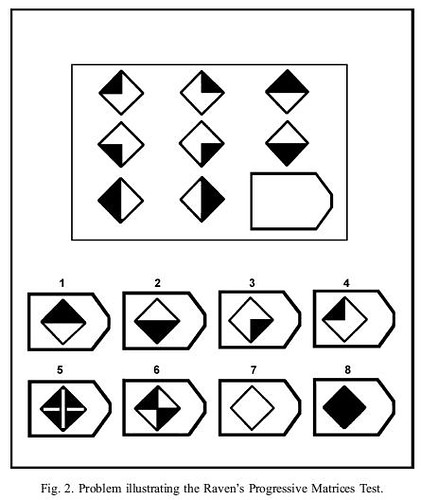
I gather this is some species of an IQ test for fluid intelligence.

No idea whether it has any relationship to a real IQ test for fluid intelligence; I've just stumbled onto it.

It does bear a resemblance to a fluid intelligence test such as the Raven's.

source: similarminds.com


good schools raise IQ, bad schools lower IQ, part 1

good schools raise IQ, bad schools lower IQ, part 2
good schools raise IQ, bad schools lower IQ, part 3
Seth Roberts on IQ

fuzzy math makes you smarter
IQ quiz
school raises IQ
intelligence is verbal, perceptual, and image rotation
math isn't English
intelligence is verbal, perceptual, and image rotation

fuzzy math makes you smarter

re:

Rising Mean IQ: Cognitive demand of mathematics education for young children, population exposure to formal schooling, and the neurobiology of the prefrontal cortex
Clancy Blair, David Gamson, Steven Thorne, David Baker
Intelligence 33 (2005) 95-106


So .... I think I'll carry on being an IQ skeptic for a bit longer here. (pdf file)

Not a skeptic.

No.

I'm not an IQ skeptic.

I am an IQ libertarian.

I'm going to carry on being an IQ libertarian for the foreseeable future.


practice practice practice

The irony of the Blair paper, if Blair & c's hypothesis is found to be true, is that while constructivist math textbooks eschew practice (eschew! ten-dollar word, eschew!) they may inadvertently have provided schoolchildren with distributed practice in the skills required to score well on IQ tests, in particular IQ tests such as the Raven's Progressive Matrices that measure fluid intelligence.


in a nutshell
  • IQ has been rising for 100 years. No one knows why.
  • Interestingly, the main rise in IQ is not in crystallized intelligence ("education, experience, and acculturation"), but in fluid intelligence ("reasoning ability applied in novel contexts" Blair, et al)
  • "Gains on measures of fluid intelligence have been approximately double those on measures of crystallized abilities, with reported fluid gains in a population based sample in the Netherlands of 18–20 points in a single generation."
  • The first 50 years of rise in IQ corresponds directly to the period in which mass education was being established. School raises IQ; it makes sense that the IQ of entire populations would rise as universal education was established.
  • "Substantial evidence of the effects of school attendance on the development of IQ has existed for some time. A detailed review of over 50 studies using naturalistic observation, post-hoc statistical comparisons, and cohort-sequential analysis concludes that there is an association between enhancement of cognitive skills related to IQ and schooling (Ceci, 1991). These studies, conducted throughout the 20th century, comparing schooled and non-schooled populations, have estimated that the enhancement of IQ by schooling ranges from 0.3 to 0.6 of an IQ point for every year of school competed. Importantly, the association between IQ and exposure to formal education is not only due to children with higher measured IQ staying in school longer." (Blair et al)
  • So the increase in education up until mid-twentieth century may account for the increase in IQ to that point. But what accounts for the continued increase after everyone was going to school?
  • Fuzzy math! "At the turn of the 20th century, much of the mathematics instruction for children in the upper elementary grades was rigid, formalistic, and emphasized drill and rote memorization. For example, one educator who visited 36 urban school systems in the 1890s characterized mathematics instruction as patently absurd: bIn no single exercise is a child permitted to think,Q he exclaimed. He is told just what to say, and he is drilled not only in what to say, but also in the manner in which he must say it. (Rice,
    1893, 38)."
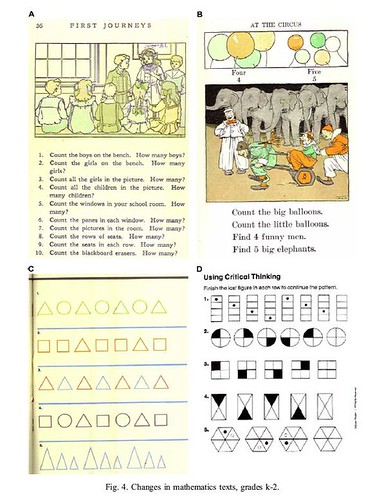
  • "The 1950s and 1960s witnessed further significant changes in the way mathematics education was conceptualized. Nationally, mathematics instruction shifted away from a focus on algorithms and basic arithmetic problems (i.e., pages and pages of simple equations) and instead emphasized problems for young students in visual-spatial relations and the holding in mind of multiple operations in problem solving. Such problem types emphasize pattern recognition and patterncompletion (see Panel 4C)."
  • "By the early 1990s, much of the basic conceptual work of geometry was delivered to children in kindergarten, first, and second grade (Panel 5d). Currently, young children regularly engage in visual-spatial problem solving associated with prefrontally based working memory functions that their grandparentsT generation would not have been exposed to until the seventh or eighth grade and that their great-grandparents’ generation may not have been introduced to at all."
  • The movement of geometry problems similar to items on the Raven's Progressive Matrices into K-5 fits the most salient facts of the situation: it coincides with the period in question (roughly 1950 - the present) and it would affect children whose frontal lobes are developing - i.e. these books are an environmental influence on a developing brain.

the bad news

Unfortunately, rising IQ scores have not led to rising math scores.

Functional implications of these gains for real world competence, however, remain unclear, particularly given the paradoxical finding that increasing fluid cognitive demand of early elementary math education has not led to substantial increased math achievement over time.

dang!


the IQ paradox

I keep threatening to write a post about the "IQ paradox," and now I've done it.

The IQ paradox is a contradiction between two findings:

  • twin studies show IQ to be highly heritable
  • the Flynn effect shows IQ has been rising steadily for 100 years, too quickly to be accounted for by genetic changes, in theory. (I say "in theory" for reasons relating to Temple Grandin's research; won't go into it here. Suffice it to say that large gene-based behavioral changes can happen very quickly in animal populations.)

This summary of Flynn's and Dickens' famous paper attempting to resolve the paradox is worth reading:

Darwin's Origin of Species sparked the modern debate about genes versus environment in explaining differences between human individuals and groups. Ever since, the pendulum of scientific opinion has swung back and forth with consensus always out of reach. For the last 15 years, psychologists have been plagued by a paradox that suggests that environment is both feeble and overwhelmingly potent.
The paradox emerged from a debate about race. US whites outscore US blacks on IQ tests by 15 points. Does that gap have environmental causes or is it partially due to genes? In 1973, Arthur Jensen constructed a model that applied kinship data to group differences in IQ. Evidence from kinship studies showed identical twins separated at birth and raised in different homes grow up with very similar IQs. The fact that they have identical genes provides an obvious explanation. Jensen argued that fully 75 percent of IQ variance between individuals was due to genetic differences (a value which sits in the middle of the range recently endorsed by a select committee of the American Psychological Association for adult IQ). Jensen's model showed that a purely environmental explanation of the black/white IQ gap meant that the environment of the average US black must be as unfavorable for the development of IQ as the lowest one percent of white environments measured in terms of their effects on IQ. That simply did not seem possible.
Jensen's model seemed to preclude a purely environmental explanation for any large IQ gap between groups. Then, in 1987, Flynn showed that in nation after nation, the current generation outscores the last generation by some 9 to 20 IQ points. The gains are greatest on those tests often called the best measures of intelligence. Their size and speed dictate an environmental explanation. Flynn applied Jensen's model. An environmental explanation meant putting the current generation within the top one-tenth of one percent of the last generation in terms of environmental quality. What was known to be true was shown to be impossible.


The basic argument of Flynn - Dickens, iirc (I haven't taken the time to read the paper again) is that the environment has a strong effect on IQ but the environment to which a person is exposed is heavily determined by his genes.

In other words, your genes don't give you your IQ. Your genes give you the environment that's going to give you your IQ. (I think that's right. If someone who actually does this research happens by and wishes to fact-check, I'll correct.)

A person with a high IQ has been given a hunger for the kind of environmental stimulation that will raise his IQ.

My sense of this is that Flynn Dickens have pushed the effect of genes back a step, to something like "drive" or "desire."
At least, that's what I take away from Robert Plomin (subscription required):


Robert Plomin of the Institute of Psychiatry in London stands at the forefront of such research. "g shows significant genetic influence," he says. Plomin points to dozens of twin and adoption studies indicating that genes contribute substantially to individual differences in g.

Such studies find that genetic influences on g are modest among infants and children but become progressively stronger throughout adulthood. This suggests that, as people grow older, they find and create environments congenial to promoting their own genetic strengths, Plomin theorizes. "It may be more appropriate to think about g [general intelligence] as an appetite rather than an aptitude," he says.

This means that twin studies finding high heritability for IQ may have "masked" the effects of the environment.

Genes determine the environment, not the IQ.

...the assumption of large environmentally driven gains in intelligence can be reconciled with the assumption of high heritability for intelligence. This is because the occurrence of gene-environment correlation resulting from reciprocal causation between phenotypic IQ and environment can mask the potency of the effect of the environment on intelligence. [Blair, et al]

In other words, studies finding .75 hereditability for IQ are actually finding .75 hereditability for environment.


math books could do it

If it's correct to see g as an appetite instead of an aptitude, this means that a widespread change in math texbooks could indeed produce a rise in IQ.

Entire generations are exposed to these books via compulsory education, which takes appetite out of the equation. Kids don't need a genetic hunger for IQ-raising lessons in visual reasoning; they're going to be doing these lessons whether they want to or not.

If the geometry-in-Kindergarten mechanism proves to be correct, then having Kindergarten children do geometry problems would be the IQ-raising equivalent of putting Vitamin D in milk and folic acid in bread.

You're not leaving it to people's natural gene-driven appetites to get smarter or to eat enough folic acid to prevent spina bifida. The government makes those choices for you.

And.... it makes sense that a math-book-driven rise in IQ wouldn't result in a rise in math achievement. IQ and achievement are two different things. Achievement -- expertise -- comes from expert instruction combined with deliberate practice. (pdf file)

A rise in IQ ought to make it easier to learn math.

It doesn't guarantee that anyone will actually do so.


update 3-25-2007

The distinction between fluid and crystallized intelligence is probably wrong.


good schools raise IQ, bad schools lower IQ, part 1
good schools raise IQ, bad schools lower IQ, part 2
good schools raise IQ, bad schools lower IQ, part 3
Seth Roberts on IQ

fuzzy math makes you smarter
IQ quiz
school raises IQ
intelligence is verbal, perceptual, and image rotation
math isn't English

The Cambridge Handbook of Expertise and Expert Performance

canadianteacher.com

Christopher had been sailing through his Test Prep book until today, when he hit a snag.

Negative exponents.

Some of you will remember that we had quite a merry little time with negative exponents last year.

Christopher appears not to remember the first thing about negative exponents.

Fortunately for him, I have completed Saxon Algebra 1 in the intervening year, so I now do know a thing or two about negative exponents.

Another thing I know about negative exponents: if you're trying to give your 7th grader practice in negative exponents, it's practically impossible to locate free worksheets online.*

Still, I've managed to come up with a few things:


edhelper, too

The edhelper sheets are pretty good.


Canada Teacher


Wonderful resource:

These tools were made to save teachers time and money! Stop paying for all those reproducible forms and worksheets that are out there. Let’s share what we already have made and stop reinventing the wheel. You can help us by submitting your own forms, letters, and reproducible materials and by visiting the sponsors on the bottom right of each page.

The site has a math worksheet generator that will create simple worksheets on negative exponents. One glitch: the answer sheet appears first. When you click on "Generatore answer sheet" the worksheet itself comes up.

Don't let it fool you.


update:

I was wrong.

Christopher does, in fact, remember the first thing about negative exponents.

Just.

I'm despairing, thinking how much distributed practice he needs on every conceivable procedure and skill (forgetting concepts altogether).

Clearly we need to go back to KUMON.

Just as clearly, I'm not going to be able to get him there.

I just spent half an hour copying out individual knowledge-bits from Saxon Algebra 1.

I guess the plan is .... what?

Either I have to commit the list to memory (along with my list of pre-algebra skills) or put together some kind of Excel grid that allows me to see the most recent time he had distributed practice on a particular skill.

Actually, an Excel chart could be good.

To give you an idea, Christopher's Test Prep book lists 49 separate skills for one school year.

Saxon math, of course, breaks these skills down further than the Test Prep book. Saxon books typically have 120-130 lessons per book, with 1 to 3 concepts or procedures covered in each lesson.

So: at least 250 separate skills in each grade level book, each of which a student has lots of distributed practice doing.

I'm trying to duplicate Saxon without the Saxon.

Reactive teaching to the max.

_______________

* Ripley's believe it or not: I now own approximately $400-worth of pre-algebra, geometry, and algebra workbooks. I have discovered precisely one worksheet on negative exponents in the lot.


state test coming right up (2006)
throwing money at the problem
more stuff only teachers can buy
help desk 1
state test coming right up (2007)
help desk 2
my life and welcome to it
inflammatory
canadianteacher.com
progress report
despair
28 out of 30

all the answers are belong to us
email to the math chair
second request
teacher's manual
it would be unusual

Illinois is holding back kids

From a comment over at my blog parentalcation.

Illinois law now requires Algebra, Geometry, and an additional year of high school math for high school graduation (previous requirement was 2 years of math, courses not specified).

Sounds good - until the Illinois State Board of Education changed their policy so that students are not allowed to earn credit towards high school graduation before 9th grade.

Net effect: No one can take Algebra before 9th grade.


and

There are students who have completed Algebra I, Geometry, and Algebra II/Pre-Calculus before 9th grade. Under Illinois law and ISBE policy they have had those three years of high school honors math credits and grades stripped from their Academic Records and High School transcripts. They have exhausted the High School math curriculum through AP Calculus BC by 10th grade, leaving them short of the three years of H.S. math credits required for H.S. graduation - and their GPAs and Class Ranks are now below those of students who have completed H.S. math only through Algebra II.

The ISBE has refused to revise their policy for cases like these, effectively placing a limit on the high end of the achievement spectrum and effectively punishing those students for achieving to the best of their ability.

School policy usually reads something like this example: *No high school credit will be awarded to elementary or middle school students concurrently enrolled in high school courses.* These kids have taken high school courses at the high school, taken the same quizzes, tests, and finals as their high school classmates, but are then informed that their work and effort do not count (and will actually count against them) because they took those classes before they were in 9th grade.


Now they are openly penalizing smart kids.

spin cycle

from Ed School Follies, a scene at Teachers College:

“The student teachers seemed to appreciate the fact that what they had just been listening to could really be of help to them in the classroom. Hands shot up all over the room to ask questions like, Where do you get the books? How do you handle competition between the kids? What do you do when parents complain that their kids aren’t learning phonics?” Her answer to that one brought down the house. “Don’t tell them you don’t teach phonics,” she said. Then added, “You do.” They all smiled and nodded, as though they understood quite well what she meant.”

the chickens have come home to roost

Here's a sample question from the 12th grade 2005 NAEP (the answer is also provided):


Only 23% of students answered this question correctly! Only 23% of the end products of our K-12 education system can answer this simple problem. 23%.

This problem is classified as Low Complexity:

This category relies heavily on the recall and recognition of previously learned concepts and principles. Items typically specify what the student is to do, which is often to carry out some procedure that can be performed mechanically. It is not left to the student to come up with an original method or solution.

This is about as simple an algebra problem that I can think of that I'm still willing to call real algebra. I think it's safe to say that if you can't do this problem, you do not possess a profound understanding of algebra.

These kids are our NCTM babies. Kids whose entire learning of math occurred under the auspices of the NCTM's standards.

decline at the top

a comment left by Miller Smith in the Direct Instruction thread at joannejacobs:

70 to 80% of the time I do DI. My students don’t know enough about the math they should be perfect at in order to complete activities in the constructivist method.

For example: I wanted the students to find the mass and volume of five selected metals and then plot that data on a mass vs. volume graph, find the slopes of the lines (find density of the metals) and then compare the order of the densities to the metal’s position of on the Periodic Table to show the trend of density of the elements.

The students ALL have taken Algebra I and II and Geometry with very good grades in all (I have all honors classes and in 11th or 12th grade).

They could not find the mass of the samples using electronic scales (didn’t know about the tare), or the volume of the metals (didn’t know about finding volume by diffence), could [not] plot a graph on paper (they used graphing calculators), couldn’t find the % error from a provided equation, on and on. They couldn’t DO the constructivist method of ‘discovering’ the trend of the elements in the Periodic Table since they did not know how to do the math and science in the classes they already passed with wonderful grades!

When the University of Maryland science professors held a meeting with the science department heads in Prince George’s County this past fall, they told the science folks for my county that is was assumed that students from the county didn’t know anything about math or science.

I do DI almost all the time. I directly teach the lower level skill the students should have learned years before before I put the students in the lab. This is very slow - at first. Since we use math all the time in chemistry (ha! Who’d a thunk it!) the student start getting very good at these skills. They then start getting the point of the labs.

These students have been so abused academically by my county with constructivism. DI should be first and foremost. When basic skills are mastered then, and only then, can you put students in an environment to discover things using the tools they have.


A couple of years ago I talked to the Dean of Liberal Arts (I think it was) at a college out on Long Island. He was a math guy (I'm thinking a mathematician, but he may have been a scientist).

When I asked him about students' knowledge of math he told me, "We can't assume students know anything we would want them to know."

This included being able to solve a linear equation with one variable.

(The phrase "decline at the top" isn't mine, but I don't remember who coined it. Waiting for Utopia discusses decline at the top.)

update: Diane Ravitch used the term in 1997.

Over the years researchers have debated the meaning of the decline in SAT scores. Some have concluded that it is solely a reflection of the democratization of American higher education meaning a growing number of minority, low-income, and low-ability students in the test-taking pool. Certainly, changing demographics contributed to the decline, yet something more was happening. Declines occurred at the top of the ability distribution, especially on the verbal part of the test. For example, in 1972 (the first year for which comparable data were available), 116,585 students - 11.4 percent of test takers -scored higher than 600 on the verbal test. By 1983 that number had fallen to only 66,292, or 6.9 percent of the total. Since then the proportion of high-scoring students has remained around 7 percent. By contrast, in mathematics the decline at the top was only temporary. In 1972, 17.9 percent of test takers scored over 600. That proportion dipped as low as 14.4 percent in 1981, but by 1995 it reached 21 percent - the highest proportion of students ever to exceed 600 on the math test.

Thursday, February 22, 2007

fantasy vs reality

Dave over at Joannes posted this example of "creative" teaching:


4th grade classroom, students have demonstrated mastery of basic multiplication facts and some conceptual understanding of multiplication as arrays and repeated addition.On the board, the teacher writes a column of 15’s (there are ten in all)151515…15——She instructs students to find the sum mentally but not to raise their hands with any answers at that moment. After a minute, she directs students to discuss their ideas in small groups of 3-4. She tells them to compare their results, not just the sum but HOW they did this. After 2 minutes, she leads a discussion, inviting students from each group to share their ideas. She comments and adds other ways, insuring that students see at least 4 methods. She asks, “Which method is easiest for you? Why?” etc… This does not take more than 15 minutes in all.”


The way it really works:

4th grade classroom, students have demonstrated mastery of basic multiplication facts and some conceptual understanding of multiplication as arrays and repeated addition. On the board, the teacher writes a column of 15’s (there are ten in all) 151515…15——She instructs students to find the sum mentally but not to raise their hands with any answers at that moment. Most of the students breathe a sigh of relief, because they have no idea of the answer. After a minute, she directs students to discuss their ideas in small groups of 3-4. She tells them to compare their results, not just the sum but HOW they did this. The kids form groups and immediately start goofing around. Luckily most of the groups end up with at least one kid who can figure out the problem because their parents tutor them at home. After 2 minutes, she leads a discussion, inviting students from each group to share their ideas. No one answers at first, but she calls on a kid anyway. He mumbles something about doing it in his head. She comments and adds other ways, insuring that students see at least 4 methods. The students furiously copy what she is doing on the board, but not quite sure what she is talking about. She asks, “Which method is easiest for you? Why?” etc… This does not take more than 15 minutes in all. Most of the kids didn’t quite understand the lesson, but that's OK… they will spiral through the curriculum and hit it up several more times over the next year. Eventually by 8th grade 20% of the kids will master the concept. The majority of them will still be adding up the numbers the long way.

Meanwhile over in Sir Zigs class across town. Zig has demonstrated to his students that that if you have the same list of numbers, you can count up how many numbers there are and its the same as a multiplication problem. The kids quickly calculate 10 x 15. Upon Zigs signal, in unison they shout out the answer. Zig gives them several other similar problems, to test their mastery. After 5 minutes, he is sure that they understand. All the kids seem to get it, and he compliments them on how smart they are. It seems like they can spit out the answer almost as fast as he can write problems. This has not taken more 15 minutes. Now that 100% of the kids have mastered this concept, he can move on to something else. He makes a mental note to revisit this concept tomorrow morning, to reinforce it. Eventually, 90+% of his kids will go on to pass the state proficiency exam.

what do employers want?

from Steve:

Business types (upper management)don't hire math types. They may authorize the job posting, but they are clueless after that. I always laugh when I hear about business types talking about what they want out of education. They want cheap labor that can get the job done.

What do the people who make the decisions want? Skills and experience. What have you worked on and how good are you? For the "high tech" world, it's a balance. They don't want newbies without experience and they don't want older people, who have experience(and high salary), but are not necessarily up to date on the latest technology. Younger people tend to have more drive and less commitments. Many companies are known to chew them up and spit them out, driven by good salaries and stock options. Can you say 60+ hour work weeks?

There is little loyalty anymore. Businesses do not care about employees as individuals. Salaries and benefits might be good, but you could be out on the street in an instant. High tech types have to be very careful about what jobs they work on and what experience they get. Many thought that Digital's VAX and VMS OS would go on forever. Now the Unix types better watch out, and I'm not talking about Linux. This has nothing to do with education.

survey, if I'm lucky

Ed, who may or may not be living in the same house I am living in, came upstairs from his office today and announced today that it is possible to post surveys online!

An outfit called Survey Monkey will do it for you free!

(The reason I take this as evidence that the Ed who is sitting in the family room at this moment is an imposter is the fact that, back in Oct or Nov, he signed a Survey Monkey survey asking the superintendent to hold a district-wide meeting to discuss the math curriculum. That was after he signed the Survey Monkey survey on parent information night.)*

Anyway, I think I've posted a survey.

Of course, if people don't vote the way I want them to vote, I'll (possibly) just ignore them and do what I want to do anyway.

I should run for School Board.

JUST KIDDING!

I'M KIDDING!

IT'S A JOKE!

* correction: He didn't sign a Survey Monkey survey. He signed an online petition.

the last word

Ken on Project Follow-Through.

Ionnidis: "Most Research Findings False"

A member of the DI listserv just posted the link to the complete paper by Ionnidis.

He says he was able to read it using his high school math.

Looks like I'll be putting Saxon to the test.

against "controlled" research


spaced repetition:

Stone's argument, in Developmentalism: An Obscure but Pervasive Restriction on Educational Improvement, is that the holism and developmentalism of education school ideology mean that an educationist will be inclined to reject controlled scientific research for the very reason that it is controlled scientific research.

Control is exactly what the philosophy of Romanticism, which is the philosophy underlying educationism, rejects.

Controlled research means you've broken a classroom whole down into its component parts and you've studied how one part affects another part.

To a person whose intellectual roots lie in Romanticism, that is wrong.

Thus: the very premise of controlled research is incompatible with Romantic philosophy.

My two cents: Stone is probably right.

Given the nature of the developmentalist view, experimentally demonstrated teaching practices are bound to invite a great degree of skepticism. The object of experimental research is to demonstrate the impact of an independent variable as an agent of change. Contrary to such an objective, developmentalism requires that social, emotional, and cognitive change emerge, not as an effect induced by an external agent, but as an independent expression of the student. Thus experimentally tested methodologies are automatically considered suspect if not outrightly objectionable depending on which developmental limitations are presumed applicable. In effect, developmentalist doctrine discourages reliance on the most important and most credible research educators have at their disposal (Bloom, 1980 as cited in Gage & Berliner, 1992; Cook & Campbell, 1979)


This goes to the question of whether there is any "real" constructivism in the schools.

I can't possibly know how much "real" constructivism there is in the schools - "real" meaning "ideal type."

From where I sit there's obviously a huge amount of really existing constructivism in the schools.

But it's wrong to argue, as Jay Mathews describes the thesis of Labaree's book, that "education schools have about as much impact on what happens in U.S. classrooms as my beloved but woeful Washington Nationals are having this season on the pennant race."

Ed schools have managed to crush every effective teaching method and curriculum known to mankind.

That's impact.