kitchen table math, the sequel

Friday, July 4, 2008

stagnation at the top, part 2

Here’s a simple principle: at the least, schools should be expected to help all students make a year’s worth of progress over the course of a year—even students that start school in September two or three grade levels above. And we should reserve our greatest praise (and perhaps rewards) for schools that accelerate the progress of all of their students and help each one reach his or her full potential. And that principle should apply to all of our children, regardless of the color of their skin, the size of their parents’ pocketbook, or their zip code. Anything else strikes me as unfair, unkind—and politically unsustainable.

Are public schools for all kids, or just some kids?


and, from the Heartland Institute:

Clowes: Is there any reason why students in schools with high concentrations of poverty should learn any less than students in an affluent district?

Sanders: Interestingly, I've caught the most political heat from some of the schools in affluent areas, where we've exposed what I call "slide and glide." One of the top-dollar districts in the state had always bragged about its test scores, but our measurements showed that their average second-grader was in the 72nd percentile. By the time those children were sixth-graders, they were in the 44th percentile. Under our value-added scheme, the district was profiled in the bottom 10 percent of districts in state. They were not happy. You'd think I had nuked the place.

With our value-added approach, we can demonstrate that our measure of school effectiveness is totally unrelated to traditional socioeconomic indicators. We have more than 1,300 elementary schools in this state; their effectiveness is totally unrelated to the racial composition of the school or the percentage of children in the federal free and reduced-price lunch program. That's looking at measures of progress, not at raw test scores.

You shouldn't hold teachers and principals of school districts accountable for things over which they have no control. You should hold them accountable for those things they do have control over. Schools and teachers don't have control over the achievement level when children walk in the door, but they do have control over how much that level is raised during the year.

If that is sustained over time, it becomes like compound interest, and what you see is populations of children constantly rising to higher and higher levels of achievement in later grades, regardless of where they started.

interview with William Sanders

Thursday, July 3, 2008

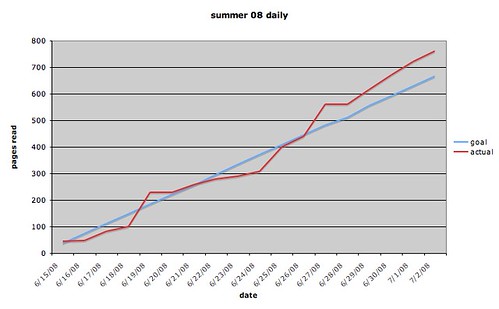
summer reading chart


Paul B suggested I make a graph for C's summer reading & I just did -- this is perfect. Highly motivating (to me, at least).

Haven't shown it to C yet as he appears to be avoiding me.

Possibly because we got started on Analyse, Organize, Write and Sentence Combining Workbook yesterday.

4th of July

The NY Times asked Ed to write an op ed piece for the Fourth of July!

ON a recent visit to the Statue of Liberty, my first since the sixth grade, I was struck by how many French people were at the site. Why more French than others from abroad? The answer may lie in the statue’s history. After all, it was conceived nearly 150 years ago almost as much for France as for the United States.

The idea for the monument stemmed from a French struggle for freedom that began in 1852, when Louis Napoleon Bonaparte, having overthrown France’s democratic republic, declared himself emperor. In the summer of 1865, after enduring 13 years of Napoleon III’s near-dictatorial rule, Édouard de Laboulaye, a historian, hosted a dinner for a small group of French liberals to celebrate the North’s victory in the American Civil War. To Laboulaye, the restoration of orderly liberty in the United States put his own government to shame.

Over brandy and cigars, he and his guests, who included Frédéric-Auguste Bartholdi, the prominent sculptor, decided to organize a public campaign to commemorate American liberty with a grand gift to the United States. But the gift would double as an implicit critique of Napoleon III.

Bartholdi later envisioned a mammoth statue of the kind of ancient Roman goddess that since 1789 had symbolized liberty and the Republic. The French revolutionary tradition actually produced two goddesses: one sported the “liberty cap” and appeared in ardent motion, her breasts often bared, a fierce expression on her face. Her counterpart stood erect and still, her body modestly draped, her expression calm and serene.

Bartholdi chose the second, unthreatening icon to have his “Liberty Enlightening the World” depict the stability that French liberals saw in the United States and wanted for their own turbulent land.

By the time construction began in the mid-1870s, Napoleon III had been removed from power and his opponents had created a moderate republican regime. France had escaped the twin perils of revolution and reaction that had characterized its political life for nearly a century. Now, Bartholdi’s statue could stand for both the French and the American republics......

A Gift from France, to France

The editing was amazing: a variant of this British writing assignment. (Here's dr. pion on precis writing.) The editor cut the original piece in half, losing only one detail everyone was sorry to see go.

I learned something. When I read the editor's version, I was disappointed in the lead paragraph, which was flat. I finished reading the piece & was blown away by the editing, especially seeing as how C. and I didn't get too far in our own efforts to edit an already-tightly written passage last July. So I re-read, thinking maybe I was wrong about the lead. But no. It was flat.

Ed raised the issue with the editor, who told him that a lead paragraph, to be interesting, must have details. When you make cuts as deep as they do for the op ed page, she said, you often end up with flat beginnings -- I assume because the details in most writers' first paragraphs are the least essential to the piece and are thus the ones most likely to be cut, although she didn't say so.

She's absolutely right. Ed fixed the problem by inserting the words "my first since the sixth grade" into the first sentence. That's all it took.

Writing is a mystery.

For me, this lead is boring:
ON a recent visit to the Statue of Liberty, I was struck by how many French people were at the site.

This one works:
ON a recent visit to the Statue of Liberty, my first since the sixth grade, I was struck by how many French people were at the site.

Why should that be?

Tuesday, July 1, 2008

the knowledge deficit

I'd been wondering what Bill Ayers thinks about knowledge.

Somewhat OT: Global Autism Project

Via Larry Welkowitz's Asperger's Conversations, I discovered an organization new to me, the Global Autism Project

In the United States, a child is diagnosed with autism every 20 minutes. In developing countries, we have no way of knowing the national situations. Dr. Eben Badoe is one of only thirty pediatricians in Ghana, a country of 19.4 million people. He is the only one diagnosing autism. He recently told us, “right now, I diagnose children and then I lose them in a way.”

The Global Autism Project is working hard to change this.

We bring research-proven methodologies of autism intervention to developing countries. A commitment to a balance of scientifically sound interventions and cultural sensitivity is integral to our work.


I wonder what we can learn from other countries in this regard.

say better

The New Yorker profile of Irene Pepperberg is available online!

Pepperberg told me that Alex also made spontaneous remarks that were oddly appropriate. Once, when she rushed in the lab door, obviously harried, Alex said, “Calm down”—a phrase she had sometimes used with him. “What’s your problem?” he sometimes demanded of a flustered trainer. When training sessions dragged on, Alex would say, “Wanna go back”—to his cage. More creatively, he’d sometimes announce, “I’m gonna go away now,” and either turn his back to the person working with him or sidle as far away as he could get on his perch. “Say better,” he chided the younger parrots that Pepperberg began training along with him.

I know I've mentioned before that I came out of Animals in Translation thinking birds are as smart as we are or smarter.


to do

I need to get hold of the paper on the model/rival technique and autistic kids:

As it happens, the model/rival method may have some utility for another species: humans. Diane Sherman, who works with autistic children in Monterey, California, has had some preliminary success in encouraging speech in her clients using Pepperberg’s protocol. In an article published in The International Journal of Comparative Psychology, Sherman and Pepperberg say that, in two studies of children in Sherman’s private practice, the model/rival method led to “significant gains” in the children’s “communication and social interaction with peers and adults.” (Behavioral changes were measured by reports from parents and teachers, and included criteria like demonstrations of empathy, improved eye contact, saying hello to people, and speaking in sentences.)

I believe this.

Years ago, on our annual family vacation back to Illinois, we rented a van to drive from Springfield to Chicago. On the road, C. and Andrew (who is autistic) got into a HORRIBLE fight. Now, Andrew is very autistic. He couldn't talk at all at the time, and he probably couldn't understand much, either.

But he had no problem understanding a fight with his brother in the car. We'd separated the two boys, putting Jimmy (big brother - also autistic) with C. in the middle seat and Andrew in the way-back, but they got into it anyway. I no longer remember how it started, though it may have begun with Andrew touching his brother. I do remember, vividly, the fight in full bloom. C. would scream, "I hate Andrew!" and, hearing this, Andrew, who in theory did not understand a word of English or any other language, would shriek with rage, lunge forward, and hit his brother -- hard -- on the back of the head. Then C. would scream in pain and fury and let loose with another "I hate Andrew!", and A. would shriek and hit him again, and so it went.

I'm pretty sure I was in there somewhere, too, shouting "Stop saying that!" at C.

We finally had to pull off the road and take the boys out of the car to separate them. We bought them junk food, put them back in the car, and drove off. They were beaming at their chips and candy, and at each other.

After that I used to say that every single part of an autistic child's brain has been messed up in some fashion except for the part that says "Hit my brother in the car."

So: model/rival. I can see it working with autistic kids.

Especially the rival part.


to track down:

Pepperberg, I.M. and Sherman, D. V. (2000). Proposed use of two-part interactive modeling as a means to increase functional skills in children with a variety of disabilities. Teaching and Learning in Medicine, 12(4), 213-20.

Pepperberg, I.M. and Sherman, D.V. (2002) Use of two-part interactive modeling as a potential means to engender social behavior in children with various disabilities. International Journal of Comparative Psychology, 15, 138-5.

Pepperberg, I.M. and Sherman, D.V. (2004) Use of two-part interactive modeling as a potential means to engender empathy in children within the autistic spectrum. IMFAR conference, Sacramento, CA.

the $100 distraction device

New research by economists Ofer Malamud and Cristian Pop-Eleches provides an answer: For many kids, computers are indeed more of a distraction than a learning opportunity. The two researchers surveyed households that applied to Euro 200, a voucher distribution program in Romania designed to help poor households defray the cost of buying a computer for their children. It turns out that kids in households lucky enough to get computer vouchers spent a lot less time watching TV—but that's where the good news ends. "Vouchered" kids also spent less time doing homework, got lower grades, and reported lower educational aspirations than the "unvouchered" kids.

Why giving poor kids computers doesn't improve scholastic achievement

Every school district in Westchester County now pays an administrator to purchase and "integrate" technology into our kids' schools.

Then, once your district has loaded up on technology, you have to pay someone to "coordinate" the technology. So that's two administrative positions. One person to buy and integrate, one person to coordinate.

Next year the computer science teacher at the high school will no longer teach. He will coordinate.

I wonder how much we're spending on repair and maintenance. Last year I read a Financial Times estimate saying that the price of purchase is 10% of the total cost of IT.

When Ed and I made our whirlwind tour of elite private schools last winter, we found very little technology, although we did see 3 schools where all the kids had laptops and all assignments and course materials were posted online.

The Dalton School, one of the most elite private schools in the country, doesn't have SMART Boards. Their money has gone into photography studios, darkrooms, carpentry shops, dance studios -- amazing.

See also: The Computer Delusion and High-Tech Heretic.

Sunday, June 29, 2008

Liz Ditz on how to organize summer reading assignments

1. Take the total # of pages required to be read by the start of school.

2. Take the total # of days left in summer vacation.

3. Multiply the total # of days by [0.75 for a compliant kid] or [0.50 for a less compliant kid]

4. Divide #1 by #2

5. Make a chart showing desired progress vs. actual progress

6. Require kid to note actual progress

7. Declare "reading catch-up days" when desired vs. actual lags some unit behind.

8. Reward above-average progress

9. In the case of children who are expected to read more than 2 books, reward completion of each book

10. It is very helpful if one or both parents read the books at the same time as the kid, and invest in discussing plot points, character development, response to the books, etc.

11. Novels with difficult textural features (dialect instead of standard spelling, complex narrative structures) may require extra parental input, such as listening to the book in recorded format, story-board mapping, etc.


Great advice.

I was already doing 1, 2, 3, 4, and 10 -- but I completely forgot the importance of 5 & 6.

Charting your own progress is a long-established principle in behaviorism. Years ago, after I'd gained weight from taking a particular medication I read everything I could find on dieting & discovered that the sole approach to dieting that actually worked was: recording everything you ate. I don't think these studies included charting your progress, but there's no question self-charting is important.

C. is ahead of the game thus far. He has 2,525 to read with 10 weeks to accomplish this feat, and he's read 617 pages with 8 weeks left to go. That's good, because he's reading the easy stuff now. Guns, Germs & Steel, The Odyssey, and the Book of Genesis are going to be a lot more difficult.

A friend of Ed's gave us a great idea. She drove to Ithaca from Washington D.C. and listened to Ian McKellan's reading of The Odyssey along the way. We got the CDs & Chris & I will listen to McKellan while reading along in the book. (He couldn't follow McKellan without the text in front of him.)

We also have to finish Megawords 5 (can't believe we got through an entire school year without finishing the book), and get going on Analyze, Organize, Write by Whimbey and Linden -- a fantastic book. (Amazon has used copies on sale for as low as five bucks at the moment.)

I've also told him he has to spend some time doing ALEKS this summer...

That chart thingie is starting to get complicated.

Saturday, June 28, 2008

politically incorrect

from Measuring Up: What Educational Testing Really Tells Us by Daniel Koretz --

As one colleague once put it simply, in politically incorrect terms, "Smart kids do well on tests."
p. 126

Daniel Koretz is Professor of Education at Harvard.

Harvard.

Where 75% of the entering class scores 700 or above on SAT reading, writing, and/or math.

I don't think we'll be seeing GATE programs staging a comeback any time soon.

the homework gap

from Measuring Up: What Educational Testing Really Tells Us by Daniel Koretz --

...these critics usually miss the flip side of the coin: ignoring noneducational causes of variations in scores--that is, assuming that scores are a direct indication of school quality--lets some high-scoring schools off the hook. Some schools have high test scores because of the students they serve rather than the quality of the education they offer, but those who are convinced that scores most reflect educational quality consider them good schools regardless. My own children attended some of the highest-scoring schools in our state. They did indeed have some truly superb teachers, but they also had some mediocre ones and a few I thought should not have been allowed to teach at all, including one English teacher whose grammatical and vocabulary errors during parents' visiting day were so egregious that they sparked repeated and audible protests from the parents sitting in the back of the room. Test scores were nevertheless always high, a reflection in part of the very high education level in the community, which was full of attorneys, physicians, academics, economists, foreign diplomats, biomedical researchers, and the like...Not only did these parents provide--on average--environments highly conducive to academic achievement, but many also provided supplementary instruction, either by reteaching material themselves or by paying for the services of neighborhood tutoring firms.

A concrete example: when my son was in seventh grade, took a math class that was not well taught. (I went and watched, to confirm my hunch.) One evening he told me that he was confused by his math homework, which was part of an introduction to probability and statistics. I first tried to clarify the homework, but I soon realized that he was missing a few key notions. I asked him for his class materials, looked them over, and retaught him some of the core concepts, and after that he was able to handle the homework. I went back to the kitchen to clean up from dinner, but he soon called me upstairs again. He had just auditioned successfully for the school's jazz band, and he was having trouble counting out rhythms in the piece he was supposed to practice. I counted them out for him, but he still found them confusing (as I had too, many years earlier, when I first tried playing jazz). So I fetched my own horn and played the music at about half tempo while he counted it out. That worked. As I resumed scrubbing pots, my wife turned to me and said, "There you have it: social class differences in educational achievement."

[snip]

Disappointing scores can mask good instruction, and high scores can hide problems that need to be addressed.

p. 119-120

There is a phenomenal amount of tutoring going on in affluent school districts. Phenomenal. One of the tutors working in my town told a friend of mine that she estimates half of the kids in Scarsdale are tutored.

I believe it. When I met with the assistant admissions director at one of the local private schools, she told me she had been a Scarsdale tutor for several years. She along with many others.

I've come to think it was inevitable that matters would develop in this way.

First of all, public schools are built to provide inputs, not outputs: instruction, not achievement.

That may not have been so deadly when schools grouped kids homogeneously. With homogeneous grouping the classroom teacher probably had a decent chance of knowing where the kids were and of being able to teach to their level.

Along comes the de-tracking movement, and now you've got heterogeneously grouped classrooms with kids all over the map in terms of readiness. The inputs model hasn't changed, so teachers are told to teach to the middle, or they're told to differentiate instruction, and when teaching to the middle or differentiating instruction work for some of the kids but not all of the kids, you assume the problem is the kid, not the school. After all, the school's job is to provide opportunities to learn, and as long as you've put PowerPoints on the SMARTBoard, you've done that.

Then add to this set-up school districts in which the vast majority of parents are college-educated and affluent enough to hire tutors, and what do you get?

You get "high-performing" schools where the kids are being retaught by parents and tutored by tutors.


can a parent sue for educational malpractice?
Galen Alessi's "Diagnosis Diagnosed"

better not to tell you now

I just asked Mattel's online Magic 8 Ball whether C. will finish his summer reading.

Bonus link: The Magic 8-Ball.

truc

Fonts can shape reality in intangible ways, as Phil Renaud, a graphic designer from Phoenix, discovered when he studied the relationship between his grades and the fonts he used for his college papers. Papers set in Georgia, a less common font with serifs, generally received A’s while those rendered in Times Roman averaged B’s.

While he acknowledges that his study was very unscientific, he wanted to remind all high school graduates heading for college that an element of surprise is important. “You don’t want to fall into the same pattern that the professor sees on every new paper,” he said.

When Comic Sans Isn't Enough, Sites Help Create Custom Fonts
by Peter Wayner
NY Times June 26, 2008


I have no idea what to make of this. I've always liked the Georgia font, though.


Quirky serifs aside, Georgia fonts win on the Web

Friday, June 27, 2008

"Investment in Humans, Technological Diffusion, and Economic Growth"


Most economic theorists have embraced the principle that certain kinds of education--the three R's, vocational training, and higher education--equip a man to perform certain jobs or functions, or enable a man to perform a given function more effectively. The principle seems a sound one. Underlying it, perhaps, is the theory that education enhances one's ability to receive, decode, and understand information, and that information processing and interpretation is important for performing or learning to perform many jobs.

[snip]

We shall consider now the importance of education for a particular function requiring great adaptation to change. We then propose two models which these considerations suggest.


II. The Hypothesis

We suggest that, in a technologically progressive or dynamic economy, production management is a function requiring adaptation to change and that the more educated a manager is, the quicker will he be to introduce new techniques of production. To put the hypothesis simply, educated people make good innovators, so that education speeds the process of technological diffusion.

Evidence for this hypothesis can be found in the experience of United States agriculture. It is clear that the farmer with a relatively high level of education has tended to adopt productive innovations earlier than the farmer with relatively little education. We submit that this is because the greater education of the more educated farmer has increased his ability to understand and evaluate the information on new products and processes disseminated by the Department of Agriculture, the farm journals, the radio, seed and equipment companies, and so on. The better educated farmer is quicker to adopt profitable new processes and products since, for him, the expected payoff from innovation is likely to be greater and the risk likely to be smaller; for he is better able to discriminate between promising and unpromising ideas, and hence less likely to make mistakes. The less educated farmer, for whom the information in technical journals means less, is prudent to delay the introduction of a new technique until he has concrete evidence of its profitability, like the fact that his more educated friends have adopted the technique with success.

Investment in Humans, Technological Diffusion, and Economic Growth
Richard R. Nelson and Edmund S. Phelps
The American Economic Review, Vol. 56, No. 1/2, (Mar. 1, 1966), pp. 69-75


Apparently Nelson-Phelps is the classic paper on education and technology diffusion.

That educated workers tend to be early adopters is one of the main reasons why the 20th century was the American Century. The U.S. educated all children in the liberal arts, while the Europeans educated only the elite, tracking the rest of its children into vocational education. Europeans saw the American model as foolish and wasteful. What use has a farmer for algebra!

But the Americans were right. Education has several "indirect" effects on economic growth beyond the direct effect of equipping a child with the skills he will need to earn a living as an adult. These indirect effects exist regardless of whether a particular boy or girl will or will not "use" algebra or Latin in his career.

One of those indirect effects is the fact that educated workers can and will adopt a good new technology sooner rather than later. Educated workers make smart early adopters.

I think the effect of this has to be enormous. Temple (Grandin) often tells me that designing new technologies is the easy part; getting an industry to adopt a new technology is what's hard. In the real world people don't beat a path to your door just because you've built a better mousetrap.

Here are Goldin and Katz:

Suggestive evidence exists that the magnitude of the indirect effects of education on labor productivity is substantial. For example, firms and establishments with more educated workers have long been found to be earlier adopters of new technologies and have been shown recently to garner greater productivity benefits from information-technology investments.

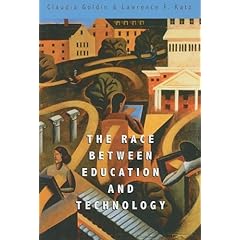
The Race between Education and Technology
Claudia Goldin & Lawrence F. Katz
p. 41

A roaring economy doesn't happen when you have an educated elite inventing groovy new technologies.

You need an educated mass to buy the stuff.

Not to mention RTFM.

Or, better yet, WTFM.


Steve Levitt summarizes The Race in 2 sentences
Jimmy graduates

The anemic response of skill investment to skill premium growth
The declining American high school graduation rate: Evidence, sources, and consequences
Pushy parents raise more successful kids

The Race Between Education and Technology book review
The Race Between Ed & Tech: excerpt & TOC & SAT scores & public loss of confidence in the schools
The Race Between Ed & Tech: the Great Compression
the Great Compression, part 2
ED in '08: America's schools
comments on Knowledge Schools
the future
the stick kids from mud island
educated workers and technology diffusion
declining value of college degree
Goldin, Katz and fans
best article thus far: Chronicle of Higher Education on The Race
Tyler Cowan on The Race (NY Times)
happiness inequality down...
an example of lagging technology diffusion in the U.S.

the Times reviews The Race, finally
IQ, college, and 2008 election
Bloomington High School & "path dependency"
the election debate that should have been

Thursday, June 26, 2008

be afraid


The film depicts the Indian and Chinese students as well-rounded and having much more parental support than the Americans. For example, Rohit sings in an American-style rock band, and Hu is learning the violin. Rohit's parents and sister routinely help him with his physics homework....

U.S. Schools: Not That Bad
by Vivek Wadhwa
Business Week May 28, 2008

Next fall, or a year after that at the latest, is the point where I get knocked out of the rink.

Until now I could figure out how to teach my kid what he wasn't learning in school. Which I have done. I've spent the past several years teaching myself math so I could re-teach math to C.

I can't do the same with high school chemistry and physics. Well, I could, but not in the time I've got.

A friend of ours, a physician, spent this year reteaching h.s. chemistry to his kid. Each and every night, he sat and taught chemistry. Worked all day, taught Honors chemistry all night.

I can't do that, and neither can Ed.

The homework gap is part of the achievement gap; at least, it is in my school district. Our family is about to experience the homework gap between us and the rest of the world.

How many families in this country have mothers and sisters who can help with physics homework? I don't know a single one.

bonus thought for the day: US Schools: Not That Bad doesn't cut it. Good enough isn't good enough. Not for a half trillion dollars a year.

The article is worth reading, btw. The author takes issue with Compton on a number of points. Comments are interesting, too.

the stick kids from the mud island

About 40 years ago I had the pleasure of spending a week in the upper Mekong River delta. My boat was working out of this little village that was basically a mud island covered with tall grass. The 'business' of the village was selling sticks retrieved from the river to villages down stream. Every morning all the men got into little canoes and went foraging all day for sticks.

While they were gone every single person in the village, down to and including infants still nursing, spent the day squatting in a big circle knocking the waterlogged bark off yesterday's sticks. It was fascinating to watch. I can still remember thinking, "I'm over here in this hell hole of a war and I'm the lucky one."

My second most often thought was, "If these poor bastards ever get an education, we're (U.S.A) screwed." Well, I think that's happened, figuratively at least.

While we spent my lifetime Guccing and Dioring our politically correct asses off, the rest of the world has been figuring out how to get the max out of their assets, all of them. I fear they are poised to eat our lunch and we still don't get it.

My kids have two and three pairs of sneaks; one for the hood, one for school, and one for gym. They have Xboxes at home and two free meals a day at school. They can't compete with the stick kids from the mud island.

I remember having a class conversation once about why knowing percentages and how to apply them was important to good shoppers. My class thought me a fool. They just hand over the EBT card (our welfare debit card) and don't worry about discounts. They truly didn't give a hoot about discounts.

I keep hoping for some kind of perfect storm to wake people up but my instincts tell me we have passed a tipping point where there's just not enough people that give a rip about this.

Assuming I'm understanding the implications of The Race Between Education and Technology correctly, and I think I am, countries need universal education to win: to be the most productive economy. The 20th century was the American century because of America's public schools.

Moreover, it's not just a question of providing universal education in the sense of doing today what we did yesterday.

Countries need universal education that becomes more universal as time goes on. More people getting more education.

What I can't tell, because I don't understand the issues well enough, is whether it's important to "win." What is life like for us when another country (and then another one after that) becomes the dominant economic power?

I don't know, but, like Paul, I have a feeling I'm going to find out.


Steve Levitt summarizes The Race in 2 sentences
Jimmy graduates

The anemic response of skill investment to skill premium growth
The declining American high school graduation rate: Evidence, sources, and consequences
Pushy parents raise more successful kids

The Race Between Education and Technology book review
The Race Between Ed & Tech: excerpt & TOC & SAT scores & public loss of confidence in the schools
The Race Between Ed & Tech: the Great Compression
the Great Compression, part 2
ED in '08: America's schools
comments on Knowledge Schools
the future
the stick kids from mud island
educated workers and technology diffusion
declining value of college degree
Goldin, Katz and fans
best article thus far: Chronicle of Higher Education on The Race
Tyler Cowan on The Race (NY Times)
happiness inequality down...
an example of lagging technology diffusion in the U.S.

the Times reviews The Race, finally
IQ, college, and 2008 election
Bloomington High School & "path dependency"
the election debate that should have been

street soccer

Wednesday, June 25, 2008

Let the sun shine in

I think (hope??) the roaches are scrambling after this report by the National Council on Teacher Quality. The overall conclusion...

For kids to do better in math, their teachers might have to go back to school. Elementary-school teachers are poorly prepared by education schools to teach math, finds a study being released Thursday by the National Council on Teacher Quality.

and here's a surprise (please excuse my sarcasm)...

Math relies heavily on cumulative knowledge, making the early years critical.

The study by the nonpartisan research and advocacy group comes a few months after a federal panel reported that U.S. students have widespread difficulty with fractions, a problem that arises in elementary school and prevents kids from mastering more complicated topics like algebra later on

Our math teachers don't understand the basics and how math concepts build on one another

Author Julie Greenberg said education students should be taking courses that give them a deeper understanding of arithmetic and multiplication. She said the courses should explain how math concepts build upon each other and why certain ideas need to be emphasized in the classroom.

Teacher candidates know their multiplication tables, but "they don't come to us knowing why multiplication works the way it does," said Denise Mewborn, who heads the University of Georgia department of math and science education.

Somehow I doubt any of this surprises KTM readers but perhaps it will start to slowly open the eyes of school administrations.

"school commitment" in Valli's study of tracking in Catholic high schools

General Track students invariably reported spending less time on homework than did academic track students. One possible explanation for the discrepancy is that since General Track students take fewer courses, they have more study time during school hours to work on assignments. They might not be counting this worktime as "homework;' it is work they complete during school.

Though one might wonder about students saying they work as hard as they can when they apparently do so little homework, the urban context of their lives needs to be considered. As one teacher from St. Catherine's said

...I don't really get into making a point of finding out what their home environment is like because I'm afraid I'm going to feel so sorry for them that I'm not going to put the academic demands on them that I would for someone else.

The context of students' out-of-school lives in all probability made lengthy, concentrated homework time an impossibility.

At Murphy High School, students noted how committed teachers were to helping them learn. They mentioned teachers' availability for tutoring or individual help, and the benefit of small class sizes. Teachers noted the importance of "starting where the students are and going from there," of re-teaching material in different ways, and of making sure everyone understood the material before moving on. In some of the more basic classes in particular, teachers kept students accountable by giving quizzes almost daily. They also provided students with positive feedback on their papers, saying "negative comments don't work with our kids."


STUDENT ATTITUDES

There is considerable concern in the literature about the self-esteem effects of homogeneous grouping on the lowest achieving students. But the "low achievers" we interviewed spoke favorably about being in lower tracks and even remedial classes. A St. Catherine 9th grader was grateful for the opportunity to take remedial courses which would help her get better by giving her "a little bit of extra help." A senior concurred: "I like the fact that they place you, how can I say, with people on your own level so that you wouldn't feel bad that people would be better than you." Students did not think their five level curriculum caused divisions in the student body or stigmatized lower achieving students: "We don't put on any airs. You do your work."

All the students in the senior group at Central Catholic similarly agreed that their tracking system had worked well for them. There was no indication that Track 3 students felt deprived of a quality education or unfavorably labeled. As previously mentioned, students said they sometimes deliberately tried to keep their grades low to get placed down a track where they wouldn't have to work so hard. But the faculty, who knew their students quite well, were alert to these efforts. Faculty often told students they were being lazy and would have to suffer with their higher track placement.

Those Central Catholic students who were in Track 3 said they liked the idea of homogeneous grouping because they were in with students at their own level. They thought this made it possible for hem to do better, to understand the material more quickly, whereas they might be failing in a higher track. One third track sophomore said the system gave him incentive to try to get up to the second and then the first track.

[snip]

Measures of school efficacy and climate again reveal no significant differences by track. Students who identify themselves as general or academic track rate their schools equally high. These three schools are apparently very successful in helping students believe in their ability and in creating a pleasant learning atmosphere for all students.

In contrast to these homogeneously grouped classes, mixed ability classes were described as unfair. Students said such classes would inevitably make it harder for students to understand and that they might fail. They favorably contrasted their tracked high school classes to their mixed ability elementary school classes where they often felt left behind with few resources to catch up. In grade school, Track 3 students never had a chance to get A's. At Central Catholic they did. As one sophomore said, "In grade school...the only people that learn are those that are quick."

This preference of low-achieving students for homogeneously grouped classes supports Berliner's (1985) and others' contention that young people, especially lower social class children, need to be in academic settings which enable them to experience success. High success rate is an essential component of learning:

...the necessity for high success experiences for young students, where curriculum has been carefully matched to the student so that the student can suceed, seems to be the precursor for the development of a positive academic self-concept (Berliner 1985: 9).

From years of commitment to low-achieving students, the teachers at Murphy, St. Catherine, and Central Catholic were highly aware of this necessity. The teachers consciously strove to develop positive self-images. They regarded this deficiency rather than lac of academic ability to be th critical factor in students' learning problems. Students knew their teachers believed they could learn:

Murphy gives you an 'attitude' that helps you do well in school. If I had had the attitude for eight years at my elementary school that I do here it would have been different. My test scores would have been a little higher and I would have learned more. I think they try to give one self-confidence, that is in getting the student to believe that he can be successful if he prepares himself correctly (Bauch et al., 1985b: 5).

Nowhere did we hear teachers say, "I don't know how to reach this type of student." Teachers were perceived as caring, even as friends. Poor academic achievement performance was not held against students as long as they were trying. As one student said, "They really do care, you know. It's not that you do well, it's that you try....They won't fail a student if he's trying as hard as he can. That's not the job here to fail kids. They want them to learn."

Only mythical thinking can picture low-achieving students in non-ability grouped heterogeneous classrooms receiving the same instruction as their higher achieving peers. We know from years of research on teacher expectations that students for whom teachers have low expectations are given less time to answer teachers' questions, receive less praise for successful performance, have their work interrupted more, are smiled at less, and are seated further away from teachers (Berliner 1985; Proctor 1984).

Tracking: Can It Benefit Low Achieving Children?
Linda R. Valli
Paper presented at the Annual Meeting of the American Educational Research Association
(70th, San Francisco, CA, April 16-20, 1986)
p. 21-26

ability grouping & SAT score decline
ability grouping in Singapore
stagnation at the top - Fordham report
Tracking: Can It Benefit Low Achieving Children?
Linda Valli on tracking in 5 Catholic high schools, 1
Linda Valli on tracking in 5 Catholic high schools, 2
"school commitment" in Valli's study of tracking in Catholic high schools
7th grade depression starts in 1st grade

more from Valli's study of tracking in Catholic high schools

My interest in tracking was re-kindled during a field study of Catholic high schools. Acquaintance with the labeling and stratification literature (Page 1983; Rist 1970) made me highly skeptical of the capacity of a tracking system to serve any students except the most privileged. My own research in a basically untracked comprehensive public high school reinforced my conviction that only such an environmnt could provide maximum opportunity for students (Valli, 1986). I was totally unprepared for students' invariably positive evaluations of their schools' tracking systems.

I first attributed St. Catherine's students' comments to the hidden, individualized nature of the school's sorting process. Classes, not students, were given level numbers; the word track was never used. I presumed that the private way in which course selection occurred muted students' criticisms and possibly tracking's negative consequences. Students, I thought, were simply not conscious of its detrimental effects.

But the next research site immediately destroyed that theory. At Central catholic a student's track was as public as his name. Every student could immediately give his track number, with Track 3 students specifying levels a, b, c, or d as well. Yet student interviews elicited the same positive comments about ability grouping heard at St. Catherine. Having explored and rejected the possibilities that students were giving us a sanitized view of their school experience or that only certain types of students were being sent for interviews, I was forced to begin to reassess my prior conclusion that tracking was nothing more than an insidious sorting mechanism for a class society. This paper is a product of that re-consideration.
Tracking: Can It Benefit Low Achieving Children?
Linda R. Valli
Paper presented at the Annual Meeting of the American Educational Research Association
(70th, San Francisco, CA, April 16-20, 1986)
p. 2-3

ability grouping & SAT score decline
ability grouping in Singapore
stagnation at the top - Fordham report
Tracking: Can It Benefit Low Achieving Children?
Linda Valli on tracking in 5 Catholic high schools, 1
Linda Valli on tracking in 5 Catholic high schools, 2
"school commitment" in Valli's study of tracking in Catholic high schools

7th grade depression starts in 1st grade

the future


"The future of inequality depends largely on increasing the supply of educated workers," she said.
Goldin discusses economic disparity and wages
The Davidsonian online
4-23-08

Steve Levitt summarizes The Race in 2 sentences
Jimmy graduates

The anemic response of skill investment to skill premium growth
The declining American high school graduation rate: Evidence, sources, and consequences
Pushy parents raise more successful kids

The Race Between Education and Technology book review
The Race Between Ed & Tech: excerpt & TOC & SAT scores & public loss of confidence in the schools
The Race Between Ed & Tech: the Great Compression
the Great Compression, part 2
ED in '08: America's schools
comments on Knowledge Schools
the future
the stick kids from mud island
educated workers and technology diffusion
declining value of college degree
Goldin, Katz and fans
best article thus far: Chronicle of Higher Education on The Race
Tyler Cowan on The Race (NY Times)
happiness inequality down...
an example of lagging technology diffusion in the U.S.

the Times reviews The Race, finally
IQ, college, and 2008 election
Bloomington High School & "path dependency"
the election debate that should have been

Tuesday, June 24, 2008

Willingham on "levels of analysis"

Linda Valli on tracking in 5 Catholic high schools

DISCUSSION

The portrait of the five tracking dimensions of these three Catholic schools is not too different from that found in a national sample of public schools. The Catholic schools had just as many subject areas and courses ability-grouped. Catholic schools students were just as constrained in placement decisions and in their chances for higher track mobility. Nor do Catholic schools seem to avoid the racial differentiation endemic in tracking. Where the organizational differences emerge is in the curriculum and instructional quality. Because students in the lower tracks in the Catholic schools received about the same type and quality of instruction as their higher track counterparts, the negative consequences were mitigated.

Because teachers were committed to improving life’s possibilities for their students, a challenging learning environment was prevalent at all track levels. Teachers, students kept stressing, expected them to do their personal best. A St Catherine student commented that teachers wouldn’t just let them sit there “and don’t do anything. They know what you can do; they know your abilities…they say, ‘We expect much more from you.’ And they help and encourage you.” At Murphy, one student reported getting a C grade from a science teacher for the same quality work for which he had previously received an A. The student did not complain: “She realized how much better I could do if I applied myself.”

A Central Catholic parent reported a similar incident with his son, who was a good athlete. A teacher refused to turn a borderline grade into a pass even though the failure prevented the student from participating in sports the rest of that year. Though the parent complained at the time, the teacher would not be dissuaded, claiming that Raymond had been “getting by” for too long. At the time of our interview, a year later, raymond was an honors student.

Teachers cared that their students learned and believed they could learn. “For the first time I think these kids are on a level of their own, they can compete among themselves and I think the goal we are asking for is attainable all of a sudden.”

Many of the students we interviewed needed that extra dose of attention and belief. In their heterogeneously grouped grade school classrooms they had apparently been easy to overlook. When many students grasp the material, it is natural for teachers to move on to the next concept or unit—leaving behind those who are still baffled. But when an entire class is still floundering, teachers are much more apt to repeat the lesson, attempting to find alternate ways of facilitating student understanding.

Perhaps the reason why lower track classes in public schools appear to be so different from the ones we observed in Catholic schools is that in public schools low achieving but school-oriented students tend to be grouped with school-alienated students. This suggests it is not the tracking system in and of itself which lowers instructional quality, but the types of groupings which lower the quality. Until now, those factors have been confounded in criticisms of lower track classes.

This means that the seemingly similar track structures in Catholic and public schools had quite different effects on students because the different “meaning systems” they conveyed affected the student-teacher relationships which occurred within them (Cohen 1969). In many comprehensive public schools, the lower track is regarded as a dumping ground for society’s losers. In these Catholic schools, teachers believed in their students’ desire to learn, to be academically successful. Students knew their teachers were committed to helping even the slowest among them, and that they did not equate rank-in-class with moral worth. This shared meaning system created trusting social relations which facilitated classroom learning (McDermott 1977). Though the philosophy and selection mechanisms of Catholic schools might facilitate this meaning system, there is no reason to believe it is restricted to any one system of schooling.

Tracking: Can It Benefit Low Achieving Students?
Paper presented at the Annual Meeting of the American Educational Research Association
(70th, San Francisco, CA, April 16-20, 1986)
p. 29-32

ability grouping & SAT score decline
ability grouping in Singapore
stagnation at the top - Fordham report
Tracking: Can It Benefit Low Achieving Children?
Linda Valli on tracking in 5 Catholic high schools, 1
Linda Valli on tracking in 5 Catholic high schools, 2
"school commitment" in Valli's study of tracking in Catholic high schools
7th grade depression starts in 1st grade

stagnation at the top, part 2: what do teachers think?

question:

For pubic schools to help the U.S. live up to its ideals of justice and equality, do you think it's more important that they focus on:

All students equally, regardless of their backgrounds or achievement levels -- 86%

Disadvantaged students who are struggling academically -- 11%

Not sure -- 3%

High-Achieving Students in the Era of NCLB (pdf file)

The breakdown on this answer doesn't surprise me at all. Yes, many of these teachers reported that their schools required them to devote the lion's share of their time to low-achieving kids at the expense of high-achieving kids. But they didn't like the situation, and they didn't approve of it.

I stopped buying the "Washington consensus" a couple of years ago.

The Washington consensus -- focus on the low-achieving kids; let the high-achieving kids fend for themselves -- sounds right on the face of it. Limited resources, neediest cases, and so on.

In real life, it's wrong. At least, it's been wrong in my experience.

thought experiment:

Close your eyes and imagine a school administrator telling a large audience of parents at a school board meeting (paraphrasing): "I only care about the low-scoring kids. They're the ones who are struggling."

How do you think the low-scoring kids attending that administrator's school are going to fare?

If no answer springs to mind, ask yourself whether it's conceivable that Siegfried Engelmann could make such a statement. Or Mike Feinberg. Or the Reverend John Foley.

It's possible that equity and excellence are separate and competing interests at the level of policy. I don't know that they are, but I'm willing to concede that they may be.

At the level of human motivation and behavior, however, excellence is excellence and integrity is integrity. An educator who has no problem writing off an entire group of children because he has to bring up the low kids' scores isn't the man for the job.


tracking in a Catholic high school

My favorite passage on the nature of a school where everyone is doing his best comes from Tom Loveless:

Intellectually stimulating low track classrooms do exist, however, and researchers have found the most productive of them in Catholic schools. Margaret Camarena and Adam Gamoran have described low track classrooms where good teaching, lively discussions, and ample learning take place. In 1990, Linda Valli published her study of a heavily tracked Catholic high school in an urban community. The school’s course designations publicly proclaimed each student’s track level. Textbooks and instruction were adapted for each track. Yet Valli discovered that "a curriculum of effort" permeated the entire school, even the lowest tracks. The school culture centered around academic progress, and the tracking system was but another facet of the school that served this aim. Students of all abilities were aggressively pushed to learn as much as they could. Every year, low track students were boosted up a level. By the senior year, the lowest track no longer existed. A judicious tracking system teaches low track students what they need to know and moves them out of the low track as quickly as possible

The Tracking and Ability Grouping Debate
Tom Loveless
07-01-98

Valli's original paper can be downloaded at ERIC.

ability grouping & SAT score decline
ability grouping in Singapore
stagnation at the top - Fordham report
Tracking: Can It Benefit Low Achieving Children?
Linda Valli on tracking in 5 Catholic high schools, 1
Linda Valli on tracking in 5 Catholic high schools, 2
"school commitment" in Valli's study of tracking in Catholic high schools
7th grade depression starts in 1st grade

Allison on academics & athletics in high school

[I double-posted Stagnation at the Top last week. Allison left this comment on the first, which I'm deleting, on 6-19-08.]

Actually, I think that the good-academics and good-schools idea you have is all about trade offs and opportunity costs. And high performing organizations understand that, and recognize that the opportunity cost of losing talent is that Someone Else has that talent, and will beat you with it.

Selective schools need to find ways to attract the talented students. The trade off isn't between a good basketball player and a good student. The trade off is between spending the time/energy/money to recruit, coach, and challenge talent vs. spending that time/energy/money on something else. High performing orgs know that talent is an asset, and basically every thing else is a liability. You can't have high morale without talent.

But talent in high schoolers comes in the form not of pure, raw unmitigated strength or coordination, but in the form of Someone Who Can Be Coached. Someone who has the discipline to do what's expected, Someone who responds well to demanding expectations. Because unless you're Michael Oher, the single talent on a team sport still isn't enough to propel that team to the top. The whole team has to play together, and it's as weak as its weakest link. This is true in history class and on the baseball field. When you set out to recruit students who won't be disruptive to your mission, who will be leaders and optimistic about your mission, then it doesn't matter whether they are football players, dramatists or math whizzes--they are supporting the goal.

I think high performing organizations just admit their trade offs up front--they can't attract the best students without spending money on infrastructure; if you ignore discipline problems, it's easier in the short term but worse in the long term; if you want excessive teacher autonomy, you won't have all classes following the same curriculum. So they decide on which trade offs they can afford. It works because they've Got A Mission, and the Mission guides their choices.

the race....

In November 2006, Jack Li's father, a longtime Caterpillar employee in Beijing, was transferred to Peoria, Ill. Jack enrolled in high school as a ninth-grader. His parents, good friends of mine for almost a decade, weren't particularly worried about their son adapting to a new school in a foreign country -- at least not academically. They believed that China has better K-12 education than the U.S.

Jack didn't disappoint them: Three months later, he scored high enough on the SATs to put him in the top 3% in math and well above-average in writing and reading. Last fall, he transferred to Illinois Mathematics and Science Academy, a college-prep program for Illinois students. He took advanced chemistry last semester and will study basic calculus next semester.

Chinese students like Jack are examples of why Microsoft's Bill Gates asked Congress today to spend more to improve American education in math and science. Unless more students can be attracted to those subjects, Mr. Gates warned, the U.S.'s competitive advantage will erode and its ability to create high-paying jobs will suffer.

I know many Americans don't believe him. They argue that American kids may not be as good at math and science as Chinese and Indian kids, but they're more well-rounded. But that's increasingly untrue. For example, Jack isn't your stereotypical Chinese nerd. He's the captain of IMSA's sophomore basketball team and tried out for the tennis team today.

Bob Compton, a Memphis-based venture capitalist, ran into many kids like Jack when he was traveling in China and India. They were two and three years ahead of his two teenage daughters -- not just in math and science, but in almost every other subject, too.

Are Hard-Working Chinese Kids a Model for American Students?

Thus far, the answer to Are hard-working Chinese kids a model for American students? is: not on your life. When push comes to shove re: economic competitiveness, pundits and policy wonks all sound like Gerald Bracey.

Here's Jay Mathews.

And here's Flypaper, for pete's sake.

Plus we are due for yet another tome from Charles Murray pointing out that half of all children are below average.

The world awaits eduwonkette's reaction.


Steve Levitt summarizes The Race in 2 sentences
Jimmy graduates

The anemic response of skill investment to skill premium growth
The declining American high school graduation rate: Evidence, sources, and consequences
Pushy parents raise more successful kids

The Race Between Education and Technology book review
The Race Between Ed & Tech: excerpt & TOC & SAT scores & public loss of confidence in the schools
The Race Between Ed & Tech: the Great Compression
the Great Compression, part 2
ED in '08: America's schools
comments on Knowledge Schools
the future
the stick kids from mud island
educated workers and technology diffusion
declining value of college degree
Goldin, Katz and fans
best article thus far: Chronicle of Higher Education on The Race
Tyler Cowan on The Race (NY Times)
happiness inequality down...
an example of lagging technology diffusion in the U.S.

the Times reviews The Race, finally
IQ, college, and 2008 election
Bloomington High School & "path dependency"
the election debate that should have been

ED in '08: America's Schools


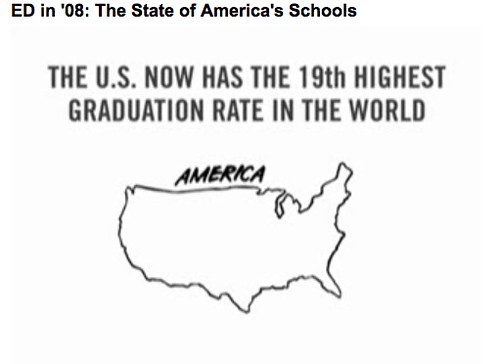
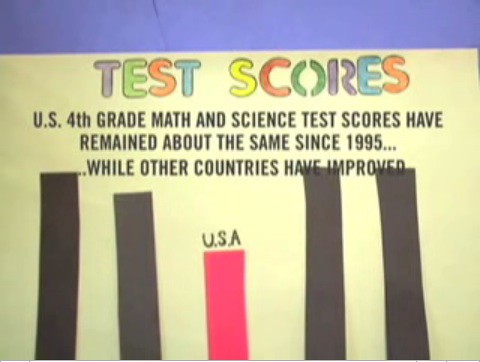
This is terrific - having watched once, I would say that it's the YouTube version of The Race Between Education and Technology -- these two screen grabs especially:


I'm just beginning the section of the book on U.S. education, but the argument seems to be that the enormous advantage the U.S. had in number of citizens attaining high school degrees is the central source of our dominance of the world economy for so many years.


Steve Levitt summarizes The Race in 2 sentences
Jimmy graduates

The anemic response of skill investment to skill premium growth
The declining American high school graduation rate: Evidence, sources, and consequences
Pushy parents raise more successful kids

The Race Between Education and Technology book review
The Race Between Ed & Tech: excerpt & TOC & SAT scores & public loss of confidence in the schools
The Race Between Ed & Tech: the Great Compression
the Great Compression, part 2
ED in '08: America's schools
comments on Knowledge Schools
the future
the stick kids from mud island
educated workers and technology diffusion
declining value of college degree
Goldin, Katz and fans
best article thus far: Chronicle of Higher Education on The Race
Tyler Cowan on The Race (NY Times)
happiness inequality down...
an example of lagging technology diffusion in the U.S.

the Times reviews The Race, finally
IQ, college, and 2008 election
Bloomington High School & "path dependency"
the election debate that should have been

2 Million Minutes

I just ordered my copy of 2 Million Minutes.

For family viewing.

Here's the trailer:


Monday, June 23, 2008

Any summer projects to share?

If your child has been assigned a summer project--particularly one that seems excessively complex, open-ended, off-topic, and/or demanding of time and/or "creativity"--I'm currently collecting anecdotes about these. I've just posted two of my own children's summer projects at Out In Left Field; I'd love to post more. You can share them as comments here, or at OILF.

Attention, Parents of Children with Autism: Emily Wants to Hear From You About Mainstreaming

Here's the post: A life less ordinary?: Mainstreaming: your experience.

I'm putting together a journalistic report on mainstreaming and autism, and I'm interested in your input. If you'd like, please tell me about your experiences, understanding of the law, opinion about its application, anything that is related to the subject of mainstreaming and autism.

You can

  1. Email Emily at daisymayfattypants at yahoo and then dot and com.
  2. Leave a comment at this post: Mainstreaming: Your Experience