kitchen table math, the sequel

Saturday, April 26, 2008

another real-world problem

More from the NSF's Algebra Cubed Project:

Using Ratios to Taste the Rainbow (pdf file)

Goal: At the end of the activity, the students will know that the actual ratio of colored skittles is not what the Mars company claims. They will also be able to calculate different ratios and percentages associated with the number of colored skittles given to their group.

KY Standards: MA-7-NPO-S-RP1
Students will apply ratios and proportional reasoning to solve real-world problems (e.g., percents, sales tax, discounts, rate).

The Mars company has been lying to us about the ratio of colored skittles?

makin' those real-world connections

Speaking of the value of word problems, this might be taking authentic assessment a tad too far. (pdf file)

happy 25th anniversary!

in today's Wall Street Journal:

Today marks the 25th anniversary of "A Nation at Risk," the influential Reagan-era report by a blue-ribbon panel that alerted Americans to the weak performance of our education system. The report warned of a "rising tide of mediocrity that threatens our very future as a nation and a people." That dire forecast set off a quarter century of education reform that's yielded worthy changes – yet still not the achievement gains we need to turn back the tide of mediocrity.

After decades of furthering educational "equality," the 1983 commission admonished the country, it was time to attend to academic excellence and school results. Educators didn't want to hear this and a generation later many still don't. Our ponderous public-school system resists change. Teachers don't like criticism and are loath to be judged by pupil performance. In educator circles, one still encounters grumbling that "A Nation at Risk" lodged a bum rap.

Others heeded the alarm, though, and that report launched an era of forceful innovation and accountability guided by noneducators – elected officials, business leaders and philanthropists.

Such "civilian" leadership has brought about two profound shifts that the professionals, left to their own devices, would never have allowed. Today, instead of judging schools by their services, resources or fairness, we track their progress against preset academic standards – and hold them to account for those results.

We're also far more open to charter schools, vouchers, virtual schools, home schooling. And we no longer suppose kids must attend the campus nearest home. A majority of U.S. students now study either in bona fide "schools of choice," or in neighborhood schools their parents chose with a realtor's help.

Those are historic changes indeed – most of today's education debates deal with the complexities of carrying them out. Yet our school results haven't appreciably improved, whether one looks at test scores or graduation rates. Sure, there are up and down blips in the data, but no big and lasting changes in performance, even though we're also spending tons more money. (In constant dollars, per-pupil spending in 1983 was 56% of today's.)

And just as "A Nation at Risk" warned, other countries are beginning to eat our education lunch. While our outcomes remain flat, theirs rise. Half a dozen nations now surpass our high-school and college graduation rates. International tests find young Americans scoring in the middle of the pack.

[snip]

....four key lessons:

First, don't expect Uncle Sam to manage the reform process....Yet some things are best done nationally – notably creating uniform standards and tests in place of today's patchwork of uneven expectations and noncomparable assessments. [ed.: I dissent]

Second, retain civilian control but push for more continuity. Governors and mayors remain indispensable leaders on the ground – but the instant they leave office, the system tries to revert. The adult interests that rule it – teacher unions, yes, but also colleges of education, textbook publishers and more – look after themselves and fend off change. If three consecutive governors or mayors hew to the same agenda, those reforms are more apt to endure.

Third, don't bother seeking one grand innovation. Education reform is not about silver bullets. But huge gains can be made by schools that are free to run (and staff) themselves, attended by choice, expected to meet high standards, and accountable for their results. [ed.: Logic of Failure says yes!]

Consider the more than 50 schools in the acclaimed Knowledge Is Power Program (KIPP) network. We don't have nearly enough today, but we're likelier to grow more of them outside the traditional system than by trying to alter the system itself.

Finally, content matters. Getting the structures, rules and incentives right is only half the battle. The other half is sound curriculum and effective instruction. If we can't place enough expert educators in our classrooms, we can use technology to amplify the best of them across the state or nation. Kids no longer need to sit in school to be well educated.

Twenty-Five Years Later: A Nation Still at Risk

Having recently discovered that there are at least 3 degree-granting high schools online, I'm betting a modest sum of money on this last one. Of course, that may be mostly because I enjoy the irony. Public schools are obsessed with technology, and always have been. [see, e.g.: Larry Cuban, Clifford Stoll, Todd Oppenheimer.] Here in Westchester, school districts are hiring assistant superintendents for technology and pouring hundreds of thousands of dollars into the latest edu-obsession, namely: SMART Boards, which in my district are being used as $4000 computer projectors if they're being used at all.* (The touch screens on some seem to require constant recalibration; others have boot-up problems; etc.) That's on top of the $400 computer projectors a lot of these districts had already purchased.

We are told, constantly, that technology will save us.

Looking at the brand-new, souped-up pitch for K12, I'm thinking: you know, it just might.

more t/k

* cost of replacement light bulb: $400

Friday, April 25, 2008

NYT's Writes "Fuzzy Maths" Obituary

Study Suggests Math Teachers Scrap Balls and Slices - New York Times:

"In the experiment, the college students learned a simple but unfamiliar mathematical system, essentially a set of rules. Some learned the system through purely abstract symbols, and others learned it through concrete examples like combining liquids in measuring cups and tennis balls in a container.
Then the students were tested on a different situation — what they were told was a children’s game — that used the same math. “We told students you can use the knowledge you just acquired to figure out these rules of the game,” Dr. Kaminski said.
The students who learned the math abstractly did well with figuring out the rules of the game. Those who had learned through examples using measuring cups or tennis balls performed little better than might be expected if they were simply guessing. Students who were presented the abstract symbols after the concrete examples did better than those who learned only through cups or balls, but not as well as those who learned only the abstract symbols.
The problem with the real-world examples, Dr. Kaminski said, was that they obscured the underlying math, and students were not able to transfer their knowledge to new problems."


What more can you say? Abstract confusing word problems bad, underlying math good.

via Flypaper

Note: post edited. The use of the word abstract, throws me. And I know I haven't been actively posting, I have been working full time, raising five kids, and taking a full time course load. Alaska is cool though; we got 18 inches of snow today.

a Math Trailblazers word problem

Lefty's post about the new research on word problems comes just two days after I found this word problem in a 5th grade Trailblazers homework pack:

Lee Yah and Manny are setting up tables for the 5th-grade family craft show. Each table is 200 cm long. Tables will line up along 2 sides of the room which measures 12 meters each. [could I possibly have copied this sentence correctly??] Each participant who wishes to sell crafts pays a $15 rental fee for 1 table or $25 for 2 tables. Mr. Moreno tells the students that all tables have been rented. Only 2 people rented two tables. How much money will the school make on the craft show?

The first thought that sprang to mind when I read through this problem was: no child can possibly learn math from this.

I myself find the thing close to inscrutable. (Do the same people who write instruction manuals write word problems for Trailblazers?)

fyi: one of ktm's frequent commenters sent me this observation in an email just last week:

But what I have long worried about is that for some reason, the skills taught in reform math programs do not *transfer* well. I have never seen anyone talk about that, but I've seen it time and again. Their learning seems to be really confined to the particular context/problem they learned it in.

Query: Does teaching new concepts in a "real world context" have the inadvertant effect of obstructing the transfer of that learning to other contexts? Do kids who learn things in the abstract have an easier time of it?

I get $170.

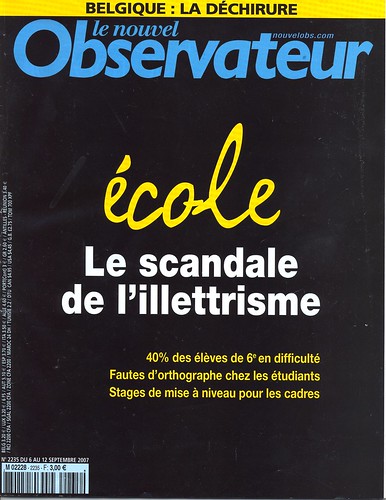
Comment en est-on arrivé là?


I had been planning to type this anti-constructivist cover story from last September's Nouvels Obs for months now (nearly 8, to be exact) and, in the wake of the news that William Ayers is the new VP for curriculum of AERA, I decided that today is the day.

Unfortunately, I'm not equipped to write about politics. Not enough background knowledge. The best I can do is to say what I do know to be the case, which is that, broadly speaking, liberals and leftists are not constructivists. Nouvels Obs, a publication of the left in France, is a classic example. (I'll ask Ed where exactly Nouvel Obs is on the political spectrum there.)

Or, heck. Take Siegfried Engelmann, whom The New Yorker describes as "hard left."

It's true that political conservatives are (probably) never constructivists, and that all constructivists are (probably) liberal or left. But -- and if I knew more logic I'd be able to state this formally -- education school liberalism & leftism is a world unto itself. A thoughtworld, as E. D. Hirsch puts it (a review of The Schools We Need by Vlorbik!)

Ed had a funny experience shortly after this issue came out. He went to dinner with several of his colleagues, all of them liberal to left, & told them about the article. News of edu-calamity in France took no one by surprise. Every person present simply took it as a given that a country having its school children sit around constructing meaning was on the primrose path to hell.

My point: education politics don't split along the customary left-right lines.

The transcript is below; I'll get Ed to translate this weekend. Still have a couple of other sidebars from the same issue to type, as well as an interview.

[note: some of the spelling & accents are going to be wrong here - had to rely on Word's spell check]


Comment en est-on arrivé là?

Bien sûr, il y a la télévision, les jeux vidéo et les nombreuses sollicitations de l’image, mais l’écrit a aussi perdu du terrain dans les programmes et les méthodes

1. Des méthodes bizarres

Le ministère est plein de bonnes intentions. Son credo, depuis l’introduction du collège unique ? « Donner du sens » aux apprentissages. En lecture, il a donc été tente un temps par la « globale » : l’enfant partait d’un texte, apprenait des mot entiers et donnait vite l’illusion qu’il pouvait lire. Gros échecs, débats échevelés. Ladite méthode est finalement bannie, mezzo voce d’abord, puis a pleine voix par Gilles de Robien en 2006, et la vielle syllabique, ou l’on apprend ses lettres avant de les assembler, est réintronisée.

Pourtant, l’approche globale a quelques beaux restes. « À la maternelle, on demande à l’enfant de retenir la forme de certains mots, des prénoms, les jours de la semaine… Or l’imagerie médicale révèle que le contour global de mots ne joue pratiquement aucun rôle dans la lecture experte. Habituer l’enfant a y prêter attention lui fait prendre de mauvaises habitudes », explique Stanislas Dehaene, professeur de psychologie cognitive expérimentale au Collège de France, a l’occasion de la sortie de son livre (1).

Pour donner du sens encore, le ministère demande aux instituteurs de travailler le français dans toutes les matières, selon la fameuse règle de la « transversalité ». « On est censé arrêter la leçon de géographie, faire ouvrir les cahiers de français, copier une phrase du cours et la travailler… Cela rompt la dynamique, et les élèves, en particulier les plus fragiles, ne s’y retrouvent pas », explique un instituteur de CM1. Cela peut même tuer le plaisir. « C’est un leurre de croire qu’on a lire une Å“uvre littéraire, et qu’on va en tirer des règles d’orthographe, poursuit une de ses collègues. Si on commence a découper les phrases, a les disséquer, on se déconnecte du sens et on assèche le rapport a la littérature. »

Toutes ces pratiques sont filles de la pédagogie « constructiviste », ou l’élève est censé « construire son apprentissage ». En ORL (observation réfléchie la langue), il faut que la règle soit découverte, comprise, et qu’elle soit réinvestie dans des exercices », explique Vincent, instituteur de CE2 dans l’Essonne. « L’intention est louable, mais quand il faut l’appliquer dans toutes les matières, elle fait perdre un temps infini, lâche une autre institutrice de CE2. Ce temps nous manque ensuite pour faire les exercices d’application et assurer les acquis. » Les familles ne s’y trompent pas. En octobre 2006, un sondage TNS-Sofres revelait que, pour 73% des parents, la grammaire et l’orthographe sont moins bien enseignes qu’avant.
C.B.
(1) « Lire dans le cerveau », Odile Jacob, Paris 2007.


2. Moins de grammaire

« Certains de mes élèves butent en lecture. Ils n’ont pas passe assez de temps sur les sons difficiles, comme le son « g », qui change selon les voyelles, ou les sons « ss » et « s » », constate une institutrice de CM1-CM2. Car l’école demande aux enfants d’apprendre plus vite.

Entre 1956 et 1969, on comptait quinze heures de français par semaine. En 1969, plus que dix. En 1990, les maîtres se sont vu allouer une enveloppe globale – entre neuf heures trente et treize heures trente – pour traiter à la fois le français, l’histoire, la géographie et l’éducation civique. Aujourd’hui, cette fourchette est tombée entre neuf et dix heures. Pourquoi, cet acréage progressif ? D’abord, parce que, selon les auteurs des programmes, les élèves sont supposés « faire » du français dans toutes les matières (la fameuse « transversalité »). Ensuite, parce qu’il a bien fallu caser l’anglais, l’éducation artistique ou l’éducation civique, introduits a l’école pour créer le fameux « bain culturel » cher à Jack Lang. Mais ce choix ne convainc pas les experts. « En reduisnt le temps d’apprentissage systématique de l’écriture, des règles de grammaire, des familles de mots… les élèves apprennent moins bien et moins vite le française », juge Anne-Marie Chartier, professeur a l’Institut national de Recherche pédagogique (INRP). « Moins une compétence est automatisee et plus elle nécessite d’attention et de place dans notre mémoire de travail », ajoute Jean-Pierre Jaffre, linguiste au CNRS. Du coup. Si un élève fait un exercice simple, comme une dictée, l’orthographe résiste. Mais si on lui demande un exercice plus complexe, comme de rédiger un texte de son cru, il n’arrive pas a tout faire. D’où ces copies truffées de fautes.

Les très bons élèves se débrouillent. Mais pour les moyens, et a fortiori les plus fragiles, cette réduction des horaires équivaut au régime de la double peine. Ils partent avec un handicap, et la politique ministérielle, en les privant d’une imprégnation suffisante, les précarise un peu plus.
C.B.


3. Une langue littéraire

Dans la cour, il peut dire « bagnole », « tire », « caisse ». Dans la classe, il est censé ne parler que d’ « automobile », d’auto », ou de « voiture ». Dehors, il peut crier : « Zyva, la, Mathieu l’est trop nul, il est », à propos de son copain qui lui a fauche le ballon. Dedans, il doit expliquer « Mathieu m’a pris le ballon des mains ». Dehors, la langue ordinaire. Dedans, le français classique, l’outil indispensable a la réussite scolaire. « Les enfants dont les parents ne parlent qu’un français simple a la maison s’en tirent bien a l’oral, mais ils sont très handicapés a l’écrit. Il y a des tournures syntaxiques et du vocabulaire qui leur manquent », explique Bénédicte, institutrice de CE2 a Saint Gervais. Ils ne rattrapent jamais leur retard. « Dans les milieux sociaux défavorises, le langage de l’école n’est pas repris dans la famille. On y verbalise moins. Si personne a la maison n’est là pour vous lire des livres vous faire raconter votre journée, corriger vos expressions, vous faites partie des 26% d’élèves en difficulté », résume un inspecteur général de l’enseignement primaire.

L’école ignore le problème. « Elle fait comme si le français scolaire était une langue que l’élève possédait déjà, comme si l’enseignant était là pour mettre en ordre des compétences déjà acquises. En réalité, il faudrait l’enseigner comme une langue étrangère », estime Marie-Christine Bellosta, professeur de littérature à la ENS, ex-femme de gauche, devenue pilier de la Fondation pour l’Innovation politique, proche de la droite. Pis : certains instituteurs croient bien faire en s’évertuant à parler « banlieue », pour êtres sûrs d’être entendus… Car, dans certains quartiers, les élèves comprennent bien que la langue classique, celle de l’école, est un signal social. Et ils la rejettent. Le phénomène prend toute son ampleur au collège, mais il naît à l’école primaire. « La langue soutenue, avec toutes ses règles, est pointe du doigt parce qu’elle est celle des Français WASP blancs dominants », résume Mathias Gavarry, professeur de lettres en collège. C’est la langue des « bourges », des « vieux », avec lesquels on ne pactise pas.
C.B.


4. Une orthographe ardue

Pas de chance pour les écoliers français. Notre orthographe est l’une des plus difficiles au monde. Pour une raison bête comme chou. Ce n’est pas parce qu’on entend un son qu’on saura l’écrire (« saint » se prononce comme « ceint », « sein » ou « sain », etc.) Les linguistes parlent de régularité entre les sons et les lettres. D’un pays a l’autre, elle varie du simple au double. Elle est de 97%, par exemple, pour l’espagnol ou l’italien, de 98-99% pour le finlandais ou le danois, mais seulement de 55% pour le français. Sans parler des problèmes d’accord, de lettres qui ne sont pas prononcées. De quoi s’arracher les cheveux. Là où un petit Espagnol mettra quelques mois à maîtriser les bases orthographiques, il faudra des années pour un Français. C’est que, dans beaucoup de pays, l’orthographe s’est simplifiée, « phonetisée », au fil des siècles. En France, non. « Notre langue est très conservatrice », reconnaît le linguiste Alain Bentolila, qui vient de publier « Urgence école : le droit d’apprendre, le devoir de transmettre » (Odile Jacob). Centralisme linguistique, institutionnalisation…Dès le XVII siècle, avec la naissance de l’Académie française, s’instaure le pouvoir du dictionnaire, référence de la langue. « Le français a été crée par des professionnels de l’écrit qui ont voulu faire une orthographe pour l’Å“il », indique Jean-Pierre Jaffre, linguiste au CNRS. Avec ses rigidités et ses absurdités. Pour la troisième édition du dictionnaire de l’Académie, en 1738, les imprimeurs n’avaient plus assez d’accents, ils ont mélangé les aigus, les graves et les circonflexes, quand ils n’en ont pas tout simplement oublié. Et les écoliers, trois siècles plus tard, continuent d’apprendre consciencieusement la liste des exceptions. D’où le débat, récurrent, sur une simplification de l’orthographe française. Les tentatives sont pour l’instant restées lettre morte. L’ »arrêté de tolérances orthographiques », en 1901, qui nettoyait notamment les règles des accords, n’a jamais été applique. Pas plus que le toilettage de 1990, qui a modifié la graphie d’environ 2 000 mots.Vous ne le savez sans doute pas, mais vous avez le droit d’écrire portemonnaie, naitre, évènement, nénufar et ognon…
N.F.


5. Une formation à revoir

Il n’est pas nécessaire d’être bon en français pour intégrer l’Institut universitaire de Formation des maîtres (IUFM) qui forme les enseignants du primaire et du secondaire. Même un candidat brouille avec les conjugaisons franchira le barrage du concours d’entrée. Il suffit qu’il excelle dans autres matières. Ces dernières années, le français représente moins du tiers du coefficient global, et seul un 5 est éliminatoire. D'ailleurs pour se présenter, il faut une licence mais pas nécessairement en lettres. N’importe quelle discipline fera l’affaire : maths, sport, psycho. Ainsi Mathieu, anthropologue de formation, 27 ans, titularisé en juin, s’avoue « nul en orthographe ».

Une fois le concours en poche, les futurs professeurs des écoles suivent pendant un an à l’IUFM des cours théoriques donnes par des profs qui, souvent, n’ont jamais enseigne dans le primaire. Un enseignement juge « jargonnant » par les étudiants. On parle par exemple « des systèmes morphographiques et graphonetiques du français » ou « des processus cognitifs en jeu dans l’acte de lire et écrire ». L’idéologie sous-jacente ? « L’enfant est acteur de son savoir. » Pendant ces cours, il est peu ou pas question de grammaire. Et il est très difficile de se faire recommander une méthode de lecture. Au nom de la « liberté pédagogique » et parce qu’a force de débats théologiques le sujet est presque devenu tabou ! Sophie, professeur des écoles en Eure-et-Loir, n’a jamais réussi, malgré ses demandes insistantes, à ce qu’on lui en indique une. Aurèlie, sortie en juin d’un IUFM, n’a eu droit qu’a neuf heures de cours consacres a l’apprentissage de la lecture. « A entendre l’intervenante, c’était à nous d’élaborer une méthode, mais ce qu’elle décrivait était vertigineux, infaisable. »

Heureusement, restent les stages dans les classes tout au long de l’année, avec des « maîtres professeurs », très appréciés des étudiants. « C’est là qu’on apprend tout. Instit, c’est un métier d’artisan », dit Sophie. Quant aux éventuelles lacunes en français a chacun de les gérer.Mathieu, l’handicape de l’orthographe, a fait des dictées chez lui avec son papa, directeur financier, en attendant de découvrir son premier poste cette semaine.
J. de L.


6. L’écran contre le livre

Pas le temps de lire ? La belle affaire. C’est même à se demander si les gamins ont encore le temps de manger quand on voit le temps qu’ils passent scotches devant leur écran… Les statistiques donnent le vertige. Deux heures et cinq minutes de télévision chaque jour entre 4 et 14 ans, une heure trois quarts à écouter la radio de 13 a 17 ans, dix heures par semaine à pianoter sur son ordinateur et sept heures devant sa console de jeux vidéo dès qu’on est ado… Les parents ne cherchent même plus à contrôler la (sur)consommation : un quart des enfants, entre 8 et 12 ans, et plus de la moitie, à partir de 13 ans, ont la télé dans leur chambre… « Chez certains garçons a l’adolescence, on atteint des proportions quasi pathologiques, indique Marc Le Bris, instituteur, auteur de « Et vos enfants ne sauront pas lire … ni compter ! » (Stock, 2004). Et même si ce n’est pas la cause principale de l’illettrisme, cela ne fait que décupler le phénomène. » L’écran ne serait pas seulement chronophage, ni uniquement un concurrent de plus pour l’école, comme l’a été, au XIX siècle, le travail l’école, comme l’a été, au XIX siècle, le travail dans le champs. Il induirait des attitudes et des comportements inquiétants. « L’absorption immodérée d’images ne s’accompagne pas d’une restitution par le langage, indique une directrice d’école dans un quartier difficile de l’Essonne. L’écran tue le dialogue, le désir de communiquer. Il rend passif. Il nuit à l’acquisition du langage. » Sans parler des nouvelles formes de communication (SMS, MSN…), les « A 1 2C4 » et autres « Teou », qui n’ont plus grand-chose à voir avec les règles ancestrales de l’orthographe française… Pour l’instant, il semblerait que l’écran fasse barrière et que les adolescents n’utilisent guère ce type d’abréviations dans leurs copies. Mais jusqu'à quand ? C’est la question que se posent les linguistes.
N.F.

Le Nouvel Observateur
No. 2235 du 6 au 12 Septembre 2007
p. 12-15


translation t/k

Le scandale de l'illetrrisme (nouvel obs: the scandal of illiteracy)
dyslexie, vraiment? ) (nouvel obs: true dyslexia? - whole language in France)
Comment en est-on arrivé là? (nouvel obs: How did we get here?)
French spelling

4 year olds learning to read in 10 to 12 weeks
Why English speaking children can't read

Lucy Calkins on teaching children to write
Becky C on starting at the top

instructional casualties in America
curriculum casualties: figures
forcing hearing children to learn as deaf children must
decline at the top: hidden reading deficits in good students
Rory: I frickin' hate whole language!

thank you, whole language

May 6: Call (Don't E-Mail) Your Congressional Representative: Please Co-Sponsor the IDEA Fairness Restoration Act

(a version of this post appears at Special Education Law Blog)


Back in 1986, Congress passed the Handicapped Children's Protection Act, which (a) recognized that parents of handicapped children might disagree with schools over effective education of handicapped children, (b) recognized that parents, compared with school districts, had smaller resources, and (c) leveled the parent/ school district playing field, by allowing parents to recover their expert witness.

But then in 2006, the Supreme Court ruled that parents cannot recover expert witness costs, in the ruling costs, in Arlington Central School District v. Murphy (2006).

The Murphy ruling was a real blow to most parents of disabled children. Why? Approximately 36% of children with disabilities live in families earning less than $25,000 a year; over 2/3 earn less than $50,000 a year. Those families can't afford the expert witness costs.

There is an act before Congress that needs your Congressional Representative's support.

The IDEA Fairness Restoration Act (H.R. 4188) would override the Supreme Court's decision in Arlington v. Murphy (2006) and allow parents who prevail in due process or litigation to be reimbursed for their expert witness fees. H.R. 4188 is important to level the playing field and protect the rights of the 7 million children with disabilities.


On Tuesday, May 6, 2008, please call your Congressional Representatives (202-224-3121) and ask them to cosponsor H.R. 4188, the IDEA Fairness Restoration Act. Have friends and family members call. It will only take 2-3 minutes!

If you do not know who your Congressional Representative is, go to http://www.house.gov and put your zip code into the box in the upper left corner. (You usually only need your five digit zip code.) You can also use http://www.congress.org to look up Representatives and phone numbers.

It helps if you ask for the Education Aide, but you can also talk to the person who answers the phone. You can also leave a voicemail message. Tell them you are a constituent and would like the Congressperson to co-sponsor H.R. 4188, the IDEA Fairness Restoration Act. Congress needs to hear from as many parents, advocates, attorneys, and others as possible.

Allowing parents to recoup their expert fees simply restores Congress' original intent, as expressed in the Handicapped Children's Protection Act of 1986.

Why Is This Act Necessary?

School districts use tax dollars to employ and pay for psychologists and other paid experts at IEP meetings and hearings.

For parents, hiring qualified medical, technical, and other expert witnesses can cost many thousands of dollars. Few parents can afford this high cost, putting due process out of reach for most parents, who struggle to afford what their children with disabilities need.

When prevailing parents cannot recover expert costs, the playing field is neither level nor fair, and children are denied a free appropriate public education and other fundamental IDEA rights.

Introduced by Congressman Chris Van Hollen (D-Maryland) and Pete Sessions (R-Texas), H.R. 4188 will restore Congress’ original intent and allow parents to recover their expert fees.

Why Is It Important For Your Congressional Representative to Co-Sponsor the Bill?

This is bi-partisan legislation, and the more co-sponsors, the more likely the passage of the act.

Why You Need to Call Your Congressional Representative:

In some ways, children with disabilities are invisible Americans (see, for example, Michael Bérubé's analysis of the Presidential candidates' positions on disability, Disability and Democracy)

Calling your Congressional Representative serves to put Congress as a whole on notice that educating all students with disabilities--as required by law--is a deep concern for the American public.

If due process is not affordable, the IEP process becomes even more one-sided and unfair. School personnel control the IEP process and often vastly outnumber parents. When the right to due process is meaningful, it helps ensure that school districts provide appropriate educations to children with disabilities.

Most parents turn to due process and litigation only as a last resort. In 2003, the GAO reported that there were only 5 hearings per 10,000 special education students. But when parents are forced into due process, they should be able to afford expert witnesses.

Over 100 disability organizations, including the Consortium of Citizens with Disabilities, Arc, Easter Seals, the Council of Parent Attorneys & Advocates, Inc., National Disability Rights Network, National Down Syndrome Society, National Down Syndrome Congress, Learning Disabilities Association, National Center for Learning Disabilities, CHADD, and others support H.R. 4188.

Read the text of the letter sent by disability organizations at The Council of Parent Attorneys and Advocates, Inc. (COPAA)'s website: http://www.copaa.org/news/organizations.html

Want more detailed information?

Download COPAA’s complete brochure on the IDEA Fairness Restoration Act and enabling parents to recover expert fees, http://www.copaa.org/pdf/MurphyBrochure.pdf

There is also a Spanish language version, http://www.copaa.org/pdf/MSSpanish.pdf

(Lea aqui en Espanol: Murphy y los derechos de los padres para recuperar el costo de los expertos: http://www.copaa.org/pdf/MSSpanish.pdf )

You can read H.R. 4188 here: http://www.copaa.org/news/IRFAct.html

For more information about H.R. 4188 and this alert, please contact Bob Berlow and Jess Butler of COPAA at protectidea@copaa.org Together, we can make the difference and restore a balanced playing field for children with disabilities.

About COPAA:


The Council of Parent Attorneys and Advocates, Inc. (COPAA) is an independent, nonprofit, §501(c)(3) tax-exempt organization of attorneys, special education advocates and parents. COPAA's mission is to be a national voice for special education rights and to promote excellence in advocacy. Our primary goal is to secure high quality educational services for children with disabilities.

Problems with "real world" math problems

I've been complaining for years that all the hands-on, "real world" math activities that dominate Reform programs shortchange kids on the autistic spectrum. They confuse the many who have language delays and gaps in worldly knowledge, and are too full of distractions for those who require streamlined, structured learning environments.

Now a new study by Jennifer A. Kaminski, a research scientist at the Center for Cognitive Science at Ohio State, reported in today's NYTimes, suggests that this kind of hands-on math is bad for everyone.

Quoting the Times: "The problem with the real-world examples, Dr. Kaminski said, was that they obscured the underlying math, and students were not able to transfer their knowledge to new problems."

As the Times also remarks: "Dr. Kaminski and her colleagues Vladimir M. Sloutsky and Andrew F. Heckler did something relatively rare in education research: they performed a randomized, controlled experiment."

sex, drugs, & rock 'n roll

I've been worried about teen drug use lately. The kids around me are now old enough to be drinking and/or using drugs, and some of them are doing so.

So I've been worried.

I've had two interesting conversations in the past week with people who know something about the subject firsthand: a police officer & a pediatrician. I'll post those conversations later on.

Naturally I've been wondering what the story is with Catholic schools seeing as how that's where we're headed in the fall. Ed and I have been assuming that Catholic high schools probably have at least somewhat lower drug use but we have no way of knowing. The world of parochial schools is new to us.

This morning, excavating the stack on my kitchen table, I found Jaye Greene's report on public schools:

Parents reflexively believe that suburban public schools provide children with safer and more wholesome environments than their urban counterparts. This report finds that the comforting outward signs of order and decency in suburban public schools don’t reflect real student behavior. Using hard national data on high school students, this report by Manhattan Institute Senior Fellow Jay P. Greene and Senior Research Associate Greg Forster finds that urban and suburban high schools are virtually identical in terms of widespread sexual activity and alcohol use. Additionally, about 40% of 12th graders in both urban and suburban schools have used illegal drugs, and 20% of suburban 12th graders and 13% of urban 12th graders have driven while high on drugs. Both types of students are about equally likely to engage in other delinquent behaviors such as fighting and stealing.

Sex, Drugs, and Delinquency in Urban and Suburban Public Schools
Jay P. Greene & Greg Forster

I'd forgotten that.

My quick skim of Greene's paper incited a brand-new, top o' the morning Google quest for studies of Catholic schools and drugs, et voilà:

Sex, Drugs, and Catholic Schools

"Private religious schools reduce teen sexual activity, arrests, and cocaine use. Contrary to popular belief, private religious schools do not achieve these results by enrolling better-behaved students."

and:

Private religious schools had much lower rates of sexual activity, arrest, and cocaine use. The differences persisted even after family characteristics were taken into account. When the authors controlled for the possibility that parents likely to produce better-behaved children might also be more likely to enroll them in a private religious school, they found that parents were more likely to choose religious private schools for children at greatest risk for problem behavior.

Looks like there's interesting data on subgroups (Catholic schools don't improve the behavior of boys living with single parents, overall, for instance). But for our own particular subgroup (boy, two-parent home), it's all good news.

no regrets

I don't regret setting bombs, Bill Ayers said. I feel we didn't do enough. Mr. Ayers, who spent the 1970s as a fugitive in the Weather Underground, was sitting in the kitchen of his big turn-of-the-19th-century stone house in the Hyde Park district of Chicago. The long curly locks in his Wanted poster are shorn, though he wears earrings. He still has tattooed on his neck the rainbow-and-lightning Weathermen logo that appeared on letters taking responsibility for bombings. And he still has the ebullient, ingratiating manner, the apparently intense interest in other people, that made him a charismatic figure in the radical student movement. Now he has written a book, Fugitive Days (Beacon Press, September). Mr. Ayers, who is 56, calls it a memoir, somewhat coyly perhaps, since he also says some of it is fiction. He writes that he participated in the bombings of New York City Police Headquarters in 1970, of the Capitol building in 1971, the Pentagon in 1972. But Mr. Ayers also seems to want to have it both ways, taking responsibility for daring acts in his youth, then deflecting it.

No Regrets for a Love Of Explosives; In a Memoir of Sorts, a War Protester Talks of Life With the Weathermen
by Dinitia Smith
September 11, 2001

Bill Ayers, newly elected Vice President for Curriculum of AERA. Membership: 25,000.

Every public school in the nation save one -- Bill Gates' High Tech High in San Diego -- is required to hire teachers trained by these people.

It's time to deregulate the schools.

Set the children free.

Let them have schools & teachers who teach.

Thursday, April 24, 2008

AERA on eduwonkette

AERA has become a gigantic tenure hustle.
eduwonkette

I'm wondering about the organizational structure of AERA.

Who writes the requests for papers?

Who makes the selections?

What role will William Ayers be playing in this process?

And, again: critical pedagogy. What is the relationship of AERA, in particular its role in tenure cases, to critical pedagogy?

how many professors in schools of education?

I've been thinking about the 25,000 members of AERA. What proportion of the country's education professors does this represent?

Here's The Education Schools Project on the number of ed schools:

The country has more than 1,200 schools, colleges and departments of education, covering a spectrum of nonprofit and for-profit programs, undergraduate and graduate.

And here's Frederick Hess on the importance of AERA to the field:

...many schools and departments of education treat AERA presentations as significant evidence of academic accomplishment when it comes to awarding tenure, pay raises, and research support... I have observed or been contacted as part of more than a few tenure or hiring cases where AERA presentations were deemed credible evidence of scholarly activity. So, in the current climate, these presentations have real value in the academy.

I wonder how elections work at AERA.

I also wonder whether AERA sees itself as a proponent of critical pedagogy.


Pedagogy of the Oppressed by Pablo Freire
Teachers College research at AERA

what do critical pedagogues think of fuzzy math?

I don't know what they think.

After reading Tex's post about William Ayers and his new post as vice president for curriculum at AERA, I figured I'd like to know, AERA being the association for education research in this country and all.

So I took a look at his blog. I still don't know, but I fear the worst:

Classrooms and schools for democracy and freedom recognize each student as an entire universe, each capable of becoming an author, artist, and activist in his or her own life—teachers in these classrooms assume that every student is an unruly spark of meaning-making energy on a voyage of discovery and surprise. And the best teachers are themselves unruly sparks, also on a voyage, also awakening to the new and moving and in solidarity with, not in service to their students.


That doesn't sound good. Plus he's got a link to Gerald Bracey. Which is a sign.

AERA has 25,000 members?

And these 25,000 members think a practitioner of critical pedagogy should be in charge of curriculum?

Couldn't he be in charge of something else?

Like the social context of education, maybe?

On the other hand, William Ayers may be more open to the concept of kids being in some way exposed to an "academic curriculum" than his predecessor in the post:

By the early 1970s, my local high school had adopted many of the nation’s post-Sputnik educational reforms. In addition to tracking (a legacy of still earlier times), academics were proclaimed the order of the day. Our national security rested on our ability to compete with the Russians, and therefore as adolescents we were told to learn more math, science, and foreign languages. By and large, my upper-middle classmates rose to the occasion. For reasons I still do not entirely grasp, they found a highly academic curriculum interesting and compelling. They were motivated. They were organized. They had binders for every class. They knew how to take tests. They did their homework. They excelled--and I did not.

Yet, I am writing today as a modestly successful academic.


I dunno.

On balance, I prefer Dave. At least he writes well. And he looks like fun.

chunking

[P]ractice changes the way a task is perceived. A chess master, for example, can look at a game in progress for a few seconds and then perfectly reconstruct that same position on a blank chessboard. That’s not because chess masters have great memories (they don’t have the same knack when faced with a random arrangement of pieces) but because hours and hours of chess playing have enabled them to do what psychologists call “chunking.” Chunking is based on the fact that we store familiar sequences—like our telephone number or our bank-machine password—in long-term memory as a single unit, or chunk. If I told you a number you’d never heard before, though, you would be able to store it only in short-term memory, one digit at a time, and if I asked you to repeat it back to me you might be able to remember only a few of those digits—maybe the first two or the last three. By contrast, when the chess masters see the board from a real game, they are able to break the board down into a handful of chunks—two or three clusters of pieces in positions that they have encountered before.

In “The Game of Our Lives,” a classic account of the 1980-81 season of the Edmonton Oilers hockey team, Peter Gzowski argues that one of the principal explanations for the particular genius of Wayne Gretzky was that he was hockey’s greatest chunker. Gretzky, who holds nearly every scoring record in professional hockey, baffled many observers because he seemed to reverse the normal laws of hockey. Most great offensive players prefer to keep the rest of the action on the ice behind them—to try to make the act of scoring be just about themselves and the goalie. Gretzky liked to keep the action in front of him. He would set up by the side of the rink, or behind the opposing team’s net, so that the eleven other players on the ice were in full view, and then slide the perfect pass to the perfect spot. He made hockey look easy, even as he was playing in a way that made it more complicated. Gzowski says that Gretzky could do that because, like master chess players, he wasn’t seeing all eleven other players individually; he was see ing only chunks. Here is Gzowski’s conclusion after talking to Gretzky about a game he once played against the Montreal Canadiens.... :
What Gretzky perceives on a hockey rink is, in a curious way, more simple than what a less accomplished player perceives. He sees not so much a set of moving players as a number of situations. . . . Moving in on the Montreal blueline, as he was able to recall while he watched a videotape of himself, he was aware of the position of all the other players on the ice. The pattern they formed was, to him, one fact, and he reacted to that fact. When he sends a pass to what to the rest of us appears an empty space on the ice, and when a teammate magically appears in that space to collect the puck, he has in reality simply summoned up from his bank account of knowledge the fact that in a particular situation, someone is likely to be in a particular spot, and if he is not there now he will be there presently.

The Physical Genius
by Malcolm Gladwell


This is what Carolyn meant when she talked about math being a seamless whole. (I think.)

can you FOIL the answers? part 2

answer: yes

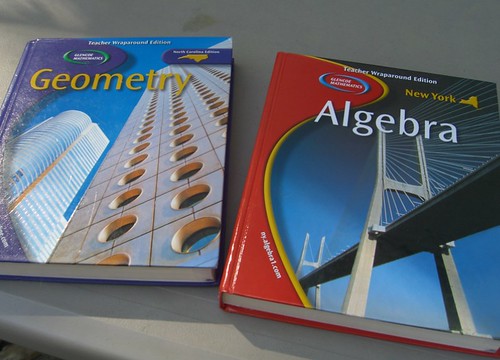
Teacher Editions of textbooks are subject to Freedom of Information Law requests, and my district has now provided me with the Teacher Wraparound Editions for Glencoe Geometry (New York) and Glencoe Algebra (New York).


ISBN numbers:
Glencoe Algebra New York (full title)
ISBN: 0-07-873316-2 0078733162 Student Edition
ISBN: 0-07-873317-0 0078733170 Teacher Wraparound Edition

Glencoe Geometry New York (full title)
ISBN: 0-07-873320-0 0078733200 Student Edition
ISBN: 0-07-873321-9 0078733219 Teacher Wraparound Edition

The North Carolina Teacher Wraparound Edition of Glencoe Geometry is identical to the New York edition:
ISBN: 0-07-860178-9 Teacher Wraparound Edition North Carolina


Feedback is essential to learning. Period. If your child's school does not collect and correct homework or perform formative assessment, it's up to you.

If it's up to you to collect and correct homework and remediate gaps, then you are going to need the Teacher Wraparound Edition. Freedom of Information Law requires that your district provide it to you when asked.


Teacher Wraparound Editions for Glencoe Algebra & Geometry, New York

On the picnic table.


state test coming right up (2006)
throwing money at the problem
more stuff only teachers can buy
help desk 1
state test coming right up (2007)
help desk 2
my life and welcome to it
canadianteacher.com
progress report
despair
28 out of 30

all the answers are belong to us
email to the math chair
second request
teacher's manual
it would be unusual
inflammatory
2 weeks off

can you FOIL the answers?
can you FOIL the answers? part 2

Bill Ayers is not a “professor of English”

In fact, he is a tenured Distinguished Professor of Education at the University of Illinois, Chicago.

I haven’t heard if Obama has corrected himself on this. However, this is what I'm interested in:

The more pressing issue is not the damage done by the Weather Underground 40 years ago, but the far greater harm inflicted on the nation’s schoolchildren by the political and educational movement in which Ayers plays a leading role today.

[...]


Instead of planting bombs in public buildings, Ayers now works to indoctrinate America’s future teachers in the revolutionary cause, urging them to pass on the lessons to their public school students.

[…]

Ayers’s influence on what is taught in the nation’s public schools is likely to grow in the future. Last month, he was elected vice president for curriculum of the 25,000-member American Educational Research Association (AERA), the nation’s largest organization of education-school professors and researchers. Ayers won the election handily, and there is no doubt that his fellow education professors knew whom they were voting for. In the short biographical statement distributed to prospective voters beforehand, Ayers listed among his scholarly books Fugitive Days, an unapologetic memoir about his ten years in the Weather Underground. The book includes dramatic accounts of how he bombed the Pentagon and other public buildings.

Sol Stern in the City Journal

Maybe the media should be questioning Obama and McCain about their views on Ayers in this influential position. Some readers might believe doing so would be a demonstration of “gotcha” politics, but I really would like to hear their answers.

Wednesday, April 23, 2008

bullying stats

I seem to be on various edu-p.r. lists these days, which is interesting. Today's "Media Advisory," from "The National School Boards Association's Council of Urban Boards of Education," contains this result from a survey of "10,270 parents in 112 urban schools from 17 states":
Bullying continues to be an issue at school. Little more than half of the parents surveyed felt that teachers had the ability to stop bullying, with close to 30 percent not sure if this was possible. More than 25 percent of parents have spoken to an administrator about bullying. Parents with students in the middle grades (6-8) were the largest group (nearly 11 percent) to report that their child was bullied during the school day at least once per month.
I'd love to know what figures you'd see in a survey of suburban, parochial, & private school parents.

something else I didn't know

For $43, the College Board will send you a copy of the test you took, your original answer sheet and a breakdown of correct and incorrect answers — providing a useful way to assess your weak spots, as well as to find a score-sheet mistake or some terrible injustice.

Appealing a Test Score

help! help!

A couple of weeks ago I downloaded a report on schools that had successfully raised the achievement of their students.

What was interesting about this report was that it included charts showing that as black students' scores rose, white students' scores rose, too. I was planning to do a screen grab of the charts....and now, instead of posting a screen grab, I'm spending hours of my life doing Spotlight & Google searches.

Any idea what report I'm talking about?

(And, yes, I have come to a sorry pass. If anyone should know what I'm talking about, it should be me. You would think.)

palisadesk on Ruby Payne & poverty

I wanted to get this comment from palisadesk up front:

I found Ruby Payne’s Framework book and articles to be worthy of discussion and very thought provoking, but also to be taken with a large dose of sodium chloride. Two egregious errors that infuse her work are overgeneralizing and reifying abstractions. She speaks of “children in poverty” and “people in poverty” as if poverty is a singular entity with clearly defined boundaries and a shared ecosystem. This is simply not the case.

There’s a big difference between, say, multi-generational urban poverty and the poverty of new immigrant families. There’s a big difference between rural poverty and urban poverty – even a big difference between the way the rural poor in agricultural communities see the world, and the way the non-urban poor in mountainous or northern communities view things. “Poverty” looks different in these varying situations, too.

Her over-simplistic characterization of a “culture of poverty” can be insidious. She has some important insights, but her overgeneralizing weakens their power and does indeed lead to the kind of stereotyping she deplores.

The viewpoints she represents as characteristic of "poverty" are amalgams at best. Even in an urban, low-income school community, we see “subcultures” where there is a strong future-time orientation, an emphasis on effort and achievement, minimal reliance on physical force to settle disagreements, etc. Different cultures exist within the larger group which Payne characterizes as “people in poverty.” Poverty is not a place, and it is (thankfully) often a temporary condition for families.

I had many insights while reading her book, and so am disappointed I can’t heartily recommend it because it goes well beyond available data and tends to perpetuate generalizations about groups of people. Her point about resources available to kids is extremely well-taken, however. I was in one school where the classrooms had no books, pencils, paper – nothing. The library was a joke (nothing new since 1954). Sure, we could teach kids how to read by writing words on the (battered and cracked) chalkboard, and photocopying stories from the public library, but really, nothing the teacher could do would compensate for the fact that there was NO way for the students to practice the skills taught and their environment – including their school environment – militated against it. There are schools like this in every large metropolitan area, I’m willing to bet. Schools where rats scurry around and buckets catch rainwater from leaking ceilings.

It doesn’t need to be an either/or situation – the precision teaching motto, “do both” is good advice here. We should endeavor both to provide the needed supports outside of school (medical care, decent housing, recreational opportunities etc.) for children and also concentrate on what we offer them in school in terms of solid instruction that will help them determine their own destiny. As things stand, schooling tends to widen the gap, rather than narrow it. We have not really come to grips with this.

My understanding of the situation is that our schools are widening the gap. True of black and, I assume, Hispanic children compared to white peers; true of white children compared to their peers in Europe and Asia.