Posts
Posts


College-educated workers are more plentiful, more commoditized and more subject to the downsizings that used to be the purview of blue-collar workers only. What employers want from workers nowadays is more narrow, more abstract and less easily learned in college.To be sure, the average American with a college diploma still earns about 75% more than a worker with a high-school diploma and is less likely to be unemployed. Yet while that so-called college premium is up from 40% in 1979, it is little changed from 2001, according to data compiled by Jared Bernstein of the Economic Policy Institute, a liberal Washington think tank.
Most statistics he and other economists use don't track individual workers over time, but compare annual snapshots of the work force. That said, this trend doesn't appear due to an influx of lower-paid young workers or falling starting salaries; Mr. Bernstein says when differences in age, race, marital status and place of residence are accounted for, the trend remains the same.A variety of economic forces are at work here. Globalization and technology have altered the types of skills that earn workers a premium wage; in many cases, those skills aren't learned in college classrooms. And compared with previous generations, today's college graduates are far more likely to be competing against educated immigrants and educated workers employed overseas.
The issue isn't a lack of economic growth, which was solid for most of the 2000s. Rather, it's that the fruits of growth are flowing largely to "a relatively small group of people who have a particular set of skills and assets that lots of other people don't," says Mr. Bernstein. And that "doesn't necessarily have that much to do with your education." In short, a college degree is often necessary, but not sufficient, to get a paycheck that beats inflation.
Economists chiefly cite globalization and technology, which have prompted employers to put the highest value on abstract skills possessed by a relatively small group, for this state of affairs. Harvard University economists Lawrence Katz and Claudia Goldin argue that in the 1990s, it became easier for firms to do overseas, or with computers at home, the work once done by "lower-end college graduates in middle management and certain professional positions." This depressed these workers' wages, but made college graduates whose work was more abstract and creative more productive, driving their salaries up.
Indeed, salaries have seen extraordinary growth among a small number of highly paid individuals in the financial sector -- such as fund management, investment banking and corporate law -- which, until the credit crisis hit a year ago, had benefited both from the buoyant financial environment and the globalization of finance, in which the U.S. remains a leader.
Richard Spitzer is one of those beneficiaries. He received his undergraduate degree in East Asian studies in 1995 from the College of William and Mary and graduated from Georgetown University's law school in 2001. The New York firm for which he works, now called Dewey & LeBoeuf, has a specialty in complex legal work for insurance companies. There, Mr. Spitzer has developed an expertise in "catastrophe bonds." An insurance company sells such bonds to investors and pays them interest, unless an earthquake, a hurricane or unexpected surge in deaths occurs.
Experts in these bonds are "probably a rarefied species -- there's only a few law firms that do them," says Mr. Spitzer, 35 years old. He typically spends two to four months on a single deal, ensuring that details like timing of payments or definition of the triggering event are precise enough to avoid disputes or default.Mr. Spitzer's salary has doubled to $265,000 since joining in 2001, in line with salaries similar firms pay.
But not all law graduates are so fortunate; many, especially those from less-prestigious schools, have far lower salaries and less job security. Similarly, some computer-science graduates strike it rich. But their skills are not as rare as they were in the early 1980s, when the discipline took off, and graduates today must contend with competition from hundreds of thousands of similarly qualified foreign workers in the U.S. or overseas.
The Declining Value of Your College Degree
in a nutshell:
(entire article posted here)
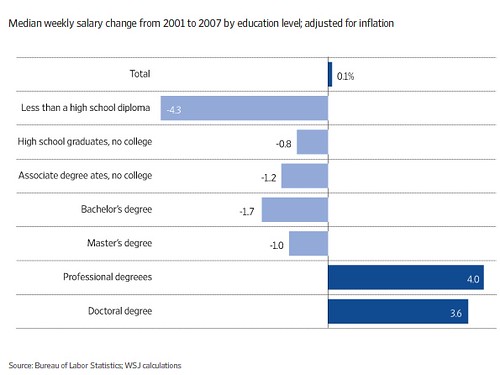
- the returns to a Bachelor's degree dropped between 2001 & 2007
- the returns to advanced degrees increased between 2001 & 2007
The rising inequality described in this article is the subject of Goldin & Katz's The Race Between Education and Technology. Their explanation, however, is quite different in substance and in emphasis.
Goldin & Katz's book isn't about the horrors of globalization. It is so not about the horrors of globalization that the word globalization doesn't even appear in the index.
The word outsourcing appears once:
Even though international outsourcing has been blamed for the decreased utilization of the less educated, the facts in this case argue against that explanation as being the primary factor. Large within-industry shifts toward more skilled workers occurred in sectors with little or no foreign outsourcing activity, at least in the 1980s and up to the late 1990s. (p. 98)
Goldin and Katz document and analyze a race between eduction and technology. As technology advances, the demand for educated workers advances, too. This has been true since the end of the 19th century.
(Prior to that, advancing technology reduced the demand for skilled labor, as when the invention of factories reduced the demand for skilled artisans.)
The law of supply and demand determines wages. For 75 years, American public schools created a continuously increasing supply of educated workers, more than any other country in the world. Because we produced so many educated workers, income inequality steadily fell.
That changed in 1980. We are no longer seeing enormous gains in educational attainment from one generation to the next. It used to be that kids were always much more educated than their parents; those days are gone.
Meanwhile, the advance of technology has not slowed. We are producing more high-level jobs, and fewer high-level workers. This means the highly educated earn more while others earn less.
The two charts below accompanied the WSJ article:
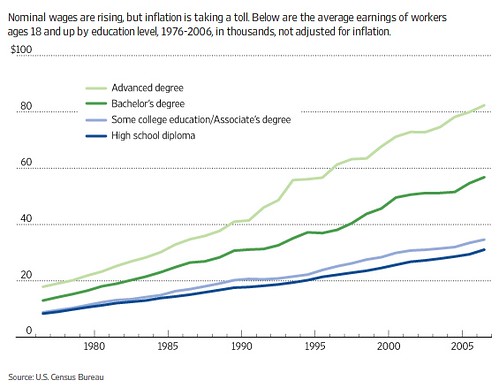
The second chart is the important one. This chart goes back to 1976. Look how close the lines are in 1976. The difference between a lawyer and a plumber back in the day wasn't that big. I'm old enough to remember that time. Newspapers and magazines were filled with articles arguing that college wasn't worth the money because you could get rich being a really good plumber.
Then look at the difference between a plumber and a lawyer today.
Winner take all.
Given the (apparently) related fact that we also see rising within group inequality, I see two rational responses:
- do everything in your power to see to it that your kids receive a superb education up through graduate or professional school
- carry on lobbying schools & governments to fix the schools, which, in my case means supporting charters & vouchers as well as school reform
Steve Levitt summarizes The Race in 2 sentences
Jimmy graduates
The anemic response of skill investment to skill premium growth
The declining American high school graduation rate: Evidence, sources, and consequences
Pushy parents raise more successful kids
The Race Between Education and Technology book review
The Race Between Ed & Tech: excerpt & TOC & SAT scores & public loss of confidence in the schools
The Race Between Ed & Tech: the Great Compression
the Great Compression, part 2
ED in '08: America's schools
comments on Knowledge Schools
the future
the stick kids from mud island
educated workers and technology diffusion
declining value of college degree
Goldin, Katz and fans
best article thus far: Chronicle of Higher Education on The Race
Tyler Cowan on The Race (NY Times)
happiness inequality down...
an example of lagging technology diffusion in the U.S.
the Times reviews The Race, finally
IQ, college, and 2008 election
Bloomington High School & "path dependency"
the election debate that should have been