kitchen table math, the sequel

Saturday, May 31, 2008

down under

tour de force:
The curriculum for public confidence
Published Thursday, 14th December, 2006
by Bruce Wilson

I was the first person in my family to finish secondary school. My father had left school at 12, because he was needed on the farm. My mother left formal school even earlier because of a death and disruption in the family. In neither case were the decisions made about their education considered odd or unsympathetic. Education, at the time when my parents were doing it, was not the answer to the future.

However, increasingly throughout that period, the terms of the educational offer changed. There was a sharp divergence, starting during the 70s, between professional and public understanding of the educational offer. When educators spoke, the public's eyes glazed over. Our rhetoric was full of arcane language and secret business. It was during that period that the profession came to believe that education was no longer about filling up people's minds with a lot of stuff.

I remember from my Diploma in Education, and subsequently, lots of analogies based loosely on the jug and the mug, which is the most pervasive image of traditional education in the professional mind. The analogy sees the teacher as the wielder of the jug, and the student as the mug, the recipient of the contents. In this bad old model of education, the teacher stood over the student pouring knowledge into the student's head, and occasionally splashing it over the student's shoulders. This was taken to be an extremely bad thing, and shortly before my Dip Ed year at La Trobe University had apparently been replaced with a greatly improved new model in which the teacher and the student sat around the jug and discussed it, or wrestled for control of it, or kicked it over in a display of class solidarity. Everyone was very excited about this new model and we students of teaching spent most of the year chatting about it, when we weren't drawing up manifestos for a democratic revolution or going to the football.

This challenge to the control of the teacher was closely related to other changes in the status of authority figures. At about the same time, Roland Barthes was gloating over the dying body of the author, while a number of theologians had a little earlier disposed of God in a bloodless coup. The fuss was about knowledge. That was what filled the jug wielded by the teacher. That was what the author had, and had to be dispossessed of. That was what God represented. Somehow, while we weren't watching, knowledge became a bad thing. It was erased from the educational offer, or at least reduced substantially in importance. Knowledge became identified among the leaders of the the teaching profession as a badge of privilege, a way of reinforcing social inequality. Knowledge was the carrier of power relationships. In the place of knowledge we substituted process. What mattered was that students investigated, explored, constructed their own understanding of the world. The content of those investigations was not what counted.

But the users of education, parents and students, were unaware that the fine print had changed. They were still expecting, and still expect today, that education should result in greater knowledge, while the providers of education hold a rather different view about the outcomes of education. (If not knowledge, then what?)

There are many reasons why we have seen a decline in public confidence in schooling, and notably in public schooling. This article will not address most of them. But in the area of curriculum, we lost the public when we decided that something other than knowledge was the purpose of education.

[snip]

There are four changes which would probably make a significant difference to public confidence.

Firstly, we should have one curriculum in Australia rather than some indeterminate number. A curriculum which was developed nationally would not in itself dramatically change public understanding: many people think we already have a national curriculum....The work should be undertaken by an agency independent of, but responsive to, those who presently manage education systems. This will help ensure that the work is designed to meet educational needs rather than political exigencies, and avoids the cluttered and opaque theoretical foundations which afflict many current curriculum documents.

Secondly, we should write our curriculum in English. No Australian curriculum document at present is comprehensible to a lay reader. We should aim for documents which are simple, explicit, and designed to be read and understood by interested parents. This approach has a number of advantages, beyond making our intentions clear to the users of education. It would assist teachers, who are mostly obliged to use official curriculum documents, to understand what we expect of them. It would enable the documents to be used in support of education rather than, as at present, as evidence of our failure. Finally, it would provide a practical illustration of the benefits of education, demonstrating that as educated individuals we can write something which is accessible to a non-expert reader.

Thirdly, we should fill those documents with explicit statements of the knowledge which we intend to impart to young people. We should base these statements on the disciplines, which represent the most powerful ways yet devised of understanding the world. Our purpose should be to teach young Australians their history and geography, introducing them to the artistic, scientific, cultural, moral and linguistic traditions which should sustain them. Our aim should be to guarantee every child a framework of knowledge which can provide a foundation point from which to comprehend and gain power over the world. Most Australian curriculum at present offers a mass of ill-digested competing frameworks, which complicate the documents and bury the really important things beneath a heap of someone's good ideas.

And fourthly, we should make the documents brief. We can do this by avoiding turgid and impenetrable introductions, lengthy lectures about teaching and extended riffs on a range of overlapping frameworks. Most obviously, we can do it by including less stuff.

I do not claim that these changes would restore public confidence in schooling. They would, however, make the curriculum a tool for restoring confidence rather than a club to beat it to death.

and again:

We should base these statements on the disciplines, which represent the most powerful ways yet devised of understanding the world.

Race Between Education and Technology

The book is out. These are major academics, fyi.

Excerpt here. (pdf file)


blurb:
Table of Contents

Part I: Economic Growth and Distribution
1. The Human Capital Century
2. Inequality across the Twentieth Century
3. Skill-biased Technological Change

Part II: Education for the Masses in Three Transformations
4. The Origins of the Virtues
5. Economic Foundations of the High School Movement
6. America's Graduation from High School
7. Mass Higher Education in the Twentieth Century

Part III. The Race
8. The Race between Education and Technology
9. How America Once Led and Can Win the Race for Tomorrow

related: public confidence in the schools
In the early 1970s, not only did most Americans believe that the public schools were functioning reasonably well, a sizable majority of adults thought that public education had actually improved since they were kids. Today, only a small minority of Americans share this optimistic view. Instead, the majority now believes that schools have gotten significantly worse. Fully half of all Americans are dissatisfied with America’s public education system, a deep concern shared by black and white parents alike.

The Two-Income Trap: Why Middle Class Mothers and Fathers Are Going Broke
by Elizabeth Warren & Amelia Warren Tyagi


It looks to me as if public confidence in the schools declined at the same time Goldin and Katz find public education no longer keeping pace with developing technology -- and no longer serving to decrease inequality.


Steve Levitt summarizes The Race in 2 sentences
Jimmy graduates

The anemic response of skill investment to skill premium growth
The declining American high school graduation rate: Evidence, sources, and consequences
Pushy parents raise more successful kids

The Race Between Education and Technology book review
The Race Between Ed & Tech: excerpt & TOC & SAT scores & public loss of confidence in the schools
The Race Between Ed & Tech: the Great Compression
the Great Compression, part 2
ED in '08: America's schools
comments on Knowledge Schools
the future
the stick kids from mud island
educated workers and technology diffusion
declining value of college degree
Goldin, Katz and fans
best article thus far: Chronicle of Higher Education on The Race
Tyler Cowan on The Race (NY Times)
happiness inequality down...
an example of lagging technology diffusion in the U.S.

the Times reviews The Race, finally
IQ, college, and 2008 election
Bloomington High School & "path dependency"
the election debate that should have been

A private public school, or a public private school?

Allison left a comment on a previous post that’s been gnawing at me. It’s not that I disagree with her necessarily, but rather that she has uncovered (unintentionally or not) what I believe to be a great truth in education.

In response to a comment I made about building a private school model that relies on both tuition and community support, she writes:

The value of using only tuition in a for profit model is that you can really be a private institution. Once you allow funding sources from other places like "the community", you've increased your stakeholders again, and you're back to the place where you aren't in control, because "the community" has its own ideas of what's an acceptable "education". If you're a for-profit private company, you have the most autonomy, and that's the best for implementing your ideas with the least number of stakeholders.. For-profit public companies have external shareholders to be beholden too, as well--that also poses problems.

Without intending to, she has just laid out the exact line of thinking of our current public school administrators.

Remember that, from an administrator’s point of view, their money doesn’t come from the public – it comes from the government. That’s who signs their checks. The last thing they want is support from the community, because it would come with strings, and they’d end up dealing with a long list of stakeholders. They’d lose their status as sole authority.

(And sure, they take some types of support, as long as it’s on their terms: unrestricted cash contributions from the PTA, parent volunteers to whom they can assign projects, and so on. But nothing that would require them to share or give up the helm.)

So, ironically, it turns out that our public schools are operating like private institutions: as autocracies with no one to answer to but themselves.

When I suggested the idea of a private school that made up for low tuitions with community support, I was interested in going in exactly the opposite direction: a school that thrived through the engagement of its supporters. Not just “only-on-my-terms” engagement, but stakeholders with a voice.

How would that be possible without creating conditions of chaos or drift? By doing what public education has failed to do: creating a set of firm guiding principles governing the mission of your school.

We haven’t had a national conversation about the purpose of public education in decades (if we ever did), and as a result we have no shared set of objectives to guide what a school should and should not do. But if we were to do that on an individual school level, at least for this hypothetical private school, I think it could work.

Imagine if we had a guiding statement like this:

At ????? Elementary School, we believe that our sole job is to help children build the academic foundation they need to excel in their school careers and, ultimately, as citizens and workers once they leave school. To this end, we believe the following:

  • Children should be taught to mastery in reading, math, and writing
  • Children should build their knowledge of the sciences to help them understand the world around them
  • Children should understand the civic and political structures of the United States, and why we believe it is the best system in the world; they should also learn its history, including both its triumphs and its missteps
  • We cannot know whether learning has occurred unless we assess students. Assessments are conducted regularly and are used to measure accomplishment and to guide future instruction
  • Every child should meet high and objective standards set collaboratively with our stakeholders
  • If a child has not learned, it means we have not taught. (with apologies to Zig Englemann)

(These are just for examples, btw – don’t get hung up on them :-))

If you lay out explicitly what you believe and what you strive to accomplish, you can say to your parents and your community members: This is a private institution; you do not have to participate. However, if you do, you have to understand that the guiding principles of this school will remain constant: they will not change, and it is this vision that you are buying into. Within this framework, which is set in stone, our stakeholders have a real voice in how we accomplish these ends, and we have boards set up that you can join, and that hold sway on the operations of this school.

If you do this – and make sure your boards make decisions on good data – you can have a public model of a private school.

What do you think – am I wrong about how public schools operate like private institutions? Am I wrong that a private school can be democratically run by its stakeholders?

What Shamu Taught Me...

...about a Happy Marriage

My Karen Pryor dog treats and target stick have arrived, and my dogs (Surfer and Abby) are liking the clicker, liking the treats, and are happy to touch their noses to the target or drop their bodies down to the floor.

Neither has, as yet, experienced a lightbulb moment.

I'm gathering my courage to try this with Andrew. His behavior has got to get under control this summer. When Ed gets back from L.A., we're all going to have a go at the training game.


trainer's motto: It's never the animal's fault.

Friday, May 30, 2008

Extra Credit

6th grade math extra credit question:

How many numbers between 1000 and 2000 are the same when you turn them upside down?

The answer was five.

This is math?

And, um, five??

Advanced Placement & TAKS

starsfan0271 wrote:

7th grade English teacher here:

Please let's go back to basics. Our kids need to learn that having poor grammar and typos may be ok for texting, or even commenting on boards, but it's not gonna cut it when trying to express yourself to a wider audience.

Advanced Placement tests for Language require knowledge of the parts of speech--by not explicitly teaching them, we are already hurting our kids chances of earning AP credit and doing well in Freshman comp in college.

5/23/2008 2:46 PM CDT

a little brain-based research is a dangerous thing

Another comment from the TAKS article:

Riebs wrote:

The members and even the well-meaning reporters who are writing are missing the message: teachers are teaching GRAMMAR. The lessons are taught directly and then applied in the current piece of writing the student is performing. When the grading rubric is designed , students and teacher together discuss which skills have been highly focused on in that particular piece of writing ....which is the application of the grammar, punctuation, usage, agreement, skills that have been directly taught, then conference on, then expectantly applied withint the piece. They then decide on the point value of each skill to be scored highly...GRAMMAR IS IN THE DOCUMENT.

We know people who never got it, who struggled with it, and those of us who found it fun because it happened to have been where we were developmentally. Research has taught us in the last 30 years just when that frontal lobe of the brain works...the abstracting part....it used to be that we expected kids to be able to LOCK IN grammar and other abstract skills between ages 12-17...and now we know that research shows that that may even extend for many individuals into the mid twenties...so spending time stuffing skills into kids; heads for momentary understanding takes away depth in the students' connections and engagement in their day. Yes, present grammar as concretely as possible, but don't expect mastery to come early for some concepts....

It is folly for the news media and the state board to talk about not enough grammar in the school day at early ages..teachers are teaching grammar. But take any book that is well published and find no error, no stylistic features no incomplete rhetorical statements for emphasis. You can't find one.

It's not about "being more creative," because in the editing stage before any creative piece is published and posted, students must edit and again...be retaught necessary grammar skills and must negotiate with the professional who is the teacher, just what sylistic license can be taken. And yes, even the babies....first grade on, have SOME editing responsibility...in the end of a piece to be posted.....but very few simply because of developmental level. The good teacher is always nudging for new skills for even the young, like sentence combining to make a young one's developmental begin to grow.

I have sat from March through this May 15th situation, and I can tell you, the games the 9 members of the board have played is astoundingly embarrassing for each and every tax payer in Texas, and I believe Texas will be duly embarrassed as the politicians take a national look at what Texas is doing, for we have supposedly been a leader in No Child Left Behind....ha...big joke...and I have educator daughter in special needs education...so I know what it's all doing at that level, too.

Grammar is tested on TAKS at 4th grade, for sure, within the writing passage those kids are given to do in one sitting....they are expected to have a specific level of control within those pieces of grammar, agreement, correct parts of speech, and all forms of basic punctuation, capitalization...It's just scored in the final copy they present to the state....control of that is necessary for adequate scoring. Remember, they have NO TEACHER INPUT so they must have been taught the importance of editing when they are alone writing for publication, which that test requires.

There's not an adult out there, who could do a piece at the adult level on a TAKS writing test that SOME grammarian and editor out there would not question. We even see careless errors on pieces that come in from adults for publication...so don't tell me grammar is not in the teacher's minds, hearts, and daily classrooms. Their kids can't survive without it, and it is curriculm everywhere in the state text books, but WITH writing strands.

Teachers ARE direct teaching grammar. We have a SBOE that are NOT curriculum savvy, and they are driving research on learning into the dump in Texas, quite unbeknownst to them, even when they care. They may have sat and listened to nearly 7th PHD, CURRICULUM SPECIALISTs, researchers in education in all these meetings, but they have not HEARD...and certainly they have just been showing us that they can't comprehend...but how should that surprise us...they voted comprehension teaching down twice...even as Mr. Craig tried to work it in in an amendment. Two board members, shortly after the voted T document down 9 to 6....said, If we are going to cut and paste from the teacher document into the Standard Works document we just accepted, so that we GET THE TEACHER DOCUMENT, why did we just vote it down? Mr. Allen, Mrs. Knight, paraphrased.

Don't get me started....thanks if you hung in there and read all this stream of conscience writing....please don't edit...I haven't for this conversation. Riebs

Student developmental levels and the last 30 years of brain-based research in exactly HOW the brain learns through engagement is a missing element in many of these bloggers' background. I am a taxpayer, parent, teacher, writing specialist, researcher...literacy professional. I am completely offended by the decision of the board....but I will tell you..I, too, loved diagraming in school. I could see it as a puzzle...just give me a longer one....I loved it....and I never wrote or for the most part EVER considered, even in high school or college (50's/60's) how I was applying grammar skills. I must say, for many of you out there who ARE talking great: grammar: it's how I somehow the reader and correct structurer I am today...people...we are out there. But for most American students, grammar never gave them what you and I have naturally....and they never learned better from it....

BECAUSE OF ONGOING RESEARCH WHEN CAN BE CONFIRMED AS CORRECT....THROUGH THE USE OF SOPHISTICATE EQUIPMENT THAT SHOWS WHEN THE BRAIN IS ENGAGING FOR DEEP LEARNING AND WHEN IT ISN'T, children and adults, for that matter, should learn through engagement that is meaninful, not through isolated bits and pieces.

5/23/2008 12:00 PM CDT

Perhaps this Comment is not the best advertisement for the lifelong benefits of sentence diagramming.

Be that as it may, this is the part that gets to me:

Research has taught us in the last 30 years just when that frontal lobe of the brain works...the abstracting part....it used to be that we expected kids to be able to LOCK IN grammar and other abstract skills between ages 12-17...and now we know that research shows that that may even extend for many individuals into the mid twenties.

I despair.

Yes, research shows that the frontal lobes continue to mature throughout the teen years and into the twenties. Martha Denckla once told me that myelination continues into the 30s but I can't find a current reference for that, so perhaps it happens in the 20s.

This research has nothing to do with the ability to learn abstract material:

The belief that children of particular ages cannot learn certain content because they are “too young” or “not ready” has consistently been shown to be false.
Fact Sheet
National Math Panel


Not only can young people with immature frontal lobes learn abstract material, we have evidence that young people with immature frontal lobes may learn algebra better than older people with mature frontal lobes:

New fMRI evidence suggests that adolescents could be at an advantage for learning algebra compared with adults. Qin and colleagues present findings indicating that after several days of practice adolescents rely on prefrontal regions to support the retrieval of algebraic rules to solve equations, as do adults. Unlike adults, however, after practice adolescents decrease their reliance on parietal regions, which assist in the transformation of the equations, suggesting an enhanced ability for learning algebra. These findings are discussed with regard to adolescent brain maturation.
Algebra and the adolescent brain (pdf file)
Beatriz Luna
Trends in Cognitive Science
Vol. 8, No. 10 October 2004, p 437-439


What "30 years of research" actually shows us, if I may be so bold, is that expecting adolescents to "take responsibility for their own learning" is a very bad idea.

to wit:

Reuben Gur: Well I think it is a frequent experience with people who have raised teenagers, or been around them, that they are every bit as smart as they will ever be and some of them are smarter than their teachers or their parents. Their memory and their ability to absorb new information and ability to reason through complex problems - and yet sometimes they do something that leaves you wide-mouthed, wondering, 'What were they thinking?' And they could then afterwards explain to you perfectly why what they did was wrong, it’s just that it didn’t all fall together at the right moment in the right circumstances. And that’s exactly what may be the result of the fact that the connections between the reasoning part of the brain and the sensory and the action part of the brain and the emotional part of the brain - all those regions need to meet with their context in the frontal lobe and right now there is no highway there, it’s only a rural road that is sometimes disrupted.

Rebels and the cause - the adolescent brain

whole everything

I'm reading the comments on the Texas vote, and have come across a terrific statement of the wholeism taught in ed schools:

paul002 wrote:

Encourage reading and writing first. Worry about grammar later. Do you teach babies the proper way to greet someone before their first word? No, you do not. You speak around them enough so they emulate what they hear. They begin speaking in incomprehensible baby talk and progress to sentences. It is the same with reading and writing. Read to children, teach them to read, and encourage them to read on their own. At the same time, teach them to write. If they are reading, they will try to emulate what they read. As they get better at writing, you can work on grammar and editing. This is why publishers have editors and writers don't do their own editing.

If you want to "go back to basics," then how much more basic can you get than teaching the written language in the same manner that you learned the spoken language?

5/23/2008 8:52 AM CDT

I'd like to slap a sticker on that one.

If I had a sticker.

Thursday, May 29, 2008

in Texas

English standards head back to basics
Teachers bitter as divided board expected to alter curriculum today

Texas Education Board rejects English teachers' input on new curriculum standards

The board's social conservatives, joined by Republican moderate Geraldine Miller of Dallas and San Antonio Democrat Rick Agosto, prevailed, 9-6, for a plan that features a back-to-the-basics approach for grammar and reading comprehension. A final vote on the plan is scheduled for today.

[snip]

"Most of the teachers in this state are going to be furious," said Alana Morris, past president of CREST (Coalition of Reading and English Supervisors of Texas).

[snip]

For some board members, though, it came down to process and a different educational approach. The prevailing side wants grammar taught separately instead of incorporating it in the context of writing.

"We believe you need to know those skills first, and then you can incorporate them into your writing," said member Terri Leo, R-Spring. "We feel the other side thinks that you are going to learn things by osmosis, by just writing."

Right you are, Terri Leo, R-Spring. The other side does indeed think that you are going to learn things by osmosis, by just writing:

Top-down [teaching] means that students begin with complex problems to solve and then work out or discover (with the teacher's guidance) the basic skills required.
source:
Educational Psychology, 7th edition
Robert Slavin
p 259
top-down teaching

Hand kids an undifferentiated mass; let them figure it out.

Have I mentioned lately that I spent 7 years of my life trying to determine the relevant parts of autism?

I don't recommend it.

Speaking of undifferentiated masses, today's news from Texas is a case of synchronicity. Just this afternoon I was saying to Barry G that it is past time for our merry band to re-visit the strands.*


bonus observation: social conservatives, a Republican moderate, and a Hispanic Democrat

Holy moly.

If I were a CRESTy, I would be asking myself whether it's a good idea to be inspiring these folks to make common cause. Which would lead me, I'm pretty sure, directly to the conclusion that I should not be posting sentiments like these on the worldwide web.


fearless leader


Texas Alternative Document
Elaine McEwan recommends Texas Alternative Document
top-down teaching
constructivism: the mother lode

*the strands decoded

fun with Spanish centered stuff

Just for fun, I ran the Spanish translation of the Prentice Hall letter Catherine posted through Word's translation feature. Here's what the computer thinks this all means in English:

Dear family,

Welcome to ________________. I wait for with illusion a successful year in ________________. In order to prepare to our students for future challenges in mathematics, we have chosen a program that includes an active approach to the learning of abilities to solve problems.

Our text book, published by Prentice Hall, is a program centered in the student. Its style takes to the students to the discovery of mathematical ideas. Soon, once they discover those ideas, they communicate what they have learned and they apply what they know. The program requests to them that they solve problems individually and in equipment. One focuses to situations of the real life to help the students to appreciate the power of the mathematics in its daily life.

Our goal is to form an association with the family and members of the community. United we can create a learning atmosphere that really helps our students. Throughout this scholastic year, we will invite you to participate in scholastic year, we will invite you to participate in scholastic events and projects of the home and the school. His son or daughter will take to the house, periodically, activities that you will share and experiment together in family. All the suggestions or commentaries are welcomes that they want to do to us on our program. If they have questions on the activities of his student in the class of mathematics, them request that leaves a message me ________________. In its message tell me which is the best hour to give back its call to them. They can also write to me to ________________.

It excites the idea to me to work with you to manage to have a satisfactory and successful scholastic year.

Kindly,

________________________


Just imagine receiving this letter in your child's backpack. Now you have an idea of how that Spanish speaking family member is feeling when they read that funky student-centered waste of trees from the good folks at Prentice Hall.

On the positive side of things, this type of computer translation is precisely why it will be awhile before my work as a translator is easily replaced by technology. It's nice to feel I still have a purpose in the 21st century.

Having it both ways; Everyday Math Responds to NMP report

I received a copy of a response that the good folks at Everyday Math prepared in response to the National Math Panel report. Cheryl Van Tilburg who lives in Singapore was kind enough to provide it to me. She got it from the curriculum head at the Singapore American School which her children attend. Yes, they use Everyday Math at that school. Right. "Water, water everywhere but not a drop to drink."

One of the authors was Jim Flanders who has been with EM for many years. It is too long to post the whole thing, so here are excerpts, plus some comments written by a math professor who is heavily involved in the issue of K-12 math education.

The basic message that EM puts forth is we do everything the NMP wants but we disagree with it all.


"For many reasons an Algebra course is a "gateway to later achievement", but for reasons we detail later the EM authors do not believe it is the gateway as the panel recommends. There is evidence, in fact, that the gateway is much more flexible than the panel maintains. For example, in the mid- 1990s the U.S. Military Academy changed its first (gateway) mathematics course for all freshmen from Calculus (a primary reason Algebra is so important) to a Modeling course based primarily on discrete mathematics and embedded in computing technology. In short, exactly what are the gateway or critical topics of a 21st-century mathematics education is a matter of considerable debate."
The mathematician's response: "They neglect to mention that as soon as the Military Academy students are done with their Modeling course they have to all take 2 or 3 semesters of Calculus, for which you need that algebra.


"The authors believe that a curriculum focused solely on the panels "Critical Foundations of Algebra" (i.e., arithmetic with whole numbers and fractions) would be a step backward and would not prepare students for success in tomorrow's world. Further, many of the parents of todays children had very unhappy experiences with the panels limited definition of mathematics. Most of them want their children to have the richer mathematical experience that EM has to offer."

Mathematician's response: "Here we have K-12 educators redefining mathematics, partially based on the logic that some parents had"very unhappy experiences" when they were kids learning math. "

"... the authors believe that the paper-and-pencil skills championed by the panel are simply the ones that students learned in the mid 1900s and are insufficient preparation for careers and daily life in the 21st century."."

Mathematician's response: "The necessary math hasn't changed or been redefined. If they were getting all kids to learn the basics, then this branching out might make sense, but such is not the case."

"EM also requires that students explore several computational algorithms. Knowing a variety of algorithms can (1) help with a variety of computational tasks, including estimation, in which a standard algorithm might be inefficient; and (2) help students better understand the concepts behind standard algorithms. Yet EM also encourages and supports teacher in being sensitive to individual differences. Some students may need to focus on one algorithm over all others and suggestions for how to identify such students are in the Teachers LessonGuides."

Mathematician's response:

"Note that like in TERC Investigations, there is no emphasis on learning efficient algorithms. Worse,note that it is what the students themselves "need tofocus on" that determines what a student uses. This student chosen algorithm might work well in an EM class in elementary school, but it ismy understanding that it is very difficult to get students to change once they are comfortable withan algorithm, and such an algorithm may not even be remotely comfortable when the student getsto college. This is a real, and unbelievable, disservice to students."

"They [fractions] are also represented in fraction-manipulating calculators, which are primarily tools for allowing students to do many more calculations with fractions than can be done on pencil-and-paper.

Mathematician's response: "Maybe so, but they won't get the "conceptual understanding of fractions" the NMP wants. "

Perhaps Andy Isaacs and Jim Flanders would care to offer their thoughts?

Wednesday, May 28, 2008

how do you say "student-centered" in Spanish?

Student Progress Report (pdf file)

Substitute Teacher's Quick Reference. (pdf file) [ed.: check out the final column]

Substitute Teacher's Survival Kit (pdf file)

Letter to the Family (pdf file)

Carta a la familia (pdf file)

Letter of Invitation to Attend Family/Teacher Conference (pdf file) [ed.: family/teacher? not parent? I'm calling that a demotion]

Spanish version (pdf file)


lost in translation
Querida familia,

Bienvenidos a ________________. Espero con ilusión un año exitoso en ________________. Para preparar a nuestros estudiantes para retos futuros en matemáticas, hemos elegido un programa que incluye un enfoque activo al aprendizaje de habilidades para resolver problemas.

Nuestro libro de texto, publicado por Prentice Hall, es un programa centrado en el estudiante. Su estilo lleva a los estudiantes al descubrimiento de ideas matemáticas. Luego, una vez que descubran esas ideas, comunican lo que han aprendido y aplican lo que saben. El programa les pide que resuelvan problemas individualmente y en equipos. Se enfoca a situaciones de la vida real para ayudar a los estudiantes a apreciar el poder de las matemáticas en su vida diaria.

Nuestra meta es formar una asociación con la familia y con miembros de la comunidad. Unidos podemos crear un ambiente de aprendizaje que realmente ayude a nuestros estudiantes. A lo largo de este año escolar, los invitaremos a ustedes a participar en eventos escolares y en proyectos del hogar y la escuela. Su hijo o hija llevará a la casa, periódicamente, actividades que ustedes compartirán y experimentarán juntos en familia.

Son bienvenidas todas las sugerencias o comentarios que quieran hacernos sobre nuestro programa. Si tienen preguntas sobre las actividades de su estudiante en la clase de matemáticas, les ruego que me dejen un recado a ________________. En su recado díganme cuál es la mejor hora para devolverles su llamada. Pueden también escribirme a ________________.

Me entusiasma la idea de trabajar con ustedes para lograr tener un año escolar satisfactorio y exitoso.

Atentamente,

______________________________________

This document poses a conundrum.

Given a choice, would you prefer:
  • not having the first clue what school personnel are talking about because your district communicates with parents families via form letters purchased from the publishers of your child's math curriculum
  • not having the first clue what school personnel are talking about because you don't speak English
This is the moment where, if I were having this conversation here at home, somebody would say, "That's splitting hairs."


update 5-29-2008, from the instructivist

The sugerencia I would give them is to shove it.

My thoughts exactly.


Teacher's Forms and Letters: the Complete Set
how to get parent buy-in
Everyday Math does it, too
I'm sorry, Bob and Mark
venomous
getting your math message out to parents
Carolyn on getting your math message out to parents
Math Trailblazers Parent Letters
Compare and Contrast
Education Jargon Generator

Tuesday, May 27, 2008

Singapore Math Trainings, via The Dyslexia Tutor


I've been over there, with hardly any internet access, so my apologies if this is old news to y'all.

The Dyslexia Tutor (Adrienne Edwards) has a post on Singapore math:

Intensive Five-day Summer Institutes in teaching “Singapore Math” are scheduled in Orlando (June 23-27), San Francisco (July 14-18), and Boston (July 28-August 1).

These three will focus on the fundamentals, and are geared to teachers of grades 1-6 who have little or no experience in Singapore Math, “especially those who intend to supplement a non-Singapore Math program or adopt a Singapore Math program.”


Go read her whole post. She has a good description of the Singapore program.


I was over there for this event. It is a brave woman who takes on three mothers-in-law. And we are indeed separated by a common language.

knowledge is good, part 2

Christian Crayton had three words to describe the test prep he did for the ACT college entrance exam as a junior at Chicago Vocational Career Academy: "It was boring."

Crayton, who is 17 and now a senior, said the daily drills "really didn’t do anything for me." He ended up with a 17 out of a possible 36 on the ACT and is unsure whether he’ll go to college.

That intense test prep has been the norm at many Chicago public high schools determined to increase student scores.

But a new study to be released today finds that kind of test prep does little to help. In fact, the study found the more schools do test prep during class, the worse students score on the test.

"Across the board, scores were lower in schools that emphasized more ACT prep," said Elaine Allensworth, lead author of the report by the University of Chicago’s Consortium on Chicago School Research. "They are spending all this time and energy on work that doesn’t help their scores."

The findings may seem counterintuitive, but the researchers said what was important was not the frequency of the prep but actually teaching college-level skills throughout high school.

ACT Prep Work Gets Failing Grade


From High School to the Future: ACT Preparation--Too Much, Too Late

ability grouping in Singapore

The other key factor in preserving academic quality [during 17 years of declining SAT scores 1964-1980] was the practice of grouping students by ability in as many subjects as possible The contrast was stark: schools that had “severely declining test scores” had “moved determinedly toward heterogeneous grouping” (that is, mixed students of differing ability levels in the same classes), while the “schools who have maintained good SAT scores” tended “to prefer homogeneous grouping.”
The Other Crisis in American Education
by Daniel Singal


Singapore, a country whose students have consistently scored above most others in international assessments such as the Third International Math and Science Study (TIMSS), credits ability grouping as one of the key factors in its students' academic success.

Cheri Pierson Yecke, conversations with Chan Jee Kun and Poon Chew Leng, officials with the Singapore Ministry of Education, September 9, 2002.
The War Against Excellence: The Rising Tide of Mediocrity in America's Middle Schools p. 99


Addressing Equity: Curriculum Standards and Support For the Slower Mathematics Student

The topic structure in Singapore’s framework is efficient because topics are not taught and retaught as students move through the primary grades. Instead of repeating topics that students have already learned, teachers simply reintroduce them as a foundation on which to build new mathematical content. This practice, however, may not be suitable for students who have more difficulty with mathematics. The Singapore system recognizes that students who have trouble with mathematics may not attain mastery by following Singapore’s regular program of mathematics instruction and that these students may need special assistance to attain competence.

Beginning in grades 5 and 6, Singapore identifies its weaker students on the basis of a general examination of mathematics and language competency. These students receive special assistance and are taught according to a special fifth- and sixth-grade mathematics framework. This special framework mandates that students in the slower track
  • receive approximately 30 percent more mathematics instruction than students in the regular track, and
  • be exposed to the same mathematical content as students in the regular track, although at a slower pace.
The mathematics framework for students needing compensatory assistance adds review material to strengthen students’ understanding of previously taught content. For example, topics on numbers and geometry taught in grade 4 are repeated at a faster pace in grade 5. The introduction of some new concepts such as ratios, rates, and averages, which are normally introduced in grade 5, are delayed until grade 6 for the weaker students (Ministry of Education, 2001a). What is important, however, is that because slower students spend extra time studying mathematics, topics usually taught in grades 5 and 6 do not have to be completely sacrificed to make room for repetition.6

To support the framework for slower students, Singapore has developed a Learning Support Program to help educators identify these students and provide them with extra help (Ministry of Education 2003c). Mathematics Support Teachers (MST), who receive on-the-job supervision and specialized training to ensure that they are professionally competent, deliver compensatory assistance.

In the United States, we expect all students to meet the standards in state frameworks, but the standards do not help teachers address the needs of slower students. In fact, U.S. standards do not acknowledge that students learn at different rates. No Child Left Behind addresses the needs of failing schools, but it does not directly require that failing students receive help. Although some research evidence supports the belief that students benefit when the curriculum is adjusted to match their ability levels (Loveless, 1999), a distinct alternative curriculum would raise concerns in the United States about potential harm to students from ability grouping. Singapore’s approach differs from traditional ability grouping in that Singapore establishes a framework that requires students to master the same content as other students, not a watered-down curriculum as often happens in U.S. ability-grouped classrooms. Singapore also provides extra assistance from an expert teacher.

What the United States Can Learn from Singapore's World-Class Mathematics System (and what Singapore can learn from the United States): An Exploratory Study (pdf file)
American Institutes for Research

January 28, 2005
pp. 34-35

Same content, different speed, good teachers.


stagnation at the top - Fordham report
Tracking: Can It Benefit Low Achieving Children?
Linda Valli on tracking in 5 Catholic high schools, 1
Linda Valli on tracking in 5 Catholic high schools, 2
"school commitment" in Valli's study of tracking in Catholic high schools

7th grade depression starts in 1st grade

ability grouping in Singapore
characteristics of schools where SAT scores did not decline
The Other Crisis in American Education by Daniel Singal
Hiding in Plain Sight: grouping & the achievement gap
tracking: first random-assignment study

SAT equivalence tables
SAT I Individual Score Equivalents
SAT I Mean Score Equivalents

chickens have come home to roost
the deathless meme of the high performing school
Allison on the naturals

Saturday, May 24, 2008

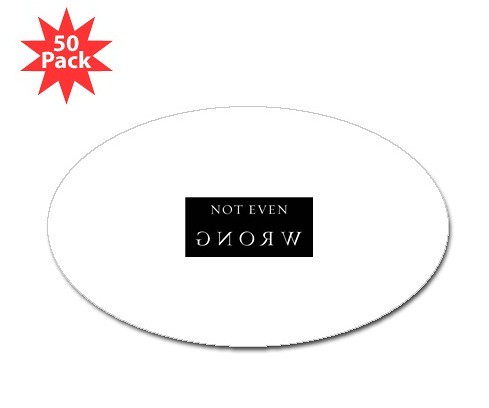
not even wrong: the sticker


source

If these babies didn't cost 80 bucks for 50, I'd get myself a batch and head over to Columbia Teachers College.

I think I'd get to work on the Lucy Calkins oeuvre first.

M.R. on homeschooling

No real rocket science.

1) We are homeschooling and are using Singapore Math. My understanding is that SM gets kids to Algebra in 7th grade, so I'm figuring 11th grade can be Calculus.

2) Child in question is about 1½ years ahead in math [we just legally finished 1st grade this week and are plowing through SM 3a right now]. Blame mom for starting him early. We're pretty much going at one year per year now, so I figure he's on pace for Calculus 1½ years earlier than normal Singapore 11th grade.

3) Math is about 1 hour per day, broken into ½ hour in the early morning with me and ½ hour in the late morning or early afternoon with Mom.

No real magic here:
A) We are using a curriculum that runs about 2 years faster then a typical US curriculum,

B) Mom got a bit of jump even on that, and

C) We do math pretty much every school day (and because I'm mean and because he only spends about 2 - 2½ hours per day on schooling we don't take summers off. I don't see much of a need) and it tends to be a priority subject [it is the first subject we do in the morning almost every day].

(Not sure whether it's OK to use M.R.'s wants his full name on the front page - will ask.)

I'm interested in the curricula you're using for other subjects, too.

In fact, I'd like to hear from concerned parent on that --- (and from everyone else).

Friday, May 23, 2008

under the bus

from Paul:

My take on this is that kids come in normal distributions, i.e. they come to your classroom with a range of capabilities. In low SES districts the spread, the standard deviation, is quite large. I've had classrooms with kids ranging from 1 year above grade to 5 years below grade.

If you are in a failing district, like mine, you are blanketed with consultants, coaches (of which I am one), tight curriculum maps, walk throughs, and on and on. The sum total of this is that you're asking teachers to teach to a really narrow portion of a theoretical distribution while, at the same time, you are 'delivered' children with a 5-6 year span in abilities.

This means that if you follow the rules, and it's perilous not to, you are by definition throwing 80% of your class under the bus. Teachers adjust the curriculum to try to push as many of the distribution as possible through the eye of the needle. They teach to their median. So by definition 40% of your class is bored and 40% don't get it.

My district retention policy is "We don't have one!" Even if they had one there is no remediation program so the miniscule portion of students who are retained are put back into the very same classroom that failed them with the expectation that the second time through will be magic.

"Just stand right there in the middle of center field, Stan, and I'll hit you a few balls," says Ollie, as he proceeds to spray 60 balls at poor Stan; all at once and all over the outfield!

Independent George on "the naturals"

re: Allison on "the naturals"

I am a sample size of one, but this matches my experiences. I am one of those 'naturals' who got to college, and realized I had three choices:

1. Study twice as hard to become a median student in chemistry
2. Study twice as hard to become a top student in economics.
3. Keep my same work habits to stay a median student in economics.

Shamefully, I chose option number 3 (and am now paying for it by working four times as hard to become a top student in an MS program I probably wouldn't have entered if I'd wised up earlier).

The other point is all those pesky foreigners are now entering the easy subjects like economics and biology.

Club English

a grammar blog for ELL students

Speaking of grammar, what do you know about KISS Grammar?

I've always meant to read the book, but haven't gotten to it.

you can look it up

from lgm, re: you can always look it up:

Our dept. chair (eng) used to tell us if you had to look up basic info, then realize the other guy was going to get and keep the job since he could communicate in real time.

I wonder if ed school professors consider holding onto a job a 21st century skill?

Dunning-Kruger effect

Linda Seebach left a link.

not even wrong

I love it!

Not even wrong!

from Vlorbik --

I think we should all get rolls of Not even wrong stickers printed up and start pasting them in edu-books here and there.

On the sly, I mean.

As a Citizen's Action.

the one that got away

Major find.

A 1991 Atlantic Monthly article on The Other Crisis in American Education.


the 16-year decline and the 1995 "recentering"

By way of background: SAT scores declined from 1964 to 1980. Math scores rose most of the way back up to where they'd been but verbal scores did not, and in 1995 the College Board recentered the scores.

My district's scores, which are significantly higher than those for other schools in our demographic, assuming I've read the charts correctly (chart correlating income and scores here; chart for determining significance here) are:

V-540 M-568 W-540 total: 1648

Prior to 1995 those scores would have been:

V-460 M-560

1108 today; 1020 before 1995. Big difference.


decline at the top

Over the years I've seen various rebuttals of the claim that the decline was due to an expansion of the pool of test takers. See here and here.

What I had not seen was the data showing that the decline was concentrated at the top:

[N]orm-referenced tests .... were able to tell us not just about the existence of the decline but something about its magnitude--half a standard deviation on the SAT--and something about its source--the decline on all norm-referenced tests was much greater among students at the top of the score distribution than among those at the bottom.

The decline at the top was so steep that the absolute number of students scoring over 650 on the verbal half of the SAT declined 45 percent between 1972 and 1982. That means the pool of top talent available for scholarship and research, for business and industry, and for the military has actually shrunk. We need to enlarge it again as quickly as we can by encouraging excellence in our schools, and we need tests that will let us gauge our progress at that vital task. The best-calibrated gauge for these purposes is a norm-referenced test. That is why a national census of educational quality should include not just a test of V and M, but a norm-referenced test of those essential, all-purpose abilities.
p. 49

[snip]

The importance of these periodic checks on test constancy is well illustrated by data on the SAT. They show that efforts to hold the difficulty level of the test constant over the years were quite successful from 1941 to 1963; less so from 1963 to 1973, when some downward drift occurred, making it a bit easier to get higher scores after 1963 than before.[23] The SAT was also easier to read in the 1960s and the 1970s than it was in the 1940s and the 1950s; the difficulty level of reading passages on the test declined, as measured by the Dale-Chall formula, from a corrected grade level of 13 to 15 to only 11 to 12.24

All in all, SAT scores in recent decades probably underestimate the great American score decline by about 8 to 12 points, roughly one-tenth of a standard deviation.

source:
A National Census of Educational Quality—What Is Needed by Barbara Lerner NASSP Bulletin / March 1987 p. 56


the one that got away

While the rest of the country was falling apart, SAT-wise, some schools sailed through those years unscathed. Daniel Singal's 1991 article summarizes a study of the ones that got away:

What has caused this great decline in our schools? The multitude of reports that now fill the library shelves tend to designate “social factors” as the prime culprit. Television usually heads the list, followed by rock music, the influence of adolescent peer groups, the increase in both single-parent families and households where both parents work, and even faulty nutrition.
Those who attribute the loss of academic performance to social factors don't take account of the small number of high schools around the country that have managed to escape the downturn. Some are posh private academies; a few are located in blue-collar neighborhoods. What they have in common is a pattern of stable or even rising test scores at a time when virtually all the schools around them experienced sharp declines. There is no indication that the children attending these exceptional schools watched significantly fewer hours of television, listened to less heavy-metal music, were less likely to have working mothers, or ate fewer Big Macs than other children. Rather, they appear to have had the good fortune to go to schools that were intent on steering a steady course in a time of rapid change, thus countering the potentially negative impact of various social factors.

It would seem obvious good sense to look closely at this select group of schools to determine what they have been doing right, but as far as I can determine this has been done in only two national studies. The better one was issued by the National Association of Secondary School Principals (NASSP) in 1978, under the somewhat pedestrian title Guidelines for Improving SAT Scores. Now out of print and hard to find, it contains one of the most perceptive diagnoses available of the underlying malady in our schools.

[snip]

The report identifies one main characteristic that successful schools have shared—the belief that academics must invariably receive priority over every other activity. “The difference comes,” we are told, “from a singular commitment to academic achievement for the college-bound student.” These schools did not ignore the other dimensions of student life. By and large, the NASSP found, schools that maintained excellence in academics sought to be excellent in everything else they did, they “proved to be apt jugglers, keeping all important balls in the air.” But academic work came first.

Two other factors help account for the prowess of these schools in holding the line against deterioration. The first is a dogged reliance on a traditional liberal-arts curriculum. In an era of mini-courses and electives, the tiny group of high schools that kept test scores and achievement high continued to require year-long courses in literature and to encourage enrollment in rigorous math classes, including geometry and advanced algebra. Though the learning environment in those schools was often “broad and imaginative,” in the words of the NASSP, fundamentals such as English grammar and vocabulary received heavy stress. The other key factor in preserving academic quality was the practice of grouping students by ability in as many subjects as possible. The contrast was stark: schools that had “severely declining test scores” had “moved determinedly toward heterogeneous grouping” (that is, mixed students of differing ability levels in the same classes), while the “schools who have maintained good SAT scores” tended “to prefer homogeneous grouping.”

If attaining educational excellence is this simple, why have these high-quality schools become so rare? The answer lies in the cultural ferment of the 1960s.

So there you have it.

The hardy little band of schools where student achievement did not decline shared three characteristics:
  • academics first and foremost, with a commitment to excellence in all endeavors
  • “dogged reliance on a traditional liberal-arts curriculum”
  • homogeneous grouping; schools with heterogeneous grouping had “severely declining scores”

My own district is doggedly moving in exactly the opposite direction. Character education and the whole child over academics, the fragmenting and blurring of the curriculum via "Exploratory" courses and interdisciplinary teaming thanks to the middle school model, and an "identified need" for "balanced classes." Balanced classes being the new term of art for heterogeneous grouping in these parts.

Oh, and more more technology.

Most school districts are headed in this direction, and the kids at the top will be hurt.

I think kids at all levels will be hurt, but if I had to guess I'd say the kids at the top and at the bottom will be worst off. More on them anon.

Nobody cares. The kids at the top are assumed to be bulletproof; as our middle school principal told a well-attended school board meeting, "I'm not concerned about the kids at the top."

The kids at the bottom can flounder and sink until they qualify for special ed. Then they'll get some "pull-out."


stagnation at the top - Fordham report
Tracking: Can It Benefit Low Achieving Children?
Linda Valli on tracking in 5 Catholic high schools, 1
Linda Valli on tracking in 5 Catholic high schools, 2
"school commitment" in Valli's study of tracking in Catholic high schools

7th grade depression starts in 1st grade

ability grouping in Singapore
characteristics of schools where SAT scores did not decline
The Other Crisis in American Education by Daniel Singal
Hiding in Plain Sight: grouping & the achievement gap
tracking: first random-assignment study

SAT equivalence tables
SAT I Individual Score Equivalents
SAT I Mean Score Equivalents

chickens have come home to roost
the deathless meme of the high performing school
Allison on the naturals

a conundrum

Googling my way around the known universe today, rounding up various decline at the top factoid and references, I came across a recently published, refereed study of "Electronic Technologies in Education Quality."

Title:

Do Electronic Technologies Increase or Narrow Differences in Higher Education Quality Between Low- and High-Income Countries?
by Norman Clark Capshaw

In developing the list, U.S. News also compiles statistics on the computer and Internet availability to students at the universities chronicled in its annual list. One of the data listed is the number of library volumes available at each institution. In addition, the list includes the number of computers available to students at the schools. It might be expected that, as the number of library volumes and the number of computers available to students increases, the ranking of the school would also climb. One would therefore expect a negative correlation1 between these variables and the institution’s rank.

This is indeed the case with the number of library volumes and volumes per student. The strong negative correlations indicate that there is some relationship between the number of library holdings and an institution’s place on the list. An even stronger correlation with volumes per student indicates that small-enrollment institutions with large library holdings are even more likely to be listed among the top schools (see Table 1). However, a counterintuitive result is obtained when analyzing the correlation of the number of computers available to students and an institution’s ranking (see Table 2). Alhough the correlation is small, its direction is counterintuitive and puzzling. It suggests that an institution suffers a penalty in its ranking when the number of computers it provides to students is large.

PEABODY JOURNAL OF EDUCATION, 83: 117–132, 2008
p. 119

That is puzzling.

I wonder what they found out about SMART Boards.

the Hawaii Chair

Another one from Susan S -- I actually did laugh so hard watching this that I had tears in my eyes.

the Hawaii Chair

Three chapter revisions down, 5 to go....

In case anyone's counting.

Talk Versus Reality

Last week my son came home and told me that a teacher asked him how to figure out percentage. The question was something like: What percentage is 18 of 156. This wasn't a math teacher. It was a teacher who was monitoring a sixth grade make-up test for Everyday Math. I guess after the test the kids were asking her how to solve it. My son (who happened to be in the room due to his odd schedule) explained it to them. I gave him an incredulous look and he said: "yup". He said that the kids don't like their regular math teacher. They just doodle in class.

Over the last 8 years, I've realized that there are two things happening in math education: talk and reality. The talk is about concepts like discovery and deep understanding. The reality is about basic competence and just getting the job done. In fifth grade, my son's Everyday Math teacher didn't get to 35 percent of the material. This wasn't carefully selected. She just stopped when the school year ended. To her credit, she did work hard to fix the basic mastery problems the kids came with. She had after-school help sessions. When I talked with her, she told me that she was not happy about how the kids got to her class in the first place, but she felt that she couldn't raise the issue. I did. It didn't seem to matter.

[I never did get a good answer to this. The best I can figure is that the school thinks the onus is on the kids and that with EM, mastery will eventually be achieved. If not, it's the student's fault. That's basically what the curriculum head told me. "If a student struggles with math for several years in a row, then you can't blame the curriculum." She also said that she liked Singapore Math, but EM was a better choice for their "mix" of kids. (private school)]

One of the problems is that Everyday Math allows this to happen on purpose. But it's more than that. Teachers and schools know that you can't put off mastery that long, but they don't all get together to fix it. I'm not talking about doing hundreds of long division problems. I'm talking about the real basics. At that school, we had a parent-teacher meeting specifically about Everyday Math. The discussion was at the "talk" level. Most focused on the need for balance and there was a lot of agreement. Almost. I wanted to talk about details, but that wasn't appropriate for the meeting. So what changed? Almost nothing. They ended up dumping EM in sixth grade and went to something that aligned more with the algebra series they used. They still didn't fix the mastery problem. I've mentioned before that even if I could get our schools to use Singapore Math, they would still allow kids to get to fifth grade not knowing their times table.

The following comments are from a recent tri-state meeting of state officials and educators to discuss bad math scores:

" ... the system and not students are to blame for low math scores ..."

"Only 22 percent of high school students achieved proficient math scores ..."

"The teachers put the test together and they're all satisfied that it's a good test..."

"Have we not got our curriculums aligned properly?" [governor]

"Educators are now trying to make sure students are actually being taught what they're being tested on."

"Another goal is to make sure all kids are given a chance to learn higher levels of math."


This has nothing do do with balance, discovery, or deep understanding. It's competence. The best they can do is to blame alignment. It's much more than that, and I'm not optimistic.

Thursday, May 22, 2008

Just discovered...

I was poking around the Anchorage School District website, and discovered that the ASD just adopted Everyday Math 2007, Third Edition. It will be mandatory for all ASD schools within two years. It was done with little controversy and no protests.

Saxson math lost out because it scored poorly on the rubric they used to evaluate the different programs.

Here is the "Student Lens" part of the rubric:

I. Student Lens

The materials provides the following for the needs/rights
of students:

a. The purpose of learning, including objectives, standards,
goals, criteria and evaluation rubrics are clear for students

b. Students can choose from a variety of strategies to
explore, solve, and communicate math concepts

c. Students are engaged through a variety of activities
which may include independent projects, cooperative
learning, manipulatives, technology, collaborative work, etc.

d. Students have opportunities for self-monitoring and
self-reflection

e. Materials make connections to real life applications

f. There is support for individual learning levels

Is it just me, or does anyone else get the feeling the evaluation was rigged?

I am so glad my kids are going to get "opportunities for ... self-reflection" in math class. I was afraid I was going to have to sign them up for yoga class.

Should I be worried?

p.s. Anchorage and Alaska are awesome. I am taking the summer off of school so I will be blogging again.

(crossposted at parentalcation)

Wednesday, May 21, 2008

andragogy

Overview:

Knowles' theory of andragogy is an attempt to develop a theory specifically for adult learning. Knowles emphasizes that adults are self-directed and expect to take responsibility for decisions. Adult learning programs must accommodate this fundamental aspect.

Andragogy makes the following assumptions about the design of learning: (1) Adults need to know why they need to learn something (2) Adults need to learn experientially, (3) Adults approach learning as problem-solving, and (4) Adults learn best when the topic is of immediate value.

In practical terms, andragogy means that instruction for adults needs to focus more on the process and less on the content being taught. Strategies such as case studies, role playing, simulations, and self-evaluation are most useful. Instructors adopt a role of facilitator or resource rather than lecturer or grader.

Good heavenly days.

How is this different from a middle school?

An exemplary middle school, I mean.


Scope/Application:

Andragogy applies to any form of adult learning and has been used extensively in the design of organizational training programs (especially for "soft skill" domains such as management development).

That, I believe.

The one realm of life as goofy and fad-driven as the education world is the business world.

Speaking of exemplary, you can get a copy of Paul S. George's The Exemplary Middle School, 3rd edition for 36 cents at Amazon.

constructivism at Wikipedia

constructivism

Constructivism views learning as a process in which the learner actively constructs or builds new ideas or concepts based upon current and past knowledge. In other words, "learning involves constructing one's own knowledge from one's own experiences." Constructivist learning, therefore, is a very personal endeavor, whereby internalized concepts, rules, and general principles may consequently be applied in a practical real-world context. The teacher acts as a facilitator who encourages students to discover principles for themselves and to construct knowledge by working to solve realistic problems. This is also known as knowledge construction as a social process (see social constructivism). We can work to clarify and organize their ideas so we can voice them to others. It gives us opportunities to elaborate on what they learned. We are exposed to the views of others. It enables us to discover flaws and inconsistencies by learning we can get good results.

Kinda falls apart there at the end.

Sunday, May 18, 2008

ed schools and you

(still revising, which is why I haven't been around -- )

I discovered today that the Public Agenda survey of professors in education schools is available online. From the press release:

In the first comprehensive survey of the views of education professors, Public Agenda found nearly eight in ten teachers of teachers (79%) believe the public's approach toward learning is "outmoded and mistaken," and suggest a different path for American education. In sharp contrast to the concerns expressed by typical Americans in earlier Public Agenda studies, small percentages of education professors feel maintaining discipline and order in the classroom (37%), stressing grammar as well as correct spelling and punctuation (19%), and expecting students to be on time and polite (12%) are "absolutely essential" qualities to impart to prospective teachers.
Professors of education offer an alternative set of priorities which translate into highly evolved expectations for K-12 teachers. Education professors overwhelmingly consider it "absolutely essential" to convey to prospective teachers the importance of lifelong learning (84%), teaching students to be active learners (82%), and having high expectations of all their students (72%). Their emphasis on a love of learning leads them to downplay more traditional educational practices. Fifty-nine percent, for example, think academic sanctions such as the threat of flunking or being held back are not important in motivating kids to learn. Six in ten (61%) believe when a public school teacher faces a disruptive class it probably means the teacher has failed to make lessons engaging enough.

"Professors of education have a particular vision of what teaching should be -- one that has some appealing features," said Deborah Wadsworth, Executive Director of Public Agenda. "But the disconnect between what the professors want and what most parents, teachers, business leaders and students say they need is often staggering. Their prescriptions for the public schools may appear to many Americans to be a type of rarified blindness given the public's concerns about school safety and discipline, and whether high school graduates have even basic skills," added Wadsworth.


Process Over Content

The process of learning is more important to education professors than whether or not students absorb specific knowledge. Nearly 9 in 10 (86%) say when K-12 teachers assign math or history questions, it is more important for kids to struggle with the process of finding the right answers than knowing the right answer. "We have for so many years said to kids 'What's 7+5?' as if that was the important thing. The question we should be asking is 'Give me as many questions whose answer is 12...,'" said a Chicago professor who was interviewed for this study.

Their focus on how to learn prompts a greater reliance on tools and less on teaching specific facts. For example, 57% think the use of calculators from the start will improve children's problem-solving skills. Only 10% of the general public, however, and 23% of public school teachers, agree. And only one-third of the professors (33%) would require students to know the names and geographic locations of the 50 states before getting a diploma. "Why should they know that?" a Los Angeles professor asked. "They need to know how to find out where they are. When I need to know that, I can go look it up. That's the important piece, and here is what's hard to get parents to understand."

yesirree, bob

It's damned hard to get parents to understand that.

It's damned hard to get parents to understand that because it is cracked.

I say that as a person from Illinois who once contemplated purchasing a t-shirt bearing the legend "University of Iowa, Idaho City, Ohio."

Full text of the report here (pdf file)


Different Drummers
the struggle
classroom discipline
portrait of a heterogeneous classroom

l squared on college prep

From the university perspective, it is not particularly helpful for them to know a little engineering at the expense of the math/physics/chemistry they might otherwise take. I feel quite certain that engineering schools are good at taking students with a solid foundation of math and basic physics and getting them to where they need to be in engineering. They are not set up to take students who think they know engineering and remediating the math, physics, etc. that they should have as prerequisites.

I don't teach engineering, but I do teach calculus, and I have a similar problem. I would rather have students who have never heard of a limit or derivative, but can do algebra and trigonometry. The 40% of the class that come in with the backward set of skills (a little calculus, but not enough algebra) really struggle.

This is extremely good to know. I believe it. I'm pretty sure rudbeckia hirta has said the same thing over the years.

oh gosh. Speaking of rudbeckia, I found this terrific post from 2006 while Googling her blog. I should probably print that one out and scotch tape it to my collection of as-yet unused calculus textbooks.