kitchen table math, the sequel: athletics
Showing posts with label athletics. Show all posts

Friday, May 29, 2009

Anonymous on competition & "positive compulsions"

Competition used to be a regular part of school: posting the perfect scores on weekly spelling tests, who can get the most math problems done correctly in a given amount of time etc. Then someone decided that was bad, because if there are winners, there are losers. Of course, I'm sure that mainstreaming and heterogeneous grouping were heavily involved in that decision.

BTW, as the parent of several full-time elite athletes, I have observed that when kids get to a certain level they provide their own motivation; the coach's role is to help them increase their fitness, skills and tactics. I have frequently seen this in kids under 12; once instructed by the coach, the kids do significant conditioning and skills work outside of practices. However, athletes are given status and recognition not offered to outstanding students. Unfortunately.

I'm intrigued by this observation.

It relates to something I've been kicking around in my mind: how did I come to be a highly motivated student?

I often wonder whether I would have survived the constructivist schools we have now, and I tend to think the answer is 'no.'

I think the answer is 'no' because a constructivist project-based school wouldn't have given me the steady supply of positive reinforcement my traditional school did. I was a straight-A student & all assignments were what today we called "short timeline." I was positively reinforced so often that studying and all forms of school work became what Eric Hollander calls a "positive compulsion."

more anon


update 3:28 pm
[T]hey don't NECESSARILY have the motivation from the beginning; some do, some don't. If they don't have/acquire it, they don't last long at the elite level. If they don't work on their own, they drop in relation to the kids who do and they get cut from the team. That bothers some people, but not everyone has the same interests. There's a finite amount of time and kids have different priorities. Someone who drops from an elite team to a less-competitive one, so he can spend more time on band/orchestra (or anything else) is making a perfectly rational decision to spend most of his extracurricular time on the activity he likes most. I don't see that as a problem, although some do.

BTW, I have never seen a situation where parents were pushing the kid into a sport he didn't want to do, or to do on at a full-commitment level, that lasted more than short term. You can't make kids get up at 4:00 am two or three days a week for swim practice for very long. Or make a young soccer player work on skills for at least half an hour a day, even if there is practice.

When I taught for Johns Hopkins CTY, we were told that this kind of intrinsic motivation is the hallmark of gifted children. Parents don't force gifted children to practice for hours; the children want to do it.

Thursday, April 9, 2009

up, up, and away part 2

I have been attending budget forums.

Another revelation:

In 2000-2001 Irvington had 46 teams & 58 coaches. (district size: roughly 1900)

In 2008-2009, with declining enrollments, we have 64 teams & 77 coaches.

64 teams, 77 coaches, and no intramural sports to speak of.*

I wonder how Catholic schools manage to provide intramural athletics for all their kids on those shoestring budgets they've got?

Someone should look into it.


* I'm pretty sure we have no intramural sports at the high school at all. The PTSA is funding a new intramural program at the middle school. I love our PTSA. I've rejoined.

Tuesday, September 9, 2008

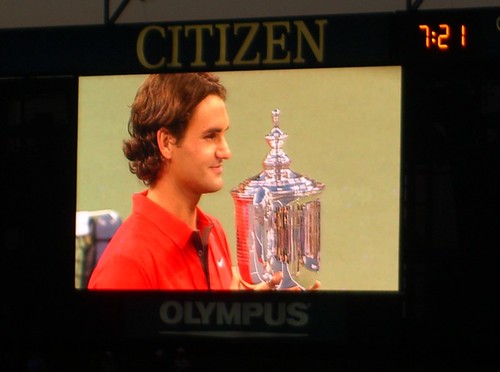
Roger!


Yes, Roger Federer and I are on a first name basis now.

This is what happens when you watch a person win the U.S. Open five years in a row.

bonus points: Andy Murray is amazing! At one point he hit an overhead lob backwards -- i.e. facing away from the net -- and the ball was IN. For a while there Roger Federer was having to smash balls out of the court and into the stands to keep Murray from getting his racket on them.

oh heck. It's impossible to see the ball on the YouTube videos.

Tuesday, June 24, 2008

Allison on academics & athletics in high school

[I double-posted Stagnation at the Top last week. Allison left this comment on the first, which I'm deleting, on 6-19-08.]

Actually, I think that the good-academics and good-schools idea you have is all about trade offs and opportunity costs. And high performing organizations understand that, and recognize that the opportunity cost of losing talent is that Someone Else has that talent, and will beat you with it.

Selective schools need to find ways to attract the talented students. The trade off isn't between a good basketball player and a good student. The trade off is between spending the time/energy/money to recruit, coach, and challenge talent vs. spending that time/energy/money on something else. High performing orgs know that talent is an asset, and basically every thing else is a liability. You can't have high morale without talent.

But talent in high schoolers comes in the form not of pure, raw unmitigated strength or coordination, but in the form of Someone Who Can Be Coached. Someone who has the discipline to do what's expected, Someone who responds well to demanding expectations. Because unless you're Michael Oher, the single talent on a team sport still isn't enough to propel that team to the top. The whole team has to play together, and it's as weak as its weakest link. This is true in history class and on the baseball field. When you set out to recruit students who won't be disruptive to your mission, who will be leaders and optimistic about your mission, then it doesn't matter whether they are football players, dramatists or math whizzes--they are supporting the goal.

I think high performing organizations just admit their trade offs up front--they can't attract the best students without spending money on infrastructure; if you ignore discipline problems, it's easier in the short term but worse in the long term; if you want excessive teacher autonomy, you won't have all classes following the same curriculum. So they decide on which trade offs they can afford. It works because they've Got A Mission, and the Mission guides their choices.