And Catherine's post about the woman who calls 911 because she can't figure out how to open her car door is worth reposting.
Showing posts with label Willingham. Show all posts
Friday, May 20, 2011
Can't Believe It Took Me this Long to Discover Willingham
I've just discovered the work of Daniel Willingham and am finding it to be so relevant and helpful, not to mention seeing examples of "inflexible knowledge" everywhere I look.
Check out the comments in this post for real life examples of "inflexible knowledge" from an SAT tutor.
And Catherine's post about the woman who calls 911 because she can't figure out how to open her car door is worth reposting.
Tuesday, January 12, 2010
against strategies, part 2
from Dan Willingham:
I have written (on this on this blog and elsewhere) about the importance of background knowledge and about the limited value of instructing students in reading comprehension strategies.
To be clear, I don’t think that such instruction is worthless. It has a significant impact, but it seems to be a one-time effect and the strategies are quickly learned. More practice of these strategies pays little or no return. You can read more about that here.
Knowledge of the topic you’re reading about, in contrast, has an enormous impact and more important, there is no ceiling—the more knowledge you gain, the more your reading improves.
In a recent email conversation an experienced educator asked me why, if that’s true, there has been such emphasis on reading strategies and skills in teacher’s professional development.
There’s a temptation to say “Oh, Americans don’t value knowledge; they don’t think that people need to know stuff.” But I rarely run into a teacher or administrator who believes that, and I actually have (as yet unpublished) survey data to support that impression. So I don’t think that’s behind it.
Doubtless there is more than one reason, but as a researcher, I have a hypothesis: People think strategies are important because most of the reading research is on strategies. But that’s an accident of the way research is done.
Behavioral research (and educational research in particular) is a more conservative enterprise than you might think. When a researcher decides to conduct a study in classrooms, he or she typically commits at minimum two years of his or her life to the project. What if nothing much happens?
A researcher is therefore motivated not to conduct studies that break utterly new ground, but rather to conduct studies in which one is fairly confident that something will happen.
One takes an intervention that has worked in the past, and adds an interesting tweak.
[snip]
[T]o be competitive for funding the proposal has to be something for which there is already evidence that it will work.
Now consider what it takes to do research on strategy instruction versus knowledge instruction. Teaching children reading strategies is quick. A research project might call for 10 or 20 lessons in total, each lasting 30 minutes or less. One can imagine getting a school administrator’s permission to do such a study in his or her district.
But the hypothesis for knowledge instruction is that it takes years to make a broad impact on students’ knowledge.
Willingham: The Zeitgeist of Reading Instruction
The Answer Sheet
Tuesday, June 23, 2009
Customer Review
Just left this review of Work Hard. Be Nice. on Amazon:
By the end of Work Hard. Be Nice., I found myself weeping in every chapter. I think this book may become a classic.I need to get my Amazon review of Dan Willingham's book written, too. (Preview: 5 stars)
I hope teachers will include Work Hard. Be Nice. on summer reading lists for upper middle school and high school students. Boys especially may cherish this book given how feminized our public schools have become.
Mike Feinberg and David Levin are teachers, yes, but they are fighters, too. They broke rules and they crossed lines. In this era of character education and "collaborative learning environments," the story of two young men who refused to collaborate with a failed system is strong medicine.
Wednesday, June 17, 2009
are parents rational?
Steve H. needs to hie himself over to Dan Willingham's blog right this minute and share his wit and wisdom re: parents and their ability to think as clearly as a person who has obtained a professional administrative services credential.
Wednesday, May 6, 2009
Monday, April 6, 2009
paging Dr. Willingham
We need Daniel Willingham to break this down:
Study gives more proof that intelligence is largely inherited
UCLA researchers find that genes determine brain's processing speed
Because unfortunately that headline has quickly turned into this one:
Bad at Math? Blame It on Your Parents
And if your kids aren't good at math, blame yourself
Just imagine the kind of damage this kind of headline can do.
We've been talking about cultural attitudes towards ability and this absolutely sends the wrong message that effort doesn't count for much. If you're not good at something, blame it on your gene pool and get on with it.
We already have a serious problem with believing that we're either good at math or we aren't. This just adds fuel to the fire.
In Why Don't Students Like School? Daniel Willingham asserts, "Our genetic inheritance does impact our intelligence, but it seems to do so mostly through the environment. There is no doubt that intelligence can be changed."
Children need to know that it is within their power to increase their intelligence. That ability can be improved with effort. If parents and educators buy into the you're-either-born-smart-or-you're-not mindset, we're doomed to continue declining on all internationally benchmarked assessments of academic ability.
We need Dr. Willingham to counteract this spin and control it with headlines that make sense. Changing cultural perceptions about learning needs to happen now.
I blogged more about it here .
Study gives more proof that intelligence is largely inherited
UCLA researchers find that genes determine brain's processing speed
Because unfortunately that headline has quickly turned into this one:
Bad at Math? Blame It on Your Parents
And if your kids aren't good at math, blame yourself
Just imagine the kind of damage this kind of headline can do.
We've been talking about cultural attitudes towards ability and this absolutely sends the wrong message that effort doesn't count for much. If you're not good at something, blame it on your gene pool and get on with it.
We already have a serious problem with believing that we're either good at math or we aren't. This just adds fuel to the fire.
In Why Don't Students Like School? Daniel Willingham asserts, "Our genetic inheritance does impact our intelligence, but it seems to do so mostly through the environment. There is no doubt that intelligence can be changed."
Children need to know that it is within their power to increase their intelligence. That ability can be improved with effort. If parents and educators buy into the you're-either-born-smart-or-you're-not mindset, we're doomed to continue declining on all internationally benchmarked assessments of academic ability.
We need Dr. Willingham to counteract this spin and control it with headlines that make sense. Changing cultural perceptions about learning needs to happen now.
I blogged more about it here .
Thursday, April 2, 2009
Why Students Don't Like School is here!
Speaking of cognitive flexibility, Dan Willingham's book is out!
I've got it!
We all need to buy it, read it, and write 5-star comments on Amazon.
I've got it!
We all need to buy it, read it, and write 5-star comments on Amazon.
this happens to me all the time
Locked in Car, Woman calls 911
Yes, I realize you could all go read Drudge on your own, un-aided & un-abetted by me.
Is there any good reason why I've posted two Drudge scoops in a row?
None that I can see. Apparently I feel the need to share.
The recording of the woman locked in her car is a classic: she has failed to break set.* Everyone fails to break set all of the time, but this gal had the bad luck to fail so spectacularly she had to call 911.
I think I'll go re-read Dan Willingham on flexible and inflexible knowledge and thank the stars it's not me on that tape.
* Not sure "break set" is still what it's called; I learned the terms "cognitive set" & "break set" in college.
Yes, I realize you could all go read Drudge on your own, un-aided & un-abetted by me.
Is there any good reason why I've posted two Drudge scoops in a row?
None that I can see. Apparently I feel the need to share.
The recording of the woman locked in her car is a classic: she has failed to break set.* Everyone fails to break set all of the time, but this gal had the bad luck to fail so spectacularly she had to call 911.
I think I'll go re-read Dan Willingham on flexible and inflexible knowledge and thank the stars it's not me on that tape.
* Not sure "break set" is still what it's called; I learned the terms "cognitive set" & "break set" in college.
Thursday, March 5, 2009
Saturday, February 28, 2009
inflexible knowledge
sigh
I've told C. he has to start doing a page of problems in Greenhall's Acing the New SAT I Math, which I ordered after comparing Amazon reader reviews for the various prep books.
Today both he and I were stumped by this problem:
8. S is the sum of 4 consecutive integers, the smallest of which is n. In terms of S, what is the sum of four consecutive integers of which the greatest is n?
I solved it via "mathematical reasoning," a phrase I'm putting in quotation marks because while I do possess sufficient mathematical reasoning abilities to solve this problem via number lines and "n + 1s," apparently I do not possess sufficient mathematical reasoning power to solve it via substitution. (Or, rather, to recognize the fact that I am looking at a simple substitution problem.)
This is maddening.
However, the book is obviously going to be good for me to work through.
Fun, too.
Does it take 10 years for inflexible knowledge to start easing up a bit?
Do we know?
Tuesday, December 30, 2008
SMARTBrief & Dan Willingham has a blog!
I am now a subscriber to the ASCD's SMARTBrief.
Sometimes this comes in handy, as when I can alert Dan Willingham to a new and wrong SMARTBrief informing educators that: “Students can benefit from tackling hardest material first.”
My heart sank when I read that headline because it gives aid and comfort to my district, where all instruction is based on the premise: hard first. e.g.: henceforth, Kindergarten children will do "research" and 3rd grade children will write "papers." That's the plan.
Seeing as how most college students can't do research and write papers, I would prefer my tax dollars not be spent on the profusion of classroom teachers, "literacy specialists," and "professional development opportunities" the district will require in order to teach writing the hard way to 5 year olds.
Fortunately, Dan W made short work of that one.
At least, he made short work of the claim on which it was based.
news flash:
Dan Willingham has a blog!!
Also a new article on studying and memory (pdf file) in American Educator!
The new article is one of his best. Fantastic.
According to Dan, the 3 principles of memory research most useful to students are:
1. memories are formed as the residue of thought: we remember what we think about [A couple of years ago I had the blinding revelation that when you obsessively go over and over a grudge or a grievance, you are in fact rehearsing that grudge and/or grievance. Which is often a bad idea. On the other hand, obsessively rehearsing school district and/or town council misbehavior has its uses.]
2. often memories are inaccessible not because we've forgotten the material, but because we lack the proper cue to recall that material to consciousness
3. the over-confidence principle: people tend to think their learning is more complete than it is
how to apply the principles
1. we remember what we think about
For teachers, the trick is to give students assignments that will force them to think about the material they've read or heard:
I think question-asking is phenomenally useful, and in fact I do something quite similar to Pressley's instructions myself when I read.
Willingham has various suggestions for how to handle longer chunks of text, but I would start by telling students to take Eugene Schwartz's advice:
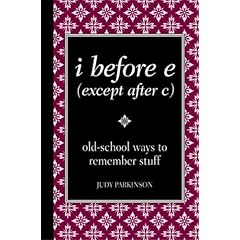
2. cues that work: mnemonics (Willingham explains) And, speaking of mnemonics, there is a new book of school mnemonics out: i before e (except after c) by Judy Parkinson
3. making sure you've actually learned the material and can recall it on a test (or in a conversation): overlearning
last but not least: the secret of peer teaching
For years I've noticed that, yes, I do learn more when I have to teach or explain a concept to someone else.
Turns out there is a very simple reason for this phenomenon:
"...you will definitely think about material carefully if you teach it to others..."
Can't believe I didn't think of that myself.
demonstrations of the 3 principles of memory by Dan Willingham (pdf file)
An Approach to Reading that Really Works, part 1 (Carolyn Johnston)
An Approach to Reading that Really Works, part 2 (Carolyn Johnston)
Sometimes this comes in handy, as when I can alert Dan Willingham to a new and wrong SMARTBrief informing educators that: “Students can benefit from tackling hardest material first.”
My heart sank when I read that headline because it gives aid and comfort to my district, where all instruction is based on the premise: hard first. e.g.: henceforth, Kindergarten children will do "research" and 3rd grade children will write "papers." That's the plan.
Seeing as how most college students can't do research and write papers, I would prefer my tax dollars not be spent on the profusion of classroom teachers, "literacy specialists," and "professional development opportunities" the district will require in order to teach writing the hard way to 5 year olds.
Fortunately, Dan W made short work of that one.
At least, he made short work of the claim on which it was based.
news flash:
Dan Willingham has a blog!!
Also a new article on studying and memory (pdf file) in American Educator!
The new article is one of his best. Fantastic.
According to Dan, the 3 principles of memory research most useful to students are:
1. memories are formed as the residue of thought: we remember what we think about [A couple of years ago I had the blinding revelation that when you obsessively go over and over a grudge or a grievance, you are in fact rehearsing that grudge and/or grievance. Which is often a bad idea. On the other hand, obsessively rehearsing school district and/or town council misbehavior has its uses.]
2. often memories are inaccessible not because we've forgotten the material, but because we lack the proper cue to recall that material to consciousness
3. the over-confidence principle: people tend to think their learning is more complete than it is
how to apply the principles
1. we remember what we think about
For teachers, the trick is to give students assignments that will force them to think about the material they've read or heard:
Given that we typically want students to retain meaning, we will mostly want students to think about what things mean when they study. It would be nice if you could simply tell your class, “When you read your textbook, think about what it means.” Naturally, you know that’s not the case. The instruction to “think about meaning” is difficult to follow because it is not specific enough. A better strategy is for students to have a specific task that will force them to think about meaning.*
Through a series of studies, reading researcher Michael Pressley figured out a way to do this that asked students to pose just one simple, specific question. He encouraged students to ask themselves “why?” at the end of each sentence as they read passages. passages. In one study, fourth- through eighth-grade students read brief passages about animals.12 For example, one began, “The Western Spotted Skunk lives in a hole in the ground. The skunk’s hole is usually found on a sandy piece of farmland near crops.” After reading each sentence, students were to ask themselves why that piece of information might be true. The researchers found that doing so produced a quite sizable benefit to memory, compared with students who were simply told to read the passage and remember it.
I think question-asking is phenomenally useful, and in fact I do something quite similar to Pressley's instructions myself when I read.
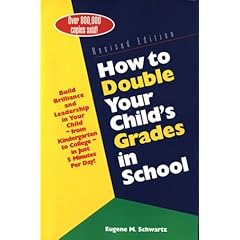
Willingham has various suggestions for how to handle longer chunks of text, but I would start by telling students to take Eugene Schwartz's advice:
turn the chapter's main ideas into questions
Any idea, phrase or sentence can be turned into a question by putting what, when, where, why, or how in front of it.
Take your reading assignment outline, extracted from your chapter signposts, and turn them into questions. The chapter title the background sources of Greek Civilization becomes what are the background sources of Greek Civilization?. A chapter title of The human body: a living machine becomes how is the human body like a living machine?.
Now you read each chapter, looking only for the answers to your questions.
You can see immediately what this technique does. It forces your attention on the main points, and prevents your being distracted by minor details.
source:
How to Double Your Child's Grades in School by Eugene Schwartz
2. cues that work: mnemonics (Willingham explains) And, speaking of mnemonics, there is a new book of school mnemonics out: i before e (except after c) by Judy Parkinson
3. making sure you've actually learned the material and can recall it on a test (or in a conversation): overlearning
Students should study until they know the material and then keep studying. How long they should continue studying depends on how long they hope to retain the material, how they will be tested, and other factors, but a good rule of thumb is to put in another 20 percent of the time it took to master the material.(So if it takes me 3 years to learn algebra 1 & 2, should I keep studying another 18 months after that?)
last but not least: the secret of peer teaching
For years I've noticed that, yes, I do learn more when I have to teach or explain a concept to someone else.
Turns out there is a very simple reason for this phenomenon:
"...you will definitely think about material carefully if you teach it to others..."
Can't believe I didn't think of that myself.
demonstrations of the 3 principles of memory by Dan Willingham (pdf file)
An Approach to Reading that Really Works, part 1 (Carolyn Johnston)
An Approach to Reading that Really Works, part 2 (Carolyn Johnston)

Tuesday, June 24, 2008
Tuesday, May 20, 2008
Wednesday, June 13, 2007
Dan Willingham - Ask the Cognitive Scientis
Concernedctparent mentioned in a comment that she's going to read Dan Willingham's articles, so I'm posting the link here (it's on the sidebar as well).
The most important one is Inflexible Knowledge: The First Step to Expertise.
I think my pick for number two is Practice Makes Perfect - But Only if You Practice Beyond the Point of Perfection.
After that I think I'd read Allocating Student Study Time.
The Privileged Status of Story is fantastic, too.
They're all good - enjoy!
Willingham posts from ktm-1 (you may need to hit refresh a couple of times to bring these posts up)
Willingham on boys and girls
how knowledge helps
declarative memory
learning modalities
different learners
Left Back
practice and overlearning
how much practice and for how long?
coherent curriculum
The most important one is Inflexible Knowledge: The First Step to Expertise.
I think my pick for number two is Practice Makes Perfect - But Only if You Practice Beyond the Point of Perfection.
After that I think I'd read Allocating Student Study Time.
The Privileged Status of Story is fantastic, too.
They're all good - enjoy!
Willingham posts from ktm-1 (you may need to hit refresh a couple of times to bring these posts up)
Willingham on boys and girls
how knowledge helps
declarative memory
learning modalities
different learners
Left Back
practice and overlearning
how much practice and for how long?
coherent curriculum
Tuesday, January 16, 2007
interview with Willingham
(Cross-posted at D-Ed Reckoning)
EdNews has a good interview with Daniel Willingham posted today on "reading comprehension:
6) What are your three main factors that you see as important in reading comprehension?There you go: decoding, fluency, and background knowledge. Three things that don't get systematicallt taught in your typical balanced literacy classroom.
Decoding, fluency, and background knowledge. Obviously, if you can't decode, it's pretty much "game over." And if you don't have some degree of fluency, you're so occupied with decoding, that you can't pay attention to the meaning of the text. Finally, if you don't have some background knowledge to which you can relate the text, you may comprehend it, but your understanding will be pretty shallow—it will be closely tied to the text itself, and you won't be able to generalize the message of the text
Here's a question: "To what extent have educators and policy-makes recognized the importance of background knowledge to reading comprehension?" My answer would be "not enough!" I'm specifically concerned about the role of the National Reading Panel report. That Report is becoming crystallized in state and federal legislation as the final word on reading, and the report is great. . . but it's incomplete because it doesn't say anything about the role of background knowledge in reading comprehension. If we're concerned about having students who are good readers we have to recognize that reading is an interaction between the words on the page and the knowledge in the reader's head. Without background knowledge, you can't comprehend a text to a level we would call "understanding." We need to pay attention to developing background knowledge in students from the first day that they are in school, and encouraging parents to do so even before then. It's not a trivial matter to decide what that content should be and how to deliver it. But if we want all children to be excellent readers it has to be done.Background knowledge: the untaught subject. Read the whole thing.
Subscribe to:
Posts (Atom)
