

 Posts
Posts


Animals Make Us Human is on the list!
I didn't even know. A friend found out and sent me the link. Then my sister had to send them an email and ask them to add my name to the book, since they'd only listed Temple as the author.
sigh
I'm filing this under schmuck with an Underwood.
Showing posts with label Temple Grandin. Show all posts
Showing posts with label Temple Grandin. Show all posts
Sunday, March 7, 2010


Monday, May 25, 2009
The Paved Mind
This is fun. Ed was reading the paper yesterday when he realized Animals in Translation had been mentioned on the editorial page: The Paved Mind by Verlyn Klinkenborg, New York Times, May 22, 2009.
Klinkenborg is talking about perception but he could just as easily be talking about mastery & automaticity.
Speaking of mastery, the Spring 2009 Direct Instruction News has an article by Engelmann on "Mastery & Rate of Learning." I'll get passages posted shortly.
automaticity theory
Klinkenborg is talking about perception but he could just as easily be talking about mastery & automaticity.
Speaking of mastery, the Spring 2009 Direct Instruction News has an article by Engelmann on "Mastery & Rate of Learning." I'll get passages posted shortly.
automaticity theory
Thursday, January 15, 2009
Friday, October 17, 2008
advertisements for myself
A starred review in Publishers Weekly!
Animals Make Us Human: Creating the Best Life for Animals Temple Grandin and Catherine Johnson. Houghton Mifflin, $26 (288p) ISBN 978-0-15-101489-7
Grandin (Animals in Translation), famed for her decades-long commitment to treating livestock as humanely as possible on its way to slaughter, considers how humans and animals can best interact. Working from the premise that “an animal is a conscious being that has feelings,” the autistic author assesses dogs, cats, horses, cows, pigs, poultry, wildlife and zoo animals based on a “core emotion system” she believes animals and humans share, including a need to seek; a sense of rage, fear, and panic; feelings of lust; an urge to nurture; and an ability to play. Among observations at odds with conventional wisdom: dogs need human parents, not alpha pack leaders, and cats respond to training. Discussions of why horses are skittish and why pigs are arguably the most intelligent of beasts—raccoons run them a close second—illuminate the intersection of people and more domesticated animals; chapters on cows and chickens focus more generally on animal welfare, particularly the horrific conditions in which they are usually raised and slaughtered. Packed with fascinating insights, unexpected observations and a wealth of how-to tips, Grandin's peppy work ably challenges assumptions about what makes animals happy. (Jan.)
PW will run an interview with Temple in the 10/20 issue.
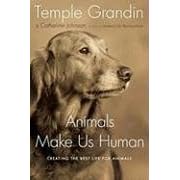
(I've just noticed that Jay Mathews' new book on KIPP is listed on the same page!)
Animals Make Us Human: Creating the Best Life for Animals Temple Grandin and Catherine Johnson. Houghton Mifflin, $26 (288p) ISBN 978-0-15-101489-7
Grandin (Animals in Translation), famed for her decades-long commitment to treating livestock as humanely as possible on its way to slaughter, considers how humans and animals can best interact. Working from the premise that “an animal is a conscious being that has feelings,” the autistic author assesses dogs, cats, horses, cows, pigs, poultry, wildlife and zoo animals based on a “core emotion system” she believes animals and humans share, including a need to seek; a sense of rage, fear, and panic; feelings of lust; an urge to nurture; and an ability to play. Among observations at odds with conventional wisdom: dogs need human parents, not alpha pack leaders, and cats respond to training. Discussions of why horses are skittish and why pigs are arguably the most intelligent of beasts—raccoons run them a close second—illuminate the intersection of people and more domesticated animals; chapters on cows and chickens focus more generally on animal welfare, particularly the horrific conditions in which they are usually raised and slaughtered. Packed with fascinating insights, unexpected observations and a wealth of how-to tips, Grandin's peppy work ably challenges assumptions about what makes animals happy. (Jan.)
PW will run an interview with Temple in the 10/20 issue.
(I've just noticed that Jay Mathews' new book on KIPP is listed on the same page!)
Subscribe to:
Posts (Atom)