kitchen table math, the sequel: vegan
Showing posts with label vegan. Show all posts

Tuesday, October 22, 2013

Yes, Vitamix will change your life

Just got this link from Chris....

Can a $400 Blender Change Your Life? Yes:
“I love my Vit-a-mix,” she continued, enunciating each syllable, before launching into a highly complimentary review of the company’s return and repair policy. “I love it so much, I would recommend it to the dead!”
My thoughts exactly.

Wednesday, August 21, 2013

35 lbs

Chris has lost 35 lbs.

35 lbs! Since June 6. Today is August 21, so that's 11 weeks.

I've lost weight, too, though I can't report how much since I haven't been weighing myself. At least 5 lbs, maybe more. Shorts that were too tight to wear at in June are loose now.

AND: I think I finally understand the Premack principle, which I'm certain is the basis of the VB6 diet we've both been following. VB6 is the first diet I've encountered that uses eating to reinforce not eating* -- and it works, just as the principle predicts. I would never have guessed, even though I've been reading about the Premack principle for years. I wouldn't have guessed because until now I haven't understood the principle.

I am now thinking PP is the secret to life. (Unless response deprivation is the secret to life. Clearly I need a MOOC on radical behaviorism.)

I'll try to find time to explain tomorrow.


* Or, more accurately, eating stuff you do like to reinforce eating stuff you don't like

Tuesday, July 9, 2013

VB6

C. has lost 10 pounds on Mark Bittman's VB6 diet!

VB6 ("Vegan before 6") is an amazingly user friendly diet: it's the first diet I've ever tried that uses eating things you like to positively-reinforce not eating things you like without causing the whole diet to crash and burn. I've spent years trying to make the Premack principle work for weight loss, and I think Bittman has actually done it.

The funny thing is, back when I briefly became a hard-core vegan (I've been a 'part-time' vegan since then), I started out by doing exactly what Bittman did: I stuck to a vegan diet during the day, then ate a regular dinner with the family.

But I saw my own 'VB6' as a way station to full-time veganism; it never occurred to me that you could actually lose weight on that regimen.

Turns out I was wrong.

Here's an excerpt:
Six years ago, the man I most trusted with my health said to me, “You should probably become a vegan.”

Not exactly the words I’d wanted to hear, and certainly not what I was expecting. But I’d asked Sid Baker, my doctor of thirty years, what he recommended, given that he’d just told me that at age 57, I had developed the pre-diabetic, pre-heart-disease symptoms typical of a middle-aged man who’d spent his life eating without discipline.

He’d laid out the depressing facts for me: “Your blood numbers have always been fine but now they’re not. You weigh 40 pounds more than you should. You’re complaining of sleep apnea. You’re talking about knee surgery, which is a direct result of your being overweight. Your cholesterol, which has always been normal up until now, isn’t. Same with your blood sugar; it’s moved into the danger zone.”

A more conventional doc would’ve simply put me on a drug like Lipitor, and maybe a low-fat diet. But Lipitor, one of the statin drugs that lowers cholesterol, is a permanent drug: Once you start taking it, you don’t stop. I didn’t like the idea of that.

Furthermore, its effectiveness in healthy people has never been established, and it’s also been implicated in memory loss and other cognitive complications; I didn’t like the idea of any of that, either. And at this point, low-fat and lowcarbohydrate diets have essentially been discredited: They might help you lose weight, but they’re not effective for maintaining that loss in the long term, and they may even wreak havoc on your system.

But becoming a vegan? A person who eats no animal products at all? Calling that a radical change to my lifestyle was more than a bit of an understatement. Yet it was clear that something had to be done. I asked Sid, “Is a compromise possible? Any other ideas?”

“You’re a smart guy,” he said. “Figure something out.”

The answer, to me, was this: I’d become a part-time vegan. And for me, this part-time veganism would follow these simple rules: From the time I woke up in the morning until 6 in the evening, I’d eat a superstrict vegan diet, with no animal products at all.

In fact, I decided to go even beyond that: Until 6 p.m., I’d also forgo hyper-processed food, like white bread, white rice, white pasta, of course all junk food, and alcohol.

At 6 p.m., I’d become a free man, allowing myself to eat whatever I wanted, usually—but not always—in moderation. Some nights, this meant a steak dinner; some nights, it was a blow-out meal at a good restaurant; other nights, dinner was a tunafish sandwich followed by some cookies. It ran, and runs, the gamut.

Whatever happened at dinner, though, the next morning I turned not to bacon and eggs or a bowl of Trix but to oatmeal or fruit or vegetables. For lunch, rice and beans or a salad—or both. Throughout the day I snacked on nuts and more fruit.

I called the diet “vegan before six,” or VB6. And it worked.

A month later, I weighed myself; I’d lost 15 pounds. A month after that, I went to the lab for blood work: Both my cholesterol and my blood sugar levels were down, well into the normal range (my cholesterol had gone from 240 to 180). My apnea was gone; in fact, for the first time in probably thirty years, I was sleeping through the night, not even snoring. Within four months, I’d lost more than 35 pounds and was below 180—less than I’d weighed in thirty years. And the funny thing was, the way I ate in the daytime began to change the way I ate at night.

An excerpt from Mark Bittman’s “VB6″

AND SEE:
I Answer Frequently Asked Questions about VB6
Help for the afflicted
Application of the Premack principle to the behavioral control of extremely inactive schizrophrenics

Saturday, May 5, 2012

thinner, part 2

In the wake of my discovery re: weight and cognition, I've decided to harp on my vegans-are-thinner experience. Re-harp, that is.

AND SEE: thinner
AND: the Ed diet

Friday, May 4, 2012

brain atrophy in teens with Type 2 diabetes

We also measured the brain, the hippocampus... What we found was that among the kids with Type 2  diabetes, their hippocampi are smaller in volume, very significantly. For those of you who work in Alzheimer's disease, the difference between the kids with Type 2 diabetes and the control kids [who were obese but did not have Type 2 diabetes] is about the same as that between a normal elderly and one with mild cognitive impairment. So the volume difference is around 12% So this is not a small, little thing. So what will happen to these children, whether we're actually seeing permanent damage or not, we don't know.

Their frontal lobe regions are also affected, and they have more overall brain atrophy than the control group. And remember, the control group was an obese control group.

Impact of Obesity and Metabolic Disease on Brain Structure and Function 5/5/11
Antonio Convit, M.D.
NYU
I haven't watched the entire lecture, but I gather that the reason he tells us to remember that the control group is obese is that we can also expect to see brain changes in obese teens who have not developed Type 2 diabetes, which would mean that the brains of teenagers with Type 2 diabetes are even more different from the brains of normal-weight adolescents.*

The lecture - the few minutes I've watched of it - is horrifying.

I had no idea.

*update (4/5/2012)

Right. Obesity in and of itself, without Type 2 diabetes, is linked to brain atrophy. Sounds like overweight may be as well, at least in people over 70.
They found that obese individuals [over age 70] had, on average, 8 percent less brain tissue than people of normal weight, while overweight people had 4 percent less tissue. According to Thompson, who is also a member of UCLA's Laboratory of Neuro Imaging, this is the first time anyone has established a link between being overweight and having what he describes as "severe brain degeneration."

"That's a big loss of tissue, and it depletes your cognitive reserves, putting you at much greater risk of Alzheimer's and other diseases that attack the brain," he said. "But you can greatly reduce your risk for Alzheimer's if you can eat healthily and keep your weight under control."
btw, remember back when I was bugging everyone about vegan diets making you thin?

Well, they do. I adopted a vegan weight-loss diet in September 2009, lost 11 pounds, and have basically kept it off ever since -- without even being a vegan. I need to get back on track, but still: even part-time veganism makes you thinner than full-time non-veganism.

Wednesday, January 11, 2012

the "China Study" abstract and the soldiers

From time to time, I mention T. Colin Campbell's The China Study: a terrific book. A few minutes ago, I found what I think is probably the main abstract from the published study, so I'm posting the link:

Diet, lifestyle, and the etiology of coronary artery disease: the Cornell China study.
Am J Cardiol. 1998 Nov 26;82(10B):18T-21T.

I went looking for Campbell & Esselstyn after reading Megan McArdle's post arguing that the biggest risk factor for heart disease is age. I'm pretty sure that's not true (as I recall, the biggest risk factor is diet), so I went looking for the incidence of heart disease amongst the Chinese peasants Campbell studied.

While I was at it, I remembered this passage from Esselstyn's book:
Autopsies of soldiers during the Korean and Vietnam Wars showed the effects of America's artery-clogging diet even on the very young. The arteries of Asian soldiers were largely clean, free of fatty deposits. But almost 80 percent of American battlefield casualties showed gross evidence of coronary artery disease--clogging and damage that, had the soldiers lived, would have grown worse with every passing decade. 
I think this passage, more than anything else I've read, was the shocker for me.

Sunday, August 28, 2011

the Barstool on Irene

from NYC Barstool:
I haven’t even opened my second box of Pop Tarts yet and this s*** is already over. Unreal. I have 2 pounds of cold cuts and 6 unopened bottles of wine. Looks like it’s gonna be Brown Sugar Cinnamon, Boars Head and a nice Cabernet for my Sunday Funday.
Same here. Ed says in addition to the FIFTEEN CANS of tuna fish he snapped up at Stop n Shop yesterday (the last cans on the shelf!), we have a pound of ham.

Nobody around here eats ham any more, either.

Ed says, "At least I didn't buy Pop Tarts."

Now we're debating whether you can eat Pop Tarts raw. C. says Yes, you can.

Sunday, July 3, 2011

off-topic - vegetables make you thin

Seriously.

They do.

Vegetables make you thin.

I'm starting to see fruits and vegetables (and legumes) the way people used to see diet pills back when it was legal for housewives to take amphetamines to lose weight: eat your vegetables, fruits, and beans, and you can eat anything else you want and still stay thin.

The reason you can eat anything else you want and still stay thin is that you don't want to eat as much as you do when you're not eating beaucoup fruits, vegetables, and legumes. Fruits, vegetables, and legumes are natural appetite suppressants.*

Here's more evidence:
[R]esearchers from Penn State gave 20 men and 21 women casseroles made with varying amounts of purée — a strategy popularized by the cookbook author Jessica Seinfeld, who has encouraged parents to sneak vegetables into foods like spaghetti.

But in the Penn State study, the goal wasn’t to trick people into eating vegetables. Adding the purée bulked up the dish and resulted in fewer calories per serving. (You can see two of the recipes developed by the researchers here.)

In a macaroni and cheese recipe from the researchers, for instance, the cheese sauce is made with skim milk, reduced-fat cheese and one cup each of puréed cauliflower and puréed summer squash.

The diners were fed the casseroles during different visits. They ate pretty much the same amount of food during each visit and reported no differences in flavor or enjoyment. But when they were served the casseroles made with puréed vegetables, they ate 200 to 350 fewer calories a meal.

“We’ve been able to change recipes a lot, even baked goods, and we’ve been doing it for preschool kids and adults,” said Barbara Rolls, director of Penn State’s laboratory for the study of human ingestive behavior. “We had a huge effect on energy intake. We’re adding cups of veggies to recipes and people don’t even notice.”

Other research by Dr. Rolls, author of the popular diet series Volumetrics has shown that eating soup or salads before a meal can also curb the appetite and result in eating fewer calories over all.

But the stealth-vegetable approach allows diners to eat the same amount of favorite foods without ingesting as many calories.

[snip]

“We offered a Tex-Mex casserole, and we could get away with adding the vegetables much more easily,” she said. “Once you put in those spicy flavors, they mask other changes in calorie density and vegetable content. The people were totally unaware we were adding lots and lots of veggies.”

While the best option is to purée vegetables and add them to home-cooked meals, Dr. Rolls said she hoped the food industry would respond by offering more convenient canned and frozen vegetable purées and more foods bulked up with vegetables
Adding Food and Subtracting Calories
by Tara Parker-Pope
May 2, 2011, 5:03 pm
my rules:
animal fat makes you eat more
plant foods make you eat less

The Sneaky Chef: Simple Strategies for Hiding Healthy Foods in Kids' Favorite Meals

The Sneaky Chef: Simple Strategies for Hiding Healthy Foods in Kids' Favorite Meals
by Missy Chase Lapine

* I'm not sure plant foods are natural appetite suppressants; it's a 'working hypothesis.' I'm 99% certain palmitic acid makes you eat more.

Monday, December 27, 2010

the secret of my success, part 2

re: weight loss, Bill Clinton, and books

These are the books I read:

The China Study by T. Colin Campbell

Reversing Heart Disease by Calwell B. Esselstyn

Dr. Neal Barnard's Program for Reversing Diabetes by Neal D. Barnard, M.D.

Eat to Live: The Revolutionary Formula for Fast and Sustained Weight Loss by Joel Fuhrman

the secret of my success - weight loss

Every few years I think I've found the secret of weight loss and maintenance.

One year it was Strattera.

Another year it was Seth Roberts and eloo.

Both Strattera and eloo seem to work, but eventually one of two things happens to people following any sort of diet regimen: either the effects wear off or your ability to stick with the program wears off.

This time around, I think it's possible I've found the secret not just to getting thin but to staying thin: quasi-veganism.

Seriously.

I adopted a heavy-duty vegan diet (no animal food, no added salt, sugar, or fat) at the end of September 2009. I didn't stick to it altogether, but pretty much.

Over the next six 5 months, I lost 11 pounds. Which for me is huge. The most I've ever lost on a normal calorie-counting and exercise diet is 5 to 7 pounds. While I was on the vegan regimen, fat just melted away; you cannot be overweight - you cannot even be middle-aged chunky - eating all plant foods with no added salt, sugar, or fat. Guaranteed. (update: or maybe not)

So I lost 11 pounds over the next six 5 months.

Then I promptly lost all desire to carry on eating all plant foods with no added salt, sugar, or fat.

So I switched to a quasi-vegan diet. Veganism (with salt, sugar, and fat) is my default setting, but I eat meat* when the spirit moves me, or when I'm out and about.

"Out and about" means "in a restaurant." It's almost not possible to be a vegan inside an American restaurant. Inside a restaurant, everything is meat. The appetizer is meat, the salad is meat, the main course is meat, the side dishes are meat, the dessert is meat. Just about the only things in a restaurant that aren't meat are the alcohol and the rolls.

If you want to know just how much meat everyone is eating, try opening up a menu and asking yourself what you would order if you wanted to be a vegan. Which I realize you don't. But try the  experiment and you'll see.

We're eating a whole lot of meat.

When I switched to quasi-veganism, I figured: this is it. This is the point where I go off the wagon and gain everything back.

That was last spring. 

Now it's Christmas 2010, and I'm still thin. (Which you can kinda see here.)

As far as I can tell, quasi-veganism works. We'll see.

The weird thing is: I seem to be the only person on the planet who knows this. Assuming I do know it, of course.

Also, I seem to be the only person on the planet who can even conceive of quasi-veganism being the Holy Grail of weight loss and maintenance. I'll be sitting around a table or a living room filled with  middle-aged people who've gained weight over the years, and I will be obviously, manifestly thinner than everyone else except Ed, and when the topic of middle-age weight gain comes up and I mention that the reason I'm thinner than everyone else except Ed is that I have become a quasi-vegan, people stare at me blankly. Most of the time, no one expresses the slightest curiosity as to what I'm talking about.*

Which is weird, don't you think?

If two years ago someone thin had told me "I've found a diet that's easy to follow and works even when you're cheating" I think that would have piqued my interest.

Anyway, assuming quasi-veganism does work - or, rather, will continue to work for me - I have an idea about the mechanism or mechanisms:
As to appetite, you can test the proposition that animal fat stokes appetite for yourself just by observing what foods people do and do not binge on.

I binge on butter; I don't binge on peanut butter. That's what it comes down to.

If I eat one toasted English muffin dripping in melted butter, I want to eat another English muffin dripping in melted butter.

If I eat one toasted bagel dripping in melted peanut butter, that's plenty.

If I eat ice cream, I want to eat more ice cream.

If I eat a bag of potato chips before dinner, which I do, I spoil my appetite.

That's another thing. Remember when parents used to worry about kids "spoiling their appetites"? I have never uttered such a warning to my own kids because until I discovered quasi-veganism, I had never seen an appetite actually get spoiled.

I have now discovered that it is in fact possible to spoil your appetite, but not by eating ice cream. Ice cream makes me hungry for lasagne. Bring it on.

Junk food made with plant fat spoils my appetite.

Junk food made with animal fat does not.


random

These things may or may not be true:
  • tofu makes you fat - no idea whether this is true, but when I come across photos of overweight vegans on the web, they seem to be of people who've put a fair amount of time and energy into knocking off fatty desserts using tofu as a substitute for butter and eggs.
update: I am not the only person on the planet who knows that quasi-veganism causes weight loss. It's me and Bill Clinton.


Junk Food Makes You Eat More

* By "meat" I mean fish, chicken, eggs, meat, and dairy.
* No one except Susan S, that is. Susan S was willing to read several dozen emails on the subject of veganism during my phase of maximum obsession. Thank you, Susan!

Tuesday, June 8, 2010

Playland

Yesterday C. and I went to Playland for their annual developmental disabilities day, also known as our annual Playland fudge day. Just inside the entrance, there's a fudge stand that sells the best fudge I've ever consumed, and C. and I binge on the stuff once a year.*

The price is $3 per piece, or buy 4 pieces & get one free.

I told the young person behind the counter that I wanted 15 pieces, and she began methodically filling up the boxes. Methodically .... and .... slowly. At some point in this process, possibly thinking I could speed things along, I said, "So that's $36, right?"

And she said "No." She didn't seem to be exactly sure how much 15 pieces would be, but she didn't think it was going to be $36.

I said, "You get 1 free with each 4, right?"

"Yes."

"So I'm paying for 12 pieces and getting 3 pieces free."

She looked confused. I went over it again, but she still didn't think $36 sounded right.

Finally I said, "I want to buy 3 boxes of fudge, with 4 pieces in each box and 1 extra free piece," and that did the trick. Twelve dollars a box.

I don't think she knew how to work backwards from "15 pieces of fudge" to 12 pieces of fudge at $3/each + 3 extra free pieces.

Meanwhile, here are the "mathematical practices" required by the new Common Core standards (pdf file) for Kindergarten:
1. Make sense of problems and persevere in solving them.
2. Reason abstractly and quantitatively.
3. Construct viable arguments and critique the reasoning of others.
4. Model with mathematics.
5. Use appropriate tools strategically.
6. Attend to precision.
7. Look for and make use of structure.

* Have I mentioned the fact that I've de-veganed myself? Well, I have.

Sunday, February 21, 2010

thinner

Speaking of Randi Weingarten and the Campaign to Combat Childhood Obesity, I weighed myself the other morning and the scale said 125.5. Since September 25, I have lost 11 pounds.

11

That's a lot.

That's more than I've lost on any diet, ever, and I lost it during the fall & winter, which is to say I lost 11 pounds at the same time of year (the Halloween-Thanksgiving-Christmas-New Year's-Valentine's Day time of year) when normally I'm regaining the 5 or 6 pounds I managed to lose by dint of determined calorie counting & food logging in the spring and summer.

So, doing my bit for the Campaign, here's my story:
The diet is almost bizarrely easy. Most of what people say about it was true for me, e.g.:
  • you lose your taste for meat &, to a much lesser degree, fat, over time (but see below)
  • minimal hunger
  • more energy
  • so far, going back on the wagon has been as easy as going off the wagon, knock on wood
  • sounds dreadful going in but your tastes change

I deviated from the true path in two respects: I eased into the diet instead of going cold turkey, and I calorie-counted. Thanks to Magic iTouch, I plan to carry on calorie counting. Fuhrman, Barnard, and Esselstyn all say there's no need to count - or restrict - calories if you're following the diet closely, but given that I'm not following it as closely as I ought, I count calories. Also, I'm guessing that calorie restriction in and of itself is probably going to be as good for me as it is for yeast cells and mice (haven't read that article, fyi).

The hitch: I ended up having problems with the no-added-fat part. First I got cranky, then I started waking up in the middle of the night feeling despairing and grim. So now. . . now, I'm not sure. My plan at the moment is to a) add some walnuts & avocados to my salads and b) cheat more.

We'll see how that goes. Maybe Gerald Reavan is right that what some of us need is a relatively high-fat diet? Dunno.


other:
  • apples & soup
  • apparently, vegetables actually do consume more calories than they contain
  • plant foods plants seem to increase metabolism (that may not be the right way to put it: Campbell found that rural Chinese peasants, who are essentially vegetarian, consume more calories than we do but weigh less - see here)
  • Campbell also found that animal protein promotes cancer growth (terrific summary)
I came across my cholesterol reading from 2006: 190.

Last month I had total cholesterol of 131, LDL (bad cholesterol) 62, HDL (good cholesterol) 60. (I know those figures don't add up.) Triglycerides: 43 (normal is below 150).

So that's it.

For me, adopting a don't-get-diabetes diet means placing a bet -- or, at this point, placing a bet on plant-based/whole foods/no added fat, sugar, or salt and hedging it with plant-based/whole foods/somewhat more fat & somewhat less carb. I don't know and can't guess which expert is right.

But there's no question this works brilliantly for weight loss.


books & blogs

blog: Happy Healthy Long Life

Eat to Live by Joel Fuhrman (for diabetes: "beans and greens")
blog: diseaseproof
Emily's Postmodern Transformation

The China Study by Thomas M. Campbell
20-year study of Chinese diet & health – “this project eventually produced more than 8000 statistically significant associations between various dietary factors and disease...”
Introduction (pdf file)

Prevent and Reverse Heart Disease by Caldwell B. Esselsstyn - all plant food all the time, "not one drop of added fat"
Chapter One

The Engine 2 Diet: The Texas Firefighter's 28-Day Save-Your-Life Plan that Lowers Cholesterol and Burns Away the Pounds by Rip Esselsstyn (haven't read - Rip Esselstyn is Caldwell Esselstyn's son - 28-day before & after photos!)

Dr. Neal Barnard’s Program for Reversing Diabetes by Neal D. Barnard
Neal D. Barnard

The Calorie Restriction Experiment by Jon Gertner New York Times October 7, 2009 - people undereating for two years straight
Calerie study: Comprehensive Assessment of Long-Term Effects of Reducing Energy Intake
The "i" Diet by Susan Roberts (haven't read but it sounds great - Roberts is part of the Calerie study)

Just to confuse everyone: Syndrome X: The Silent Killer by Gerald Reaven, Terry Kirsten Strom, and Barry Fox

Anticancer: A New Way of Life by David Servan-Schreiber "All of us have cancer cells in our body. But not all of us will develop cancer."
David Servan-Schreiber

Volumetrics Eating Plan by Barbara Rolls - "Eat big food."
Barbara Rolls

And: Younger Next Year

scared straight
the Ed diet
Barney adopts a healthy new eating style

Sunday, November 15, 2009

Barney adopts a healthy new eating style

Yesterday, Ed and I were experimenting with our groovy new, life-extending Vita Mix blender when we noticed Andrew systematically emptying the refrigerator of vegetables. We did what we often do: ordered him to Stop and then, after spending a few seconds discussing the mystery that is Andrew (deciding in this case that Andrew must be collecting vegetables because he wanted to watch us blend stuff he wouldn't drink on a bet), went back to what we were doing and forgot all about Andrew, who had by this time left the kitchen. Out of sight, out of mind.

Andrew has never eaten a fresh vegetable in his life. He ate baby food vegetables when he was little, but when he stopped eating baby food he stopped eating vegetables. He doesn't eat fruit, either. Or noodles or rice or eggs or Chinese or Japanese food or hot dogs or hamburgers, and so on. In short, Andrew has an eating disorder. Two eating disorders: his autistic eating disorder (eating disorders seem to be common in autism) and his feeding-tube-as-a-preemie eating disorder (not sure whether doctors believe such a thing exists, but I do).

The reason we have a groovy new, life-extending blender, in case you're wondering, is that my sisters and brother and I have been scared straight by my mom's heart failure,* and my brother's scheme for not getting diabetes and also not getting heart failure was to buy a commercial-strength blender that makes commercial-strength smoothies and the best potato soup my California sister says she's ever eaten.

That ought to do it.

After I'd spent about 60 seconds considering the life-extending properties of the Vita Mix, I realized that the person in the household who really needs a life-extending commercial-strength blender is Andrew. For years I've been worried about his horrifically poor diet, and I've hatched various schemes to try to force some vegetable juice down him, none of which got off the ground. Andrew will have no truck with V8 juice.

But a commercial blender -- wow. Suddenly I could see a way to start small and work up. Start with something Andrew likes (grocery store apple juice), combine it with a tiny bit of something he doesn't like (any form of actual fruit) and have him drink it the same way he drinks pink antibiotics when he has to. Not willingly, but he gets it down.

Then I had a second brainstorm: positive reinforcement!

the plan: Blend half a box of apple juice in the Vita Mix and show Andrew that the other half is still inside the box, unadulterated & correct, waiting to be his once he swallows the blend.

It worked!

Andrew has now eaten (well, drunk) the first 7 grapes of his entire life. Also the first 3 slices of banana.

It's a miracle.

So back to yesterday afternoon. As I say, we forgot about Andrew and went back to what we were doing, which was figuring out how to make commercial-quality smoothies in the privacy of our own home.

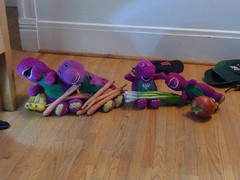
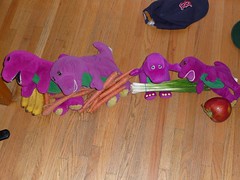
A little later in the day I went upstairs to Andrew's room and found a brand new Barney tableau: vegan Barney.


Somebody's going to have to tell Andrew tyrannosaurus rex was not a herbivore.

* update 7/3/2011: My mom didn't have heart failure as we learned much later.

Sunday, November 8, 2009

the Ed diet

off-topic

I was talking to my tennis teacher yesterday about Ed.

My tennis teacher is a big Italian guy who is frequently trying to lose 30 pounds. Since I am frequently trying to lose 5 pounds, we talk about food and weight a lot.

For the past month I've been keeping him apprised of my efforts to become a 'vegan.'1

The latest news: Ed, who has no interest in becoming a vegan, has lost weight. Three pounds, possibly 4.2 He has lost weight entirely because he is married to a woman who is interested in becoming a vegan. Which is annoying because Ed was already extremely thin; Ed was already so thin he is borderline too thin for my tastes. Now he's thinner.

Meanwhile, in the midst of the Ed transformation, the Times ran an article on the Calerie study, a project looking at people who reduce their daily calories by 25 percent for two years.

For me, the most amazing finding of the study is the fact that its subjects have actually managed to remain in the study. That is the revelation, not the fantastic drops in cholesterol and blood pressure, etc. Although I've lost weight a number of times over the years, I'm not sure I've ever stuck to a reduced-calorie diet for more than a few days in a row; the notion of living on a restricted-calorie diet for two years is inconceivable.

But the Calerie people have done it, and apparently we know the secret of their success: they all switched to low-energy density foods. Vegetables, fruits, and soup: 3
Apples are superb in this regard. At the medical centers running Calerie, you see a lot of people walking around eating apples. Even subjects who disliked apples have discovered that calorie restriction, which generally has the effect of making food taste better, has given them a surprising desire for the fruit.

[snip]

When I asked Susan Roberts, who runs the Tufts study, if there was a danger in Americans trying calorie restriction on their own, without a dedicated team of medical experts offering advice, she suggested that there are built-in safety mechanisms. Roberts said she didn’t think anyone would be successful by reducing portion size. “If you don’t change your diet to a high-satiety diet, you will be hungry, and you will fail,” she told me. A high-satiety diet, she said, was bound to be a healthful diet with a lot of vegetables, fruits and insoluble fiber — the kind found in some breakfast cereals, like Fiber One — that her research indicates has a unique effect in helping calorie-restriction subjects feel fuller, probably because they activate certain receptors in the lower intestine. Roberts added, “If people are doing this on their own and succeeding, well, I’d be surprised if they’re eating a lot of Hostess Twinkies.”
I don't happen to like apples, particularly. Or fruit, generally.4 I so lack a taste for fruit that I have to set a formal goal of consuming 4 fruits a day & keep a running tally to hit the mark. Even then, likely as not I won't make it.

Ed, on the other hand, loves fruit.

Yesterday Ed mentioned that he keeps a bag of apples on his desk at work. A bag. He snacks on apples all day long; he eats at least 4 apples a day, he said.

I had no idea.

Something else I didn't know: since age 22 he's been eating soup for lunch.

Every day.

And apples. Four apples, at least. Every day.

I didn't know.

He basically invented the Volumetrics diet when he graduated college & didn't think to mention it to anyone he happened to be married to who might be trying to lose weight.

So I was telling my tennis teacher about the Ed diet. Soup and apples, I said. The Ed diet. We should all try it.

My tennis teacher said I should write it up, and now I have.
__________________
1 How I dislike that word! Who came up with it? And why? Do we know?
2 I've lost 5, but I've been trying.
3 Barbara Rolls is always cited for her work on low-energy density foods & satiety.
4 I do like Twinkies.

Tuesday, October 6, 2009

in case you'd like to share my pain...

Eat to Live by Joel Fuhrman

The China Study by Thomas M. Campbell
20-year study of Chinese diet & health – “this project eventually produced more than 8000 statistically significant associations between various dietary factors and disease...”
Introduction (pdf file)

Prevent and Reverse Heart Disease by Caldwell B. Esselsstyn

The Engine 2 Diet: The Texas Firefighter's 28-Day Save-Your-Life Plan that Lowers Cholesterol and Burns Away the Pounds by Rip Esselsstyn (son of Caldwell: 28-day before & after photos!)

Dr. Neal Barnard’s Program for Reversing Diabetes by Neal D. Barnard

And don't forget: Younger Next Year

I miss you guys!

Well....I'm in Irvington, clearing my head.

I've been so fogged in by fear, grief, and suspense over my mom's health that I can't come up with a proper metaphor and/or clinical term to convey the situation and have been on radio silence. Although I did, during my mom's first ICU stay, acquire the term mentating. As in: Your mother is mentating so well!

I have not been mentating well.

quick update: Since August 12, when my mother fell and fractured her pelvis, she has been:
  • in Evanston Hospital ER
  • in Evanston Hospital CCC (cardiac care)
  • in Evanston nursing home for rehab
  • back to Evanston Hospital ER
  • Evanston ICU
  • back to Evanston CCC
  • in Highland Park skilled nursing care facility
  • in Highland Park Hospital ER
  • in Highland Park Hospital
  • back to Highland Park skilled nursing facility
Gosh.

Has it been 56 days?

I'm grateful I have 3 siblings to help me deal with all this. I just wish C. had 3 (typical) siblings, too.


scared straight

My mom has heart failure.*

She didn't start out with heart failure; she started out with a weight problem, which apparently led to high blood pressure. In middle age she developed Type 2 diabetes, and then, three years ago, she had a heart attack. After that, heart failure.

In short, she seems to be a classic case of what is now called metabolic syndrome.

Of course we kids are horrified not just by the prospect of losing our mother but by the possibility of going through what she is going through ourselves -- and of putting our kids through this, too.

Hence: scared straight.

Which seems to mean becoming a vegan.

When I told a friend that the vegans appear to be right, she said Anthony Bourdain called them a "Hezbollah-like splinter faction" of vegetarians.


humor

* update 7.3.2011: My mom didn't have heart failure. Her PCP thought she did, but she didn't. A year before she died, I went with her to see her cardiologist, who gave us a blank look when we brought up her heart failure and told us she didn't have it. The only reason this exchange took place was that I'd read an article about left ventricular assist devices, and I wanted to know whether my mom could have one. Turned out she wasn't a candidate for a left ventricular assist device because she didn't have heart failure. 

I'll probably never know why we all lived with a fatal diagnosis hanging over our heads for -- how many years? I don't remember. Also, I'm pretty sure the fact that everyone thought my mother had heart failure led to everyone mistaking symptoms of kidney failure for symptoms of heart failure. The extreme pain she was experiencing from kidney failure severely constricted her life and caused the fall that ultimately killed her. 

I know this will sound obvious, but it bears saying: when you're dealing with a parent's health issues, make sure you understand the diagnosis. As I understand it now (and please correct me if I'm wrong), there are two forms of congestive heart failure: chronic and acute. It's entirely possible that both my mother and we kids were told that she had the acute form and no one explained the difference.


It's also possible she was misdiagnosed -- or that she was correctly diagnosed by her original cardiologist, who left town, but there was some kind of miscommunication with the PCP.