

 Posts
Posts


C. called home after school to say that the math test was "pretty easy."
"But, oh mom!" he said. "It didn't have the problems we did!"
"What problems?"
"It didn't have population problems or problems about the price of something."
"It didn't?"
"No!"
"What kind of percent problems did it have?"
"Problems about markups and discounts."
Inflexible Knowledge: The First Step to Expertise
Showing posts with label hyperspecificity. Show all posts
Showing posts with label hyperspecificity. Show all posts
Thursday, February 14, 2008


Monday, December 10, 2007
hyperspecificity in Math A
Another classic example of hyperspecificity:
C. did not recognize this expression as a case of the distributive property:
Can't say I blame him.
update
from Barry:
I'm amazed by how difficult it is to see that "expression X" is the same as "expression Y." This is an ongoing source of pain in my mental life these days (not to put too fine a point on it), because I came to feel, shortly after Animals in Translation was completed, that Temple's & my thesis concerning hyperspecificity in animals and autistic people is wrong in some important way -- either wrong or perhaps right for the wrong reasons.
We argued that autistic people, children, and animals are hyperspecific compared to typical adults. Autistic people, children, and animals are splitters; nonautistic adults are lumpers; etc. (I know I've said all this before, but feel I must repeat in case newcomers stop by.)
The classic hyperspecificity story re: autistic children is the little boy who was painstakingly taught to spread butter on bread and then had no clue how to spread peanut butter on bread.
Until I began to reteach myself math, this kind of thing seemed to me incontrovertible evidence of the otherness of the autistic brain. But now that I'm factoring trinomials I've discovered I have something in common with that little boy. That's probably why God or the universe decided I should take up math. I needed an object lesson.
Still, the observations Temple has spent a lifetime making of animals' (and autistic people's) hyperspecificity aren't wrong. Normal adult humans aren't hyperspecific in the same way animals and autistic people are hyperspecific.
Sometimes I wonder whether the issue is simply that non-autistic adults pass through the hyperspecific stage of knowledge more quickly or more frequently than autistic people do. When a "typical" adult (typical being the preferred term these days) encounters brand-new material he, too, is hyperspecific, as I am with math. Everyone starts out a splitter.
But I don't think that's quite it, either.
I'm getting the feeling that animals may not be hyperspecific across the board, but perhaps only in certain realms. Maybe animals are more hyperspecific than adult humans when it comes to sensory data? e.g.: To a horse a saddle feels completely different at a walk, a trot, and a canter -- so different that he will buck his rider off when he moves from a trot to a canter if he hasn't been carefully trained to tolerate the saddle at all 3 gates individually.
Better story: Temple's black hat horse.
This was a horse who was terrified of people wearing black hats. He wasn't terrified of people wearing white hats or red hats. Just black hats.
I'm thinking, this morning, that humans may be relatively oblivious to "sensory data," that we're lost in words -- so perhaps words are the place where you'll see us being hyperspecific ? (There's evidence that language masks sensory data, but I don't know it/remember it well enough to summarize.)
Temple complains about this all the time. She'll give a talk and her audience will take away a too-specific meaning from her words; then they'll go out and apply her advice all wrong & bollocks things up. "People get hung up on the specific words," she'll say. (I'll write down the next example of this that crops up - can't think of one offhand.) These conversations have gotten to be quite funny because, after years of reading countless articles on autistic people being literal-minded and "concrete," I am now spending my time listening to an autistic person complain that normal people are literal-minded.
Well, she's right. Looking at an expression like 2x(x+1) + 3(x+1), I'm like the horse with the saddle and so is my 13-year old son.
"x+1" next to 2x is completely different from "x+1" next to 3.
Different enough to make us start pitching our riders into the haystack.
percent troubles
Robert Slavin on transfer of knowledge
rightwingprof on what students don't know
Inflexible Knowledge: The First Step to Expertise
C. did not recognize this expression as a case of the distributive property:
2x(x+1) + 3(x+1)
Can't say I blame him.
update
from Barry:
This isn't real obvious when you first come across it. So do this. Let's let x + 1 = T.
Now substitute T in the expression and you get:
2x(T) + 3(T)
Can you factor out the T?
Yes. You get T(2x + 3)
Now substitute the x + 1 back in. You get:
(x+1)(2x+3)
I think it was Ron Aharoni who referred to seeing expressions such as (x+1) as single entities as "chunking". To help students do such "chunking" it helps to do what I did above so they can see that x + 1 represents a number, and as such it can be factored.
I'm amazed by how difficult it is to see that "expression X" is the same as "expression Y." This is an ongoing source of pain in my mental life these days (not to put too fine a point on it), because I came to feel, shortly after Animals in Translation was completed, that Temple's & my thesis concerning hyperspecificity in animals and autistic people is wrong in some important way -- either wrong or perhaps right for the wrong reasons.
We argued that autistic people, children, and animals are hyperspecific compared to typical adults. Autistic people, children, and animals are splitters; nonautistic adults are lumpers; etc. (I know I've said all this before, but feel I must repeat in case newcomers stop by.)
The classic hyperspecificity story re: autistic children is the little boy who was painstakingly taught to spread butter on bread and then had no clue how to spread peanut butter on bread.
Until I began to reteach myself math, this kind of thing seemed to me incontrovertible evidence of the otherness of the autistic brain. But now that I'm factoring trinomials I've discovered I have something in common with that little boy. That's probably why God or the universe decided I should take up math. I needed an object lesson.
Still, the observations Temple has spent a lifetime making of animals' (and autistic people's) hyperspecificity aren't wrong. Normal adult humans aren't hyperspecific in the same way animals and autistic people are hyperspecific.
Sometimes I wonder whether the issue is simply that non-autistic adults pass through the hyperspecific stage of knowledge more quickly or more frequently than autistic people do. When a "typical" adult (typical being the preferred term these days) encounters brand-new material he, too, is hyperspecific, as I am with math. Everyone starts out a splitter.
But I don't think that's quite it, either.
I'm getting the feeling that animals may not be hyperspecific across the board, but perhaps only in certain realms. Maybe animals are more hyperspecific than adult humans when it comes to sensory data? e.g.: To a horse a saddle feels completely different at a walk, a trot, and a canter -- so different that he will buck his rider off when he moves from a trot to a canter if he hasn't been carefully trained to tolerate the saddle at all 3 gates individually.
Better story: Temple's black hat horse.
This was a horse who was terrified of people wearing black hats. He wasn't terrified of people wearing white hats or red hats. Just black hats.
I'm thinking, this morning, that humans may be relatively oblivious to "sensory data," that we're lost in words -- so perhaps words are the place where you'll see us being hyperspecific ? (There's evidence that language masks sensory data, but I don't know it/remember it well enough to summarize.)
Temple complains about this all the time. She'll give a talk and her audience will take away a too-specific meaning from her words; then they'll go out and apply her advice all wrong & bollocks things up. "People get hung up on the specific words," she'll say. (I'll write down the next example of this that crops up - can't think of one offhand.) These conversations have gotten to be quite funny because, after years of reading countless articles on autistic people being literal-minded and "concrete," I am now spending my time listening to an autistic person complain that normal people are literal-minded.
Well, she's right. Looking at an expression like 2x(x+1) + 3(x+1), I'm like the horse with the saddle and so is my 13-year old son.
"x+1" next to 2x is completely different from "x+1" next to 3.
Different enough to make us start pitching our riders into the haystack.
percent troubles
Robert Slavin on transfer of knowledge
rightwingprof on what students don't know
Inflexible Knowledge: The First Step to Expertise
what understanding without procedural knowledge looks like
Extremely useful comment left by palisdesk:
on the 5th grade students she assessed:
conceptual understanding w/o procedural knowledge:
This is so helpful. It makes sense to me that a student could have some degree of conceptual understanding without procedural knowledge, and yet when I try to think of how that would work I come up with a blank. It's clear to me, for instance, that my "conceptual understanding" of unfamiliar subjects -- economics, say -- is thin at best. God is in the details.
hyperspecificity for conceptual knowledge -- ?
One thing I think I see happening with palisdesk's 5th graders is "hyperspecificity" for conceptual understanding. I'm used to seeing hyperspecificity for concrete knowledge. I hadn't really thought about hyperspecificity for concepts such as the meaning of multiplication. It makes sense, though. I'm pretty sure it happens to me all the time, teaching myself algebra 2. I'll have a basic conceptual understanding of a concept -- logarithms, say -- that doesn't immediately transfer to a problem type I haven't done before. I'll try to come up with an example to post.
As usual, I'm hamstrung by a lack of terminology. Our sturdy workhorse words -- procedural, conceptual -- are failing to give me the distinctions I need within the category of "conceptual understanding."
These 5th graders have for arithmetic what I have for logarithms: some kind of start-up understanding of the concept that won't take them very far when confronted with an actual logarithm problem in the flesh.
thank you palisdesk, pissed-off teacher, instructivist, redkudu, dy/dan, nyc educator, exo, smartest tractor (I'm sure I'm leaving others off ....)
For parents and the broader public schools are a black box. Mike Schmoker says that's by design; the official term for management in schools is "loose-coupling," which means, I gather, that the goal of management is to protect the core functions of the organization from outside scrutiny. (more later...much, much later)
Teachers who share their experiences with outsiders are functioning as the education reporters our country needs but does not have.
Robert Slavin on transfer of knowledge
hyperspecificity posts
loose coupling & instrutional leadership
on the 5th grade students she assessed:
I assessed a whole [5th grade] cohort in math (only one was a special education student, and he was no worse than the rest), with similar results.
They scored well in understanding "concepts." Whoop-de-doo. But none could reliably do computation with regrouping, do mental computation of any sort, measure accurately, use a number line, name fractions, or do any operations with fractions or decimals. Surprisingly they could not even count money correctly!! They could not figure out elapsed time, nor read non-digital clocks.
What good is all this great "conceptual understanding" if you can't count coins under $3.00, measure the length of a board, find the perimeter of a triangle or determine whether to add or subtract to compare two numbers? The one thing most were good at was reading graphs -- pictographs, bar graphs and simple tables.
Some of these students were quite bright and had good reasoning ability but what they ALL lacked was knowledge of number facts, facility with algorithms, precise vocabulary (perpendicular, acute angle, numerator, range), an organized approach (if guessing didn't work they were stuck), in short MASTERY at any level. Like [instructivist's] students, all have had nothing but fuzzy blah-blah since entering school. Few to none can afford Kumon and most don't have computers at home or access to them, so even that kind of practice is not available to them.
A recent study of teacher competence in our district found that most teachers in 5-8 grade mathematics did not themselves show mastery of the subject at that level. I think we may have come full circle. The system is now being run by people who are its products, and many are quasi-literate and numerate, however bright and caring they may be. Also, the lack of any kind of intellectual rigor or scientific and statistical training in their preparation has left them vulnerable to every fad that comes down the pipeline.
conceptual understanding w/o procedural knowledge:
The best way to illuminate my point would be to contrast my findings with what might have occurred in "the old days." Time was -- the 50's? 60's? when you might often find students who could proficiently, or at least adequately, perform basic operations -- including, in many cases, operations with fractions and decimals -- but would have been at a loss to explain what they were doing, or why they were (for instance) regrouping in subtraction, or inverting fractions to divide them. It was not considered necessary for students to have a "deep" understanding of the number system per se. Most of us (I remember this myself) "got it" in the process of learning the algorithms and how to apply them, and did (eventually) understand why you had to regroup, what you were doing when inverting fractions (I would have wanted to show how it works, even now it would be hard to explain succinctly in words, but it's easy enough to demonstrate).
The children I was assessing -- with a detailed, widely-used norm-referenced diagnostic math test and also with a locally developed "performance assessment" -- showed the opposite pattern. They understood about place value (haven't played with Base 10 blocks for years for nothing), knew that multiplication is repeated addition, that fractions can name parts of an object, or members of a group, and so on. They could show you (with the ever-present manipulatives), or draw a diagram and explain. They could tell you why you have to rename the ones as tens, why you have to keep the decimal points lined up, what the value of various coins etc. is, what the "big hand" and the "little hand" on a clock indicate, and so forth.
What they could NOT do was reliably apply a procedure to come up with an answer. Given a problem like 24X86, they knew this means you make 24 groups of 86 (or 86 groups of 24), but would get lost trying to build them with blocks or count out the tally marks. If they tried to use the algorithm, typically they got directionality, order of steps, etc. all mixed up, and they didn't know the number facts. The brighter ones would figure out the answer had to be something around 2000, but many did not even get that far. When counting coins, they lacked a strategy such as, counting the quarters first, then the dimes, then the nickels, etc. They randomly counted each one separately and continually lost count. They didn't know how to "count up" to find a difference (or an interval between numbers or clock times).
This is so helpful. It makes sense to me that a student could have some degree of conceptual understanding without procedural knowledge, and yet when I try to think of how that would work I come up with a blank. It's clear to me, for instance, that my "conceptual understanding" of unfamiliar subjects -- economics, say -- is thin at best. God is in the details.
hyperspecificity for conceptual knowledge -- ?
One thing I think I see happening with palisdesk's 5th graders is "hyperspecificity" for conceptual understanding. I'm used to seeing hyperspecificity for concrete knowledge. I hadn't really thought about hyperspecificity for concepts such as the meaning of multiplication. It makes sense, though. I'm pretty sure it happens to me all the time, teaching myself algebra 2. I'll have a basic conceptual understanding of a concept -- logarithms, say -- that doesn't immediately transfer to a problem type I haven't done before. I'll try to come up with an example to post.
As usual, I'm hamstrung by a lack of terminology. Our sturdy workhorse words -- procedural, conceptual -- are failing to give me the distinctions I need within the category of "conceptual understanding."
These 5th graders have for arithmetic what I have for logarithms: some kind of start-up understanding of the concept that won't take them very far when confronted with an actual logarithm problem in the flesh.
thank you palisdesk, pissed-off teacher, instructivist, redkudu, dy/dan, nyc educator, exo, smartest tractor (I'm sure I'm leaving others off ....)
For parents and the broader public schools are a black box. Mike Schmoker says that's by design; the official term for management in schools is "loose-coupling," which means, I gather, that the goal of management is to protect the core functions of the organization from outside scrutiny. (more later...much, much later)
Teachers who share their experiences with outsiders are functioning as the education reporters our country needs but does not have.
Robert Slavin on transfer of knowledge
hyperspecificity posts
loose coupling & instrutional leadership
Wednesday, August 15, 2007
birthday & a vacation
Christopher & Andrew turned 13 today.
And tomorrow is vacation.
Tonight, after C. blew out the one candle that was still lit after our wait for Christian to get Andrew (back) to the table, I said that my birthday present would be having Christopher tell me what 10% off twenty-five dollars was.
Christopher started to say, "Irvington," the perseverative in-joke he and Christian swap back and forth 50 or 60 times a night. (The joke is: Jimmy, asked a question, will often answer, "Irvington." What'd you do this weekend, Jimmy? "Irvington!" What day is it, Jimmy? "Irvington! Irvington!" Hence Christopher, when asked What is 10% off twenty-five bucks also answers "Irvington!" which is just as hilarious the 10,000th time he's said it was the it was the first couple thousand.)
Anyway, he started to say, "Irvington," then stopped mid-word. Which is not easy to do. I know this because Georgia Mason's Stereotypic Animal Behaviour: Fundamentals and Applications to Animal Welfare 2nd Edition says so.
Then he said, "It's $2.50, and the price is..... $22.50."
Back on the 25th!
hyperspecificity in autism
hyperspecificity in autism and animals
hyperspecificty in the rest of my life
hyperspecificity redux: Robert Slavin on transfer of knowledge
Inflexible Knowledge: The First Step to Expertise
Devlin on Lave
rightwingprof on what college students don't know
percent troubles
what is 10 percent?
birthday and a vacation
And tomorrow is vacation.
Tonight, after C. blew out the one candle that was still lit after our wait for Christian to get Andrew (back) to the table, I said that my birthday present would be having Christopher tell me what 10% off twenty-five dollars was.
Christopher started to say, "Irvington," the perseverative in-joke he and Christian swap back and forth 50 or 60 times a night. (The joke is: Jimmy, asked a question, will often answer, "Irvington." What'd you do this weekend, Jimmy? "Irvington!" What day is it, Jimmy? "Irvington! Irvington!" Hence Christopher, when asked What is 10% off twenty-five bucks also answers "Irvington!" which is just as hilarious the 10,000th time he's said it was the it was the first couple thousand.)
Anyway, he started to say, "Irvington," then stopped mid-word. Which is not easy to do. I know this because Georgia Mason's Stereotypic Animal Behaviour: Fundamentals and Applications to Animal Welfare 2nd Edition says so.
Then he said, "It's $2.50, and the price is..... $22.50."
Back on the 25th!
hyperspecificity in autism
hyperspecificity in autism and animals
hyperspecificty in the rest of my life
hyperspecificity redux: Robert Slavin on transfer of knowledge
Inflexible Knowledge: The First Step to Expertise
Devlin on Lave
rightwingprof on what college students don't know
percent troubles
what is 10 percent?
birthday and a vacation
Thursday, August 2, 2007
advice re: fractions, decimals, percent
from the Comments thread to: What is 10%?
from Steve H:
"What is 10% off? issue."
I've just been going over this with my son. I keep asking him 10% of WHAT NUMBER, exactly? I want him to always know what that amount is. I don't call it the whole because it might be confusing for problems that ask for 10% off of 50% off. The classic problem is the store that tells you that you can get an additional 10% off of the 30% off discount price. The question is WHAT number, exactly, does the 10% refer to?
I also got done telling him that when you see something like 30% in a word problem, you never use the number 30 in the calculations. You have to use either .3 or 3/10. It seemed like a minor point, but I could see it sink in.
In the past, we've talked about 15% tips and how to calculate them, but he needs to see percent problems in all forms and see fractions and decimals as two different forms of the same thing.
Another good problem is to talk about the store owner who buys at the wholesale price and marks up by 100% to get the retail price. The store owner could then have a sale and mark down the goods by 30%. The question still has to be WHAT NUMBER, exactly, does the percent refer to?
Another issue I ran into was that he was thrown a little by things like 125% - percents greater than 100%.
from Joanne Cobasko:
I used many work sheets converting fractions to decimals (by doing the division-since a fraction is just a division problem) and then converting decimals to percents.
The repetition that a fraction is a decimal and a decimal is a fraction, and a percent under 100 is represented by a 2 digit decimal seems to be working well. I did this when I noticed that Saxon was not providing the simple algorithms to solve the fraction of a whole problems (and of course multiplication of decimals and fractions haven't been introduced so I taught that too). I have been teaching ahead of Saxons approach with the actual algorithms. My son hates drawing the pictures- but I have him draw to prove he understands. I taught him to write the equation first and solve the problem then draw the picture.
When Saxon began introducing problems looking for a fraction of a group I taught that the word "of" meant that you had to multiply the fraction (or decimal) by the whole number.
1/2 of 30 = 1/2 * 30/1 = 30/2 = 15
or
50% of 30 = .5 * 30 = 15.0
Start with the simple fractions 1/2, 1/4, 1/3, then work up to the others.
Memorizing that
1/2 =.5 = 50% or
1/4 = .25 = 25% or
1/3 =.333 = 33.3%
We are now approaching doing percents in our head such as
1/8 which is half of 1/4 so
1/8 =12.5% (1/2 of 25%) and that
2/5 = 40% because 1/5=20% so 2 of the 1/5's would be twice as much, so
2*20%=40%
I am hoping this familiarity with decimals, fractions and percents combined with memorization and mental math skills (which Saxon introduced in HS version of 5/4 and higher)will help my son to solve more advanced problems such as the ones you are now presenting to Chris.
[from Catherine: we are doing LOTS of these worksheets - and we need to do mental math, but C. isn't quite "up to that" yet...]
more from Steve H:
I see a clear difference in my son between before mastery and after mastery. Before mastery, he may be able to explain and do a problem eventually, but he doesn't fully grasp the subtleties and variations of what he is doing. After mastery, the process and understanding is automatic.
We've been working on combining plus and minus signs when you add, subtract, multiply and divide. Unfortunately, he is always trying to find a simple pattern that solves the problem. The fault with patterns is that they are based on nothing. There are lots of patterns that can be found and many of them are not helpful at all. I always try to explain things using the basic identities.
One thing we ran into the other day was where does the minus sign belong in a fraction. I told him that you can put the negative sign anywhere you want.
I told him to identify terms and always think of a term or number with a sign in front of it. If you don't see a sign, it's a '+'. I also told him that a minus sign is really a factor of -1.
if you have
3 - 1/2
Then the second term is
- 1/2
or it could be
(-1)(1/2)
or
(-1)/2
or
1/(-2)
You can put the minus sign in front of the number, like
-.5 or -(1/2)
or you can put it in the numerator or denominator. Since the fraction is just a number, you can think of the minus sign in front of everything, but you can also put it into the numerator or the denominator if you want.
He didn't like that idea.
I gave him this fraction.
(-2)/3
I then asked him what
(-1)/(-1)
equals. He hesitated and then asked, "One"?
I said OK, now multiply
(-2)/3 by (-1)/(-1)
to see what you get.
He knows how to multiply numbers with different signs, but he had to think about this. You could see the wheels turning.
I told him that whenever I look at a minus sign, I can see all of the different places I can put it or all of the different ways I can use it.
These things can't sink in without a lot of practice. Mastery provides understanding. It can't be rote. Understanding is not possible without mastery. Finally, mastery and understanding have little to do with pattern recognition.
from instructivist:
from le radical galoisien:
There is a rough method of deriving a fraction from any arbitrary decimal.
For example, 2/7 is 0.285714286 (etc.) 1 divided by that decimal is 3.5. That is 7/2, or the inverted form of 2/7 ...
hyperspecificity in autism
hyperspecificity in autism and animals
hyperspecificty in the rest of my life
hyperspecificity redux: Robert Slavin on transfer of knowledge
Inflexible Knowledge: The First Step to Expertise
Devlin on Lave
rightwingprof on what college students don't know
percent troubles
what is 10 percent?
birthday and a vacation
from Steve H:
"What is 10% off? issue."
I've just been going over this with my son. I keep asking him 10% of WHAT NUMBER, exactly? I want him to always know what that amount is. I don't call it the whole because it might be confusing for problems that ask for 10% off of 50% off. The classic problem is the store that tells you that you can get an additional 10% off of the 30% off discount price. The question is WHAT number, exactly, does the 10% refer to?
I also got done telling him that when you see something like 30% in a word problem, you never use the number 30 in the calculations. You have to use either .3 or 3/10. It seemed like a minor point, but I could see it sink in.
In the past, we've talked about 15% tips and how to calculate them, but he needs to see percent problems in all forms and see fractions and decimals as two different forms of the same thing.
Another good problem is to talk about the store owner who buys at the wholesale price and marks up by 100% to get the retail price. The store owner could then have a sale and mark down the goods by 30%. The question still has to be WHAT NUMBER, exactly, does the percent refer to?
Another issue I ran into was that he was thrown a little by things like 125% - percents greater than 100%.
from Joanne Cobasko:
I used many work sheets converting fractions to decimals (by doing the division-since a fraction is just a division problem) and then converting decimals to percents.
The repetition that a fraction is a decimal and a decimal is a fraction, and a percent under 100 is represented by a 2 digit decimal seems to be working well. I did this when I noticed that Saxon was not providing the simple algorithms to solve the fraction of a whole problems (and of course multiplication of decimals and fractions haven't been introduced so I taught that too). I have been teaching ahead of Saxons approach with the actual algorithms. My son hates drawing the pictures- but I have him draw to prove he understands. I taught him to write the equation first and solve the problem then draw the picture.
When Saxon began introducing problems looking for a fraction of a group I taught that the word "of" meant that you had to multiply the fraction (or decimal) by the whole number.
1/2 of 30 = 1/2 * 30/1 = 30/2 = 15
or
50% of 30 = .5 * 30 = 15.0
Start with the simple fractions 1/2, 1/4, 1/3, then work up to the others.
Memorizing that
1/2 =.5 = 50% or
1/4 = .25 = 25% or
1/3 =.333 = 33.3%
We are now approaching doing percents in our head such as
1/8 which is half of 1/4 so
1/8 =12.5% (1/2 of 25%) and that
2/5 = 40% because 1/5=20% so 2 of the 1/5's would be twice as much, so
2*20%=40%
I am hoping this familiarity with decimals, fractions and percents combined with memorization and mental math skills (which Saxon introduced in HS version of 5/4 and higher)will help my son to solve more advanced problems such as the ones you are now presenting to Chris.
[from Catherine: we are doing LOTS of these worksheets - and we need to do mental math, but C. isn't quite "up to that" yet...]
more from Steve H:
I see a clear difference in my son between before mastery and after mastery. Before mastery, he may be able to explain and do a problem eventually, but he doesn't fully grasp the subtleties and variations of what he is doing. After mastery, the process and understanding is automatic.
We've been working on combining plus and minus signs when you add, subtract, multiply and divide. Unfortunately, he is always trying to find a simple pattern that solves the problem. The fault with patterns is that they are based on nothing. There are lots of patterns that can be found and many of them are not helpful at all. I always try to explain things using the basic identities.
One thing we ran into the other day was where does the minus sign belong in a fraction. I told him that you can put the negative sign anywhere you want.
I told him to identify terms and always think of a term or number with a sign in front of it. If you don't see a sign, it's a '+'. I also told him that a minus sign is really a factor of -1.
if you have
3 - 1/2
Then the second term is
- 1/2
or it could be
(-1)(1/2)
or
(-1)/2
or
1/(-2)
You can put the minus sign in front of the number, like
-.5 or -(1/2)
or you can put it in the numerator or denominator. Since the fraction is just a number, you can think of the minus sign in front of everything, but you can also put it into the numerator or the denominator if you want.
He didn't like that idea.
I gave him this fraction.
(-2)/3
I then asked him what
(-1)/(-1)
equals. He hesitated and then asked, "One"?
I said OK, now multiply
(-2)/3 by (-1)/(-1)
to see what you get.
He knows how to multiply numbers with different signs, but he had to think about this. You could see the wheels turning.
I told him that whenever I look at a minus sign, I can see all of the different places I can put it or all of the different ways I can use it.
These things can't sink in without a lot of practice. Mastery provides understanding. It can't be rote. Understanding is not possible without mastery. Finally, mastery and understanding have little to do with pattern recognition.
from instructivist:
[We are now approaching doing percents in our head such as
1/8 which is half of 1/4 so
1/8 =12.5% (1/2 of 25%) and that
2/5 = 40% because 1/5=20% so 2 of the 1/5's would be twice as much, so
2*20%=40%]
This is a great way to learn mental math. I have been doing this instinctively.
Calculating tips of 15% or 20% (service mus really be good) menally should also be child's play. Ten percent of anything is easy. Add half of that and you get 15%. It's baffling that some kids struggle with this.
[1/3 =.333 = 33.3%]
There is a fancy, six-figure word that goes with repeating decimals (the bar on the repeating number or numbers): vinculum. Converting these repeating decimals to fractions is a nice algebra exercise. The number of numbers covered by the vinculum tells you if you need to multiply by 10x, 100x or whatever.
AND:
"Understanding is not possible without mastery."
That's a powerful statement. It should blow the constructivists out of the water who purport to seek "understanding" but disparage mastery with obnoxious phrases like "drill and kill."
AND:
It occurred to me that a calculator is of limited use when trying to figure out if certain fractions are repeating decimals when converted. The calculators I am familiar with do automatic rounding.
I tried 5/7 on my TI-30X IIS and get 0.71. No indication that a repeating decimal is involved. My TI-83 Plus gives me more but also rounds without showing the group of repeating numbers.
I see this as another reason why long division is important. How would calculator-dependent students see that the sequence 714285 repeats, I ask NCTM?
from le radical galoisien:
There is a rough method of deriving a fraction from any arbitrary decimal.
For example, 2/7 is 0.285714286 (etc.) 1 divided by that decimal is 3.5. That is 7/2, or the inverted form of 2/7 ...
hyperspecificity in autism
hyperspecificity in autism and animals
hyperspecificty in the rest of my life
hyperspecificity redux: Robert Slavin on transfer of knowledge
Inflexible Knowledge: The First Step to Expertise
Devlin on Lave
rightwingprof on what college students don't know
percent troubles
what is 10 percent?
birthday and a vacation
Wednesday, August 1, 2007
what is ten percent?
The whole family has gotten into the act on the What is 10% off? issue.
Even Ed is now writing math word problems.
This is serious.
Here are Ed's two from this afternoon:
1.
When you're training for a 10K race, you run a series of 1K laps. Your first lap takes you 4 minutes. Each subsequent lap is 10% slower than the last one.
What is your total time for the 10 laps?
2.
If on average you run 1K in 4 1/2 minutes, how long will it take you to run a 10K race?
I realize these two questions are logically contradictory, but I'm not going to worry about that for now. Ed says sports are a great source of word problems, and he's right.
I decided today to start giving C. the same problem written as a percent & as a fraction.
Then, having fixed on this plan, I decided to throw in a whole-part problem (something he's never done before) to boot:
1.
finding the parts when the whole is given [note: I labeled the problem with these words]
Christopher wants to buy a $50 video game for 20% off.
By what dollar amount is the price reduced? ___________
What will Christopher pay? ___________
Draw and label a bar model of the problem.
Then write the equation and solve it.
2.
finding the parts when the whole is given
Christopher wants to buy a $50 video game for 1/5 off.
By what dollar amount is the price reduced? ___________
What will Christopher pay? ___________
Draw and label a bar model of the problem.
Then write the equation and solve it.
3.
finding the parts when the whole is given
Christopher wants to buy a $50 video game for 1/5 off.
By what dollar amount is the price reduced? ___________
What will Christopher pay? ___________
Draw and label a bar model of the problem.
Then write the equation and solve it.
This is one of those moments where you see exactly how valuable an experienced teacher at the top of his/her game is to kids learning math. Or to kids learning anything.
Because I've worked my way through so much of Saxon, Singapore, & "Russian Math," I have pretty good pedagogical content knowledge. For instance, I now know what "part-whole" versus "whole-part" problems are, a concept I'd never heard of before.
But I still lack "kids-learning-math" knowledge.
I don't have a good sense of the proper use of contrast and comparison in instruction (i.e. having C. do the same problem framed as percent and fraction - good idea or not?); nor do I have a sense of how long it should take for a student C's age to learn these things, which means that when C. doesn't seem to be learning what I'm teaching I can't tell whether he needs more practice or I need to teach differently or both.
I'm making all my mistakes with my own kid.
Still.
By the end of this summer - preferably by the end of tomorrow - he is going to know what 10% off is or I am going to die trying.
hyperspecificity in autism
hyperspecificity in autism and animals
hyperspecificty in the rest of my life
hyperspecificity redux: Robert Slavin on transfer of knowledge
Inflexible Knowledge: The First Step to Expertise
Devlin on Lave
rightwingprof on what college students don't know
percent troubles
what is 10 percent?
birthday and a vacation
Even Ed is now writing math word problems.
This is serious.
Here are Ed's two from this afternoon:
1.
When you're training for a 10K race, you run a series of 1K laps. Your first lap takes you 4 minutes. Each subsequent lap is 10% slower than the last one.
What is your total time for the 10 laps?
2.
If on average you run 1K in 4 1/2 minutes, how long will it take you to run a 10K race?
I realize these two questions are logically contradictory, but I'm not going to worry about that for now. Ed says sports are a great source of word problems, and he's right.
I decided today to start giving C. the same problem written as a percent & as a fraction.
Then, having fixed on this plan, I decided to throw in a whole-part problem (something he's never done before) to boot:
1.
finding the parts when the whole is given [note: I labeled the problem with these words]
Christopher wants to buy a $50 video game for 20% off.
By what dollar amount is the price reduced? ___________
What will Christopher pay? ___________
Draw and label a bar model of the problem.
Then write the equation and solve it.
2.
finding the parts when the whole is given
Christopher wants to buy a $50 video game for 1/5 off.
By what dollar amount is the price reduced? ___________
What will Christopher pay? ___________
Draw and label a bar model of the problem.
Then write the equation and solve it.
3.
finding the parts when the whole is given
Christopher wants to buy a $50 video game for 1/5 off.
By what dollar amount is the price reduced? ___________
What will Christopher pay? ___________
Draw and label a bar model of the problem.
Then write the equation and solve it.
This is one of those moments where you see exactly how valuable an experienced teacher at the top of his/her game is to kids learning math. Or to kids learning anything.
Because I've worked my way through so much of Saxon, Singapore, & "Russian Math," I have pretty good pedagogical content knowledge. For instance, I now know what "part-whole" versus "whole-part" problems are, a concept I'd never heard of before.
But I still lack "kids-learning-math" knowledge.
I don't have a good sense of the proper use of contrast and comparison in instruction (i.e. having C. do the same problem framed as percent and fraction - good idea or not?); nor do I have a sense of how long it should take for a student C's age to learn these things, which means that when C. doesn't seem to be learning what I'm teaching I can't tell whether he needs more practice or I need to teach differently or both.
I'm making all my mistakes with my own kid.
Still.
By the end of this summer - preferably by the end of tomorrow - he is going to know what 10% off is or I am going to die trying.
hyperspecificity in autism
hyperspecificity in autism and animals
hyperspecificty in the rest of my life
hyperspecificity redux: Robert Slavin on transfer of knowledge
Inflexible Knowledge: The First Step to Expertise
Devlin on Lave
rightwingprof on what college students don't know
percent troubles
what is 10 percent?
birthday and a vacation
Sunday, July 22, 2007
percent troubles
Students who can work with fractions and decimals still have an inordinate amount of trouble with percents. They can answer the questions, “What decimal is 3/4?” and, “What percent is .75?” and yet not be able to write 3/4 as a percent. They can know that .2=20%. They can work with the problem, “80% of what number is 40?” and can know that 100-20=80 and yet not have any idea of how to solve the problem, “Jackson paid $40 for a jacket which was on sale for 20% off. What was the regular price of the jacket?” (How many students would solve that problem by taking 20% of $0=$8, and concluding erroneously that the regular price must be $0+$8=$48?!)
Math Word Problems Decimals & Percents Level B, p. iv
by Anita Harnadek
ISBN 0-89455-821-8
hyperspecificity in autism
hyperspecificity in autism and animals
hyperspecificty in the rest of my life
hyperspecificity redux: Robert Slavin on transfer of knowledge
Inflexible Knowledge: The First Step to Expertise
Devlin on Lave
rightwingprof on what college students don't know
percent troubles
what is 10 percent?
birthday and a vacation
Thursday, July 19, 2007
rightwingprof on what students don't know
I'm supposed to be racking up more Time On Task on my super-duper self-regulation anti-procrastination chart, but first this message from the future:
Ed discovered yesterday that C. doesn't have a clue what a 10% reduction in price means.
He couldn't think how to figure it, and, when Ed reminded him how to figure it (he does know the procedures), he didn't know what the answer meant.
Ed reminded him about moving the decimal point. C. moved it the wrong way and came up with the possibility that the new cost would be $350. (How many times have I told him - and had him tell me - that when you "move the decimal point" by one digit you are either multiplying or dividing by ten, depending upon which way you moved it? Many.)
When he eventually figured out that 10% was $3.50, he got confused because he thought $3.50 must be the reduced price and he knew that couldn't be right. (Thank God for small favors.)
He had no idea he needed to subtract the 10% from the original price, though he did eventually realize there was a second step. (Next question: how many times have I told him - and had him tell me - that to find out what the price will be after a 10% deduction you can either multiply the original price by 0.1 and subtract the product from the original price, OR you can multiply the original price by 0.9 and be done with it? Many.)
This reminds me of my friend's son who, in 8th grade this year, could not figure a 10% tip for a pizza delivery - not even when his mom gave him pencil and paper and told him to do it that way.
He's in the accelerated math class, too.
These kids have learned nothing.
It's a nightmare.
Speaking of which, Susan J asked the other day whether it might make more sense to start with fractions this summer, instead of percent.
The answer is yes.
I've put away Algebra 1, and I've fished out my copy of Saxon 7/6 (7th grade), which it turns out I do own, after all.
We're going to be doing Saxon bar models for the rest of the summer and then on into the school year and possibly beyond......right up to the point at which C. has fractions, decimals, and percents imprinted on his tough, leathery, little pre-teen brain.
Maybe a branding iron would do the trick.
.........................
That wasn't a very nice thing to say.
hyperspecificity in autism
hyperspecificity in autism and animals
hyperspecificty in the rest of my life
hyperspecificity redux: Robert Slavin on transfer of knowledge
Inflexible Knowledge: The First Step to Expertise
Devlin on Lave
rightwingprof on what college students don't know
percent troubles
what is 10 percent?
birthday and a vacation
But forget "higher-order thinking." Let's turn to basic mathematical knowledge that every sixth-grader should know, but many of my students (more and more each semester) do not. And I know they don't know these things because I have to explain them in class. Students do not know
- what a rate is: I have more than a few students who do not understand why they cannot just add the tax rate to the item price to get the total sale price.
- basic addition and subtraction: I have more than a few students who do not understand that you subtract the cost from the revenue to get the gross profit margin, or do not know that to get the total costs, you add the fixed and variable costs.
- basic multiplication and division: I have more than a few students who do not know that they must mutiply the number of units by the unit cost to get the total cost. I have more than a few students who do not know that because the interest rate is annual, they must divide it by 12 to calculate the monthly amoritization table.
- the relationship between multiplication and division: When we start doing optimization problems in Excel Solver, I have to tell students that because Solver does not like division, they must construct their problem with multiplication instead, and I have many students who do not know or understand how to do this (I also have more than a few students who do not know that you cannot divide by zero.)
- what an arithmetic mean is: I have more than a few students who not only do not understand what a mean is, but seem unable to grasp the concept. It goes without saying that they also do not grasp any statistical concept beyond the arithmetic mean.
Ed discovered yesterday that C. doesn't have a clue what a 10% reduction in price means.
He couldn't think how to figure it, and, when Ed reminded him how to figure it (he does know the procedures), he didn't know what the answer meant.
Ed reminded him about moving the decimal point. C. moved it the wrong way and came up with the possibility that the new cost would be $350. (How many times have I told him - and had him tell me - that when you "move the decimal point" by one digit you are either multiplying or dividing by ten, depending upon which way you moved it? Many.)
When he eventually figured out that 10% was $3.50, he got confused because he thought $3.50 must be the reduced price and he knew that couldn't be right. (Thank God for small favors.)
He had no idea he needed to subtract the 10% from the original price, though he did eventually realize there was a second step. (Next question: how many times have I told him - and had him tell me - that to find out what the price will be after a 10% deduction you can either multiply the original price by 0.1 and subtract the product from the original price, OR you can multiply the original price by 0.9 and be done with it? Many.)
This reminds me of my friend's son who, in 8th grade this year, could not figure a 10% tip for a pizza delivery - not even when his mom gave him pencil and paper and told him to do it that way.
He's in the accelerated math class, too.
These kids have learned nothing.
It's a nightmare.
Speaking of which, Susan J asked the other day whether it might make more sense to start with fractions this summer, instead of percent.
The answer is yes.
I've put away Algebra 1, and I've fished out my copy of Saxon 7/6 (7th grade), which it turns out I do own, after all.
We're going to be doing Saxon bar models for the rest of the summer and then on into the school year and possibly beyond......right up to the point at which C. has fractions, decimals, and percents imprinted on his tough, leathery, little pre-teen brain.
Maybe a branding iron would do the trick.
.........................
That wasn't a very nice thing to say.
hyperspecificity in autism
hyperspecificity in autism and animals
hyperspecificty in the rest of my life
hyperspecificity redux: Robert Slavin on transfer of knowledge
Inflexible Knowledge: The First Step to Expertise
Devlin on Lave
rightwingprof on what college students don't know
percent troubles
what is 10 percent?
birthday and a vacation
Tuesday, July 17, 2007
Saxon Algebra 1: how to teach percent word problems
from Saxon Algebra 1, p 236:
large image here
.............................
The first time C. tried this problem he found it quite difficult. (And, yes, we're talking about a kid who is 1/3 of the way through Math A: algebra 1/geometry.)
Fortunately I stumbled upon the precision teaching folks at that point, and realized I needed to teach the component skills separately. In this case, C. needed practice drawing and labeling the diagram, so I had him do only that for 3 sessions, I think.
Then we did word problems like the one above.
We moved to "story" problems accidentally, "story" problems meaning:
"Jane and Faye have 32 bagatelles left. If they began with 160 bagatelles, what percent of the original number remains?"
(I managed to assign a story problem accidentally because I was flipping through the solution manual looking for solutions with ovals in them, and didn't realize the solution I'd found was a solution to a story problem, not a word problem. fyi)
C. didn't recognize that the story problem could be solved using the same ovals and percent equations he uses to solve percent word problems. Talk about hyperspecificity. I was so wrong to say autistic people and animals are hyperspecific and the rest of us aren't. God is punishing me.*
Today I need to locate the first Saxon lesson on percent story problems and teach that directly.
Nevertheless, in spite of my bumbling, this method is slowly but surely leading C. to some comprehension of what is happening when you take a percent of something in the real world, if you'll pardon the expression.
Speaking of the real world, what is a bagatelle?
I'll post a screenshot of the oval diagrams he uses for problems in which the solution is more than 100% later.
.............................
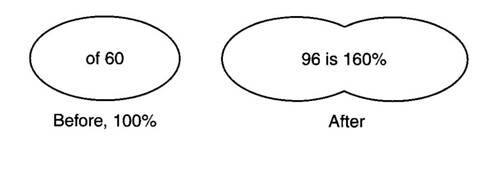
update: Saxon oval diagrams for problems in which the solution is greater than 100% of the original quantity
large image here
* I don't say that with disrespect. God should punish me.
hyperspecificity in autism
hyperspecificity in autism and animals
hyperspecificty in the rest of my life
hyperspecificity redux: Robert Slavin on transfer of knowledge
Inflexible Knowledge: The First Step to Expertise
Devlin on Lave
rightwingprof on what college students don't know
percent troubles
what is 10 percent?
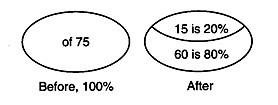
To solve word problems about percent, it is necessary to be able to visualize the problem. We will begin to work on achieving this visualization by drawing diagrams of percent problems after we work the problems. Learning to draw these diagrams is very important.
Twenty percent of what number is 15? Work the problem and then draw a diagram of the problem.
We will use ... 20 for percent, WN for what number, and 15 for is.
20/100 · WN = 15
The "before" diagram is 75, which represents 100 percent. The "after" diagram shows that 15 is 20 percent. Thus the other part must be 60, which is 80 percent.
large image here
.............................
The first time C. tried this problem he found it quite difficult. (And, yes, we're talking about a kid who is 1/3 of the way through Math A: algebra 1/geometry.)
Fortunately I stumbled upon the precision teaching folks at that point, and realized I needed to teach the component skills separately. In this case, C. needed practice drawing and labeling the diagram, so I had him do only that for 3 sessions, I think.
Then we did word problems like the one above.
We moved to "story" problems accidentally, "story" problems meaning:
"Jane and Faye have 32 bagatelles left. If they began with 160 bagatelles, what percent of the original number remains?"
(I managed to assign a story problem accidentally because I was flipping through the solution manual looking for solutions with ovals in them, and didn't realize the solution I'd found was a solution to a story problem, not a word problem. fyi)
C. didn't recognize that the story problem could be solved using the same ovals and percent equations he uses to solve percent word problems. Talk about hyperspecificity. I was so wrong to say autistic people and animals are hyperspecific and the rest of us aren't. God is punishing me.*
Today I need to locate the first Saxon lesson on percent story problems and teach that directly.
Nevertheless, in spite of my bumbling, this method is slowly but surely leading C. to some comprehension of what is happening when you take a percent of something in the real world, if you'll pardon the expression.
Speaking of the real world, what is a bagatelle?
I'll post a screenshot of the oval diagrams he uses for problems in which the solution is more than 100% later.
.............................
update: Saxon oval diagrams for problems in which the solution is greater than 100% of the original quantity
When a problem discusses a quantity that increases, the final quantity is greater than the initial quantity. If we let the initial quantity represent 100 percent, the final percent will be greater than 100. This means that the "after" diagram representing the final quantity will be larger than the "before" diagram. The "after" diagrams in this book will not be drawn to scale. [emphasis in the original]
[snip]
What number is 160 percent of 60? Work the problem and then draw a diagram of the problem.
WN = 160/100 · 60
large image here
* I don't say that with disrespect. God should punish me.
hyperspecificity in autism
hyperspecificity in autism and animals
hyperspecificty in the rest of my life
hyperspecificity redux: Robert Slavin on transfer of knowledge
Inflexible Knowledge: The First Step to Expertise
Devlin on Lave
rightwingprof on what college students don't know
percent troubles
what is 10 percent?
Subscribe to:
Posts (Atom)