kitchen table math, the sequel: productivity
Showing posts with label productivity. Show all posts

Tuesday, October 1, 2013

Have I mentioned lately that I am not a fan of credentialism? (and Word is not for writers)

Edel went to a college in Pennsylvania and Melinda to one in New York. Both have undergraduate degrees in elementary education, yet they both recalled how lost they felt when they first stood in front of a classroom. They hadn’t done nearly enough student teaching, they felt, and, in any case, the student teaching they had done hadn’t prepared them to deal with issues, as Edel put it, “like poverty, drugs, crime, and hunger” that she was seeing on a daily basis.

In desperation, Edel sent a note to one of her college professors asking for help. (He gave her a few pointers.) Melinda recalls thinking that even the most basic elements of her job — classroom management, organization, lesson planning — were things she had to figure out on her own, after she had begun teaching. When I asked them what they had learned in college, they shouted in unison: theory! (Denise went on to get a master’s degree in education, which she laughingly described as “not exactly hands-on.”)

Three Sisters (Not Chekhov's) by Joe Nocera | NY Times | Published: September 27, 2013
Speaking of classroom management, organization, and lesson planning, I am trying to figure out how to make my computer act like Google.

Katie Beals told me, a while back, that computers were not designed with writers in mind, and that is soooooo true. I have dozens of copies of exercises, lessons, class readings, handouts, fables, folktales, fairy tales, myths, etc. scattered all over my hard drive, and I can't tell which ones it's safe to throw out because I can't tell which copies really are identical copies and which are different.

Of late, I have taken to dating every single thing I write, create, or duplicate (making duplicates is the real problem)....but that doesn't work, either, because duplication produces multiple copies with the same date in the filename, which doesn't help.

Word does tell me, in the Finder window, which of several documents I opened most recently, BUT if I forget to read the date and open the document without thinking -- which I inevitably do--the history is gone.

I need my computer to do its own personal Google search.

I need it to go find every single copy of a document AND every single near-copy of a document (and I'd like it to find things it thinks may be related to the documents I'm looking for).

Then I need my computer (this part is nothing like Google) to tell me which copies are exactly the same, which ones are not the same, what exactly is different among the four or five copies of the same file, and when I last revised what.

I've tried to develop a habit of including a "Last Revised" notation inside every document I create, but I create hundreds and hundreds of tiny documents -- exercises and lessons and brief passages for my class -- and at any one time I'm juggling so many of them that I have not become a person who automatically and without having to think about it includes a "Last Revised" line in every document.

I will keep trying, but why should I have to become that person, anyway?

Word could easily enter a "Last Revised" line in every document I create, so why doesn't it?

As far as I can tell, Word was created for students, not teachers.

Students and student types.

Word was created for people who were going to write something ONCE, put it out there, then never look at it again.

Word was not created for people who write something once, then revise it after class, then re-revise it one year later, then re-re-revise it after that class, then re-re-re-revise it one year after that, etc.

It's a problem.


Wednesday, September 11, 2013

The secret

Premack gave a group of rats free access to drinking water and a running wheel (Premack, 1959). He recorded their behavior across several minutes. Initially (at baseline), each rat spent some time drinking and some time running, but on average rats spent more time running than drinking: about 250 seconds running and only about 50 seconds drinking. Then, Premack restricted the rats’ access to the wheel: they were allowed to run only after they had drunk a certain amount of water. The rats soon learned the contingency and started drinking water in order to gain access to the running wheel. Unsurprisingly, the total amount of running decreased, because the rats now had to work to obtain access to the wheel. But the total amount of drinking increased to more than 100 seconds, as the rats now performed this behavior more often in order to gain access to the wheel. In effect, the activity of running was acting as a reinforce, and it was increasing the probability of an otherwise infrequent behavior, drinking:

S (running restricted) → R (drinking) → C (access to wheel)

Premack went on to show a similar pattern in human children (Premack, 1959). He put the children in a room that contained a pinball machine and a bowl of candy, and he recorded how much time each child spent playing pinball and eating candy. Some of the children spent more time playing pinball. Premack then restricted access to the pinball machine, allowing these children to play only after they had eaten some candy. Candy eating increased, showing that access to the preferred activity (pinball) could reinforce the less-preferred activity (candy eating). Conversely, children who preferred eating candy in the first place could be trained to play more pinball, by making access to the candy contingent on playing pinball.

Thus, in both rats and children, the opportunity to perform a highly frequent behavior can reinforce a less-frequent behavior. This idea came to be known as the Premack principle. Examples of the Premack principle abound in human life. For example, left to their own devices, most children will spend more time watching television than doing their homework. Thus, watching television is a preferred activity, and it can be used to reinforce the less-preferred activity of homework. The parent restricts television time, making it contingent on homework. As a consequence, the child spends more time doing homework than he would have done if television had not been restricted. A later extension of the Premack principle, the response deprivation hypothesis, suggests that the critical variable is not which response is normally more frequent but merely which response has been restricted: by restricting the ability to execute almost any response, you can make the opportunity to perform that response reinforcing (Allison, 1993; Timberlake & Allison, 1974). For example, perhaps you have a chore, like cleaning your room or doing laundry, that you normally detest. But if access to this activity is restricted, it can become reinforcing. If you have been studying for several hours straight, the idea of “taking a break” to clean your room or do the laundry could begin to look downright attractive. If so, you’ve experienced the Premack principle at work.

Learning and Memory: From Brain to Behavior New York: Worth Publishers, 2007
Mark Gluck
Eduardo Mercado
Catherine Myers
p316-317

Monday, July 22, 2013

Workflowy for packing

Workflowy cuts my packing time in half, or close to. It's amazing.

With my usual travel list(s), I get into an obsessive-compulsive scanning doom loop.

I put something in my bag and cross it off my list.

Then I put something else in my bag and cross that off my list.

Unfortunately, crossed-off does not mean invisible, so every time I check my list to see what to pack next, I end up rereading the whole thing, or at least re-scanning the whole thing; plus I start to experience doubt.

Did I really pack the long cord for the iPad? Sure I crossed it off the list, but did I put it in my bag?

Better check.

(Same problem with recipes, btw.)

With Workflowy, when you cross something off the list it disappears (if you want it to).

So the list gets smaller and smaller, and there's never anything to scan other than items you have definitely not packed. There's no re-scanning, and there's (almost) no checking or re-checking. Out of sight, out of mind.

When you want to restore the list, you just Un-cross all the crossed-off items et voilà! List restored.


Saturday, June 15, 2013

Best productivity app ever

Workflowy


Looking at the "How I use Workflowy" post, I realize I have forgotten everything about GTD (Getting Things Done).

Interesting. The violin teacher is using Workflowy to assign and monitor practice.

Friday, February 10, 2012

habit, part 1

I keep mentioning my Eternal Basal Ganglia project...the one that never, ever gets done. (It's close! I swear!)

One of the issues I've been struggling with is the question of how people develop good habits as opposed to bad habits. More to the point, how would one go about developing a good habit on purpose?

Which, of course, raises the question of what, exactly, a habit is.

Answering that question has turned out to be more difficult than I expected. We all know a habit when we see one, and we all have numerous habits of our own, some of which we're trying to "break." But when you try to reverse-engineer the concept, it gets slippery.

I think Piers Steel's terrific book, The Procrastination Equation: How to Stop Putting Things Off and Start Getting Things Done, has helped me finally make the jump from "What is a habit?" to "What would I need to do if I wanted to create a habit on purpose?"

More later.

Thursday, February 9, 2012

The Procrastination Equation

the equation:

Motivation = E x V/I x D

E = Expectancy: your level of confidence (but not over-confidence) you'll actually get whatever you're trying to do done
V = Value: how much you value getting whatever you're trying to do done
I = Impulsiveness: (no explanation required)
D = Delay: length of time before you realize the reward/goal/etc. - people "irrationally find present costs more salient than future costs"

The book is fantastic. Briliant. Amazing.

More anon.

The Procrastination Equation.

The Procrastination Equation at Science Daily.

Tuesday, September 6, 2011

Routine Builder


A fantastic app: Routine Builder.

I am now watering my plants on schedule, once a week, instead of whenever I remember it, which is about once a month, if I'm lucky.

If my plants are lucky, I should say.

I've just this minute added "Eat An apple" to the daily queue.

Wednesday, October 6, 2010

slippery slope

…[I]f once a man indulges himself in murder, very soon he comes to think little of robbing; and from robbing he comes next to drinking and Sabbath-breaking, and from that to incivility and procrastination. Once begin upon this downward path, you never know where you are to stop. Many a man has dated his ruin from some murder or other that perhaps he thought little of at the time.

Thomas De Quincey, "Second Paper on Murder"
via Fallacy Files

Sunday, August 29, 2010

words to the wise

9pm now; Andrew is still wearing his backpack

A while ago I heard Ed say, "School starts in one week, and you never go to school on Sunday."

I'm sure that fell on deaf ears.


Big Calendar
Debbie Stier's big calendar
the big picture
blank calendar template (pdf file) 
self-charting increases motivation


anthem

avoiding the thesis

"Excerpts from a seventeen-hour piece composed in graduate school"

from the Avoidance Trilogy (directions for clicking through to the music here)

Saturday, August 21, 2010

learned industriousness

Given the fundamental nature of procrastination, it is curious how such a mechanism could have become prevalent. One would expect that such a disadvantageous characteristic would have long been culled from our gene pool. To address this, George Ainslie argues that people in a hunter/gatherer environment should find that their motivational compulsions fit motivational demands almost perfectly: "As long as they sleep and hoard and mate when the relevant urge arises, they will behave more or less adaptively in the environment in which those urges evolved" (1992, p. 88). Unfortunately, in our civilized circumstances, contingencies are quite different, and it often becomes important to act not as nature intended.

There are some who have likely inherited characteristics that let them deal better with procrastination without any type of self-regulatory assistance. Like the naturally athletic, they don't need a lot of help to stay motivationally fit. Fortunately, there is help for the rest of us. There are many, many ways to reduce procrastination if not effectively eliminate it. Here we review three: Learned Industriousness, Energy Regulation, and Goal Setting. Of note, most procrastinators have a wide streak of impulsiveness in them and likely are looking for the "quick fix." Unfortunately, the more powerful the remedy for procrastination, the longer it takes to work.

Piers Steel at Procrastination Central

I am taking his advice re: learned industriousness to heart.

Friday, August 20, 2010

the big picture

I'm going to try to make a big calendar this weekend. Debbie S. made one for her kitchen and says it's magic. Both of her kids have been studying it and so has she.

I could use some magic where time is concerned, and I've been looking for years. After the Time Timer, I tried PlannerPad, which worked reasonably well until I ordered the "executive size" PlannerPad, which I found awkward to carry about. I've been trying to get back in the habit of using the personal sized PlannerPad for a couple of months now.

Still and all, PlannerPad didn't give me a sense of time beyond the confines of one week.

We'll see.

Debbie Stier's big calendar
the big picture
blank calendar template (pdf file) 
self-charting increases motivation 
what is one year?  

Saturday, August 7, 2010

Monday, July 19, 2010

instapaper

A few years back, C. moved into my then-office to sleep because Andrew had gotten too noisy to share a bedroom with. Since I never managed to get my computer shut down by bedtime, Ed and C. eventually developed a guessing game re: how many windows Mom has open on her iMac. It was always many dozens. Many, many dozens.

I think my life is about to change.

Thursday, October 8, 2009

apps

I mentioned Tuesday that I have not been mentating so well of late.

It's been so bad I had to break out my Time Timer for the past two days running just to figure out when it was going to be time to stop doing whatever I was doing now and start doing whatever I was supposed to be doing do next.

Time Timer worked great. I recommend it.

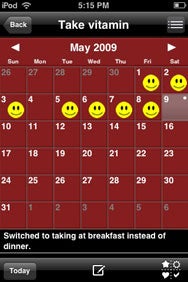
I've also been using two iTouch apps every day, day in and day out: one for diet, another for positive reinforcement. Both are terrific. Fantastically useful and motivating.

I think Karen Pryor would approve.


iAchieve:


Lose It!
Lose It! screen shots
Does This Pencil Skirt Have an App?


Wednesday, May 27, 2009

James Fallows software recommendations

Just saw this comment on David Allen's blog:
I have used and even written about Personal Brain. It is intriguing, but at least for my kind of work (text heavy, lots of reference material) I find that it doesn't scale very well. But it is so distinctive and interesting that it's certainly worth a look. I find MindManager better/easier for graphically-oriented organizing, and a normal outliner, including the not-quite-normal but useful BrainStorm, to work better with straight text. And, of course, Zoot to keep track of large-volume reference material.
I use Inspiration for thinking and outlining and I love Scrivener's for writing (and for keeping everything in one place).

I'm going to check out Zoot.

What I need is ONE piece of software that keeps everything in the same 'document': notes, to-dos, research, factoids, and whatever it is I'm writing.

Scrivener's comes very close.


mind mapping templates available for download

Tuesday, May 26, 2009

Freedom


C. has been using Freedom for a few weeks.

Every once in a while he rigs it so Andrew can't get on the internet, either. The other night we heard a cry of outrage from the basement & C. said, "I put Freedom on." He and Christian thought that was hilarious.

I'm signing up tonight, when C. is here to oversee the proceedings.

Invisibility Cloak does something similar for PCs.