kitchen table math, the sequel: animals
Showing posts with label animals. Show all posts

Wednesday, July 31, 2013

Color me not surprised

In sum, we propose that adults never fully outgrow the cognitive and perceptual biases that are so striking in infants and preschoolers. That is a humbling thought, much as it was humbling to discover that humans are not the center of the universe or as rational and ‘‘in control’’ as once thought. However, if clarity can come from investigating extreme cases, then perhaps studying children, who show these biases more blatantly than adults, might be a rich source of insight and future hypotheses about adult cognition.

Not Quite as Grown-Up as We Like to Think: Parallels Between Cognition in Childhood and Adulthood
Adele Diamond and Natasha Kirkham | Psychological Science Volume 16—Number  4 | p 291-297.
I'm just waiting for the day they find out crows are smarter than people.

A lot smarter.

Friday, May 3, 2013

Monty and the pigeon

I remember, back when Carolyn J. & I first started writing the original Kitchen Table Math, the Monty Hall problem coming up. I had never heard of it.

I think I remember, too, saying a couple of times, on the blog, that I came away from writing Animals in Translation thinking birds might just be as smart as people, or smarter. I didn't want to think that, particularly; How smart are birds, anyway? wasn't the topic of the book, which was mostly about mammals, not birds. But every time Temple told me a bird story, I would think hmmmmm.

The crow-and-the-rifle story, about a crow repeatedly taunting a rancher, has never left me.

So naturally, when I saw "Pigeons, Humans, and the Monty Hall Dilemma," I had to look.
The Monty Hall Dilemma is a probability puzzle that is notorious for eliciting suboptimal decisions from humans. A participant is given a choice from among three doors, one of which conceals a valuable prize. After an initial selection, one of the remaining, nonwinning doors is opened, and the participant is given a chance to switch to the other unopened door. The probability of winning is higher if the participant switches. Pigeons maximize their wins by switching on virtually all trials of a Monty Hall Dilemma analogue, whereas humans utilize a suboptimal strategy involving probability matching. Possible reasons for the difference between these two species’ performance are considered.

Pigeons, Humans, and the Monty Hall Dilemma by Walter T. Herbranson Current Directions in Psychological Science 2012 21: 297
No time to read or even skim --- but looking forward.

Friday, February 15, 2013

recent comments seems to be broken & other

Will try to figure it out....

Meanwhile, thanks, everyone, for weighing in on Surfer's diet ----- (and canola oil!)

Calorie replacement is the issue as I think Allan says. I'm going to figure out what kind of non-tampered-with meat I can buy around here. ("Non-tampered-with": how's that for an informed position?)

On another subject, and for passersby: the word "hateful" is verboten!

Monday, February 11, 2013

dogs are omnivores

Back to the vet's today for our third set of stitches and a really huge dog-cone attached via chest strap.

At the office I pussy-footed around the subject of: can a dog be a vegan? (I read The China Study two years ago, see below.)

"Do dogs need to eat meat?" I asked.

The vet, who tends to scoff a lot (I was hoping to forestall scoffing), gave me a look. "What do you mean, meat?" he said. "Do you mean raw meat?" He looked like he was fixing to scoff.

Raw meat, as I discovered yesterday, shows up frequently on websites devoted to dog nutrition. I haven't learned why as yet.

"Well," I said, "sure. Raw meat. Or cooked meat. Or just meat in general. Should I be giving Surfer real meat?"

"Dogs aren't obligate carnivores," he said.

What? Dogs aren't carnivores? (And what's obligate?)

I was gobsmacked.

An "obligate carnivore," it turns out, is a cat. A cat has to eat meat or it will die, hence the term "obligate." Cats are obliged to eat meat. Dogs are not obligate carnivores, and they are not obliged to eat meat. They just like to eat meat, same as people, but a dog can be a vegetarian. The vet actually used the word "vegetarian" himself, which is a lot better than me saying "vegetarian" and getting scoffed at. If I remember correctly, and I think I do, the vet actually said, "A dog can be a perfectly healthy vegetarian."

So today Surfer ate Amy's lentil soup, diced tomatoes, olive oil, and a boatload of fish oil. He was a pretty good sport about it, but I don't think he's going to be too thrilled when the cruciferous vegetables show up.

From The China Study:
...I decided to start an in-depth laboratory program that would investigate the role of nutrition, especially protein, in the development of cancer....I chose to do this research at a very basic science level, studying the biochemical details of cancer formation. It was important to understand not only whether but also how protein might promote cancer....

What we found was shocking. Low-protein diets inhibited the initiative of cancer by aflatoxin, regardless of how much of this carcinogen was administered to these animals. After cancer, initiation was completed, low-protein diets also dramatically blocked subsequent cancer growth. In other words, the cancer-producing effects of this highly carcinogenic chemical were rendered insignificant by a low-protein diet. In fact, dietary protein proved to be so powerful in its effect that we could turn on and turn off cancer growth simply by changing the level consumed.

Furthermore, the amounts of protein being fed were those that we humans routinely consume. We didn't use extraordinary levels, as is so often the case in carcinogen studies.

But that's not all. We found that not all proteins had this effect. What protein consistently and strongly promoted cancer? Casein, which makes up 87% of cow's milk protein, promoted all stages of the cancer process. What type of protein did not promote cancer, even at high levels of intake? The safe proteins were from plants, including wheat and soy.

[snip]

But how much protein is too much or too little? Using rats, we investigated a range of 4-24% dietary protein....Foci did not develop with up to about 10% dietary protein. Beyond 10%, foci development increased dramatically with increases in dietary protein.

[snip]

The most significant finding of this experiment was this: foci developed only when the animals met or exceeded the amount of dietary protein (12%) needed to satisfy their body growth rate. That is, when the animals met and surpassed their requirement for protein, disease onset began.

This finding may have considerable relevance for humans even though these were rat studies. I say this because the protein required for growth in young rats and humans as well as the protein required to maintain health for adult rats and humans is remarkably similar.

According to the recommended daily allowance (RDA) for protein consumption, we humans should be getting about 10% of our energy from protein. This is considerably more than the actual amount required....What do most of us routinely consume? Remarkably, it is considerably more than the recommended 10%. The average American consumes 15-16% protein....

[snip]

[D]id it make any difference what type of protein was used in these experiments? For all of these experiments, we were using casein, which makes up 87% of cow's milk protein. So the next logical question was whether plant protein, tested in the same way, has the same effect on cancer promotiona s casein. The answer is an astonishing "NO." In these experiments, plant protein did not promote cancer growth, even at the higher levels of intake....Gluten, the protein of wheat, did not produce the same result as casein, even when fed at the same 20% level.

China-Cornell-Oxford Project 

Saturday, February 9, 2013

help desk - Surfer

One of our dogs, Surfer, has cancer. We heard yesterday, then today we found out how bad it is.

It's bad. Mast cell cancer, Stage 3. Eighty percent of dogs with this diagnosis die within 8 months.

(Just one thing after another around here, it seems.)

Anyway, I'm posting to ask for whatever knowledge or experience anyone has in this realm. Apparently there is a brand-new chemo drug that targets a receptor on the surface of the mast cell, so Surfer will begin taking that shortly. The vet said they started another dog on the drug 4 weeks ago, and when they saw the dog again the bloody tumor on his face was gone and he looked "5 years younger."

(I'll take it!)

I'm also going to figure out whatever anti-cancer diet exists for dogs. I know quite a bit about anti-cancer diets for people because I went on a health-book reading binge when my mother fell ill. (Best books I read: Anti-Cancer by Daniel Servan-Schreiber and The China Study by T. Colin Campbell.)

However, reading anti-cancer books for people doesn't instantly tell me what an anti-cancer diet for a dog might be, since dogs are carnivores. (People are omnivores, right?)

I'm a believer in diet as a treatment for cancer because of my father's experience. He was diagnosed with three different kinds of cancer in the last 20 or 25 years of his life (squamous cell, bladder, and prostate) and he didn't die from cancer, or even come close. He tracked down all the information he could on cancer and diet, and followed the dietary recommendations to the letter. All three cancers eventually disappeared.

Of course, I think my father had interesting genetics ... which I suspect may have made him more able to deter cancerous cells. On the other hand, he did have cancer - 3 kinds of cancer, no less - so he obviously wasn't cancer-proof, interesting genetics or no.

My dad used all available conventional treatments as well, so it's impossible to say what role diet played in his survival, if any. However, no doctor expected to see his bladder cancer disappear in the way that it did. It recurred for years and then .... it was gone.

I remember my mom's report after what I think must have been my dad's last trek to Mayo Clinic for follow-up.

The doctor said: "You have cancer, and you're going to continue to have cancer, but you're not going to die of cancer."

My father died many years later, in his Springfield townhouse, where he lived on his own, unassisted.

Probably a heart attack.

Definitely not cancer.

Thursday, August 2, 2012

wolf dogs at Louisiana State Penitentiary - photos

I don't think you need a subscription to the Wall Street Journal to see these, but let me know if you do.

Pretty sure the article is free, too:

July 31, 2012, 8:09 p.m. ET
Prison's Guards Are Part Wolf, All Business
Bitten by Rising Cost of Human Guards, Louisiana Prison Deploys Canine Hybrids at Night; 'They're Going to Catch You'
By GARY FIELDS

Independent George reflects

re: sticky wages at the Louisiana State Penitentiary, Independent George writes:
You know you've been fully immersed into the canine world when the first thing you think about when reading an econ article on a math blog is how they've gotten the dogs wrong.
I cracked up when I read that.

Since I, too, find dogs majorly fascinating, I'm posting Independent George's second Comment:
The other red flag from your quoted passage is "120 pounds". Wolves don't naturally grow anywhere close to that size, which makes me question how much wolf is actually in those supposed hybrids.

I will say, though, that wolves ARE scary; when you see those yellow eyes staring at you in the yard, I completely understand how that would deter a prisoner escape. True wolfdogs behave very differently from dogs, and we're genetically hardwired to spot the difference. The very thing which causes the intimidation is also what makes them so unruly. And the lesson from the Belyaev experiments is that you can't have both - the behavioral traits are tied too strongly to the physical appearance.
I first grasped the "genetically hardwired" understanding between people and dogs when Christopher was age 7.

Unfortunately, Safari ate my post, so I will have to reconstruct it later.

Sunday, June 14, 2009

Damar the starling bird


Cognition and Language Lab via Grrlscientist

I think I've mentioned a couple of times that I came out of Animals in Translation thinking if there is one critter as smart as people or smarter, it's birds. There might be others, of course. There might be lots of others. But birds were the ones that were hard to ignore.

Funny thing: The Birds was one of my favorite movies when I was a kid.

Saturday, January 31, 2009

stereotype threat redux

If you're interested in the not yet peer reviewed study of Obama's inauguration and its effect on test scores, it's probably worth reading this (long) 2-year old post on stereotype threat.

Stereotype threat is real; I've experienced it myself more than once in my life.

My worst experience, which is mortifying to this day, happened at Dartmouth.

When I was at the college, there were a tiny number of women attending classes as the first group of co-eds.* Everywhere we went, we were surrounded by a sea of men. This meant that I rarely opened one of the remarkably heavy doors to the big old buildings on campus, because if a Dartmouth boy got to the door first -- and a Dartmouth boy always did get to the door first -- he opened the door for me.
's always
So I was used to having the enormous, heavy, old wood doors opened for me by Dartmouth boys.

One day I found myself walking alone towards the student center, nobody around but me. The student center was a new building, and its entry door was a standard-issue, see-through glass job, weighing what all such doors weigh and easily opened by a 4-year old child.

I clutched. There was no one around me to open the door ---- and I spent a split second thinking that if there was no one to open the door, I wouldn't be able to get in. This was a conscious thought.

It was appalling.

Worse yet, I was a raging feminist at the time. Mary Daly,** Andrea Dworkin -- you name the angry feminist author & I'd read her, underlined her, & annotated her up the ying-yang. I wanted a career & success, and I wanted a career and success in a world filled with men who had careers and success. I was on a Mission from God.

So there I was, Mary Daly aficionado; I'm walking to the Student Center, and I'm consciously asking myself, "How will I get inside the building if nobody opens the door?"

Ever since that moment, and especially in light of my revelatory experience of stereotype threat on a television game show, I've wondered about this phenomenon.

First of all, how conscious is stereotype threat most of the time? I have no idea. All I know is that there have been 3 occasions in my life during which I have become consciously aware that I (apparently) believed I could not do things men can do. Like open doors, for instance.

But how many times did I unconsciously activate this thought?

And second: does overcoming stereotype threat require a certain personality?

I've thought about that a lot. I was a scrapper, and have always been happy to scrap with myself, if need be. (Not coincidentally, I'm sure, very often I do need be.) The only reason I managed to prevail on the game show was that I was so furious with myself that I was more or less able to get out of panic mode and into battle mode.

But suppose I hadn't been a scrappy person?

Suppose I'd been a meeker sort of person?

I think the outcome of the game tells me the answer. All three contestants appeared to be scared witless, and the contestant who won was the contestant who managed to work up a bit of wrath. (Which reminds me: I've got to get a post up about the research on success and "Agreeableness," one of the five personality factors psychologists seem to have reached consensus on.*** Turns out super-successful people really aren't as nice as not-super-successful people, just like everyone thinks. Research shows.)

Back on topic: I'm very keen to see the effects of an Obama presidency on young black people ... and in fact I have already seen one such in my own house: C. (the other C.) has cut his dreadlocks! He said it was time for a change. I told him: OK, now you have to go to law school.

Funny thing: I have changed my blonde hair back to its original brown, and I have done this entirely because Michele Obama is a black woman who has black hair. Don't ask me why.

Fortunately, it's working out fine. I say "fortunately," because it doesn't always. Back when Hillary was First Lady & she cut her hair, I cut my hair, too, and I looked like he**.

That's not all. When George Bush was elected president, Ed bought me a pair of cowboy boots; plus I have two Sarah Palin skirts, which I bought on sale and wear to school board meetings.

Point is: people are weirdly social & sociable, and we spend a lot of time copying the folks around us or above us. That's the moral of Alex the parrot, who couldn't learn one-on-one, but learned brilliantly when he had a model to copy & compete with.)

These are interesting times.

That said, I still don't like the stimulus bill.


Obama and the stereotype threat (Frontal Cortex)
D-Ed Reckoning on the nitty gritty
Stimulus Bill Would Provide Flood of Aid to Education

* aka "co-hogs," which was not a term of affection. You could be sitting in a lecture hall, minding your own business, and suddenly, from behind, you'd hear: "Look at the co-hog taking notes."

** I wish to heck I'd kept my old copy of Gyn/Ecology. I'd love to read all the stuff I wrote in the margins. otoh, how excruciating would that be? Thank God I never kept a journal.

*** Personality: What Makes You the Way You Are by Daniel Nettle

Thursday, January 15, 2009

Friday, October 17, 2008

advertisements for myself

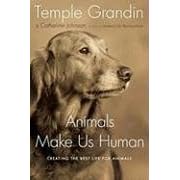
A starred review in Publishers Weekly!

Animals Make Us Human: Creating the Best Life for Animals Temple Grandin and Catherine Johnson. Houghton Mifflin, $26 (288p) ISBN 978-0-15-101489-7
Grandin (Animals in Translation), famed for her decades-long commitment to treating livestock as humanely as possible on its way to slaughter, considers how humans and animals can best interact. Working from the premise that “an animal is a conscious being that has feelings,” the autistic author assesses dogs, cats, horses, cows, pigs, poultry, wildlife and zoo animals based on a “core emotion system” she believes animals and humans share, including a need to seek; a sense of rage, fear, and panic; feelings of lust; an urge to nurture; and an ability to play. Among observations at odds with conventional wisdom: dogs need human parents, not alpha pack leaders, and cats respond to training. Discussions of why horses are skittish and why pigs are arguably the most intelligent of beasts—raccoons run them a close second—illuminate the intersection of people and more domesticated animals; chapters on cows and chickens focus more generally on animal welfare, particularly the horrific conditions in which they are usually raised and slaughtered. Packed with fascinating insights, unexpected observations and a wealth of how-to tips, Grandin's peppy work ably challenges assumptions about what makes animals happy. (Jan.)

PW will run an interview with Temple in the 10/20 issue.


(I've just noticed that Jay Mathews' new book on KIPP is listed on the same page!)

Tuesday, July 1, 2008

say better

The New Yorker profile of Irene Pepperberg is available online!

Pepperberg told me that Alex also made spontaneous remarks that were oddly appropriate. Once, when she rushed in the lab door, obviously harried, Alex said, “Calm down”—a phrase she had sometimes used with him. “What’s your problem?” he sometimes demanded of a flustered trainer. When training sessions dragged on, Alex would say, “Wanna go back”—to his cage. More creatively, he’d sometimes announce, “I’m gonna go away now,” and either turn his back to the person working with him or sidle as far away as he could get on his perch. “Say better,” he chided the younger parrots that Pepperberg began training along with him.

I know I've mentioned before that I came out of Animals in Translation thinking birds are as smart as we are or smarter.


to do

I need to get hold of the paper on the model/rival technique and autistic kids:

As it happens, the model/rival method may have some utility for another species: humans. Diane Sherman, who works with autistic children in Monterey, California, has had some preliminary success in encouraging speech in her clients using Pepperberg’s protocol. In an article published in The International Journal of Comparative Psychology, Sherman and Pepperberg say that, in two studies of children in Sherman’s private practice, the model/rival method led to “significant gains” in the children’s “communication and social interaction with peers and adults.” (Behavioral changes were measured by reports from parents and teachers, and included criteria like demonstrations of empathy, improved eye contact, saying hello to people, and speaking in sentences.)

I believe this.

Years ago, on our annual family vacation back to Illinois, we rented a van to drive from Springfield to Chicago. On the road, C. and Andrew (who is autistic) got into a HORRIBLE fight. Now, Andrew is very autistic. He couldn't talk at all at the time, and he probably couldn't understand much, either.

But he had no problem understanding a fight with his brother in the car. We'd separated the two boys, putting Jimmy (big brother - also autistic) with C. in the middle seat and Andrew in the way-back, but they got into it anyway. I no longer remember how it started, though it may have begun with Andrew touching his brother. I do remember, vividly, the fight in full bloom. C. would scream, "I hate Andrew!" and, hearing this, Andrew, who in theory did not understand a word of English or any other language, would shriek with rage, lunge forward, and hit his brother -- hard -- on the back of the head. Then C. would scream in pain and fury and let loose with another "I hate Andrew!", and A. would shriek and hit him again, and so it went.

I'm pretty sure I was in there somewhere, too, shouting "Stop saying that!" at C.

We finally had to pull off the road and take the boys out of the car to separate them. We bought them junk food, put them back in the car, and drove off. They were beaming at their chips and candy, and at each other.

After that I used to say that every single part of an autistic child's brain has been messed up in some fashion except for the part that says "Hit my brother in the car."

So: model/rival. I can see it working with autistic kids.

Especially the rival part.


to track down:

Pepperberg, I.M. and Sherman, D. V. (2000). Proposed use of two-part interactive modeling as a means to increase functional skills in children with a variety of disabilities. Teaching and Learning in Medicine, 12(4), 213-20.

Pepperberg, I.M. and Sherman, D.V. (2002) Use of two-part interactive modeling as a potential means to engender social behavior in children with various disabilities. International Journal of Comparative Psychology, 15, 138-5.

Pepperberg, I.M. and Sherman, D.V. (2004) Use of two-part interactive modeling as a potential means to engender empathy in children within the autistic spectrum. IMFAR conference, Sacramento, CA.

Saturday, May 31, 2008

What Shamu Taught Me...

...about a Happy Marriage

My Karen Pryor dog treats and target stick have arrived, and my dogs (Surfer and Abby) are liking the clicker, liking the treats, and are happy to touch their noses to the target or drop their bodies down to the floor.

Neither has, as yet, experienced a lightbulb moment.

I'm gathering my courage to try this with Andrew. His behavior has got to get under control this summer. When Ed gets back from L.A., we're all going to have a go at the training game.


trainer's motto: It's never the animal's fault.

Wednesday, May 14, 2008

horse and dog


This one's very sweet:


horse and cat, too:


Of course, I don't have the nerve to watch the videos of "horse kicking dog," "horse killing cyclist," etc.

herd instinct


I found this posted at what looks like a terrific new horse blog: Equus Palaverous.