

 Posts
Posts


"Teachers CAN'T assign whole-class books, but CAN be held accountability for reading scores?"Teachers should run schools. Or else we should forget about schools, and just have teachers.
That sums up why I won't teach in my district now. I can either teach the kids the concepts needed for their grade OR I can follow your curriculum script in the way you want it followed.
They do not lead to the same outcomes, however. And to require the script and then say it must not have been followed assiduously enough if your scores don't go up is a no-win situation for a teacher, especially a newer teacher who hasn't had years of experience in subverting the requirements!
I'd be careful though of referring to yourself as "reform-minded" -- the word reform itself has been co-opted by larger forces than yourself (not in suburbia, but in urban areas) -- and they too are pushing policies like you want to change. Content free understanding, knowledge not something you need to impart, they can google it, etc.
Showing posts with label teachers teaching kids. Show all posts
Showing posts with label teachers teaching kids. Show all posts
Monday, June 4, 2012
Jen on not teaching in her district


Thursday, January 7, 2010
60 lessons a week
Have I mentioned lately that I am not a fan of differentiated instruction?
I've just this moment discovered Miss Brave, by the way. She's wonderful, but her school is a dystopian futureworld of guided reading, "strategies," goals, literacy coaches, and "APs." And paperwork. And more, more paperwork. Your tax dollars at work.
Lucy Calkins has a lot to answer for.
The good news: at least they're using phonics.
I've just this moment discovered Miss Brave, by the way. She's wonderful, but her school is a dystopian futureworld of guided reading, "strategies," goals, literacy coaches, and "APs." And paperwork. And more, more paperwork. Your tax dollars at work.
Lucy Calkins has a lot to answer for.
The good news: at least they're using phonics.
Thursday, October 15, 2009
Meet the parents
from Magister Green:
My personal favorite moments come when our beloved administrators (who have advanced degrees in Education, natch) insist that the key to getting parents and families on board with new educational practices (read: Fad of the Moment) is "educating them." We need to "educate" the parents about what these new practices (fads) are all about and, should parents or even other teachers (!!) express reservations, well...they just need more "education"! The underlying principles and assumptions of these new fads are never questioned since, of course, they come from "experts" who have done "studies", so we all should just shutu....err, educate ourselves.My district uses the expression "marketing to parents."
Wednesday, September 30, 2009
stop the madness
here is redkudu, writing on the Core Knowledge blog:
I am thankful some attention is being focused on the unreasonable expectations placed on teachers: that there is some acknowledgment that it cannot ALL be done. This is especially true when you look at what teachers should be able to expect – that because a student is in a certain grade they have passed certain benchmarks which are designated by the state to assure us the students have the minimum skills necessary to accomplish grade-level work. Unfortunately, this is often not the case.
As a high school teacher, I’ve been expected to conduct Socratic Seminars, but never trained in how to do so. I found and purchased a book on such, read up, developed a lesson plan, and presented it. I received poor marks on an evaluation for that, because the method I’d read and produced was not the same method (a modified version) that the school preferred.
Ditto Marzano’s 9, by which we are formally evaluated at my new school. No training, no available materials (his books) in case I want to read up on them. Ditto small group learning, the student portfolio, PBL’s, and a whole host of other programs brought in via 20 minute PowerPoint at staff training without any supporting texts or ongoing training. And I should be able to demonstrate these methods and techniques in a classroom with learning disparities ranging from semi-literate to college level in 90 minutes on Mondays, 70 minutes on Wednesdays, and 45 minutes on Fridays. (Actually, our school has 9 different schedules, which also impact Tuesdays and Thursdays, early release Wednesdays, pep rally days, testing days, Homeroom days (once a 6 weeks – I’m expected to provide a meal for 25 students to enhance our “bonding”), actual homerooms (once a day), and other events.) Band-aids for gaping wounds and all that. I’d love to have a classroom in which levels were as simple as below expected, at expected, and above expected. I’d like to able to say the only thing I do in the summers is relax.
Sunday, August 23, 2009
pick one
Class size reduction or rapid formative assessment?: A comparison of cost-effectiveness
Stuart S. Yeh, a, University of Minnesota, Educational Policy and Administration, 86 Pleasant Street, S.E., Minneapolis, MN 55455, United States Received 18 October 2007; revised 26 June 2008; accepted 25 September 2008. Available online 2 October 2008.
Educational Research Review Volume 4, Issue 1, 2009, Pages 7-15
Abstract
The cost-effectiveness of class size reduction (CSR) was compared with the cost-effectiveness of rapid formative assessment, a promising alternative for raising student achievement. Drawing upon existing meta-analyses of the effects of student–teacher ratio, evaluations of CSR in Tennessee, California, and Wisconsin, and RAND cost estimates, CSR was found to be 124 times less cost effective [emphasis added] than the implementation of systems that rapidly assess student progress in math and reading two to five times per week. Analysis of the results from California and Wisconsin suggest that the relative effectiveness of rapid formative assessment may be substantially underestimated. Further research regarding class size reduction is unlikely to be fruitful, and attention should be turned to rapid formative assessment and other more promising alternatives.
Monday, August 3, 2009
guerilla instructivism, part 3
from Exo:
from Redkudu:
Yes, we cover up. I taught in NY, middle school. Workshop model prescribed, word walls, bulletin boards, not more than 20% of premade or teacher-made posters, the rest -students work... No seats in rows! No teacher talking longer than 10 minutes! Teach the whole child, not the subject.. etc, etc, etc. I was shushed by my more experienced and well-meaning fellow teachers from even saying "direct instruction" aloud. So when talking to my principal about what I do, and writing up the course descriptions I used "problem-solving", "case study method", guided discovery" to cover for my very direct teaching. Well, since my results in regents passing were good, the principal seleted to ignore my classroom when walking around the building, but I was warned beforehand about any external visitors so I could move the desks from rows into groups, and do a lab...
from Redkudu:
Not only does guerilla teaching live, but I'm required to have my lesson plans in a binder on the desk for any passing visitations by admin.
And, due to past experience, I now have a system of code in which my lesson plans look one way (constructivist), but the lesson goes another. Never yet had anyone complain because, I think, they truly don't know what they're looking at.
Saturday, July 18, 2009
Visible Learning
Dan Dempsey put me onto Visible Learning: A synthesis of over 800 meta-analyses relating to achievement by John Hattie, which I will be reading shortly thanks to Two-Day 1-Click.
Here's something I didn't know:
wow.
It's always worse than you think.
So I guess we can safely assume the peer editing thing won't be working out.
The Hidden Lives of Learners by Graham Nuthall
review of Hidden Lives
Here's something I didn't know:
As Nuthall (2007) has shown, 80% of feedback a student receives about his or her work in elementary (primary) school is from other students. But 80% of this student-provided feedback is incorrect!80%.
p. 4
wow.
It's always worse than you think.
So I guess we can safely assume the peer editing thing won't be working out.
The Hidden Lives of Learners by Graham Nuthall
review of Hidden Lives
Friday, July 10, 2009
accountable
My view of education (by Mr. Rydberg, retired math teacher; adopted by Mr. Pearson.)
Since only about 3% of a child’s first 18 years of life is spent in school, I believe a child’s education is the primary responsibility of the parent(s); my role is to support and assist in that endeavor. Although I am committed to work hard, your student cannot do well without your help. You are crucial and indispensable. With these commitments in place, the success of your child will be a delight to us all. But, you are the key, without you, (checking homework and helping prepare for tests; providing a quiet place and time to study; being accountable for results; making time to discuss school work; and helping with organization), their success will be limited.
I left a comment about parents (re)teaching math on Curriculum Matters.
The math tutor I know told me: "I get the call in 5th grade."
5th grade.
That's when the highly educated parents whose children he tutors max out their reteaching skills.
If parents are crucial and indispensable to their children's math education, the only children learning math are going to be the ones whose parents can afford to hire tutors.
parents are responsible for results
CA Math Frameworks: parents must be "involved" in math education at all grade levels
CA math framework: Responsibilities of Teachers, Students, Parents, Administrators
parents are the problem
outsourcing to parents
CT Coalition for World Class Math
NJ Coalition for World Class Math
PA coalition for World Class Math
United States Coalition for World Class Math
Parents' Group Wants to Shape Math Standards
Common Core Standards: Who Made the List?
Friday, June 19, 2009
Kate on teaching & tutors in an affluent district
I teach in a district with many wealthy families.
Some of the teachers at my school drive very nice cars. They are all married to someone who makes alot more than we do.
Some parents would hire a tutor whether their child needs it or not. They feel like if they don't, they're not doing everything they can.
I don't think tutors are particularly helpful, for several reasons.
In my experience the main benefit of a tutor is that it compels students who tend to blow off/copy assignments to sit and focus on math for at least an hour a week.
I prefer my students not get tutored because they sometimes cop an attitude in class like they don't have to pay attention, because the tutor will teach it to them later. (This is not very many students...just an obnoxious, overprivileged few.) Overall it sends a message that parents don't trust teachers to get the job done.
All that being said, most of my students don't have tutors. They participate in learning activities and complete the work I ask them to, and we get good results.
Thanks, Kate!
(Back in a bit - I promised myself I would do "first things first" this morning. Sure, I've already broken that promise, but that's why God invented the mid-course correction.)
Thursday, June 4, 2009
'an okay teacher with a big mouth'
I feel I know this teacher: I've always loved the teachers with the big mouths! I like quiet teachers, too.... it's just that I have a soft spot in my heart for the brassy ones.
(I have a soft spot in my heart for brassy people in general, come to think of it.)
I'm trying to remember whether palisadesk has given us studies on teacher effectiveness having to do with the teacher as a strong personality -- ? Can't remember. If she's around, I hope she'll weigh in.
In any event, this teacher sounds like a lot of fun.
She was inspired to write a manifesto on taking the bull by the horns after attending a two-day conference on professional learning communities:
(I have a soft spot in my heart for brassy people in general, come to think of it.)
I'm trying to remember whether palisadesk has given us studies on teacher effectiveness having to do with the teacher as a strong personality -- ? Can't remember. If she's around, I hope she'll weigh in.
In any event, this teacher sounds like a lot of fun.
She was inspired to write a manifesto on taking the bull by the horns after attending a two-day conference on professional learning communities:
From: Ballantine, Sara
Sent: Thursday, January 29, 2009 10:49 PM
To: All Teachers and Staff
Subject: The Problem With Education in America: An AutobiographyDear Esteemed Colleagues,
I would like to take this opportunity to say, well, to say that we suck. Don’t believe me? Ask Rob, he’ll show you the numbers. Now please take a minute to compose yourselves, grab a tissue, call your mom/spouse/brother/sister/accountant/etc. to wallow in self pity.
Done? Let’s move on.
The question still remains, who is to blame?
No, scratch that. That isn’t the question. The question remains, WHAT ARE WE GOING TO DO ABOUT IT?
I do need to preface this by saying that I have no misgivings about my talent, as well as my shortcomings. I believe it would be safe to say that we, in fact, all have talent, as well as shortcomings. So again, just to be clear, I write this not to determine who is the “suckiest” out of all of us, but rather, as a call to action.
We are all aware that our first semester numbers were pretty dismal to say the least...I don’t feel the need to outline all of the barriers in our way; we are all well aware of the current state of things in our country, our district, and our school.
Thus, I propose that we stop focusing on the things we can’t change, and concentrate on the things we can.
Let’s stop blaming the social demographics of our students, the apathy of parents, the lack of motivation in our students, the skills that they “didn’t come in with,” the middle school teachers, the elementary teachers, the birth control that the parents of our students didn’t take, the fact that we didn’t have any coffee this morning, the union, admin, each other, and start taking responsibility for the job that we were hired to do.
Let’s change our focus from the curriculum that is not available, the money that isn’t there, the challenges imposed by the “block” schedule, and start looking to each other as our greatest resources.
[snip]
The issue is critical, more so than some of us care to admit, and the time to take action is now. Actually, it was yesterday, and even before that, so it must be NOW.
I understand that I am saying things that many of us don’t want to hear, presenting issues that we would rather not confront, and making suggestions that we fear we will not be able to fulfill. I understand that this letter will make me unpopular among some of you, and expect some criticism. And to be frank, I really don’t care. I say that with conviction because this isn’t about me, it’s not about you, it’s about the 900 lives that we are charged with five days a week, 180 days a year, and the job we elected to do.
Some of us will be convening in the staff lounge (in the cafeteria) tomorrow at lunch to begin this dialogue and create and action plan; however, I hope to see ALL of us there. Let’s face it; we don’t have until next week, next month or next year.
So, Esteemed Colleagues, I propose that we do everything we can to make us not just “Better than Good,” but that we do whatever it takes to be more gooder.
No, scratch that. Let’s be great.
Sincerely,
Sara Ballantine
I'm sorry, but I have to say it: DUMP THE BLOCK SCHEDULING. I mean, c'mon. You've got a teacher with a big mouth who's willing to lead the charge, rally the troops, swear off complaining (and gossiping!) in the teacher's lounge -- and you're saddling her with block scheduling?
How about no?
Since I'm not a teacher, I want to add that I haven't put up this post because I think Ms. Ballantine and her colleagues "suck."
I've put it up because I think Ms. Ballantine's approach to herself, her job, and her abilities is pretty close to exemplary -- at least, it is for a certain personality type. Probably the brassy personality type. As she says, she's not concerned about her talent or her shortcomings; she knows she has talent and she knows she has shortcomings. Talent and shortcomings are neither here nor there. What matters is the kids, and that's what she's saying.
"I suck and my data isn't great" can be a highly productive attitude, and I'm in a position to know. That's all.
The Comments are nice, too.
Sunday, April 5, 2009
the golden age 1956-1970
A woman here in town gave me permission to post this account of her experience teaching in Manhattan public schools between the years 1956-1970:
A quick explanation of that last observation: the writer of this account was responding to my assertion that Irvington should adopt only field-tested curricula.
I read her narrative & marvel. She is talking about the public schools of Goldin & Katz's America:
Are teachers today required to include "provisions for reinforcement and review" in their lesson plans? (Come to think of it, what is the status of lesson plans nowadays, anyway?)
My own school district appears to be almost exclusively concerned with understanding. Not just understanding: Enduring Understanding. Enduring Understanding and Essential Questions. It's in the Plan.*
Actual learning, in the sense of content making it into a child's long-term memory, is assumed.
When, lo and behold, a child fails to recall on tests the material he has "understood" in class, that is a problem for parents to fix.
That's not the way it was when American schools were great.
Steve Levitt summarizes The Race in 2 sentences
Jimmy graduates
The anemic response of skill investment to skill premium growth
The declining American high school graduation rate: Evidence, sources, and consequences
Pushy parents raise more successful kids
The Race Between Education and Technology book review
The Race Between Ed & Tech: excerpt & TOC & SAT scores & public loss of confidence in the schools
The Race Between Ed & Tech: the Great Compression
the Great Compression, part 2
ED in '08: America's schools
comments on Knowledge Schools
the future
the stick kids from mud island
educated workers and technology diffusion
declining value of college degree
Goldin, Katz and fans
best article thus far: Chronicle of Higher Education on The Race
Tyler Cowan on The Race (NY Times)
happiness inequality down...
an example of lagging technology diffusion in the U.S.
the Times reviews The Race, finally
IQ, college, and 2008 election
Bloomington High School & "path dependency"
the election debate that should have been
the golden age: a NYC teacher remembers
the White House cites Goldin & Katz
* the newly approved 21-page Strategic Plan, the one that includes 21st century skills but does not include college preparation
As a retired teacher, my experience was in Manhattan elementary schools in the NYC school system. This was a challenging teaching environment since the children ranged from the economically advantaged to the very economically disadvantaged. I taught in East Harlem and later in P.S. 9 on West End Avenue/84th St., two extremes.
We teachers were not indoctrinated in, and certainly didn't teach, the "whole method" system of reading. Most of us went to the City Colleges--City College, Hunter College, Brooklyn, Queens-- and learned teaching methods, materials, and philosophy. Most of my peers had a Masters degree in Education.
We could not qualify to teach in the NYC school system merely by sending for a certificate to show that we went to college. We had to be licensed by NYC, thoroughly tested in knowledge in every area of teaching before going into the classroom. This included a speech test. Any student teacher with an accent, speech impediment or related problem, especially with s, t, d, r, or l, was to be helped by a speech pathologist. FREE! I remember going to Professor Davidson, a leading speech therapist and being drilled with the poem "Jenny Kissed Me" on many 8AM mornings.
The NYC Board of Education issued curriculum bulletins for every grade and in every subject area. These bulletins were uniform for all the boroughs and indicated what was to be taught. I never experienced any teacher who thought they or the students were being stifled. On the contrary, we teachers were as creative as was necessary to do our jobs. I, being a budding artist then, always found creative ways to engage the students in learning.
We were required to make lesson plans for approval. Our lesson plan book was collected every week by our assistant principal. Each lesson had to have a stated goal, a provision for review and reinforcement, procedures or methods, and a conclusion. It wasn't fun making lesson plans, but it made us more efficient, focused, and better teachers.
Why should anyone need "Field Tested" curricula if teachers are properly trained and supervised?
That's my story and I'm sticking to it.
A quick explanation of that last observation: the writer of this account was responding to my assertion that Irvington should adopt only field-tested curricula.
I read her narrative & marvel. She is talking about the public schools of Goldin & Katz's America:
At the dawn of the twentieth century the United States became the richest nation in the world. Its people had a higher average standard of living than those in Britain, the previous leader. America was poised to ascend further. The gap between it and other front-runners would widen and the standard of living of its residents would cotinue to grow, even when its doors were open to the world's poor. American economic supremacy would be maintained to the end of the century, and beyond. In economic terms, the twentieth century fully merits the title "The American Century."That was then.
The twentieth century could also be titled the "Human Capital Century." By the end of the twentieth century all nations, even the poorest, provided elementary schooling and beyond to most of their citizens. At the start of the century and even by its midpoint many nations, including relatively rich ones, educated only those who could personally afford to attend school. The United States was different. Its educational system had always been less elite than those of European countries. By 900, if not before, it had begun to educate its masses at the secondary level not just in primary schools, at which it had remarkable success in the nineteenth century.
That the twentieth century was both the American Century and the Human Capital Century is no historical accident. Economic growth in the more modern period requires educated workers, managers, entrepreneurs, and citizens. Modern technologies must be invented, innovated, put in place, and maintained. They must have capable workers at the helm. Rapid technological advance, measured in various ways, has characterized the twentieth century. Because the American people were the most educated in the world, they were in the best position to invent, be entrepreneurial, and produce goods and services using advanced techologies.
The Race Between Education and Technology
by Claudia Goldin & Lawrence F. Katz
p. 1-2
Two Tales of the Twentieth Century: A Summary
The history of inequality during the twentieth century is a tale in two parts. The first was punctuated by episodes of declining inequality, some quite sudden and rapid. Stable or slowly rising inequality marked other parts of the period. On the whole, the first three-quarters of the century were years of greatly diminished inequality and lowered returns to education. Americans grew together as economic growth was shared throughout the income distribution during much of the period.
Everything came to a halt in the 1970s.
by Claudia Goldin & Lawrence F. Katz
p. 87
Are teachers today required to include "provisions for reinforcement and review" in their lesson plans? (Come to think of it, what is the status of lesson plans nowadays, anyway?)
My own school district appears to be almost exclusively concerned with understanding. Not just understanding: Enduring Understanding. Enduring Understanding and Essential Questions. It's in the Plan.*
Actual learning, in the sense of content making it into a child's long-term memory, is assumed.
When, lo and behold, a child fails to recall on tests the material he has "understood" in class, that is a problem for parents to fix.
That's not the way it was when American schools were great.
Steve Levitt summarizes The Race in 2 sentences
Jimmy graduates
The anemic response of skill investment to skill premium growth
The declining American high school graduation rate: Evidence, sources, and consequences
Pushy parents raise more successful kids
The Race Between Education and Technology book review
The Race Between Ed & Tech: excerpt & TOC & SAT scores & public loss of confidence in the schools
The Race Between Ed & Tech: the Great Compression
the Great Compression, part 2
ED in '08: America's schools
comments on Knowledge Schools
the future
the stick kids from mud island
educated workers and technology diffusion
declining value of college degree
Goldin, Katz and fans
best article thus far: Chronicle of Higher Education on The Race
Tyler Cowan on The Race (NY Times)
happiness inequality down...
an example of lagging technology diffusion in the U.S.
the Times reviews The Race, finally
IQ, college, and 2008 election
Bloomington High School & "path dependency"
the election debate that should have been
the golden age: a NYC teacher remembers
the White House cites Goldin & Katz
* the newly approved 21-page Strategic Plan, the one that includes 21st century skills but does not include college preparation
Sunday, March 29, 2009
Rich Getzel on teachers & constructivism
The fact is, it would be a lie to say that schools teach "reading, writing, and 'rithmetic" these days. Sounding out words, memorizing 6 x 4 - we're obviously going to lose these kids if we demand that they master these basic skills. This is the kind of thinking that pervades education, and as a new educator, I want to do terrible things to the snake oil salesmen who have peddled this ideology.
But don't lay the fault squarely on the teachers. Many publications often pit parents (who depise EM) against teachers (who unqualifiedly embrace it). But practically every teacher I know (that's a lot) depises the fuzzy math programs to which our schools have subscribed.
I am a new teacher, 23, but I learned mathematics from a traditionalist perspective. I came to my school, as a newly minted educator, and I was horrified by the Impact Math textbook that I was expected to use. It is worse than Everyday Mathematics. It is constructivism on steroids, and I wish more people would talk about this program, because it gets short shrift compared to Everyday Math.
At no point does the textbook spell out any procedure necessary to solve a problem. It is riddled with convoluted "discovery" exercises that theoretically will help students induce the right answer, and the right way (or ways) to get there. There is a dearth of practice problems (i.e. the kind of problems that students will be expected to answer on a standardized test).
So how did I adjust? I simply never used the textbook. It could never work with CTT students who, across the board, were years behind in mathematics. I taught the way I was taught the material. It's a challenge because every night I have to hunt for activities and problems. But I do believe that the students have responded very well. It's a shame, because they don't have a standard reference (textbook) to help them do their homework at night, but even if we used the Impact Textbook, they would not have a reference.
Practically every teacher I know who has had the misfortune of inheriting Impact Mathematics does some variation of what I do. Even my principal is baffled by the textbook, but it was sold as the most widely used textbook out there. The higher-ups (chancellor and his ilk) are gung-ho about constructivist learning, and as a result, teachers, and sometimes even administrators, are slaves to a system they despise.
But hey, it's a change from the old way, and any change is good, right?
But don't lay the fault squarely on the teachers. Many publications often pit parents (who depise EM) against teachers (who unqualifiedly embrace it). But practically every teacher I know (that's a lot) depises the fuzzy math programs to which our schools have subscribed.
I am a new teacher, 23, but I learned mathematics from a traditionalist perspective. I came to my school, as a newly minted educator, and I was horrified by the Impact Math textbook that I was expected to use. It is worse than Everyday Mathematics. It is constructivism on steroids, and I wish more people would talk about this program, because it gets short shrift compared to Everyday Math.
At no point does the textbook spell out any procedure necessary to solve a problem. It is riddled with convoluted "discovery" exercises that theoretically will help students induce the right answer, and the right way (or ways) to get there. There is a dearth of practice problems (i.e. the kind of problems that students will be expected to answer on a standardized test).
So how did I adjust? I simply never used the textbook. It could never work with CTT students who, across the board, were years behind in mathematics. I taught the way I was taught the material. It's a challenge because every night I have to hunt for activities and problems. But I do believe that the students have responded very well. It's a shame, because they don't have a standard reference (textbook) to help them do their homework at night, but even if we used the Impact Textbook, they would not have a reference.
Practically every teacher I know who has had the misfortune of inheriting Impact Mathematics does some variation of what I do. Even my principal is baffled by the textbook, but it was sold as the most widely used textbook out there. The higher-ups (chancellor and his ilk) are gung-ho about constructivist learning, and as a result, teachers, and sometimes even administrators, are slaves to a system they despise.
But hey, it's a change from the old way, and any change is good, right?
Sunday, February 22, 2009
recommended reading from Palisadesk
Mary Damer's book (Reading Instruction for Children Who Are At-Risk or Have Disabilities; coauthor William Bursuck) is a recent addition to my favorites. I use it mostly as a reference, and loan it to colleagues because it has a lot of useful examples, sections on vocabulary, teaching language skills, etc. Lots of practical lesson exemplars, and a DVD showing how to teach beginning readers to blend sounds, segment words into constituent phonemes, etc. (Most teachers learned nothing about this in their training so many don't know how to do it -- the DVD is a great addition because a demo is more effective than a verbal description)
Some of my favorites from earlier on:
Specifically on the topic of reading and language skills:
Marilyn J. Adams, Beginning to Read: Thinking and Learning About Print
Nathlie Badian, ed. Prediction and Prevention of Reading Failure
Andrew Biemiller, Language and Reading Success
Margaret Bishop, The ABC's and All Their Tricks (great reference book)
Douglas Carnine, Jerry Silbert, Edward J. Kameenui, et alia, Teaching Strugglng and At-Risk Readers
Jeanne Chall, The Academic Achievement Challenge
--- The Reading Crisis
--- Learning to Read: The Great Debate
--- Stages of Reading Development
CORE Reading Research Anthology: The Why? of Reading Instruction (Arena Press, 2001)
Siegfried Engelmann, Teaching Disadvantaged Children in the Preschool
-- Preventing Failure in the Primary Grades
---Your Child Can Succeed
Rudolf Flesch, Why Johnny Can't Read and Why Johnny STILL Can't Read
Barbara Foorman (ed) Preventing and Remediating Reading Difficulties:Bringing Science to Scale
Irene Gaskins, Success With Struggling Readers: The Bnchmark School Approach
Susan Hall and Louisa Moats, Straight Talk About Reading
----- Parenting A Struggling Reader
(both are good books to loan to parents with valuable charts and tables and indicators of what to look for in an effective classroom, good books for kids at various stages, etc.)
Stephanie Harvey and Anne Goudvis, Strategies That Work (for older readers Gr 4 and up)
Peggy McCardle and Vinita Chhabra, The Voice of Evidence in Reading Research
Elaine McEwan, Teach Them ALL to Read: Catching the Children Who Fall Throught the Cracks
Diane McGuinness, Why Our Children Can't Read
Bonnie McMillan, Why Schoolchildren Can't Read
Daniel J. Moran & Richard Malott (eds) Evidence-Based Educational Methods
Michael Pressley, Reading Instruction That Works
Louise Spear-Swerling and Robert Sternberg, Off Track: When Poor Readers Become "Learning Disabled"
-- Perspectives on Learning Disabilities
Deborah Simmons & Edward Kameenui (eds) What Reading Research Tells Us About Children with Diverse Learning Needs
Keith Stanovich, Progress in Understanding Reading
Sharon Vaughan and Silvia Linan-Thompson, Research-Based Methods of Reading Instruction, Grades K-3
(great resource for teachers just beginning to get a grip on effective reading instruction. Nice layout, lots of user-friendly activities and resources)
Sharon Walpole and Michael C. McKenna, The Literacy Coach's Handbook: A Guide to Research-Based Practice (focus is on effective teaching in K-3)
Arthur Whimbey, Mastering Reading Through Reasoning
--- Analytical Reading and Reasoning
--- Problem Solving and Comprehension
( techniques for good readers at middle school level and up)
Maryann Wolf (ed) Dyslexia, Fluency and the Brain
Maryann Wolf, Proust and the Squid
Alberto Manguel, A History of Reading
On effective instruction :
Wesley Becker and Siegfried Engelmann, Teaching: Evaluation of Instruction
Wesley Becker, Applied Psychology for Teachers
Grant Coulson, Ph.D. Power Teaching
Siegfried Engelmann, Teaching Needy Kids In Our Backward System
Siegfried Engelmann and Douglas Carnine, Theory of Instruction: Principles and Applications (warning: very difficult reading. Well written, but cognitively dense)
Norris Haring and Barbara Bateman, Teaching the Learning-Disabled Child
(significantly, the effective strategies outlined here work even better with average or gifted students -- good teaching is good teaching)
Kent Johnson and Elizabeth Street, The Morningside Model of Generative Instruction
Fred Jones, Positive Classroom Instruction
Michael Maloney, Teach Your Children Well
Stan Paine et alia, Structuring Your Classroom for Academic Success
Michael Pressley et alia, Motivating Primary Grade Students
Jerome Rossner, Helping Children Overcome Learning Difficulties
Beth Sulzer_Azaroff & G. Roy Mayer, Achieving Educational Excellence (1 & 2)
Owen R. White & Norris G. Haring, Exceptional Teaching
Related:
Roger Bass, Amy's Game: The Concealed Structure of Education
Robert C. Dixon, The Surefire Way to Better Spelling (for adults, from the author of Spelling Mastery. Some cool tips and many interesting insights into the language)
Kieran Egan, Getting It Wrong From the Beginning: Our Progressivist Inheritance from Herbert Spencer, John Dewey and Jean Piaget
-- The Educated Mind: How Cognitive Tools Shape Our Understanding
Arthur K. Ellis and Jeffrey Fouts, Research on Educational Innovations
(some trenchant analyses of Outcomes-Based Education, learning styles, "Whole Language," self-esteem programs, interdisciplinary learning, "brain based" education and so forth. On the other hand, co-operative learning, mastery learning, Direct Instruction and teaching for intelligence show consistent and positive empirical outcomes).
John Taylor Gatto, The Underground History of American Education
James F.Kavanagh The Language Continuum: From Infancy to Literacy
Philip Lieberman, Human Language and our Reptilian Brain: The Subcortical Bases of Speech, Syntax and Thought
John Mighton, The End of Ignorance: Multiplying Our Human Potential
Ernst Moerk, First Language Taught and Learned
--- The Guided Acquisition of First Language Skills
Cathy L. Watkins, Project Follow Through: A Case Study of Contingencies Influencing Instructional Practices of the Educational Establishment (brilliant analysis, and a must-read for anyone with serious interest in changing the "system")
Arthur Whimbey, Intelligence Can Be Taught
-- Why Johnny Can't Write
I'm sure I'm forgetting some important ones, but that's a start.
Some of my favorites from earlier on:
Specifically on the topic of reading and language skills:
Marilyn J. Adams, Beginning to Read: Thinking and Learning About Print
Nathlie Badian, ed. Prediction and Prevention of Reading Failure
Andrew Biemiller, Language and Reading Success
Margaret Bishop, The ABC's and All Their Tricks (great reference book)
Douglas Carnine, Jerry Silbert, Edward J. Kameenui, et alia, Teaching Strugglng and At-Risk Readers
Jeanne Chall, The Academic Achievement Challenge
--- The Reading Crisis
--- Learning to Read: The Great Debate
--- Stages of Reading Development
CORE Reading Research Anthology: The Why? of Reading Instruction (Arena Press, 2001)
Siegfried Engelmann, Teaching Disadvantaged Children in the Preschool
-- Preventing Failure in the Primary Grades
---Your Child Can Succeed
Rudolf Flesch, Why Johnny Can't Read and Why Johnny STILL Can't Read
Barbara Foorman (ed) Preventing and Remediating Reading Difficulties:Bringing Science to Scale
Irene Gaskins, Success With Struggling Readers: The Bnchmark School Approach
Susan Hall and Louisa Moats, Straight Talk About Reading
----- Parenting A Struggling Reader
(both are good books to loan to parents with valuable charts and tables and indicators of what to look for in an effective classroom, good books for kids at various stages, etc.)
Stephanie Harvey and Anne Goudvis, Strategies That Work (for older readers Gr 4 and up)
Peggy McCardle and Vinita Chhabra, The Voice of Evidence in Reading Research
Elaine McEwan, Teach Them ALL to Read: Catching the Children Who Fall Throught the Cracks
Diane McGuinness, Why Our Children Can't Read
Bonnie McMillan, Why Schoolchildren Can't Read
Daniel J. Moran & Richard Malott (eds) Evidence-Based Educational Methods
Michael Pressley, Reading Instruction That Works
Louise Spear-Swerling and Robert Sternberg, Off Track: When Poor Readers Become "Learning Disabled"
-- Perspectives on Learning Disabilities
Deborah Simmons & Edward Kameenui (eds) What Reading Research Tells Us About Children with Diverse Learning Needs
Keith Stanovich, Progress in Understanding Reading
Sharon Vaughan and Silvia Linan-Thompson, Research-Based Methods of Reading Instruction, Grades K-3
(great resource for teachers just beginning to get a grip on effective reading instruction. Nice layout, lots of user-friendly activities and resources)
Sharon Walpole and Michael C. McKenna, The Literacy Coach's Handbook: A Guide to Research-Based Practice (focus is on effective teaching in K-3)
Arthur Whimbey, Mastering Reading Through Reasoning
--- Analytical Reading and Reasoning
--- Problem Solving and Comprehension
( techniques for good readers at middle school level and up)
Maryann Wolf (ed) Dyslexia, Fluency and the Brain
Maryann Wolf, Proust and the Squid
Alberto Manguel, A History of Reading
On effective instruction :
Wesley Becker and Siegfried Engelmann, Teaching: Evaluation of Instruction
Wesley Becker, Applied Psychology for Teachers
Grant Coulson, Ph.D. Power Teaching
Siegfried Engelmann, Teaching Needy Kids In Our Backward System
Siegfried Engelmann and Douglas Carnine, Theory of Instruction: Principles and Applications (warning: very difficult reading. Well written, but cognitively dense)
Norris Haring and Barbara Bateman, Teaching the Learning-Disabled Child
(significantly, the effective strategies outlined here work even better with average or gifted students -- good teaching is good teaching)
Kent Johnson and Elizabeth Street, The Morningside Model of Generative Instruction
Fred Jones, Positive Classroom Instruction
Michael Maloney, Teach Your Children Well
Stan Paine et alia, Structuring Your Classroom for Academic Success
Michael Pressley et alia, Motivating Primary Grade Students
Jerome Rossner, Helping Children Overcome Learning Difficulties
Beth Sulzer_Azaroff & G. Roy Mayer, Achieving Educational Excellence (1 & 2)
Owen R. White & Norris G. Haring, Exceptional Teaching
Related:
Roger Bass, Amy's Game: The Concealed Structure of Education
Robert C. Dixon, The Surefire Way to Better Spelling (for adults, from the author of Spelling Mastery. Some cool tips and many interesting insights into the language)
Kieran Egan, Getting It Wrong From the Beginning: Our Progressivist Inheritance from Herbert Spencer, John Dewey and Jean Piaget
-- The Educated Mind: How Cognitive Tools Shape Our Understanding
Arthur K. Ellis and Jeffrey Fouts, Research on Educational Innovations
(some trenchant analyses of Outcomes-Based Education, learning styles, "Whole Language," self-esteem programs, interdisciplinary learning, "brain based" education and so forth. On the other hand, co-operative learning, mastery learning, Direct Instruction and teaching for intelligence show consistent and positive empirical outcomes).
John Taylor Gatto, The Underground History of American Education
James F.Kavanagh The Language Continuum: From Infancy to Literacy
Philip Lieberman, Human Language and our Reptilian Brain: The Subcortical Bases of Speech, Syntax and Thought
John Mighton, The End of Ignorance: Multiplying Our Human Potential
Ernst Moerk, First Language Taught and Learned
--- The Guided Acquisition of First Language Skills
Cathy L. Watkins, Project Follow Through: A Case Study of Contingencies Influencing Instructional Practices of the Educational Establishment (brilliant analysis, and a must-read for anyone with serious interest in changing the "system")
Arthur Whimbey, Intelligence Can Be Taught
-- Why Johnny Can't Write
I'm sure I'm forgetting some important ones, but that's a start.
Sunday, September 28, 2008
what is area?
Ed just talked to a young man who, while he was going to college, tutored in a New York City middle school. One day he overheard a math teacher in the school ask another math teacher how to calculate the area of a triangle. The teacher needed to know because, "I have to teach area of a triangle today."
Wednesday, September 24, 2008
help desk - info request for Project Lead the Way
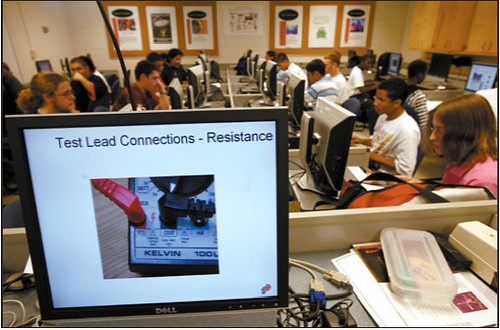
I heard this week from a teacher-commenter on KTM who has just had word that her district has adopted Project Lead the Way (aka Project Bleed You Dry - scroll down) & is seeking info on the program. Teacher is disturbed by the fact that this program has appeared out of nowhere:
What is really bothering me about the adoption of PLTW is that there seems to be a lack of transparency in the decision making process and a sense of responsibility to the tax-payers. I'm so tired of districts and states being "sold" on these sorts of things. Maybe states and districts feel that if they buy these products/programs, then it will be up to the developers to prove their effectiveness and they'll be off the hook... (just speculating...)
Thursday, September 11, 2008
Thursday, August 14, 2008
for parents of new middle schoolers--
The single most useful piece of advice I've ever read as a parent of a middle school child:
Andromeda on organization and the middle school child.
Also, 3 years ago a lot of us wrote posts and comments about books and products that had helped our kids deal with middle school.
(fyi: the old site is broken. Can't be edited. That's why the links are slowly deteriorating with no one to fix them...I have no idea what to do about it other than get rich enough to hire someone to copy all the source code and then take the whole thing down.)
posts on middle school & organization:
my two favorite middle school books:
if you decide to go the expanding file route...
The Globe-Weis Fabric Poly Expanding File is amazingly sturdy.
Andromeda on organization and the middle school child.
Also, 3 years ago a lot of us wrote posts and comments about books and products that had helped our kids deal with middle school.
(fyi: the old site is broken. Can't be edited. That's why the links are slowly deteriorating with no one to fix them...I have no idea what to do about it other than get rich enough to hire someone to copy all the source code and then take the whole thing down.)
posts on middle school & organization:
- mom gets wake-up call at end of school year
- accordion files for middle school students
- Donna Goldberg on students' sense of time
- Donna Goldberg's web site
- the 3 simple building blocks of success (How to Double Your Child's Grades in School)
- an approach to reading that really works (part one) (How to Double...)
- an approach to reading that really works (part two) (How to Double...)
my two favorite middle school books:
- The Organized Student by Donna Goldberg
- How to Double Your Child's Grades in School by Eugene Schwartz
if you decide to go the expanding file route...
The Globe-Weis Fabric Poly Expanding File is amazingly sturdy.
Sunday, August 3, 2008
Wednesday, July 30, 2008
pretty is as pretty does
Ugly Criminals (pdf file)
Using data from three waves of Add Health we find that, consistent with theoretical expectations, being very attractive reduces a young adult’s (ages 18-26) propensity for criminal activity and being unattractive increases it. A variety of tests demonstrate that this result is not because beauty is acting as a proxy for socio-economic status. Being very attractive is also positively associated with wages, and with adult vocabulary test scores, which suggests the possibility that beauty may have an impact on human capital formation. We demonstrate that, especially for females, holding constant current beauty, high school beauty (pre-labor market beauty) has a separate impact on crime, and that high school beauty is correlated with variables that gauge various aspects of high school experience, such as GPA, suspension or having being expelled from school, and problems with teachers.
These results suggest two handicaps faced by unattractive individuals. First, a labor market penalty provides a direct incentive for unattractive individuals toward criminal activity. Second, the level of beauty in high school has an effect on criminal propensity 7-8 years later, which seems to be due to the impact of the level of beauty in high school on human capital formation, although this second avenue seems to be effective for females only. These findings are robust to numerous specification and robustness checks.
Somebody should tell the Broader, Bolder people about this.
Tuesday, July 22, 2008
Summarizing, Paraphrasing, Retelling
Emily Kissner's book, unfortunately, is part of my great unread. One of these days...
Still, I've read enough of it to recommend it.
The introduction & second chapters are online:
Chapter 2 is droll:
what is a summary, anyway?
And there you have it: a window onto the world of our public schools, where educators decide not to teach the stuff they agree kids have to know because somebody else already should have taught it.
Not my problem.
I had never thought about summaries reflecting the structure of the original text.
I find that interesting, helpful, and intriguing.
* Which is better? spit or regurgitate?
** Note: this teacher comes from "the more affluent part of the district."
Still, I've read enough of it to recommend it.
The introduction & second chapters are online:
I started teaching language arts at the height of the whole language movement. The supervisor in my district had removed the old scope and sequence, drill and kill–based curriculum in favor of a far more open curriculum that allowed teachers to plan their own lessons and make their own judgments. “But I have no judgment!” I remember wailing to my mother, also a teacher. [note: this is exactly the way I felt when I first had kids and read advice books telling me to "trust my instincts": I didn't have any instincts] “How do you think I learned what to do?” she asked, and showed me her bookshelf, which was covered with stacks and stacks of professional books. I got the message. I couldn’t expect to make it through a career of teaching with only the knowledge I had picked up in a handful of undergraduate courses. If I was going to be successful, I needed to read. And read. And read.
During the next few years, I amassed my own collection of books. When I came to a thorny patch in my instruction—for example, how to get students to apply grammar skills to their writing—I would look through the books for ideas and solutions. If I didn’t find the answer in my own books, I would borrow from my mother’s bookshelf or the reading specialist’s....
This helped me to cope with the changes that swept through my classroom during the course of the next seven years. I started teaching seventh grade writing, then added sixth grade writing to the mix. When Integrated Language Arts came to our school a few years later, I was thrilled to be able to teach a ninety-minute block of reading and writing. Our state outcomes became content standards, our state testing program was transformed from performance-based assessment to “selected response,” or multiple choice, and the district middle school reading and writing department was headed by three different supervisors who dispersed three different curriculum manuals. As if these changes were not enough, I uprooted myself after seven years and went to teach a self-contained sixth grade class in a tiny rural district. Moving from a district with 28,000 students to a district with 1,800 was quite a culture shock.....
The more things changed, the more I could see how some things remained the same. Whether I was teaching to outcomes or standards, whether my curriculum was organized according to theme or genre, whether I had a classroom with windows, I faced young adolescents every day. All the books in the world cannot prepare a teacher for what happens once the students walk into the room.
I certainly wasn’t prepared to teach summarizing. Included as a content standard and an assessment anchor, I knew that summarizing was important, and I dutifully tried to help my sixth and seventh graders write summaries of both fiction and nonfiction texts. I envisioned smoothly written short pieces, like those in TV Guide, that would elegantly capture the essence of a text with a minimum of words.
What I got were stacks of bizarre constructions that claimed to be summaries—or “sumeries,” as my students often wrote—that either copied whole sentences of text, focused on just one section, or missed the main points altogether. Sometimes I wondered if the students had read the same text that I had. The more able students could occasionally pull together a coherent comment or two, but often they would try to jam a summary into the traditional paragraph template—topic sentence, supporting details, concluding sentence.
I learned many things from the article. How tomb robbers took things from tombs, what they stole from tombs, and what they were like. It was a great article.
I wasn’t sure of how to help them. My usual comments—“Elaborate. Add more. Give more detail”—are not helpful for summarizing. The students thought I had become temporarily insane when I told them, “That’s too long. Make it short. Are those details necessary?”
Standing in front of the classroom with a student summary on the overhead projector, I struggled to explain to the students why it was not effective.
“But the article is about trees, right?” Patrick asked from the front row. “So why can’t I say, ‘This article is about trees?’”
I floundered. As the teacher, I was supposed to know these things!
“It’s not good writing,” I said, finally.
“It sounds good to me,” Patrick said, to a chorus of agreement from elsewhere in the room. “I think it’s fine.”
Chapter 2 is droll:
The scene was grim. Eight of us were packed into a cramped, unair-conditioned room, spending the first week of our summer in a kind of curricular sweatshop. Our task was daunting: to unite the previously divided middle school reading and writing programs into one cohesive class. And write 100 days of curriculum in one week, using enough detail so that reading teachers could confidently teach the writing components and writing teachers could teach the reading. The sixth grade table had rapidly devolved into a bizarre reading–writing turf war.
“I don’t think retelling is something we want to assess in middle school,” a reading specialist said. “I mean, just being able to spit back* the characters and plot of a story doesn’t show any higher level thinking.” To those of us who had taught writing, she said, patronizingly, “One of the goals of teaching reading is to get kids to think critically.”
Really.
“Are you talking about retelling or summarizing?” asked a veteran teacher.
“Aren’t they both the same thing?” someone else asked. [shoot me]
“If we include retelling—or summarizing—would it be a reading activity or a writing activity?”
“How would we assess it?”
“Well,” said one teacher, who came from the more affluent part of the district, “I don’t think summarizing is a skill that we should have to teach in middle school. It’s time that we stop babying students and expect them to use what they learned in elementary school.”**
“Or should have learned,” someone else chimed in. Reading teachers and writing teachers united momentarily to agree that students should have already learned basically everything before arriving in middle school.
I’ve found that there’s no way to win one of these arguments. [ditto!] In this case, nothing I could have said would have convinced any of these teachers that they were wrong. (Despite the fact that I was the only one who had actually taught reading and writing together, I was still considered a “writing” teacher, and therefore unable to comprehend reading issues!) This group perpetuated four pervasive myths about the related skills of summarizing, paraphrasing, and retelling.
what is a summary, anyway?
If paraphrasing is just restating ideas, and a retelling is completely oral, what is a summary? This question has plagued researchers—and students— for years. Definitions for a summary abound. It may be most useful to study some of the important characteristics of a summary. Although there are some issues still up for debate, most people agree on the following points.
A summary should be shorter than the original text. How much shorter? It depends. A fifteen-page article could be summarized in one page, two pages, or even a single paragraph, depending on the purpose of the summary and the needs of the audience. A summary should include the main ideas of the text. Although this sounds easy enough, it’s where most students, and most adults, have trouble. Stating the main ideas of a text is easy when the author comes out and states them. The task becomes much more difficult when the main ideas are implicit, or unstated, as is usually the case in fiction.
A summary should reflect the structure and order of the original text. This can become another stumbling block. Fiction text written in chronological order is easiest for students to summarize. When it comes to nonfiction, however, authors use a variety of structures. Most students are used to the form of text that states a main point and then supports that point with details. (That’s the structure I’ve used in most of this book.) However, if a text is written in compareand- contrast order, the summary should follow suit.
A summary should include important details. “But how do I know which details are important?” students ask, and research shows that adolescents don’t always agree with adults on the importance of specific ideas (Garner et al. 1989). But summaries do need to include the details that support an author’s main points. A summary, therefore, is a shortened version of an original text, stating the main ideas and important details of the text with the same text structure and order of the original. It had taken me time, but I could finally lay the myths of summarizing to rest. I knew what summarizing was, how paraphrasing was completely different, and why a retelling and a summary could never be confused. Unfortunately, I didn’t learn these things in time for curriculum writing.
The argument at the sixth grade table evaporated as our supervisor came over. “Everything going well?” he asked, and all at the table smiled and nodded.
“You know,” said the reading specialist, after he left, “we only have to write 100 days worth of lessons. We could always leave it up to the individual teachers whether or not to teach summarizing.”
Another teacher nodded. “That way, those of us with—uh, more advanced kids—can move on to lessons that will really benefit them.” She looked pointedly at me.
“Besides,” someone else said, “if we were going to have summarizing tasks, we’d need to have anchor papers, rubrics, assessments—it’s just too much work.”
And there you have it: a window onto the world of our public schools, where educators decide not to teach the stuff they agree kids have to know because somebody else already should have taught it.
Not my problem.
I had never thought about summaries reflecting the structure of the original text.
I find that interesting, helpful, and intriguing.
* Which is better? spit or regurgitate?
** Note: this teacher comes from "the more affluent part of the district."
Subscribe to:
Posts (Atom)