kitchen table math, the sequel: school decline
Showing posts with label school decline. Show all posts

Tuesday, February 24, 2009

Literacy 2.0

Having just taken a look at the March issue of Educational Leadership, I conclude that the amount of reading students do in K-12 will be dropping even further than it already has, a development that does not bode well for SAT scores.

Apparently, the hive mind has concluded that here in the 21st century "literacy" no longer means "reading:"
New media demand new literacies. Because of inexpensive, easy-to-use, widely distributed new media tools, being literate now means being able to read and write a number of new media forms, including sound, graphics, and moving images in addition to text.

New media coalesce into a collage
. Being literate also means being able to integrate emerging new media forms into a single narrative or "media collage," such as a Web page, blog, or digital story. That is, students need to be able to use new media collectively as well as individually

New media are largely participatory, social media. Digital literacy requires that students have command of the media collage within the context of a social Web, often referred to as Web 2.0. The social Web provides venues for individual and collaborative narrative construction and publication through blogs and such services as MySpace, Google Docs, and YouTube. As student participation goes public, the pressure to produce high-quality work increases.

[snip]

Being able to actively create rather than just passively consume new media is important for the obvious reason that it teaches literacy and job skills that are highly valued in a digital society.

[snip]

A strong case can be made that commanding new media constitutes the current form of general literacy and that adding the modifier digital is simply not necessary anymore. Whether or not this is the case, digital literacy warrants a central focus in K–12 learning communities.

[snip]

1. Shift from text centrism to media collage.

General literacy means being able to read and write the media forms of the day, which currently means being able to construct an articulate, meaningful, navigable media collage. The most common media collage is the Web page, but a number of other media constructs also qualify, including videos, digital stories, mashups, stand-and-deliver PowerPoint presentations, and games and virtual environments, to name a few.

[snip]

Both essay writing and blog writing are important, and for that reason, they should support rather than conflict with each other. Essays, such as the one you are reading right now, are suited for detailed argument development, whereas blog writing helps with prioritization, brevity, and clarity. The underlying shift here is one of audience: Only a small portion of readers read essays, whereas a large portion of the public reads Web material. Thus, the pressure is on for students to think and write clearly and precisely if they are to be effective contributors to the collective narrative of the Web.

[snip]

7. Develop literacy with digital tools and about digital tools.

In practical terms, access to citizenship is largely a function of literacy. This is not a new concept. Jefferson wrote copiously about the need for an educated and literate public if democracy was to succeed.

Topics such as the environmental effects of living a technology-enhanced lifestyle and the social costs of the digital divide provide important subject matter for project-based learning that involves science, social studies, and other curriculum areas. Having students research the personal, local, and global implications of these issues will help them place technology within the larger perspective of community and reevaluate their idea of what it means to be successful. Having them address these issues in school will show them that the goal of education is to produce not only capable workers, but also caring, involved, and informed neighbors and citizens.

[snip]

Although some teachers are genuinely excited about the emerging nature of literacy brought about by powerful digital tools, others feel overwhelmed—some to the point where they are prompted to leave the profession.

Orchestrating the Media Collage
by Jason Ohler
Educational Leadership March 2009 Vol. 66 No. 6


Jayson Ohler is a digital humanist.

communications majors on the rise
Schoolbook Simplification and Its Relation to the Decline in SAT-Verbal Scores
Donald P. Hayes home page
decline in SAT-V scores - chart

decline and fall

Table 2: Average SAT Scores of Entering College Classes, 1967–2004*


source:
Kruse Kronicle


* When the SAT was renormed in April 1995, mean scores were set at or near the midpoint of 500 of the 200–800 score scale, a process called recentering. All scores in this table reflect that process. Means after 1996 are recentered, and those for 1996 are based on recentered scores plus scores converted from the original to the new scale. Means for 1987–1995 were recomputed after individual scores were converted from the original to the new scale; means for 1972–1986 were converted to the new scale after a formula was applied to the original mean and standard deviation; and means before 1972 are based on estimates.

Friday, August 8, 2008

lagging technology diffusion in real life

Remember this observation from The Race Between Education and Technology?

It is clear that the farmer with a relatively high level of education has tended to adopt productive innovations earlier than the farmer with relatively little education.

Greenscaper Bob describes the same phenomenon in indoor plantscaping, where he says the U.S. is 30 years behind Europe:

If we don't understand the difference between capillary action and osmosis, it's a symptom of an education problem. If we don’t understand that plants have no intelligence to start and stop “drinking” water, it's a symptom of an education problem. If we believe a clay pot and saucer is the best way to maintain plants in containers, it's a symptom of an education problem. If we think the term “self-watering” is synonymous with sub-irrigation, it's a symptom of an education problem.

I see these beliefs expressed every day of my blogging research on the web. They lead to an opinion that our level of science education in the field of gardening and horticulture is woefully weak. Is this an anomaly peculiar to the field of horticulture or is it symptomatic of our overall education?

David Brooks wrote an op-ed piece yesterday titled The Biggest Issue and benchmarked our education decline around 1975. I’ve been an eyewitness to much of this in the field of “ornamental” horticulture, which attracted high school students to land grant colleges by the thousands in the ‘70s.

This was the time of the biggest houseplant boom of all time. Ferns in macramé hangers were everywhere. As a mid-life career changer from IBM and the business of data processing I was caught up in it too. I seriously thought of buying a plant shop in Southern California. Instead, I found my way into the field of interior plantscaping.

That was the beginning of my discovery about the techno-averse, anti-business character of the ornamental horticulture world. As I discovered the prevailing practice of “poke and pour” interior plant maintenance, I started looking for better ways to water and found them.

I didn’t have to look too far. Sub-irrigation planters were already well established in Europe by the 1970s. They were, however, essentially unknown here in the U.S. Over thirty years later, thanks to our woefully deficient science education they still are.

Our education system is the top rung issue that will most likely guide my vote in the coming presidential election. I believe it is the issue that will have the greatest impact on the quality of life of our young people and future generations. We simply cannot afford to have “flat earth” believers competing in a flat earth global economy.

Greenscaper Bob
It's Our Education, Stupid
Inside Urban Green


Steve Levitt summarizes The Race in 2 sentences
Jimmy graduates

The anemic response of skill investment to skill premium growth
The declining American high school graduation rate: Evidence, sources, and consequences
Pushy parents raise more successful kids

The Race Between Education and Technology book review
The Race Between Ed & Tech: excerpt & TOC & SAT scores & public loss of confidence in the schools
The Race Between Ed & Tech: the Great Compression
the Great Compression, part 2
ED in '08: America's schools
comments on Knowledge Schools
the future
the stick kids from mud island
educated workers and technology diffusion
declining value of college degree
Goldin, Katz and fans
best article thus far: Chronicle of Higher Education on The Race
Tyler Cowan on The Race (NY Times)
happiness inequality down...
an example of lagging technology diffusion in the U.S.

the Times reviews The Race, finally
IQ, college, and 2008 election
Bloomington High School & "path dependency"
the election debate that should have been

Thursday, June 19, 2008

stagnation at the top

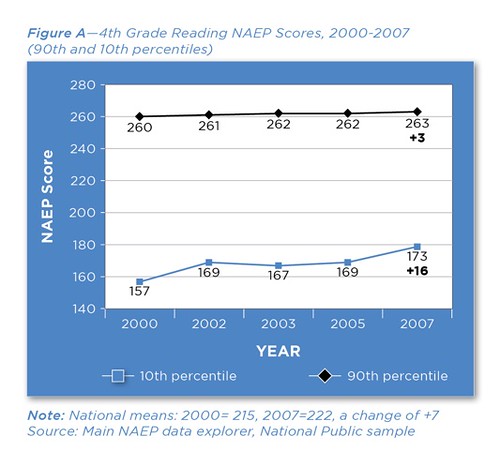
Fordham's report on "High-Achieving Students in the Era of NCLB" is out. I've read only 10 pages or so, but it's tremendously interesting: interesting and suggestive. (report here - pdf file)

The report doesn't establish causality (and doesn't claim to), but the authors clearly think that NCLB and the standards movement in general is working: working in the sense that the bottom 10% on NAEP are steadily improving their achievement:


This is the first time I've seen the idea that NCLB is working supported by data.

It's also the first time I've heard that it's the bottom scorers, not the "bubble children" who are benefiting from NCLB.

A couple of things for now.

The report doesn't seem to mention the 1995 recentering of SAT scores or the fact that the decline in SAT scores was concentrated at the top. The report practically invites readers to shrug off the "needs" of the top 10% -- if they're already on top, how can they go higher?

Beyond this, I'm somewhat disturbed by the universal acceptance of the idea that "excellence" and "equity" are two separate things. Apparently the policy world is prepared to recognize only two conceivable positions:

  • you can have equity or you can have excellence, but you can't have "both"
  • you can have equity and you can have excellence; you can have "both"

The possibility that equity and excellence are flip sides of a coin isn't on the menu.

What I've seen, time and again, that if a school isn't doing a good job teaching the bottom 10%, it isn't doing a good job teaching the top 10%, either. It may look like it's doing a good job. But once you factor out the parent reteaching & the tutors, you see that ineffective teaching is ineffective teaching. Period.

I had started to wonder about this in terms of athletic programs. Often people think of athletics and academics as either/or -- and when you're talking about athletics and academics at the highest level of individual achievement, of course they are either/or.

But when you're looking at a school, what goes with what?

Good academics with poor athletics?

Good athletics with poor academics?

I'm coming to the conclusion that's not the case.

No time to give my various "data points" at the moment, so I'll content myself with just one.

Two weeks ago I attended the Sports Orientation Night at C's new school. The place was mobbed. The principal spoke first. Toward the end of this talk he said that 10 or 12 years ago, the school had decided to raise its admission standards. The one thing he regretted at the time, he told his wife, was that the school had always been known for its strong athletic programs. Once they started admitting more academically oriented kids with higher scores, their win-loss records would suffer.

But that's not what happened. Instead, the wins show up; in one year alone the school won 3 more citywide championships than they had in the preceding 7 years. The principal and the athletic director both said they still don't understand why that happened.

To me, it made sense. I'd been noticing that great high schools, academically speaking, tend to have great teams.

A school that's on the march is on the march. They're not on the march here, but phoning it in there. When you're on a mission, you're on a mission.

I understand that trade-offs exist, opportunity costs are real, etc. But I don't think "trade-offs" and "opportunity costs" capture the way a high-performing organization functions.

In fact, I'm sure of it.

Back later.

Monday, June 9, 2008

the Great Compression, part 2

the Great Compression, part 1:
[I]nequality decreased in the 1940s and the reductions were substantial. The narrowing of the wage structure during the 1940s has been termed the "Great Compression." It involved a world war, inflation, tight labor markets, rising union strength, and substantial government intervention in the labor market.
p. 54

Apparently, the "Great Compression" is famous amongst economists and economic historians; it has been studied extensively.

As it turns out, the "Great Compression" was not a post-Depression phenomenon. It went on for many decades, and it preceded the Depression. The argument of The Race Between Education and Technology, assuming I have this right, is that education was the most important cause of three quarters of a century of declining inequality -- as well as the most important cause of the steadily rising inequality that commenced in the late 1970s:

The data series we unearthed and compiled revealed that the wage structure and the returns to education and skill all moved in the direction of greater equality decades before the better known Great Compression of the 1940s. The wage structure narrowed, skill differentials were reduced, and the return to education decreased sometime between 1890 and 1940, most likely in the late 1910s. The entire compression of the wage structure across the twentieth century, therefore, was larger in magnitude, lengthier in duration, and more complicated in its reasons than has been previously recognized.”
The Race Between Education and Technology, p. 57

The book is revolutionary.

Thus far it confirms everything many of us have assumed -- felt, in my case -- to be true.

Steve Levitt summarizes The Race in 2 sentences
Jimmy graduates

The anemic response of skill investment to skill premium growth
The declining American high school graduation rate: Evidence, sources, and consequences
Pushy parents raise more successful kids

The Race Between Education and Technology book review
The Race Between Ed & Tech: excerpt & TOC & SAT scores & public loss of confidence in the schools
The Race Between Ed & Tech: the Great Compression
the Great Compression, part 2
ED in '08: America's schools
comments on Knowledge Schools
the future
the stick kids from mud island
educated workers and technology diffusion
declining value of college degree
Goldin, Katz and fans
best article thus far: Chronicle of Higher Education on The Race
Tyler Cowan on The Race (NY Times)
happiness inequality down...
an example of lagging technology diffusion in the U.S.

the Times reviews The Race, finally
IQ, college, and 2008 election
Bloomington High School & "path dependency"
the election debate that should have been

Tuesday, January 29, 2008

not your father's SAT

I probably won't be able to find his comment now, but I believe lrg has raised the question of whether student performance and school quality have in fact declined over the years or whether performance has remained the same while expectations have risen.

The answer is that performance has declined at all levels, including the top, although -- and this will strike most of us around here as ironic -- I think it's possible that performance in math may actually have risen in students who take the SAT. There is no question that performance on reading tests has declined across the board.

I spent quite a long time wondering about this issue myself. Had American schools really declined or did people just think they had? I became especially curious about this question after reading an edu-blogger's post saying that American schools "serve rich white kids well." (The original post seems to have been deleted from the blogger's archives.)

That struck me as wrong, but I didn't know.

For quite awhile I was on the lookout for evidence concerning advantaged white students, a phrase I prefer to "rich white kids." Eventually I learned that this question had been asked and answered. The decline is real. It started in 1969 and ended in the early 1980s.

Best sources for a quick trip through what has taken place:

Verbal, Math and Combined scores 1962-2001

SAT scores were "recentered" in 1995. Today's SAT-V scores are roughly 70 to 80 points higher than the same score prior to 1995: SAT I Individual Score Equivalents.

Best primer on decline in student achievement: Waiting for Utopia


decline at the top

The recentering of SAT scores is a major factor in suburban parents' perception that their children are attending high-quality schools. No one in the wider public knows the scores have changed -- and school districts don't make a habit of filling parents in on the real value of a 600 on the SAT-V.

A 600 today was a 520 in 1994. Same test, same raw score, different conversion formula.

No one knows. Parents "read" their kids' scores through the filter of their own scores back in the day.


more on SAT-M later

also see:
The Seeds of Growth