

 Posts
Posts


Showing posts with label cooking. Show all posts
Showing posts with label cooking. Show all posts
Wednesday, December 10, 2008


Sunday, December 23, 2007
Friday, February 9, 2007
dropping in for a quick update
Just a quick update. We've finally gotten to Cartesian geometry -- after they did linear and quadratic equations (well, "did" in the current "let's mention it then move on to something else" sense), but only barely. The worksheet had a graph with little cartoon bubble labels: slope, x-axis, y-axis, intercept. The slope bubble pointed to the line, which could just as easily be the equation, but perhaps I'm being picky. Below it was a question: If x is 5, what will y be?
It would have been a perfectly reasonable question except that the tics on the axes weren't labeled. Were they 1, 2, 3, ..., or 2, 4, 6, ..., or 5, 10, 15, ... ? That little glitch made it just a tad difficult to answer the question.
That was presented along with set theory, which was your basic Venn diagrams, with unions and intersections.
Then they went back to "probability and statistics" (and yes, those are sneer quotes). I've already said I think it's bizarre to teach either in the 8th grade, but if you're going to teach it, then teach it. There was no new information presented the second time around. "Probability" was nothing more than your standard ball problem ("If there are 8 green balls and 4 red balls in the hat, what is the probability that you will select a red ball?"), which explains embarrassments like this. Worse was the "statistics" component, which was nothing more than median, mean, and mode.
I hate to break it to the math ed folks, but statistics is not "soft," and it is far more than measures of central tendency. Ultimately, even the hard sciences come down to statistics. Carbon-14 dating (and potassium-argon dating) are statistics. DNA testing is statistics. Epidemiology is statistics.
The math ed people I know wouldn't know a frequentist from a Bayesian, or MANOVA from a t-test. Call me cynical, but I can't help but wonder if that doesn't have something to do with this mess of a curriculum. Why revisit the same concepts over and over again? Couldn't they at least introduce -- in concept, if nothing else -- standard deviations or sample v. population?
If you're going to teach it, teach it. That's my outmoded, stale, dinosaurian view, anyway.
We did the "probability" and "statistics" worksheets in fifteen minutes. That's how much substance there was. But there were terms on the worksheet (she'd copied this one from somewhere, you could tell that) they hadn't covered (from the original source). She had told them to ignore anything they didn't understand (what kind of advice is that for a teacher to give a student?) but he wanted to know what they meant. So we talked about the normal distribution, standard error, and standard deviation (the terms from the original source on the handout).
(By the way, there's an interesting video of Peter Donnelly discussing common statistical errors here, if you're interested.)
In more general terms, I'm teaching Ricky formalism, to set up his problems in sequential, logical steps. He finds it anal retentive, and I'm not drilling him a lot because it frustrates him, but some every time I see him. He just doesn't understand why he should write "Let x equal the number of pears" at the top of the problem. I didn't either when I was his age, but I did it because I had no choice (that's the way math was taught back then). Now, I understand why, and that's why I'm passing it on to him. His biggest problem is that he's pretty good at figuring out how to solve a problem, and he doesn't see why he can't skip steps if he knows the intervening ones. I was like that. But there's a reason for it -- so he won't be like these students.
Anway, back to the beef and noodles.
It would have been a perfectly reasonable question except that the tics on the axes weren't labeled. Were they 1, 2, 3, ..., or 2, 4, 6, ..., or 5, 10, 15, ... ? That little glitch made it just a tad difficult to answer the question.
That was presented along with set theory, which was your basic Venn diagrams, with unions and intersections.
Then they went back to "probability and statistics" (and yes, those are sneer quotes). I've already said I think it's bizarre to teach either in the 8th grade, but if you're going to teach it, then teach it. There was no new information presented the second time around. "Probability" was nothing more than your standard ball problem ("If there are 8 green balls and 4 red balls in the hat, what is the probability that you will select a red ball?"), which explains embarrassments like this. Worse was the "statistics" component, which was nothing more than median, mean, and mode.
I hate to break it to the math ed folks, but statistics is not "soft," and it is far more than measures of central tendency. Ultimately, even the hard sciences come down to statistics. Carbon-14 dating (and potassium-argon dating) are statistics. DNA testing is statistics. Epidemiology is statistics.
The math ed people I know wouldn't know a frequentist from a Bayesian, or MANOVA from a t-test. Call me cynical, but I can't help but wonder if that doesn't have something to do with this mess of a curriculum. Why revisit the same concepts over and over again? Couldn't they at least introduce -- in concept, if nothing else -- standard deviations or sample v. population?
If you're going to teach it, teach it. That's my outmoded, stale, dinosaurian view, anyway.
We did the "probability" and "statistics" worksheets in fifteen minutes. That's how much substance there was. But there were terms on the worksheet (she'd copied this one from somewhere, you could tell that) they hadn't covered (from the original source). She had told them to ignore anything they didn't understand (what kind of advice is that for a teacher to give a student?) but he wanted to know what they meant. So we talked about the normal distribution, standard error, and standard deviation (the terms from the original source on the handout).
(By the way, there's an interesting video of Peter Donnelly discussing common statistical errors here, if you're interested.)
In more general terms, I'm teaching Ricky formalism, to set up his problems in sequential, logical steps. He finds it anal retentive, and I'm not drilling him a lot because it frustrates him, but some every time I see him. He just doesn't understand why he should write "Let x equal the number of pears" at the top of the problem. I didn't either when I was his age, but I did it because I had no choice (that's the way math was taught back then). Now, I understand why, and that's why I'm passing it on to him. His biggest problem is that he's pretty good at figuring out how to solve a problem, and he doesn't see why he can't skip steps if he knows the intervening ones. I was like that. But there's a reason for it -- so he won't be like these students.
Anway, back to the beef and noodles.
Tuesday, January 2, 2007
no-knead bread
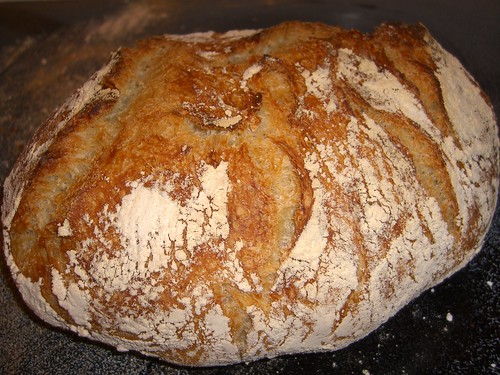
I made this today.
It tastes as good as it looks.
Costs approximately 20 cents per loaf.
There is nothing to it.
everything you need to know
As far as I can tell there is only one way to sc*** up this bread: forget to put the lid on the pan.
It's possible you can sc*** it up by adding 5x as much yeast as the recipe calls for. I don't know. I added 5x as much yeast as the recipe calls for to the same loaf I baked without a lid. (Must have the lid. Lid is key.)
You can not sc*** this up by mixing up a batch of dough, setting it out to rise, and then forgetting the whole thing until you happen to glance at your bake stand and think, Holy cow, how long has that been sitting there?
This may not sound like the definition of freedom, but it is. The fact that you can't sc*** this bread up by letting it rise too long means you don't have to get bogged down doing & re-doing mental math to figure out things like Where will I be in 18 hours when the dough finishes its first rise and Will I be asleep when the dough finishes its second rise?
None of that matters.
If you're some place else, it's not a problem.
If you're asleep, it's not a problem.
The dough can wait.
It's probably better if it does wait.
Subscribe to:
Posts (Atom)