From
College Degree, No Class Time Required:
David Lando plans to start working toward a diploma from the University of Wisconsin this fall, but he doesn't intend to set foot on campus or even take a single online course offered by the school's well-regarded faculty.
Instead, he will sit through hours of testing at his home computer in Milwaukee under a new program that promises to award a bachelor's degree based on knowledge—not just class time or credits.
"I have all kinds of credits all over God's green earth, but I'm using this to finish it all off," said the 41-year-old computer consultant, who has an associate degree in information technology but never finished his bachelor's in psychology.
Colleges and universities are rushing to offer free online classes known as "massive open online courses," or MOOCs. But so far, no one has figured out a way to stitch these classes together into a bachelor's degree.
Now, educators in Wisconsin are offering a possible solution by decoupling the learning part of education from student assessment and degree-granting.
Wisconsin officials tout the UW Flexible Option as the first to offer multiple, competency-based bachelor's degrees from a public university system.
By CAROLINE PORTER
January 24, 2013, 6:32 p.m. ET
Wall Street Journal
Wow.
I'm thinking....all those
disruptive technology people may turn out to be right for the wrong reason.
The coming Disruption won't be courses going online.
The coming Disruption will be courses going away altogether. (Some of them, anyway.)
The tests go online, not the courses.
I don't believe in making predictions, but even so I have simply
never been able to see how MOOCs save the day. I can't stand online courses myself, my students don't like them, and I don't know any grownups who like them, either. The people touting them (and investing in them) don't seem to have taken any coursework via MOOCs themselves, as far as I can tell.
So while the logic of the MOOC --
put the best professors online so thousands can learn! -- often seems unassailable, I just don't see it. Put it this way: I don't believe in making predictions, and I continue to wonder what I'm missing, but I will not be investing my pennies in
Udacity, Coursera, or edX.
I have always thought, though, that there is a major use for the internet when it comes to assessment.
Maybe college competency exams are the missing piece?
Such a scenario -- MOOCs fail as a means of making college affordable, but competency exams succeed -- strikes me as possible.
First, according to the
Bain/Sterling Partners report, one-third of U.S. colleges and universities are in financial trouble.
Second, the economy continues to be depressed and, absent "
regime change" at the Federal Reserve, will remain depressed.
*
Given a depressed economy, I assume some colleges will close.
College closings will put pressure on state universities to expand, but state colleges are also in financial stress and have been raising tuition. They are in no position to grow.
At some point, it seems to me, political pressure will build on state legislatures to find another way to provide college diplomas.
In short, I can imagine Wisconsin's move attracting a lot of imitators, and sooner rather than later. I can also imagine a circular effect, with college closings leading to the introduction of competency exams, and the introduction of competency exams then leading to more college closings.
That's disruption.
We'll see.
If competency exams begin to take hold, I can imagine a number of other developments that might be very interesting.
* The economy is growing but is not going back to trend as it always has done in the past, including the Great Depression. I know people hold out hope that a housing recovery will lead to a real recovery, but since I am persuaded by Scott Sumner's analysis, I don't see housing as the white horse.
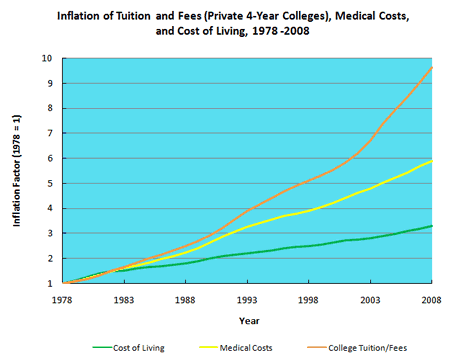
chart from: historinhas
and see:
Lawyers without Law School
proposal for a national baccalaureate
why college costs so much
US News: 2-year law degrees


 Posts
Posts