New York City Comptroller Scott M. Stringer said Monday the city school system has poor inventory controls and inaccurate records, leaving thousands of computers and tablets either missing or unused.
[snip]
The comptroller said his team investigated computers and tablets bought from Apple Inc. and Lenovo Group for nine schools and department headquarters from July 2011 through June 2013.
The report said the department was unable to name the whereabouts of 1,817 laptop and desk computers at these sites, and auditors found 394 devices sitting in unopened boxes, some for years.
Mr. Stringer said he believed this was probably “just the tip of the iceberg” of lost or unused goods among city schools.
Maybe if we had dumped Trailblazers for Singapore Math when Scarsdale did, we'd be voting against $2-million dollar surpluses, too.
For the record, I was having a lot of difficulty grasping the fund balance until I drew the bar model. At least in my experience, the fungibility of money is counterintuitive. I kept getting caught up in worries about "programs" and "teachers" etc. It was quite difficult for me to grasp that we were voting on a surplus, not "programs" and not "teachers."
I'm certain many, many voters just didn't 'see' the budget in the way a bar model presents it: as one big chunk of money, with $2.1 million not dedicated to any item appearing in the budget. Yes votes were votes for programs, not the surplus.
The corollary: it's easy for administrators and school boards to blow smoke where the fund balance is concerned. In our case, the superintendent and board president, who was running for re-election, told the local newspaper that we "really" had only $900K in the fund because a) the federal government might not send the $700K it's supposed to send and b) $400K was being used to pay a tax cert. The first claim is absurd; the second is misleading because the district ran more than the legally allowed surplus this year (you can see that on the documents).
Normally the way things work is that whenever the fund balance is too high, the district pays down debt to get back below the limit. I'm sure that's what they did with the $400K. District documents show an extra $300K surplus between last year and this, apart from the $2 million dollar surplus.)
On the other hand, most of Scarsdale's SPED students would have passed the tests without any increase in spending, same as the general education students. New York's tests were too easy.
So I don't know what to make of this.
Years ago, an education attorney told me: "No Child Left Behind is really a special education law."
Needless to say, my district has been embroiled in budget misery and strife for lo these past four years: ever since the crash of 2008.
(Horrifying that I feel compelled to write "crash of 2008." As if it's in the past, which it ... isn't.)
Anyway, the budget.
Every year since the crash, come January, when budget season begins, the district blows up. Without fail. For the next four months we stagger through a war of all against all until May, when we vote on the budget, and the budget passes. Then we do the same thing again the next year, and it doesn't get better; it gets worse. This year's vote was May 15, and I'm still recovering.
After the vote, calm returns and the summer comes, then the fall, then Halloween, Thanksgiving, and Christmas -- and then bam! January is here again, and Oh no!Cuts!Layoffs!Oh no!
Of course everyone is expecting (and dreading) the news, but then, too, everyone is surprised and aghast, and the town convulses.
Why do we have to keep doing this?
I mean, I know why we have to keep doing this (because 4 is not 2), but why do we have to keep being surprised and bushwhacked each January when we find out which beloved young new teacher/guidance counselor will be saying goodbye this year?
Why can't we at least develop a clear picture of what the problem is, show it to everyone, let the truth sink in, and then go from there? With a shared understanding of reality (that being: 4 is not 2) if not a shared agreement on the solution.
But no one's ever worried about that in the past, not that I've heard, and no one's bringing it up today, either. The problem is the mandates, not the teaching, not the curriculum, not the ideology.
Three percent of New York property tax collections were used to pay pension costs in 2001; by 2015, pension costs are expected to eat up 35 percent of property tax collections. Deficits Push N.Y. Cities and Counties to Desperation By DANNY HAKIM Published: March 10, 2012
I wonder if there are betting pools (yet) on how this is going to play out.
The IBM example of pay is typical for many companies. They put people into pay categories with fixed pay limits, review workers once or twice a year, and set enormously high stadards of expectation. Managers don't look good to their bosses if too many employees are at the highest performance level. Also, they don't want to deal with the potential complaints of putting bad workers into the lowest level. This means that people are thrilled to get a 2-3% raise, but this is unlikely as your pay gets higher. The company starts talking about the actual dollars you are getting. Also, if some are getting 3%, then that has to come out of someone else's pay. Then, if you get to the top of your pay category, they just set up more hoops for you to jump through to be promoted to the next level.
Ultimately, however, it's all driven by supply and demand for your job skills. Companies are taking advantage of what I call job inertia. People will put up with less money just because they don't want to move or prove themselves all over in a new job. At some point, however, you might realize (usually by seeing someone else leave the company) that you can make a lot more by going to another company. I'm sure that there is a pattern of job follow-the-leader to other companies. This keeps companies honest - a little bit.
Companies can pay you whatever they want. They make up the job categories and pay limits. They can give out over-inflation raises if they decide to. The company might be making profits that far exceed inflation.
In the first company I worked, where I used to go on their college recruiting trips, we thought we figured out the corporation's policy. We would go to good colleges (like RPI) and only interview students with 3.75 or higher grade point averages. They would be offered very competitive starting salaries, and since they were young, their salaries would increase by the highest percentages each year. After a few years, some might jump ship and leave, but many would get married and settle down in the area. Then, the company would start giving these people less and less for raises. They would claim that there were fixed dollars that were allocated for each department for raises. Some years, departments were told that 10% of the employees would get no raises. The department managers would know who to pick - the ones least likely to leave.
Ultimately, supply and demand keep companies honest, but in the public education world, it's all about having everything controlled by contract negotiation, even preventing parental influence and control via charter schools. They have lost the argument that people with comparable educational backgrounds and job risk make more money.
I wouldn't agree with a). [School boards] knew exactly what they were doing [when they negotiated contracts promising above-inflation increases in compensation forever.] Here it is illustrative to draw the family trees.. vendors that want b.o.e. business, union members' extended families - all have their interests represented on the b.o.e. Some of the comments we hear are that the income of the residents has been studied, and there is an assumption as to how much is wanted from the pockets. Those that cannot pony up need to move on.
For b) [voters signed off on these contracts], I dont' know about you, but in my district there is no line item vote by the people and there is no light on the union contracts either before or after the negotiations. People stood up at the budget meetings and objected to compensation well above private industry and against line item 10% salary raises for the ones that were spelled out rather than hidden up in the union contract. The answer every time was a smug smile and 'We have a contract', with some words to the effect that those employees not under a union agreement have had their wages frozen. Meanwhile, seethroughny.com has the facts. In retirement, my kids' teachers are in six figures between the base salary and the part-time work, not without including the other bennies. Nice work, if you can get it.
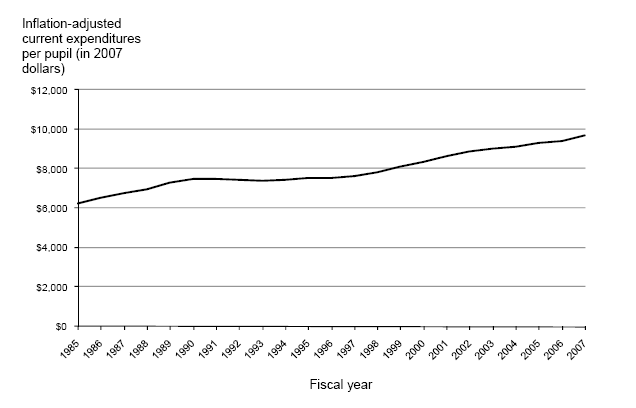
The union contract requires something in the neighborhood of a 4% increase in total compensation every year. (Employee salaries make up approximately 80% of the total budget.)
Meanwhile the tax cap requires us to hold spending increases to inflation, which is 2%.
The only way to stay within the cap is to cut jobs.
It's obvious to everyone that you can't cut jobs forever, but it's not obvious to everyone that you can't increase taxes above the rate of inflation forever.
Frankly, I'm confused myself.
There's no way out, right?
If you have permanent above-inflation spending increases while taxpayers aren't having concomitant above-inflation increases in their own incomes, eventually you run out of money, right?
Same for cutting jobs. Each year individual compensation goes up 4%, so you cut enough positions to average out at a 2% increase overall. (This year we need to cut 10 FTEs - "full-time equivalents" - to stay within the cap.) But you're not done. The next year individual compensation goes up by 4% again, so you have to cut more positions to average out at a 2% increase overall.
Am I figuring this wrong?
I know only two people who see things this way.
As far as I can tell, the only answer that makes mathematical sense is to persuade the union to agree to a contract that stays within inflation.
Good thing apparel prices have been falling or we'd all be walking around naked. Walking around naked or, alternatively, walking around fully clothed with a whopper of a student apparel loan to pay off.
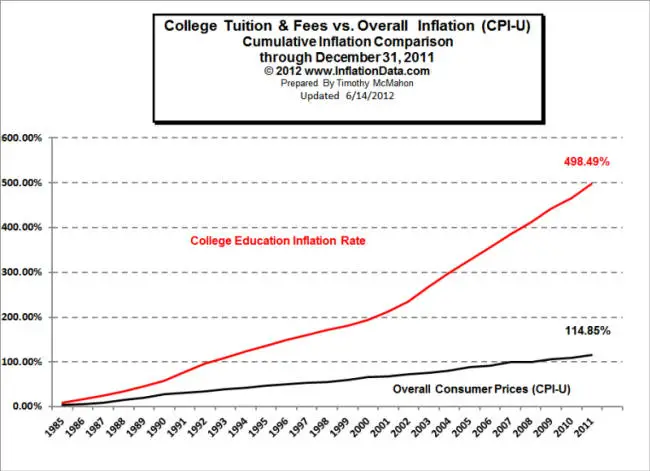
And while we're on the topic of mind-boggling and rising prices for the big stuff, as opposed to reasonable and falling prices for the little stuff, why do I have to keep hearing about housing bubbles when the really huge bubbles seem to be tuition and health care?
I was sitting here on the sofa going through ancient Education Weeks when I heard Pat Sajak introduce a contestant as "a curriculum support specialist."
"A curriculum support specialist," he said. "What is that?"
answer: "It's a teacher that goes into the classroom to support the curriculum and other teachers."
Who says times are hard? Back in the real Depression, curriculums and teachers didn't have support! Curriculums and teachers had to make do with a principal, a superintendent, and the occasional school nurse.
Vendors everywhere, technology, no books, Smartboards (it's the 20th anniversary of the invention of the Smartboard!), and, during plenary sessions, constant calls for Parent Responsibility, each one met with thunderous applause. Parents were not a popular group amongst the Celebrants.
During the session on bullying, three teachers asked plaintively, "Why is bullying our responsibility?" "Why is everything on us?" They were aggrieved.
The great and the good (Brian Williams, Cory Booker) thought teachers had a lot to be aggrieved about. Democracy is hanging by a thread, they told us: the only reason we have a country at all is teachers. And yet Americans fail to feel "reverence" toward teachers. What is to be done?
Mehmet Oz said pretty much the same thing; then he showed us a graph charting the rise of obesity in America and said rising obesity is the reason "there's no money for education." We need to lose weight! Because we need more money for education!
Also, the NEA wants the government to pay for college and graduate degrees for teachers. We'll need to lose a whole lot of weight for that.
My friend attended a session where there was a group of young administrators seated in the middle of the room. The teachers booed the administrators. Now that's interesting ---- what was going on? I wish I'd been there.
A fellow from the Department of Education told us that DOE is rolling out "an ambitious 5-year initiative": the moon shot of this generation. Which was.....a website. The moon shot of this generation is a Department of Education website.
We watched a lot of student videos, all created with a product called Adobe-something-or-other: raps about Haiti; a geography class in California making soup. In the soup video, a pretty girl who came to America from Nicaragua complained that nobody knows where Nicaragua is or that a person who speaks Spanish and has brown eyes might be from Nicaragua and not Mexico. Another student in the video said somebody thought "Guatemala" was guacamole.
Maybe the reason students don't know where Nicaragua is or that Guatemala is a country not a dip is that they're making soup in geography class.
A high-energy Brit pitched his Teacher Channel, I think it was called: there will be authentic content!! We watched an authentic video of a grade school class in Florida where the kids scotch-taped together little houses and stuck them in a line on a stage. Then the teacher walked along the stage blowing the houses with a leaf-blower to simulate a hurricane. Some of the houses blew apart and some didn't. Shots of fist-pumping little kids; fade-out.
The Brit told us we had just witnessed "learning" and said there would be many thousands such videos available on Teacher Channel, which was being sponsored or hosted or public-private partnered or some such with WNET, the host of Celebration of Teaching and Learning. Applause!
In the session on how to teach counting using a children's book, the Math for America Master Teacher banned the words "permutation" and "order" because "permutation" and "order" are words, not understanding. He told us, repeatedly, that he makes his high school students spend a full test hour drawing the answers to counting problems in order to show them that multiplying 5x4x3 is more efficient than drawing 60 houses with 1 of 3 pigs inside. At the end of the sessions, he advocated the use of children's books for teaching high school counting problems. "How many handshakes amongst the 7 dwarfs?" That was a good counting question we could base on a children's story, he said.
At one point a teacher said she'd made a counting tree, and the Master Teacher said, a look of mock incomprehension on his face, "Tree? What is a tree? Why do you talk about trees?"
Five minutes later he put up a Powerpoint picture of a counting tree -- an actual tree, with a trunk going down to the ground, and branches pointing up to the sky. I don't know why a real tree is good and an abstract tree is bad. He didn't say. The rule seemed to be that everything the teachers said was old-school and wrong, while everything the Master Teacher said was up-to-date and correct.
The Master Teacher had no blackboard, whiteboard, or Smartboard, so you had to try to remember everything he had just finished saying while trying to follow whatever he was saying now, and his Powerpoint drawings were confusing, at least to me. He spoke too fast. He told us over and over again that we needed to hold with our students the kind of conversation he was holding with us: i.e., a conversation for understanding.
I don't recommend it. The "conversation" consisted mostly of our Master Teacher eliciting wrong answers and forbidden vocabulary from his class. There were probably 5 people of 30 who could work the problems, so he focused on them and didn't bother with the rest of us.
I'm actually thinking about writing James Simons a letter.
Description: If three pigs live in five houses and each pig lives alone, how many living arrangements are possible? Participants will learn how a children’s book illustrates a simple way to solve counting problems like this without listing all possibilities. Teachers at all levels, from elementary to high school, will learn how students can find the answers without using confusing words like “permutation.”
The only problem is that it doesn't mention the Triborough Amendment, which you need to know something about in order to understand why the union would choose to work without a contract.
Also, in the illustration below, substitute the words "since the crash" for "in the last several years."


 Posts
Posts