kitchen table math, the sequel: Animals Make Us Human
Showing posts with label Animals Make Us Human. Show all posts

Friday, May 3, 2013

Monty and the pigeon

I remember, back when Carolyn J. & I first started writing the original Kitchen Table Math, the Monty Hall problem coming up. I had never heard of it.

I think I remember, too, saying a couple of times, on the blog, that I came away from writing Animals in Translation thinking birds might just be as smart as people, or smarter. I didn't want to think that, particularly; How smart are birds, anyway? wasn't the topic of the book, which was mostly about mammals, not birds. But every time Temple told me a bird story, I would think hmmmmm.

The crow-and-the-rifle story, about a crow repeatedly taunting a rancher, has never left me.

So naturally, when I saw "Pigeons, Humans, and the Monty Hall Dilemma," I had to look.
The Monty Hall Dilemma is a probability puzzle that is notorious for eliciting suboptimal decisions from humans. A participant is given a choice from among three doors, one of which conceals a valuable prize. After an initial selection, one of the remaining, nonwinning doors is opened, and the participant is given a chance to switch to the other unopened door. The probability of winning is higher if the participant switches. Pigeons maximize their wins by switching on virtually all trials of a Monty Hall Dilemma analogue, whereas humans utilize a suboptimal strategy involving probability matching. Possible reasons for the difference between these two species’ performance are considered.

Pigeons, Humans, and the Monty Hall Dilemma by Walter T. Herbranson Current Directions in Psychological Science 2012 21: 297
No time to read or even skim --- but looking forward.

Friday, April 23, 2010

advertisements for myself

A couple of days ago I caught sight of Ed's copy of The New York Review of Books lying on the kitchen table. (Where else?)

I looked at the cover, didn't see anything that caught my interest. Normally that's the end of it. I never look at the table of contents.

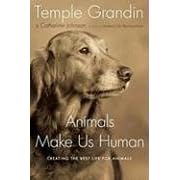
For some reason, though, this time I did. I opened the paper, turned to the contents, and was skimming down the list, asking myself why I was doing this since I wasn't feeling any more interested on this second pass, when suddenly I realized I was reading familiar words: Animals Make Us Human: Creating the Best Life for Animals by Temple Grandin and Catherine Johnson. Which hadn't been mentioned on the cover.

I had no idea!

After I stumbled across the review I called Ed to alert him, then left the house without reading more than a few paragraphs. I hate reading reviews. Ed called later to say that it was a "rave," and I still have not read the thing in its entirety.

But I'm glad it's there.

Sunday, March 7, 2010

indies nominees

Animals Make Us Human is on the list!

I didn't even know. A friend found out and sent me the link. Then my sister had to send them an email and ask them to add my name to the book, since they'd only listed Temple as the author.

sigh

I'm filing this under schmuck with an Underwood.

Tuesday, January 20, 2009

advertisements for myself, part 2

But to remark that “Animals Make Us Human” is a slightly lesser book than “Animals in Translation” is like saying Randy Newman's “Good Old Boys” is a slightly lesser album than “Sail Away.” If you liked the first one, you’re going to like the second.

The Joys and Pains of Being an Animal
By DWIGHT GARNER

Boy.

I'm having a very good week.

Ed and I heard Temple speak at the 92nd Street Y last night. She was wonderful. Her mom was there, too. She's 80 years old, I believe, and she told us she's speaking to parents of children with autism all over the country. She'd taken the bus in freezing snow and slush to come see Temple.

That was a funny autism thing.

I had wangled free tickets by asking Temple to get them for me, but I didn't ask for anything else, so Ed and I went early and stood at the front of the line so we'd get good seats. When the lady standing behind us found out I was Temple's coauthor, she asked why we weren't already inside.

Why we weren't already inside was: Temple is autistic & doesn't think of these things, & I'm so used to autistic people that it doesn't occur to me to think of them, either.

Meanwhile Temple's mom had taken the bus in freezing snow & slush and bought her own ticket. When she got there someone was aghast that Temple's mom had purchased a $27 ticket to hear her own daughter, so they told her she could have a free ticket to something else at the Y, an offer she snapped right up.

She told us something interesting.

She said the Bettelheim era hadn't affected her because she lived in Boston and everyone was a Calvinist. They didn't believe in Freud, and they didn't get on the couch.


The Creation of Dr. B by Richard Pollack

Friday, October 17, 2008

advertisements for myself

A starred review in Publishers Weekly!

Animals Make Us Human: Creating the Best Life for Animals Temple Grandin and Catherine Johnson. Houghton Mifflin, $26 (288p) ISBN 978-0-15-101489-7
Grandin (Animals in Translation), famed for her decades-long commitment to treating livestock as humanely as possible on its way to slaughter, considers how humans and animals can best interact. Working from the premise that “an animal is a conscious being that has feelings,” the autistic author assesses dogs, cats, horses, cows, pigs, poultry, wildlife and zoo animals based on a “core emotion system” she believes animals and humans share, including a need to seek; a sense of rage, fear, and panic; feelings of lust; an urge to nurture; and an ability to play. Among observations at odds with conventional wisdom: dogs need human parents, not alpha pack leaders, and cats respond to training. Discussions of why horses are skittish and why pigs are arguably the most intelligent of beasts—raccoons run them a close second—illuminate the intersection of people and more domesticated animals; chapters on cows and chickens focus more generally on animal welfare, particularly the horrific conditions in which they are usually raised and slaughtered. Packed with fascinating insights, unexpected observations and a wealth of how-to tips, Grandin's peppy work ably challenges assumptions about what makes animals happy. (Jan.)

PW will run an interview with Temple in the 10/20 issue.


(I've just noticed that Jay Mathews' new book on KIPP is listed on the same page!)