kitchen table math, the sequel: inquiry
Showing posts with label inquiry. Show all posts

Wednesday, December 11, 2013

In the world of MOOCs, 2 + 2 is never 4

The statistical model found that measures of student effort trump all other variables tested for their relationships to student success, including demographic descriptions of the students, course subject matter and student use of support services. The clearest predictor of passing a course is the number of problem sets a student submitted. The relationship between completion of problem sets and success is not linear; rather the positive effect increases dramatically after a certain baseline of effort has been made. Video Time, another measure of effort, was also found to have a strong positive relationship with passing, particularly for Stat 95 students. The report graphs these and other relationships between variables examined by the logistic-regression models and pass/fail.

While the regression analysis did not find a positive relationship between use of online support and positive outcomes, this should not be interpreted to mean that online support cannot increase student engagement and success. As students, Udacity service providers and faculty members explained, several factors complicated students’ ability to fully use the support services, including their limited online experience, their lack of awareness that these services were available and the difficulties they experienced interacting with some aspects of the online platform. It is thus the advice of the research team that additional investigations be conducted into the role that online and other support can play in the delivery of AOLE courses once the initial technical and other complications have been addressed.

Conclusion: The low pass rates in all courses should be considered in light of the fact that the project specifically targeted at-risk populations, including students who had failed Math 6L before Spring 2013 and groups demonstrated by other research to be less likely to succeed in an online environment. Previous studies (see Section 1) have found that these students do less well in online than in face-to-face courses. Further, student groups in at least one major study (Jaggars and Xu, 2013) who were found to experience the greatest negative effect from taking courses online share many of the characteristics found among the AOLE partner high school students in particular, a group with very low pass rates in Spring 2013.

Overall, much was learned during and from the first iteration of AOLE and improvements are already in progress in the second AOLE iteration. Perhaps most importantly, the faculty members who taught these courses, although they had to contend with major difficulties along the way, believe that the content that has been developed has tremendous potential to advance students’ critical thinking and problem solving abilities. One faculty member summed it up this way: "Udacity has brought to the table ways to make the courses more inquiry-based and added real life context."
PRELIMINARY SUMMARY SJSU+ AUGMENTED ONLINE LEARNING ENVIRONMENT PILOT PROJECT September 2013
Let's reprise.
  • The clearest predictor of success in the course was the number of problem sets students completed. In other words, practice. 
  • The online mentors, aka teachers-slash-tutors, didn't help. But they might have helped if students had a) had lots of internet experience (practice) & thus could figure out how to get to the mentors; b) known the online mentors existed; and c) been able to get the MOOC site to work.
  • "Previous research" had found that weak students do better in face-to-face courses, so….SJSU opted to run a MOOC and fill it with weak students.
  • "Most importantly," the teachers who taught the MOOCs think the "content" has "tremendous potential to advance students’ critical thinking and problem solving abilities."
Practice is what matters, so the instructors are focused on inquiry; weak students do badly in online courses, so the MOOC people put weak students in online courses; educational technology never works.

A person who lives in the world where two plus two equals four would be doing something else.

Eureka
Eureka, part 2
Eureka, part 3
Eureka, part 4
Eureka, part 5

Flipping the Classroom: Hot, Hot, Hot
MOOCs grow the gap
The New York Times is surprised
In the world of MOOCs, 2+2 is never 4
World's funniest joke: humor depends on surprise
Dick Van Dyke on comedy
Philip Keller on the flipped classroom
If students could talk
Who wants flipped classrooms? (Salman Khan on liberating teachers)
True story
Are math & science lectures boring in a way humanities & social science lectures are not?

Monday, December 27, 2010

let's not and say we did, part 3

“Look, this is what you need to do. So like it or not, do it.”
A principal pushing teachers to raise expectations and adopt an inquiry model

quoted in Marshall Memo 307
A Weekly Round-up of Important Ideas and Research in K-12 Education
October 26, 2009
Raising expectations AND adopting an inquiry model is going to be H-E-double hockey sticks for the kids.

Also...."pushing"?

"Like it or not, do it" is pushing?

Not shoving?

let's not and say we did
let's not and say we did, part 2
let's not and say we did, part 3

Sunday, June 27, 2010

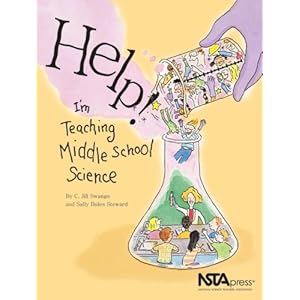
help is on its way


Help I'm Teaching Middle School Science
by C. Jill Swango


"A great guide to the practical aspect of teaching inquiry-based middle school science."

Monday, April 12, 2010

I/We/You

Teach Like a Champion: 49 Techniques that Put Students on the Path to College on the subject of inquiry:
There's a consistent progression to the lessons of the champion teachers who informed this book. It's best described as "I/We/You." (As far as I know, Doug McCurry, founder of Amistad Academy Charter School, coined this phrase. Others use the terms direct instruction, guided practice, and independent practi to describe what McCurry means.) This name refers to a lesson in which responsibility for knowing and being able to do is gradually released from teacher to student. It means beginning with "I" by delivering key information or modeling the process you want your students to learn as directly as possible, then walking your students through examples or applications. In the "We" step, you first ask for help from students at key moments and then gradually allow them to complete examples with less and less assistance on more and more of the task. Finally, in the "You" step, you provide students the opportunity to practice doing the work on their own, giving them multiple opportunities to practice

[snip]

The recipe may sound obvious to some, but it doesn't happen this way in many classrooms. Often students are released to independent work before they are ready to do so effectively. They are asked to solve a problem before they know how to do it on their own. They're asked to infer the best solution by "inquiry" when they have little hope of doing so in an effective and efficient way. In many cases, they independently and industriously practice doing a task the wrong way. They reflect on "big questions" before they know enough to do so productively.

Teach Like a Champion: 49 Techniques that Put Students on the Path to College
by Doug Lemov
p. 71 - 72

These are the teachers whose practices he is describing:
[H]e decided to seek out the best teachers he could find — as defined partly by their students’ test scores — and learn from them. A self-described data geek, he went about this task methodically, collecting test-score results and demographic information from states around the country. He plotted each school’s poverty level on one axis and its performance on state tests on the other. Each chart had a few outliers blinking in the upper-right-hand corner — schools that managed to squeeze high performance out of the poorest students. He broke those schools’ scores down by grade level and subject. If a school scored especially high on, say, sixth-grade English, he would track down the people who taught sixth graders English.

He called a wedding videographer he knew through a friend and asked him if he’d like to tag along on some school visits. Their first trip to North Star Academy, a charter school in Newark, turned into a five-year project to record teachers across the country.

Building a Better Teacher
by Elizabeth Green
New York Times | March 2, 2010

Lemov's taxonomy
Teach Like a Champion is out
more words you don't see in Teach Like a Champion

Friday, March 27, 2009

constructivism doesn't work, part 1: little scientists

New study out from the University of Virginia re: science education, which David Klein once told me is in even worse shape than math education. Gauging by the first sentence in Tai & Sadler's report, David is right:
Inquiry-based instructional practises are a mainstay of the National Science Education Standards (National Research Council, 1996) and Benchmarks of Science Literacy (AAAS, 1993) in the USA.

Same Science for All? Interactive association of structure in learning activities and academic attainment background on college science performance in the USA
Robert H. Tai; Philip M. Sadler
International Journal of Science Education
Vol. 31, No. 5, 15 March 2009, pp. 675–696


Here's a nice summary of where things stand, drawn from O'Neill & Polman:
In recent years, a number of curriculum reform projects have championed the notion of having students do science in ways that move beyond hands-on work with authentic materials and methods, or developing a conceptual grasp of current theories. These reformers have argued that students should come to an understanding of science through doing the discipline and taking a high degree of agency over investigations from start to finish. This stance has occasionally been mocked by its critics as an attempt to create ‘‘little scientists’’—a mission, it is implied, that is either romantic or without purpose. Here, we make the strong case for a practice-based scientific literacy, arguing through three related empirical studies that taking the notion of ‘‘little scientists’’ seriously might be more productive in achieving current standards for scientific literacy than continuing to refine ideas and techniques based on the coverage of conceptual content.

Why Educate ‘‘Little Scientists?’’ Examining the Potential of Practice-Based Scientific Literacy
D. Kevin O’Neill, Joseph L. Polman
JOURNAL OF RESEARCH IN SCIENCE TEACHING
VOL. 41, NO. 3, PP. 234–266 (2004)
I have not read O'Neill & Polman's study as yet.* However, a mere glance at the final section turns up the phrase "student-designed research projects," accompanied by a vote for Deborah Meir, "the principal who has led school reforms in New York and Boston [and recommended] that educators foster 'the capacity to hazard an opinion on matters of science that may pertain to political and moral priorities, and a healthy and knowing skepticism toward the misuse of scientific authority'** (Meier, 1995)."

Rubbish.

"Student-designed research projects" and "the capacity to hazard an opinion on matters of science that may pertain to political and moral priorities" have nothing to do with each other.

In fact, I would go so far as to say that the typical student-designed research project is likely to render a teen-aged student less able to hazard an opinion on a matter of science that may pertain to political and moral priorities than a solid, book-based, content-rich science course would do, while at the same time causing him to consider himself more able. Not knowing what he or she doesn't know: that's your little scientist.

In any event, Robert Tai and Philip Sadler's analysis of survey data from more than 8000 high school students produced the following conclusion, which will come as a surprise only to ed-school trained educators:
Self-led, self-structured inquiry may be the best method to train scientists at the college level and beyond, but it's not the ideal way for all high school students to prepare for college science.
This is the kind of thing parents and taxpayers do not need a peer-reviewed study to figure out, mostly because parents and taxpayers have a clue.

Data show that "autonomy doesn't seem to hurt students who are strong in math and may, in fact, have a positive influence on their attitude toward science" Tai said. However, "Students with a weak math background who engaged in self-structured learning practices in high school may do as much as a full letter grade poorer in college science," he said.

[snip]

According to Tai, many secondary science classes are turning to a self-structured method of learning with the notion that students will discover science on their own. "Advocates should be sobered by this study's findings," Tai said.

Sobered, hell.

Advocates should be overcome by guilt and remorse; advocates should get down on their hands and knees and beg forgiveness of parents and taxpayers for the countless thousands of young people lost to scientific and science-related careers because they arrived at college having spent 13 years pretending to be little scientists instead of acquiring the content knowledge they needed to study science in college.

But I don't see that happening.

* If you'd like me to send you the study, email me: cijohn @ verizon.net
** I guess pure research is out.