

 Posts
Posts


I teach high school math. I took a break to work in the private sector from 2002 to 2009. Since my return, I have been stunned by my students’ lack of basic skills. How can I teach algebra 2 students about rational expressions when they can’t even deal with fractions with numbers?
Please don’t tell me this is a result of the rote learning that goes on in grade- and middle-school math classes, because I’m pretty sure that’s not what is happening at all. If that were true, I would have a room full of students who could divide fractions.
Showing posts with label fractions. Show all posts
Showing posts with label fractions. Show all posts
Thursday, January 17, 2013
fractions, again
Wonderful post on Diane Ravitch's blog, written by a high school math teacher. The whole thing is great, but I especially love this passage:


Wednesday, August 22, 2012
two-fifths
re: oops
Here's the original image from Smarter Balanced Assessment Corporation:

And here is the Education Week adaptation of the original:

Presumably at least two people vetted this image: the person who created it and the editor who signed off on it.
Apparently neither one noticed that Figures A and C changed significantly from the first version to the second.
In the Smarter Balanced Assessment Corporation image, only Figure B. represents 2/5.
In the Ed Week image, A, B, and C all represent 2/5. (At least, Figure A. now looks as if it does to me.) As a result, the question Which model best represents 2/5? has become nonsensical.
I'm guessing this is a case of humanities-trained people -- people who 'don't use math' in real life -- knowing so little about fractions that they didn't 'see' the difference between the original image and the adaptation.
Here's the original image from Smarter Balanced Assessment Corporation:
And here is the Education Week adaptation of the original:

Presumably at least two people vetted this image: the person who created it and the editor who signed off on it.
Apparently neither one noticed that Figures A and C changed significantly from the first version to the second.
In the Smarter Balanced Assessment Corporation image, only Figure B. represents 2/5.
In the Ed Week image, A, B, and C all represent 2/5. (At least, Figure A. now looks as if it does to me.) As a result, the question Which model best represents 2/5? has become nonsensical.
I'm guessing this is a case of humanities-trained people -- people who 'don't use math' in real life -- knowing so little about fractions that they didn't 'see' the difference between the original image and the adaptation.
Tuesday, August 21, 2012
oops
Sorry to be out of touch -- our Long Goodbye (Chris goes to college tomorrow) is taxing, and taxing is time-consuming.
Am checking in to leave this image from the new issue of Education Week. The legend says it was "adapted from Smarter Balanced Assessment Corporation."
Apparently something was lost in translation. (Page 5)
Like the meaning of two-fifths.

Consortia Provide Preview of Common Assessments
By Catherine Gewertz
Published in Print: August 22, 2012
Am checking in to leave this image from the new issue of Education Week. The legend says it was "adapted from Smarter Balanced Assessment Corporation."
Apparently something was lost in translation. (Page 5)
Like the meaning of two-fifths.

Consortia Provide Preview of Common Assessments
By Catherine Gewertz
Published in Print: August 22, 2012
Friday, August 10, 2012
Knowledge of fractions & division predict success in algebra
When I first started writing kitchen table math, with Carolyn Johnston, Carolyn told me that fractions are the math cliff.
Yesterday, Glen left a link to a new study in Psychological Science confirming the critical importance of fractions -- and long division -- to a child's future success in algebra:

Yesterday, Glen left a link to a new study in Psychological Science confirming the critical importance of fractions -- and long division -- to a child's future success in algebra:
Our main hypothesis was that knowledge of fractions at age 10 would predict algebra knowledge and overall mathematics achievement in high school, above and beyond the effects of general intellectual ability, other mathematical knowledge, and family background. The data supported this hypothesis.More from the article:
and:
Early knowledge of whole-number division also was consistently related to later mathematics proficiency.
and:
The greater predictive power of knowledge of fractions and knowledge of division was not due to their generally predicting intellectual outcomes more accurately.
ABSTRACT
Identifying the types of mathematics content knowledge that are most predictive of students’ long-term learning is essential for improving both theories of mathematical development and mathematics education. To identify these types of knowledge, we examined long-term predictors of high school students’ knowledge of algebra and overall mathematics achievement. Analyses of large, nationally representative, longitudinal data sets from the United States and the United Kingdom revealed that elementary school students’ knowledge of fractions and of division uniquely predicts those students’ knowledge of algebra and overall mathematics achievement in high school, 5 or 6 years later, even after statistically controlling for other types of mathematical knowledge, general intellectual ability, working memory, and family income and education. Implications of these findings for understanding and improving mathematics learning are discussed.
[snip]
Marked individual and social-class differences in mathemat- ical knowledge are present even in preschool and kindergarten (Case & Okamoto, 1996; Starkey, Klein, & Wakeley, 2004). These differences are stable at least from kindergarten through fifth grade; children who start ahead in mathematics generally stay ahead, and children who start behind generally stay behind (Duncan et al., 2007; Stevenson & Newman, 1986). There are substantial correlations between early and later knowledge in other academic subjects as well, but differences in children’s mathematics knowledge are even more stable than differences in their reading and other capabilities (Case, Griffin, & Kelly, 1999; Duncan et al., 2007).
These findings suggest a new type of research that can con- tribute both to theoretical understanding of mathematical development and to improving mathematics education. If researchers can identify specific areas of mathematics that consistently predict later mathematics proficiency, after controlling for other types of mathematical knowledge, general intellectual ability, and family background variables, they can then determine why those types of knowledge are uniquely predictive, and society can increase efforts to improve instruction and learning in those areas. The educational payoff is likely to be strongest for areas that are strongly predictive of later achievement and in which many children’s understanding is poor.
In the present study, we examined sources of continuity in mathematical knowledge from fifth grade through high school. We were particularly interested in testing the hypothesis that early knowledge of fractions is uniquely predictive of later knowledge of algebra and overall mathematics achievement.
One source of this hypothesis was Siegler, Thompson, and Schneider’s (2011) integrated theory of numerical development. This theory proposes that numerical development is a process of progressively broadening the class of numbers that are understood to possess magnitudes and of learning the functions that connect those numbers to their magnitudes. In other words, numerical development involves coming to understand that all real numbers have magnitudes that can be assigned specific locations on number lines. This idea resembles Case and Okamoto’s (1996) proposal that during mathematics learning, the central conceptual structure for whole numbers, a mental number line, is eventually extended to rational numbers. The integrated theory of numerical development also proposes that a complementary, and equally crucial, part of numerical development is learning that many properties of whole numbers (e.g., having unique successors, being countable, including a finite number of entities within any given interval, never decreasing with addition and multiplication) are not true of numbers in general.
One implication of this theory is that acquisition of fractions knowledge is crucial to numerical development. For most children, fractions provide the first opportunity to learn that several salient and invariant properties of whole numbers are not true of all numbers (e.g., that multiplication does not necessarily pro- duce answers greater than the multiplicands). This understanding does not come easily; although children receive repeated instruction on fractions starting in third or fourth grade (National Council of Teachers of Mathematics, 2006), even high school and community-college students often confuse properties of fractions and whole numbers (Schneider & Siegler, 2010; Vosniadou, Vamvakoussi, & Skopeliti, 2008).
This view of fractions as occupying a central position within mathematical development differs substantially from other theories in the area, which focus on whole numbers and relegate fractions to secondary status. To the extent that such theories address development of understanding of fractions at all, it is usually to document ways in which learning about them is hindered by whole-number knowledge (e.g., Gelman & Williams, 1998; Wynn, 1995). Nothing in these theories suggests that early knowledge of fractions would uniquely predict later mathematics proficiency.
Consider some reasons, however, why elementary school students’ knowledge of fractions might be crucial for later mathematics—for example, algebra. If students do not under- stand fractions, they cannot estimate answers even to simple algebraic equations. For example, students who do not under- stand fractions will not know that in the equation 1/3X = 2/3Y, X must be twice as large as Y, or that for the equation 3/4X = 6, the value of X must be somewhat, but not greatly, larger than 6. Students who do not understand fraction magnitudes also would not be able to reject flawed equations by reasoning that the answers they yield are impossible. Consistent with this analysis, studies have shown that accurate estimation of fraction magnitudes is closely related to correct use of fractions arithmetic procedures (Hecht & Vagi, 2010; Siegler et al., 2011). Thus, we hypothesized that 10-year-olds’ knowledge of fractions would predict their algebra knowledge and overall mathematics achievement at age 16, even after we statistically controlled for other mathematical knowledge, information-processing skills, general intellectual ability, and family income and education.
Early Predictors of High School Mathematics AchievementRobert S. Siegler1, Greg J. Duncan2, Pamela E. Davis-Kean3,4, Kathryn Duckworth5, Amy Claessens6, Mimi Engel7, Maria Ines Susperreguy3,4, and Meichu Chen4Psychological Science 23(7) 691–697

Saturday, July 7, 2012
math & fractions
"Academic Music"
No idea what to make of this, but I don't rule it out. Temple always used to say that music was the precursor to language. She may actually have said that music is language for some animals...I don't recall now.
No idea what to make of this, but I don't rule it out. Temple always used to say that music was the precursor to language. She may actually have said that music is language for some animals...I don't recall now.
Saturday, October 15, 2011
add this problem to the curriculum
re:
Addition and subtraction make intuitive sense to me; multiplication and division do not. It's really that simple. For me, "math" - math as opposed to simple counting - begins with multiplication and division.
This observation brings me to a corollary: people always say kids fall off the math cliff when it's time to learn fractions, but I think the math cliff comes sooner. I think the math cliff is multiplication, only nobody knows it.
Nobody knows it because falling off a math cliff isn't like falling off a real cliff; with a math cliff, you can walk right over the edge and just hang there for awhile, suspended in mid air, like Wile E. Coyote.

The real drama comes after the fall, which is when kids finally get to fractions. Fractions aren't the cliff, and they aren't the fall. Fractions are the crash-landing at the bottom.
At least, that's my guess for the moment.
Setting metaphor aside, though, if it's true that we are not equipped with an intuitive understanding of multiplication and division, and I believe it is true, why don't more people know this?
Everyone knows fractions are hard; why doesn't everyone know multiplication and division are hard?
It's true most people perceive that certain aspects of multiplication and division are hard. Namely: memorizing the times tables is hard (for many children) and learning to do long division is hard (for many children). But I've never seen anyone take these facts to mean that there is something intrinsically challenging about multiplication and division in a way that is not the case with addition and subtraction.
Why?
I don't know, but I have some thoughts.
Which.... will have to wait. It's getting late, and I'm still trying to edit the body of this post into shape, so I'm going to set that aside and skip to the end, and just say that I think children should probably be taught to solve problems like the one above, which appeared on the October SAT. I'm pretty sure problems this can be used to find out whether students are suffering associative interference between addends and factors, which I bet an awful lot of students are no matter how quickly and accurately they can construct factor trees.
I'm also thinking more attention should be paid to teaching young children the terminology of arithmetic: addends, subtrahends, factors, and the like. I think -- I don't know -- that fluency with the terminology might help reduce associative interference. "All math looks alike": the 5 and the 2 in 5+2 look exactly like the 5 and the 2 in 5x2. But the words addend and factor have nothing in common whatsoever.
More later.

r2 is a multiple of 24 and 10. What is the smallest value?Here, from a few weeks ago, is Stanislaus Dehaene on multiplication:
[O]ur intuition of quantity is of very little use when trying to learn multiplication. Approximate addition can implemented by juxtaposition of magnitudes on the internal number line, but no such algorithm seems to be readily available for multiplication. The organization of our mental number line may therefore make it difficult, if not impossible, for us to acquire a systematic intuition of quantities that enter in a multiplicative relation. (This hypothesis is supported by the fact that patients can have severe deficits of multiplication while leaving number sense relatively intact; in particular, patient NAU (Dehaene & Cohen, 1991), who could still understand approximate quantities despite aphasia and acalculia, was totally unable to approximate multiplication problems).This passage precisely captures my experience learning arithmetic.
Addition and subtraction make intuitive sense to me; multiplication and division do not. It's really that simple. For me, "math" - math as opposed to simple counting - begins with multiplication and division.
This observation brings me to a corollary: people always say kids fall off the math cliff when it's time to learn fractions, but I think the math cliff comes sooner. I think the math cliff is multiplication, only nobody knows it.
Nobody knows it because falling off a math cliff isn't like falling off a real cliff; with a math cliff, you can walk right over the edge and just hang there for awhile, suspended in mid air, like Wile E. Coyote.
The real drama comes after the fall, which is when kids finally get to fractions. Fractions aren't the cliff, and they aren't the fall. Fractions are the crash-landing at the bottom.
At least, that's my guess for the moment.
Setting metaphor aside, though, if it's true that we are not equipped with an intuitive understanding of multiplication and division, and I believe it is true, why don't more people know this?
Everyone knows fractions are hard; why doesn't everyone know multiplication and division are hard?
It's true most people perceive that certain aspects of multiplication and division are hard. Namely: memorizing the times tables is hard (for many children) and learning to do long division is hard (for many children). But I've never seen anyone take these facts to mean that there is something intrinsically challenging about multiplication and division in a way that is not the case with addition and subtraction.
Why?
I don't know, but I have some thoughts.
Which.... will have to wait. It's getting late, and I'm still trying to edit the body of this post into shape, so I'm going to set that aside and skip to the end, and just say that I think children should probably be taught to solve problems like the one above, which appeared on the October SAT. I'm pretty sure problems this can be used to find out whether students are suffering associative interference between addends and factors, which I bet an awful lot of students are no matter how quickly and accurately they can construct factor trees.
I'm also thinking more attention should be paid to teaching young children the terminology of arithmetic: addends, subtrahends, factors, and the like. I think -- I don't know -- that fluency with the terminology might help reduce associative interference. "All math looks alike": the 5 and the 2 in 5+2 look exactly like the 5 and the 2 in 5x2. But the words addend and factor have nothing in common whatsoever.
More later.

Saturday, August 13, 2011
teach the number line in 1st grade
Several times over the past years I've come across the idea that humans possess an innate number line inside our minds. At least, that's how I interpret of the snippets of research I've read.
Not long after encountering the possibility that number lines have a privileged place in math learning, I read H. Wu's revelatory definition of a fraction as a point on the number line:
David Geary's new longitudinal study seems to add further evidence that number lines are important:
Not long after encountering the possibility that number lines have a privileged place in math learning, I read H. Wu's revelatory definition of a fraction as a point on the number line:
The following is a new approach to the teaching of fractions. It is not new in the sense of introducing new concepts; the subject is too old for that. Rather, it is new in the way the various skills and concepts are introduced and woven together. Whereas it is traditional to ask you to believe that the concept of a fraction is so profound that you have to be willing to accept multiple meanings for it at the outset, we merely ask you to accept one clear-cut definition of a fraction (as a point on the number line), and use reasoning to deduce as logical consequences all other meanings of this concept.I've been relying heavily on number lines for self teaching and reteaching for several years now.
On the Teaching of Fractions (pdf file)
H. Wu
David Geary's new longitudinal study seems to add further evidence that number lines are important:
The researchers also found that first-graders who understood the number line and how to place numbers on the line and who knew some basic facts showed faster growth in math skills than their counterparts during the next five years.
MU Psychology Study Finds Key Early Skills for Later Math Learning
Long-term study shows students must know about numbers at beginning of first grade
July 11, 2011
Wednesday, June 23, 2010
we begin
Definition of a Fraction
Recall that a number is a point on the number line (§5 of Chapter 1). This chapter deals with a special collection of numbers called fractions, which are usually denoted by m/n, where m and n are whole numbers and n ≠ 0. We begin by defining what fractions are, i.e., specifying which of the points on the number line are fractions. The definition will be both clear and simple. If you find it strange that we are making a point of giving a definition of fractions, it is because this is something thousands (if not hundreds of thousands) of teachers have been trying to get at for a long time. Most school textbooks and professional development materials do not bother to give a definition at all. A few better ones at least try, and typically what you would find is the following:
Three distinct meanings of fractions — part-whole, quotient, and ratio — are found in most elementary mathematics programs.
[snip]
Such an explanation is unsatisfactory for several reasons. To say that something you try to get to know is three things simultaneously strains one’s credulity. For instance, if I tell you I have discovered a substance that is as hard as steel, as light as air, and as transparent as glass, would you believe it? Another reason for objection is that a fraction is being explained in terms of a “ratio”, but most people don’t know what a ratio is.2 In addition, while we are used to the idea of a division a ÷ b where a is a multiple of b (see §3.4 of Chapter 1), we are not sure yet of what 2 ÷ 3 means. So to use this to explain the meaning of 2/3 does not seem to make sense. Finally, we anticipate that fractions would be added, subtracted, multiplied and divided, and it is not clear how one goes about adding, subtracting, multiplying and dividing a part-whole, or a quotient, or a ratio.
This is why we opt for a definition that is both simple and clear.
Chapter 2: Fractions (Draft) (pdf file)
H. Wu
Department of Mathematics #3840
University of California, Berkeley
Berkeley, CA 94720-3840
Wednesday, April 28, 2010
Why do we insist on teaching fractions like we teach poetry?
...asks professor Hung-Hsi Wu of Berkeley at last week's NCTM (National Council of Teachers of Mathematics) Conference. Once you learn algebra, precision is most desirable, mathematics can not be taught in an ambiguous manner. He brings Mark Twain, Shakespeare and Keats into an informative and, for me, entertaining conference session. (At one point, he turned the definition of multiplication of fractions into free form verse!) From his presentation:
"You've worked so hard to understand, don't you need a treat? Here's the standard algorithm. You can almost use it mindlessly."
At which point people in the audience started snickering & guffawing. Wu continued:
"We drive mindlessly. Do we consider the internal combustion engine when we do so?"
He insists that computation is a part of mathematics:
Consider Hamlet's comment on Denmark after his father's death:
'Tis an unweeded garden
That grows to seed; things rank and gross in nature
Possess it merely.
Compare it with the definition of 3/4 :My favorite quote from his presentation came after working to understand the product formula (is there an official name for this?): a/b x c/d = ac/bd. He said something along the lines of:
Take a pizza (or a fraction bar) and divided it into 4 equal parts. Take 3 parts.
"You've worked so hard to understand, don't you need a treat? Here's the standard algorithm. You can almost use it mindlessly."
At which point people in the audience started snickering & guffawing. Wu continued:
"We drive mindlessly. Do we consider the internal combustion engine when we do so?"
He insists that computation is a part of mathematics:
Analogies and metaphors have a place in mathematics. They can be very helpful in the understanding of precise concepts and reasoning. However, it is a mistake to allow them to replace precise concepts and reasoning.
Let us hope that fractions will be taught with less poetry, but with more emphasis on
precise definitions, andWant to enjoy the whole presentation in your own home? Point your browser to: http://math.berkeley.edu/~wu/NCTM2010.pdf
precise reasoning
Thursday, January 8, 2009
Is this 21st Century Learning?
If you can get through the song, perhaps you might enjoy the "Fling the Teacher" game on his website which asks 16 questions in a Who Wants to be a Millionaire" style.
Q8 What are the three parts of an essay? one answer: "There is only one main part to an essay and that is writting it."
When you answer all 16 questions, your teacher is bound and gagged and stuck in a barrel where he is flung from a trebuchet and lands with cuts and bruises.
Makes hangman look rather humane. I'm really glad I don't teach in the U.K.
Wednesday, April 2, 2008
Wu's fractions: Common Denominators
This is the 3rd in a series of posts fleshing out the material written by Hung Hsi Wu in Critical Concepts for Understanding Fractions. See also Part I and Part II.
Last time, we left off after how to represent fractions on the number line. We showed that while a number is unique, and has a unique position on the number line, there were many different representations for that number based on how the number line was partitioned into pieces.
Recall we showed that 4/3 is the same as (5 x 4)/(5 x 3) with this example: locate 4/3 by its unique spot on the number line. We do this by breaking each unit into thirds, and then jumping 4 such 3rd-units to the right:

Now we partition each 3rd-unit into 5ths. Doing so immediately gives us 15-ths for each unit. Now we count how many 15ths our point 4/3 is: the answer is 20.

While our example was specific, our technique was not. Any fraction would have worked, and any new non zero partitioning. This demonstrated for us the mathematical fact: for all whole numbers k, m, and n, (such that n is not equal to zero and k is not equal to zero), m/n = km/kn.
In other words, m/n and km/kn are equivalent fractions. The equality symbol above tells us that these two quantities are the same. We can understand that to mean that there is one location on the number line that represents m/n, and it's the same location as that for km/kn, for any k, m, and n (such that n and k are nonzero.)
We note here that this is a good place to reinforce your comfort with commutativity of multiplication. We want students to feel comfortable recognizing that we could just as easily have said m/n = mk/nk and that would also be an equivalent fraction. This is where mastery of the underlying multiplication table is so important. The way to really believe the commutativity is to already know it's true for all of the natural numbers. We want to be able to multiply a fraction by k/k from either side without confusion.
This is also a good time to discuss a fairly beautiful fraction: k/k. Remember that our definition of a fraction is: the fraction m/n is the point on the number line, when we partition each unit into equal nths, and then make m jumps to the right of Zero on those new nth-hash marks. So the fraction k/k is the point on the number line when we partition each unit into equal kths and then make k jumps to the right of zero. This ALWAYS lands us at 1. So k/k is the same number as 1.
For students that are clicking this together, this is another way to see why m/n = mk/nk, but remember, we didn't resort to that explanation in the first place, because we'd like to become familiar with manipulating expressions like mk/nk WITHOUT reducing them. We are trying to build up more helpful denominators, to learn how to create new denominators, not just reduce them. Real mastery of k/k doesn't just lead us to say "that's 1, that cancels" but to say "we can replace 1 with k/k!"
Equivalent fractions are useful because they allow us to move quickly to compare fractions to each other, by use of this fact: Any two fractions may be represented as two fractions with the same denominator.
Mathematically, how would you do this? Well, take 2 fractions: m/n and k/l. m/n is the same as ml/nl. k/l is the same as nk/nl.
So now both m/n and k/l can be represented with the denominator nl.
Why do we care? Because now we can easily compare fractions, and we will now be better able to add and subtract them. Consider first the comparison. Two fractions with the same denominator can both be represented easily on the number line without confusion. Start with m/n and k/l. They become ml/nl and kn/nl respectively. ml/nl and kn/nl are represented by locations on the same sequence of (nl)ths. ml/nl is to the left of kn/nl if ml . By converting to a common denominator, we were able to solve the problem without having to graph out two different denominators. All we did was look at the numerators.
This leads to a specific method for comparing fractions. We convert each fraction to having the same denominator, and then look to see which numerator is bigger. In other words:
for all whole numbers k,l,m,n, k/l= m/n is equivalent to kn = ml .
This is just what we said above. It is also called the Cross Multiplication algorithm. (multiply the bottom of the left and the top of the right; multiply the bottom of the right and the top of the left. Which product is bigger?) In that case, we shorten the original procedure by ignoring that common denominator nl and just comparing the numerators. But indirectly, we are exploiting the fact that these two fractions are now represented by the same common denominator to determine which is larger or smaller.
Just as comparing two fractions is easier when you have common denominators, adding and subtracting them is easier too. We'll pick this up in the next post.
Update: above links fixed and should point correctly now!
Last time, we left off after how to represent fractions on the number line. We showed that while a number is unique, and has a unique position on the number line, there were many different representations for that number based on how the number line was partitioned into pieces.
Recall we showed that 4/3 is the same as (5 x 4)/(5 x 3) with this example: locate 4/3 by its unique spot on the number line. We do this by breaking each unit into thirds, and then jumping 4 such 3rd-units to the right:

Now we partition each 3rd-unit into 5ths. Doing so immediately gives us 15-ths for each unit. Now we count how many 15ths our point 4/3 is: the answer is 20.

While our example was specific, our technique was not. Any fraction would have worked, and any new non zero partitioning. This demonstrated for us the mathematical fact: for all whole numbers k, m, and n, (such that n is not equal to zero and k is not equal to zero), m/n = km/kn.
In other words, m/n and km/kn are equivalent fractions. The equality symbol above tells us that these two quantities are the same. We can understand that to mean that there is one location on the number line that represents m/n, and it's the same location as that for km/kn, for any k, m, and n (such that n and k are nonzero.)
We note here that this is a good place to reinforce your comfort with commutativity of multiplication. We want students to feel comfortable recognizing that we could just as easily have said m/n = mk/nk and that would also be an equivalent fraction. This is where mastery of the underlying multiplication table is so important. The way to really believe the commutativity is to already know it's true for all of the natural numbers. We want to be able to multiply a fraction by k/k from either side without confusion.
This is also a good time to discuss a fairly beautiful fraction: k/k. Remember that our definition of a fraction is: the fraction m/n is the point on the number line, when we partition each unit into equal nths, and then make m jumps to the right of Zero on those new nth-hash marks. So the fraction k/k is the point on the number line when we partition each unit into equal kths and then make k jumps to the right of zero. This ALWAYS lands us at 1. So k/k is the same number as 1.
For students that are clicking this together, this is another way to see why m/n = mk/nk, but remember, we didn't resort to that explanation in the first place, because we'd like to become familiar with manipulating expressions like mk/nk WITHOUT reducing them. We are trying to build up more helpful denominators, to learn how to create new denominators, not just reduce them. Real mastery of k/k doesn't just lead us to say "that's 1, that cancels" but to say "we can replace 1 with k/k!"
Equivalent fractions are useful because they allow us to move quickly to compare fractions to each other, by use of this fact: Any two fractions may be represented as two fractions with the same denominator.
Mathematically, how would you do this? Well, take 2 fractions: m/n and k/l. m/n is the same as ml/nl. k/l is the same as nk/nl.
So now both m/n and k/l can be represented with the denominator nl.
Why do we care? Because now we can easily compare fractions, and we will now be better able to add and subtract them. Consider first the comparison. Two fractions with the same denominator can both be represented easily on the number line without confusion. Start with m/n and k/l. They become ml/nl and kn/nl respectively. ml/nl and kn/nl are represented by locations on the same sequence of (nl)ths. ml/nl is to the left of kn/nl if ml . By converting to a common denominator, we were able to solve the problem without having to graph out two different denominators. All we did was look at the numerators.
This leads to a specific method for comparing fractions. We convert each fraction to having the same denominator, and then look to see which numerator is bigger. In other words:
for all whole numbers k,l,m,n, k/l= m/n is equivalent to kn = ml .
This is just what we said above. It is also called the Cross Multiplication algorithm. (multiply the bottom of the left and the top of the right; multiply the bottom of the right and the top of the left. Which product is bigger?) In that case, we shorten the original procedure by ignoring that common denominator nl and just comparing the numerators. But indirectly, we are exploiting the fact that these two fractions are now represented by the same common denominator to determine which is larger or smaller.
Just as comparing two fractions is easier when you have common denominators, adding and subtracting them is easier too. We'll pick this up in the next post.
Update: above links fixed and should point correctly now!
Friday, March 28, 2008
More fun with number lines and fractions
Attempting to understand fractions as numbers, and that arithmetical operations on fractions follow naturally from arithmetical ops on whole numbers, we started to familiarize ourselves with arithmetic on the number line. Picking up from where I left off in this previous post, we remind ourselves that the critical key is not to be counting the Fence Posts, but the jumps. We could explain 7 - 4 by jumps, rather than counting the hash marks on the number line. Once that is crystal clear in our minds, we can then abstract away from the jumps, and think instead of motion on the number line as continuous motions, where we moved along the number line progressively:
This idea is a kind of intermediate step. For now, let's think of this motion to facilitate us thinking about the number of Unit Segments we've moved. That is, instead of thinking of addition in terms of jumps, we can think of addition as a continuous motion whose number of Unit Segments corresponds to the number. What's a Unit Segment? It's the length of the segment between 0 and 1.
We add 4 and 3 by starting at Zero and moving 4 units to the right. Then we move 3 units to the right. We get 7. Graphically, we see that on the number line, we reached 7 by moving right for 7 segments. So 7 is made up of 7 unit segments, just as it was reached by 7 jumps.

Subtraction, then, means moving the correct number of unit segments to the left. 7 - 3 means moving 7 units to the right, and then moving 3 units to the left. The number we reach, 4, is made up of 4 unit segments, just as it is 4 jumps from zero.
Another way to look at this is that the number 7 can be represented EITHER by the position of the point on the number line, OR by the length of the segment from 0 to 7. They are equivalent representations (isomorphisms, actually.) (It's not clear to me that this is the most child-friendly way to think about it. Someone with 4th graders needs to find out if it's useful to present this to children--I think it's easier to think of the jumps being of the unit length for now, and we'll adapt the lengths of the jumps.) Wu puts this as "we identify this standard representation of the number with its right endpoint" of the segment that starts at Zero. But if this is too hard, the jumps still work: the number is represented as the location on the number line that we end up at after we've completed all jumps.
We are now ready for fractions. No, really, we are! We begin with a specific fraction, and we work up to a generalization.
The fraction 1/3 has a numerator and a denominator. We will show how it is a fraction of our unit segment, the segment from 0 to 1. We now partition our unit segment into thirds. 1/3 is then symbolized by starting at 0 and moving to the right one partition of one segment:
The position of the right endpoint of that segment is the location of 1/3 on the number line.
But just as we could partition the unit segment into thirds, we can partition all of the segments between consecutive integers into thirds. The hash marks of these partitions are the fractions whose denominators equal 3. Again, this is saying "we identify this standard representation of the number with its right endpoint." These thirds function as our new "units", and we could make jumps on them just as before. The place we land on our jump is the number.
So, now that we know how to imagine the number line in thirds, we can generalize:
The fraction m/n is the point on the number line, when we partition each unit into equal nths, and then make m jumps to the right of Zero on those new nth-hash marks, or equivalently, partition each unit into n equal segments, and then move m nth-segments to the right.

There you have it--a definition of a fraction! Now, an important point glossed over in these examples is that a point on the number line is unique. Its representation, however, can be varied. This is worth stressing: a number, be it whole or fraction, corresponds to the unique location on the number line (or, as Wu would put it, to the unique line segment whose right endpoint ends at that location.)
With whole numbers, most people don't think that's very interesting. But with fractions, there are many representations for the same number. This can be confusing. The best way to clarify it is to say: they are still the same number-it's just a different way of reading the same number. This leads to a clear understanding of equivalent fractions.
Consider the fraction 4/3. we will show that (5 x 4)/(5 x 3) = 4/3 as follows: First, locate 4/3 by its unique spot on the number line. We do this by breaking each unit into thirds, and then jumping 4 such 3rd-units to the right:

Now we partition each 3rd-unit into 5ths. Doing so immediately gives us 15-ths for each unit. Now we count how many 15ths our point 4/3 is: the answer is 20. We could do this for any partition--7ths, 162nds, etc. It doesn't matter. No matter how you partition into equal bits, you haven't moved off of your point on the number line. Nothing about repartitioning changed your location.
Similarly, improper fractions are a breeze: we can see that 10/3 is 10 jumps to the right on the 3rd-hash-marks. It's also 3 jumps on the Unit Hash marks and 1 jump on the thirds: 3 and 1/3. Since the same point on the number line can be read in either fashion, they must be the same number, because a number is defined by its unique point on the number line.
We'll pick up with common denominators next.

This idea is a kind of intermediate step. For now, let's think of this motion to facilitate us thinking about the number of Unit Segments we've moved. That is, instead of thinking of addition in terms of jumps, we can think of addition as a continuous motion whose number of Unit Segments corresponds to the number. What's a Unit Segment? It's the length of the segment between 0 and 1.
We add 4 and 3 by starting at Zero and moving 4 units to the right. Then we move 3 units to the right. We get 7. Graphically, we see that on the number line, we reached 7 by moving right for 7 segments. So 7 is made up of 7 unit segments, just as it was reached by 7 jumps.

Subtraction, then, means moving the correct number of unit segments to the left. 7 - 3 means moving 7 units to the right, and then moving 3 units to the left. The number we reach, 4, is made up of 4 unit segments, just as it is 4 jumps from zero.

Another way to look at this is that the number 7 can be represented EITHER by the position of the point on the number line, OR by the length of the segment from 0 to 7. They are equivalent representations (isomorphisms, actually.) (It's not clear to me that this is the most child-friendly way to think about it. Someone with 4th graders needs to find out if it's useful to present this to children--I think it's easier to think of the jumps being of the unit length for now, and we'll adapt the lengths of the jumps.) Wu puts this as "we identify this standard representation of the number with its right endpoint" of the segment that starts at Zero. But if this is too hard, the jumps still work: the number is represented as the location on the number line that we end up at after we've completed all jumps.
We are now ready for fractions. No, really, we are! We begin with a specific fraction, and we work up to a generalization.
The fraction 1/3 has a numerator and a denominator. We will show how it is a fraction of our unit segment, the segment from 0 to 1. We now partition our unit segment into thirds. 1/3 is then symbolized by starting at 0 and moving to the right one partition of one segment:

The position of the right endpoint of that segment is the location of 1/3 on the number line.
But just as we could partition the unit segment into thirds, we can partition all of the segments between consecutive integers into thirds. The hash marks of these partitions are the fractions whose denominators equal 3. Again, this is saying "we identify this standard representation of the number with its right endpoint." These thirds function as our new "units", and we could make jumps on them just as before. The place we land on our jump is the number.
So, now that we know how to imagine the number line in thirds, we can generalize:
The fraction m/n is the point on the number line, when we partition each unit into equal nths, and then make m jumps to the right of Zero on those new nth-hash marks, or equivalently, partition each unit into n equal segments, and then move m nth-segments to the right.

There you have it--a definition of a fraction! Now, an important point glossed over in these examples is that a point on the number line is unique. Its representation, however, can be varied. This is worth stressing: a number, be it whole or fraction, corresponds to the unique location on the number line (or, as Wu would put it, to the unique line segment whose right endpoint ends at that location.)
With whole numbers, most people don't think that's very interesting. But with fractions, there are many representations for the same number. This can be confusing. The best way to clarify it is to say: they are still the same number-it's just a different way of reading the same number. This leads to a clear understanding of equivalent fractions.
Consider the fraction 4/3. we will show that (5 x 4)/(5 x 3) = 4/3 as follows: First, locate 4/3 by its unique spot on the number line. We do this by breaking each unit into thirds, and then jumping 4 such 3rd-units to the right:

Now we partition each 3rd-unit into 5ths. Doing so immediately gives us 15-ths for each unit. Now we count how many 15ths our point 4/3 is: the answer is 20.
 We could do this for any partition--7ths, 162nds, etc. It doesn't matter. No matter how you partition into equal bits, you haven't moved off of your point on the number line. Nothing about repartitioning changed your location.
Similarly, improper fractions are a breeze: we can see that 10/3 is 10 jumps to the right on the 3rd-hash-marks. It's also 3 jumps on the Unit Hash marks and 1 jump on the thirds: 3 and 1/3. Since the same point on the number line can be read in either fashion, they must be the same number, because a number is defined by its unique point on the number line.
We'll pick up with common denominators next.
Thursday, March 27, 2008
On our way to fractions: the number line
Prof. Wu's document Critical Concepts for Understanding Fractions tries to clarify operations on fractions by use of the number line. Wu stresses that fractions should be defined succinctly as numbers (rather than as pieces of wholes, or operations, etc.) To show that what students already know about whole number guides them to understand what is true of fractions, he shows the relationship between arithemetic on the number line for whole numbers and arithmetic on the number line for fractions.
That means we need to already have mastery of the number line for whole numbers in order to make fractions clear. That mastery means fluency showing addition, subtraction, multiplication and division with remainder on the number line, as well as flency with properties of commutativity, associativity and distribution. The number line should reinforce all of what we already know about whole number arithmetic. It should not be new--we should use our mastery of whole number arithmetic to arrive at mastery of the number line, and then we'll use mastery of the number line for whole numbers to achieve understanding of fractions.
So let's begin:
The standard number line for non-negative numbers is a ray, beginning at Zero and extending to infinity. We show a piece of it here:

By convention, this ray extends to the right. The non negative integers, or whole numbers, are shown at the has marks. The space between 0 and 1 is a fixed length. This length is the same length as between 1 and 2, and any two consecutive numbers. We don't care what the length is, but we do like to recognize that it represents a UNIT. Later, this will matter more, but for now, just keep clear that the actual distance between the 0 and 1 is arbitrary; the issue is that that spacing is consistent for each consecutive number.
The biggest confusion with the number line is that it starts at Zero. This is probably odd for kids because we don't hold up our first finger and say "Zero!" But here, the First Tick Mark is the Zero. So we have to learn to go from counting on our fingers, where we sort of assume "zero means nothing", including no place/position, to an abstraction where Zero exists.
On the number line, Zero is our starting point. This is actually how we counted on our fingers, but we didn't think about it very often.
Now, we use Zero, the place, on our number line as our starting point, and count by keeping track of MOTIONS, or JUMPS from the starting point to the next tick mark. We don't count the fence posts; we count the motions from fence post to fence post.
Practicing with the number line until it's ALWAYS clear that there's 1 more fence post than motions between fence posts is critical.
Addition, then, looks like this: jumps to the right. (Again, this is convention.)
We add 4 and 3 by starting at Zero and making 4 jumps to the right. The first jump takes us to 1, then fourth to 4.

Then we make 3 more jumps to the right. The first of these takes us to 5. The last takes us to 7. We end up at 7.

Commutativity of addition should be obvious now: whether you made 4 jumps to the right and then 3 to the right, or 3 to the right and 4 to the right, you always ended up at 7. Associativity should be just as clear: 3 + (4 + 5) is the same as (3 + 4) + 5 for the same reason.
Subtraction is then defined as well. Subtracting a number from another number, you jump to the left (by convention.) 7 - 3: We start at zero, and take 7 jumps to the right to arrive at 7. Then to subtract 3 FROM 7, we make 3 jumps to the left. We end at 4.
Multiplication then is just a set of grouping of jumps. 4 X 10 is 4 Tens. That means, you learn to make a set of ten jumps, and then you call that grouping something like "a ten jump". And now you make a total, from 0, of 4 of these grouped jumps.
(Exercise: How do you do division with remainder? Answer: For X divided by Y, you start at zero and make grouped jumps of length Y. When you reach X, you stop. You count the number of grouped jumps you were able to complete, and the remainder is the number of singleton jumps left to reach X.)
The critical key no matter what the operations is to remember not to be counting the Fence Posts, or the hash marks between the numbers (inclusive or exclusively), just the jumps.
If the jumps are clear, then the next thing to realize was that you could have visualized those motions between numbers not as jumps but as continuous motions, where we moved along the number line progressively:

This is the simplest way to connect it back to fractions, because when we look at fractions, we now will consider the space between the hash marks.
That means we need to already have mastery of the number line for whole numbers in order to make fractions clear. That mastery means fluency showing addition, subtraction, multiplication and division with remainder on the number line, as well as flency with properties of commutativity, associativity and distribution. The number line should reinforce all of what we already know about whole number arithmetic. It should not be new--we should use our mastery of whole number arithmetic to arrive at mastery of the number line, and then we'll use mastery of the number line for whole numbers to achieve understanding of fractions.
So let's begin:
The standard number line for non-negative numbers is a ray, beginning at Zero and extending to infinity. We show a piece of it here:

By convention, this ray extends to the right. The non negative integers, or whole numbers, are shown at the has marks. The space between 0 and 1 is a fixed length. This length is the same length as between 1 and 2, and any two consecutive numbers. We don't care what the length is, but we do like to recognize that it represents a UNIT. Later, this will matter more, but for now, just keep clear that the actual distance between the 0 and 1 is arbitrary; the issue is that that spacing is consistent for each consecutive number.
The biggest confusion with the number line is that it starts at Zero. This is probably odd for kids because we don't hold up our first finger and say "Zero!" But here, the First Tick Mark is the Zero. So we have to learn to go from counting on our fingers, where we sort of assume "zero means nothing", including no place/position, to an abstraction where Zero exists.
On the number line, Zero is our starting point. This is actually how we counted on our fingers, but we didn't think about it very often.
Now, we use Zero, the place, on our number line as our starting point, and count by keeping track of MOTIONS, or JUMPS from the starting point to the next tick mark. We don't count the fence posts; we count the motions from fence post to fence post.
Practicing with the number line until it's ALWAYS clear that there's 1 more fence post than motions between fence posts is critical.
Addition, then, looks like this: jumps to the right. (Again, this is convention.)
We add 4 and 3 by starting at Zero and making 4 jumps to the right. The first jump takes us to 1, then fourth to 4.

Then we make 3 more jumps to the right. The first of these takes us to 5. The last takes us to 7. We end up at 7.

Commutativity of addition should be obvious now: whether you made 4 jumps to the right and then 3 to the right, or 3 to the right and 4 to the right, you always ended up at 7. Associativity should be just as clear: 3 + (4 + 5) is the same as (3 + 4) + 5 for the same reason.
Subtraction is then defined as well. Subtracting a number from another number, you jump to the left (by convention.) 7 - 3: We start at zero, and take 7 jumps to the right to arrive at 7. Then to subtract 3 FROM 7, we make 3 jumps to the left. We end at 4.
Multiplication then is just a set of grouping of jumps. 4 X 10 is 4 Tens. That means, you learn to make a set of ten jumps, and then you call that grouping something like "a ten jump". And now you make a total, from 0, of 4 of these grouped jumps.
(Exercise: How do you do division with remainder? Answer: For X divided by Y, you start at zero and make grouped jumps of length Y. When you reach X, you stop. You count the number of grouped jumps you were able to complete, and the remainder is the number of singleton jumps left to reach X.)
The critical key no matter what the operations is to remember not to be counting the Fence Posts, or the hash marks between the numbers (inclusive or exclusively), just the jumps.
If the jumps are clear, then the next thing to realize was that you could have visualized those motions between numbers not as jumps but as continuous motions, where we moved along the number line progressively:

This is the simplest way to connect it back to fractions, because when we look at fractions, we now will consider the space between the hash marks.
Wednesday, March 19, 2008
Critical Concepts for Understanding Fractions
Hung Hsi Wu has written a document for the NMAP about fractions. This document "contains a detailed description of the most essential concepts and skills together with comments about the pitfalls in teaching them. What may distinguish this report from others of a similar nature is the careful attention given to the logical underpinning and inter-connections among these concepts and skills."
Basically, this is a document about what you need to know about fractions and how they work. This is how they should be understood. It is NOT a teacher's manual, and certainly not a student's textbook, but it is the mathematical basis of one, and it's a darn good start.
It is dense. Like a good math paper, there are no extra words to confuse. There is exactly as much precision and description but no more. That makes it slow reading if you are unfamiliar with the material.
Read it for yourself. Do you know everything it says? If not, does it help you identify your own lapses in understanding fractions? Does it help you to explain these concepts to your own youngster?
Over the next few days, I'll write more posts about this document, expanding on some of his writing. Perhaps we can make a KTM parent manual from this document with enough feedback and examples.
Basically, this is a document about what you need to know about fractions and how they work. This is how they should be understood. It is NOT a teacher's manual, and certainly not a student's textbook, but it is the mathematical basis of one, and it's a darn good start.
It is dense. Like a good math paper, there are no extra words to confuse. There is exactly as much precision and description but no more. That makes it slow reading if you are unfamiliar with the material.
Read it for yourself. Do you know everything it says? If not, does it help you identify your own lapses in understanding fractions? Does it help you to explain these concepts to your own youngster?
Over the next few days, I'll write more posts about this document, expanding on some of his writing. Perhaps we can make a KTM parent manual from this document with enough feedback and examples.
Thursday, March 13, 2008
In a fraction fix
Today in their final report, the National Math Advisory Panel said:
Difficulty with the learning of fractions is pervasive and is an obstacle to further progress in mathematics and other domains dependent on mathematics, including algebra. It also has been linked to difficulties in adulthood, such as failure to understand medication regimens. Algebra I teachers who were surveyed for the Panel as part of a large, nationally representative sample rated students as having very poor preparation in “rational numbers and operations involving fractions and decimals” (see Panel-commissioned National Survey of Algebra Teachers, National Mathematics Advisory Panel, 2008). The Final Report of the National Mathematics Advisory Panel, p. 30Today in the blogosphere, a student teacher said:
Today I taught a lesson about fractions from Everyday Mathematics. Fractions were not something I was good at in school, so I was nervous about teaching it. It went okay, but some of the students gave answers that were not correct, and I was having trouble explaining why they were correct. Luckily my master teacher was in the classroom so she was able to help me give an explanation on why that students answer was not correct.Houston, we have a problem.
Homeschooling Conventions: no foldables here
I have attended the Northern Virginia Homeschooling Convention (NOVA Conference) and a Homeschool Curriculum Fair in Maryland. There were no sight words or whole word reading programs to be seen, no fuzzy math, and no foldables. Actually, the only thing even close to a foldable was a locally produced phonics flip chart that made a variety of different words to sound out as you flipped it around.
Disclaimer: while I don't really "know" the people in charge of the NOVA Conference, through a series of e-mails, I gave them permission to use a quote I had previously written about their conference, and they let me purchase some of their old data DVDs to send to friends (both school teacher friends and homeschooling friends) as Christmas presents.
Here's some of their workshops (If you're interested, you can buy the DVD-ROM of all the workshops for $40, but you won't get it until a month or two after the conference ends in July):
Algebra Alcatraz!
Homeschooling Through High School
Spelling and the Brain
This one was very interesting! He talked about the differences between boys and girls and how each learns best and how to keep their interest. He's very funny, too.
The Good Reader
There's a lot more, you can see all the workshops online.
By the way, the top 3 choices in a survey of homeschoolers for math in a homeschooling magazine I subscribe to were Math-U-See, Saxon, and Singapore Math.
If you just want some good ideas about how to better teach your children and some great resources, a homeschooling convention is an interesting and fun place to learn about learning, no matter what type of schooling you choose for your children.
visual learning
foldables
why lawyers burn out
Independent George re: foldables
your tax dollars at work part 2
my busy day
not your father's formative assessment
remembering key concepts in math with foldables
south of the border
Steve H and palisadesk on foldables
homeschooling convention: no foldables
you may have to hit refresh a couple of times to load these pages:
21st century skills in Singapore
the master plan
horselaughs are heard in Singapore
more horselaughs in Singapore
Disclaimer: while I don't really "know" the people in charge of the NOVA Conference, through a series of e-mails, I gave them permission to use a quote I had previously written about their conference, and they let me purchase some of their old data DVDs to send to friends (both school teacher friends and homeschooling friends) as Christmas presents.
Here's some of their workshops (If you're interested, you can buy the DVD-ROM of all the workshops for $40, but you won't get it until a month or two after the conference ends in July):
Algebra Alcatraz!
Why not just break out of Algebra prison and study some practical subjects? If you’ve ever felt this way, you owe it to yourself to invest just 50 minutes to find out whether this Algebra stuff is right for you. (Oh, by the way, bring Mom or Dad with you to this seminar! They need answers, too!)
Homeschooling Through High School
Can it possibly be a good idea to homeschool all the way through high school? Can homeschooled teens get into college? What about teaching advanced math and science? This encouraging seminar is designed to reassure parents (and teens) that it’s not only possible to homeschool through high school, but that it is a wonderful choice. Learn how other families have made it through the high school years, and how you can too!Seeing Fractions is Understanding Fractions
Four out of five people don't understand fractions! With one hands-on model, Steve demonstrates how to do the basic operations and see where the formulas come from. The grand finale is how to convert a fraction to a decimal to a percent.
Spelling and the Brain
Many children (and some adults) have difficulty learning to spell, but the difficulty may not be with the student so much as with the method of presentation. Find out in this workshop how spelling information is most efficiently stored in the brain, and why. With a greater insight into the nature of spelling and neurological function presented in this workshop, the parent/teacher will be well-equipped to meet the needs of all their children, not just the “naturally” good spellers.Teaching Boys & Other Children Who Had Rather Be Making Forts All Day
This one was very interesting! He talked about the differences between boys and girls and how each learns best and how to keep their interest. He's very funny, too.
The Good Reader
An overall plan for teaching reading to children. Includes the development of good language skills, starting at birth; tips on pre-reading instruction; appropriate phonics instruction for ages three, four, five, and older; reviews of a number of phonics programs along with recommendations; beginning reading lists; suggestions for remedial reading; and a discussion on encouraging reluctant readers. Jessie Wise has over thirty years' experience in reading instruction and has field-tested many of the reading programs now on the market.
There's a lot more, you can see all the workshops online.
By the way, the top 3 choices in a survey of homeschoolers for math in a homeschooling magazine I subscribe to were Math-U-See, Saxon, and Singapore Math.
If you just want some good ideas about how to better teach your children and some great resources, a homeschooling convention is an interesting and fun place to learn about learning, no matter what type of schooling you choose for your children.
visual learning
foldables
why lawyers burn out
Independent George re: foldables
your tax dollars at work part 2
my busy day
not your father's formative assessment
remembering key concepts in math with foldables
south of the border
Steve H and palisadesk on foldables
homeschooling convention: no foldables
you may have to hit refresh a couple of times to load these pages:
21st century skills in Singapore
the master plan
horselaughs are heard in Singapore
more horselaughs in Singapore
Sunday, February 24, 2008
Math education IS mathematical engineering
Math education is mathematical engineering, so says Professor Hsu-Shieh Wu, professor of mathematics at UC Berkeley, topologist, gifted teacher, member National Mathematics Advisory Panel, etc. He is clear: this is not an analogy, but a definition.
Wu gave the plenary talk at the National Council of Teachers of Mathematics (NTCM) Annual Meeting in 2007. The comments here are taken from the slides of that talk (available here) and from recent papers he has written on the same subject, that of the relationship between mathematicians and math educators (see here). The errors or confusions should be considered due to me, rather than Wu. Consider the comments in italics to be straight from his talk or papers, and the rest to be from me.
Wu uses this definition of engineering: engineering is the customization of abstract scientific principles to satisfy human needs.
Mechanical engineering, then is about turning the laws of classical physics into pulleys, cranes, refrigerators, etc. It's how you build your cel phone or IPod so you can drop it without it breaking. Likewise, chemical engineerings is about turning chemistry into the plexiglas for your aquarium, the non toxic antibacterial cleanser you use on kid's toys, the gas you put in your car.
Mathematical engineering, then, is about customizing mathematics for use by students and teachers in K-12. That is the human need of mathematical engineering. Without the customization of math to students and teachers in K-12, math cannot be used by adults. It is as if you were unable to make any use of chemistry or physics. Math education, and its pedagogy, matters deeply. You cannot simply throw adult math at school age children.
Engineering gets better over time, with refinements, but the underlying principles don't change. Engineering must find its way between two principles: the inviolable scientific principle, and user friendliness of the end product.
Likewise, mathematical engineering must improve with better pedagogy, better adaptation to the students, etc. but it can not change violate the principles of mathematics: 1) precision, 2) definition, 3) coherence, and 4) reasoning, 5) purposefulness.
Precision means making clear, unambiguous mathematical statements. There is no unspoken context in math: you are expected to make clear what is known/given, and what is unknown.
Definition: concepts in math have specific definitions. A specific concept as a specific definition--one, and all others can be shown equivalent. But the structure of math demands a definition for all concepts.
Coherence: math builds on prior knowledge. Nothing comes out of the blue, but it unfolds from what is known already.
Reasoning: mathematics cannot proceed without reasoning. Reasoning must be illuminated.
Purposefulness: math is goal oriented. It solves specific problems.
Mathematical engineering, that is, math education, to date as lost these principles. While there is some pedagogy available for teachers, over and over again we see that the teaching of basic ideas (geometry, fractions, etc.) of math violate most or all of the above 5 principles. This is unworkable engineering: it is the equivalent of chemical engineering labs that don't know enough chemistry to create stable chemicals.
In other papers as well as this talk, Professor Wu elaborates on the failures of current pedagogy to address those 5 principles. He does this by showing the failure in the presentation of fractions, geometry, and in what he calls the Fundamental Assumption of School Mathematics. I will address the fractions presentation in another post.
For geometry, he states that the mathematics of Euclid and Hilbert goes from axioms to theorems to proofs in an un-user friendly way. However, the major school presentations either teach it this way, without addressing students' learning capacity, or they present it without definitions, theorems, and proofs, as if it is experimental geometry, and so it lacks precision, coherence, reasoning, etc.
For the Fundamental Assumption of School Math: mathematically, it is true that all arithmetic operations on fractions (i.e. rational numbers) can be extrapolated to work on the reals. Why this is true is nontrivial mathematics. School math is only about rationals, and then presentation of irrationals is done without any such claim or explanation that it can be done. The assumption is left unstated: a vioation of the precision, definition, reasoning, etc.
So mathematical engineering requires both mathematicians and math educators, just as chemical engineering requires engineers and chemists. The math educators are needed because they know the students, and what is needed by the students at their various ages. Math educators know what the school math curriculum is for a given level, if not how to present it. They, too, are familiar with what the maturity level of their students is. Mathematicians are needed because correct mathematics must be taught at each of these levels, even though what is known at each level is different. That means a variety of correct explanations must be made available. That requires deep subject knowledge--deep enough to understand what's true and correct from a variety of view points. And in truth, these issues come together as we attempt to find the best approach for each student: you need both pedagogy and mathematics in order to reach students and still teach them math that adhered to the above 5 principles.
Wu gave the plenary talk at the National Council of Teachers of Mathematics (NTCM) Annual Meeting in 2007. The comments here are taken from the slides of that talk (available here) and from recent papers he has written on the same subject, that of the relationship between mathematicians and math educators (see here). The errors or confusions should be considered due to me, rather than Wu. Consider the comments in italics to be straight from his talk or papers, and the rest to be from me.
Wu uses this definition of engineering: engineering is the customization of abstract scientific principles to satisfy human needs.
Mechanical engineering, then is about turning the laws of classical physics into pulleys, cranes, refrigerators, etc. It's how you build your cel phone or IPod so you can drop it without it breaking. Likewise, chemical engineerings is about turning chemistry into the plexiglas for your aquarium, the non toxic antibacterial cleanser you use on kid's toys, the gas you put in your car.
Mathematical engineering, then, is about customizing mathematics for use by students and teachers in K-12. That is the human need of mathematical engineering. Without the customization of math to students and teachers in K-12, math cannot be used by adults. It is as if you were unable to make any use of chemistry or physics. Math education, and its pedagogy, matters deeply. You cannot simply throw adult math at school age children.
Engineering gets better over time, with refinements, but the underlying principles don't change. Engineering must find its way between two principles: the inviolable scientific principle, and user friendliness of the end product.
Likewise, mathematical engineering must improve with better pedagogy, better adaptation to the students, etc. but it can not change violate the principles of mathematics: 1) precision, 2) definition, 3) coherence, and 4) reasoning, 5) purposefulness.
Precision means making clear, unambiguous mathematical statements. There is no unspoken context in math: you are expected to make clear what is known/given, and what is unknown.
Definition: concepts in math have specific definitions. A specific concept as a specific definition--one, and all others can be shown equivalent. But the structure of math demands a definition for all concepts.
Coherence: math builds on prior knowledge. Nothing comes out of the blue, but it unfolds from what is known already.
Reasoning: mathematics cannot proceed without reasoning. Reasoning must be illuminated.
Purposefulness: math is goal oriented. It solves specific problems.
Mathematical engineering, that is, math education, to date as lost these principles. While there is some pedagogy available for teachers, over and over again we see that the teaching of basic ideas (geometry, fractions, etc.) of math violate most or all of the above 5 principles. This is unworkable engineering: it is the equivalent of chemical engineering labs that don't know enough chemistry to create stable chemicals.
In other papers as well as this talk, Professor Wu elaborates on the failures of current pedagogy to address those 5 principles. He does this by showing the failure in the presentation of fractions, geometry, and in what he calls the Fundamental Assumption of School Mathematics. I will address the fractions presentation in another post.
For geometry, he states that the mathematics of Euclid and Hilbert goes from axioms to theorems to proofs in an un-user friendly way. However, the major school presentations either teach it this way, without addressing students' learning capacity, or they present it without definitions, theorems, and proofs, as if it is experimental geometry, and so it lacks precision, coherence, reasoning, etc.
For the Fundamental Assumption of School Math: mathematically, it is true that all arithmetic operations on fractions (i.e. rational numbers) can be extrapolated to work on the reals. Why this is true is nontrivial mathematics. School math is only about rationals, and then presentation of irrationals is done without any such claim or explanation that it can be done. The assumption is left unstated: a vioation of the precision, definition, reasoning, etc.
So mathematical engineering requires both mathematicians and math educators, just as chemical engineering requires engineers and chemists. The math educators are needed because they know the students, and what is needed by the students at their various ages. Math educators know what the school math curriculum is for a given level, if not how to present it. They, too, are familiar with what the maturity level of their students is. Mathematicians are needed because correct mathematics must be taught at each of these levels, even though what is known at each level is different. That means a variety of correct explanations must be made available. That requires deep subject knowledge--deep enough to understand what's true and correct from a variety of view points. And in truth, these issues come together as we attempt to find the best approach for each student: you need both pedagogy and mathematics in order to reach students and still teach them math that adhered to the above 5 principles.
Sunday, December 23, 2007
Chocolate Pecan Pie & Fractions
I have been baking chocolate pecan pie almost every Christmas for over 20 years. Tonight my 5th grade daughter helped me with this recipe:
CHOCOLATE PECAN PIE
1 pie shell, unbaked
Filling:
1/4 cup (1/2 stick) unsalted butter
2 ounces unsweetened chocolate
3 large eggs
1 cup sugar
3/4 cup dark corn syrup or sugar cane syrup
1/2 teaspoon pure vanilla extract
3 tablespoons bourbon or rum (optional)
1/4 teaspoon salt
1 1/2 cups pecan halves
Preheat the oven to 350 degrees F.
To make the filling: melt the butter and chocolate in a small saucepan over medium-low heat, remove from heat and let cool. Beat the eggs in a large mixing bowl until frothy and then blend in the sugar. Stir in the syrup, vanilla, bourbon, salt, and the melted butter mixture until well blended.
Arrange the pecans on the bottom of the pie crust and carefully pour the egg mixture over them. Bake until the filling is set and slightly puffed, about 45-50 minutes. Test for doneness by sticking a thin knife in the center of the pie, if it comes out pretty clean, you're good to go. Transfer the pie to rack and cool completely before cutting.
We made two pies because we’re having 15 guests for dinner on Christmas Day. My daughter instantly converted all the fractions to the quantities needed for two pies. She was faster than I was. It may not seem like such a great achievement to some, but to me it was wonderful.
Thank you, Kumon!
CHOCOLATE PECAN PIE
1 pie shell, unbaked
Filling:
1/4 cup (1/2 stick) unsalted butter
2 ounces unsweetened chocolate
3 large eggs
1 cup sugar
3/4 cup dark corn syrup or sugar cane syrup
1/2 teaspoon pure vanilla extract
3 tablespoons bourbon or rum (optional)
1/4 teaspoon salt
1 1/2 cups pecan halves
Preheat the oven to 350 degrees F.
To make the filling: melt the butter and chocolate in a small saucepan over medium-low heat, remove from heat and let cool. Beat the eggs in a large mixing bowl until frothy and then blend in the sugar. Stir in the syrup, vanilla, bourbon, salt, and the melted butter mixture until well blended.
Arrange the pecans on the bottom of the pie crust and carefully pour the egg mixture over them. Bake until the filling is set and slightly puffed, about 45-50 minutes. Test for doneness by sticking a thin knife in the center of the pie, if it comes out pretty clean, you're good to go. Transfer the pie to rack and cool completely before cutting.
We made two pies because we’re having 15 guests for dinner on Christmas Day. My daughter instantly converted all the fractions to the quantities needed for two pies. She was faster than I was. It may not seem like such a great achievement to some, but to me it was wonderful.
Thank you, Kumon!
Monday, November 12, 2007
Sundseth on fractions
This is funny.
I was Googling images of fraction multiplication and I found this. (Look down towards the middle.) The funny thing is, Doug didn't make that drawing. That's Carolyn's.
I was Googling images of fraction multiplication and I found this. (Look down towards the middle.) The funny thing is, Doug didn't make that drawing. That's Carolyn's.
Tuesday, October 30, 2007
what is basic for a high school senior?
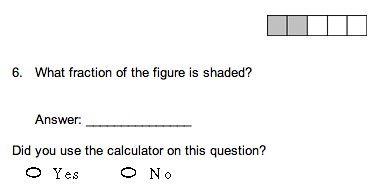
update - wrong, wrong, wrong
I'm sorry..... this is completely wrong.
I didn't hit the "Submit" button, so the page stayed on its default 4th grade position.
This problem is Below Basic for 12th graders.
Must go back now and check whether the function problem is listed in the category I assumed.
Subscribe to:
Posts (Atom)