kitchen table math, the sequel: classroom discipline
Showing posts with label classroom discipline. Show all posts

Wednesday, June 25, 2014

School violence, suburban schools, charter schools

Followup to School violence 1940 - 1950

The 1940-1950 chart: School Survey Hoax:

I'm going to number sections of this post, just to make things quicker (for me & for people reading)

1. 

In the wake of learning, from the Comments thread (thank you!), that the 1940-1990 school chart is way too vivid to be true (I wondered about that -- should have listened to myself), I've done some Googling re: school violence.

Haven't finished, but while I was at it, I remembered this passage from Elizabeth Warren's book The Two-Income Trap:
Today's parents must also confront another frightening prospect as they consider where their children will attend school: the threat of school violence....[T]he statistics show that school violence is not as random as it might seem. According to one study, the incidence of serious violent crime--such as robbery, rape, or attack with a weapon--is more than three times higher in schools characterized by high poverty levels than those with predominantly middle- and upper-income children.[41] Similarly, urban children are more than twice as likely as suburban children to fear being attacked on the way to or from school. The data expose a harsh reality: Parents who can get their kids into a more economically segregated neighborhood really improve the odds that their sons and daughters will make it through school safely.[42]

Footnotes:
41. Thomas D. Snyder and Charlene M. Hoffman, Digest of Education Statistics, 2001, NCES 2001-130 (U.S. Department of Education, National Center for Education Statistics, February 2002), Table 150, Percent of Public Schools Reporting Crime Incidents and the Seriousness of Crime Incidents Reported, by School Characteristics, 1996-1997.

42. U.S. Department of Justice, Bureau of Justice Statistics, Sourcebook of Criminal Justice, 2000, NCJ 190251 (December 2001), Table 2.0001, Students Age 12 to 18 Reporting Fear of School-Related Victimization.
Setting aside the question of whether school violence was significantly higher in 1990 than in 1940, the fact is that parents universally believe suburban schools are safer than urban schools.

I'm pretty sure urban parents have the same perception of charter schools.

Charter schools radiate an image of safety and calm.

I believe parents choose charter schools in part because they believe their children will be safer in a charter school than in a traditional public school.


2.

Are charter schools actually safer?

Hard to tell. They may not be.

From 2013:
Teachers' perceptions of school safety across all school levels tended to differ by sector. Private school teachers were less likely than teachers in other sectors to report being threatened with injury in the past 12 months. Among private school teachers, 3.9 percent reported injury threats, compared with 9.6 percent of traditional public school teachers. Teachers in charter schools (10.8 percent) and BIA schools (12.6 percent) were most likely to report being threatened with injury...

[snip]

Among traditional public public school teachers, reports of being threatened with injury varied by community type. Teachers in central city schools were more likely to report threats of injury in the past 12 months than teachers in urban fringe/large town schools and teachers in rural/small town schools. In central city traditional public schools, 13.5 percent of teachers reported injury threats. In urban fringe/large town schools, 7.9 percent of teachers reported injury threats. In rural / small town schools, 8.6 percent of teachers reported injury threats.
They need to disaggregate the data. I have no idea what proportion of charter schools are "central city."

One note: the fact that charter school teachers report a threat level as high as they do weighs against the idea that charters are cherry-picking the easy students.


3.

Has there "always" been violence in schools?

The answer is 'yes,' but that is neither here nor there.

There has always been violence, period, but some places and times have been more violent than others.

The question is whether schools had become significantly more violent by 1990 than they were in 1940.

At the moment, it looks to me as if the government didn't really start collecting statistics on violence in schools until around 1990. (I may be wrong about that, but so far that's what I'm turning up.)

The label "school violence" didn't really exist prior to the 1970s (which is not to say that school violence didn't exist):


Source: "The School in School Violence: Definitions and Facts" | Michael Furlong & Gale Morrison | Journal of Emotional and Behavioral Disorders | Summer 2000, Vol.8, No. 2, p. 72

Setting the quest for school violence statistics aside, it's well established that there was a large increase in "violence-related injuries and homicides among adolescents during the late 1980s and early 1990s."(Furlong & Morrison, 2000)

That increase affected the schools:
In some ways, society has expected a protective bubble to exist between the problems of our communities and the spillover into the school setting. Schools have remained relatively safe environments for teachers and students (Furlong & Morrison, 1994; Garbarinio, 1992); however, in some areas, the community norms and behaviors regarding violence have thoroughly invaded the school (Devine, 1995). This is particularly true in urban environments where there is a commitment to subculture norms and values that endorse the use of violence in solving conflicts (Devine, 1995; Wolfgang & Ferracuti, 1967).


4.

Do some schools keep order better than others?

Yes!

Within the same city and the same demographic, some schools keep order and some do not:
The 11 (Philadelphia) schools differed significantly on all five measures of school climate. The largest between-school differences were found for planning and action; clarity of rules; and student influence. Schools, therefore differ considerably in the degree to which students perceive that the school is making any effort to implement school improvements; in the clarity of school rules; and in the degree to which students have any influence on school policies. Note, however, that sizable but smaller effects were found for the other two climate scales as well: students feel more respects and they perceive that school rules are more fair at some schools than at others. Schools are not at all identical in the rules, procedures, norms, and practices that make up school climate.

While one might expect that 11 public schools in the same large, urban school district would evidence similar levels of disorder, this was not the case at all....Schools varied to a great degree in how safe their students felt.

[snip]

Four of the five school climate variables significantly predicted victimization: respect for students, planning and action, fairness of rules, and clarity of rules. Student influence on decision making had no effect. Respect for students had the greatest influence on lower levels of victimization.

The Effects of School Climate on School Disorder | Wayne N. Welsh | The ANNALS of the American Academy of Political and Social Science 2000 567: 88
Rules and respect (warm/strict): that is the recipe for safe schools as well as for good parenting.

We've known for decades that "authoritative" parents raise more successful kids, and yet somehow no one's ever heard of the research.

Kids need authoritative surrogate parents at school, too.


5.

Traditional public schools expel students all the time.

That includes SPED kids.

Monday, May 27, 2013

Speaking of Scarsdale (warning: bad language)

Recording Of Angry Chaperone On Edgemont Bat Mitzvah Bus Hits YouTube

Here's the tape: https://soundcloud.com/scarsdale10583/barmitzvahrant

This reminds me of Mary Damer telling me that the single biggest challenge for a new teacher is classroom management, and that includes a teacher just coming out of the Marines.

Friday, October 19, 2012

parents v. schools, Victorian edition

Have stumbled upon a brief history of discipline in British schools. Apparently parents have long been held in low regard by the public servants hired to teach their children:
In the early part of 1890 a teachers’ newspaper, The Schoolmistress, complained that its urban readers were under the constant threat of violence. It noted that the ‘rough language and violence heaped on teachers in some of the low and rough neighbourhoods of London and other large towns can hardly be imagined by those who have not witnessed it’. The image that the paper put forward was of a school system in a state of siege, with teachers fearing that they could be attacked at any time by the parents of their pupils. Though the lurid descriptions that appeared in The Schoolmistress were undoubtedly exaggerated for dramatic effect, they reflected a very real problem that afflicted schools at the time, which was a severe and ongoing hostility between parents and teachers.

The underlying issue in these conflicts was school discipline. By 1890 many parents were objecting to what they saw as the cruel and arbitrary use of corporal punishment then endemic within the school system. Children were not only caned but also subjected to many other forms of physical punishment, from being struck across the knuckles with slates, to receiving blows to the head with metal classroom pointers. In one case the disciplinary regime of a particular school involved a teacher stalking round the classroom, threatening children with a large knife. Parents generally thought that such forms of behaviour were inappropriate and that their children should be protected from such treatment.

Any sense of outrage felt by parents was reinforced by the fact that most of the punishment that occurred in schools was unlawful.

[snip]

The common perception of Victorian schools is that they were primitive and brutal institutions in which children were subjected to violent discipline. Though there is a certain amount of truth in this, it fails to acknowledge the general unpopularity of corporal punishment among parents as well as pupils. Even in the 19th century this type of punishment was seen as an archaic and outmoded disciplinary tool. The negative image was supported by popular literature, such as Charles Dickens’ novel Nicholas Nickleby (1838) and by real-life events, including the infamous Eastbourne Manslaughter of 1860 in which a school boy was beaten to death by his teacher. By this date opposition to corporal punishment was at its height and it was generally believed that the demise of the practice was fast approaching.

Yet the use of corporal punishment persisted. Teachers felt it had value as a disciplinary tool, believing that it was a quick and simple means by which order could be imposed on a class. Meanwhile many politicians and judges educated at public schools saw corporal punishment as a normal and natural part of childhood and had little sympathy with the objections of parents. Collectively their efforts helped to preserve its use as an educational tool and to institutionalise it as a standard disciplinary measure within schools. From the early 1890s onwards a number of administrative and legal measures were brought into effect that protected the rights of those teachers who wished to strike children. Classroom teachers were permitted to use corporal punishment and the rights of head teachers to inflict punishment were extended considerably. By the time of the First World War the parental protests against disciplinary excesses had been suppressed and corporal punishment was established as a normal and expected form of discipline. The practice was only banned in British state schools in 1987.

Spare the Rod
By Jacob Milddleton History Today | Volume: 62 Issue: 11 2012
So...it took 150 years, give or take, for parents to drive corporal punishment out of the schools.

Successive generations of U.S. parents have been agitating for phonics and a knowledge-based education in the liberal arts for -- is it 110 years now?

Give it another 40, and maybe we'll see some action.

Sunday, June 24, 2012

the leafy suburbs, part 3: other people's children

another issue re: the responsibilities of the school versus the parent

One of the issues Ms. Slaughter mentions confronting is her son's disruptive classroom behavior.

Well, suppose Ms. Slaughter and her husband fail to improve their son's classroom behavior.

Where does that leave the other kids in the classroom?

We experienced this ourselves when C. was in middle school. I remember one day talking to him about his math class, where he was learning virtually nothing due to the Death March to Algebra nature of the curriculum, we assumed. So I was interviewing him, trying to nail down whatever was or was not going on that week, and at some point in our conversation C. mentioned in passing that he could not hear what the teacher was saying in class.

You can't hear?

I had no idea what he was talking about -- I'd certainly never noticed him having trouble hearing. I was thinking, Is this one of those boy things where boys' hearing is slightly not as good as girls' hearing

No.

It wasn't.

It turned out - news to me - that C. could not hear what the teacher was saying because he was in "the bad class," which is to say the noisy, hyperactive, out of control class. So every day was pretty much bedlam, and C. couldn't hear anything the teacher was saying because the other kids were so loud.

The other kids are so noisy you can't hear? Mind you, this was the accelerated class, the class with the kids who were headed to calculus and selective colleges. So noisy C. couldn't hear the teacher.

I was probably in my 2nd year of dealing with the school's insane curriculum at that point. It had never crossed my mind there was another whole dimension of awful going on.

At least one boy in the class had ADHD; there may have been as many as 3 boys with ADHD (I don't know). I happen to know that their parents were doing everything they could do on their end, but even if they weren't, the classroom disruption was (apparently) such that my own child could not hear what the teacher was saying.

Which of course got me to wondering whether C., who was a bit shy, had been placed in the class precisely because he was a bit shy. One of his other teachers had told me that he always had C. sit next to the noisy children as a means of classroom management (fine in that case), and C. had told me an endearing story about a very quiet little girl in his math class who, he said, was always being used as a separator for the noisy boys. "She hates it," C. said.

We can argue about the extent to which parents are responsible for their children's behavior at school.

But the school, not the parents, has to be responsible for maintaining classroom order.

It's not just that the quality of a troubled child's K-12 education shouldn't depend on his parents, which is my belief.

The quality of the other children's K-12 education shouldn't depend on that child's parents, either.


leafy suburbs, part 2

re: the leafy suburbs, Jen asks:
I have to be a bit of a devil's advocate here. Why is it that teachers are expected to do what parents here are saying they can't do?

That is, parents can't get one or two children to, say, do homework and study at home for a bit, whereas a teacher who has them for 45-50 minutes a day (or twice that every other day if block scheduled) is not only supposed to teach but also supposed to motivate them enough to do the homework and studying?
I actually have an answer to this question!

A few of them.

FIRST: Kids are often much more cooperative with other adults than with their own parents. That's why so many parents I know, parents who were trying to reteach content at home, finally gave up and hired tutors.

C. is your classic cooperative kid, and when he was in 8th grade, as I recall, we reached the point where I was shouting so much something had to give. That was when I discovered Karen Pryor's work. I remember, going into Christmas break, devouring Pryor, having a major heart to heart with myself, and vowing to do a 180 as soon as the new semester began, which I more or less did. The household was pretty close to being in crisis, and C. is a mild-mannered kid! (If Susan S is around, she'll vouch for me on that one - )

I used to think: what would be happening around here if C. weren't a mild-mannered kid?

Meanwhile, C. was having precisely zero problems at school. I think he had one - no, two - detentions in his entire 3 years at middle school, and one of the 2 was a group detention most of his math class (math again) served for being disrespectful to a substitute teacher.

SECOND: Parents really, truly don't have the training we need to deal with a lot of the stuff we deal with. Not that parents should have to have training! I'm not suggesting anything of the kind. I'm just saying that, for instance, using the principles of positive reinforcement to deal with a challenging autistic child (or a completely non challenging nonautistic child you're trying to reteach math to) does not come naturally to anyone, as far as I can tell.

Of course, teachers don't get a lot of training in behavior management, either, but schools do seem to have school psychologists these days, and at least some of them have had some real training and experience.

Good teachers do acquire an extremely impressive set of skills where classroom management is concerned, something I'm still working on. A behaviorist I know told me that classroom discipline is THE issue every new teacher faces, and that includes a new teacher who has just served a tour of duty as a Marine.

THIRD: Even if the parent is highly skilled at maintaining law and order inside the home, the parent is not inside the classroom. I can't tell you how often I've heard about school personnel assuming that parents can magically, from miles away, directly influence their children's behavior inside the classroom.

My own funniest story on this score concerns Andrew, who, a few years ago, was being very difficult on the bus. Now Andrew, as I think a fair number of you know, is autistic and nonverbal. He doesn't talk. We can talk to him, but it's not clear how much he understands.

(Andrew is also weirdly smart - this is something the teachers and aides say, btw, not just a parent fantasy .... Andrew is sui generis. I need to say that out of loyalty and also out of honesty. btw, Susan can probably attest to that one, too. Susan watched Andrew during my mother's funeral, and afterwards said to me, "I think he ordered something from Amazon.")

Anyway, Andrew was being difficult on the bus, and the head of transportation called to discuss the situation. He wanted me to make Andrew stop. Somehow I, as the parent, was supposed to be able to change my autistic child's autistic behavior on a bus. When I expressed skepticism that I would be able to influence Andrew's behavior from afar, the transportation director asked me: Can you have a talk with Andrew?

I said: Andrew doesn't talk.

The thing is: the transportation director knew Andrew doesn't talk. And yet he was on the phone asking  me to 'have a talk' with my nonverbal son.

That's an extreme example, but I've seen the same thing with ADHD kids: I've seen school personnel assume that a parent can affect an ADHD child's behavior without being present to do so.

That's not how ADHD works. In fact, it is pretty much the opposite of how ADHD works. I know a family that has done a fantastic job with their very ADHD son: meds, therapy, very strong behavioral boundaries, lots of love, authoritative parenting --- a fantastic job. Their son is a very good kid.

Nevertheless, as far as I know he was quite disruptive in classrooms through all of through middle school (not sure about high school). The classroom disruption problem in his case was really, truly a "school problem" in the sense that it was taking place inside the school. His parents had his behavior  well under control at home; I saw it. They had also taught him terrific manners; I saw those, too. But  keeping his classroom behavior under control inside a classroom without being inside the classroom themselves was not possible.

With disorders like autism and ADHD, if the school doesn't deal with the problem, it doesn't get dealt with.

FOURTH: This brings me to my final answer, which is that when a teacher can't manage a student in his or her classroom, other arrangements need to be made by the school.

This isn't just my personal opinion; it's pretty much the law. By law, a student who can't function inside a regular classroom must be evaluated, must be given an IEP (if that's what's called for), and must be educated -- by the school.

That said, I know this is an area where schools often miss the boat. The horror stories I've heard .... I think the phrase "radical inclusion" (not my term) captures it. When school administrators decide that full inclusion (what is it called now - collaborative classrooms?) is the way of the world come what may, when full inclusion collaborative classrooms include a child the teacher absolutely cannot control no matter how much special training and support s/he is given, that is wrong for all concerned. It's wrong for the child, it's wrong for the teacher, and it's wrong for the other children.

Also: full inclusion for all is a decision the school has made, not the parents. The school has a responsibility to provide a calm and safe learning environment for all children.

That is my opinion; general education children have no entitlement to nondisrupted classrooms, sad to say.

Tuesday, June 19, 2012

Raymond Chandler on writing & school

from Willpower: Rediscovering the Greatest Human Strength by Roy Baumeister and John Tierney:
Chandler had his own system for turning out The Big Sleep and other classic detective stories. "Me, I wait for inspiration," he said, but he did it methodically every morning. He believe that a professional writer needed to set aside at least four hours a day for his job: "He doesn't have to write, and if he doesn't feel like it, he shouldn't try. He can look out of the window or stand on his head or writhe on the floor, but he is not to do any other positive thing, not read, write letters, glance at magazines, or write checks."

Thie Nothing Alternative is a marvelously simpe tool against procrastination for just about any kind of task....Just follow Chandler's regimen:

"Write or nothing. It's the same principle as keeping order in a school. If you make the pupils behave, they will learn something just to keep from being bored. I find it works. Two very simple rules, a. you don't have to write. b. you can't do anything else. The rest comes of itself.
Write or don't write, but if it's don't write, don't do anything else, either.

Never thought of that. 

Monday, April 19, 2010

Will Burrow on Teach Like a Champion

There's been a discussion of Teach Like a Champion on the DI list, and the consensus seems to be that Lemov's taxonomy is very close to DI.

Will Burrow gave me permission to post this reaction:
I have read about half of it. for $16 it is the buy of the century. Anyone who teaches a child must read the book and keep it close at hand forever. The book has solid suggestions for delivering any type of material--and yes it validates DI.
Another Will Burrow link.

Wednesday, April 14, 2010

warm/strict

from Teach Like a Champion: 49 Techniques that Put Students on the Path to College:
We're socialized to believe that warmth and strictness are opposites: if you're more of one, it means being less of the other. I don't know where this false conception comes from, but if you choose to believe in it, it will undercut your teaching. The fact is that the degree to which you are warm has no bearing on the degree to which you are strict, and vice versa. Just as you can be neither warm nor strict (you may teach the children of parents who are this way and see for yourself the cost), you can also be warm and strict. In fact, as this Warm/Strict technique shows, you must be both: caring, funny, warm, concerned, and nurturing -- and also strict, by the book, relentless, and sometimes inflexible. It's not, "I care about you, but you still must serve the consequence for being late," but, "Because I care about you, you must serve the consequence for being late."

...Not only should you seek to be both: you should often seek to be both at exactly the same time. When you are clear, consistent, firm, and unrelenting and at the same time positive, enthusiastic, caring, and thoughtful, you start to send the message to students that having high expectations is part of caring for and respecting someone. This is a very powerful message.

page 213
Doug Lemov is describing the approach used by authoritative parents, whose children fare better academically and socially than those of permissive, authoritarian, and neglectful parents.

A good teacher is like a good parent.

Lynn G - more on public school expulsions

I just got a call last night from another parent looking for some school that will take her son. He's been kicked out of the regular public school for discipline issues. He comes from a great family (mom was big in the PTO a few years back). The public school couldn't care less -- kick him out and tutor is fine by them. I told her to try the Big Picture school, which also has great success with kids tossed out of public school.

There isn't a KIPP in the area to recommend, or I would have. My anecdotal experience is that the Charters and Magnets are where the suburbs ditch their trouble makers.
That's my experience too, here in Westchester. Except we don't have any charters and we've lost the one magnet school we had. (If there are other magnets here in Westchester, let me know.)

Tuesday, April 13, 2010

military schools

Terrific comments about sending kids to or attending schools on military bases -- hadn't read them until this moment.

Having read them, I now take back what I wrote about military schools doing a better job of classroom discipline - !

Lynn G on whether KIPP kicks kids out

Public schools kick kids out. It is standard policy. They have to provide tutoring and/or pay for alternative placements, but they are quite happy to do that and bill the taxpayers for it. As the public schools struggle to show improvement in test scores, I expect to see more low performing kids shuffled off to alternative programs where their scores won't count against the sending school district.

I've looked at the expulsion and graduation rates at inner city schools, and KIPP does a better job of keeping kids in and getting them to graduation than the public schools they came from. KIPP has a lower expulsion rate than say, the Hartford public schools, where kids are expelled or encouraged to drop out at much higher rates than the charters.
Absolutely.

My $32K per pupil public school has some species of "zero tolerance" policy, which means the administration kicks kids out and pays for home tutoring. e.g.: If a student is caught smoking pot in the bathroom, he's gone. Period. I assume most parents support this policy, but that's beside the point. The point is: if a student in my district steps across the line, he's out.

I suspect my district has a higher rate of student expulsions than KIPP:
With children who had more serious behavioral problems, who would tell a teacher to f*** off without feeling any remorse, the Porch [in-class detention] had little power....Levin was resolved to expel students only in the most extreme circumstances, which, it turned out, happened only once or twice a year, far less than in many regular public schools that forced students to transfer to special programs for discipline problems. Levin and Feinberg considered each student they could not teach a failure on their part. They kept looking for ways to get the number of dismissals down to zero.

Work Hard. Be Nice. by Jay Mathews
page 171
KIPP doesn't do what it does by cherry picking students or kicking students out or having parents sign contracts.

It does what it does through excellent teaching and through the creation of an "authoritative" school culture that keeps kids in line the same way authoritative parents keep kids in line. Lemov calls this culture "warm/strict," and I recognize his account: he is describing the school culture of Hogwarts, my son's Jesuit high school.

Monday, March 8, 2010

palisadesk on Fred Jones

Fred Jones ... had imbibed the “born teacher” myth and had a rude awakening when he was called upon to do some consulting at a school for incarcerated teens. The principal directed him to a classroom, where he entered to find students standing on tables, throwing things, climbing on windowsills, some huddled under tables, all kinds of ruckus, and the teacher yelling ineffectively at the front. Well, they were juvenile delinquents after all.

He went to some other classrooms and a period or two later noticed something. He was in a class of students who could have been from Groton or Phillips Exeter. They were seated, attentive, raising hands to answer, deeply engaged – in algebra, no less. It was a few moments before he realized that these were the exact same students as he had seen in the first classroom. Only the teacher was different.

That set him on the path to learn what it was that made one teacher highly successful with these (unlikely) students, while another was not. He learned over time that there are identifiable skills, behaviors and practices that teachers can learn that will make them much more effective, regardless of their baseline at the start. Those who are “natural born teachers” just do more of these things without being taught – but others can learn.

I took a week-long course from Fred Jones a few summers ago in Maine. It was worth every penny. His book, Positive Classroom Instruction, is now out of print (but available on secondhand book sites) and an excellent one on instructional issues, while Positive Classroom Discipline has some extremely good ideas and practical ones for managing student behavior not only in a positive way but in an instruction-friendly way. – so that more time is spent on effective learning.

His book Tools for Teachers is an excellent handbook for any new teacher (or one changing assignments, grade levels, etc). I refer to my copy frequently.

His website has lots of good articles and resources.

This is the point that is so difficult to get across to administrators and school boards.

Students are better or worse, depending on the environment.

So are parents.

In our middle school, I was a PITA and then some.

At Hogwarts, I barely know what's going on. As a matter of fact, it's entirely possible I don't know the last names of all of C's teachers.

That's because they're doing the teaching.

Tuesday, July 28, 2009

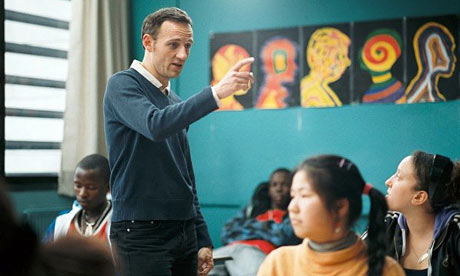
Entre les murs


photo: 'Every day I was playing a role'
by Stuart Jeffries
The Guardian, Friday 20 February 2009


I saw the beginning and the end of Entre les Murs ("The Class") on our flight home; will have to buy the DVD to watch the rest. Since the DVD isn't out, looks like I'm ordering the book.

From The Guardian:
The Class ... depicts a convincingly multicultural bunch of schoolkids. The film is refreshing, too, in that the teacher isn't overlord but hobbled prey, brought down or at least humbled by the wit and cunning of his (perhaps rather fancifully) articulate students. They subvert his lessons, for instance, arguing (with some justice) that no one in modern France needs to know the imperfect subjunctive, and use his classes to fight out ethnic rivalries.

But there are delightful moments. In one, a student teasingly asks the teacher if he's gay. "That really happened to me," says Bégaudeau, "and I was so pleased when it did, so I could turn the presumed insult back on the student. So I said: 'No, I'm not gay, but what's it to you?' I wanted to nail his homophobic perspective," Bégaudeau giggles. "That said, when you're 15 you use anything you can to mock someone else, so to call a fellow student a homo or a teacher a paedo isn't really a big problem. It's aimed at getting a reaction, so the teacher must try not to give the student what they want."

Ironically, the film's pivotal moment1 comes when Bégaudeau himself uses abusive language to his students. He calls two girls who have challenged his authority "petasses" (translated in the subtitles as "skanks"). It's a shocking moment: the teacher has lost it so badly that he resorts to offensively adolescent abuse. Never are we further in the film from the Robin Williams model of celluloid pedagogy; never has an authority figure in the classroom been so painfully exposed.

"That really happened to me, too. I called some girls that word. I regretted it immediately, but I felt so betrayed by them." In life, as in the film, the two girls were class representatives at a disciplinary hearing for a boy who risked expulsion for his unruly behaviour in class. What angered Bégaudeau was that they blabbed the hearing's findings to the boy, when their role as class representatives demanded their discretion.
For anyone who has even a glancing acquaintance with learning theory, Direct Instruction, precision teaching, Vicki Snider,2 Karen Pryor, John Taylor Gatto, or KIPP, the film is as appalling as it is riveting.

First of all, the students, age 13 to 15, are fantastically under-educated through no obvious fault of their own. From what I could see, M. Marin's teaching is atrocious.

And second, although it's not right to characterize the teacher as "hobbled prey" -- he gives as good as he gets, which is part of the problem -- no one in the school has the faintest concept of what effective classroom management is or what achieving it entails. At one point the teachers assemble for a staff meeting at which a new idea is presented for consideration: because discipline problems have increased, some teachers have come up with a plan to give students 6 points at the beginning of the school year and then progressively take points away after each infraction.

Astonishingly, a parent representative - a mother - is present for this discussion. Even more astonishingly, she is no baker of cupcakes. Frowning darkly, she tells the assembled staff that the 6-point scheme is typical of the school: you set the children up for failure and then you punish them.

Her observation sinks like a stone, and the 6-point idea is eventually abandoned after a protracted argument between two of the teachers over whether it is or is not a good thing to exercise flexibility when enforcing the rules. Which is better: judicial discretion or mandated sentencing? That is the question that lights their fire. Talk about a thoughtworld.

Unfortunately for the kids, the parent rep has nailed it. One of the film's many virtues is that it makes the connection between bad teaching and bad behavior 3 somewhat transparent, although that is not the intent. Given what we see of classroom instruction (we see quite a lot), the school seems almost designed to produce maximum failure, and a number of the students appear -- to me, at least -- to be living in a state of something close to open revolt, as well they might: it is a hopeless situation. Virtually no member of the staff appears to give any thought to whether students are ready to learn the material being taught in class, or to whether, after the material has been taught, students have actually learned it. Nor is the central character troubled by his inability to answer student questions. Toward the end of the protracted contest between teacher and class over the imperfect subjunctive & whether anyone uses it in real life (teacher's answer: "snobs" do), one of the quiet students (there are a lot of quiet students) asks how they can know when to use formal language in written communication and when to use informal.

The teacher's answer: it's hard to say. Students will have to develop "intuition" re: formal vs informal language, and their intuition will tell them when to use what. This is not a short answer, by the way. It is quite a long answer. Which makes the follow-up all the more exasperating for you, the helpless viewer: when the teacher finally wraps it up, a second student (another of the quiet ones) asks, "What is intuition?"

I guess the teacher couldn't have seen that one coming since, as I recall, his explanation of intuition is equally useless.

More from The Guardian:

The Class ends on the last day of the school year. All the students but one have left the classroom. Then a girl who viewers have scarcely seen before approaches M Bégaudeau's desk and says: "Sir, I didn't learn anything from your class." "It is a heartbreaking scene. We got her to do it again and again and on each take it got sadder and sadder. Everyone on the shoot was miserable by the final take.

"I think, to be honest, that scene shows how schoolchildren know how to get under your skin, how to say the words that shatter your world. She probably did learn something, but she wanted to hurt me, for whatever reasons.

My memory of this scene as it appears in the film is different:4 I think what the girl actually says is that she hasn't learned anything from any of her teachers, and she is afraid -- terribly afraid -- she will have to go to vocational school, which she doesn't want to do. She is insistent on both points, and, yes, the scene is sad.

The teacher greets this revelation as another challenge to his authority and, as is his way, attempts to argue the point: the girl can't possibly have learned nothing in an entire year of school, he says.

As for me, I was thinking just the opposite. I was finding it miraculous that any of these kids had learned anything in 11 years of schooling.5

You can watch a clip here.


francophile on the film & on differences between French & English schools

1 the scene I missed...
2 education needs a "science of teaching"
3 "the heart of successful behavior management is good instruction" Mary Damer & Elaine McEwan
4 you can read the original on page 162 of the book
5 Children in France attend school by age 4.

Tuesday, July 21, 2009

military schools

Only in the military?

After my first visit to Hogwarts, on Sports Orientation Night, I came away thinking the place felt like a "happy military school." As it turned out, that was by design; the principal told us so on Family Orientation Day. I've forgotten how he put it, but the gist was that Jesuit schools have much in common with military schools.

Loyola himself, of course, was a soldier.

My point: happy military schools work.

Knowing what I do now, I take issue with this observation:
Behavioral problems are not an issue [inside military schools] due to the values students are taught at home.
I would wager a very large sum of money that a person who has actually taught in a military school would read this passage and hoot.

Your typical classroom pits 20 to 30 kids against 1 adult. That's not quite the Battle of Thermopylae, but close enough.


Kids in groups are like dogs in packs
* (I say that with affection for kids and dogs): they rev each other up, and beyond a certain point parents can't control their kids from home no matter how sterling their values. It is the school's job to keep order and a cheerful spirit.

Most schools don't: because of political correctness that dictates "radical inclusion;" because ed schools don't teach classroom management skills; because public schools seem to believe that classroom discipline begins and ends in the home.

It doesn't. The public schools in my district, where the school population is upper middle class children from well-organized families, are safe and reasonably orderly, but there are constant complaints about disrupted classrooms, kids not being able to hear because of commotion made by the 'hyper' kids, etc. At the high school, students and parents have been told that disruptive kids in honors courses "don't deserve to be in the class."

I think it's unlikely that military kids are better behaved than kids in my district when they're not under their parents' direct supervision, and I credit military school personnel, not military parents,** with the orderly environment inside military schools.


* "In 2008, 39% of the fatalities involved multiple dogs."

** Not a criticism of military parents or anyone else. All I'm saying is: if a parent isn't inside the classroom, he isn't the one keeping order.

Monday, February 23, 2009

Rubber Room


via Jaye Greene


"The biggest problem that we face on a day to day basis is the discipline and the lack of disciplinary consequences."

This is the biggest problem students and parents face, too (arguably), and it is a major reason why middle class families with children have been at high risk of banktupcy for years now.

Here's Elizabeth Warren:
The rise in housing costs has become a family problem. Home prices have grown across the board (particularly in larger urban areas), but the brunt of the price increases have fallen on families with children. Our analysis shows that the median home value for the average childless couple increased by 26 percent between 19874 and 2001—an impressive rise in less than twenty years. (Again, these and all other figures are adjusted for inflation.) For married couples with children, however, housing prices shot up 78 percent during this period—three times faster. To put this in dollar terms, in 1984 the average married couple with young children owned a house worth $72,000. Less than twenty years later, a similar family bought a house worth $128,000—an increase of more than $50,000. The growing costs made a big dent in the family budget, as monthly mortgage costs made a similar jump, despite falling interest rates….

Why would the average parent spent so much money on a home?

[snip]

For many parents, the answer came down to two words so powerful that families would pursue them to the brink of bankruptcy: safety and education. Families put Mom to work, used up the family’s economic reserves, and took on crushing debt loads in sacrifice to these twin gods, all in the hope of offering their children the best possible start in life.

The best possible start begins with good schools, but parents are scrambling to find those schools.

[snip]

Everyone has heard the all-too-familiar news stories about kids who can’t read, gang violence in the schools, classrooms without textbooks, and drug dealers at the school doors.

[snip]

So what does all this have to do with educating middle-class children, most of whom have been lucky enough to avoid the worst failings of the public school system? The answer is simple—money. Failing schools impose an enormous cost on those children who are forced to attend them, but they also inflict an enormous cost on those who don’t.

Saturday, February 14, 2009

Paul H on the toxic stew

more tales from the font:

Constructivism, as practiced by CMP is actually an amalgam of discovery learning, clothed in multiculturalism, with a dash of politically correct, story vignettes to 'connect' the child to real world problems. It's not that these things, in and of themselves are inappropriate, it's just that the program throws so much into a one day lesson, the math gets hijacked.

It's not atypical for one of these vignettes to have a dark skinned blue eyed child, named Ming lee, sitting in a wheel chair, talking in Spanish to her friend Sascha from Russia. Put that in front of a child who is reading at a third grade level as an introduction to a seventh grade lesson on solving proportions, and you have the makings of a nightmare. It's very hard at times to get by the intro.

Then when you get into the lesson's problem sets it is very often the case that the problems serve up a hodge-podge;fill out a table, look for a pattern, find equivalent fractions, make a graph, and on and on. It makes my head explode sometimes and I've been doing math forever.

I understand the need to make connections and provide spaced repetition but it should never get in the way of base understanding in the topic at hand. When it does, and the paradigm is discovery/group learning, the results are not pretty.

The math gets lost in a blizzard of roadblocks around; the weird names, and how come we saw that guy in the wheel chair last year, and are trees really alive, and why is the Chinese guy speaking Spanish to a Russian, do I really have to make a table, and on and on.

You mix this altogether and it's a toxic stew for behavior because each child is hung up on a different facet of the jewel. If you can't put all these fires out fast, really fast, the third of your class that is ADHD gets going with the third of the class that is laughing at the goofy names, while the last third passes notes about the day's scoop.

The math is lost. Instead of providing a structure to hang the practice and spaced reps upon, CMP rips the structure into tiny little pieces in the arcane hope that the kids will put it all together again.


C. and I used to laugh about the many and multi-splendored names of the children populating Saxon's word problems. The one I remember best was: Monifa.

Monifa?

Who in the world is named Monifa? (Apart from a pygmy hippo in Australia, that is.)

Of course today I wonder whether the choice of "Monifa" was John Saxon's little in-joke on multi-culturalism in math books.

Friday, February 13, 2009

Niki Hayes on classroom discipline

I sent the Mary Damer/Elaine McEwan passage to Niki Hayes -----

Research supports the underlying thesis of our problem-solving process: the heart of successful behavior management is good instruction. Effective teaching becomes an even more essential variable for managing student behavior when one or more of the following conditions is present: (a) a student has a particularly chaotic home environment, (b) a student’s learning problems are extensive and complex, or (c) a student’s behavior is especially impulsive.

Here's Niki:
Yep. In one of the few prof development sessions that I attended that was worth my time, the speaker asked, "Which comes first, behavior or academics?" We all said, of course, "behavior."

"Wrong," she said. "If you want to change student behavior, change the academics. Academics drive student behavior." What she meant was, primarily, the curriculum and, secondarily, the pedagogy. She was a special ed trainer.

Speaking of good curricula, Niki is writing a book about John Saxon!

Thursday, February 12, 2009

are we having fun yet? discipline in a constructivist classroom

Mary Damer & Elaine McEwan on the other problem with constructivism:
Research supports the underlying thesis of our problem-solving process: the heart of successful behavior management is good instruction. Effective teaching becomes an even more essential variable for managing student behavior when one or more of the following conditions is present: (a) a student has a particularly chaotic home environment, (b) a student’s learning problems are extensive and complex, or (c) a student’s behavior is especially impulsive.

If Carla, the fourth grader who was constantly in your office last year poses no problem in fifth grade, chances are that her teacher this year is more skillful. If you observe Carla, you are likely to see her current teacher employing teaching methods that reflect the most valid research practices. Whenever you have a teacher on your staff who is complaining that a student who posed no problems last year is now a noncompliant rule-breaker, take a close look at that teacher’s instructional methods. You may find important clues to the student’s sudden misbehavior in the quality of the teacher’s instruction.

Instructional practices derived from specific curriculum designs can also directly affect student behavior. Many of the constructivist curricular innovations of the past 10 years that were created to develop hands-on cooperative learning, and student-centered environments often produced unintended results for children who are distractible, impulsive, or less motivated toward school.

Consider the following observation notes based on a classroom observation of two sixth graders in a math class. [NOTE: the two 6th graders she mentions here are the two children having behavior problems, and for whom the behaviorists have been called in]

The students are seated five to a table. They are manipulating small blocks into patterns in order to invent a method of multiplying fractions. Only two students in the class appear to have understood the concept. Other students in the class seem confused and frustrated. The teacher is unable to assist the students who are having difficulty and still monitor the other students. The instant she pauses to provide assistance to one table of students, a craps game begins on the other side of the room with several students exchanging pennies for the blocks they are now flicking across a finish line. One of the two referred students is walking around the classroom, seemingly to avoid the assigned task; the other unmanageable student has lined up his blocks like a train.

The frustration and lack of structure engendered by this activity have created multiple, predictable triggers to unmanageable behavior. No behavior intervention plan will succeed in a classroom where the assigned task is as frustrating as this one is, and the activities are as unstructured as these activities are.

Managing Unmanageable Students: Practical Solutions for Administrators
by Elaine K. McEwan & Mary Damer
p 13-14


note: "the last 10 years"

The book was published in 2000.

Twenty years of hands-on collaborative group learning.

A friend of mine was saying the other day that the hottest major in the college where she teaches is Communications.

I wonder if those two facts are related in any way.


CNN: 10 most popular majors
Niki Hayes on classroom discipline

Saturday, January 31, 2009

meet the parents, part 2: classroom discipline

Robert Pondiscio has a post up about James Rogers' tantrum on the subject of parents & kids.
What, then, has made the Nevada education system go from good to average to less than average since the 1960s when Nevada's high schools won multiple awards for being the best in the nation....The state of K-12 education in the state of Nevada is where the public - that is you out there - has allowed it to sink. Your only relationship with the education system is to ship your unprepared kids to school not with the expectation of success, but with the demand that an education system, inadequately funded, develop and/or repair children that you as a parent did not prepare for school or support while your children attended school.
And so on.

Teacher Anne's response caught my attention:
I have been a teacher for 35 years. When I started teaching, the children I taught were eager to learn, respected me, and other adults, had manners, and worked hard. Now, I have children who do not do homework, who have no bedtimes, who talk back, who have little or no desire to actually get an education, and who do not understand the values of hard work or accountability.
I've been thinking about classroom discipline lately.

It seems to me that all students should be entitled to attend cheerful, orderly schools.

Period
.

A cheerful, orderly school should be the bare minimum.

So, assuming that kids today really are more difficult to deal with (I don't doubt it), schools have to adapt. It's that simple. Teach the kids you have.

Someone else may have a better idea, but my thinking is that schools need to hire behaviorists to perform functional assessments of student behavior, create positive behavior plans for students who need them (regardless of whether those students are or are not "classified"), then teach teachers how to use the plan -- and support teachers while they're learning.

Since Palisadesk has told us that ed schools no longer teach classroom management (which seems to be the case), it falls to public schools to provide this training, which mean teachers must have real "professional development" when it comes to classroom management. By "real" I mean a person like Mary Damer who comes into the classroom, directly instructs teachers in how to keep a group of kids on task & well mannered, and supports the teacher while he or she is mastering the skills involved.

The behaviorist should also help administrators develop a school-wide plan for hallway, restroom, and playground calm, as well as for orderly and efficient trips to the principal's office.

Basically, I think schools should forget about hiring "school psychologists" and get into the business of hiring school behaviorists. We'd all be a lot better off.

Last but not least, students whose difficulties can't be managed by one teacher heading one classroom without help should be taught in smaller classes elsewhere in the building. That classroom, too, should be cheerful and orderly -- and this I know schools can do because my two autistic children have been taught in cheerful orderly classrooms by teachers who know what they're about.

Of course, that's not what's happening. I've heard from teachers who have worked in urban schools where children with severe behavior problems were kept in classrooms on the orders of central administration. Neither the teacher nor the building principal had the authority to remove these children, who in some cases were so violent and erratic that all learning stopped and classmates lived in a chronic state of stress and fear.

Such policies -- the teacher called them "radical inclusion" -- are unethical.

Students should be entited to attend school in a cheerful and orderly environment, and the people who are responsible for creating and sustaining that cheerful and orderly environment are the grownups in charge.


the parents

Which brings me to the parents.

Yes, in the best of all possible worlds children would have two-parent families in which Mom and Dad see eye to eye and the kids go to bed on time at night.

But we don't live in the best of all possible worlds, and there are limits to what a parent can do from home to control his child's behavior at school.

Special ed parents are always dealing with this. I remember talking to a mom who was working as an aide in her developmentally disabled daughter's special needs school. The daughter had all kinds of behavior problems in addition to delays (ditto that), and every time the child acted up in school the teacher would pick up the phone and telephone the mom, who was in another part of the school dealing with another child in another classroom. She'd get these calls all day long! Finally she finally told the teacher, "I am here, I'm not there. I can't do anything about my daughter's behavior over the telephone."

Of course schools should be pow-wowing with parents and working together with them on behavior issues if possible. But even when you have competent parents who are doing their best, the fact is that nobody trains parents, either, and because we parents are our own bosses, it can sometimes take a while to realize we're on the wrong track. At least, that has happened to me at times. "The bad gets normal," as Temple says: when problems develop gradually, you don't notice them. Instead, the new bad situation becomes the new normal. The parent may not even realize there is a problem.

That can happen with kids and families, and I know it's happened to me.

The point is: the school has to be responsible for student behavior while students are at school.

Whatever it takes.