Barry pointed me to a terrific post by Haim, one of the regulars on Math Teach, who writes:
As it happens, a good friend of mine did his dissertation on learning styles some fifteen years ago. He did his study in the context of math education at the college level. I still clearly remember the frisson when he told me that 30 yrs of scientific literature on the subject was thoroughly consistent: not a shred of (real) evidence to support the hypothesis of learning styles.
His study did not perturb the consistency. At the time, I remember thinking "Gosh, after 30 yrs of nothing maybe it's time to look for another fishing hole."
Since then, of course, I have been deeply impressed by the evident fact that 30 yrs of nothing makes not the slightest impression on the Education Mafia. They carry on, exuberantly, as if learning styles are real.
Just a few days after reading Haim, and quite by accident, I came across the possibility that learning styles may actually exist (!)
Just not the learning styles we've heard so much about for lo these 30 years.
We tested healthy college students who were given low doses of three different drugs: a drug that enhances the release of dopamine, a drug that reduces the release of dopamine, and a placebo; each student was tested in each of the three conditions.
[snip]
We hypothesized that all participants would learn to choose A over B, but that they would do so on different bases, depending on which drug they had been given. When dopamine levels are elevated, we hypothesized, participants should learn to choose symbol A, which had received the most positive feedback (that is, they should learn “Go” to A). But they should be relatively impaired in learning to avoid (NoGo) symbol B....
[snip]
We found a striking effect of the different dopamine medications on this positive versus negative learning bias....While on placebo, participants performed equally well at choose-A and avoid-B test choices. But when their dopamine levels were increased, they were more successful at choosing the most positive symbol A and less successful at avoiding B. Conversely, lowered dopamine levels were associated with the opposite pattern: worse choose-A performance but more-reliable avoid-B choices. Thus the dopamine medications caused participants to learn more or less from positive versus negative outcomes of their decisions.
These research discoveries raise the intriguing question of whether individual differences in learning from positive versus negative outcomes of decisions can be found even in nonmedicated healthy people. Indeed, although on average our study participants taking the placebo showed roughly equal choose-A and avoid-B performance, individual participants still performed better at one or the other; we refer to these subgroups as positive or negative learners....[A] mutation in another gene previously shown to control the density of (NoGo) D2 receptors in the basal ganglia predicted the extent to which participants learned from negative decision outcomes. Together, these results provide more-specific confirmation of our model’s suggestion that Go and NoGo learning depends on the D1 and D2 receptors.
Given the fundamental nature of procrastination, it is curious how such a mechanism could have become prevalent. One would expect that such a disadvantageous characteristic would have long been culled from our gene pool. To address this, George Ainslie argues that people in a hunter/gatherer environment should find that their motivational compulsions fit motivational demands almost perfectly: "As long as they sleep and hoard and mate when the relevant urge arises, they will behave more or less adaptively in the environment in which those urges evolved" (1992, p. 88). Unfortunately, in our civilized circumstances, contingencies are quite different, and it often becomes important to act not as nature intended.
There are some who have likely inherited characteristics that let them deal better with procrastination without any type of self-regulatory assistance. Like the naturally athletic, they don't need a lot of help to stay motivationally fit. Fortunately, there is help for the rest of us. There are many, many ways to reduce procrastination if not effectively eliminate it. Here we review three: Learned Industriousness, Energy Regulation, and Goal Setting. Of note, most procrastinators have a wide streak of impulsiveness in them and likely are looking for the "quick fix." Unfortunately, the more powerful the remedy for procrastination, the longer it takes to work.
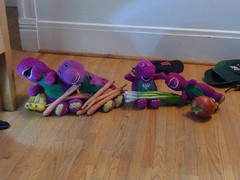
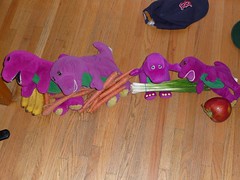
Yesterday, Ed and I were experimenting with our groovy new, life-extending Vita Mix blender when we noticed Andrew systematically emptying the refrigerator of vegetables. We did what we often do: ordered him to Stop and then, after spending a few seconds discussing the mystery that is Andrew (deciding in this case that Andrew must be collecting vegetables because he wanted to watch us blend stuff he wouldn't drink on a bet), went back to what we were doing and forgot all about Andrew, who had by this time left the kitchen. Out of sight, out of mind.
Andrew has never eaten a fresh vegetable in his life. He ate baby food vegetables when he was little, but when he stopped eating baby food he stopped eating vegetables. He doesn't eat fruit, either. Or noodles or rice or eggs or Chinese or Japanese food or hot dogs or hamburgers, and so on. In short, Andrew has an eating disorder. Two eating disorders: his autistic eating disorder (eating disorders seem to be common in autism) and his feeding-tube-as-a-preemie eating disorder (not sure whether doctors believe such a thing exists, but I do).
The reason we have a groovy new, life-extending blender, in case you're wondering, is that my sisters and brother and I have been scared straight by my mom's heart failure,* and my brother's scheme for not getting diabetes and also not getting heart failure was to buy a commercial-strength blender that makes commercial-strength smoothies and the best potato soup my California sister says she's ever eaten.
That ought to do it.
After I'd spent about 60 seconds considering the life-extending properties of the Vita Mix, I realized that the person in the household who really needs a life-extending commercial-strength blender is Andrew. For years I've been worried about his horrifically poor diet, and I've hatched various schemes to try to force some vegetable juice down him, none of which got off the ground. Andrew will have no truck with V8 juice.
But a commercial blender -- wow. Suddenly I could see a way to start small and work up. Start with something Andrew likes (grocery store apple juice), combine it with a tiny bit of something he doesn't like (any form of actual fruit) and have him drink it the same way he drinks pink antibiotics when he has to. Not willingly, but he gets it down.
Then I had a second brainstorm: positive reinforcement!
the plan: Blend half a box of apple juice in the Vita Mix and show Andrew that the other half is still inside the box, unadulterated & correct, waiting to be his once he swallows the blend.
It worked!
Andrew has now eaten (well, drunk) the first 7 grapes of his entire life. Also the first 3 slices of banana.
It's a miracle.
So back to yesterday afternoon. As I say, we forgot about Andrew and went back to what we were doing, which was figuring out how to make commercial-quality smoothies in the privacy of our own home.
A little later in the day I went upstairs to Andrew's room and found a brand new Barney tableau: vegan Barney.
Somebody's going to have to tell Andrew tyrannosaurus rex was not a herbivore.
* update 7/3/2011: My mom didn't have heart failure as we learned much later.
I saw the beginning and the end of Entre les Murs ("The Class") on our flight home; will have to buy the DVD to watch the rest. Since the DVD isn't out, looks like I'm ordering the book.
The Class ... depicts a convincingly multicultural bunch of schoolkids. The film is refreshing, too, in that the teacher isn't overlord but hobbled prey, brought down or at least humbled by the wit and cunning of his (perhaps rather fancifully) articulate students. They subvert his lessons, for instance, arguing (with some justice) that no one in modern France needs to know the imperfect subjunctive, and use his classes to fight out ethnic rivalries.
But there are delightful moments. In one, a student teasingly asks the teacher if he's gay. "That really happened to me," says Bégaudeau, "and I was so pleased when it did, so I could turn the presumed insult back on the student. So I said: 'No, I'm not gay, but what's it to you?' I wanted to nail his homophobic perspective," Bégaudeau giggles. "That said, when you're 15 you use anything you can to mock someone else, so to call a fellow student a homo or a teacher a paedo isn't really a big problem. It's aimed at getting a reaction, so the teacher must try not to give the student what they want."
Ironically, the film's pivotal moment1 comes when Bégaudeau himself uses abusive language to his students. He calls two girls who have challenged his authority "petasses" (translated in the subtitles as "skanks"). It's a shocking moment: the teacher has lost it so badly that he resorts to offensively adolescent abuse. Never are we further in the film from the Robin Williams model of celluloid pedagogy; never has an authority figure in the classroom been so painfully exposed.
"That really happened to me, too. I called some girls that word. I regretted it immediately, but I felt so betrayed by them." In life, as in the film, the two girls were class representatives at a disciplinary hearing for a boy who risked expulsion for his unruly behaviour in class. What angered Bégaudeau was that they blabbed the hearing's findings to the boy, when their role as class representatives demanded their discretion.
First of all, the students, age 13 to 15, are fantastically under-educated through no obvious fault of their own. From what I could see, M. Marin's teaching is atrocious.
And second, although it's not right to characterize the teacher as "hobbled prey" -- he gives as good as he gets, which is part of the problem -- no one in the school has the faintest concept of what effective classroom management is or what achieving it entails. At one point the teachers assemble for a staff meeting at which a new idea is presented for consideration: because discipline problems have increased, some teachers have come up with a plan to give students 6 points at the beginning of the school year and then progressively take points away after each infraction.
Astonishingly, a parent representative - a mother - is present for this discussion. Even more astonishingly, she is no baker of cupcakes. Frowning darkly, she tells the assembled staff that the 6-point scheme is typical of the school: you set the children up for failure and then you punish them.
Her observation sinks like a stone, and the 6-point idea is eventually abandoned after a protracted argument between two of the teachers over whether it is or is not a good thing to exercise flexibility when enforcing the rules. Which is better: judicial discretion or mandated sentencing? That is the question that lights their fire. Talk about a thoughtworld.
Unfortunately for the kids, the parent rep has nailed it. One of the film's many virtues is that it makes the connection between bad teaching and bad behavior 3 somewhat transparent, although that is not the intent. Given what we see of classroom instruction (we see quite a lot), the school seems almost designed to produce maximum failure, and a number of the students appear -- to me, at least -- to be living in a state of something close to open revolt, as well they might: it is a hopeless situation. Virtually no member of the staff appears to give any thought to whether students are ready to learn the material being taught in class, or to whether, after the material has been taught, students have actually learned it. Nor is the central character troubled by his inability to answer student questions. Toward the end of the protracted contest between teacher and class over the imperfect subjunctive & whether anyone uses it in real life (teacher's answer: "snobs" do), one of the quiet students (there are a lot of quiet students) asks how they can know when to use formal language in written communication and when to use informal.
The teacher's answer: it's hard to say. Students will have to develop "intuition" re: formal vs informal language, and their intuition will tell them when to use what. This is not a short answer, by the way. It is quite a long answer. Which makes the follow-up all the more exasperating for you, the helpless viewer: when the teacher finally wraps it up, a second student (another of the quiet ones) asks, "What is intuition?"
I guess the teacher couldn't have seen that one coming since, as I recall, his explanation of intuition is equally useless.
More from The Guardian:
The Class ends on the last day of the school year. All the students but one have left the classroom. Then a girl who viewers have scarcely seen before approaches M Bégaudeau's desk and says: "Sir, I didn't learn anything from your class." "It is a heartbreaking scene. We got her to do it again and again and on each take it got sadder and sadder. Everyone on the shoot was miserable by the final take.
"I think, to be honest, that scene shows how schoolchildren know how to get under your skin, how to say the words that shatter your world. She probably did learn something, but she wanted to hurt me, for whatever reasons.
My memory of this scene as it appears in the film is different:4 I think what the girl actually says is that she hasn't learned anything from any of her teachers, and she is afraid -- terribly afraid -- she will have to go to vocational school, which she doesn't want to do. She is insistent on both points, and, yes, the scene is sad.
The teacher greets this revelation as another challenge to his authority and, as is his way, attempts to argue the point: the girl can't possibly have learned nothing in an entire year of school, he says.
As for me, I was thinking just the opposite. I was finding it miraculous that any of these kids had learned anything in 11 years of schooling.5
Years ago the director of the charter school for autistic kids Jimmy & Andrew were attending told me that the only way to turn 'data' into positive reinforcement was to chart it.
That was a revelation. I already knew about the importance of "taking data," as behavior analysts call it. Taking data seems to be a pivotal behavior in behavioral treatment; just keeping track of what you're doing -- or what your goofy kids are doing -- helps. Knowing what you're doing changes what you're doing.
This is true even for children with severe autism, by the way. I've seen it. The minute you start counting & recording a child's behaviors to get a baseline, the behavior changes. It's uncanny.
In any event, the director's friend was working on his dissertation and had been recording his word count every day. But he'd stalled out & was stuck. Blocked.
She told him he needed to chart his data. It isn't good enough just to write down numbers day in and day out, you have to see a line going up-up-up (or, in the case of weight loss, down-down-down) if your daily numbers are going to serve as a force for good.
Practically the instant the words were out of her mouth, I knew she was right, and I've been trying to chart stuff ever since. Problem is, I've never been able to figure out how to chart the things I need to chart. Weight loss is easy; it's weight against date. Page counts are easy. Pages against date & keep a running total.
But I've never worked out how to chart the other phases of writing (or anything else): planning, organizing, reading, interviewing, etc.
Just this week, I'm trying to figure out how to chart C's studies for the summer. He has a bunch of reading to do for Hogwarts, which is easy. Last summer I made a simple chart for both of us that worked like a charm. It's a good thing, too, because he had to read 2500 pages in 8 weeks. He may have been one of the few kids in the school who actually did it, and we have the schedule and the chart to thank for it.
This summer I want him to do a bunch of other things, too. On the advice of friends, I've decided to pay him to do some but not all of them, and I have no idea how to record these activities in a manner that will be a) clear and b) motivating.
Here's the scheme:
I don't know what to do with this, chart-wise.
Plus I'm befuddled on the question of positive reinforcement and intrinsic motivation, but that's another story.
One of the questions in my mind this year, with C. attending Hogwarts, has been: why is the place so happy?
Somehow, the school motivates the kids to work hard and strive, and yet the winner-take-all burnout culture that often exists in high-performing public high schools doesn't exist there.
Why is that?
I don't know the answer, although I think it has to do with the fact that the kids develop a group identity the first day they arrive, when they attend a formal induction ceremony held in a nearby chapel.
In the ceremony a senior escorts each of the new boys up the center aisle of the sanctuary to the chancel, where a priest holding a mace blesses him and presents him with a freshman pin he is to wear on his jacket. Then he joins his mentor group standing off to the side.
I assume the mentor groups are related to the house system in British boarding schools:
the house system
Can competition and camaraderie coexist? They do in Highlands Latin School’s house system.
At first it may seem that competition and camaraderie are at odds, and sometimes they probably are. But in Highlands Latin School’s house system, they seem to go together quite well. A traditional fixture of many British schools, the “house” system has enabled Highlands to accomplish a number of goals that can be elusive for many schools.
The Origins of the “House” System
The house system is widely used in British schools and schools that model themselves after the British system in countries with past British colonial ties, such as Australia, Canada, Hong Kong, India, and Singapore. The system began in boarding schools, where students actually ate, drank, and slept in individual houses during school terms. The house system still operates this way in prestigious British boarding schools, such as Harrow, Eton, and Winchester College.
But, perhaps because of its obvious merits, the system is now used even in day schools, where the term ‘house’ refers simply to groupings of pupils, with no buildings involved. The houses are usually named after Christian saints or for famous persons historically connected with the school.
[snip]
At Highlands Latin School in Louisville, Kentucky, the advantages of the house system have been manifold. The houses provide not only an increased sense of identity and belonging, they also provide students with a sense of tradition. Leadership opportunities also abound in the house system.
Highlands, which is an outgrowth of the work of Cheryl Lowe, founder of Memoria Press, has seen a marked change in the attitude of students as a result of the establishment of the houses. “Because of the competition and the identification of each student with a house,” says Martin Cothran, a Highlands instructor and a co-director of the school, “there are constant opportunities to cheer your fellow students on. The positive attitudes of students toward one another and toward the school have been quite amazing since we started our program.”
The sense of tradition is palpable too. The Highlands house system, which is only a year old, already has about it the sense of history.
[snip]
The feature of the houses most popular with students is the competitions. At Bingley Grammar School in West Yorkshire, England, houses compete on the basis of academics, attendance, and sports. Sports competition includes cross country, netball, rugby, and table tennis. At Highlands, students compete in academics, community service, and sports, including dodgeball, soccer, ultimate frisbee, kickball, and volleyball. They also compete in chess and Latin Scrabble.
Academic competition is based on GPA. Houses are given points on the basis of how house teams perform in academic quick recall competitions. Community service points might be given on the basis of which house turned out the most members to sing at a rest home.
Competition used to be a regular part of school: posting the perfect scores on weekly spelling tests, who can get the most math problems done correctly in a given amount of time etc. Then someone decided that was bad, because if there are winners, there are losers. Of course, I'm sure that mainstreaming and heterogeneous grouping were heavily involved in that decision.
BTW, as the parent of several full-time elite athletes, I have observed that when kids get to a certain level they provide their own motivation; the coach's role is to help them increase their fitness, skills and tactics. I have frequently seen this in kids under 12; once instructed by the coach, the kids do significant conditioning and skills work outside of practices. However, athletes are given status and recognition not offered to outstanding students. Unfortunately.
I'm intrigued by this observation.
It relates to something I've been kicking around in my mind: how did I come to be a highly motivated student?
I often wonder whether I would have survived the constructivist schools we have now, and I tend to think the answer is 'no.'
I think the answer is 'no' because a constructivist project-based school wouldn't have given me the steady supply of positive reinforcement my traditional school did. I was a straight-A student & all assignments were what today we called "short timeline." I was positively reinforced so often that studying and all forms of school work became what Eric Hollander calls a "positive compulsion."
more anon
update 3:28 pm
[T]hey don't NECESSARILY have the motivation from the beginning; some do, some don't. If they don't have/acquire it, they don't last long at the elite level. If they don't work on their own, they drop in relation to the kids who do and they get cut from the team. That bothers some people, but not everyone has the same interests. There's a finite amount of time and kids have different priorities. Someone who drops from an elite team to a less-competitive one, so he can spend more time on band/orchestra (or anything else) is making a perfectly rational decision to spend most of his extracurricular time on the activity he likes most. I don't see that as a problem, although some do.
BTW, I have never seen a situation where parents were pushing the kid into a sport he didn't want to do, or to do on at a full-commitment level, that lasted more than short term. You can't make kids get up at 4:00 am two or three days a week for swim practice for very long. Or make a young soccer player work on skills for at least half an hour a day, even if there is practice.
When I taught for Johns Hopkins CTY, we were told that this kind of intrinsic motivation is the hallmark of gifted children. Parents don't force gifted children to practice for hours; the children want to do it.
re: Allison's post "How to Incentivize Them," I'm digging out from under & have just come across a study of coaches using self-charting to incentivize a swim team. The kids on the team were ages 16 to 19.
The present study was composed of two experiments aimed at solving the problems of competitive swimming coaches who described their team's attendance and work rates as poor and irregular. ...All behavioral applications were conducted in the on-going environment by the coaches themselves.
Attendance at training was poor and irregular. Apart from not attending, swimmers sometimes arrived late and left early and in some instances did not enter the water. ...The coaches had attempted to enforce rules of attendance and participation in training. These were implemented by simply stating the rule conditions. ...These attempts failed to improve swim-practice attendance.
The coaches were also concerned with the effect and amount of swimming being done in practices where traditional coaching methods were employed. For the most part, swimmers followed identical programs of work and were directed and encouraged in their efforts by the verbal commands of the coaches. Quite often, swimmers were subjected to arbitrary delays while they waited for further direction. These delays severely reduced the swimmers' work loads and gave them time to behave inappropriately by leaving the water, interfering with others, etc. These behaviors further reduced the productivity of the training session.
The traditional coaching procedures also seemed to reduce the effectiveness of the coaches. They were required to function as directors and supervisors who regulated the swimmers' pool usage. Attempts were made to control inappropriate behaviors. As a result, the coaches were forced to spend less time in more suitable roles, such as improving stroke techniques and attending to individual demands.
Self-administered reinforcing systems appear to possess behavior maintenance possibilities (Glynn, 1970; Malott, 1971). Self-recording techniques modified classroom studying and talking-out behaviors (Broden, Hall, and Mitts, 1971) and academic achievement (Glynn, 1970). In normal subject applications, self-reinforcement procedures have generally been shown to be as effective as experimenter-determined contingencies (Bandura and Perloff, 1967; Kanfer and Duerfeldt, 1967; Marston, 1967). Two studies appear to have direct bearing on the problems involved in this investigation. Hall, Christler, Cranston, and Tucker (1970) demonstrated that being on time for class contingent upon the posting of names on the classroom bulletin board effectively reduced the number of late arrivals in a required classroom situation to almost zero. Rushall and Pettinger (1969) reported that self-recording on "program boards" increased the work output of competitive swimmers in training as much as did deliberate coaching procedures aimed at inspiring greater productivity.
Santogrossi, O'Leary, Romanczyk, and Kaufman (1973) reported that self-evaluation procedures failed to reduce disruptive behaviors in adolescent boys from a psychiatric hospital school. They indicated that the supportive studies for the value of self-reinforcing contingencies generally have used normal subjects and have been conducted only over brief periods of time. Their investigation was undertaken over a longer period than the above referenced studies, and they cautioned about generalizing the evidenced short-term effects of self-reinforcement to longer-term situations. Since the present study attempted to provide permanent solutions to two behavior problems, this caution could be clarified by the evidenced outcomes.
[snip]
This study involved the use of publicly self-recording attendance to reduce attendance problems in a competitive swimming team.
[snip]
The members of the Shannon Heights Sharks competitive swimming team from Dartmouth, Nova Scotia, Canada served as subjects. The team, composed of 16 boys and 16 girls, whose ages ranged between 9 and 16 yr, practised eight times per week in a 25-yard pool.
[snip]
A large waterproof display board was constructed, on which each swimmer could indicate his/her cumulative attendance at practice. Spaces were also provided for the recording of each swimmer's present and best attendance records. Prominent spaces were reserved for the posting of the names of those who had the best records. During the experimental conditions, each swimmer indicated attendance at practice by entering a check-mark in the appropriate space. A swimmer who did not satisfy the conditions for attendance had his/her total accumulated checkmarks removed.
[snip]
The measurements were the number of absentees, number of late arrivals, and the number of swimmers leaving early. All interobserver reliabilities were 100%.
[snip]
Under attendance board conditions, the number of absentees was reduced by 45%,. Late arrivals were reduced by 63%, and early departures were completely suppressed. Post checks indicated that the attendance board remained effective in controlling the problems of attendance.
[snip]
DISCUSSION
The attendance board conditions were effective in the overall reduction of the problem behaviors associated with attending swimming training. The group as a whole was enthusiastic about the use of the boards. Many swimmers who had valid excuses for being absent attempted to arrange substitute practices on Sundays and early mornings. After 11 months of use, the record number of consecutive attendances was in excess of 130.
[snip]
The swimmers recorded their own attendance. Two senior squad members supervised the board and its use. Apart from the initial introduction of each experimental condition, the coaches were required to do little in the experiment. Occasionally, after practice they remarked on the progress of individuals. They were relieved of the bothersome task of checking attendance. The procedures demanded that the swimmer focus his/her attention on the task of self-recording. This served as a form of knowledge of progress as the number of consecutive attendances accumulated. The recording procedure was always undertaken with the team in close proximity. The possibility for vicarious reinforcement existed. The various performances of individuals drew a number of reactions from the gathered members. Peer and coach reactions were primarily positive approval and recognition. It was not possible to locate one single event as the reinforcer in this situation.
[snip]
EXPERIMENT II
This study involved the use of publicly self recording training-unit completion to increase work output in a competitive swimming team.
[snip]
A number of reactions to the program boards were gathered. Most of the swimmers in the club appeared to prefer the use of the program boards to the previous coach-directed form of control. One girl, however, stated: "I don't like them. They make me work too hard." A striking incident demonstrated another girl's preference for using the boards. During the reversal procedure, when the board had been removed from her pool lane, she demanded to swim where there was one. When this request was refused, she left practice and did not return for two days.
[snip]
After 12 months, the contingencies were still in effect and the behaviors generated in the study still evident. It would seem that the characteristics of publicly self-recording performance progress in both work output and attendance is a durable reinforcing process. EFFECTS OF SELF-RECORDING ON ATTENDANCE AND PERFORMANCE IN A COMPETITIVE SWIMMING TRAINING ENVIRONMENT THOMAS L. MCKENZIE AND BRENT S. RUSHALL1 JOURNAL OF APPLIED BEHAVIOR ANALYSIS 1974, 73,199-206 NUMBER 2 (SUMMER 1974)
The little girl who went on strike because they took away the charts raises a question for me.
Do kids in differentiated instruction classrooms get enough feedback / positive reinforcement?
In my other child's private school, the advisor is a great system. It's one of your child's teachers. If you think your child is developing a social or academic problem, you raise the issue with your child's advisor. This is marvelous, because it provides a listener for the parent, who may very well have a legitimate complaint about the other teacher. Let's say, a child feels that the homework is assigned, but not collected, by a new teacher. The child's advisor can speak with the new teacher, encouraging him to collect the homework. The parent is not left in the position of having to complain either to the teacher, or to the principal, neither good options. As a parent, I don't want to make a stink about a small problem. In the public school, though, I've seen small problems balloon into huge problems, because there are no avenues for parents to provide rational feedback on their child's academic experience.
Hogwarts has "mentor group," which is similar -- although they don't seem to invite parents to talk to mentors, particularly.
C's mentor keeps track of the kids' grades and intervenes if grades start to slip. She also is a bear (that's a good thing) on the issue of kids using their planners. She checks their planners every day to see if they've written down their assignments; if they haven't, she has them do so.
She is building a habit. She isn't just haranguing the kids on the importance of being organized (which is what public schools do & what I've often done myself), she is teaching them how to be organized, and she is giving them practice each and every day until using the planner becomes automatic.
We have only recently realized our job as parents isn't just to produce a "good kid" and a good student, our job is also to build good habits. In the past couple of years, as C. has gotten older and more responsible, Ed and I have both taken to scolding him about his messy ways. We find his stuff all over the house, we get mad, we remonstrate.
That's not the way to do it.
We need to set a time each and every day when we have him do a quick clean-up of his room and his desk, and we need to keep doing this until it becomes second nature for C. to do a quick clean-up of his room and his desk.
Speaking of building habits, a commenter recommended Glenn Latham's The Power of Positive Parenting awhile back. I've only dipped into it, and don't know what he has to say on the subject of teaching kids to clean up their rooms and use their planners, but it is a fantastic book.
The greater power of bad events over good ones is found in everyday events, major life events (e.g., trauma), close relationship outcomes, social network patterns, interpersonal interactions, and learning processes. Bad emotions, bad parents, and bad feedback have more impact than good ones, and bad information is processed more thoroughly than good. The self is more motivated to avoid bad self-definitions than to pursue good ones. Bad impressions and bad stereotypes are quicker to form and more resistant to disconfirmation than good ones. Various explanations such as diagnosticity and salience help explain some findings, but the greater power of bad events is still found when such variables are controlled. Hardly any exceptions (indicating greater power of good) can be found. Taken together, these findings suggest that bad is stronger than good, as a general principle across a broad range of psychological phenomena.
Bad Is Stronger Than Good Roy F. Baumeister and Ellen Bratslavsky, Catrin Finknauer, Kathleen D. Vohs. Review of General Psychology 2001, Vol. 5 No 4, 323-70.
The relationship between students’ accuracy with schoolwork and their subsequent behavior is described by the 80% Commandment: “Thou shall not expect a student to do a learning task when he or she does not have the skills to complete the task with 80% success. Otherwise, that student will either act out or tune out.” Today’s frustrated students who lack basic skills most often respond by acting out.
Oh gosh, it was sweet. All those little 14 year olds, dressed up in their brand-new, no-iron shirts and ties and chinos.
C. has been going to the school for the past week and a half to run cross country even though he's not a cross country kid. He's been doing that because the coach sent each freshman a welcome letter inviting him to join the team, telling him it would be a good way to make new friends if he didn't know anyone at the school. There would be no cuts, the coach said, and kids were free to leave the team if it wasn't for them.
Basically, the coach "pitched" the team to the kids! That's something I haven't seen before.
The school actively works to get as many kids involved in organized sports as possible. This goal is so important (I gather) that they give parents their figures for number-of-kids-in-sports. Three of the teams make no cuts: track, swimming, and wrestling. Then they have an extensive set of intramural sports, too. They want everyone playing.
The cross country experience has been a blinding success -- amazing! Karen Pryor should write a book about this place. In just one week C. has taken two (three?) minutes off his time, made new friends, taken the train by himself, and absorbed the concept of "personal best" and competing against yourself when you're just starting out and it's not your sport.
There hasn't been a false note at this school. Not one.
I'm sure I've mentioned, on occasion, that Andrew (autistic, turning 14) is a holy terror.
This summer I'm in a panic because things are way out of hand. By this age, Jimmy (autistic, just turned 21) was a Good Citizen. Not at school, where he still had a lot of problems, but at home and in public. Andrew is the opposite. He's at his best in school, though he's not great there. He's chronically difficult here at home and impossible in public.
Over the past year it's become obvious that we've dropped the ball. But I didn't know how badly we'd handled things until today.
Last week we dropped Andrew off at a camp for developmentally disabled and physically handicapped kids. It was a scene. The nurse argued with Ed about the medications, which were improperly labeled, she said, and I tried to deal with Andrew, who went into a massive tantrum. I held my ground: I had my clicker! Miraculously, I managed to get him back on track using a combination of stare-downs followed by clicks the instant there was a break in the shrieking, but not until everyone there had acquired a look of polite horror on his face & the elderly gentleman manning the canteen had said, "Olivier is going to have his hands full this week." (Olivier was Andrew's assigned aide; he's from France.)
We didn't think camp was going to work.
We figured we'd hear from them the next day, asking us to come get him.
Then, when we didn't hear from the camp (apart from the nurse, who called to report that the local CVS had mislabeled the medicine bottles so we still didn't have properly labeled medication), we figured when we picked Andrew up we'd be told that he wouldn't be invited back.
That's not what happened.
We drove up to the camp and there was Andrew, calmly hanging out with the rest of the campers and the counselors, all of whom looked cheerful and relaxed.
They brought us papers to sign, which included their notes on Andrew's behaviors, things he needed to improve, etc. The standard end-of-camp form they give all the parents.
The report: Andrew had no behaviors at the camp, and there was nothing to improve.
No behaviors and nothing to improve for a whole week.
The counselors were hugging him and saying goodbye; other counselors were strolling past calling out, "Goodbye, Andrew!"
The young European counselors all took this for granted, but the nurse was openly amazed. She's middle-aged & raised a handicapped child herself. "We had a very good week," she said, wonderingly. As she was running through the list of rational acts she had and the staff had witnessed, Andrew wandered off into the kitchen behind her office and picked up an empty soda can, & the nurse said without missing a beat, "Andrew come back from there." He put the can down, came back, and waited politely while she finished talking to us. (We need a nurse.)
The counselor sitting beside her took my email address so she could send me a photo of Andrew hugging another counselor -- a pretty blonde from England -- and then the two of them told us all about their weekend program during the school year, and they wrote out every date for us by hand on a piece of scratch paper so we could be sure to apply for spots for Andrew.
Nobody said anything about a weekend program the day we brought him to camp.
Within 5 seconds of our leaving the nurse's office and heading to the car, Andrew started in. First with the "bad sounds" and the dark face. Stage One.
I said, "This is going to be exactly like The Miracle Worker. He spent all week in a cabin, and he's perfect. Now he's going to drop his napkin on the floor." I said the same thing to a counselor in the parking area, and he wrote down the title of the movie so he could rent it.
Sure enough.
We needed to get something to eat before heading back, so we parked in front of a deli and went inside. Andrew made a beeline for an occupied table and snatched up a little girl's beverage, which I snatched right back, of course, but he'd been so fast I hadn't been able to get out in front of him to prevent his getting it in the first place. A bad sign.
We went to the counter to order, and pretty soon Andrew was making his little warning sounds. He was getting his bad look, too.
So I took him to a table and we sat down, but he didn't drink his juice or eat his chips, just sat there looking stony. Another bad sign.
Pretty soon he was making more of his warning sounds, and picking at the sides of his temples; that's Stage Two. Meanwhile I was clicking away and lavishly praising every lull in the action, but it was no use. He started slapping the sides of his head, and within 10 minutes all told he was doing his war whoops and the guttural vibrating scream that has to be heard to be believed and he had crashed his heavy wood chair over onto the tile floor.
With Andrew it's always the wind-up and then the pitch.
I hauled him out to the car, pushed him inside, shut the door, and went back inside the deli.
Andrew sat in the car for a minute or two, then opened the door.
I went back out and asked him if he was ready to be calm. Then I clicked him when he was calm for a second, calm meaning "not shrieking."
That was a bust. When he's ticked off, Andrew interprets praise for good behavior as the A-OK sign. Praise is the releaser that lets him go back to doing the thing you're trying to get him to stop doing by praising him for not doing it. [see: release word] Behaviorists have a term for this, but I forget what it is. So, having been momentarily calm, and having received his click, Andrew reeled back to the beginning of his wind-up (bad face, warning sounds), and I put him back inside the car & closed the door.
He opened the door again, set one foot out on the curb. No sounds. I clicked. Still no sounds. OK.
We went back inside, sat down, and started over. Andrew was wearing his dark look, but he wasn't saying anything, so that was fine & Ed by that time had finished up ordering & he sat down, too. So far so good.
The owner of the place came over and introduced himself. "Stay as long as you like," he said.
We weren't expecting that, and Ed said later it was a good omen. The owner said his 6-year old is autistic, and he's carried him shrieking out of Applebee's more times than he can count. Every time he carries the kid out, he leaves fifty bucks on the table because he knows the bill isn't going to be more than that. So he always spends fifty bucks at Applebee's.
That was funny to hear, because I have never, in my life, overpaid for something just because an autistic kid of mine happened to be shrieking and carrying on while I tried to settle a bill. That's probably why Jimmy ended up being a Good Citizen, come to think of it. Andrew's problem is that we ran out of energy and will somewhere along the line, and we stopped taking him anywhere instead of slugging it out with him in public.
Meanwhile, sometime during the Applebee's conversation, Andrew had decided to turn normal. When I looked at him again he was sitting cheerfully in his chair, eating his chicken fingers and drinking his juice. Then he threw his trash in the container and carried the leftovers to the car, after Ed and I were finished, too.
Time to download my copy of Grammar Trainer and get to work.
I still cry every time I see this scene.
update:
Susan S suggested I post the breakfast scene. I saw this movie so many times when I was a kid I practically have a scene-by-scene breakdown committed to memory. For people who don't know the history of the film, Anne Bancroft and Patty Duke starred in the play on Broadway before making the movie. They did the breakfast scene 6 times a week.
My Karen Pryor dog treats and target stick have arrived, and my dogs (Surfer and Abby) are liking the clicker, liking the treats, and are happy to touch their noses to the target or drop their bodies down to the floor.
I'm gathering my courage to try this with Andrew. His behavior has got to get under control this summer. When Ed gets back from L.A., we're all going to have a go at the training game.


 Posts
Posts


 . Always. Turns out the truth of the matter may be it depends.