

 Posts
Posts


What's the story with this little boy's homework? (And how old do you think he is? I'm guessing 2nd grade - ?)
If you click on the link, you'll see a photo of a little guy crying, presumably about his math homework. The worksheet is titled "Using Mental Math to Add" or "Doing Mental Math to Add."
This photo was posted. Watch what happened next.
Assuming he's crying over the worksheet (I have no reason to think he's not) -- what's the problem?
By this point, would he know his addition facts?
Or is he having to do these problems without knowing his facts by heart?
Is there something else going on?
One thing I've become concerned by of late: children spending their days engaged in mini lessons and peer discussion, then doing the 'hard stuff' at home, when they're tired.
I was talking to the mother of a second grade child here who has some sensory issues. The little girl is getting completely overwhelmed at night, trying to do her homework. She melts down and sobs unless her other is in the room with her. Even with her mother by her side, she struggles to get through the work.
I asked how much homework she's doing, and it sounded like a lot. Too much. In math alone, she has a full worksheet to do and several minutes of computer practice.
Listening to the mom, I suddenly realized: it's entirely possible students here are doing no worksheets during class time at all.
The kids have to do worksheets because Common Core, but worksheets aren't constructivist and we are now a Tony Wagner district so .... maybe all the worksheets have to happen at home. Out of sight, out of mind.
But that means kids go through a full day of school and a full raft of after school activities before they start the real work.
Showing posts with label homework. Show all posts
Showing posts with label homework. Show all posts
Saturday, October 10, 2015


Monday, July 12, 2010
time with children
Don't ask me how it happened, but recently, in my travels, I came across the Bureau of Labor Statistics' American Time Use Survey. To analyze American Time Use, the Bureau uses an Activity Lexicon (pdf file), a 39-page list of things people do.
Under sleeping, for example, the Bureau includes the following options:
sleeping
waking up
falling asleep
dreaming
dozing off
cat napping
napping
getting some shut-eye
getting up
dozing
Not sleeping is also a possibility:
insomnia
lying awake
tossing and turning
counting sheep
Two and a half pages are devoted to subcategory 01: Caring For and Helping HH Children.* Reading the list gave me a happy feeling:
01 Physical care for hh children
02 Reading to / with hh children
03 Playing with hh children, not sports
04 Arts and crafts with hh children
05 Playing sports with hh children
06 Talking with/listening to hh children
And so on. Time with children.
Subcategory 02 -- Activities Related to HH Children's Education -- brought me up short:
01 Homework (hh children)
helping hh child with homework
signing hh child's homework log
reviewing hh child's homework
checking hh child's homework for completion
helping hh child with a school project
picking up hh child's books/assignments
quizzing hh child before a test
and:
02 Meetings and school conferences (hh children)
observing hh child's class
meeting with guidance counselor of hh child
attending hh child's parent-teacher conference
meeting with principal of hh child
attending hh child's back-to-school night
talking to / with hh child's tutor
meeting w/school psychologist of hh child
meeting with hh child's tutor
talking with teachers of hh child
attending hh child's school open house
attending a PTA meeting
meeting w/school speech pathologist of hh child
and:
04 Waiting associated with hh children's education
waiting to meet with hh child's teacher
And that's it, the entire list apart from a one-line subcategory dedicated to home schooling of HH children. Six categories for helping with HH child's homework, 2 categories for dealing with HH child's tutor, another 4 categories for spending time on HH child's other school-related challenges and traumas (meeting with principal of hh child; meeting with school psychologist of hh child; meeting w/school speech pathologist of hh child...) Plus an entire category consecrated to time spent waiting to meet with hh child's teacher. Talk about fresh hell.
Where are the good parts?
Where is the "hh children's education" equivalent of "listening to hh child sing/recite" and "hearing about hh child's day," both of which appear under the heading "Caring For and Helping HH Children"?
Where is subcategory 05: discussing school's program to accelerate hh child's learning with school personnel?
Or subcategory 06: vetting hh child's merit aid award offers with admissions officers?
Tutors come up elsewhere in the lexicon as well. Under "Telephone calls to / from paid child or adult care providers," the Bureau lists three activities:
talking on phone to day care provider
talking on phone to a tutor
talking on phone to a babysitter
Tutors crop up again under Childcare Services:
01 Using paid childcare services
hiring a nanny or babysitter paying for lessons, instructions
paying for daycare
paying for tutorial services
checking out daycare facility
hiring a tutor
paying for summer camp
paying for after school care program
talking to / with the daycare provider
meeting with daycare providers
talking to / with the camp counselor
talking to / with babysitter
Finally - and this took me by surprise - tutors appear in Category 04, Subcategory 02: Activities Related to Nonhh Children's Education. In Category 04 we find the American people engaging in all of the aforementioned parental Activities on behalf of other people's children:**
observing nonhh child's class
meeting w/school speech pathologist of nonhh child
observing nonhh child's class
meeting with guidance counselor of nonhh child
attending non-hh child's parent-teacher conference
meeting with principal of nonhh child
attending non-hh child's back-to-school night
talking to / with nonhh child's tutor
meeting w/school psychologist of nonhh child
meeting with nonhh child's tutor
talking with teachers of nonhh child
attending nonhh child's school open house
attending PTA meeting
I wonder what Activities Related to HH Children's Education will look like in 2020?
I'd like to see a new activity on the list: visiting private, parochial, charter, and public schools to decide where to spend your child's tuition vouchers.
* HH = household
**see Anonymous for an explanation
Under sleeping, for example, the Bureau includes the following options:
sleeping
waking up
falling asleep
dreaming
dozing off
cat napping
napping
getting some shut-eye
getting up
dozing
Not sleeping is also a possibility:
insomnia
lying awake
tossing and turning
counting sheep
Two and a half pages are devoted to subcategory 01: Caring For and Helping HH Children.* Reading the list gave me a happy feeling:
01 Physical care for hh children
02 Reading to / with hh children
03 Playing with hh children, not sports
04 Arts and crafts with hh children
05 Playing sports with hh children
06 Talking with/listening to hh children
And so on. Time with children.
Subcategory 02 -- Activities Related to HH Children's Education -- brought me up short:
01 Homework (hh children)
helping hh child with homework
signing hh child's homework log
reviewing hh child's homework
checking hh child's homework for completion
helping hh child with a school project
picking up hh child's books/assignments
quizzing hh child before a test
and:
02 Meetings and school conferences (hh children)
observing hh child's class
meeting with guidance counselor of hh child
attending hh child's parent-teacher conference
meeting with principal of hh child
attending hh child's back-to-school night
talking to / with hh child's tutor
meeting w/school psychologist of hh child
meeting with hh child's tutor
talking with teachers of hh child
attending hh child's school open house
attending a PTA meeting
meeting w/school speech pathologist of hh child
and:
04 Waiting associated with hh children's education
waiting to meet with hh child's teacher
And that's it, the entire list apart from a one-line subcategory dedicated to home schooling of HH children. Six categories for helping with HH child's homework, 2 categories for dealing with HH child's tutor, another 4 categories for spending time on HH child's other school-related challenges and traumas (meeting with principal of hh child; meeting with school psychologist of hh child; meeting w/school speech pathologist of hh child...) Plus an entire category consecrated to time spent waiting to meet with hh child's teacher. Talk about fresh hell.
Where are the good parts?
Where is the "hh children's education" equivalent of "listening to hh child sing/recite" and "hearing about hh child's day," both of which appear under the heading "Caring For and Helping HH Children"?
Where is subcategory 05: discussing school's program to accelerate hh child's learning with school personnel?
Or subcategory 06: vetting hh child's merit aid award offers with admissions officers?
Tutors come up elsewhere in the lexicon as well. Under "Telephone calls to / from paid child or adult care providers," the Bureau lists three activities:
talking on phone to day care provider
talking on phone to a tutor
talking on phone to a babysitter
Tutors crop up again under Childcare Services:
01 Using paid childcare services
hiring a nanny or babysitter paying for lessons, instructions
paying for daycare
paying for tutorial services
checking out daycare facility
hiring a tutor
paying for summer camp
paying for after school care program
talking to / with the daycare provider
meeting with daycare providers
talking to / with the camp counselor
talking to / with babysitter
Finally - and this took me by surprise - tutors appear in Category 04, Subcategory 02: Activities Related to Nonhh Children's Education. In Category 04 we find the American people engaging in all of the aforementioned parental Activities on behalf of other people's children:**
observing nonhh child's class
meeting w/school speech pathologist of nonhh child
observing nonhh child's class
meeting with guidance counselor of nonhh child
attending non-hh child's parent-teacher conference
meeting with principal of nonhh child
attending non-hh child's back-to-school night
talking to / with nonhh child's tutor
meeting w/school psychologist of nonhh child
meeting with nonhh child's tutor
talking with teachers of nonhh child
attending nonhh child's school open house
attending PTA meeting
I wonder what Activities Related to HH Children's Education will look like in 2020?
I'd like to see a new activity on the list: visiting private, parochial, charter, and public schools to decide where to spend your child's tuition vouchers.
* HH = household
**see Anonymous for an explanation
Saturday, February 28, 2009
palisadesk on students learning at school vs. at home
This is partly a difference between high and low-SES school communities. In very low SES urban neighborhoods, especially with many families that do not speak English, the expectation that parents will help with work at home to any significant degree simply won't wash.
My district does not permit using homework for school grades -- all work used to evaluate student learning must be done in school. The expectation is that all the teaching required will also be done in school. Our primary division is really quite strong on the teaching side of things, with the vast majority of kids meeting or exceeding expectations for their grade and a lot of support and good instructional practices (if not curricula) are in place.
Unfortunately, with high mobility and transience, by the middle school years there is a huge influx of students lacking the preparation "our" kids received and the achievement is much more varied and the task confronting classroom teachers almost impossible.
Nevertheless, a lot of learning does take place at school, and despite the odds, a number of our students are successful in getting into competitive secondary schools (usually these are students we have had from the beginning).
We have a long way to go, but the focus is certainly on teaching the kids *in school* and not on relying on parents or tutors to do it -- that is just not going to happen.
My district does not permit using homework for school grades -- all work used to evaluate student learning must be done in school. The expectation is that all the teaching required will also be done in school. Our primary division is really quite strong on the teaching side of things, with the vast majority of kids meeting or exceeding expectations for their grade and a lot of support and good instructional practices (if not curricula) are in place.
Unfortunately, with high mobility and transience, by the middle school years there is a huge influx of students lacking the preparation "our" kids received and the achievement is much more varied and the task confronting classroom teachers almost impossible.
Nevertheless, a lot of learning does take place at school, and despite the odds, a number of our students are successful in getting into competitive secondary schools (usually these are students we have had from the beginning).
We have a long way to go, but the focus is certainly on teaching the kids *in school* and not on relying on parents or tutors to do it -- that is just not going to happen.
Thursday, January 29, 2009
What Homework is Necessary?
I know there's been plenty of discussion on the efficacy of homework here. Just wanted to point out a post on Dy/Dan, for those that don't already subscribe:
I Do Not get Homework At All Sometimes
The comments are interesting. Most lean to the Alfie Kohn view: homework=worthless. I know I'm not alone in believing that math takes practice.
For those of you in the know, where's the research?
I Do Not get Homework At All Sometimes
The comments are interesting. Most lean to the Alfie Kohn view: homework=worthless. I know I'm not alone in believing that math takes practice.
For those of you in the know, where's the research?
Sunday, November 2, 2008
Internet Required for Homework?
There's an organization in Readington, NJ called ReadingtonParents.org, (here's the page on constructivist math -- sound familiar?).
Anyway, one of the parents involved, John Painter has a blog associated with the organization, Readingtonparents.org Editor's Blog. He recently posted an essay on the various pitfalls of assigning homework that requires the internet. Here's the opening paragraph:
Since I'm not involved with the daily homework grind anymore (except for myself) I found his comments eye-opening.
Anyway, one of the parents involved, John Painter has a blog associated with the organization, Readingtonparents.org Editor's Blog. He recently posted an essay on the various pitfalls of assigning homework that requires the internet. Here's the opening paragraph:
One recent survey of K-12 teachers indicated that 77% of them assign homework which requires the internet. My experience with my own kids certainly backs that up. Unfortunately, these assignments not only require an internet connection, but also direct parental supervision. Most (if not all) of these assignments are based on a simplistic or erroneous understanding of internet technology, or they put an undue burden on parents to provide expensive infrastructure and safety monitoring.
Since I'm not involved with the daily homework grind anymore (except for myself) I found his comments eye-opening.
Saturday, September 6, 2008
summer homework
from the Sun (which is threatened with extinction at the end of September -- another life crisis in the making):
My feeling: the whole parent involvement in the schools thing is not working out. At least, it's not working out the way schools mean it to work out. As far as I can tell, the requirement that parents be deeply involved in homework produces further antagonism between schools & the people who send their kids to them.
Then, when those people write newspaper columns about the horrors of parental involvement, everyone else loses confidence, too.
Speaking of parent involvement, one of the big selling points for Catholic high school around here was my best friend's experience in LA. Her two kids, one boy & one girl, attended Catholic schools K-12. Both were accepted by highly selective colleges (Yale for one) where both have done very well -- and neither my friend nor her husband helped with homework ever. No tutors, either. Once, when I filled my friend in on the kind of labor we've had to put into homework, she simply stared at me, a look of noncomprehension on her face. It was as if we lived on different planets, which we did.
I mentioned back in June that C. was given a monster summer reading assignment by his new school. Two thousand five hundred and forty-nine pages in all, not that anyone was counting. Five novels, Guns, Germs and Steel, the Book of Genesis, the first 12 books of The Odyssey, The 7 Habits of Highly Effective Teens, and six Science articles from the New York Times. Plus quite a number of short-answer written responses.
This turned out to be completely do-able -- not just do-able, but for the most part fun. I did take Liz's (and Paul's) advice about organizing the reading, and I did keep C. on track by managing his Excel chart (that's a screen grab of the chart I made for me). But that was easy (and productive - I'm now using the chart for my own work).
I didn't have to nag, and I didn't have to "help." That was the big surprise. It turns out that the school understands the meaning of C's reading scores better than I do. (woo hoo!) The school definitely understands the kind of novels a new freshman boy likes to read better than I do. I would never have chosen these books. *
Thus far I conclude that the "secret" to a good summer homework assignment is:
At this point, my sense is that the sheer amount of summer reading and writing kids are asked to do isn't the problem. The problem is giving kids summer homework that is either over their heads or too logistically complicated for them to manage.
This brings me back to the FWOT aspect of projects and constructivism in general. Kids being taught via projects and discovery must expend huge amounts of time and energy organizing and simply remembering everything they're supposed to do.
I'd put money on it C. had the largest summer assignment of any kid mentioned in Skenazy's column, and yet I spent no time helping with content and minimal time helping with logistics. It's pretty easy, in terms of the demands on executive function, to remember you have to read 8 books. It's hard to remember you have to answer 8 questions and the 8 questions have 8 questions, too.
SAT prep
A few years ago I read a book about kids who scored perfect 1600s on the SAT. The main feature of perfect-scoring kids that distinguished them from everyone else was the amount of reading they did:
bonus factoid: One of my friend's children had something very close to a perfect score on the new 3-section SAT. (I don't know what the other child scored, but it had to be quite high as well.)
No SAT prep class & no tutor.
Just 13 years of Catholic schools.
* And not just because I hadn't read them, either. What a fabulous list! I read everything on it, and loved everything on it save one of the novels. (C. liked that one just fine.)
** nix on the Anne Frank assignment
Summer homework is due. Today.
Today is Day One for 1.1 million New York City public school children. The rest of New York's school children are matriculating right around now, too, and it seems that most of them — public and private — were asked to do something school-related over the summer. The question is: Did they do it?
The answer, albeit Clintonian, is: That depends on what the word "they" means.
Did "they" do it if mom sat next to them till 3 a.m. last night, doing the typing to save time? What if she read them "A Tale of Two Cities" out loud? What if dad rented the DVD and suggested topic sentences?
In our house, we certainly intended to have our kids do their work in a timely fashion. As August rolled around, the vague notion of something important we were supposed to do — they were supposed to do — started rising like a harvest moon.
[snip]
The brilliant idea of having the moppets do "a little bit every day" so it wouldn't be a "burden," and yet they wouldn't "lose the gains they made in the academic year" had about as much impact in our household as the brilliant idea of having them start raising organic alpacas and selling the wool for college tuition. Lovely in theory, but — hey, "The Simpsons" are on.
All of which means we have sabotaged our children's education, according to a lot of folks in the field.
[snip]
"I really have to start paying attention," my friend Marla said last week as she hunted for her daughters' assignments. My cousin and her son got three hours of sleep the night before their school in Chicago began. My sister was shocked to find that the eight questions her high school junior had put off turned out each to have eight sub-sections each — a,b,c,d,e,f,g and h — and "h" was always, "Write a definition of all the adjectives you just used." No sleep for them.
But at least they weren't over at my friend Carol's apartment. It took quite a while before Carol's daughter started cutting out pictures for her summer book report collage.
On Anne Frank.
[snip]
[These] are the stress-free months us parents don't get throughout the school year either, which is why the stomach feels such distress when it is time to start the whole cycle again. And so, teaching our kids perhaps the worst academic lesson of all, we pull a first night all-nighter. On the other hand, it's amazing how much of "A Tale of Two Cities" you can absorb when the clock is ticking, the DVD is blaring, dad's gluing and mom's typing. It's also very easy to give an example of, say, "The worst of times."
We may all have forgotten buckets of what we learned last year, but we remember this one: Homework stinks.
Hope you got yours in on time.
That Panic Last Night
By LENORE SKENAZY
September 2, 2008
My feeling: the whole parent involvement in the schools thing is not working out. At least, it's not working out the way schools mean it to work out. As far as I can tell, the requirement that parents be deeply involved in homework produces further antagonism between schools & the people who send their kids to them.
Then, when those people write newspaper columns about the horrors of parental involvement, everyone else loses confidence, too.
Speaking of parent involvement, one of the big selling points for Catholic high school around here was my best friend's experience in LA. Her two kids, one boy & one girl, attended Catholic schools K-12. Both were accepted by highly selective colleges (Yale for one) where both have done very well -- and neither my friend nor her husband helped with homework ever. No tutors, either. Once, when I filled my friend in on the kind of labor we've had to put into homework, she simply stared at me, a look of noncomprehension on her face. It was as if we lived on different planets, which we did.
I mentioned back in June that C. was given a monster summer reading assignment by his new school. Two thousand five hundred and forty-nine pages in all, not that anyone was counting. Five novels, Guns, Germs and Steel, the Book of Genesis, the first 12 books of The Odyssey, The 7 Habits of Highly Effective Teens, and six Science articles from the New York Times. Plus quite a number of short-answer written responses.
This turned out to be completely do-able -- not just do-able, but for the most part fun. I did take Liz's (and Paul's) advice about organizing the reading, and I did keep C. on track by managing his Excel chart (that's a screen grab of the chart I made for me). But that was easy (and productive - I'm now using the chart for my own work).
I didn't have to nag, and I didn't have to "help." That was the big surprise. It turns out that the school understands the meaning of C's reading scores better than I do. (woo hoo!) The school definitely understands the kind of novels a new freshman boy likes to read better than I do. I would never have chosen these books. *
Thus far I conclude that the "secret" to a good summer homework assignment is:
- work the student is capable of doing without help. I had no idea C. could read GGS, the Bible, or The Odyssey completely on his own. But he did, and he seems to have understood them, at least judging by the brief conversations we've had.
- at least some work the student wants to do or will enjoy doing. C. loved all five novels, which were so terrific that one of his friends bought and read one of them, too.** Those 5 novels, I believe, increased C's motivation to read the Bible & The Odyssey, neither of which would naturally have sparked his interest. The 5 contemporary books whetted his appetite for more challenging fare. (I think.)
- extremely short-and-sweet questions along with answer forms on which to write the answers. All of the summer assignments, which came from Religion, Classics, English, History, Science, and Guidance, were bundled together in one print-out, which was mailed home and posted online. And nearly all of the written work could be completed on that one form. The science teacher also included examples of student work to show exactly what he wanted students to do.
At this point, my sense is that the sheer amount of summer reading and writing kids are asked to do isn't the problem. The problem is giving kids summer homework that is either over their heads or too logistically complicated for them to manage.
This brings me back to the FWOT aspect of projects and constructivism in general. Kids being taught via projects and discovery must expend huge amounts of time and energy organizing and simply remembering everything they're supposed to do.
I'd put money on it C. had the largest summer assignment of any kid mentioned in Skenazy's column, and yet I spent no time helping with content and minimal time helping with logistics. It's pretty easy, in terms of the demands on executive function, to remember you have to read 8 books. It's hard to remember you have to answer 8 questions and the 8 questions have 8 questions, too.
SAT prep
A few years ago I read a book about kids who scored perfect 1600s on the SAT. The main feature of perfect-scoring kids that distinguished them from everyone else was the amount of reading they did:
[S]tudents who ace the SAT read an average of fourteen hours a week. Average score students, on the other hand, read only eight hours a week—an immense drop-off. The biggest difference, however, was found in the amount of time students spent reading for school. Average score students spent four hours a week reading literature, textbooks, and other assigned reading for school. Perfect score students put in nine hours a week for school-assigned reading, more than double the amount of time.
[snip]
What do 1600 students read for fun?...The book most frequently mentioned—by a total of 6 percent of perfect score students—was Catch-22 by Joseph Heller.
The Perfect 1600 Score: The 7 Secrets of Acing the SAT
Tom Fischgrund
bonus factoid: One of my friend's children had something very close to a perfect score on the new 3-section SAT. (I don't know what the other child scored, but it had to be quite high as well.)
No SAT prep class & no tutor.
Just 13 years of Catholic schools.
* And not just because I hadn't read them, either. What a fabulous list! I read everything on it, and loved everything on it save one of the novels. (C. liked that one just fine.)
** nix on the Anne Frank assignment
Tuesday, August 19, 2008
School starts, always a surprise
Of course, it's not a pleasant one. My 7th graders Algebra I teacher doesn't assign homework. Scientific studies you know.
Can anyone steer me to the pro and con scientific studies? I suspect all I need to do is go through the "homework" label, but the post is "therapy" nonetheless!
Thanks!
Can anyone steer me to the pro and con scientific studies? I suspect all I need to do is go through the "homework" label, but the post is "therapy" nonetheless!
Thanks!
Sunday, March 30, 2008
Dana Huff: The Homework on Homework #2
Two weeks ago, Dana Huff summed up a discussion on homework. She comes back with round two: a discussion of Harris Cooper's 1989 article, “Synthesis of Research on Homework.”
One of the frustrations that Huff and I share is that there's no standard definition of homework. Cooper provides a tidy one:
Previous related posts at Dana Huff's blog, Huffenglish.com: (I have elucidated some titles)
Grading to Communicate
Dana Huff, Agent Provocateur
Homework
Researching the Efficacy ofHomework Correction Techniques
Brief review of Classroom Instruction That Works (Marzano et al.)
Previous related posts here at KTM:
dy/dan on "why I don't assign homework"
Steve on teachers, homework, "Extra Help"
Steve on "collecting and correcting"
Effect size of collecting and correcting homework
All KTM posts labelled homework
citation for Cooper article:
Cooper, Harris. “Synthesis of Research on Homework.” Educational Leadership. 47.3 (November 1989): 85-91. Professional Development Collection. EBSCO. Weber School Library, Atlanta, GA. 29 March 2008..
One of the frustrations that Huff and I share is that there's no standard definition of homework. Cooper provides a tidy one:
Cooper defined homework as “tasks assigned to students by school teachers that are meant to be carried out during non-school hours”What is your children's schools' definition of homework?
Previous related posts at Dana Huff's blog, Huffenglish.com: (I have elucidated some titles)
Grading to Communicate
Dana Huff, Agent Provocateur
Homework
Researching the Efficacy ofHomework Correction Techniques
Brief review of Classroom Instruction That Works (Marzano et al.)
Previous related posts here at KTM:
dy/dan on "why I don't assign homework"
Steve on teachers, homework, "Extra Help"
Steve on "collecting and correcting"
Effect size of collecting and correcting homework
All KTM posts labelled homework
citation for Cooper article:
Cooper, Harris. “Synthesis of Research on Homework.” Educational Leadership. 47.3 (November 1989): 85-91. Professional Development Collection. EBSCO. Weber School Library, Atlanta, GA. 29 March 2008.
Wednesday, March 26, 2008
collect and correct
The terrific Huffenglish blog, which I think Liz Ditz may have introduced me to, pointed me to research on homework.
Turns out the question of whether collecting and correcting homework produces more learning than simply assigning homework & not looking at it has been asked and answered.
Collect-and-correct wins hands down.
source:
Classroom Instruction that Works: Research-Based Strategies for Increasing Student Achievement by Robert J. Marzano, Debra J. Pickering, & Jane E. Pollock
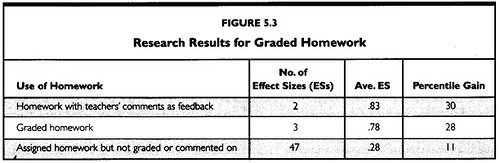
The average effect size for assigned-but-not-graded-or-commented-upon homework is .28; average effect size for graded homework is .78; average effect size for homework with teacher's comments or feedback is .83.
.83 is a very large effect size:
And, from Robert Coe, of The CEM Center:
As far as I can tell, collecting and correcting (which would cost nothing to implement in a school district not collecting and correcting) is a far more powerful force for student achievement than small class size (which costs a bundle) or SMART Boards ($4000 a pop).
So --- bonne idée!

source:
Class Size: Counting Students Can Help (pdf file)
Robert Marzano's book, which is published by the ASCD, is extremely well-known in the field of education.
HyperStat: Measuring Effect Size
The Effective Use of Effect Size Indices in Institutional Research by Christi Carson (pdf file)
Food for Thought by Howard S. Bloom (pdf file)
Statistical Power Analysis for the Behavioral Science by Jacob Cohen
Evidence-Based Education
What is an effect size? by Robert Coe
The Homework on Homework, Part One
Turns out the question of whether collecting and correcting homework produces more learning than simply assigning homework & not looking at it has been asked and answered.
Collect-and-correct wins hands down.
source:
Classroom Instruction that Works: Research-Based Strategies for Increasing Student Achievement by Robert J. Marzano, Debra J. Pickering, & Jane E. Pollock
The average effect size for assigned-but-not-graded-or-commented-upon homework is .28; average effect size for graded homework is .78; average effect size for homework with teacher's comments or feedback is .83.
.83 is a very large effect size:
Effect size = (mean of experimental group - mean of control group)/standard deviation Generally, the larger the effect size, the greater is the impact of an intervention. Jacob Cohen has written the most on this topic. In his well-known book he suggested, a little ambiguously, that a correlation of 0.5 is large, 0.3 is moderate, and 0.1 is small (Cohen, 1988). The usual interpretation of this statement is that anything greater than 0.5 is large, 0.5-0.3 is moderate, 0.3-0.1 is small, and anything smaller than 0.1 is trivial. There is a good site that describes all this that is worth a visit for those really interested.
source:
Bandolier
And, from Robert Coe, of The CEM Center:
Interpreting Effect Sizes
Provided our data have the kind of distribution shown in Figure 1 (a ‘Normal’ distribution), we can readily interpret Effect Sizes in terms of the amount of overlap between the two groups.
For example, an effect size of 0.8 means that the score of the average person in the experimental group exceeds the scores of 79% of the control group. If the two groups had been classes of 25, the average person in the ‘afternoon’ group (ie the one who would have been ranked 13th in the group) would have scored about the same as the 6th highest person in the ‘morning’ group. Visualising these two individuals can give quite a graphic interpretation of the difference between the two effects.
[snip]
Another way to interpret effect sizes is to compare them to the effect sizes of differences that are familiar. For example, an effect size of 0.2 corresponds to the difference between the heights of 15 year old and 16 year old girls in the US. A 0.5 effect size corresponds to the difference between the heights of 14 year old and 18 year old girls. An effect size of 0.8 equates to the difference between the heights of 13 year old and 18 year old girls.
What is an effect size? A brief introduction
Robert Coe

As far as I can tell, collecting and correcting (which would cost nothing to implement in a school district not collecting and correcting) is a far more powerful force for student achievement than small class size (which costs a bundle) or SMART Boards ($4000 a pop).
So --- bonne idée!
source:
Class Size: Counting Students Can Help (pdf file)
Robert Marzano's book, which is published by the ASCD, is extremely well-known in the field of education.
HyperStat: Measuring Effect Size
The Effective Use of Effect Size Indices in Institutional Research by Christi Carson (pdf file)
Food for Thought by Howard S. Bloom (pdf file)
Statistical Power Analysis for the Behavioral Science by Jacob Cohen
Evidence-Based Education
What is an effect size? by Robert Coe
The Homework on Homework, Part One
Sunday, March 16, 2008
Around the Edublogosphere: Homework #1, Homework #2, Classroom Management
Homework #1--How Mrs. Bluebird gets her students to do homework
Mrs Bluebird teaches middle school in a low SES school. A couple of years ago, she attended a national conference for middle school teachers, and came away with this gem.
One of the workshops that Mrs. Eagle and I attended was on increasing student motivation. As anyone who has ever taught middle school knows, these kids can be slugs. We had a lot of problems with kids turning in work, especially homework, and were looking at some innovative ways to motivate them. (I wish I could remember who the presenter was, but alas, I don't.) The presenter put forth a lot of good ideas, but the one that resonated with us was something we call the Homework Helper. He said that the number one reason kids don't do homework is because they don't understand it.
His solution is to give the kids the answers to the homework.
Okay, I know what you're thinking because you could have heard a pin drop in that room as we all looked at each other and went, "What????" Homework is, after all, practice. If a kid doesn't get it, and does the homework wrong (if he does it at all), then he's repeating the wrong thing. He's learning and remembering something that is wrong. However, if you give the kid a key to check the work, then they're doing it correctly, and learning it correctly.
Wouldn't it be great if all teachers were as insightful as Mrs. Bluebird?
Homework #2--Dana Huff wades into the studies on homework and achievement
It all started with a discussion over at The Teachers' Lounge on homework (Homework Myth? Kids Need a Break, Ban Bad Homework, Alfie Kohn Weighs In , Drudgery or the Pursuit of Knowledge, Spotlight on the Home, The Dichotomy of Homework, and a Final Word from Grant Wiggins).Dana Huff (who teaches high-school English at a private school) carried on with digging into the research on the value of homework. She and I share two frustrations:
1. What counts as homework? There doesn’t seem to be much rigor in the definition.The Blogger Formerly Known as RdKd, now blogging as Catching Sparrows, sums up the classroom management discussion
2. Does the age of the student affect the results? In other words, is homework equally effective in first grade and tenth grade?
You will have to go read her post to get her list of behavior expectations--for herself.I do, in fact, stand at the door between each period, but what is so illuminating about what Mr. K says is that I do often feel as if I’m establishing a contract with students in which certain behaviors will not be indulged in my classroom, and I know the other effective teachers out there do the same. Over at Joanne Jacobs, I commented about the gray areas between “show ‘em who’s boss” management styles and the fallacy that its only alternative is some sort of “let’s all gather and hold hands” soft approach.
It’s a social contract, with the heavier responsibilities and behavior restrictions actually lying (rightfully so) on the teacher’s shoulders. In return for the students’ agreement to behave civilly and responsibly, to communicate their needs and dissatisfaction in an appropriate manner, and to reject inappropriate behavior within the classroom walls, the teacher’s portion of my personal, internal contract (the one I relay to them through my actions throughout the year) reads something like this:
I have been observing a 4th grade student for one of my gradschool classes. In second grade, this young man had a host of behavior issues. Miss C., his teacher this year, is brilliant in several dimensions, not the least of which is classroom management. I don't know if Miss C. has a contract with her students similar to Catching Sparrow's, but she behaves as if she does. Miss C's classroom is a calm, orderly, respectful place. My young student is thriving and learning. Miss C's approach lets him stay out of frustration and fear, which means many, many fewer behavioral problems. Fewer behavioral problems means the student is experiencing academic success, which again contributes to better behavior.
Monday, February 18, 2008
l squared on "collect and correct"
I teach college, so I feel a little as though I shouldn't have to collect homework...but, of course, I do. If you don't collect it, they don't do it. Collecting the homework may be the single most effective thing I do to improve student learning. I don't check all the problems, just 2-4 representative ones, but it still makes a big difference.
Steve H on collecting and correcting
Friday, February 15, 2008
Steve on teachers, homework, and Extra Help
"I check to make sure they made the effort and tried the assignment while they check their answers, and we go over every single problem that is asked."
Do you collect the homework? You should. I did. I didn't grade each problem, but I saw what the issues were myself on a daily basis and I gave each homework a check/plus/minus effort grade. If you don't collect the homework and grade it somehow, then students don't have any incentive to do it in the first place. When I went over problems in class, I didn't have to rely on students to ask questions. Few do.
"How can you assume that it's a "teacher problem" when something isn't understood in class?"
How can you, the professional, assume that it isn't when you rely on the kids to tell you if there is a problem. You see and grade the tests. What do you do if students have major issues? By the time you get to a test, it's really difficult to go back and fix things. Perhaps eliminating homework and giving weekly quizzes would work better. Something other than monthly tests needs to push the students and inform the teacher about what is going on.
High school kids should take more responsibility, but you can't use that as a prerequisite for a good education. You have to try to structure things to prevent failure, not just leave it up to the kids.
Many students would NEVER come to my office hours. I never threw that back at them. I tried to think of ways to make it unnecessary for them to need extra help. Students hate going for extra help. It's a last resort. By then, the problem is really bad. A large use of extra help by many students implies that there is something fundamental going wrong, and it can't be blamed on the students.
Steve is on a roll today.
Having just finished Karen Pryor's Don't Shoot the Dog - a life-altering book - I've been thinking about this issue here at home.
We were reaching - had reached - the point at which I was using "aversives" to compel C. to get things done.
Of course I learned years ago, from behaviorists who taught us techniques for raising autistic kids, that aversives aren't very effective. Pryor goes further. Pryor argues, rightly I believe, that negatives have negative side effects.
A "negative reinforcer," by the way, increases the likelihood that a particular behavior will be repeated in the future. That's why it's called a "reinforcer," and that's what makes it different from a punishment. A punishment doesn't increase the likelihood of the punished behavior occurring in the future.
Unfortunately (or maybe fortunately), punishers also don't particularly decrease the likelihood of the behavior occurring again. Behaviorists universally seem to think that punishing bad behavior just is not an effective means of getting people to straighten up and fly right.
In theory, a negative reinforcer should be no different from a positive reinforcer; in both cases the behavior being reinforced is likely to be repeated. Thus doing your math homework to get a good grade should be no different from doing your math homework to avoid getting a bad grade.
But in reality, negative reinforcement has side effects. This is Pryor's view; I don't think this is a consensus view in the field. Pryor is a researcher and a trainer. Her many years of animal training have made her an advocate of the exclusive use of positive reinforcement.
More on side effects later.
Everything Steve has said in his comments thus far could have been written by Pryor. I think.
Here at home, I've been working on increasing positive reinforcement while reducing negative reinforcement and punishment.
Pryor is right: positives work far better than negatives.
Why is it so much more difficult to use them, I wonder?
Tuesday, December 4, 2007
Why I Don't Assign Homework
Liz Ditz left a link to Dy/Dan's blog.
I love this guy!
the homework problem
Here's what I love about Dy/Dan's post on not assigning homework.
First and foremost, not only has he thought out his position, he's researched it for a Master's thesis. The research is icing on the cake; the fact that he is so closely scrutinizing and adapting his "practice"* in response to his students' achievement is what makes me long to have a kid in his class.
Ed and I have been talking about the homework issue lately, mostly because C's social studies teacher told Ed he has students who never do their homework. We were both surprised to hear this though we shouldn't have been.** Kids not doing homework is a chronic issue for teachers everywhere.
Here's a Phi Delta Kappan article on the subject:
Jackson's idea is that the practice of having kids do largely pointless homework assignments in K-5 in order to build "good homework habits" leads instead to homework refusal when kids reach middle school age and begin to assert themselves. Homework inoculation.
So....the cure for h.s. kids not doing homework is to get rid of homework K-5.
I'm sure that will work.
This is the kind of thing that makes me want to send this fellow a link to Karen Pryor's web site. Pryor makes short shrift of such motive mongering. She doesn't care to learn why a dog is behaving badly; she doesn't want to hear his history:
Animal behaviorists make a useful distinction between ethology and psychology.
You do need to know ethology (how does this species act & think?)
You don't need to know much about psychology (how does this particular animal act and think, and why?)
When it comes to students not doing their homework, all you really need to know is that procrastination is a core human behavior that is not going to be conquered any time soon and certainly not by high school students. Asking students what they are thinking when they fail to spend 50 minutes a night doing geometry homework is absurd. They're not thinking about geometry one way or the other. That's the point.
This teacher needs to forget about what students are thinking and ask the school to send a behavior analyst to his class to change the incentives. A mere amateur like myself can spot some major de-motivators in his data.
If he can't round up a professional, he should read a book on behavior analysis and figure it out himself. ***
The "homework situation" appears to be an unholy mess. Setting aside the question of homework quality, I would like to see schools adopt policies of supervised homework like the one in place at La Salle High School. If a student is not getting homework done at home, I would assign him to a supervised homework study hall where he would get it done because a responsible adult would see to it. And I would make this a positive experience, not negative.
If I had my druthers, our schools would drop-kick the many state-mandated character-ed implementations over the stadium wall and replace them with school-wide positive behavior plans devised by the Bob and Lynn Koegels of this world.
Or else just hire a whole lot of teachers like Dy/Dan.
* hate that word, but it's correct in this context
** I have no business being surprised by any failure to complete assigned work...
*** I'm starting with Karen Pryor's Don't Shoot the Dog, which I will be using for my kids and for me.
I love this guy!
the homework problem
Here's what I love about Dy/Dan's post on not assigning homework.
First and foremost, not only has he thought out his position, he's researched it for a Master's thesis. The research is icing on the cake; the fact that he is so closely scrutinizing and adapting his "practice"* in response to his students' achievement is what makes me long to have a kid in his class.
Ed and I have been talking about the homework issue lately, mostly because C's social studies teacher told Ed he has students who never do their homework. We were both surprised to hear this though we shouldn't have been.** Kids not doing homework is a chronic issue for teachers everywhere.
Here's a Phi Delta Kappan article on the subject:
I tried to figure out why promising students in my own geometry classes persistently failed. Every year students entered my classes not fully prepared for the large body of new concepts, vocabulary, skills, and logical principles that are central to a college-prep geometry course. With rare exceptions, the deficiencies were surmountable, provided that these students accepted the need to study and work on sample problems outside of class. But, despite a claimed orientation toward college, many of them failed geometry, in large part because of "homework resistance" that seemed rooted in early elementary school and shaped by adolescent identity pressures.Occasional missed geometry assignments weren't a big deal in my classes. After all, an unknowable but surely substantial portion of completed homework involved copying from classmates. An additional portion consisted of "homework simulations" with correct answers to odd-numbered problems (which have answers in the back of the book) embellished with jottings that gave the appearance of work. So, like most of my colleagues, I gave credit for homework but based most of a student's grade on tests, quizzes, and in-class projects. Class time was an intense geometry experience for all but the most tuned-out. But since test questions looked remarkably similar to those covered in homework, students who didn't do the homework had trouble passing tests or participating fully in class.
At year's end, out of 90 geometry students in three sections, 38 had completed less than 60% of the assignments. Of these 38, two quite talented students managed to earn a semester grade of C, another three earned D's, and the remaining 33 all earned F's. In contrast, all but a handful of the students who had completed 80% or more of the assignments passed with grades of C or better.
The puzzle. Why would so many students willingly waste a year sitting through geometry class and earn zero credits toward graduation? All had managed to pass algebra, and many even had good attendance in my class. Most had the requisite mathematical ability and would have passed had they spent 40 to 50 minutes daily outside of class on the homework. Free tutoring and homework help were available at lunch and after school, but no one showed up more than once or twice; most never came at all. What were they thinking? Countless frustrating conversations convinced me that most students in this situation can't tell you the teal reasons for their behavior, because they themselves don't know. They offer a charming variety of excuses, evasions, defensive maneuvers, mea culpas, and doleful expressions, many well practiced from prior confrontations with parents or counselors. Almost all say that to succeed they would need to start doing all their homework. They further insist that they want to be successful. So what's going on that students can't explain to us - or to themselves?
Homework Inoculation and the Limits of Research
Bruce Jackson
Phi Delta Kappan Sep 2007 Vol. 87, Iss. 1 pg. 55
Jackson's idea is that the practice of having kids do largely pointless homework assignments in K-5 in order to build "good homework habits" leads instead to homework refusal when kids reach middle school age and begin to assert themselves. Homework inoculation.
So....the cure for h.s. kids not doing homework is to get rid of homework K-5.
I'm sure that will work.
This is the kind of thing that makes me want to send this fellow a link to Karen Pryor's web site. Pryor makes short shrift of such motive mongering. She doesn't care to learn why a dog is behaving badly; she doesn't want to hear his history:
Karen helped me learn to read Ben's canine signals accurately, unhindered by my own emotion....She was the one, who during one of Ben's fits in class, came over, gently put her hand on my arm and calmly said, "Emma, it is only behavior."
"Only behavior?" I gasped. Could it be so simple? This "behavior" had caused me so much grief in my life, both personally and professionally. It had become a source of tension in my marriage and almost caused me to lose several friendships....I had allowed Ben's aggression to balloon into a problem that took over our lives. I found hope that night in class, with Karen's calm words: "It's only behavior." After all, through positive reinforcement, behavior--any behavior--can be changed.
Click to Calm Healing the Aggressive Dog
by Emma Parsons
Animal behaviorists make a useful distinction between ethology and psychology.
You do need to know ethology (how does this species act & think?)
You don't need to know much about psychology (how does this particular animal act and think, and why?)
When it comes to students not doing their homework, all you really need to know is that procrastination is a core human behavior that is not going to be conquered any time soon and certainly not by high school students. Asking students what they are thinking when they fail to spend 50 minutes a night doing geometry homework is absurd. They're not thinking about geometry one way or the other. That's the point.
This teacher needs to forget about what students are thinking and ask the school to send a behavior analyst to his class to change the incentives. A mere amateur like myself can spot some major de-motivators in his data.
If he can't round up a professional, he should read a book on behavior analysis and figure it out himself. ***
The "homework situation" appears to be an unholy mess. Setting aside the question of homework quality, I would like to see schools adopt policies of supervised homework like the one in place at La Salle High School. If a student is not getting homework done at home, I would assign him to a supervised homework study hall where he would get it done because a responsible adult would see to it. And I would make this a positive experience, not negative.
If I had my druthers, our schools would drop-kick the many state-mandated character-ed implementations over the stadium wall and replace them with school-wide positive behavior plans devised by the Bob and Lynn Koegels of this world.
Or else just hire a whole lot of teachers like Dy/Dan.
* hate that word, but it's correct in this context
** I have no business being surprised by any failure to complete assigned work...
*** I'm starting with Karen Pryor's Don't Shoot the Dog, which I will be using for my kids and for me.
Wednesday, November 14, 2007
My new favorite quote...
...when asked why students need to practice spelling words and master math facts:
Practice makes permanent.
Practice makes permanent.
Thursday, October 11, 2007
uh-oh
So Ed spent hours the other night helping the son of a friend of ours with a social studies writing assignment.
Mom just called.
Son got a C.
Ed is so not going to be happy.
Of course, he's doing better than I am. I got a C- in Earth Science on my article summary, which I co-wrote with my child.
I'm thinking it's just possible that the whole Literacy thing, which appears to be happening in every nook and cranny of our country, may finally be the thing that does in public schools. There are a whole lot of parents out there who aren't going to be thrilled to see their kids bringing home inexplicable Cs and Ds on papers their parents had to co-write because their kid didn't have a clue where to start.
Remember the British historian?
Getting her C+ in Connecticut?
btw, we now know for a fact that we've had intentional grade deflation here in Irvington. The Phase 4 teacher, back in 6th grade, was told "to keep her grades down."
The issue wasn't that her grades were too high. Her grades were low. (In one of her years, as I recall, she was having class averages in the 70s and perhaps even the 60s once or twice.)
She was told to keep her grades down, period.
Parents and students weren't informed.
We are now going to be experiencing harsh, punitive grading of writing, too, it appears.
oh, yay
grade deflation in high schools
Susan's book, What High Schools Don't Tell You says a lot of high schools deliberately use grade deflation in 9th grade (must find the passage).
Her advice is to find out whether your school has a grade deflation policy and, if so, to tell them to top doing it.
That'll work.
update
hmmm....
Don't see the passage now.
Mom just called.
Son got a C.
Ed is so not going to be happy.
Of course, he's doing better than I am. I got a C- in Earth Science on my article summary, which I co-wrote with my child.
I'm thinking it's just possible that the whole Literacy thing, which appears to be happening in every nook and cranny of our country, may finally be the thing that does in public schools. There are a whole lot of parents out there who aren't going to be thrilled to see their kids bringing home inexplicable Cs and Ds on papers their parents had to co-write because their kid didn't have a clue where to start.
Remember the British historian?
Getting her C+ in Connecticut?
btw, we now know for a fact that we've had intentional grade deflation here in Irvington. The Phase 4 teacher, back in 6th grade, was told "to keep her grades down."
The issue wasn't that her grades were too high. Her grades were low. (In one of her years, as I recall, she was having class averages in the 70s and perhaps even the 60s once or twice.)
She was told to keep her grades down, period.
Parents and students weren't informed.
We are now going to be experiencing harsh, punitive grading of writing, too, it appears.
oh, yay
grade deflation in high schools
Susan's book, What High Schools Don't Tell You says a lot of high schools deliberately use grade deflation in 9th grade (must find the passage).
Her advice is to find out whether your school has a grade deflation policy and, if so, to tell them to top doing it.
That'll work.
update
hmmm....
Don't see the passage now.
ditto that
from Susan S:
As it happens, Lynn G gave me this recommendation just a couple of days ago:
I like the Volume Library from Southwestern. It's almost better than an encyclopedia, as it is arranged by topic, not alphabetically. It is designed to give you all of the background knowledge for a k-12 curriculum in 3 volumes. The reproducible maps are almost worth the price all by themselves.
That one's going on the credit cards pronto.
My favorite grade school assignments are when they have to write something and are told to use the Internet for "research." They can't scan, they can't extrapolate a main idea, they can't summarize, but they are told to use the vast world of the Internet before they put together their assignment.
I'm beginning to appreciate our little World Book and Britannica encyclopedias.
As it happens, Lynn G gave me this recommendation just a couple of days ago:
I like the Volume Library from Southwestern. It's almost better than an encyclopedia, as it is arranged by topic, not alphabetically. It is designed to give you all of the background knowledge for a k-12 curriculum in 3 volumes. The reproducible maps are almost worth the price all by themselves.
That one's going on the credit cards pronto.
Saturday, October 6, 2007
kitchen table fear & loathing
from the Wall Street Journal:
Even better:
First line in the article:
Me, too.
Having a kid in the middle school is misery. In August, facing the prospect of another year dealing with the place, I had bad dreams. I was thinking that was nuts, until I talked to a mom I hadn't seen in a while, who said she was having bad dreams, too.
That's what you pay the big bucks for, I guess.
Ed and I may have had the single worst fight of our entire married life over homework, come to think of it.
Maybe I'm missing something, but when did schools determine that the best place for kids to learn math, science and English is at their own kitchen table?
Even better:
I'm not sure when it happened, but at some point U.S. schools decided that if you can't teach 'em, test 'em...or pile on more homework.
First line in the article:
I hate school!
Me, too.
Having a kid in the middle school is misery. In August, facing the prospect of another year dealing with the place, I had bad dreams. I was thinking that was nuts, until I talked to a mom I hadn't seen in a while, who said she was having bad dreams, too.
That's what you pay the big bucks for, I guess.
Yes, I know that's a bit immature for someone 41 years old. But it's true. I hate school -- so much so that my wife, Amy, and I have hired a college student to help our fifth-grade son manage his schoolwork a few times a week.
It's not that we can't do the work with him, or that we don't want to. Just this evening we helped him study for a reading test, and over the weekend I was quizzing him on customary and metric units of measurement one day and biological definitions the next.
No, it's that the volume of homework and tests that fill his docket is, in a word, ridiculous.I'm not sure when it happened, but at some point U.S. schools decided that if you can't teach 'em, test 'em...or pile on more homework.
The result is that my son's life -- and by extension our family life -- is a constant, stress-laden stream of homework and tests and projects. It overshadows everything we do, always hanging over our head. It affects our weekends, our meals, our vacations, our work time, our playtime, our pocketbooks.
And to what end? Maybe I'm missing something, but when did schools determine that the best place for kids to learn math, science and English is at their own kitchen table?
Yes, I know that's a bit immature for someone 41 years old. But it's true. I hate school -- so much so that my wife, Amy, and I have hired a college student to help our fifth-grade son manage his schoolwork a few times a week.It's not that we can't do the work with him, or that we don't want to. Just this evening we helped him study for a reading test, and over the weekend I was quizzing him on customary and metric units of measurement one day and biological definitions the next.
[snip]
But the level of homework and anxiety my son deals with on a daily basis is well beyond anything healthy. And from talking to other parents, this problem is hardly unique to our family.Amy and I knew there was a problem several weeks ago when our son brought home a D and a C. This was the first time that he earned anything less than a B. And then, a week later, another D.
At first we were mad. He's just not paying attention to the questions; he's rushing through the tests; he's being careless. We quizzed him before the test and again afterward. How is it that he can know the information before and after, yet not during?
It turns out he's stressed out. He told Amy that he wishes he could do better. But he already wakes up on school days between 4 a.m. and 5 a.m., panicked that he doesn't know the material he has already studied. He wakes up Amy to help him go over his notes one more time. He studies in the car on the way to school. Some nights he's up past 10 p.m., writing, reading or memorizing. He spends parts of many weekends reading and doing projects.
Then he sees the Ds and Cs and gets dejected, wondering how he could possibly study any harder or any longer.
The truth is, he can't. His childhood is already all but consumed by textbooks, notebooks and flashcards.
Bermuda triangle
Compounding the problem, as Amy says, is that this barrage of schoolwork "is killing our family." Amy says it makes her "feel like the worst mom in the world." Here's why: Many times our efforts to help our son lead to short tempers and blown fuses because at some point he simply has had enough of all this studying. He just wants to be outside on a Saturday, but he's stuck inside on a project, or reciting the synonyms and antonyms to justify, villain and abandon.
One of Amy's colleagues calls it the Bermuda Triangle, because first the child gets mad, then the parent helping gets mad, and then the parent listening to the meltdown gets mad.
source:
Homework is Hurting Our Family
Ed and I may have had the single worst fight of our entire married life over homework, come to think of it.
help desk - homework proposal for the site committee
A couple of weeks ago, I attended my first site committee meeting a week ago, thanks to the efforts of two activist parents and the PTSA. (The PTSA here has been great, by the way. They're working on openness, communication, information flow --- great, great job).
Anyway, thanks to two activist parents (that I know of), the PTSA, and the newly constituted school board, we can now attend site committee meetings.
Which was always our right by law, but never mind.
The first meeting was devoted to choosing an agenda for the year, so the principal came prepared with a long list of possibilities.
One was "homework."
Some parents want less homework, he said. (I'm in this faction.)
Some parents want more homework.
So....homework. That could be a focus.
I'm going to put together a homework proposal for the site committee to consider and reject, and I'd like some help. (Yes! You, too, can be thanked for your input, without even having to live here.)
Roughly, here's what I'm thinking.
The site committee could put together a voluntary pilot project to gather information about homework.
Specifically (I'm thinking) what you need to know about each homework assignment is this:
I don't think it would be too hard to figure this out.
You could include, with some (most? all?) homework assignments, a simple set of questions, the answers to which could function as a survey of sorts, or a diagnostic assessment.
The sheet might list:
I would set this up as a pilot program, asking for teacher volunteers. You'd want to start with your most confident and competent teachers, because you'd want to set things up to succeed.
You wouldn't force students and parents to participate, either, but if the feedback proved valuable, you might want to help students develop a habit of tracking their time to the extend they are able. (I still don't understand time myself; I have no idea how long tasks take, and constantly underestimate the time involved in this or that commitment.)
Most middle school kids could probably handle these questions on their own, though it would be better if parents monitored the time recording.
I would start this pilot program by telling people that the school wants to look at what's going on with homework, ability grouping, differentiated instruction, etc.
I'd invite people to make suggestions about questions to include.
I would ask for volunteers (teachers, parents, students).
I would share all data with any parent, teacher, resident, or citizen who wished to take a look, removing student names, of course.
I might also ask for volunteers to run some statistical analyses, or advise on ways to analyze it correctly.
That's as far as I've gotten------what do you think?
And: how would you analyze the information that came back?
from instructivist:
This, the middle school is either doing or trying to do - except for Math A and Earth Science. The Earth Science teacher has free rein to "work the kids" (direct quote), because "this is a high school course."
from anonymous:
I wonder whether there is a way to blind the answers.... because this Commenter is right; most parents don't want to say, "My kid took two hours to do this assignment."
I'm an outlier in this respect, and I can only get away with it because Ed and I both have Ph.D.s & because C. is a pretty good student with no "issues" etc. -- and because we've had it up to here with the b*s, and everyone knows it. Somehow, the message has been conveyed that if it's taking C. 2 hours to do 10 math problems, we're not interested in hearing that there's something wrong with him.
This isn't a normal relationship to have with your school.
2.
What do people feel about vocal minorities?
I probably like vocal minorities just fine.
Dunno.
Anyway, thanks to two activist parents (that I know of), the PTSA, and the newly constituted school board, we can now attend site committee meetings.
Which was always our right by law, but never mind.
The first meeting was devoted to choosing an agenda for the year, so the principal came prepared with a long list of possibilities.
One was "homework."
Some parents want less homework, he said. (I'm in this faction.)
Some parents want more homework.
So....homework. That could be a focus.
I'm going to put together a homework proposal for the site committee to consider and reject, and I'd like some help. (Yes! You, too, can be thanked for your input, without even having to live here.)
Roughly, here's what I'm thinking.
The site committee could put together a voluntary pilot project to gather information about homework.
Specifically (I'm thinking) what you need to know about each homework assignment is this:
Could the student complete the assignment in a reasonable period of time, without assistance, and do a good job?
That is to say: could the student complete the assignment in a reasonable period of time, without assistance, and receive a grade of 90 or above?
I don't think it would be too hard to figure this out.
You could include, with some (most? all?) homework assignments, a simple set of questions, the answers to which could function as a survey of sorts, or a diagnostic assessment.
The sheet might list:
- homework assignment & date
- start time (when child began work on assignment)
- finish time (when child finished work on assignment)
- one question: did child need help to do this assignment?
- grade received (and...uh...yes, this would require whatever teacher piloted the system actually to collect and correct homework)
I would set this up as a pilot program, asking for teacher volunteers. You'd want to start with your most confident and competent teachers, because you'd want to set things up to succeed.
You wouldn't force students and parents to participate, either, but if the feedback proved valuable, you might want to help students develop a habit of tracking their time to the extend they are able. (I still don't understand time myself; I have no idea how long tasks take, and constantly underestimate the time involved in this or that commitment.)
Most middle school kids could probably handle these questions on their own, though it would be better if parents monitored the time recording.
I would start this pilot program by telling people that the school wants to look at what's going on with homework, ability grouping, differentiated instruction, etc.
I'd invite people to make suggestions about questions to include.
I would ask for volunteers (teachers, parents, students).
I would share all data with any parent, teacher, resident, or citizen who wished to take a look, removing student names, of course.
I might also ask for volunteers to run some statistical analyses, or advise on ways to analyze it correctly.
That's as far as I've gotten------what do you think?
And: how would you analyze the information that came back?
from instructivist:
I think teachers of rotating classes should coordinate the amount of homework assigned to prevent overloading. Teachers tend to forget that they are not the only ones assigning homework.
Homework should also be meaningful practice of what's being learned and not be wasteful busywork.
This, the middle school is either doing or trying to do - except for Math A and Earth Science. The Earth Science teacher has free rein to "work the kids" (direct quote), because "this is a high school course."
from anonymous:
Homework quality and quantity is always a topic that generates a lot of parental discussion. PTA has a guideline about it; I think it was 10min X grade level for time. The Wall Street Journal had piece about h.w. recently too.1.
On the survey: Right now I have 4 things nightly to sign between 2 children besides the responsibility of checking the fifth grader's h.w. and reteaching if necessary as well as digging up art supplies when some teacher assigns a time consuming craft project as part of a 'multiple intelligence' assessment. I wouldn't want another piece of paper to fill in unless I knew a) that my answers would not be held against my child and b) the results would be representative of everyone, not just the concerns of a vocal minority.
What I'd like to see is no homework for Gr. 6 - 12 other than a research paper, assigned reading, projects with an academic not arts/crafts purpose and instrumental music practice. The remaining time would be used for studying and enriching extracurriculars, and be determined by the student's needs.
As it stands now, if my child realizes he didn't understand a point in the math lesson, or he would like to read the science text, he has no time to do so because he must allocate the rest of the evening to the multiple intelligence homework, word searches, literature novel, and projects as well as make sure all notebooks will pass the forthcoming but unannounced 'notebook quiz'.
Other things I'd like to see: no homework over vacations. No assignments without a grading rubric, no class without a syllabus - in other words, expectations need to be clear and stated up front.
My final h.w. request: assignments that change from year to year so that the lil' sibs don't have such a big advantage over the noobs.
I wonder whether there is a way to blind the answers.... because this Commenter is right; most parents don't want to say, "My kid took two hours to do this assignment."
I'm an outlier in this respect, and I can only get away with it because Ed and I both have Ph.D.s & because C. is a pretty good student with no "issues" etc. -- and because we've had it up to here with the b*s, and everyone knows it. Somehow, the message has been conveyed that if it's taking C. 2 hours to do 10 math problems, we're not interested in hearing that there's something wrong with him.
This isn't a normal relationship to have with your school.
2.
What do people feel about vocal minorities?
I probably like vocal minorities just fine.
Dunno.
Thursday, October 4, 2007
Homework for parents has come out of the closet . . .
. . . and is on full display in a school in New Jersey.
The parents of Damion Frye’s ninth-grade students are spending their evenings this fall doing something they thought they had left behind long ago: homework.
So far, Mr. Frye, an English teacher at Montclair High School, has asked the parents to read and comment on a Franz Kafka story, Section 1 of Walt Whitman’s “Song of Myself” and a speech given by Robert F. Kennedy in 1968. Their newest assignment is a poem by Saul Williams, a poet, musician and rapper who lives in Los Angeles. The ninth graders complete their assignments during class; the parents are supposed to write their responses on a blog Mr. Frye started online.
If the parents do not comply, Mr. Frye tells them, their child’s grade may suffer — a threat on which he has made good only once in the three years he has been making such assignments.
I don’t even know what to say. Except, most parents have meekly accepted this. BE AFRAID, BE VERY AFRAID.
The voice of reason:
“Common educational wisdom is that you don’t assign homework that kids can’t do on their own,” she said.
Catherine here, diving into Tex's post.
Tex has just inspired my first full-length Irvington Parents Forum op-ed of the school year.
And, let me just add that Mr. Frye is extremely lucky he does not work in Irvington.
We'd make short work of Mr. Frye.
The parents of Damion Frye’s ninth-grade students are spending their evenings this fall doing something they thought they had left behind long ago: homework.
So far, Mr. Frye, an English teacher at Montclair High School, has asked the parents to read and comment on a Franz Kafka story, Section 1 of Walt Whitman’s “Song of Myself” and a speech given by Robert F. Kennedy in 1968. Their newest assignment is a poem by Saul Williams, a poet, musician and rapper who lives in Los Angeles. The ninth graders complete their assignments during class; the parents are supposed to write their responses on a blog Mr. Frye started online.
If the parents do not comply, Mr. Frye tells them, their child’s grade may suffer — a threat on which he has made good only once in the three years he has been making such assignments.
I don’t even know what to say. Except, most parents have meekly accepted this. BE AFRAID, BE VERY AFRAID.
The voice of reason:
“Common educational wisdom is that you don’t assign homework that kids can’t do on their own,” she said.
Catherine here, diving into Tex's post.
Tex has just inspired my first full-length Irvington Parents Forum op-ed of the school year.
And, let me just add that Mr. Frye is extremely lucky he does not work in Irvington.
We'd make short work of Mr. Frye.
Friday, September 7, 2007
“Triplets” Homework, Part 2
I have learned more about the troublesome triplets homework of my previous post.
In response to my questions, the teacher informed me that she had clearly stated to the class that it was just something for them to try, not to worry if they can’t get the answers. I’m assuming my daughter didn’t hear those instructions, or misunderstood. She usually tries hard to do her best on her homework, and typically becomes quite unhappy when she has to struggle to complete her work.
In addition, I was informed the triplets homework was not an “academic assignment”. Ding, ding, ding! Okay, I’m a little slow, but I think I get it now. Apparently, there are two types of homework -- “academic” and “non-academic”. As the prayer says, I can only hope for the “wisdom to know the difference”. It can be very difficult to tell sometimes.
As some commenters on my initial post noted, there seems to be a growing trend of schools telling us how to spend our home time in activities that have no real bearing on academic learning. Do they think this a way to encourage parental support? I’m with the crowd that says to the schools please just focus on academics. I’ll decide how I want to spend our family time.
Anyway, after all this, I decided that playing the “triplets game” can actually be fun. (I have a vague recollection that there is a board game based on this premise.) For this triplet - “cross, wood, blooded” – I struggled a bit before I settled upon “red” as the correct answer. However, I liked my daughter’s response much better. She confidently answered “Jesus”. Her explanation? He died on a cross, it was wood and it was blooded all over. Somehow, I don’t think this is the answer the school was expecting. :-)
In response to my questions, the teacher informed me that she had clearly stated to the class that it was just something for them to try, not to worry if they can’t get the answers. I’m assuming my daughter didn’t hear those instructions, or misunderstood. She usually tries hard to do her best on her homework, and typically becomes quite unhappy when she has to struggle to complete her work.
In addition, I was informed the triplets homework was not an “academic assignment”. Ding, ding, ding! Okay, I’m a little slow, but I think I get it now. Apparently, there are two types of homework -- “academic” and “non-academic”. As the prayer says, I can only hope for the “wisdom to know the difference”. It can be very difficult to tell sometimes.
As some commenters on my initial post noted, there seems to be a growing trend of schools telling us how to spend our home time in activities that have no real bearing on academic learning. Do they think this a way to encourage parental support? I’m with the crowd that says to the schools please just focus on academics. I’ll decide how I want to spend our family time.
Anyway, after all this, I decided that playing the “triplets game” can actually be fun. (I have a vague recollection that there is a board game based on this premise.) For this triplet - “cross, wood, blooded” – I struggled a bit before I settled upon “red” as the correct answer. However, I liked my daughter’s response much better. She confidently answered “Jesus”. Her explanation? He died on a cross, it was wood and it was blooded all over. Somehow, I don’t think this is the answer the school was expecting. :-)
Subscribe to:
Posts (Atom)