kitchen table math, the sequel

Monday, August 3, 2009

guerilla instructivism, part 3

from Exo:
Yes, we cover up. I taught in NY, middle school. Workshop model prescribed, word walls, bulletin boards, not more than 20% of premade or teacher-made posters, the rest -students work... No seats in rows! No teacher talking longer than 10 minutes! Teach the whole child, not the subject.. etc, etc, etc. I was shushed by my more experienced and well-meaning fellow teachers from even saying "direct instruction" aloud. So when talking to my principal about what I do, and writing up the course descriptions I used "problem-solving", "case study method", guided discovery" to cover for my very direct teaching. Well, since my results in regents passing were good, the principal seleted to ignore my classroom when walking around the building, but I was warned beforehand about any external visitors so I could move the desks from rows into groups, and do a lab...

from Redkudu:
Not only does guerilla teaching live, but I'm required to have my lesson plans in a binder on the desk for any passing visitations by admin.

And, due to past experience, I now have a system of code in which my lesson plans look one way (constructivist), but the lesson goes another. Never yet had anyone complain because, I think, they truly don't know what they're looking at.

Coalition for World Class math on Twitter

here

Here's the Facebook page.

CA World Class Math

Web site is up this morning.

You may want to sign the letter.


CA Coalition for World Class Math
CO Coalition for World Class Math
CT Coalition for World Class Math
NJ Coalition for World Class Math
PA coalition for World Class Math
United States Coalition for World Class Math
Parents' Group Wants to Shape Math Standards

Common Core Standards: Who Made the List?

6.30.2009 Parents Group Wants to Shape Math Standards
7.1.2009
Common Core Standards: Who Made the List?
7.14.2009
‘Common Core’ Initiative: Who’ll Make Decisions? (Jill Gladstone, Timotha Trigg)
7.24.2009 
A Look at the Promises and Challenges of Common Standards—UPDATED
7.30.2009
Transparency of Common-Standards Process at Issue

Core Knowledge: Voluntary National Standards Dead on Arrival

I've just gotten the Core Knowledge post re: the National Governors Association and the Council of Chief State School Officers standards from Robert Pondiscio:
Written By: Robert Pondiscio Blogger
23-7-09
Categorized in: Education


A draft of the newly developed common core state standards purports to offer “sufficient guidance and clarity so that they are teachable, learnable and measurable,” however the ELA guidelines offer almost no specific content and little that would be of use to teachers in planning lessons–or parents in understanding what their child is expected to know.

Copies of the draft, an effort spearheaded by the Council of Chief State School Officers (CCSSO) and the National Governors Association (NGA) have begun circulating among reviewers. A copy found its way to me without any restrictions on its use or circulation. I have posted the draft document here.

The draft insists that the voluntary standards be “coherent” but defines coherence to mean they “should convey a unified vision of the big ideas and supporting concepts within a discipline and reflect a progression of learning that is meaningful and appropriate.” Framed as a series of benchmarks students must reach “to be college and career ready,” the draft enumerates standards such as the ability to “determine what text says explicitly and use evidence within text to infer what is implied by or follows logically from the text.”

To put this as blandly as possible, this is neither a revelatory insight nor a meaningful standard. Educators hoping for guidance on what particular texts are expected to be taught, or how to get students to reach the bland and obvious standards will be disappointed. On specific “texts” the draft says merely:

The literary and informational texts chosen should be rich in content….This includes texts that have broad resonance and are referred to and quoted often, such as influential political documents, foundational literary works, and seminal historical and scientific texts.

“At first glance, these language standards are, despite the brave descriptors, very similar to the dysfunctional state standards already in place,” notes Core Knowledge founder E.D. Hirsch, Jr. “Like most state standards, they naively take a formalistic approach to language ability. They assume that the ability to understand literary and informational language is chiefly a how–to skill, whereas it is chiefly a topic-dependent skill that varies with specific topic familiarity.”

A sample scientific text on covalent bonds in the draft document, Hirsch notes, is a “a good illustration of this general point. Will it be more useful for understanding such texts to spend class time teaching some will-o-the-wisp language proficiency or to impart a good general education in science and the humanities?

“One begins to despair,” Hirsch concludes.

Speaking as a parent who has had to enroll her son in a Jesuit high school to provide him a liberal education, I do not want to hear that E.D. Hirsch is beginning to despair.

Disciplinary specialists, of whom E.D. Hirsch is one, need to be writing these standards.

too much knowledge

Comment on Curriculum Matters:
My problem with any of these standards is that they are too focused on knowledge learned rather than basic learning process skills. Learning these 100 things about algebra or these 100 things about American history is not the point and just forces kids to learn a bunch of stuff that they may not be interested in, or that prevents them from learning other stuff they might be interested in.

Meanwhile Core Knowledge has apparently called the draft "Dead on Arrival," though you can't read the post because the Core Knowledge blog is down.

I'm taking my cues from E.D. Hirsch.

Sunday, August 2, 2009

stakeholders

To the Editor:

Your June 17, 2009, article on national standards discusses the virtual exclusion so far of the National Council of Teachers of Mathematics, the National Council of Teachers of English, and the International Reading Association from the Common Core State Standards Initiative. But the exclusion of other key stakeholders also must be addressed.

First is the exclusion of authentic subject-matter groups from the “Common Core” decisionmaking process that determines what is in the final document. Anyone proposing to create mathematics and English-language-arts standards must enlist and pay heed to the expertise of true subject-area experts. Members of the American Mathematical Society, the Mathematical Association of America, appropriate engineering societies, and the Association of Literary Scholars and Critics should be allowed to provide input.

In addition to being true experts in their fields, college and university professors are in the best position to inform standards-writing committees about what high school graduates need to know and be able to do for success in credit-bearing college-level courses. It is well documented that community colleges nationwide have freshman remediation rates of more than 70 percent in math and English. Clearly, the community college stakeholders must have a seat at the standards-writing table.

Tax-paying parents are another important stakeholder group absent from the Common Core project. Yet the ultimate responsibility for ensuring that children receive a proper education rests with them. It is they who must closely monitor the success of students and schools, and it is they who must pay the price—in dollars and in anguish—when inadequate standards leave children ill-prepared for college or the workplace. Dozens of grassroots parent groups have sprung up in the past decade to advocate for improvements in mathematics education in the public schools. Our group, the United States Coalition for World Class Math, is just one of these.

Before mathematics standards for K-12 are finalized, the National Governors Association and the Council of Chief State School Officers should make room at the table for one of the most important education constituencies in the country: the parents of children in our public schools.

Amy Flax
Westfield, N.J.
Jill Gladstone
Bridgewater, N.J.
Sarah-Kate Maskin
Ridgewood, N.J.
Renata Pestic
Oradell, N.J.
Timotha Trigg
Chadds Ford, Pa.

The writers are co-founders of the United States Coalition for World Class Math.

Vol. 28, Issue 36, Pages 26-27


CO Coalition for World Class Math
CT Coalition for World Class Math
NJ Coalition for World Class Math
PA coalition for World Class Math
United States Coalition for World Class Math
Parents' Group Wants to Shape Math Standards

Common Core Standards: Who Made the List?
Education Week coverage:
6.30.2009 Parents Group Wants to Shape Math Standards
7.1.2009 Common Core Standards: Who Made the List?
7.14.2009 ‘Common Core’ Initiative: Who’ll Make Decisions?
7.30.2009
Transparency of Common-Standards Process at Issue

1.12.2007 how politics work

guerilla instructivism, part 2

[A parent] wouldn't know of "guerrilla instructivists" because if they WERE known, they would be disciplined, transferred, or fired (or all of the above). I doubt if a single parent of the hundreds of students I've taught in the last 10 years would regard me as a guerrilla instructivist, nor do any of them, in all likelihood, know that I am using DI and other non-approved practices and curricula. I use the same lingo as everyone else, reporting on "shared reading," "making meaning" and whatnot, but I mean different things by those terms and use empirically-validated materials and methods to achieve the goals.

If I were to "come out," I would certainly be disciplined, probably moved to a position where I couldn't do any of the things I am doing.

....The fact is that methods, materials, instructional practices and use of teaching time is often prescribed at the district level, with no teacher input, even down to the last minute, and classrooms are searched for materials that are deemed inappropriate. Teachers have very little say in what and how to teach. They certainly can't do things like, junk Guided Reading and do DI (pdf file) instead. Teachers must follow the established protocols. They are lower-level employees, not independent contractors.

....Small districts tend to be more responsive to their clientele.* The real edu-nazis are in large urban districts, where they have a population that they can manipulate, ignore or work around, and who rarely are politically active and almost never in an effective manner. The administration runs the show. Teachers, like me, who strongly disagree with what is being done have to fly under the radar. Kind of like being in the Underground in WW2. You need a good "cover," and you must under no circumstances let on what you are actually doing.

Of course many who want to teach effectively throw in the towel and go to the private sector. I have given this serious consideration from time to time, but am stopped by the realization that in the private sector I will not be able to serve the population I do now. Every year I rescue a few off the Titanic, in spite of administration, curriculum and other impediments. Their parents don't know, the admin doesn't know (everyone can chalk it up to sudden "development.")

But I know.

So I am still here. But if you were a parent in my school, you would not know that I was a guerilla instructivist. You wouldn't know who the others are, either.

This reminds me of my days writing for New Woman Magazine. I used to lace my articles with all manner of rupturous, pro-male sentiments, but I'd cloak my heresies in proper language and tone and I'd usually get away with it.


* not in my experience, but I haven't been able to discover whether my district is unusual

palisadesk on guerilla instructivism

You talk about a long list of readiness characteristics in your district, but what about ed schools? You talk about a long list of readiness characteristics in your district, but what about ed schools?

In my area the 2 major ed schools focus on "big ideas" like diversity, social justice and being a change agent. They don't concern themselves with any practicalities, like how to teach anybody anything.

I surveyed the new teachers and the army of student teachers coming into our school over the last decade and they all report learning nothing about assessment, classroom management, cognitive or behavioral science, early reading/literacy, communicating with parents or indeed much of anything of a practical nature. They study Paulo Friere, Jonathan Kozol, Sylvia Ashton-Warner,* and so on. The content is nearly all theoretical and philosophical, nothing empirical, evidence-based or useful on the classroom level.

This is not all that unusual a situation. In many areas it is the district that teaches new teachers what to do and provides workshops and non-credit courses on balanced literacy, how to administer the Developmental Reading Assessment, do Writers Workshop and Guided Reading, and so on. The mandate for these practices comes not from the Ed schools but from the district level and from the department of education level higher up. I haven't seen any evidence that ed schools set the agenda; they seem to be responsive to what the education bureaucracy wants -- in many cases, ed school staff are bureaucrats as well, sometimes on assignment for a 2-5 year stint at an ed school, other times they hold double assignments. It's one big cabal running both the ed schools and senior management in the bureaucracy.


An even more cynical blogger might take away that by pushing these literacy skills down to parents' responsibilities, it leaves teachers free to give Writer's Workshop instead.

I find that many parents and private citizens do not know this, so I will point it out: teachers are not, in most jurisdictions, "free" to give or not give Writers Workshop, or Guided Reading, or whatever curriculum practice is the latest craze. Most districts are quite prescriptive and require teachers to comply with very specific guidelines -- what materials they may (and may not) use, what practices they MUST employ (Word Walls, Writers Workshop, Readers Workshop, Guided Reading, Shared Writing, and so on). They may be specifically forbidden to do other things (teach standard algorithms, teach systematic phonics, hold students accountable for spelling, meeting deadlines, completing assignments). Many districts have "literacy police" (even "numeracy police") who go around inspecting classrooms and monitoring compliance. Teachers have very little freedom in most districts to choose their own methods or materials. That has both positive and negative consequences.

The infatuation with most of the practices so often deplored here (and elsewhere) does not come from teaching staff but from higher up in the bureaucracy. Indeed, surveys have shown almost as great a disconnect between what teachers want and think effective vs. what administrators and bureaucrats want/believe as the Public Agenda study "Different Drummers" showed exists between ed school faculty and the public at large, including teachers. There is a great divide, but the power is largely on one side.

Being a successful "guerrilla instructivist" requires camouflage and using the opposition's terminology and jargon to describe things totally incongruent with the prevailing philosophy. One can generally assume ignorance of instructional matters, research and cognitive science on the part of school and district administration, so unless you wave red flags in front of them they will not notice the details of what you do as long as you appear assertively compliant.

What would we do without palisadesk (and redukudu & Paul B & Instructivist & Concerned ....)?

That is not a rhetorical question.

What these teachers do for children, families, and for their country goes far beyond guerilla instructivism. I was about to invoke the samizdat, but that's not quite right, is it? This is America; palisadesk has a right to speak her mind, although if she were to do so using her own name she would put her job at risk.

I've just asked Ed whether there is a historical precedent for this kind of 'inside reporting.' He says that during the Ancien Regime there were members of the court who, using a pseudonym, wrote about court intrigues and the like.

But that's all he could think of on the spur of the moment.

The writings of guerilla instructivists make me wonder whether the internet really is something new and different: whether the internet has a "democratizing" effect in realms that have been anything but democratic.

We will see.

wedding dance


Vicky S just sent the link. I cried through most of the video.

That's because I have 3 kids. Back in Studio City I told my friend Debra, after the twins were born and I found myself mail-ordering goofy Christmas sweater knitting kits,* that once you have 3 kids you turn into the kind of person who cries over Hallmark ads. My mom had four kids and she always cried over Hallmark ads.

She didn't cry over real life.

She just cried over the ads.


* Once you have 3 kids you also turn into the kind of person who doesn't manage to actually complete the Christmas sweater knitting kit.

le Mini Kit

On our next to last day in St. Romain en Viennois we went to the local Intermarché, where I purchased a Mini Kit Incassable in the school supplies section.


contents:
ruler
protractor
right triangle 45-45-90
right triangle 30-60-90

I'm pretty sure it is not possible to buy trigonometry paraphernalia in U.S. supermarkets.

I also scored a Travaux Pratiques for writing proofs and a Vocabulary Coach for memorizing Spanish & French vocabulary. Vocabulary Coach is very cool.

The Intermarché is a big-box Target-type store, like Meijer's in the Midwest.


When I get back to Springfield, IL in a couple of weeks, I'll see if Meijer's has right triangles idéal pour la trousse.

I'm guessing no.


the Academy

"Let no one ignorant of geometry enter here."

- inscription above the entry to Plato's Academy

(thanks to MagisterGreen)

First Principles of Algebra - 1912

downloadable from Google Books
Preface

In writing the First Principles of Algebra the authors have had constantly before them two chief aims:

(1) To provide a gradual and natural introduction to the symbols and processes of algebra.

(2) To give vital purpose to the study of algebra by using it to do interesting and valuable things.

Each of these aims leads to the same order of topics, which, however, differs somewhat from the conventional order.

If it is admitted that there should be a gradually increasing complexity of forms to be manipulated, it follows that factoring and complicated work in fractions have no proper place in the first half year. This book is arranged so that factoring may begin with the second semester and complicated fractions may come still later. Simple fractions are treated in Chapter V.

The pupil is introduced to the algebraic notation by recalling and stating in terms of letters certain rules of arithmetic with which he is already familiar. The simplicity of the algebraic formulas, compared with the arithmetical statement of rules known to the pupil, cannot fail to impress him with the usefulness and power of the subject which h is about to study. This impression will be deepened when, in Chapter VI [Literal Equations and Their Uses], rules which caused considerable trouble in arithmetic are derived with the utmost ease by algebraic processes.

[snip]

For the development of skill in algebraic manipulation it is not sufficient to solve a certain number of exercises when an operation is first introduced. To fix each operation in the learner's mind, there must be recurring drills extending over a considerable period of time. These are amply provided for in this book. The fundamental operations on integral and simple fractional expressions, the solution of simple equations, and the representation of given conditions in algebraic symbols are constantly reviewed in the numerous lists of "drill exercises," many of which may be solved mentally. Factoring is practised almost daily throughout the second half year.

The principles of algebra used in the Elementary Course are enunciated in a small number of short rules--eighteen in all. The purpose of these rules is to furnish, in simple form, a codification of those operations of algebra which require special emphasis. Such a codification has several important advantages:

By constant reference to these few fundamental statements they become an organic, and hence a permanent, part of the learner's mental equipment.

By their systematic use he is made to realize that the processes of algebra, which seem so multifarious and heterogeneous, are, in reality, few and simple.

Such a body of principles furnishes a ready means for the correction of erroneous notions, a constant incitement to effective review, and a definite basis upon which to proceed at each stage of progress.

The authors gratefully acknowledge the receipt of many helpful suggestions from teachers who have used their High School Algebra

H. E. Slaught.
N. J. Lennes.
Chicago and New York,
April, 1912

[snip]

Chapter VI: Literal Equations and Their Uses

102. Some of the advantages of algebra over arithmetic in solving problems have been pointed out in the preceding chapters. For instance, the brevity and simplicity of statement secured through the use of letters to represent numbers; the translation of problems into equations; and the clear and logical solution of these equations, step by step.

Another advantaged is set forth in the present chapter; namely, the opportunity offered in Algebra to summarize the solution of a whole class of problems by solving what is called a literal equation, thus obtaining a formula which may be used in solving other problems.

For example, in arithmetic we solved many problems obtaining the interest when the principal, rate, and time were given. We now see that all of these can be summarized in the one literal equation

i = prt.

[snip]

104. In arithmetic a problem is said to be solved when a numerical answer is obtained which satisfies the conditions given. The solutions thus far found in algebra have, for the most part, been of this sort.

It is customary, however, to say that a problem has been solved in the algebraic sense when a formula is found which gives complete directions for deriving the numerical answer.

Thus, p = i/rt is a solution for the principal since it states precisely how to find the principal in terms of interest, rate, and time.

105. It is thus seen that from the literal equation i=prt we obtain the complete solution of every problem which calls for any one of these four numbers in terms of the other three.

In modern times machines are extensively used for computation. The algebraic solution of a literal equation gets the problem ready for the computing machine, that is, it gets the formula which the computer must use.

First Principles of Algebra: Elementary Course
by H.E. Slaught Associate Professor of Mathematics in the University of Chicago
N.J. Lennes Instructor in Mathematics in Columbia University
Boston ALlyn and Bacon 1912
pp. pp. iii - v; 92-93


One hundred years ago, mathematicians wrote math textbooks with the advice of math teachers. Today parents have to organize grass roots political movements to lobby for the inclusion of mathematicians in the design of national standards.


CO Coalition for World Class Math
CT Coalition for World Class Math
NJ Coalition for World Class Math
PA coalition for World Class Math
United States Coalition for World Class Math
Parents' Group Wants to Shape Math Standards

Common Core Standards: Who Made the List?

Saturday, August 1, 2009

God's soldiers

Voltaire, eager to undermine the claims of conventional religion by contrasting the infighting of the Catholic Church with the sedate purity, unity and rationality of the students of Euclid, boasted that there were no sects among geometers. This, with the arrival of non-Euclidean geometry in the next century, would prove to be overly optimistic, but more important, invoking geometry as some kind of antithesis of revealed religion was a rhetorical mistake. After all, some of the best geometers of the past two centuries (including Christopher Clavius, the author of the preeminent early-modern version of Euclid's Elements; including Fracois d'Auilon; including Giovanni Girolamo Saccheri, author of books which, after a period of long neglect, would help lay the basis for non-Euclidean geometry) were Jesuits.

God's Soldiers: Adventure Politics, Intrigue, and Power -- A History of the Jesuits
by Jonathan Wright
p. 193-194

Thursday, July 30, 2009

Building Early Literacy in Minnesota


In Minnesota, there is a great push to teach parents what children need to know to get "ready to read".

The Multinomah County Library lists on its website the Six Early Literacy Skills:

Young children need a variety of skills to become successful readers. A panel of reading experts has determined that six specific early literacy skills become the building blocks for later reading and writing. Research indicates that children who enter school with more of these skills are better able to benefit from the reading instruction they receive when they arrive at school.


Vocabulary
Vocabulary, knowing the names of things, is an extremely important skill for children to have when they are learning to read. Most children enter school knowing between 3,000 and 5,000 words.

Help develop your child's vocabulary by reading a variety of books with him, both fiction and nonfiction, and by naming all the objects in your child's world.

Print Motivation
Print Motivation is a child's interest in and enjoyment of books. A child with print motivation enjoys being read to, plays with books, pretends to write, asks to be read to and likes trips to the library.

Encourage print motivation in your child by making shared book reading a special time, keeping books accessible, and letting your child see that you enjoy reading. Explain how you use reading and writing in everyday life.

Print Awareness
Print Awareness includes learning that writing in English follows basic rules such as flowing from top-to-bottom and left-to-right, and that the print on the page is what is being read by someone who knows how to read. An example of print awareness is a child's ability to point to the words on the page of a book.

Your child's print awareness can be encouraged by pointing out and reading words everywhere you see them - on signs, labels, at the grocery store and post office.

Narrative Skills
Narrative Skills, being able to understand and tell stories, and describe things, are important for children being able to understand what they are learning to read. An example of a narrative skill is a child's ability to tell what happens at a birthday party or on a trip to the zoo.

Help your child strengthen her narrative skills by asking her to tell you about the book, instead of just listening to you read the story. Encourage your child to tell you about things he has done that have a regular sequence to them.

Letter Knowledge
Letter Knowledge includes learning that letters have names and are different from each other, and that specific sounds go with specific letters. An example of letter knowledge is a child's ability to tell the name of the letter B and what sound it makes.

Letter knowledge can be developed by using a variety of fun reading or writing activities, like pointing out and naming letters in alphabet books, picture books, or on signs and labels. For babies, talk about the shape of things, and for preschoolers, try drawing letters and pictures in the sand.

Phonological Awareness
Phonological Awareness is the ability to hear and manipulate the smaller sounds in words. Phonological awareness includes the ability to hear and create rhymes, to say words with sounds or chunks left out and the ability to put two word chunks together to make a word. Most children who have difficulty in reading have trouble in phonological awareness.

Strengthen phonological awareness by playing fun word games with your child:

•Make up silly words by changing the first sound in a word: milk, nilk, pilk, rilk, filk.
•Say words with a pause between the syllables ("rab"and "it") and have your child guess what word you are saying.
•Read stories of poems with rhymes or different sounds to your child.


This push apparently has nothing whatsoever to do with the schools.

Parents going to any Hennepin County or Ramsey County library (where Minneapolis and Saint Paul reside, respectively) will see posters, signs, bookmarks, and other materials teaching them about these skills. The libraries go to great lengths to name the "6 skills" needed for early literacy, building these skills into their baby, toddler, and preschooler story times and informing the adults present what they are attempting to do.

While there are vague references on the Hennepin County Library web site to the "experts" who defined these six skills, and to their literacy development program being in line with MN Early Learning Standards for Language and Literacy Development, the Department of Education never says anything specifically about these skills at all. There are no references to the research, and no apparent sign on from schools.

I asked around, and was finally told that this early literacy push was developed by the Minnesota Library Association, but can't find any record of that. Multinomah County Library itself supposedly developed the graphic used above.

My own neophyte perspective is that this is a heck of a lot better than what you see in the elementary schools themselve. Do they even admit to phonological awareness being taught outside of SPED? But it's not entirely accurate; the "letter knowledge" description suggests both that letters have sounds and that sounds have letters, not really differentiating between the ideas. Still, this seems to imply that phonics and spelling have a place in creating literate people.

Is this push everywhere in the country at libraries, or is this particular set of 6, the graphics, the rest, just a Minnesotan phenomenon?

Does this mesh with how the schools teach? Where is this coming from, and why did a state library association have to do this? A cynical blogger might suggest that libraries and schools don't have the same incentive structure. A public library loses a lot when it loses a literate populace, but public schools gain a great deal.

Tuesday, July 28, 2009

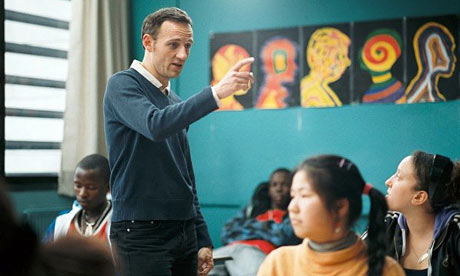
Entre les murs


photo: 'Every day I was playing a role'
by Stuart Jeffries
The Guardian, Friday 20 February 2009


I saw the beginning and the end of Entre les Murs ("The Class") on our flight home; will have to buy the DVD to watch the rest. Since the DVD isn't out, looks like I'm ordering the book.

From The Guardian:
The Class ... depicts a convincingly multicultural bunch of schoolkids. The film is refreshing, too, in that the teacher isn't overlord but hobbled prey, brought down or at least humbled by the wit and cunning of his (perhaps rather fancifully) articulate students. They subvert his lessons, for instance, arguing (with some justice) that no one in modern France needs to know the imperfect subjunctive, and use his classes to fight out ethnic rivalries.

But there are delightful moments. In one, a student teasingly asks the teacher if he's gay. "That really happened to me," says Bégaudeau, "and I was so pleased when it did, so I could turn the presumed insult back on the student. So I said: 'No, I'm not gay, but what's it to you?' I wanted to nail his homophobic perspective," Bégaudeau giggles. "That said, when you're 15 you use anything you can to mock someone else, so to call a fellow student a homo or a teacher a paedo isn't really a big problem. It's aimed at getting a reaction, so the teacher must try not to give the student what they want."

Ironically, the film's pivotal moment1 comes when Bégaudeau himself uses abusive language to his students. He calls two girls who have challenged his authority "petasses" (translated in the subtitles as "skanks"). It's a shocking moment: the teacher has lost it so badly that he resorts to offensively adolescent abuse. Never are we further in the film from the Robin Williams model of celluloid pedagogy; never has an authority figure in the classroom been so painfully exposed.

"That really happened to me, too. I called some girls that word. I regretted it immediately, but I felt so betrayed by them." In life, as in the film, the two girls were class representatives at a disciplinary hearing for a boy who risked expulsion for his unruly behaviour in class. What angered Bégaudeau was that they blabbed the hearing's findings to the boy, when their role as class representatives demanded their discretion.
For anyone who has even a glancing acquaintance with learning theory, Direct Instruction, precision teaching, Vicki Snider,2 Karen Pryor, John Taylor Gatto, or KIPP, the film is as appalling as it is riveting.

First of all, the students, age 13 to 15, are fantastically under-educated through no obvious fault of their own. From what I could see, M. Marin's teaching is atrocious.

And second, although it's not right to characterize the teacher as "hobbled prey" -- he gives as good as he gets, which is part of the problem -- no one in the school has the faintest concept of what effective classroom management is or what achieving it entails. At one point the teachers assemble for a staff meeting at which a new idea is presented for consideration: because discipline problems have increased, some teachers have come up with a plan to give students 6 points at the beginning of the school year and then progressively take points away after each infraction.

Astonishingly, a parent representative - a mother - is present for this discussion. Even more astonishingly, she is no baker of cupcakes. Frowning darkly, she tells the assembled staff that the 6-point scheme is typical of the school: you set the children up for failure and then you punish them.

Her observation sinks like a stone, and the 6-point idea is eventually abandoned after a protracted argument between two of the teachers over whether it is or is not a good thing to exercise flexibility when enforcing the rules. Which is better: judicial discretion or mandated sentencing? That is the question that lights their fire. Talk about a thoughtworld.

Unfortunately for the kids, the parent rep has nailed it. One of the film's many virtues is that it makes the connection between bad teaching and bad behavior 3 somewhat transparent, although that is not the intent. Given what we see of classroom instruction (we see quite a lot), the school seems almost designed to produce maximum failure, and a number of the students appear -- to me, at least -- to be living in a state of something close to open revolt, as well they might: it is a hopeless situation. Virtually no member of the staff appears to give any thought to whether students are ready to learn the material being taught in class, or to whether, after the material has been taught, students have actually learned it. Nor is the central character troubled by his inability to answer student questions. Toward the end of the protracted contest between teacher and class over the imperfect subjunctive & whether anyone uses it in real life (teacher's answer: "snobs" do), one of the quiet students (there are a lot of quiet students) asks how they can know when to use formal language in written communication and when to use informal.

The teacher's answer: it's hard to say. Students will have to develop "intuition" re: formal vs informal language, and their intuition will tell them when to use what. This is not a short answer, by the way. It is quite a long answer. Which makes the follow-up all the more exasperating for you, the helpless viewer: when the teacher finally wraps it up, a second student (another of the quiet ones) asks, "What is intuition?"

I guess the teacher couldn't have seen that one coming since, as I recall, his explanation of intuition is equally useless.

More from The Guardian:

The Class ends on the last day of the school year. All the students but one have left the classroom. Then a girl who viewers have scarcely seen before approaches M Bégaudeau's desk and says: "Sir, I didn't learn anything from your class." "It is a heartbreaking scene. We got her to do it again and again and on each take it got sadder and sadder. Everyone on the shoot was miserable by the final take.

"I think, to be honest, that scene shows how schoolchildren know how to get under your skin, how to say the words that shatter your world. She probably did learn something, but she wanted to hurt me, for whatever reasons.

My memory of this scene as it appears in the film is different:4 I think what the girl actually says is that she hasn't learned anything from any of her teachers, and she is afraid -- terribly afraid -- she will have to go to vocational school, which she doesn't want to do. She is insistent on both points, and, yes, the scene is sad.

The teacher greets this revelation as another challenge to his authority and, as is his way, attempts to argue the point: the girl can't possibly have learned nothing in an entire year of school, he says.

As for me, I was thinking just the opposite. I was finding it miraculous that any of these kids had learned anything in 11 years of schooling.5

You can watch a clip here.


francophile on the film & on differences between French & English schools

1 the scene I missed...
2 education needs a "science of teaching"
3 "the heart of successful behavior management is good instruction" Mary Damer & Elaine McEwan
4 you can read the original on page 162 of the book
5 Children in France attend school by age 4.

Friday, July 24, 2009

constructivism, behaviorism, and the Socratic Method

The Humpty-Dumpty quality to the lingo of the education world, where words mean what he wants them to mean, often stymies the parents trying to get to the core of what their school, district, board, or teacher is actually doing. When the labels are "spiral learning", "constructivism", "child-centered" or "discovery learning", parents on this board become reflexively suspicious. Often these words are used as a foil against "traditional methods", a term equally devoid of clarity. Are we all meaning the same thing? When a teacher or curriculum espouses discovery learning, do they mean what we think they mean? Do any of us know?

So here's a word most of us have a pretty good agreement on: The Socratic Method.

For now, we leave aside whether Socrates used the method the same way, and leave aside if he thought the method was for demonstrating ignorance or if it can be used to generate knowledge.

Let's just use it as it is used in teaching, such as in law school: the Socratic Method is both a learning theory and a pedagogy, where the teacher and the student engage in a discussion, or a series of guided questions, in order to reach the truth. The student is expected to familiarize themselves with the basic issues at hand (by reading and studying the assigned materials), and from there, the teacher begins a series of questions that are designed to expose errors in the students' beliefs or reasoning. Once exposed, questions are then asked that can only be answered by using correct reasoning. In this way, the teacher guides the student along to the right understanding.

The advantages of this method are pretty clear: first, the student has been forced, effectively, to engage more actively with the material and the ideas than in a listen-to-lecture setting. With practice, this engagement would lead to understanding how to use the appropriate material to prepare better in the first place. That means shoring up mastery of the underlying knowledge necessary to participate competently in the first place.

Second, this method uses students' misconceptions as the guidestones for learning. Misconceptions are the real reason for failure to understand material, and unrecognized misconceptions undermine all learning placed on top of them. By going to great lengths to determine and categorize the likely misconceptions in the first place, teachers are much more aware of stumbling blocks for their students, and are more likely to recognize when a student has foundational problems in their knowledge.

Third, while the method uses students' misconceptions, it uses teachers' corrective guidance to move past those misconceptions. It does not rely on the student making that realization on their own. The corollary to this is that the method pushes inexorably towards The Truth. That is: there is a right answer, that can be reached by knowing true facts and then using proper reasoning.
.

There are still some problems with this method. It's unclear that it scales well: can one lengthy conversation tackle a classroom full of misconceptions? Another issue is how to encourage participation. Is this exercise just one of humiliation? Can it be made to be encouraging rather than stifling for a group of young children? young teens? older teens? how so? Can a teacher keep this method from devolving into tearing students' ideas down without building up correct notions?

There are many resources to help teachers to use the Socratic Method. There are even some books that teach entire subjects using this, and not just philosophy! (My favorite is a computer science book called The Little Lisper, which teaches LISP to a child using this method.)

So could discovery learners and instructionalists agree on the value of using the Socratic Method for math and science teaching? If this were the discovery learning method being employed, what would be the objection? And to constructivists, if we granted you that we approved of the Socratic Method for discovery learning, would that be good enough? or not?

What do the teachers think? Anyone using this method to teach math or science? Anyone doing it with their whiteboarding? Just how difficult is it to use the Socratic Method in a classroom?

Thoughts on teaching Physical Science

As of now, I am preparing to leave Catholic School for Girls and move back to teaching in public high school. I feel sorry for the students who will see another change in the teaching staff (in the last four years, this school saw 3 Biological Science teachers, 3 Chemistry/Physics Teachers, and 4 Principals come and go).


When I got the position there and was assigned to teach Physical Science, Biology, Anatomy, and Environmental Science, I realized that I came to an empty well - there was no curriculum plan (the list of objectives for science courses found in the office binder belonged to another school and was so vague that it could not help me), no teacher manuals for disciplines - nothing except the textbooks and a lab supply room full of 20 -year old "supplies". I knew the curriculum for biology but had no idea what should be taught in physical science (I don't think NY schools teach physical sience at all!), anatomy, or environmental science. So I worked from scratch and created my own curriculum maps. And as I did it, I understood that perhaps the most important course of all in this sequence, the one that required the most effort from me was Physical Science. So I wrote a letter to whoever will take my position to save that teacher some effort and prevent some common (as I saw in upper grades) problems growing from students not knowing the basics.


Here is the excerpt from this letter:

Dear fellow teacher:
As you are getting ready to teach sciences at xxxxx, even if you are a seasoned sciences teacher, please take few minutes to read this - it may help you to understand the major goals of the science courses sequence used in this school as well as to organize your planning and instruction. Also, it is some practical advice based on my experience of teaching here. Even though you will find the curriculum objectives (not really re-worked) and my syllabi, this may be still useful.

The sequence of science courses is as follows:
1) Physical Science – 9th grade
2) Biology – 10th grade
3) Chemistry – 11th grade
4) Physics – elective for juniors/seniors with pre-requisite of 85 in math.
5) Anatomy – elective, no pre-requisites
6) Environmental science – elective, no pre-requisites (not offered in 2009-2010)

PHYSICAL SCIENCE.

Textbook (oldie but goodie!) – Focus on Physical Science by Heimler and Price. It is the best around, with great review exercises and good explanations and examples. I have ordered more through Amazon, but if they don’t come – make photocopies of the units for students. It also has a good lab manual.


As you can see, Physical Science is the first course in the sequence. It lays down the foundation for taking other science courses and, for majority of students, serves as a substitute for the physics course they don’t select to take. In addition, the freshmen come here from a variety of institutions – and many lack basic mathematical and logical reasoning skills not to mention the fuzzy middle school science that leaves them with no clear idea what science disciplines are and how to learn and study for science courses. That simply means that this course will require the most organized, structured, and clear instruction that you can deliver. It must give the students not just an understanding of methods of science, but provide mastery with basic chemistry and physics as well as logical reasoning and mathematics.

Overall, the advice is – leave the “discovery” for later and teach as directly as possible! Use the labs to practice and apply, not to introduce. Based on the attained mastery of Physical Science concepts and skills, the students (and you!) will have it much easier in upper courses from the sequence , where the student-designed and conducted investigations can be used.

Aligning with math.

Physical science involves mathematics. Shall we say that math used is on almost the elementary level, though you will see many students experiencing problems with applying math. And if these problems are not resolved now, they have little chances of experiencing success in chemistry and physics!. Understanding of concepts is absolutely inseparable from the ability to justify the reasoning with mathematics.


So, here are some “obstacles” that require more work on your part. It is also a good idea to ask the math teachers how they explain a particular math concept and skills to students, so you use the same language.


  • In the very beginning, the decimal/fraction/exponent relationship must be reviewed.


Example: 100 = 100/1 = 10² and 1/10 = 0.1 = 1x 10-¹

  • Metric system is based on 10. Ensure the mastery of conversions.
  • Rounding to the nearest tenth, hundredth etc. should be reviewed as necessary (most likely – should)
  • Fractions – basic addition, subtraction, multiplication and division of simple fractions.
  • How to treat proportion as a fraction. (Absolutely essential for stoichiometry and some physics problems! ( If X relates to Y like this, then X1 relates to Y1 like that.)
  • Simple algebraic equations (review before teaching oxidation numbers) as well as adding and subtracting positive and negative numbers.
    Example: x +12 = 24
    x = 12

    12/x = 3
    x= 4

    +5 – 7 = - 2
    Note: have them write fractions in the standard form – with the horizontal line between numerator and denominator.
  • Transforming formulas. a=b/c Find b. Find c. and so on.
  • Practice treating units as numbers in calculations. It helps to see where the units of a variable come from and aids in remembering the formulas (and concepts).

    Critical: Introduce the format for solving problems and stick with it. Require it even for the easy problems – then the students WILL definitely benefit when solving more difficult and multi-step problems in this course and in further courses. The format allows extracting and organizing information from the word problems clearly so the possible solution routs are easily predictable. I followed the format taught in soviet schools, which is this:
    (I do it in the form of a table: divide the page in 3 columns

Column 1:


WHAT IS GIVEN in the problem:


Use appropriate variables and units provided in the texthat is asked (variable, units)


Column 2:
Basic formula(s) connecting what is given and what is asked + necessary derivatives


Column 3:


Solution (complete with units)


Answer, with units


Examples:
From physics – Find the work done by gravity force when a 2-kg rock falls from the height of 1.5 m to the ground.


Given:
m rock = 2 kg
d = 1.5 mg=a = 9.8 m/sec­²


Asked:


W - ? (J)


Formulas:


W = Fd
(we were not given F, but we can find F if we know mass and acceleration)
F= ma
Substitute ma for FW = mad


Solution:


W = 2kg x 9.8 m/sec² x 1.5m = 29J


Answer: W=29J


Example 2 (From Chemistry)


Find the masses of salt and water needed to prepare 300g of 10% solution.


Given:


V solution =300 g
% Conc. = 10%


Asked:


m water -? (g)


m salt-? (g)


Formulas (Reasoning)
1)10% means:
10g of salt in 100g of solution
then
x g of salt are in 300 g of solution

2)m of solution = m of salt + m of water, therefore

m of water = m solution – m salt


Solution:
1) 10g/x = 100g/300g
x = 3000g/100g = 30g of salt

2) 300g – 30g = 270g of water

Answer: to make 10% solution one should take 30g of salt and 270 g of water


In terms of planning the program, I have found it more useful to clearly separate Chemistry part of the course and Physics part of the course. My syllabus reflects that. Chemistry part (including oxidation states, balancing of chemical reactions and stoichiometry problems) is done in the first semester, and Physics part - in second semester. It correlates with concept sequence taught by math department, so you can arrange the use of problems from your course in math classes and arrange with math teachers to provide more attention to necessary math skills.. It usually works well, and science and math are mutually reinforced.

Of course, you may choose to follow the sequence in the textbook or introduce physics first.

You will find the list of topics to be taught in the syllabus (in the Main Office, Science binder). However, let me emphasize the topics that will require more of your attention – the concepts and skills that usually cause problems for students in biology and chemistry courses if not mastered.

Metric System conversions
Symbols and names of major chemical elements; names of major acids, bases, and salts
Electron configurations and creation of bonds
Calculation and use of oxidation numbers to write the formulas of compounds
Balancing of chemical reactions
Simple stoichiometry – mass to mass problems
Calculation of concentration of solution; preparation of solutions
Properties of water
Neutralization reactions
Reading and creating the graphs - speed, acceleration etc.
Light and Sound – electromagnetic and mechanical waves
Energy transfer, especially heat.

(End of excerpt)


Thursday, July 23, 2009

Common Core State Standards

A draft of the Common Core State Standards has been posted by EdWeek.

Core State Standards Draft


The problem I have with the document (in math) is that it's called a "College and Career Readiness Standards for Mathematics", but it treats all K-12 students the same. Their target readiness goal seems to be the end of high school. If a student meets all of these goals, there is no guarantee that he/she is ready for all college degree programs.

For careers that require a college degree, the requirements are already defined. You can survey all college departments and determine what high school math courses (and SAT/ACT scores) are required for their program. You can ask them what level of math they expect from new students, and what top level math course is required. Students and parents don't need some sort of generic, one standard fits all, document or education. Students need to know exactly what level of math they need going into college and coming out of college, and they need to know it when they are still in K-8. Reaching some sort of generic requirement by the end of high school is not enough.

This is what bothers me a lot about education; it's statistical, not individual. Their goal is some sort of statistical best average math goal by the end of high school. I would like to see some sort of individual, what I like to call door-closing, analysis. For better or worse, one of the key points is getting to a proper algebra course in 8th grade and having access to the traditional set of math classes in high school. Of course, this is usually preceeded by some sort of tracking test in 6th grade. Focusing on what an average student needs by the end of high school allows schools to ignore major problems in K-8 math. They can push all issues back to high school and put the onus on the students.

Tuesday, July 21, 2009

The Importance of Mastery

I was paging through the Memoria Press catalog that came in the mail the other day, and it had an article by Cheryl Lowe titled "The Four Principles of Latin Study." Under Principle #1 ("Memorize the Latin Grammar"), she emphasizes the importance of really knowing the Latin grammar cold before moving on to the "fun stuff" and adds:

Digging deep and working for mastery builds interest, confidence, and a feeling of accomplishment in students. Students like what they have mastered and they dislike what they have only half learned. So slow down, stay awhile, let the student relish and enjoy learning the Latin grammar. The tendency to skim over, even to denigrate the lower skills in a rush to get to the higher ones is a characteristic of modern education. The result is superficial learning, which I think is the cause of student boredom and frustration.

gone fishing

Back next week!

Teaching Company high school courses on sale

I'm probably going to spring for Algebra II, God help me. (There's a workbook, too, for about $30 extra, but it's not listed on the web site. If you order, call the customer service rep.)

This review persuaded me:

An Oldie But A Goodie
April 30, 2009

To put this TTC course in a historical perspective, it's course #102 with a copyright date 1994. If you can remember back then, there wasn't much of an internet, computer graphics were in infancy, and DVD technology was still being developed. Does this mean this course should be re-done and "modernized"? Well, that'd be nice, but it's really not necessary. But it does mean the visual aids, such as they are, are very basic, and the teacher makes extensive use of the simple old blackboard and flip-chart easel.

Now, I kind of liked that, because it reminded me of when I first took Algebra II in high school, 50 years ago. But if you - or the kid you got this for - get bored if there are no special effects, animations or related "eye candy" at every turn, then this course will indeed be a poor choice. This course is for those who not only want to learn algebra, but are willing to do what it takes to learn algebra. For those people, this course is an excellent investment. It's going to take some work on the student's part, first and foremost being concentration. To state it another way, if you want to learn algebra and how to work algebra problems, this course is a valuable asset, and if you don't, I'm at a loss as to what to recommend.

Most TTC Science & Math course are survey courses, meaning they "sell" the subject and its high points in an entertaining manner, and take you up to, but not into, problem-solving. That's NOT true with this one. It doesn't pretend, or even try, to get you fired up about algebra. This is a pure dirty-hands work-course. Frequently, the instructor will put a problem on the board, and ask the student to stop the "tape" and solve the problem. When you restart the course, the instructor will show the solution and what steps are involved. If you skip these problems, you have no way of gauging how much you've learned - or not. To learn algebra, you have to work algebra - there's no ducking this - and this course offers plenty of that kind of opportunity.

I'll also note that, although it's not on the web page, this course still comes with a workbook, aligned with the lecture topics, with answers in the back. If you're looking forward to a formal classroom course, working these problems is certainly in your best interest.

Another reviewer mentioned "Algebra II for Dummies". This is also a good self-study approach. There's a companion workbook, which I also recommend. (The price for both is only about $30.) Between this DVD course and the Dummies book and the workbooks, you should have all you need to fully move around at this algebra level. And if you'll be taking a high-school course, these two items will prepare you about as much as is possible.

Regarding the instructor - ok, Jay Leno he's not. But I enjoyed his "blue collar" kind of instruction, and I had no problem at all understanding him or the information he was trying to get across. And no, he doesn't look at the camera all the time, but this makes it "seem" like a classroom environment, where the teacher certainly doesn't (I hope) spend the entire period glaring at you.

I really enjoyed this course and got a lot out of it. It was well worth the price. For the intended audience, I definitely recommend it."

This is annoying. The chemistry course, which I bought just a few months ago, has now been revised.

Working memory and the blind

We are talking about the huge swaths of children labelled "learning disabled" who can't read, but what about the actually disabled who learn anyway?

How do the blind learn to read, or compute, or do any of the tasks we think of as reading/writing/math?

Has anyone ever read anthing about the cognitive workings of the blind?

I increase my working memory by writing things down on paper and looking at what I've written.

How do they maintain working memory? Are the brilliant scholars who are blind particularly adept at maintaing working memory using braille? or do they just have fantastically larger working memory than the rest of us? How do they organize their working memory--do they do it "visually" to some degree? Or do they use other senses somehow? Is their auditory loop for working memory MUCH larger than mine, e.g.?

Anyone ever read any research on this? Or even any anecdotal memoirs?

with good instruction & curricula, how many kids still have reading problems?

from palisadesk:

Well, I don't know but I'll chime in with some citations anyway. My guess is that the rate of incidence is dependent on a number of other variables. Thus, you would expect to see a higher incidence in some populations than others.

The evidence is mixed on this topic. Frank Vellutino is one of the major contributors to this line of research. Studies in several US states done by Vellutino (Albany, NY), Torgesen (Fla), someone in Texas -- I forget who-- and elsewhere came up with fairly consistent findings that explicit instruction in reading, including code knowledge, blending and advanced phonics skills reduced the number of students with decoding disabilities to under 10%. (The range was 3%-10%).

Vellutino's studies, and some others, did not include children with IQ's below 90. Decoding difficulties, per se, are not correlated with IQ.

Different programs were used, as well as ad-hoc instruction that drew on various sources and materials but was focused and explicit. No particular program or approach clearly surpassed others -- some were more suited to 1:1 instruction, others to group instruction.

Gough and others published a large-scale study that showed more than 95% of children in first and second grades could be taught effectively enough to score above the 25th percentile, which is considered in the average range.

One problem with all these studies, however, is that they lack longitudinal data. Children who successfully master basic decoding skills and are reading well in first and second grade may fall behind later for a variety of reasons (no single cause). Some continue to struggle with decoding skills at higher levels, others with syntax, language comprehension (including, but not limited to, vocabulary), fluency, auditory and working memory, and more. While poor readers in second grade rarely end up as outstanding readers in fifth grade, the opposite can happen: the good reader in second grade can be a failing reader in fifth and beyond.

Some of Vellutino's articles:

Vellutino, F. R., Scanlon, D. M., Sipay, E.R., et al. (1996). "Cognitive profiles of difficult-to-remediate and readily remediated poor readers: Early intervention as a vehicle for distinguishing between cognitive and experimental deficits as basic causes of specific reading disability." Journal of Educational Psychology 88(4): 601-638.

Vellutino, F. R., Scanlon, D. M., Snowling, M. J., & Fletcher, J. M. (2004). "Specific reading disability (dyslexia): What have we learned in the past four decades?" Journal of Child Psychology Psychiatry 45(1): 2-40.

Scanlon, D. M., & Vellutino, F. R. (1997). A comparison of the instructional backgrounds and cognitive profiles of poor, average, and good readers who were initially identified as at risk for reading failure. Scientific Studies of Reading, 1, 191- 215.

Vellutino, F. R., Scanlon, D. M., and Tanzman, M. S. (1994). Components of reading ability: Issues and problems in operationalizing word identification, phonological coding, and orthographic coding. In G. R. Lyon (Ed.), Frames of reference for the assessment of learning disabilities: New views on measurement issues (pp. 279-329).

Other sources make the point that low-achievers (who may find reading difficult for varying reasons) need much more instructional time -- at least twice as much, sometimes 3 times as much, and in a more intensive, fast-paced, interactive milieu. This is rarely provided and probably not even possible in most public school settings. The only longitudinal accounts of such success are from the UK, and the details of what was done and when and how in both the Clackmannanshire and W. Dunbartonshire studies are sketchy.

Nothing similar has taken place on this side of the Atlantic; the best overall results have been from DI schools, but even there, population mobility, staff turnover and limitations on instructional time lower the ceiling for student achievement.


Accelerating Reading Attainment: The Effectiveness of Synthetic Phonics by Joyce E. Watson and Rhona S. Johnston (pdf file)
One Man's Quest to Eliminate Illiteracy
West Dunbartonshire's Literacy Scheme

miscue analysis

at D-Ed Reckoning

Invaluable.

Check out this conclusion contained near the end of a 31-page case study of a 5th grade boy's reading:
John’s comprehension at his current fifth grade level is excellent when he is relieved of the task of recognizing words.

military schools

Only in the military?

After my first visit to Hogwarts, on Sports Orientation Night, I came away thinking the place felt like a "happy military school." As it turned out, that was by design; the principal told us so on Family Orientation Day. I've forgotten how he put it, but the gist was that Jesuit schools have much in common with military schools.

Loyola himself, of course, was a soldier.

My point: happy military schools work.

Knowing what I do now, I take issue with this observation:
Behavioral problems are not an issue [inside military schools] due to the values students are taught at home.
I would wager a very large sum of money that a person who has actually taught in a military school would read this passage and hoot.

Your typical classroom pits 20 to 30 kids against 1 adult. That's not quite the Battle of Thermopylae, but close enough.


Kids in groups are like dogs in packs
* (I say that with affection for kids and dogs): they rev each other up, and beyond a certain point parents can't control their kids from home no matter how sterling their values. It is the school's job to keep order and a cheerful spirit.

Most schools don't: because of political correctness that dictates "radical inclusion;" because ed schools don't teach classroom management skills; because public schools seem to believe that classroom discipline begins and ends in the home.

It doesn't. The public schools in my district, where the school population is upper middle class children from well-organized families, are safe and reasonably orderly, but there are constant complaints about disrupted classrooms, kids not being able to hear because of commotion made by the 'hyper' kids, etc. At the high school, students and parents have been told that disruptive kids in honors courses "don't deserve to be in the class."

I think it's unlikely that military kids are better behaved than kids in my district when they're not under their parents' direct supervision, and I credit military school personnel, not military parents,** with the orderly environment inside military schools.


* "In 2008, 39% of the fatalities involved multiple dogs."

** Not a criticism of military parents or anyone else. All I'm saying is: if a parent isn't inside the classroom, he isn't the one keeping order.

Tracy W on the speech

Tracy W responds to Mike Petrilli's post at Flypaper:

Here’s an African-American president, speaking to the NAACP, and arguing for reform in our schools and responsibility in our homes and community.

Notice the lack of any responsibility for schools. If school staff, the paid professionals, aren’t responsible for learning, why pay them?

And if parents are going to be responsible, then they should have the money, which they can then use to hire teachers if they think it’s worthwhile.

Writing instructors everywhere (I include parents in this category):* save this Comment to show your students.

This is one of the most succinct rebuttals of an argument I have ever read.

It is a fantastically difficult feat to pull off.

As to Tracy's point, I would love to see a system where parents did the hiring, which is what is taking place in the world of homeschooling now.

I imagine that if parents did the hiring some teachers would establish 'private practices' while others might be employed by schools with an organizational structure similar to a community college, perhaps, or to a law firm. The school would employ teachers and provide health insurance, but would not assign students to classrooms. Parents would choose.

I can also imagine that these schools would have school-wide "positive behavior" systems in place, offering parents a happy and safe environment for their kids. For most parents, "happy and safe" is priceless, and such schools would be swamped with customers.

As in a law firm, teachers might have tenure; presumably they would also have a great deal more authority over what they teach and how they teach it.


* Mary Hake says that she helped all of her kids with their school writing assignments, and she advises parents to do the same. I'll get my interview with Mary assembled shortly.

On the liberal arts

"The utilitarian or servile arts enable one to be a servant-- of another person, of the state, of a corporation, or of a business-- and to earn a living. The liberal arts, in contrast, teach one how to live; they train the faculties and bring them to perfection; they enable a person to rise above his material environment to live an intellectual, a rational, and therefore a free life in gaining truth."


Sister Miriam Joseph, C.S.C., Ph.D.

The Trivium

The Liberal Arts of Logic, Grammar, and Rhetoric
Understanding the Nature and Function of Language

Monday, July 20, 2009

Doug Sundseth on writers editing themselves

Catherine: "In other words, it takes two decades for writers to be able to edit their own prose well." (see: Kellogg, R.T. (2008). Training writing skills: A cognitive developmental perspective [pdf file] Journal of writing research, 1(1), 1-26)

Had you said something like, "edit their own prose and get anything useful out of the process", I might agree. I don't think that most writers ever get to the point where they can "edit their own prose well." The best that you can expect is that if you give your work a week or two before you look at it with an eye to editing you can sometimes see poor writing of various sorts.

Oh, you might be able to do a good job of basic copyediting. But I think that significant writing is too closely tied to each writer's idiosyncratic thinking process for the writer to notice flaws of logic, organization, and flow as often as you really need to. And absent those things, I don't think you can say that the writer can edit his own work "well."

Frankly, finding even a professional editor that can do a good job of structural editing of the work of others is a non-trivial task. Even good editors are often lured down the alleyways of comma placement, spelling, and a random selection editorial peeves of dubious validity.

IME, a good reader who is willing to say, "I don't follow this part", is as useful as (sometimes more useful than) most editors. If you can tell me where you're having a problem, I can often see all or part of the problem and rewrite to correct it. If you can articulate why you don't understand the part, you're invaluable.

But good readers are hard to find, too.

On outlining: In many ways, the formal outlining taught in the 70s was worse than useless. Until I managed to get past the cumbersome process involved in the sort I was taught, I actively avoided outlining at all, to the great detriment to my writing.

Now, I always outline any writing longer than a page or two, but I haven't used a formal outline since the last time it was required in high school. I make notes, draw lines, and rewrite the parts I can no longer read for all the scribbling. At the end, I have a plan that is functionally an outline, but it bears little resemblance to the roman numeral, capital letter, lower-case roman numeral (etc.) outline taught in some writing classes.

This is why Writers Workshop makes no sense. Editing is a separate process from writing; in the real world (the 21st century world!) the professional writer has a professional editor.

I'm now convinced that the goal of writing instruction should be to teach students to write the best first draft they possibly can -- because the first draft is pretty much going to be their last draft even if you force them to "revise."

The fact is: they're not going to revise.

They're not going to revise because they're nowhere near being able to read their own words the way a stranger reads them.

More later.


Ronald Kellogg
The Psychology of Writing

Placebo Education

Marginal Revolution has a link to an interesting post today on the concept of "Placebo Education" from Tyler Cowen's new book:

Placebo effects can be very powerful and many supposedly effective medicines do not in fact outperform the placebo. The sorry truth is that no one has compared modern education to a placebo. What if we just gave people lots of face-to-face contact and told them they were being educated?

how Paul teaches problem solving to middle school kids

I use an organizer that approaches this technique. I think it's adapted from an ELA template called four square. Here's what I have the kids do.

Take a piece of paper and fold into quarters. Open it up and draw a rectangle in the center. Now you've got four quadrants and a rectangle which is not exactly 'four square' but in the interests of marketing I guess four square sounds sexier.

Read the problem twice. Then in the rectangle restate the question in the form 'find blah blah blah in units of xxxxxx'.

Read the problem again and in the upper left quadrant identify and define all the symbols (variables and constants) you'll use in your solution.

Read the problem again and use the lower left quadrant for a diagram/picture.

Read the problem again and use the upper right quadrant to define your strategy. This can be words or preferably a set of equations to solve.

The lower right quadrant is where you show your arithmetic.

Finally, the back of the paper is used to justify your answer.

It works well for entry level problem solving of the kind you would encounter through maybe grade six. If kids master this it should instill some good habits for more complicated things.

grading student writing

Lynn G asked:

If 80% of student feedback is wrong, what % of teacher feedback is wrong? Are we just assuming that the teacher is 100% correct the 20% of the time they actually provide feedback?

Hah!

I wish ---

Students have long believed (on good evidence) that if the same paper is submitted to two teachers in two different sections of the same course, the paper is likely to receive two very different grades. In 1961, Paul Diederich and his colleagues proved that this student belief is no myth. When 30 student papers were graded by fifty-three graders (a total of 15,900 readings), more than one third of the papers received every possible grade. That is, 101 of the 300 papers received all nine grades: A, A-, B+, B, B-, C+, C, C-, and D. Diederich also reported that

94 percent [of the papers] received either seven, eight or nine different grades; and no essay received less than five different grades from fifty-three readers. Even when the raters were experienced teachers, the grades given to the papers by the different raters never attained a correlation greater than .40. Diederich, P.B., French, J.W., and Carlton, S.T. "Factors in judgments of writing ability." Research Bulletin RB-61-15. Princeton, N.J.: Educational Testing Service, 60 pp.

The Schools We Need and Why We Don’t Have Them
E. D. Hirsch
pages 185-188

peer teaching

re: 80% of student feedback is incorrect:

Fer*Cambe:

As a teacher I see this in class every single day, kids wrongly explaining to others what they've done right and wrong. Especially what they've done wrong! Even if it's a subjective question the kids will authoritatively tell each other exactly how wrong they are when they might be onto something really special.


Vicky S:

Remember my famous group work/peer review story? My son was in a group doing a math problem. He understood it and worked out the right answer; the four other kids were arguing for a different answer. He had been appointed group leader, who was supposed to give the group's answer. When called upon to give the group's answer, he gave his (correct) answer.

He was reprimanded for not giving the group's "consensus" answer. When he protested that it was wrong, he was told he should have done a better job convincing them of the rightness of his answer.

So you can see that the point of the whole exercise was far afield from the kids actually learning how to do the problem...


Doug Sundseth:

Peer review in my son's (3rd grade) class wass of the form, "It's got a great beat and you can dance to it, so I give it an A". Had this been managed at all by the teacher, it could have risen to the level of merely useless, but the teacher's classroom management skills needed remediation -- desperately.

Dan Dempsey

in a comment on Allison's post on problem solving, Dan writes:
From Bertrand Russell or was it Alfred North Whitehead...."the goal is to have no problems only exercises".

By expanding long term memory one can turn potential problems into exercises.

It seems that the goal of many pushing the discovery/inquiry approach is to have no exercises but only problems. *

I am still in shock from Dr. Ruth Parker's powerpoint given at NCTM national that the Standard Algorithm always harms conceptual understanding, which seems to be a recipe for lots of problems.

The person most everyone would like to hire is the one that has so much extensive background knowledge that most everything is an exercise.

Brilliant!

Here's Ken on the subject of struggle:


* students must struggle

the last word

Fun Fact Friday! - Student/Teacher Ratio from Education Gadfly on Vimeo.

Gabriela has a problem

If you've time to comment on this Flypaper post, you should.