

 Posts


This is extremely good news. (If you can't access it through ktm, you can through eduwonk.)
I would rather be working on a new charter school for Westchester County than trying to change my district.
Friday, March 30, 2007


bar models and multimedia learning
Myrtle's post on bar models reminded me of an interesting interview I read with Richard Mayers, who is apparently a major researcher in the area of "multimedia learning."
Multimedia learning is much simpler than I realized: Mayers defines it as "the presentation of material using both words and pictures.”
This is the kind of research that jibes so completely with my felt experience of learning math (learning anything, really) that I'm simply going to assume it's true until someone demonstrates otherwise.
uh-oh
Cliff Atkinson interview, Richard Mayer
Multimedia Learning by Richard Mayer
Myrtle on bar models
page splatter in Trends in Cognitive Science
Doug Sundseth on page splatter (and penguins)
Glencoe page splatter
page splatter redux
Multimedia learning is much simpler than I realized: Mayers defines it as "the presentation of material using both words and pictures.”
This is the kind of research that jibes so completely with my felt experience of learning math (learning anything, really) that I'm simply going to assume it's true until someone demonstrates otherwise.
Principles:
...[I]n Multimedia Learning (Cambridge University Press, 2001), I describe some research-based principles for the design of multimedia instructional messages including the following:
- multimedia principle, in which people learn better from words and pictures than from words alone;
- coherence principle, in which people learn better when extraneous material is excluded rather than included; [ed.: RESEARCH PROVES! PAGE SPLATTER IS BAD!]
- contiguity principle, in which people learn better when corresponding words and pictures are presented at the same time or next to each other on the screen;
- modality principle, in which people learn better from animation with spoken text than animation with printed text;
- signaling principle, in which people learn better when the material is organized with clear outlines and headings; and
- personalization principle, in which people learn better from conversational style than formal style. [bullets added for emphasis]
For example, in designing a PowerPoint slide it is important to not present an overwhelming amount of information (i.e., coherence principle) and it is useful to have simple graphics to supplement words (i.e., multimedia principle). Finally, it is important to note that good design principles for inexperienced learners might not be the same as for experienced learners.
[snip]
Bullets don't kill learning, but improper use of bullets kills learning.
uh-oh
Cliff Atkinson interview, Richard Mayer
Multimedia Learning by Richard Mayer
Myrtle on bar models
page splatter in Trends in Cognitive Science
Doug Sundseth on page splatter (and penguins)
Glencoe page splatter
page splatter redux
Bar Diagrams II
Algebra without algebra:

The kid thinks, "I can see that $24 will be divided into four equal groups of $6. Jim will have 3 groups of 6...that's $18.
Method #2
Let j be Jim's money and d be Dan's money: j + d = 24; j - 2 = 3*(d + 2) so j = 3(d + 2) + 2 substitute in to the first equation: 3(d+2)+2 + d = 24 simplify: 4d + 8 = 24, solve: d = $4; j = $20.
They both have their charms.
multimedia learning (Catherine)
Fifth grade word problem from Singapore: Jim and Dan have $24 altogether. If Jim gives $2 to Dan, he will have three times as much money as Dan. How much money does Jim have?
Observe the mighty bar diagram in action:

The kid thinks, "I can see that $24 will be divided into four equal groups of $6. Jim will have 3 groups of 6...that's $18.
Method #2
Let j be Jim's money and d be Dan's money: j + d = 24; j - 2 = 3*(d + 2) so j = 3(d + 2) + 2 substitute in to the first equation: 3(d+2)+2 + d = 24 simplify: 4d + 8 = 24, solve: d = $4; j = $20.
They both have their charms.
multimedia learning (Catherine)
this afternoon's brilliant idea

I'm going to have to get this book.
I think.
flap copy:
White papers are at the forefront of an educational marketing revolution. Powerful enough to lure readers and able to persuade with unyielding strength, the well-written white paper is a super weapon in the marketing professional's arsenal.
Wearing many hats, the white paper can talk business or converse technically, and it can inform or influence. Best of all—it is highly sought-after. The white paper's underlying strength rests on this premise: If you give readers something of value, they will give you their loyalty, and ultimately their business. This book aims to equip anyone with the tools necessary to immediately begin writing white papers that attract readers and keep them engaged.
sample chapter (pdf file)
White Paper Writer Industry Report
Ed has a friend from Princeton who quit journalism several years ago (bureau chief at AP) and has been making a bloody fortune writing White Papers and books ever since.
punished by rewards
In light of the desire of educators to rethink our schools, this bit that Catherine posted from Cheri Yecke caught my eye,
One person’s damage is another person’s progress. Reading the Bowles and Gintis paper cross-linked by Vlorbik, I learned that schools "prepare [children] for adult work rules... by what we call the correspondence principle, namely, by structuring social interactions and individual rewards to replicate the environment of the workplace." Bowles and Gintis are quite optimistic that schools can bring about social change by socializing children to not "function well, and without complaint, in the hierarchical structure of the modern corporation."
I highly doubt that "prosocial traits" like the willingness to conform quietly to group norms in school group work, leading to group-think as well as free-riding and table-pounding, are not seen as "individually advantageous” by the individual children who exhibit these traits.
In the following paragraph, I set Bowles and Gintis’ variables “A” and “B” to specific extreme values. You can choose your own values according to your own tastes for social change, or not.
Let the destabilization begin.
My take on the cooperative, socialistic ideals promulgated in the public schools is that they don’t stop administrators and teachers and parents and children from being competitive. Humans want to compete. Neither school reformers nor teacher unions eliminate competition; they drive it underground and it pops up again in weird new ways that are less transparent and less fair to everyone. At least Bowles and Gintis are refreshingly honest about teachers using rewards to punish capitalists.
I became alarmed as I read article after article in which middle school activists expressed their arrogant assumption that America’s public schools were their personal vehicles for social engineering. I came to see how radical middle school activists were driving many of the policies and practices that have been so damaging to the public education system in America at all grade levels, and how such policies and practices were responsible for damaging the trust between many parents and the public schools.
One person’s damage is another person’s progress. Reading the Bowles and Gintis paper cross-linked by Vlorbik, I learned that schools "prepare [children] for adult work rules... by what we call the correspondence principle, namely, by structuring social interactions and individual rewards to replicate the environment of the workplace." Bowles and Gintis are quite optimistic that schools can bring about social change by socializing children to not "function well, and without complaint, in the hierarchical structure of the modern corporation."
First, schools influence which cultural models children are exposed to. Second, schools immerse children in a structure of rewards and sanctions.
Concerning the first, we note that a huge body of evidence attests to the fact that a society’s values are passed from generation to generation through a process of transmission which may be vertical (from parents) or oblique (from others in the prior generation) and involves a psychological internalization of values. The school system is an unusual form of oblique transmission whereby a particular group of people that is often quite unrepresentative of the population of parents (teachers) occupy privileged positions as behavioral models for children (Marx 1963/1852):125).
Children initially acquire cultural traits by vertical transmission from their parents (assume the parents have identical traits). They are subsequently paired with a cultural model (a teacher, that is) who may have the same or a different array of cultural traits.
Confining attention to a single trait, suppose the teacher has the same trait as the parents. Then the youth is assumed to retain the trait. But if the parents and the teacher have different traits, the youth considers which one to adopt, surveying the experiences of those he knows (his classmates) for guidance in making the switch. Among the experiences the youth may find salient are the rewards and punishments associated with the particular structure of schooling. The reward structure … includes the close association… between the personality and behavioral traits associated with getting good grades in school and the traits associated with garnering high supervisor rankings at work.
In this view, culture thus evolves by some individuals (those paired with an unlike model) shifting from what they take to be lower-payoff to higher-payoff cultural forms…. In this model, it is possible for a school system or any other system of socialization to promote the spread of a cultural trait that would otherwise not proliferate, suggesting that schools do more than simply reproduce the reward structure of the rest of the society. Schooling thus may promote prosocial traits even if these are not individually advantageous.
I highly doubt that "prosocial traits" like the willingness to conform quietly to group norms in school group work, leading to group-think as well as free-riding and table-pounding, are not seen as "individually advantageous” by the individual children who exhibit these traits.
[S]chooling can also promote traits which are advantageous to one group (the group determining the structure of schooling) even if they are not generally advantageous.
In the following paragraph, I set Bowles and Gintis’ variables “A” and “B” to specific extreme values. You can choose your own values according to your own tastes for social change, or not.
Schooling can affect the direction of cultural evolution in two ways. First, if most teachers are [socialists] then the children of [socialist] parents will rarely switch, while [capitalist] children will virtually all have the occasion (a mismatch) to consider a switch. Second, if the reward structure of the school favors those with [socialist] traits (even if the [capitalists] might do better in adult life) then a significant number of [capitalist] children will become [socialists]....
Depending on the specific assumptions of the model and the specific value of parameters, there can either be two stable “homogeneous” cultural equilibria involving very high frequencies of either the advantaged or disadvantaged trait, or a single stable “heterogeneous” equilibrium involving a moderate frequency of both cultural forms.
These propositions show the importance of such oblique cultural institutions as schools, which are necessary to stabilize cultural forms, such as the legitimacy of being subservient in the workplace, that benefit one group, in this case employers, at the expense of another, the employees.
Let the destabilization begin.
My take on the cooperative, socialistic ideals promulgated in the public schools is that they don’t stop administrators and teachers and parents and children from being competitive. Humans want to compete. Neither school reformers nor teacher unions eliminate competition; they drive it underground and it pops up again in weird new ways that are less transparent and less fair to everyone. At least Bowles and Gintis are refreshingly honest about teachers using rewards to punish capitalists.
into the Green Zone
From The Gadfly:
KIPP is looking for smart, savvy, energetic people to help it carry out its newly-assumed obligation to stabilize and reconstruct Iraq, and to spread its "work hard, be nice" message to traditionally underserved religious minorities and militias. For more information, see here. Email résumés to KIPPFertileCrescent@dod.mil
more schools behaving badly
You guys are too much.
From the Comments thread to More Fun with Middle School!
from Myrtle:
vintage Doug:
Doug checked:
Susan S:
Reading this I had one of my not-infrequent moments of empathy for our public school educators and their active dislike of parents.
We really are a pain in the tochus.
But that's what makes us great!
(And, ummm, we'd probably be less obnoxious if we didn't get stuff like this in the mail.)
From the Comments thread to More Fun with Middle School!
from Myrtle:
The first contact my school has had with me via email was a few days ago. It was a "kindergarten round-up" and the remainder of the email spelled out the legal ramification for providing false documents and then an explanation of how they would call the police and you WOULD be investigated if you didn't provide a birth certificate within a month of enrolling since this might be evidence that you had kidnapped the child. (They didn't use kidnapped but some other phrase)
Lovely. Just gave me the warm and fuzzies. It's like having a boyfriend spell out on a first date exactly how he will beat you up if you cheat on him, "just FYI!"
vintage Doug:
I think it would be only fair if you were to respond to this importunate demand for documentation with a list of circumstances which would cause you to swear out a child-abuse complaint against the kindergarten teacher and the school administration.
Just so everyone's on the same page, don't you know.
Doug checked:
I think in Texas schools are legally exempt from any sort of CPS investigation. A friend of mine's chld suffered a bad concussion and the school never called an ambulance. The ER doctor called CPS, the child spent time in ICU. CPS said they couldn't investigate it because it was a public school. It was the school's responsibility to do their own investigation.
And there is a cap on how much they can be sued for civilly.( I think in Texas the ISDs have their own police force) and at one point it was proposed to legally fine parents who don't show up to conferences.
This happened in my suburban district. And I can't explain why I don't feel like voting yes on their bond proposals. Maybe it's their stellar public relations outreach and customer satisfaction guaranteed or your property taxes refunded.
Yeah, we're all on the same page.
PS I'm betting they bully their teachers the same way they bully the parents.
Susan S:
Hey, he got a "C". Isn't that average?
Reading this I had one of my not-infrequent moments of empathy for our public school educators and their active dislike of parents.
We really are a pain in the tochus.
But that's what makes us great!
(And, ummm, we'd probably be less obnoxious if we didn't get stuff like this in the mail.)
more fun with middle school!
This letter arrived in the mail yesterday.
We've never met this teacher.
We've never spoken with this teacher.
We've never received an email from this teacher.
We've never received a telephone call from this teacher.
Nice to make her acquaintance now, though!
today's form letter from the school!
We've never met this teacher.
We've never spoken with this teacher.
We've never received an email from this teacher.
We've never received a telephone call from this teacher.
Nice to make her acquaintance now, though!
today's form letter from the school!
Thursday, March 29, 2007
The War Against Excellence
from the preface of Cheri Pierson Yecke's book:
My dual passions for advocating for academic excellence and examining the motivations behind the contemporary middle school concept drove me to write this book. As a mother of two daughters who were academically gifted and as a middle school teacher, I experienced firsthand the frustrations of trying to meet the intellectual needs of high ability and highly motivated children within the prescriptive confines of the radical middle school plan.
My husband referred to my advocacy for our children as an example of the “she-bear” instinct--”if you mess with my cubs, you had better look out.” While both of our daughters generally had very positive experiences in their schools, during their middle school years I had to fight one battle after another as I sought to ensure that their educational needs were met.
As a middle school teacher, I became increasinly frustrated with administrative policies that were implemented by fiat with the solemn declaration that “this is good for kids because everyone is doing it.” Trendy new policies, such as the widespread elimination of ability grouping, the dumbing-down of the curriculum, and a wholesale embrace of cooperative learning and peer tutoring, were not good for all kids—and I didn’t care who else was “doing it.”
As a mom and as a teacher, I knew intuitively that these practices did not serve the best interests of all children, and I wondered where they were coming from.
As our district’s Teacher of the Year and as a concerned parent, I had a voice to express my views, but it did not carry the weight of those who were looked to as experts. I found that concerned parents and dedicated educators were often made to feel ignorant and insignificant when they attempted to argue against the latest trends and fads. Self-proclaimed experts, cloaking themselves in pseudo-wisdom, often looked with disdain upon anyone who dared to question either their beliefs or the translation of their beliefs into practice.
I left the classroom and went back to earn my doctorate so that I could become more knowledgeable and perhaps obtain the same level of mainstream credibility as these so-called “experts.” During those years, I became alarmed as I read article after article in which middle school activists expressed their arrogant assumption that America’s public schools were their personal vehicles for social engineering. I came to see how radical middle school activists were driving many of the policies and practices that have been so damaging to the public education system in America at all grade levels, and how such policies and practices were responsible for damaging the trust between many parents and the public schools.
The battle to determine the focus of the middle school—either as a vehicle for social engineering or one that supports rigorous levels of academic achievement—crystallized in a war of words between advocates for the middle school concept and advocates for gifted learners.
here we go again
I have no problem with discussion questions. Our students' projects culminate in a report and presentation, after they have downloaded around 15,000 rows of data, run 26 different analyses (which must be done in a specific order, since some analyses provide the input or variables for other analyses), and decided on recommendations based on those analyses. They must include a section in the report critiquing their analyses and discussing the strengths and weaknesses, which lets us see how well the UNDERSTAND what they are doing and WHY, and not just whether they can do it or not.
But discussion questions come in the whole quality spectrum, and some are just plain idiotic. Consider this one:
The square root of 169 is 13, so the square root of 170 is slightly larger than 13. I guess. A couple of paragraphs? Of what? What is she looking for, and what is the purpose of this question?
This one is a little better, but not much:
At least with this one we know what she's after. But why give them the answer, and why use the classic 3-4-5? If she really wants to know if they understand how to apply the Pythagorean Theorem, why not just give them a triangle problem? What does this tell her about what they know the triangle problem wouldn't?
Is this woman just out of ed school, or what?
But discussion questions come in the whole quality spectrum, and some are just plain idiotic. Consider this one:
In a couple of paragraphs, explain how you would estimate the square root of 170.
The square root of 169 is 13, so the square root of 170 is slightly larger than 13. I guess. A couple of paragraphs? Of what? What is she looking for, and what is the purpose of this question?
This one is a little better, but not much:
The base of a right triangle is 3 meters long, and the height is 4 meters. In a couple of paragraphs, explain how you know the third side is 5 meters long.
At least with this one we know what she's after. But why give them the answer, and why use the classic 3-4-5? If she really wants to know if they understand how to apply the Pythagorean Theorem, why not just give them a triangle problem? What does this tell her about what they know the triangle problem wouldn't?
Is this woman just out of ed school, or what?
Wednesday, March 28, 2007
blogs I'd like to link to
For some reason I can't get either of these two blogs posted on the sidebar:
Teaching in the 408
The Common School
So now they're here.
I'll keep trying.
Teaching in the 408
The Common School
So now they're here.
I'll keep trying.

vlorbik.com (cross)posts something KTM-ish
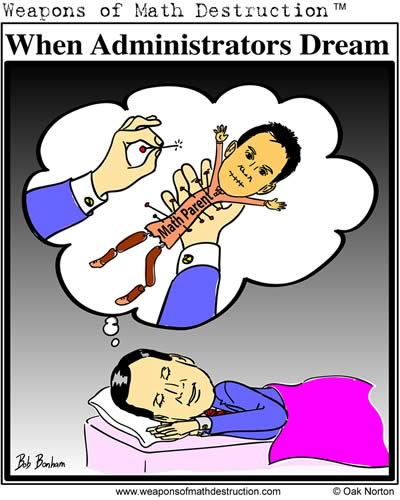
Here's a (PDF) paper called "Schooling in Capitalist America Revisited" (2001). Economists Samuel Bowles and Herbert Gintis understand that schools aren't failing, as so many claim: they're doing exactly what they're designed to do (keeping kids ignorant). While I'm at it: the great John Taylor Gatto hasn't updated his page in years. Go buy his book anyway.
in case you were wanting to hear something funny about cancer
I for one was not, but this really is pretty funny.
(from kausfiles via Drudge)
Well, maybe not funny. It's funny at first, and after awhile you think......oy.
(from kausfiles via Drudge)
Well, maybe not funny. It's funny at first, and after awhile you think......oy.
Tuesday, March 27, 2007
nice work if you can get it
So I was talking to a friend today whose kid is having trouble in a class. Most of the kids are having trouble.
Extra help doesn't help.
She talked to the department chair who recommended one of the other teachers, a novice, as a tutor.
Fee?
$100/hour
My friend protested, so the teacher said she'd work 1 1/2 hours.
One hundred dollars/90 minutes for a teacher who has been teaching only a couple of years.
One hundred bucks for a teacher currently teaching a class in which a number of the students "are struggling and don't belong." direct quote, middle school principal
In Irvington, if a student is struggling, he doesn't belong.
Core principle.
I'm STEAMED.
I've spent at least 5 hours today studying transformations, creating worksheets, working with Christopher, etc.
It's 9:30 pm and I still need to create a set of worksheets for him to use during study hall.
All of this is happening because I'm too stubborn to shell out $100/hour to get some other teacher in the math department to do Ms. K's job.
mark my words
I will never hire an Irvington teacher as a tutor.
Ever.
Class-size Reduction and America's Misplaced Priorities
The Common School: A Question of Scale: Class-size Reduction and America's Misplaced Priorities
Via Eduwonk... new blogger "Dewey", who is reputed to be a minor education wonk, makes the case that class size reduction would have a tiny effect on educational outcomes.
My only observation:
Isn't it possible that reducing class size would actually have a negative effect, instead of a small positive one?
We already have difficulty attracting teachers into teaching, especially in math and science. Doubling the number of teachers would have to entail reducing standards and quality.
Wouldn't the net effect of the lower average teacher quality more than cancel out the small benefits of reduced class size?
Go read the full post and if your statistically savvy, analyze his data and conclusions.
Pretty damn good for his 2nd post though.
(Cross posted at Parentalcation)
Via Eduwonk... new blogger "Dewey", who is reputed to be a minor education wonk, makes the case that class size reduction would have a tiny effect on educational outcomes.
But the really mind-blowing results come when you start comparing a class-size reduction to giving students a teacher with a reasonably good (though not unlikely) combination of teacher credentials (estimated by adding the relevant values in the table above). Clotfelter and Ladd do their own estimates of this sort and come up with a combined effect size of 15% - 20% SD for math (and 8%-12% for reading) of a well- credentialed teacher.He figures it would take approximately 150% billion dollars in increased salary costs (if the improvement for reducing students is linear that is), for a net benefit of 1.6% to 4% SD in math instruction. He then goes on to propose several novel ideas about how that money could be better spent for a much more significant educational outcome.
The first time I read this portion of the study I said to myself, "Yeah class size is less important,” but that finding is not particularly novel to anyone who follows this sort of research. But when I decided to actually compare how much less important class size is my jaw dropped. The effect size of teacher credentials is 8 to 10 times that of a major class size reduction in math and 6 to 8 times as big in reading!!!
My only observation:
Isn't it possible that reducing class size would actually have a negative effect, instead of a small positive one?
We already have difficulty attracting teachers into teaching, especially in math and science. Doubling the number of teachers would have to entail reducing standards and quality.
Wouldn't the net effect of the lower average teacher quality more than cancel out the small benefits of reduced class size?
Go read the full post and if your statistically savvy, analyze his data and conclusions.
Pretty damn good for his 2nd post though.
(Cross posted at Parentalcation)
non-school factors and math
from the new blog The Common School, written by an anonymous cog in the D.C ed organization scene:
I've been assuming this was true for some time now, but it's nice to see it confirmed by an anonymous cog.
This phenomenon is clearly true for us.
The ITBS has C. reading at a 12.6 level, which is in the 95th percentile.
At school he's reading books at a 5.1 to 6.5 level.
He's acquiring his reading comprehension at home.
His math is at the 88th percentile, and that's with huge amounts of teaching and reteaching at home. Without our help I assume C. would be much lower. He'd probably have the same kind of Verbal-Math gap our friend D's son ended up with. His SAT-V score was 780 or 790; his math, after massive tutoring, was in the low 600s (iirc).
That's an enormous gap, and it's directly attributable to the constructivist pedagogy of the schools he attended. (Think what that score would have been without the tutor.)
Back to Christopher. The ITBS says he's great on fractions -- and, again, ditto. We've spent lots of time directly teaching fractions at home.
On scales measuring skills we haven't worked on (punctuation, "words with affixes," decimals, etc.) he scores lower.
Looking at C's ITBS report, what I see is very high scores in the areas of "home influence," not so great scores in the areas being handled by the school.
Slide and glide.
non-school factors and math
non-school factors, math, and reading
In general the impact that school-based factors have on reading tests scores is significantly lower than the impact that such factors have on math scores and conversely the impact of non-school factors such as parental education levels is much bigger for reading than for math. Given that parents typically interact with their children more through language than through math, it makes intuitive sense that the parental (and peer etc.) impact on language skills would be larger than their impact on math skills.
A Question of Scale
I've been assuming this was true for some time now, but it's nice to see it confirmed by an anonymous cog.
This phenomenon is clearly true for us.
The ITBS has C. reading at a 12.6 level, which is in the 95th percentile.
At school he's reading books at a 5.1 to 6.5 level.
He's acquiring his reading comprehension at home.
His math is at the 88th percentile, and that's with huge amounts of teaching and reteaching at home. Without our help I assume C. would be much lower. He'd probably have the same kind of Verbal-Math gap our friend D's son ended up with. His SAT-V score was 780 or 790; his math, after massive tutoring, was in the low 600s (iirc).
That's an enormous gap, and it's directly attributable to the constructivist pedagogy of the schools he attended. (Think what that score would have been without the tutor.)
Back to Christopher. The ITBS says he's great on fractions -- and, again, ditto. We've spent lots of time directly teaching fractions at home.
On scales measuring skills we haven't worked on (punctuation, "words with affixes," decimals, etc.) he scores lower.
Looking at C's ITBS report, what I see is very high scores in the areas of "home influence," not so great scores in the areas being handled by the school.
Slide and glide.
non-school factors and math
non-school factors, math, and reading
Subscribe to:
Posts (Atom)