kitchen table math, the sequel: Search results for working memory
Showing posts sorted by relevance for query working memory. Sort by date Show all posts

Monday, January 23, 2012

Why students have to memorize things

re: Larry Summers' claim that "in a world where the entire Library of Congress will soon be accessible on a mobile device..., factual mastery will become less and less important":

Larry Summers is wrong.

Factual mastery has not and will not become less important, for the simple reason that it is not possible to think about something stored on Google.

While you are thinking about something, that something has to be lodged inside working memory, not Google.

Biology does not work the way Larry Summers thinks it works.

Working memory

If I ask you to multiply 36 by 3 inside your head, working memory is what you use to do it.

Working memory (WM) does three things:
  1. Holds the problem -- "multiply 36 by 3" -- in consciousness 
  2. Retrieves the relevant knowledge from long-term memory (the times tables, in this case)
  3. Performs the calculation
Boiling it down, working memory is:
  1. a form of storage
  2. a search engine 
  3. a "computer" or thinker
"Critical thinking" is accomplished by working memory.

3 to 5

The fact that we can think only about things stored inside working memory leads directly to the need for "factual mastery."

Factual mastery—knowledge stored inside long-term memory—is essential because although long-term memory is vast, working memory is tiny:
...cognitive tasks can be completed only with sufficient ability to hold information as it is processed. The ability to repeat information [you have just heard or read] depends on task [difficulty]... but can be distinguished from a more constant, underlying mechanism: a central memory store limited to 3 to 5 meaningful items in young adults.

The Magical Mystery Four: How Is Working Memory Capacity Limited, and Why? by Nelson Cowan
Working memory can hold three to five items at once. That's it. That's the limit.

Three to five.

I hit this limit all the time trying to write about new topics. The basal ganglia, for instance. For well over a year, I have been endlessly working and re-working a project on the basal ganglia, a subject I knew essentially nothing about going in. Where the basal ganglia were concerned, my long-term memory was a blank slate.

The upshot: I was not able to write about the basal ganglia until I actually learned about the basal ganglia: learned as in committed the material to memory. It didn't matter how many times I looked up basal ganglia on the internet. I looked up the basal ganglia on the internet a lot, as a matter of fact; then I forgot whatever it was I had looked up while I was looking up something else to do with the basal ganglia, after which I'd have to go back and re-look up the first thing all over again.

Try it if you don't believe me.

Here are some terms related to the basal ganglia:

Dorsal striatum
Ventral striatum
Putamen
Nucleus accumbens
Ventral tegmental area
Orbital frontal cortex
Dopamine
Two pathways
OCD
Addiction
Habit
Impulsive
Compulsive
Intuition
Probabilistic learning
Associative learning
Statistical learning
Serotonin
Orbitofrontal cortex
Cortico-striatal circuit

Now supposing I handed you a laptop and asked you to look up each term on Wikipedia, then write a coherent, reasoned 5-paragraph essay on the basal ganglia: what it is and what it does. Just a quick summary organized into 5 coherent paragraphs.

You couldn't do it.

You couldn't do it because every time you wrote about the ventral striatum, the dorsal striatum, and the orbitofrontal cortex, you would forget the VTA and the putamen—and you would forget the VTA and the putamen because your working memory will hold only 3 to 5 things at once. Something has to go.

That's what happened to me when I took the SAT with a calculator I didn't know how to use. Each time I swapped the steps for using the calculator into working memory, my brain swapped the information for the problem I was doing back out of working memory. Then, when I tried to cram the information for the problem back into working memory, the calculator steps got squeezed out again.

I could remember the problem, or I could remember the calculator, but I couldn't remember both at the same time. Too much information, literally.

My calculator fiasco illustrates the reason you need to practice until you learn content and skills to the point of 'automaticity.' (Automaticity is another basal ganglia term, by the way. The basal ganglia are the part of the brain that underpins automaticity.) Once you've learned something so well you don't have to think about it, you free up space in working memory to hold other things.

Thus if you know the times tables "by heart," you don't need to pull "3x6=18" into working memory. Working memory can locate "3x6=18" inside long-term memory and use it without displacing "36x3."

Knowledge stored inside the brain is different from knowledge stored outside the brain

Experts always possess factual mastery of their fields. Always.

The reason experts always possess factual mastery of their fields is that knowledge stored in long-term memory is different from knowledge stored on Google.

Knowledge stored in long-term memory is (or becomes) biologically connected, or "chunked." Thus to an expert on the basal ganglia, ten facts about the basal ganglia are just one or two big facts about the basal ganglia.

Chunking is the magic, because working memory doesn't care about chunk size. Working memory can hold 3 to 5 small and simple items or 3 to 5 large and complex items. Either will do. Chunking gets around the limits on working memory.

Dan Willingham's demonstration of working memory

For a demonstration of the chunking principle, read the list below, then look away and try to remember what you've read:

CN
NFB
ICB
SCI
ANC
AA

How many letters did you recall?

To find out how many letters you would have recalled via prior chunking inside long-term memory, see Daniel Willingham's explanation in "How Knowledge Helps" (American Educator | Spring 2006).

(The answer is all of them.)

You can't Google knowledge chunks

Knowledge chunks can be created only inside the brain, via learning. You can't Google someone else's complex knowledge chunks and swap them into your own working memory. It doesn't work that way. Your own brain has to do the work of chunking, and your brain does that work through the process of learning, bit by bit and step by step.

Which means that the process of storing content in long-term memory is not a simple matter of "memorizing facts" so you can "regurgitate" them later.

Over time, memorization creates the complex knowledge chunks that allow knowledgeable people to engage in complex thought.

Experts think better than novices because experts have factual mastery


To a gratifying degree, I can now think about nearly all 19 items on the basal ganglia list at the same time. I'm still struggling with "putamen" and "ventral tegmental area," but the other 17 are stored in memory: my memory, not Google's. So, for me, those 17 items are no longer 17 separate items, but closer to 2 or 3. When I think about 1 item on the list, I'm thinking about the others.

I reached this point by committing these terms and concepts to memory. As the terms entered my long-term memory, they became biologically connected and chunked. Now that I can think about them at the same time, which means I can write about them, too.

What makes experts expert, to a large degree, is factual mastery of their fields. Factual mastery allows experts to think deeply and well because the content they are thinking about has been biologically connected and chunked inside their brains, and there is no obvious limit to the amount of chunked content working memory can manage so long as knowledge has been chunked into no more than 3 to 5 separate entities.

Factual mastery is required for complex thought.

Which brings me back to Larry Summers.

If our schools are going to ask students to 'think' about material they haven't learned, students are going to be thinking about 3 to 5 small, not-well-elaborated items at a time. Period. Their thinking will be superficial, and the conclusions they reach will be superficial, too.

Which is exactly what we see in Larry Summers' op-ed about education, a field in which he is neither expert nor learned.

AND SEE: 
Superior Memory of Experts and Long-Term Working Memory (LTWM)
Extremely fast learning & extended working memory
The Number and Quality of Representations in Working Memory by Weiwei Zhang and Steven J. Luck
How Knowledge Helps by Daniel T. Willingham American Educator Spring 2006

#whystudentsneedtomemorize

Tuesday, January 1, 2008

bigger & better

Lots of cool brain stuff at New Scientist.

Maybe I'll just forget the Book Club and spend my time hanging out on the web doing exercises intended to increase my working memory. (Sorry - I didn't write down the source that put me onto those two sites, but I remember it being serious.)

UNTIL recently, a person's IQ - a measure of all kinds of mental problem-solving abilities, including spatial skills, memory and verbal reasoning - was thought to be a fixed commodity largely determined by genetics. But recent hints suggest that a very basic brain function called working memory might underlie our general intelligence, opening up the intriguing possibility that if you improve your working memory, you could boost your IQ too.
Working memory is the brain's short-term information storage system. It's a workbench for solving mental problems. For example if you calculate 73 - 6 + 7, your working memory will store the intermediate steps necessary to work out the answer. And the amount of information that the working memory can hold is strongly related to general intelligence.
A team led by Torkel Klingberg at the Karolinska Institute in Stockholm, Sweden, has found signs that the neural systems that underlie working memory may grow in response to training. Using functional magnetic resonance imaging (fMRI) brain scans, they measured the brain activity of adults before and after a working-memory training programme, which involved tasks such as memorising the positions of a series of dots on a grid. After five weeks of training, their brain activity had increased in the regions associated with this type of memory (Nature Neuroscience, vol 7, p 75).
Perhaps more significantly, when the group studied children who had completed these types of mental workouts, they saw improvement in a range of cognitive abilities not related to the training, and a leap in IQ test scores of 8 per cent (Journal of the American Academy of Child and Adolescent Psychiatry, vol 44, p 177). It's early days yet, but Klingberg thinks working-memory training could be a key to unlocking brain power. "Genetics determines a lot and so does the early gestation period," he says. "On top of that, there is a few per cent - we don't know how much - that can be improved by training."

As far as I can tell, the idea that working memory is highly related to IQ is solid and not likely to be significantly revised any time soon. I have the impression that, for awhile there, neuroscientists were thinking that IQ might actually be working memory, but that hypothesis seems to have been abandoned.

Thursday, April 26, 2007

Extremely fast learning

Drop whatever you're doing and go read Larry Squire's commentary on the Tse, et al study right this minute.

This is revolutionary.

Of course, that means it will take 20 years for these findings to filter out to the public schools (if they ever filter out at all).

Bob Koegel told us years ago that it takes 20 years for new research to be widely adopted in teaching practice. Ten years for other researchers to confirm the finding, another 10 years for dissemination.

Larry Squire, fyi, is a honcho.

highlights
We learn and remember better when new material can be related to what we already know. Professional athletes can remember details of particular plays that occurred in a long match. Experienced poker players can reconstruct the card distribution and betting sequence that occurred in previous hands. This is possible because these individuals have a rich background of relevant experience and therefore can organize new material into meaningful and orderly patterns.
[snip]
Memory consolidation refers to the gradual process of reorganization by which new memories become remote memories (3, 4). Initially, the learning of facts and events (declarative memory) depends on the hippocampus, a structure deep in the temporal lobe of the mammalian brain. As time passes after learning, the importance of the hippocampus gradually diminishes and a more permanent memory is established in distributed regions of the neocortex. This process typically takes a few years in humans and at least a month in rodents. According to one influential model (5), the process is slow because if changes were made rapidly, they would interfere with the preexisting framework of structured knowledge that has been built up from other experiences.
[snip]
The most surprising finding by Tse et al., and what connected the schema concept to memory consolidation, was that removal of the entire hippocampus as early as 48 hours after the rapid learning of two new flavorplace associations fully spared memory of the associations... It was not the case that memory of the new associations was never dependent on the hippocampus, nor that memory was somehow formed directly in the neocortex, because hippocampal lesions made 3 hours after learning abolished memory of the new associations. In short, the neocortex was able to incorporate new information rapidly. This is unexpectedly rapid for a process that, on the basis of as many as 20 studies in experimental animals, ordinarily takes at least a month (7). [ed.: a month in rats, years in people]
[snip]
It is tempting to suppose that memory consolidation proceeded rapidly because new information was fully compatible with what had already been learned—in other words, a good schema was available. If so, questions naturally arise about the minimum requirements for an effective schema. [ed.: yes, they do]
[snip]
caption:
Good schemas wanted. When a rat learns associations between flavors and spatial locations, as studied by Tse et al. (1), the associations are initially learned as individual facts (left). [ed.: precisely what cognitive science has been finding for at least 20 years] With extended training, the animal develops an organized structure or schema for flavors and places (middle). This organized knowledge structure (bold lines) can then support rapid learning of new associations in a single trial and the rapid consolidation of information into the neocortex (right).
Ericsson, expertise, and "extended working memory"

For months now I've been meaning to put up a post about Ericsson's concept of extended working memory.

Around here we've been accustomed to thinking that "knowledge is good" because knowledge and skills learned to the point of automaticity take a load off of working memory.

But it seems there's more to it. From The Role of Deliberate Practice in the Acquisition of Expert Performance (pdf file):
[E]xpert performers have acquired skills that enable them to circumvent general memory and processing limits. Chase and Simon (1973) originally attributed experts' superior memory to chunking in short-term memory. This account has been revised, and the exceptional memory of experts has been shown to reflect rapid storage in long-term memory (Charness, 1976; Frey & Adesman, 1976; Lane & Robertson, 1979). ....The most important implication of these acquired memory skills is that they enable experts to circumvent the limited storage capacity of short-term memory. Thus these skills eliminate any restrictive influence of individual differences in this basic capacity (Ericsson & Smith, 1991b)
I assume Ericsson and his team are talking about the same phenomenon Tse and her team demonstrated in mice: extremely rapid learning that circumvents the normal constraints on working memory and new learning.

(an aside: the terminology researchers use to characterize memory has bewildered me for years, so let me point out that short-term memory and working memory are two different things)

In other words, it's not just that practicing knowledge to the point of automaticity "frees up space" in working memory so you can solve more complicated problems.

What Tse, Squire, and Ericsson all appear to be saying is that practicing knowledge to the point of automaticity also makes it possible to acquire new knowledge very rapidly.

and see:
why students have to memorize things

Sunday, October 23, 2011

rat psych - "careless errors" in reading the SAT

During my year of living dangerously, doing SAT math prep off and on with C., I was chronically amazed stunned by the number and type of "careless errors" he and I both made taking timed sections of the test. In particular, I made repeated errors of "simple" reading, particularly when I was tired or the room was hot. I made so many reading errors that when I finally took the real test, I had no way to predict my math score at all: no way to estimate how many reading errors I had -- or had not -- made.

I eventually came up with a theory of careless errors, the details of which I've forgotten at the moment. I do recall that it had to do with working memory. Arguably the SAT tests working memory above all: all 10 sections put you into working memory blowout. I experienced working memory blowout so often that I began to notice a connection. As far as I can tell, you make more careless errors when your working memory is overtaxed (and you hit the limits of working memory much more quickly when you're sleep-deprived or overheated).

I've just come across a new study that I think confirms my subjective experience:
This study resolves two long-standing debates in the field. Does our working memory function like slots, and after our four slots [emphasis added] are filled with objects we cannot take in any more; or does it function like a pool that can accept more than four objects, but as the pool fills the information about each object gets thinner? And is the capacity limit a failure of perception, or of memory? [emphasis added]

“Our study shows that both the slot and pool models are true,” says Miller. “The two hemispheres of the visual brain work like slots, but within each slot, it’s a pool. We also found that the bottleneck is not in the remembering, it is in the perceiving.” [emphasis added] That is, when the capacity for each slot is exceeded, the information does not get encoded very well. The neural recordings showed information about the objects being lost even as the monkeys were viewing them, not later as they were remembering what they had seen.
Picower: 1 Skull + 2 Brains = 4 Objects in Mind
Failures of working memory are failures of perception!

Subjectively, that's what I experienced taking practice sections; that's what it felt like. Once I hit a certain level of tiredness, or heat, or working memory blow-out, I stopped being able to read.

The same thing happens on the reading and writing sections, too. The reading and writing sections are so taxing that you reach points where you simply cannot take in what the sentence or paragraph before you says. * I'm not talking about losing the ability to answer questions about the sentence or paragraph.

I'm talking about losing the ability just to read the words on the page.

I'm a 10
rat psych: what to do about SAT math (part 1)
rat psych: what to do about SAT math (part 2)
rat psych: what to do about SAT math (part 3)
rat psych: careless reading errors on the SAT

* I say "you" because I know I am not alone in this.

Sunday, March 6, 2011

uh-oh

"when A.P. testing began in 1956, memorization was not yet a dirty word"

Rethinking Advanced Placement
By CHRISTOPHER DREW
Published: January 7, 2011
In theory, the new A.P. courses are going to replace "memorization" with "critical thinking."

In reality, critical thinking depends on memorization: you can't think critically without something to think about, and that something has to be stored in long-term memory. If you're going to think critically, you have to know (i.e. remember) what you're thinking about.

What happens when you try to think critically about a subject without memorizing its terms and concepts first?

What happens is that you can think about 4 items at most. That is the number of new, discrete elements you can hold in conscious, "working memory"* at one time. Four. And four may be pushing it.

Of course, when it comes to critical thinking, 4 is a tiny number. Experts think critically about far more elements at one time; being able to think about a vast amount of complex material is pretty much the definition of an expert, as a matter of fact:
The sine qua non of skilled cognitive performance is the ability to access large amounts of domain specific information [i.e. knowledge]. For example, it is estimated that chess masters have access to as many as 100,000 familiar configurations of chess pieces (Chase & Simon, 1973). As another example, in order to make sense of what he or she is reading, a reader must have access to information gained from previously read text. This is particularly true when reading complex technical material filled with jargon.
summary of Ericsson, K. A., & Kintsch, W. (1995). Long-term working memory. Psychological Review, 102, 211-245.
David Zach Hambrick, 1998, gt8781a@prism.gatech.edu

basal ganglia lollapalooza

Here's an example from my own life.

As a nonfiction writer, I'm essentially a permanent student: I am constantly trying to write interesting articles and books (mostly books) about material that may be brand-new to me. My current project involves the basal ganglia, which I knew nothing about going in. The vocabulary alone is overwhelming: nucleus accumbens, orbitofrontal circuit, putamen, striatum --- and that's just for starters.

So here's the question. How exactly am I to (a) understand and (b) think critically about a passage that contains these four terms if I haven't memorized what these terms mean and how they are related to each other first?

The answer is: I can't.

If I don't memorize vocabulary, I have to look up the definitions and then try to hold the definitions in mind while also reading and trying to think about what I'm reading.

It can't be done, and the reason I know it can't be done is that I've spent a lot of time trying to do it. I always make the same mistake with each new project I tackle. Somehow I think I can just look things up (Google!) and remember them while I read a complex study or article.

But I can't. No one can. Looking up four new words and remembering four new meanings maxes out working memory. There's no capacity left to read and understand a text using those four new words and four new meanings, let alone think.

I don't know why this is. Logically speaking, shouldn't it take just as much working memory to hold 4 memorized terms in mind as it does to hold 4 non-memorized terms in mind?

The answer is no: knowledge - content stored in long-term memory - extends working memory.

When you know a lot about a subject - when you have a great deal of knowledge stored in long-term memory - you can think about more than just 4 things at once.


blackboards vs PowerPoints

* Working memory is essentially consciousness: it's what you're thinking about and/or remembering right now. When you hold a phone number in memory while dialing it, you're using working memory.

Tuesday, July 21, 2009

Working memory and the blind

We are talking about the huge swaths of children labelled "learning disabled" who can't read, but what about the actually disabled who learn anyway?

How do the blind learn to read, or compute, or do any of the tasks we think of as reading/writing/math?

Has anyone ever read anthing about the cognitive workings of the blind?

I increase my working memory by writing things down on paper and looking at what I've written.

How do they maintain working memory? Are the brilliant scholars who are blind particularly adept at maintaing working memory using braille? or do they just have fantastically larger working memory than the rest of us? How do they organize their working memory--do they do it "visually" to some degree? Or do they use other senses somehow? Is their auditory loop for working memory MUCH larger than mine, e.g.?

Anyone ever read any research on this? Or even any anecdotal memoirs?

Wednesday, November 28, 2007

brute memorization

Terrific post from Instructivist on the subject of memory and memorization.

This is something I've struggled with: how to distinguish "brute memorization" (my term for it) from "natural memorization" or, in instructivist's phrase, "thoughtful memorization."

Constructivist philosophy defines the word "memorization" as most folks do: the student sits down with a set of flash cards and commits material to memory.

I assume (don't know) that the flash card approach is essential in some realms: foreign language courses, law school, med school.....yes?

But "brute memorization," generally speaking, probably isn't the best way to go about acquiring knowledge, and is not the method a knowledge-focused curriculum like Saxon Math employs.

Unfortunately, we don't have a term for the kind of memorization Saxon Math induces.

Saxon Math produces memorization via spaced repetition, which is, I believe, the way everyday life produces memorization.

Here is my sense of the way in which natural memorization works:

  • content to be committed to memory is broken into the smallest meaningful units
  • the smallness of the units allows each unit to be held in working memory (or consciousness) in its entirety

  • in time the units being practiced naturally enter long-term memory

This seems to be the way most material enters long-term memory in the day to day. One repeatedly encounters and/or practices an idea or skill until one simply "has it."

Example.

I'm going to guess that quite a few ktm readers and commenters now possess a usable or at least semi-usable definition of the term working memory.

Did you acquire this by sitting down with a flash card and rotememorizing it?

No.

You acquired a usable knowledge of working memory by repeatedly encountering the term in posts and comments until you remembered it.

This process is natural, and it is inevitable. Memory is a core function of the brain; people who don't remember things have brain disorders. Bad ones.

Constructivist antipathy to memory and remembering is quite perverse -- it is unnatural, as a matter of fact -- but it is consistent with constructivist antipathy to knowledge.

The brain naturally acquires knowledge. Yes, I know the brain does not naturally acquire knowledge of algebra absent a good textbook and teacher ( ! )

However, if you have a good textbook and/or teacher it is entirely natural to acquire knowledge of algebra whether you give a damn about algebra or not. As a matter of fact, it's entirely natural to acquire some knowledge of algebra even with a mediocre textbook and a so-so teacher. Repeated practice causes us to remember what we've practiced, period.

If you don't want students acquiring knowledge, you're going to have to oppose memory and memorization.

.....................................

As to direct memorization and its place in formal education or in any training program, my sense is that it is often the fastest route to remembering. From time to time Saxon will tell the student, "Memorize this." His meaning is always: You're going to need this, you're going to use this, just go ahead and memorize it.

Direct memorization is a shortcut.

I think.

.....................................

hmmm...

Direct memorization
probably isn't a bad term for the kind of simple, straightforward, put-it-on-a-flashcard-and-practice-it memorization constructivists call "rote."

Friday, November 16, 2007

finding the basic principle


What about teachers? Were there teachers who were pretty important to you?

Nora Ephron: Yes. I had a couple of great, great teachers. The teacher who changed my life was my journalism teacher, whose name was Charles Simms. I always tell this story. I love it. I had already decided that I was going to be a journalist. I didn't know why exactly, except that I had seen a lot of Superman comics. Lois Lane and all of those major literary characters like that, but Mr. Simms got up the first day of class, and he went to the blackboard, and he wrote "Who, what, where, why, when, and how," which are the six things that have to be in the lead of any newspaper story. Then he did what most journalism teachers do, which is that he dictated a set of facts to us, and then we were all meant to write the lead that was supposed to have "who, what, where, why, when, and how" in it.

He dictated a set of facts that went something like, "The principal of Beverly Hills High School announced today that the faculty of the high school will travel to Sacramento, Thursday, for a colloquium in new teaching methods. Speaking there will be Margaret Mead, the anthropologist, and two other people." So we all sat down at our typewriters, and we all kind of inverted that and wrote, "Margaret Mead and X and Y will address the faculty in Sacramento, Thursday, at a colloquium on new teaching methods, the principal announced today." Something like that. We were very proud of ourselves, and we gave it to Mr. Simms, and he just riffled through them and tore them into tiny bits and threw them in the trash, and he said, "The lead to this story is: There will be no school Thursday!" and it was this great epiphany moment for me. It was this, "Oh my God, it is about the point! It is about figuring out what the point is." And I just fell in love with journalism at that moment.

I just fell in love with the idea that underneath, if you sifted through enough facts, you could get to the point, and you had to get to the point. You could not miss the point. That would be bad. So he really kind of gave that little shift of mind a major push. I just fell in love with solving the puzzle, figuring out what it was, what was the story, what was the truth of the story.

interview, Nora Ephron

Ed told me that when his first wife was learning to do radio journalism her boss kept telling her she was "backing into the story." Ed remembers being fascinated by that: backing into the story.

Print journalists call it burying the lede.

She would go into the radio booth and read the text she'd written; then the guy would tear it apart.

Temple has a wonderful way of talking about not backing into stories and not burying the lede and such. She calls what she learned to do in college find the basic principle. Temple figured this out on her own. She would have a mass of facts, figures, and concepts she had to master for a course and her working memory was too limited to hold more than a couple of them at the time, so she had to find a work-around.

Her workaround was to find the basic principle, the one idea from which all the other ideas flowed logically. Then that one idea would work as a cue, helping her to remember all the other ideas.

Of course, everyone's working memory is severely limited. The idea used to be that working memory could hold "the magical number 7 plus or minus 2" items. But these days people are saying the magical number is closer to 3 or 4.

I don't think Temple's working memory is any more limited than a typical person's; I think the real problem is that her working memory is slower. She told me once that the reason she can't do mental math is that if she's adding 12 to 29, say, by the time she's able to close the 9+2 "window" in her mind's eye (another term for working memory), she's forgotten 10+20. If she does manage to retrieve 10 + 20, she's forgotten 2+9, carry 1.

I back into my story all the time. Then some editor will tell me to fix it and I do. This has happened enough times that these days, after finishing a draft, I try to figure out how much introductory stuff has to go. It's not easy.

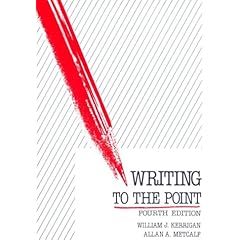
It's gotten easier since I discovered William J. Kerrigan's Writing to the Point. Which reminds me. I have to scan some more of Kerrigan's book and get it posted.

Judging by the essay Concerned Parent's 9-year old daughter just wrote, I'd say Hake's Grammar and Writing the closest thing we've got in print to Kerrigan. Hake wrote the Saxon Math books 5/4 through 8/7, then decided to write a "Saxon Grammar," too.


The Magical Number 4 in Short Term Memory: A Reconsideration of Mental Storage Capacity
by Nelson Cowan, 2001


William J. Kerrigan and Allan A. Metcalf
Paperback: 192 pages
Publisher: Harcourt; 4th Ed edition (January 1987)
Language: English
ISBN-10: 015598313X
ISBN-13: 978-0155983137


Wednesday, March 26, 2008

Cognitive Load Theory (CLT) For Beginners

Cognitive Load Theory (CLT) from Greg Kearsley's site, Theory into Practice:

Sweller's Cognitive Load Theory: Overview

This theory suggests that learning happens best under conditions that are aligned with human cognitive architecture. The structure of human cognitive architecture, while not known precisely, is discernible through the results of experimental research. Recognizing George Miller's research showing that short term memory is limited in the number of elements it can contain simultaneously, Sweller builds a theory that treats schemas, or combinations of elements, as the cognitive structures that make up an individual's knowledge base. (Sweller, 1988)

The contents of long term memory are "sophisticated structures that permit us to perceive, think, and solve problems," rather than a group of rote learned facts. These structures, known as schemas, are what permit us to treat multiple elements as a single element. They are the cognitive structures that make up the knowledge base (Sweller, 1988). Schemas are acquired over a lifetime of learning, and may have other schemas contained within themselves.

The difference between an expert and a novice is that a novice hasn't acquired the schemas of an expert. Learning requires a change in the schematic structures of long term memory and is demonstrated by performance that progresses from clumsy, error-prone, slow and difficult to smooth and effortless. The change in performance occurs because as the learner becomes increasingly familiar with the material, the cognitive characteristics associated with the material are altered so that it can be handled more efficiently by working memory.

From an instructional perspective, information contained in instructional material must first be processed by working memory. For schema acquisition to occur, instruction should be designed to reduce working memory load. Cognitive load theory is concerned with techniques for reducing working memory load in order to facilitate the changes in long term memory associated with schema acquisition.
From Kevin McGrew's blog, a guest post by Walter Howe, Cognitive Load Theory for School Psychologists:

  • Have you ever done something successfully, but not known exactly how you did it? It’s a common experience. It works, but we generally either cannot repeat this feat readily or transfer this performance to other, similar situations. We have performed a particular task successfully, but we haven’t really learnt a lot.
  • In CLT, this one-off success isn’t learning (in other theories it is regarded as learning, and termed implicit learning or procedural knowledge). Learning only occurs when we have abstracted a series of steps and rules that we can repeat in similar situations or even teach others so they, too, can be successful. These rules and procedures are called schemas or schemata and they are stored in long-term memory. Novices, by definition, either don’t have a schema for a particular learning task or it is very unsophisticated. Experts, on the other hand, have many, very sophisticated schemas, which they apply without thinking (i.e. the application of these schemas has become automatic).
  • CLT is concerned with how we learn or (in CLT terms), how we develop schemas and automate them and become experts. It applies to learning relatively complex material, as schema acquisition and development are generally unimportant for simple tasks, although how simple a task is depends both on the task itself and the individual who is learning how to do it successfully, as you will see.
Go read the whole thing, and while you are at it, poke around with Kevin McGrew's other posts on cognitive load theory and math, for starters.

CLT has obvious implications for the design of instruction in mathematics, among other things.

PS:
Kevin McGrew keeps a number of wonderful resources: IQ's Corner ("An attempt to share contemporary research findings, insights, musings, and discussions regarding theories and applied measures of human intelligence. In other words, a quantoid linear mind trying to make sense of the nonlinear world of human cognitive abilities.") Tick Tock Talk: The IQ brain clock ("An attempt to track the "pulse" of contemporary research and theory regarding the psychology/neuroscience of brain-based mental/interval time keeping. In addition, the relevance of neuroscience research to learning/education will also be covered.")

Tuesday, April 24, 2007

smart people need more practice

This is kind of cool ---


Highly accomplished and talented people often choke under pressure because the distraction caused by stress consumes their big supply of short-term memory, says Sian Beilock, assistant professor of psychology at the University of Chicago, who conducted the research. In the business world, for instance, short-term memory is what lets you listen to what people are saying and yet maintain a point you want to bring up.

Because people in this group heavily rely on short-term memory to tackle challenges, they're at a particular disadvantage. When put under pressure, they resort to using less accurate short cuts to solve problems, such as guessing and estimation, much like those with lesser abilities.

[snip]

.... when talented people begin to feel the heat....

....they started worrying about screwing up. That consumed the working memory capacity of those in the study, which had allowed them to use complex strategies to solve problems in other circumstances.

"Once they had all this capacity to devote to a problem," says Beilock, "and now they're thinking about their worries, trying to suppress them and possibly causing themselves to freak out more."

[snip]

One of Gray's studies has shown that people with higher intelligence also are more taxed by having to control their emotions.

[snip]


If choking under pressure is a concern for you, Beilock's advice is practice, practice, practice--and not just problem solving, but problem solving in high-pressure situations. Memorizing methods of handling problems means you won't have to rely on your short-term memory.
source:
Why Pros and CEOs Choke

There's a strong association between high working memory capacity and high IQ. For awhile there, I think, people were thinking that working memory might actually be IQ.

I take these findings to mean that high-working memory types have "coasted" on WM; they haven't learned work-arounds or shortcuts -- like all these brainy little math kids who refuse to write out the steps because they can do them faster in their heads. (This may be completely wrong... I'm free associating.)

Because they're naturally fast, they haven't learned how to be efficient.

Tuesday, July 9, 2013

Prior knowledge gets around working memory limits

[I]t’s well known that extensive background knowledge allows one to circumvent the limitation of working memory. To take an obvious example, if I ask you to hold six letters in mind for one minute, it will be much easier to do with B-R-A-K-E-S than with X-P-W-M-Q-R. Although both are a string of six letters, the first forms a word, so you can treat it like a single unit. It’s like holding one thing in working memory, not six. Naturally, this saving of space in working memory only works if you know the word “brakes.” The same phenomenon is observed in many other domains. The chess expert looking at a board does not see 16 white pieces—she sees several clusters of pieces, each cluster defined by the relationship of the pieces to one another and to opposing pieces. Whether it’s chess pieces or letters in a word, the compacting of many things into one thing in working memory is based on prior knowledge.
Have Technology and Multitasking Rewired How Students Learn? by Daniel T. Willingham

Friday, July 22, 2011

working memory in children

[T]he findings from this study indicate that the three main components of the Baddeley and Hitch (1974) model of working memory are in place by 6 years of age. The capacity of each component increases linearly from age 4 to early adolescence.


The Structure of Working Memory From 4 to 15 Years of Age
Susan E. Gathercole
University of Durham Susan J. Pickering, Benjamin Ambridge,
and Hannah Wearing
University of Bristol
Developmental Psychology 2004, Vol. 40, No. 2, 177–190
Children have lower working memory than adults, and lower working memory has ramifications for language learning and some cases of problem solving.

Wednesday, July 20, 2011

working memory

Just came across this textbook chapter on working memory and thought I'd share it. Don't know who wrote it.

Bielock writes that "working-memory differences across people account for between 50 percent to 70 percent of individual differences in abstract reasoning ability or fluid intelligence."

Working memory also makes you dumber in some situations.

I'll get to that later.

Choke: What the Secrets of the Brain Reveal About Getting It Right When You Have To

Friday, November 11, 2011

anonymous on lefties taking the SAT

Good advice:
Lefties should be particularly vigilant about the chairs/desks. I've heard stories about them having to take long tests on right-handed flip-up deskettes; a true nightmare. I know the registration forms for my grad comps asked lefties to identify themselves, because almost all of the seats in the auditorium had right-hand deskettes. They brought in as many extra lefty ones as they needed. Is there a similar question on SAT registrations?
I have got to find time to write a quick post on working memory.

I believe that the "transmission mechanism" from right-hand desks for left-hand test-takers to reduced performance is working memory blowout.

And see: death by calculator. Death by calculator is a case of working memory blowout.

(The real-world term for working memory blowout problems is cognitive load theory.)

Saturday, June 30, 2012

letter to Andrew Rosenthal

re: Texas Republicans and "Knowledge-Based Education," I've sent this email to an address that I hope belongs to Andrew Rosenthal:
Hi -

I am a writer (Animals in Translation; Animals Make Us Human) and an instructor of freshman composition.

My class blog is here.

My husband, Ed Berenson, is Director of the Institute of French Studies at NYU (his new book is The Statue of Liberty: A Transatlantic Story).

Both of us strongly support “knowledge-based education,” and we are likely in the majority of parents, including liberal parents living in New York.

Although it’s not obvious from the platform’s wording, knowledge – not critical thinking per se – is the issue the Texas Republican Party has taken a position on. The phrase “critical thinking” means something quite different inside public education than out, and I’m hoping you’ll consider writing a follow-up to clarify.

Boiling it down, there are two fundamental issues in the ‘education wars,’ one involving values, the other involving empirical research on the brain.

In terms of values, a majority of parents (and taxpayers and liberal arts professors) want schools to transmit to students knowledge of the liberal arts disciplines.

The K-12 establishment disagrees. Education professors [tend to] believe knowledge is changing so quickly that material taught today will be obsolete tomorrow, so content doesn’t matter. Instead of teaching knowledge, schools should teach students to ‘think critically’ and to ‘learn how to learn.’

(If you're interested, I compare my own district's ‘content doesn’t matter’ 7th grade reading program to the Core Knowledge reading sequence here. My district spends $29K per pupil.)

In terms of research on the brain, the K-12 establishment believes that ‘knowing’ and ‘thinking’ are separate functions. In the age of the internet, they argue, there is no reason for students to 'memorize' and 'regurgitate' knowledge because you can find any information you need on Google.

That sounds logical, but cognitive science has shown that it’s wrong. In reality, it's not possible to think about content stored on Google. While you are thinking, content must be stored inside 'working memory,' and working memory for “external,” unlearned content is tiny -- while working memory for knowledge stored in long-term memory is much larger.

In short, “knowledge” stored in the brain is biologically different from “knowledge” stored outside the brain, and the difference matters to the quality of thought. Thinking depends on knowing.

Cognitive scientist Daniel Willingham’s article for teachers is worth reading:
Critical Thinking: Why Is It So Hard to Teach?

In closing, I’ll mention that Ed headed the California History/Social Science Project in the ‘90s. CHSSP was a state-wide effort by the superintendent of schools to remove professional development from education schools and put it in the hands of disciplinary specialists – in other words, to make professional development “knowledge-based.”

I’m sure Ed would be happy to talk to you if you’re interested.
Hoping you’ll look into this further and consider writing a follow-up –

Catherine Johnson
Of course, I've omitted the question of direct instruction in values...

Tuesday, September 4, 2007

Susan J's brilliant lesson on per cent

Susan's lesson is wonderful.

Read these two lines:

Remember that it doesn't make any difference whether you write a fraction with a slanted division line between the numerator and denominator or with a horizontal division line between the numerator and denominator:

This direction comes exactly where it should, arriving at the precise moment in which a student may be starting to feel confused by the horizontal notation 33% = 33/100.

The use of light violet highlighting is fantastic, too:


Don't forget that in word problems, is almost always means equals and of almost always means times.

This next line is a terrific example, IMO, of the proper way to teach a procedure:

You can probably divide 300 by 100 in your head. But it is useful to remember that an easy way to divide a number by 100 is to move the number's decimal point two places to the left. You should also remember that when a number isn't written with a decimal point, you put the decimal point just to the right of the number.

One of the problems with "traditional" math, which I'm sure plagues a lot of reteaching parents, too, is that teachers & parents fall back on purely procedural teaching whenever a student is struggling with a concept. You can see that your student's working memory is already maxed out just dealing with the new material, and you know there's no point adding even more information to the load. He's not going to absorb it, and he may lose focus on the concept he's trying to master.

I've thought about this a lot, because I do more "straight" procedural teaching than I would like.

I'm constantly looking for an "in" to offer an explanation or make a connection between the new material and something C. (presumably) already knows. But if I were actually writing a curriculum, explanations wouldn't be an "add-on," and I wouldn't be looking for an "in." The explanation would be a seamless part of the sequence of instruction and example. My starter examples would be simple enough to do two things:

  • incorporate an explanation within the structure of the example
  • leave enough working memory free to allow the student to read and understand a simple explanation accompanying the example

The Singapore Math books work this way. Rarely do they give a student "too much" at the same time. In Singapore Math, the examples are the explanation to a large degree. The written text is spare, even terse.

That's what Susan has pulled off. She has set up a simple per cent problem that gives her a fraction with a 300 in the numerator and a 100 in the denominator. Both of those numbers -- 300 and 100 -- are already "chunked"; the load on working memory is extremely low. The student can hold them in WM while reading Susan's reminder that moving the decimal point two places is another way of dividing by 100.

In short, having set up the correct teaching example, she can in two sentences express and distinguish between two ideas that trip up many a middle school student:*

  • moving the decimal point two places to the left is the same thing as dividing by 100
  • moving the decimal point two places to the left is just an easy way of dividing by 100, a shortcut, no more & no less**

This is agile writing.

I would describe my own efforts to teach per cent this summer as clunky.

First of all, I don't write my own problems. I use whatever problem happens to be on the page before me in whatever workbook I'm using.

As a result, C. ends up with a fraction along the lines of 286/100, which he can't divide mentally. When he forgets he can move the decimal point, I remind him; then, as he's laboriously writing out 2.86 (because his handwriting, along with everything else, has also not been learned to fluency), I say, "What are we doing when we move the decimal point?" At this point he's focused on getting the number right and only vaguely registers the move-the-decimal-point explanation, which he's sick of hearing in any case.

It doesn't work (not well, at any rate), because the explanation is an add-on.


writing is all about structure

That's the famous William Goldman slogan about screenplays: structure, structure, structure.

Structure is practically impossible to "see" when we read, and it is the single hardest trick of the trade to pull off.

The answer to Susan's question -- Are math books too verbose? -- is yes, for the same reason the answer to that question is yes with nearly any piece of writing. Remember the UK writing assignment:

[Judith] Koren describes how two British women she knows became effective essayists and speakers. “Each week, they’d had homework exercises like this: While preserving every essential point, reduce a 100-word essay to 50 words, then to 20, then to 10. Reduce 500 words to 50, 1,000 words to 100. Week after week, year after year...."
(appeared in American Enterprise Magazine)


The reason you can keep cutting a piece of writing after you've already cut it down to the bone, the reason it gets better with each cut, is that you are correcting and refining the structure.

In a piece of educational writing about math, the structure is refined and the verbiage trimmed by choosing the correct example or sequence of examples of the concept being taught.


Singapore Math for afterschooling

This reinforces my decision to use the Singapore Math books for formal afterschooling. They are superb.

I don't think you can find an unnecessary word anywhere in the series.***


* The article The Effects of Cumulative Practice on Mathematics Problem Solving by Kristin H. Mayfield & Philip N. Chase has a fascinating observation about "stimulus discrimination training" in math practice sets -- will post ASAP.

** This is so important for students just learning math. Especially when I was relearning arithmetic, I found myself constantly confused over the question of whether a particular procedure was "real" or just a shortcut. (Can't explain better than that at the moment.)

*** This may be true of the Saxon books, too. However, the Saxon books cover all the standards in all the states, or nearly so, which makes them too unwieldy for the time I have to work with.

Sunday, March 6, 2011

Daniel Ethier on cognitive load theory

on another thread, Daniel Ethier writes:
Cognitive load theory has much to say about the educational implications of our limited working memory on learning.

As I read various papers on cognitive load theory, I keep having aha moments as I find reasons for things I see in the classroom.

The key to getting around our limited working memory is automaticity. If you know something well enough to not have to think about it, it does not take up working memory. And so you are free to think about the problem you're trying to solve.

Use Google Scholar and read some of the many papers about various aspects of cognitive load theory. Well worth the time.

Friday, November 16, 2007

from short term memory to working memory

This is a terrific short summary of the transition from short term memory, the concept I was taught in college, to today's notion of working memory.

I don't know whether this is the best account of how this idea has evolved, but it does coincide with the changes I've seen over the years.

Thursday, January 11, 2007

teaching problem solving to second graders, part 2

(Part 1 is here.)

Now the students are ready to start solving simple comparison problems with variables.

First the students are taught how to translate a phrase like "T is less than H" or "R is more than W" onto a number family.

The lesson might be taught like this:

Sometimes we refer to a number without telling which number it is. We can call that number J or B or any other letter. Here is a sentence that tells about two numbers: J is less than M.

We don't know which numbers J and M are, but we can put those numbers in a number family. J is less than M. So J is the small number. M is the bug number.

The big number goes at the end of the arrow. The small number goes close to the big number. Here's how you write it.


Then an example using "more," like "R is more than W," is taught.

After the students are firm on this skill, they are ready to tackle a translation like "J is 18 more/larger than K."

This must be a difficult skill because in CMC they scaffold the instruction by circling the number which tells how much more. Like this:


Eventually the scaffolding is faded.

To translate the problem, the students are instructed to ignore the circled number. This makes the problem identical to one they know how to translate -- "J is larger than K." They know that this can be translated into:


Then they are taught to place the circled number, 18, into the only available spot in the number family. Like this:


Once the students are firm on this skill, they can be given a problem that they know how to solve like "F is 12 more than 56." Now they should be able to translate this to a number family and solve for F.

Then the problem can be made more difficult by specifying two variables and the value of one of the variables, such as "R is 250 more than P. R is 881. What number is P?"

Finally, the students are ready to start solving real word problems like "Fran was 14 years older than Ann. Ann was 13 years old. How many years old was Fran?"

Here's how they are taught how to solve these kinds of problems:


This is a good stopping point. This represents a month worth of instructional time for the lessons and the practice. That's for lower performers, higher performers can probably learn this in about a week. Bear in mind that the students are learning and practicing about 10 other strands of material while all this is going on.

The value of this problem solving technique (like Singapore Math's bar graphs) is twofold. First, it reduces solving math problems to a systematic process; this will clarify the student's thought process. Second, the use of the written number families frees up the novice student's working memory which is taxed heavily in solving word problems. Given enough practice, these skills will become automatic for the student and lodged in long term memory. When this occurs, the burden on the student's working memory is becomes much less and the need for the number family prompt is diminished.

Teaser for next lesson: The students learn how to solve word problems like "Jerry weighed 72 pounds. Terry weighed 94 pounds. How much heavier is Terry than Jerry?" To solve problems like this, the students are taught the concept of moving forward and backward along the number family line.

Monday, January 23, 2012

Larry Summers has a really bad idea

In today's Times, Larry Summers weighs in on the question of what college students ought to learn in college.

Larry's answer: not too much, because the entire Library of Congress will soon be accessible on a mobile device with search procedures that are vastly better than any card catalog!

Larry bases his novel and highly original thesis (to wit: "factual mastery will become less and less important") on "what we now understand about how people learn."

(Does Harvard have node chairs, I wonder? Sounds like no.)

OK, I'm going to go look up calculus on the internet. I've always been interested in calculus, so now that I've received a mobile device for Christmas, I'm going to look it up. Then I'm going to collaborate with some friends who also looked up calculus on the internet to figure out what to do about the 21st century global world meltdown.

I'm going to do this because I've noticed that economists use calculus in their collaborative group papers.

[pause]

There is a reason why students must commit content to memory as opposed to looking it up on a mobile device with search procedures that are vastly better than any card catalog.

That reason has to do with working memory.

More anon.

What You (Really) Need to Know by Lawrence A. Summers

update: Why students have to memorize things
and see: Extremely fast learning & extended working memory

AND SEE:
The founder, chair, and CEO of Netflix has a really bad idea
Larry Summers has a really bad idea
Wash U professor on Reed Hastings' really bad idea
Barry Eichengreen has a really bad idea
President Obama has a really bad idea

David Brooks has a really bad idea

David Brooks has a really bad idea, part 2
David Brooks has a really good idea

The Daily has a really bad idea