kitchen table math, the sequel: Search results for Karen pryor
Showing posts sorted by relevance for query Karen pryor. Sort by date Show all posts

Friday, February 15, 2008

Steve on teachers, homework, and Extra Help

"I check to make sure they made the effort and tried the assignment while they check their answers, and we go over every single problem that is asked."

Do you collect the homework? You should. I did. I didn't grade each problem, but I saw what the issues were myself on a daily basis and I gave each homework a check/plus/minus effort grade. If you don't collect the homework and grade it somehow, then students don't have any incentive to do it in the first place. When I went over problems in class, I didn't have to rely on students to ask questions. Few do.


"How can you assume that it's a "teacher problem" when something isn't understood in class?"

How can you, the professional, assume that it isn't when you rely on the kids to tell you if there is a problem. You see and grade the tests. What do you do if students have major issues? By the time you get to a test, it's really difficult to go back and fix things. Perhaps eliminating homework and giving weekly quizzes would work better. Something other than monthly tests needs to push the students and inform the teacher about what is going on.

High school kids should take more responsibility, but you can't use that as a prerequisite for a good education. You have to try to structure things to prevent failure, not just leave it up to the kids.

Many students would NEVER come to my office hours. I never threw that back at them. I tried to think of ways to make it unnecessary for them to need extra help. Students hate going for extra help. It's a last resort. By then, the problem is really bad. A large use of extra help by many students implies that there is something fundamental going wrong, and it can't be blamed on the students.


Steve is on a roll today.

Having just finished Karen Pryor's Don't Shoot the Dog - a life-altering book - I've been thinking about this issue here at home.

We were reaching - had reached - the point at which I was using "aversives" to compel C. to get things done.

Of course I learned years ago, from behaviorists who taught us techniques for raising autistic kids, that aversives aren't very effective. Pryor goes further. Pryor argues, rightly I believe, that negatives have negative side effects.

A "negative reinforcer," by the way, increases the likelihood that a particular behavior will be repeated in the future. That's why it's called a "reinforcer," and that's what makes it different from a punishment. A punishment doesn't increase the likelihood of the punished behavior occurring in the future.

Unfortunately (or maybe fortunately), punishers also don't particularly decrease the likelihood of the behavior occurring again. Behaviorists universally seem to think that punishing bad behavior just is not an effective means of getting people to straighten up and fly right.

In theory, a negative reinforcer should be no different from a positive reinforcer; in both cases the behavior being reinforced is likely to be repeated. Thus doing your math homework to get a good grade should be no different from doing your math homework to avoid getting a bad grade.

But in reality, negative reinforcement has side effects. This is Pryor's view; I don't think this is a consensus view in the field. Pryor is a researcher and a trainer. Her many years of animal training have made her an advocate of the exclusive use of positive reinforcement.

More on side effects later.

Everything Steve has said in his comments thus far could have been written by Pryor. I think.

Here at home, I've been working on increasing positive reinforcement while reducing negative reinforcement and punishment.

Pryor is right: positives work far better than negatives.

Why is it so much more difficult to use them, I wonder?

Tuesday, December 4, 2007

Why I Don't Assign Homework

Liz Ditz left a link to Dy/Dan's blog.

I love this guy!


the homework problem

Here's what I love about Dy/Dan's post on not assigning homework.

First and foremost, not only has he thought out his position, he's researched it for a Master's thesis. The research is icing on the cake; the fact that he is so closely scrutinizing and adapting his "practice"* in response to his students' achievement is what makes me long to have a kid in his class.

Ed and I have been talking about the homework issue lately, mostly because C's social studies teacher told Ed he has students who never do their homework. We were both surprised to hear this though we shouldn't have been.** Kids not doing homework is a chronic issue for teachers everywhere.

Here's a Phi Delta Kappan article on the subject:

I tried to figure out why promising students in my own geometry classes persistently failed. Every year students entered my classes not fully prepared for the large body of new concepts, vocabulary, skills, and logical principles that are central to a college-prep geometry course. With rare exceptions, the deficiencies were surmountable, provided that these students accepted the need to study and work on sample problems outside of class. But, despite a claimed orientation toward college, many of them failed geometry, in large part because of "homework resistance" that seemed rooted in early elementary school and shaped by adolescent identity pressures.

Occasional missed geometry assignments weren't a big deal in my classes. After all, an unknowable but surely substantial portion of completed homework involved copying from classmates. An additional portion consisted of "homework simulations" with correct answers to odd-numbered problems (which have answers in the back of the book) embellished with jottings that gave the appearance of work. So, like most of my colleagues, I gave credit for homework but based most of a student's grade on tests, quizzes, and in-class projects. Class time was an intense geometry experience for all but the most tuned-out. But since test questions looked remarkably similar to those covered in homework, students who didn't do the homework had trouble passing tests or participating fully in class.

At year's end, out of 90 geometry students in three sections, 38 had completed less than 60% of the assignments. Of these 38, two quite talented students managed to earn a semester grade of C, another three earned D's, and the remaining 33 all earned F's. In contrast, all but a handful of the students who had completed 80% or more of the assignments passed with grades of C or better.

The puzzle. Why would so many students willingly waste a year sitting through geometry class and earn zero credits toward graduation? All had managed to pass algebra, and many even had good attendance in my class. Most had the requisite mathematical ability and would have passed had they spent 40 to 50 minutes daily outside of class on the homework. Free tutoring and homework help were available at lunch and after school, but no one showed up more than once or twice; most never came at all. What were they thinking? Countless frustrating conversations convinced me that most students in this situation can't tell you the teal reasons for their behavior, because they themselves don't know. They offer a charming variety of excuses, evasions, defensive maneuvers, mea culpas, and doleful expressions, many well practiced from prior confrontations with parents or counselors. Almost all say that to succeed they would need to start doing all their homework. They further insist that they want to be successful. So what's going on that students can't explain to us - or to themselves?

Homework Inoculation and the Limits of Research
Bruce Jackson
Phi Delta Kappan Sep 2007 Vol. 87, Iss. 1 pg. 55


Jackson's idea is that the practice of having kids do largely pointless homework assignments in K-5 in order to build "good homework habits" leads instead to homework refusal when kids reach middle school age and begin to assert themselves. Homework inoculation.

So....the cure for h.s. kids not doing homework is to get rid of homework K-5.

I'm sure that will work.

This is the kind of thing that makes me want to send this fellow a link to Karen Pryor's web site. Pryor makes short shrift of such motive mongering. She doesn't care to learn why a dog is behaving badly; she doesn't want to hear his history:

Karen helped me learn to read Ben's canine signals accurately, unhindered by my own emotion....She was the one, who during one of Ben's fits in class, came over, gently put her hand on my arm and calmly said, "Emma, it is only behavior."

"Only behavior?" I gasped. Could it be so simple? This "behavior" had caused me so much grief in my life, both personally and professionally. It had become a source of tension in my marriage and almost caused me to lose several friendships....I had allowed Ben's aggression to balloon into a problem that took over our lives. I found hope that night in class, with Karen's calm words: "It's only behavior." After all, through positive reinforcement, behavior--any behavior--can be changed.

Click to Calm Healing the Aggressive Dog
by Emma Parsons

Animal behaviorists make a useful distinction between ethology and psychology.

You do need to know ethology (how does this species act & think?)

You don't need to know much about psychology (how does this particular animal act and think, and why?)

When it comes to students not doing their homework, all you really need to know is that procrastination is a core human behavior that is not going to be conquered any time soon and certainly not by high school students. Asking students what they are thinking when they fail to spend 50 minutes a night doing geometry homework is absurd. They're not thinking about geometry one way or the other. That's the point.

This teacher needs to forget about what students are thinking and ask the school to send a behavior analyst to his class to change the incentives. A mere amateur like myself can spot some major de-motivators in his data.

If he can't round up a professional, he should read a book on behavior analysis and figure it out himself. ***

The "homework situation" appears to be an unholy mess. Setting aside the question of homework quality, I would like to see schools adopt policies of supervised homework like the one in place at La Salle High School. If a student is not getting homework done at home, I would assign him to a supervised homework study hall where he would get it done because a responsible adult would see to it. And I would make this a positive experience, not negative.

If I had my druthers, our schools would drop-kick the many state-mandated character-ed implementations over the stadium wall and replace them with school-wide positive behavior plans devised by the Bob and Lynn Koegels of this world.

Or else just hire a whole lot of teachers like Dy/Dan.


* hate that word, but it's correct in this context
** I have no business being surprised by any failure to complete assigned work...
*** I'm starting with Karen Pryor's Don't Shoot the Dog, which I will be using for my kids and for me.

Friday, March 7, 2008

Thank You, Karen Pryor

After hearing Catherine talk about Karen Pryor's Don't Shoot the Dog, I decided it was time to give it a go. (I gotta say, Catherine, your recommendations are usually spot on.)

My local library didn't have it, but I was able to track it down via state-wide interlibrary loan. This is actually a good thing -- normally, I can buy a book or get it from the library, and then I put it off and never really get to it. But -- interlibrary loan! No renewals! Get cracking!

I started it this morning during my warmup on the treadmill, and only got about 10 pages in before I started running and it got too bouncy to read. Finished up, checked in with the family, wasn't thinking about it, then went to go take a shower.

Once in the shower -- BAM!

I got it.

When I'm depressed, I engage in "retail therapy," and I'm training myself to be depressed. When I'm nervous, I eat treats, and I'm training myself to be nervous.

What am I training my kids to do? What am I training my husband to do?

Catherine -- if you set up a discussion group, I am so in.


(This, admittedly, may seem a bit simplistic. But it was quite the "aha!" there in the shower.)

Sunday, June 24, 2012

leafy suburbs, part 2

re: the leafy suburbs, Jen asks:
I have to be a bit of a devil's advocate here. Why is it that teachers are expected to do what parents here are saying they can't do?

That is, parents can't get one or two children to, say, do homework and study at home for a bit, whereas a teacher who has them for 45-50 minutes a day (or twice that every other day if block scheduled) is not only supposed to teach but also supposed to motivate them enough to do the homework and studying?
I actually have an answer to this question!

A few of them.

FIRST: Kids are often much more cooperative with other adults than with their own parents. That's why so many parents I know, parents who were trying to reteach content at home, finally gave up and hired tutors.

C. is your classic cooperative kid, and when he was in 8th grade, as I recall, we reached the point where I was shouting so much something had to give. That was when I discovered Karen Pryor's work. I remember, going into Christmas break, devouring Pryor, having a major heart to heart with myself, and vowing to do a 180 as soon as the new semester began, which I more or less did. The household was pretty close to being in crisis, and C. is a mild-mannered kid! (If Susan S is around, she'll vouch for me on that one - )

I used to think: what would be happening around here if C. weren't a mild-mannered kid?

Meanwhile, C. was having precisely zero problems at school. I think he had one - no, two - detentions in his entire 3 years at middle school, and one of the 2 was a group detention most of his math class (math again) served for being disrespectful to a substitute teacher.

SECOND: Parents really, truly don't have the training we need to deal with a lot of the stuff we deal with. Not that parents should have to have training! I'm not suggesting anything of the kind. I'm just saying that, for instance, using the principles of positive reinforcement to deal with a challenging autistic child (or a completely non challenging nonautistic child you're trying to reteach math to) does not come naturally to anyone, as far as I can tell.

Of course, teachers don't get a lot of training in behavior management, either, but schools do seem to have school psychologists these days, and at least some of them have had some real training and experience.

Good teachers do acquire an extremely impressive set of skills where classroom management is concerned, something I'm still working on. A behaviorist I know told me that classroom discipline is THE issue every new teacher faces, and that includes a new teacher who has just served a tour of duty as a Marine.

THIRD: Even if the parent is highly skilled at maintaining law and order inside the home, the parent is not inside the classroom. I can't tell you how often I've heard about school personnel assuming that parents can magically, from miles away, directly influence their children's behavior inside the classroom.

My own funniest story on this score concerns Andrew, who, a few years ago, was being very difficult on the bus. Now Andrew, as I think a fair number of you know, is autistic and nonverbal. He doesn't talk. We can talk to him, but it's not clear how much he understands.

(Andrew is also weirdly smart - this is something the teachers and aides say, btw, not just a parent fantasy .... Andrew is sui generis. I need to say that out of loyalty and also out of honesty. btw, Susan can probably attest to that one, too. Susan watched Andrew during my mother's funeral, and afterwards said to me, "I think he ordered something from Amazon.")

Anyway, Andrew was being difficult on the bus, and the head of transportation called to discuss the situation. He wanted me to make Andrew stop. Somehow I, as the parent, was supposed to be able to change my autistic child's autistic behavior on a bus. When I expressed skepticism that I would be able to influence Andrew's behavior from afar, the transportation director asked me: Can you have a talk with Andrew?

I said: Andrew doesn't talk.

The thing is: the transportation director knew Andrew doesn't talk. And yet he was on the phone asking  me to 'have a talk' with my nonverbal son.

That's an extreme example, but I've seen the same thing with ADHD kids: I've seen school personnel assume that a parent can affect an ADHD child's behavior without being present to do so.

That's not how ADHD works. In fact, it is pretty much the opposite of how ADHD works. I know a family that has done a fantastic job with their very ADHD son: meds, therapy, very strong behavioral boundaries, lots of love, authoritative parenting --- a fantastic job. Their son is a very good kid.

Nevertheless, as far as I know he was quite disruptive in classrooms through all of through middle school (not sure about high school). The classroom disruption problem in his case was really, truly a "school problem" in the sense that it was taking place inside the school. His parents had his behavior  well under control at home; I saw it. They had also taught him terrific manners; I saw those, too. But  keeping his classroom behavior under control inside a classroom without being inside the classroom themselves was not possible.

With disorders like autism and ADHD, if the school doesn't deal with the problem, it doesn't get dealt with.

FOURTH: This brings me to my final answer, which is that when a teacher can't manage a student in his or her classroom, other arrangements need to be made by the school.

This isn't just my personal opinion; it's pretty much the law. By law, a student who can't function inside a regular classroom must be evaluated, must be given an IEP (if that's what's called for), and must be educated -- by the school.

That said, I know this is an area where schools often miss the boat. The horror stories I've heard .... I think the phrase "radical inclusion" (not my term) captures it. When school administrators decide that full inclusion (what is it called now - collaborative classrooms?) is the way of the world come what may, when full inclusion collaborative classrooms include a child the teacher absolutely cannot control no matter how much special training and support s/he is given, that is wrong for all concerned. It's wrong for the child, it's wrong for the teacher, and it's wrong for the other children.

Also: full inclusion for all is a decision the school has made, not the parents. The school has a responsibility to provide a calm and safe learning environment for all children.

That is my opinion; general education children have no entitlement to nondisrupted classrooms, sad to say.

Saturday, December 22, 2007

book club

We may need to form a book club for interested folks. I say this selfishly because I need people to help me brainstorm my way through Karen Pryor's Don't Shoot the Dog, especially now that I'm hyper-aware of how difficult it is to generalize newly-acquired knowledge.

Pryor's book is brilliant. Reading it I see that I've been barking up the wrong tree thinking cognitive science has the answers. (barking?) Cognitive science does have answers; it's a valuable and riveting field. But when it comes to education the behaviorists are way out in front. Direct Instruction, Precision Teaching, Don't Shoot the Dog -- they're so far out in front they're disappeared from view.

No wonder their work is no longer taught in ed schools. (scroll down)


life-altering factoid number 1

Chickens procrastinate.

Using either fixed or variable schedules, extremely long sequences of behavior can be trained. A baby chick can be induced to peck a button a hundred times or more for each grain of corn. For humans there are many examples of delayed gratification. One psychologist jokes that the longest schedule of unreinforced behavior in human existence is graduate school. [ed.: followed closely by middle school]

[snip]

Another phenomenon occurs on very long schedules: slow starts. The chick pecks away at a steady rate once it gets started, because each peck brings it nearer to reinforcement, but researchers have noted that a chick tends to "put off" starting for longer periods as the schedule of reinforcement gets longer.

This is sometimes called delayed start of long-duration behavior, and it's a very familiar aspect of human life. On any long task, from doing the income taxes to cleaning out the garage, one can think of endless reasons for not starting now. Writing, even sometimes just the writing of a letter, is a long-duration behavior. Once it gets started, things usually roll along fairly well, but, oh! it's so hard to make oneself sit down and begin, James Thurber found it so difficult to start an article that he sometimes fooled his wife (who was understandably anxious for him to write articles since that was how the rent got paid) by lying on a couch in his study all morning reading a book in one hand while tapping the typewriter keys at random with the other.

Don't Shoot the Dog, Revised Edition, p. 25


palisdesk on change in ed school curriculum
The Misbehavior of Organisms
Marian Breland Bailey: many lives (pdf file)
book club
a heroine I didn't know I had

Monday, February 18, 2008

bring back self esteem

I've mentioned a couple of times that I regret the fact that "character education" has replaced "self-esteem" as the psychosocial focus of public schools.

Of course, I have to assume that in practice any given school's definition of "high self esteem" may have been "self esteem on our terms," which in turn probably meant low self esteem, not high. But I still prefer self-esteem to character as a school's guiding principle.

Character education, in my experience, has been quite punitive. It almost has to be given its premise, which is that the character students have developed at home needs improvement -- and that the character of school personnel doesn't.

This is where the Bible has it right.

I'm not crazy about the notion of children as inherently more flawed than grownups to tell the truth. Very young children possesss all kinds of sweet, altruistic impulses along with the usual obnoxious impulses. Rightly or wrongly, I tend to see kids as innately good in a fundamental sense.

I'd like my kids to attend a school in which administrators, teachers, and support staff feel the same.


middle school and depression

Which brings me to middle school.

The difference between a middle school and a junior high, we have repeatedly been told, is that middle school "educates the whole child."

What does that mean?

It means, first of all, that academics often take a back seat to "character" education activities. Middle school kids here are required to attend a character ed assembly each and every month; to my knowledge the school has never, not once in 2 1/2 years, staged an assembly devoted to an academic or intellectual topic. Ed, reading Martin J. Wiener's English Culture and the Decline of the Industrial Spirit 1850-1980 last summer, wondered whether character education is always be opposed to academics. I think it may be.

Beyond this, I am coming to feel that character education, as implemented by so many of our public schools, is incompatible with the creation of a positive school environment. You don't hear Karen Pryor talking about "bad" horses and "bad" dogs -- quite the opposite. Pryor's view of dog aggression is: "It's just a behavior!"

Middle school kids would be far better off if middle school behaviors like not knowing how to keep track of 6 or 7 different courses at the same time were not viewed not as a sign of poor character.

Disorganization is just a behavior is a far more humane way to understand a spacy 11-year old. Giving a 6th grader an "F" on his notebook for disorganization strikes me as bad for the 6th grader.

Little did I know that middle schools crop up in research on the development of depression in adolescence as a contributing factor:

…evidence has accumulated to suggest that, in addition to the family influences just described, schools and neighborhoods contribute to patterns of academic and psychological adjustment, especially during the transition from elementary to middle schools (National Research Council, 1993). Therefore, the school environment is likely to be implicated in the development of depression. This view is corroborated, at least partially, by the fact that certain forms of psychological distress, including depressive symptoms, increase during the middleschool years. Perceptions of being academically competent and receiving good grades have been linked with a reduced risk for emotional and behavioral difficulties, whereas low perceived academic competence is related to depressive symptoms in children (Blechman, McEnroe, Carella, & Audette, 1986; Cole, 1991). Moreover, adolescents who do not feel a connection with school may be more likely to engage in antisocial activities and substance abuse in efforts to boost their self-esteem and sense of belonging (Rosenberg, Schooler, & Schoenbach, 1989). In general, it has become increasingly clear that problems of academic alienation, poor school performance, and minor delinquency that become more prominent in early adolescence are linked to negative mental health problems such as depression that are manifested later in adolescence (Eccles, Lord, & Roeser, 1996). Such negative outcomes have been related to diminished support for the development of competence, for feelings of belongingness, and for autonomy promotion characteristic of elementary school, but not of middle-school, environments (Higgins & Parsons, 1983). Evidence such as this suggests that the failure of the school environment to facilitate development as children progress into middle schools may contribute to motivational and mental health problems. Inappropriate school environments during early adolescence can place many young people at risk for the negative trajectories that some lives take, including alienation from prosocial activities and peers, depression, and involvement in antisocial pursuits. Importantly, positive adjustment to school, including academic engagement and achievement, is likely to serve as a protective factor against negative mental health outcomes (Eccles et al., 1996).

source:
The Development of Depression in Children and Adolescents
Dante Cicchetti and Sheree L. Toth
February 1998
American Psychologist

Vol. 53, No. 2, 221-241

Blechman, E.A., McEnroe, M.J., Carella, E.T., & Audette, D.P. (1986). Childhood competence and depression. Journal of Abnormal Psychology, 95, 223-227.

Eccles, J. S., Lord, S., & Roeser, R.W. (1996). Round holes, square pegs, rocky roads, and sore feet: A discussion of stage-environment
fit theory applied to families and school. In D. Cicchetti & S. L. Toth (Eds.), Rochester Symposium on Developmental Psychopathology: Volume 7. Adolescence: Opportunities and challenges (pp. 47-92). Rochester, NY: University of Rochester Press.

Higgins, E. T., & Parsons, J. E. (1983). Social cognition and the social life of the child: Stages as subculture. In E. T. Higgins, D. W. Ruble, & W, W. Hartup (Eds.), Social cognition and social behavior: Developmental issues (pp. 15-62). New York: Cambridge University Press.

National Research Council. (1993). Losing generations: Adolescents
in high-risk settings. Washington, DC: National Academy Press.

Rosenberg, M., Schooler, C., & Schoenbach, C. (1989). Self-esteem and adolescent problems: Modeling reciprocal effects. American Sociological Review, 54, 1004-1018.


I have more than once seen the "transition" to middle school cited as a source of profound stress in the lives of young adolescents. Typically researchers and authors seem simply to assume that "transition" from one school to another per se is the source of difficulty.

I am coming to think that the middle school model in and of itself, its core assumptions, is bad for children -- bad, or at least not good. When you assume that other people's children universally require substantial character education, how reinforcing can you be?

Sunday, January 13, 2013

browbeating at the kitchen table!

I LOVE this Comment by Jen:
Funny, well, funny in a sad way, that I had JUST now had a quick conversation with 21 yo college kid about how it may actually come down to homeschooling his little bro (10 yo).

Oldest kid got a better than average education in an urban district. He had some truly excellent HS teachers and was in an IB program. Whatever he missed out on that suburban kids had (nicer facilities, actual guidance counselors) was, we felt, more than made up for by the diversity of his experience, the exposure to so many different kinds of people and lifestyles, his ability to get along with all sorts of people in all sorts of settings.

BUT, the quality had slipped for the brother who is only 3 years younger. It was kind of a crapshoot to leave him be and know that he was only getting maybe 60% of the quality that his brother got. (Some very good teachers' positions not offered back to them, incompetent teachers mysteriously still there as the program went through a strange move and change of name and grade levels and the like, teachers retiring rather than deal with the craziness, etc.)

Youngest -- well, the new curriculum has basically proven itself a failure for everyone that doesn't have a concerned, aware parent at home and even for many that do. You could come out of our system now knowing almost NOTHING it seems. Gaaa. There's only so much you can teach over the dinner table and through browbeating.
It's true!

Jen is right!

There is only so much you can teach over the dinner table and through browbeating.

I am living proof of that.

I spent four years browbeating math at the kitchen table (not to mention one summer browbeating SAT math)* and my kid does not know math.

He's taking "Math Patterns in Nature" or some ungodly concoction next semester to fulfill his college math requirement.

Auuuuugggggghhhhh!

I'm thinking "There's only so much you can teach over the dinner table and through browbeating" should replace "They do what they do."

* For passersby, I should add that the actual period of browbeating was more like .... one or perhaps two years, just up to the point where I read Karen Pryor's Don't Shoot the Dog. (see: posts on positive reinforcement)

Friday, March 28, 2008

The meaning of good work

I just received my gently used copy of Spelling Mastery, Level E by Robert Dixon and Siegfried Engelmann. Perhaps my favorite passage in the Teacher's Book is The Importance of Corrections.

Correct all mistakes immediately.

The very term "correction" has a negative connotation, but corrections are a positive, critical part of effective teaching. Corrections are the equivalent of MORE INSTRUCTION, and that instruction is prompted directly by needs that students demonstrate.

Bringing every student to mastery on every component of Spelling Mastery exercises is vital to the effectiveness of the program. Spelling Mastery departs from traditional spelling programs in that once a word (or generalization) is introduced in the program, IT DOESN'T GO AWAY. Everything in the program is reviewed cumulatively, as insurance of long-term retention and transfer to writing.

[snip]

Using quick pacing and an upbeat, positive attitude toward corrections are major keys to effectively correcting an entire group. Don't forget to communicate to students how pleased you are when you are not having to correct them, particularly on difficult items.

Remember this about corrections. Students don't always know what constitutes a good job. When you hold them to a very high criterion of performance (especially early in the program) they learn exactly what your expectations are. They also see that by having high performance expectations, you are making it easier for them to learn and use what is being presented. Once they see the rules of the "game," their performance improves dramatically. They learn fast and generalize well -- things they would not do if they never learn what "good work" really means.

I think that Karen Pryor would approve.

Thursday, June 3, 2010

Karen Pryor on 'changemakers'

So you've become a clicker trainer! Naturally you are very excited. You want other people around you to stop using punishment-based methods and start clicking. So you introduce the clicker at your dog club or high school or wherever you are using it. And guess what: people not only don't change, they get mad at you.

Build a better mousetrap and, in chronological order, the world will:
  1. Ignore you
  2. Pretend to agree, but actually do nothing
  3. Resist, delay, obstruct
  4. Openly attack you (the dangerous phase, but also a sign that change is starting)
  5. Absorb
  6. Utilize
  7. Take credit
  8. Proselytize
On Being a Changemaker
In my school district, we've reached number 4.

Thursday, October 8, 2009

apps

I mentioned Tuesday that I have not been mentating so well of late.

It's been so bad I had to break out my Time Timer for the past two days running just to figure out when it was going to be time to stop doing whatever I was doing now and start doing whatever I was supposed to be doing do next.

Time Timer worked great. I recommend it.

I've also been using two iTouch apps every day, day in and day out: one for diet, another for positive reinforcement. Both are terrific. Fantastically useful and motivating.

I think Karen Pryor would approve.


iAchieve:


Lose It!
Lose It! screen shots
Does This Pencil Skirt Have an App?


Saturday, May 31, 2008

What Shamu Taught Me...

...about a Happy Marriage

My Karen Pryor dog treats and target stick have arrived, and my dogs (Surfer and Abby) are liking the clicker, liking the treats, and are happy to touch their noses to the target or drop their bodies down to the floor.

Neither has, as yet, experienced a lightbulb moment.

I'm gathering my courage to try this with Andrew. His behavior has got to get under control this summer. When Ed gets back from L.A., we're all going to have a go at the training game.


trainer's motto: It's never the animal's fault.

Tuesday, July 28, 2009

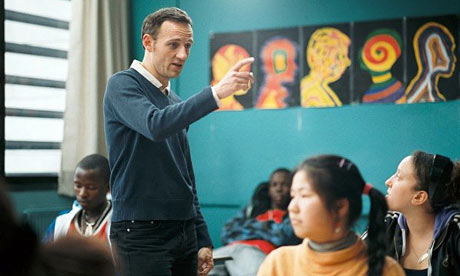
Entre les murs


photo: 'Every day I was playing a role'
by Stuart Jeffries
The Guardian, Friday 20 February 2009


I saw the beginning and the end of Entre les Murs ("The Class") on our flight home; will have to buy the DVD to watch the rest. Since the DVD isn't out, looks like I'm ordering the book.

From The Guardian:
The Class ... depicts a convincingly multicultural bunch of schoolkids. The film is refreshing, too, in that the teacher isn't overlord but hobbled prey, brought down or at least humbled by the wit and cunning of his (perhaps rather fancifully) articulate students. They subvert his lessons, for instance, arguing (with some justice) that no one in modern France needs to know the imperfect subjunctive, and use his classes to fight out ethnic rivalries.

But there are delightful moments. In one, a student teasingly asks the teacher if he's gay. "That really happened to me," says Bégaudeau, "and I was so pleased when it did, so I could turn the presumed insult back on the student. So I said: 'No, I'm not gay, but what's it to you?' I wanted to nail his homophobic perspective," Bégaudeau giggles. "That said, when you're 15 you use anything you can to mock someone else, so to call a fellow student a homo or a teacher a paedo isn't really a big problem. It's aimed at getting a reaction, so the teacher must try not to give the student what they want."

Ironically, the film's pivotal moment1 comes when Bégaudeau himself uses abusive language to his students. He calls two girls who have challenged his authority "petasses" (translated in the subtitles as "skanks"). It's a shocking moment: the teacher has lost it so badly that he resorts to offensively adolescent abuse. Never are we further in the film from the Robin Williams model of celluloid pedagogy; never has an authority figure in the classroom been so painfully exposed.

"That really happened to me, too. I called some girls that word. I regretted it immediately, but I felt so betrayed by them." In life, as in the film, the two girls were class representatives at a disciplinary hearing for a boy who risked expulsion for his unruly behaviour in class. What angered Bégaudeau was that they blabbed the hearing's findings to the boy, when their role as class representatives demanded their discretion.
For anyone who has even a glancing acquaintance with learning theory, Direct Instruction, precision teaching, Vicki Snider,2 Karen Pryor, John Taylor Gatto, or KIPP, the film is as appalling as it is riveting.

First of all, the students, age 13 to 15, are fantastically under-educated through no obvious fault of their own. From what I could see, M. Marin's teaching is atrocious.

And second, although it's not right to characterize the teacher as "hobbled prey" -- he gives as good as he gets, which is part of the problem -- no one in the school has the faintest concept of what effective classroom management is or what achieving it entails. At one point the teachers assemble for a staff meeting at which a new idea is presented for consideration: because discipline problems have increased, some teachers have come up with a plan to give students 6 points at the beginning of the school year and then progressively take points away after each infraction.

Astonishingly, a parent representative - a mother - is present for this discussion. Even more astonishingly, she is no baker of cupcakes. Frowning darkly, she tells the assembled staff that the 6-point scheme is typical of the school: you set the children up for failure and then you punish them.

Her observation sinks like a stone, and the 6-point idea is eventually abandoned after a protracted argument between two of the teachers over whether it is or is not a good thing to exercise flexibility when enforcing the rules. Which is better: judicial discretion or mandated sentencing? That is the question that lights their fire. Talk about a thoughtworld.

Unfortunately for the kids, the parent rep has nailed it. One of the film's many virtues is that it makes the connection between bad teaching and bad behavior 3 somewhat transparent, although that is not the intent. Given what we see of classroom instruction (we see quite a lot), the school seems almost designed to produce maximum failure, and a number of the students appear -- to me, at least -- to be living in a state of something close to open revolt, as well they might: it is a hopeless situation. Virtually no member of the staff appears to give any thought to whether students are ready to learn the material being taught in class, or to whether, after the material has been taught, students have actually learned it. Nor is the central character troubled by his inability to answer student questions. Toward the end of the protracted contest between teacher and class over the imperfect subjunctive & whether anyone uses it in real life (teacher's answer: "snobs" do), one of the quiet students (there are a lot of quiet students) asks how they can know when to use formal language in written communication and when to use informal.

The teacher's answer: it's hard to say. Students will have to develop "intuition" re: formal vs informal language, and their intuition will tell them when to use what. This is not a short answer, by the way. It is quite a long answer. Which makes the follow-up all the more exasperating for you, the helpless viewer: when the teacher finally wraps it up, a second student (another of the quiet ones) asks, "What is intuition?"

I guess the teacher couldn't have seen that one coming since, as I recall, his explanation of intuition is equally useless.

More from The Guardian:

The Class ends on the last day of the school year. All the students but one have left the classroom. Then a girl who viewers have scarcely seen before approaches M Bégaudeau's desk and says: "Sir, I didn't learn anything from your class." "It is a heartbreaking scene. We got her to do it again and again and on each take it got sadder and sadder. Everyone on the shoot was miserable by the final take.

"I think, to be honest, that scene shows how schoolchildren know how to get under your skin, how to say the words that shatter your world. She probably did learn something, but she wanted to hurt me, for whatever reasons.

My memory of this scene as it appears in the film is different:4 I think what the girl actually says is that she hasn't learned anything from any of her teachers, and she is afraid -- terribly afraid -- she will have to go to vocational school, which she doesn't want to do. She is insistent on both points, and, yes, the scene is sad.

The teacher greets this revelation as another challenge to his authority and, as is his way, attempts to argue the point: the girl can't possibly have learned nothing in an entire year of school, he says.

As for me, I was thinking just the opposite. I was finding it miraculous that any of these kids had learned anything in 11 years of schooling.5

You can watch a clip here.


francophile on the film & on differences between French & English schools

1 the scene I missed...
2 education needs a "science of teaching"
3 "the heart of successful behavior management is good instruction" Mary Damer & Elaine McEwan
4 you can read the original on page 162 of the book
5 Children in France attend school by age 4.

Wednesday, January 2, 2008

academic motivation

Good observations and resources from Liz & palisdesk in the comments thread.

I'm thinking about motivation this year for a couple of reasons. The first has to do with my determination to:

a) commit every last word of Karen Pryor's Don't Shoot the Dog to memory

and

b) apply it

and

c) do same with David L. Watson's Self-Directed Behavior.

Looks like I'll also have to spend time slogging through the 2nd edition of John Cooper's Applied Behavior Analysis thanks to last week's Barnes and Noble Promotional Gift Card snafu.*

My second reason has to do with the question: how does one convince a teenager that staying in school is a good idea?

I don't know the answer to that. I don't even know where to begin.

............................

* sauve qui peut alert: B&N Promotional Gift Cards do not cover textbooks, & customer service reps are apparently unable to cancel as yet unplaced orders for textbooks. Promotional Christmas Gift Cards are a risky proposition, I conclude. On the other hand, my efforts to spend this season's $50 Garnet Hill Promotional Gift Card without purchasing a $100-item at full price sans Promotional Discount seem to have met with success. So that's something.

Wednesday, September 3, 2008

back to school

C's first day of school!

Oh gosh, it was sweet. All those little 14 year olds, dressed up in their brand-new, no-iron shirts and ties and chinos.

C. has been going to the school for the past week and a half to run cross country even though he's not a cross country kid. He's been doing that because the coach sent each freshman a welcome letter inviting him to join the team, telling him it would be a good way to make new friends if he didn't know anyone at the school. There would be no cuts, the coach said, and kids were free to leave the team if it wasn't for them.

Basically, the coach "pitched" the team to the kids! That's something I haven't seen before.

The school actively works to get as many kids involved in organized sports as possible. This goal is so important (I gather) that they give parents their figures for number-of-kids-in-sports. Three of the teams make no cuts: track, swimming, and wrestling. Then they have an extensive set of intramural sports, too. They want everyone playing.

The cross country experience has been a blinding success -- amazing! Karen Pryor should write a book about this place. In just one week C. has taken two (three?) minutes off his time, made new friends, taken the train by himself, and absorbed the concept of "personal best" and competing against yourself when you're just starting out and it's not your sport.

There hasn't been a false note at this school. Not one.

It's amazing.