kitchen table math, the sequel: Search results for Andrew Wolf
Showing posts sorted by relevance for query Andrew Wolf. Sort by date Show all posts

Thursday, June 24, 2010

the nativity gap

from Bostonian:
Where is the evidence, adjusting for race, that American math curricula are worse than those used in Asia?

William Schmidt, director of the U.S. national Research Center for the Third International Mathematics and Science Study, is the person to read on this subject:

The Role of Curriculum
A Coherent Curriculum: The Case of Mathematics (pdf file)

and see:
The Sequence of Mathematics Topics in Top-Achieving Countries (pdf file)


nativity gap

This Stiefel, Schwartz, and Conger study, while not an analysis of curriculum, supports Schmidt's argument:

Do Immigrants Differ from Migrants? Disentangling the Impact of Mobility on High School Completion and Performance
Leanna Stiefel, Amy Ellen Schwartz, and Dylan Conger

from the New York Sun's story:
Foreign-born newcomers to New York City's public schools are performing better than native-born newcomers, a New York University study shows.

The working paper by NYU education researchers titled "Do Immigrants Differ From Migrants?" has also deflated any notions that immigrant students tend to do worse in American schools the older they are when they arrive. On the contrary, the findings demonstrated that immigrant students actually do better if they begin their American education in high school rather than in elementary or middle school.

[snip]

Ms. Schwartz, speaking at an NYU symposium last week, said she and her colleagues had hypothesized that immigrant students "who come late are the ones who are really disadvantaged," guessing that their lack of language skills, the stress of moving to a new country, and institutional differences between the schools they came from and the New York schools might hurt their graduation rate and performance on tests.

Instead, they found that the foreign born "just do remarkably better," Ms. Schwartz said.

Foreign-Born Students New to N.Y. Outshine Native Born
by Sarah Garland
New York Sun
February 11, 2008 Edition

Here is Andrew Wolf's take:
Immigrant children outperform some native-born children in New York schools, my colleague Sarah Garland reported the other day. Indeed, it seems the longer newly-arrived children attend our schools, the worse they do. These conclusions come from a new study, "Do Immigrants Differ From Migrants?"

"The foreign born are whizzing by the native born at every level," one of the researchers, Amy Ellen Schwartz, said.

[snip]

If one drives past the Bronx High School of Science any given school day morning, one will encounter a seemingly endless caravan of yellow school buses. Most of these buses come from Queens, the borough known for its immigrant population. Sixty percent of those recently offered a spot at Bronx Science as a result of their test scores come from Queens, as are 40% of the new freshmen at Stuyvesant. It [sic] it turns out that a good number of these commuter students are recent immigrants, why do the city's specialized high schools seem to have such a disproportionate number of newly arrived students?

Whizzing By
BY ANDREW WOLF
March 3, 2008
I miss the Sun.

Saturday, April 12, 2008

Andrew Wolf on test scores & tenure

Much of the current controversy over the use of standardized tests to determine teacher tenure is a reflection of the fact that many teachers are being evaluated by principals who themselves have no expertise running a classroom. The experiments attempting to create "instant" principals now can be declared a failure. Insuring that there is a fully qualified "principal teacher" running a school costs not a penny more than hiring an unqualified neophyte.

Making Do with Fewer Dollars
Andrew Wolf
New York Sun
April 11, 2008

He's talking about the Leadership Academies.

Friday, March 23, 2007

how to play

Last week, New York State revised its list of schools under registration review, the so-called SURR list. These are schools that are performing so badly that they are being considered for closing.

The idea of closing schools departs a bit from reality. Demolition crews do not come in and level the building. Usually "closing the school" means changing the name and number of the school, removing the principal and some, if not all, of the teaching staff. Most importantly for educrats, the school is now considered new, not failing, so it is removed from the SURR list.

I know of some schools that have had three different numbers in recent years. But changing the number doesn't change much. Five of the nine new schools just added to the SURR list have been there before under a different number. This is the strategy of rearranging the deck chairs on the Titanic, a sad reality for the children.

The city's Department of Education has found a brilliant way to reduce the total number of schools on the SURR list and make itself look better in the public eye. The education bureaucrats do a preemptive strike and "close" schools before the state designates them as SURR. Thus the department can boast of a decline in the number of SURR schools and give the "new" school a free pass for a number of years.

source:
The Numbers Game ($)
Andrew Wolf

I almost have to admire the resourcefulness here.

Thursday, June 21, 2007

making meaning


Here at ktm-2, we've been behind the curve.

We've been thinking constuctivism was about constructing knowledge.

It's not.

Constructivism is about constructing meaning.


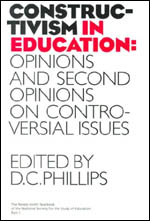
  • D.C. Philips: Thus, von Glasersfeld's epistemology.... leads him ....to argue that each individual science and mathematics student is responsible for building his or her own set of understandings of these disciplines;....teachers cannot assume that all students
    have the same set of understandings, or that their own ways of understanding are shared by their students. The Good, the Bad, and the Ugly: the Many Faces of Constructivism (pdf file) by D.C. Phillips Educational Researcher, Vol. 24, No. 7, pp. 5-12

  • According to [constructivist] theory, learning occurs only when students make an effort to construct their own understanding out of a problem situation. Constructivist-Compatible Beliefs and Practices among U.S. Teachers (pdf file) by Jason L. Ravitz, Henry Jay Becker, Yan Tien Wong Center for Research on Information Technology and Organizations U. California Irvine July 2000

Naturally all this stuff is driving parents crazy, especially seeing as how constructivist educators have stopped teaching for mastery but have carried right on testing for it. Well, everywhere except Scarsdale, that is.

Unfortunately, our plight doesn't elicit much interest from policy wonks and education journalists, most of whom* apparently believe that a quarter century of constructivist training in our schools of education has little to do with the achievement gap. (Interesting, isn't it, how it never seems to be progressive educators who make any headway narrowing the gap...I wonder why that is?)

So naturally I've been enjoying the spectacle of eduwonk getting the constructivist treatment:

OK, I am increasingly convinced that there is a reading crisis in our schools. On his blog, Fred Klonsky, a teachers' union head in Illinois, writes about the article(s) that Rick Hess and I have done on the competition - equity tension. But he ascribes a conclusion to us that is not in the article...and then he further tries to muddy the issue when called on it. Klonsky says that what he did is "make meaning" of what we wrote. Oh brother, try just reading what it says. It's an article, not a work of political philosophy.


That was Tuesday, June 19.

Today is Thursday, and eduwonk hasn't recovered:

....one lame, pseudo post-modern BS, attempt to spin out of this, “make meaning” from it as though this is a political theory seminar and we’re debating Montaigne....

yeeeaaahhhh

Let's have more of that!


update from Linda Seebach:

When I was a graduate student in mathematics (decades ago, that was) a significant part of the first-year courses was intended to develop students' intuitive understanding of the unfamiliar and abstract object that populate the mathematical universe, and you'd better believe that the professors expected all of us to acquire "the same set of understandings" they themselves had.


constructivist lollapalooza (thank you, instructivist)


* with a few notable exceptions (see: Linda Seebach, Debra Saunders, Andrew Wolf)

Monday, May 21, 2007

it's always worse than you think, part 2

Peter Rivera is not well known to many New Yorkers, despite a decade and a half in the Assembly. He is familiar to the mental health industry because he chairs that committee. In his Bronx district, his major efforts seem to be towards directing "member item" funds into questionable projects.

Mr. Rivera is making a stab at wider recognition with the introduction of a dangerous piece of legislation, one that has grave implications for our schools, our children, and our society.

Mr. Rivera proposes that all students in middle and high school be required to watch the Mr. Gore's film, "An Inconvenient Truth." In fact, by the end of his press release, he expands the mandate right down to the first grade. It is never too early to proselytize.

"This documentary," Mr. Rivera says, "captures the science along with social issues that undoubtedly have relevance to the lives of all of our young people. It is a must showing to our future generations if only to have them serve as our daily reminders to the adults who govern this planet that we must change or cease to exist."

Mr. Rivera, who up until now never seemed to be particularly interested in the education issues of his community, where test scores rise a lot slower than the temperature of the earth, seems to have found a new cause.

" Al Gore has suggested that every science class in America watch this film," Mr. Rivera says. "My legislation will mandate the showing to all students in grades 1 through 12 because the message of this documentary must be seen by every member of the next generation. They are the ones most likely to listen. The Environmental Revolution we need to confront global warming, if there is one, will come from the youth, as most uprisings do, not from their parents, who are mostly too entrenched in old behavior and lifestyles to be willing to make real change."

source:
An Inconvenient Assemblyman
by Andrew Wolf
New York Sun ($)
Start the revolution without me.

Please.

bonus post

fun in Canada

Wednesday, February 14, 2007

KIPP & the spiral

from Making Schools Work School-by-School reform:

[Hedrick] Smith: Okay. Does KIPP have a fifth grade math curriculum?

[Mike] Feinberg: No, KIPP does not have a fifth grade math curriculum; it has a fifth grade math philosophy, it has a fifth grade math scope and sequence but not a curriculum. We realized early on that trying to view the solution as reinventing the wheel and creating a brand new curriculum didn't make a lot of sense. There're a lot of smart people in this country who've already spent a lot of time working on what is good curriculum at first grade, fifth grade and ninth grade. The issue is not that we don't have good curriculum; the issue is that we're not getting the kids to learn it.

Smith: But what's that all about then, getting the kids to learn?

Feinberg: Getting the kids to master the material.

Smith: No, I understand that but what's the key to that? If the curriculum is reasonably good, then what's the key?

Feinberg: Instructional delivery, being very good at teaching in front of the room, very good at using those resources. Being very good at assessing the students and where they are and re-teaching and whatever, doing whatever is necessary to get the kids to really, truly master the material.

You know, talk about curriculum, if I put in front of you a fifth, sixth, seventh, and eighth grade textbook in math and opened up to page 200 and I jumbled them up, and said, “order them from fifth through eighth grade in order,” you'd have a very tough time because they all look the same. That's because, unfortunately, we have this national strategy of “we're not really going to teach to master, we're going to teach to exposure and over lots and lots of years of kids seeing page 200 in the math book, eventually somehow they're going to learn it. We're going to teach them how to reduce fractions in fifth grade, in sixth grade, in seventh grade, in eighth grade, in ninth grade and continue until finally somehow magically they're going to get it.” Instead of thinking, “let's teach the kids how to reduce fractions at a mastery level in fifth grade, maybe spend a little time reviewing it in sixth grade but let's move on to pre-algebra and let's move on to algebra then.” And that's been our take and so it's not that we have a different math curriculum as much as we have a different math strategy and a different math philosophy.


the semiotics of PBS

This passage tells you why the media continues to carry articles on the need for progressive education to replace ineffective traditional practices:

[Feinberg]: The issue is not that we don't have good curriculum; the issue is that we're not getting the kids to learn it.

Smith: But what's that all about then, getting the kids to learn?

Feinberg: Getting the kids to master the material.

Smith: No, I understand that but what's the key to that? If the curriculum is reasonably good, then what's the key?

The interviewer, whose company produced this program, does not know that teaching to mastery is a practice unique to a handful of schools like KIPP.

Nor is he aware of the term "spiral curriculum" and its meaning.

The number of education writers in this country who know and understand these terms is very small. Jay Mathews, Andrew Wolf, Linda Seebach in Colorado, Debra Saunders in California....

What names am I missing?


Google is very confusing

Levin co-authored KIPP Math, a comprehensive fifth- through eighth-grade math curriculum that culminates in students completing a two-year high-school Algebra I course by the end of eighth grade.


So now I've heard 3 things about KIPP Math:

sigh

I'm thinking "KIPP Math" is probably a scope and sequence, not a curriculum.

Everything else is probably true.

The common thread is teaching math to mastery.

Monday, March 19, 2007

Walt Gardner

Walt Gardner is back.

In the Sun.

March 19, 2007

‘The End of Mayoral Control'

It was always a comforting delusion that the mayor possessed the wherewithal somehow lacking in the members of the Board of Education [Oped, "The End of Mayoral Control," March 2, 2007].

But New Yorkers had to learn their lesson the hard way that the ills afflicting the nation's largest school district can only begin to be addressed through a democratic — not autocratic — process.

Even then, however, the huge disparity in income between residents that was documented in a news article in the same issue as Andrew Wolf's column serves as a stark reminder of the task ahead.

Socioeconomic factors play too important of a role in student performance to be overcome by the best teachers working under the most enlightened board.

WALT GARDNER
Los Angeles, Calif.

For some reason this is reminding me of the poem my mom used to recite when we were kids:

I met a man upon the stair,
A little man who wasn't there.
He wasn't there again today.
I wish that man would go away!


I don't know why.

Friday, April 11, 2008

in the Sun today

In the midst of the state financial crisis, the governor and legislature still found funds in the budget to increase education spending across the state by a record $1.75 billion dollars. School spending has long been at the center of a key public policy debate, one that was "resolved" by a settlement of the long standing Campaign for Fiscal Equity lawsuit.

That lawsuit began as an effort to create a uniform funding formula that would insure that New York City schoolchildren would get a "fair" share of total state spending. It morphed into debate as to just how much public spending it takes to provide a quality education.

Now that settlement is at risk. This year the funds were "found." Next year is likely to bring a heavy dose of fiscal reality due to an uncertain economy.

[snip]

If one measures a quality education by an improvement in test scores, we have already proven in New York City that there is no linkage between increased education expenditures and better performance, at least those measured by test scores.

Students here have been the beneficiaries of the most substantial increase in school spending ever. The city education budget has ballooned under Mayor Bloomberg from $12.5 billion in Fiscal Year 2003 to more than $20 billion annually now. Although some of this results from increased state aid, and a bit from federal largesse, most of the influx of cash comes out of the pockets of city taxpayers. All this money is serving a measurably smaller student population — during this same period, city public schools lost 60,000 students, about a 5% decline.

[snip]

Curriculum Choice. Teaching and curriculum strategies can be divided, albeit simplistically, into two categories: progressivism and instructivism. Progressive education, which assumes that children gather knowledge naturally with little intervention by teachers dominates our schools, almost to the exclusion of what most of us would deem "traditional" teacher-led instruction. This is the strategy that has failed us both in the days before mayoral control as well as today.

Why not offer parents, within the existing public schools, the explicit choice of which pedagogy they prefer for their children? This can be done in any school with two or more classes per grade, and not add anything to the cost of instruction. My suspicion is that the test scores of children taught a content-rich curriculum in a traditional setting will outpace those of the students in the "progressive" classroom next door. In fact, I would predict that in not too many years, progressive pedagogy would retreat into a small number of "boutique" schools, as parental demand for better instruction grows. While choice advocates continue their fight for vouchers and increasing the number of charter schools, parents can be given potent choices that can be put in place now, and with substantially less controversy. For those who seek to build better communities by strengthening neighborhood schools, here is a way to achieve this without removing more tax dollars from our pockets.

Making Do With Fewer Dollars
by Andrew Wolf
NY Sun April 11, 2008


I've been saying this for years.

Create a constructivist track and a classical or traditional track inside the same school. Let parents choose which track they prefer for their kids; let teachers choose which track they prefer to teach.

The Main Street School once did something like this. Two of the best teachers in the school teamed up to teach a "project course." All content was to be taught via projects.

Approximately 25% of the "rising" 5th grade parents signed their kids up for the class. And remember: these teachers were universally seen as terrific people and professionals. And yet I was told at the time that the school was having to recruit parents to enroll their kids in the class, and some parents signed up mainly to guarantee their children would be with their friends. The rest of us couldn't choose our kids' classmates.

The point is: Irvington has already run this experiment, and we have our answer. A constructivist class here in Irvington will attract 25% of the parent population at most even under the best of circumstances. The vast majority of parents -- that would be the people who are paying the bills and elect the school board -- did not want their kids in a project-based class.

Today, just 4 years later, we are a project-based district K-8, and the high school is in the cross hairs.

They do what they do.

Friday, June 22, 2007

don't teach Shakespeare

To teach Shakespeare effectively, a strong teacher needs to direct her entire class, a teaching strategy frowned upon in a system that demands group work using a strategy called the "workshop model." Shakespeare is content. I recently heard about a staff developer who wrote the word "content" on the blackboard, and then proceeded to put a big X through it.

"You are not to teach content, ever," he warned. Students should choose their own books, and discuss them in groups and thus "construct their own knowledge."

"What about ‘Romeo and Juliet'?" asked one teacher, who has taught the plays of Shakespeare in her class for years. "Why would you want to teach that?" replied the staff developer.

Mrs. Badillo and the Bard
Andrew Wolf
NY Sun
June 22, 2007

Wednesday, August 1, 2007

glutton for punishment, part 2

It may be time for me to stop reading the Sun's op-ed page -- either that, or stop reading the Sun's op-ed page until Andrew Wolf gets back from wherever it is he's gone off to.


The Parents Job II
by Diane Ravitch

Several weeks ago, I wrote an article in the Sun titled "Don't Blame the Teachers." My basic argument was that proposals for merit pay, performance pay, and other incentive plans assume that teachers are slackers who need more pay to do their best. [ed.: or, alternatively, proposals for merit pay assume that teachers are normal human beings who respond to incentives like everyone else on the planet] I contended that in many classrooms, teachers confront students who have negative attitudes about academics, are not pushed to succeed by their parents, and are immersed in an anti-intellectual popular culture.

The responses I received to my article were fascinating. One prominent businessman wrote to complain that I was letting incompetent teachers off the hook. A friend who is a member of a New England state board of education said that she had met many lazy teachers. A parent advocate complained that I was blaming parents. [ed.: parent advocate? as in advocate for parents?] A prominent journalist who writes about race and poverty said that I was blaming poor kids for their poverty, even though my article was about all sorts of students, not just poor kids.

Not surprisingly, the letters I received from teachers thanked me for recognizing that what happens to their students outside the classroom and the attitudes they bring to class are even more important than what happens in their classes.


ding! ding! ding!

wrong:

You shouldn't hold teachers and principals of school districts accountable for things over which they have no control. You should hold them accountable for those things they do have control over. Schools and teachers don't have control over the achievement level when children walk in the door, but they do have control over how much that level is raised during the year.

and:

"The biggest factor affecting student achievement is teacher effectiveness," said Sanders, who emphasizes that class size effects and differences in ethnicity, family income, and urban-suburban location fade into insignificance when compared to teacher effects.

back to Ravitch:

A response from a high school science teacher in Brooklyn, David R., was unusually thoughtful and detailed. He pointed out that he has students in his classes from 70 different nations, speaking almost as many languages, most of whom are lower-middle class or in poverty. Many of his students regularly miss their first or second period classes because they have a two-hour trip to school or they are expected by their parents to baby-sit for a younger sibling in the morning or they just don't care about showing up.

This same teacher said that even when attendance is good, large numbers of his students have poor language skills.... Many were indifferent even when the teachers used videos or PowerPoint or other visuals to try to stir their interest. [ed.: they were indifferent to POWERPOINT?????]

But even among his native-born students, he said, apathy is rampant. Recently he warned a student that if she didn't improve her achievement, she was unlikely to pass her Regents' science exam. "She shrugged her shoulders. That shrug wasn't the shrug of one student: that was a collective shrug of many, many students." Despite field trips and projects and every trick known to the teachers' trade, many of the students "just don't care." [ed.: field trips, projects, AND POWERPOINT - and they still don't care????]

When the teacher reports a high failing rate, the principal naturally wants to know what he did wrong. What could he do differently? [ed.: clueless administrators couldn't be part of the problem, could they?] He knows what should be done for students to have higher levels of achievement. He knows the answers, but they are out of his hands.

Get the students to study instead of watching television or playing on their computers or hanging out with their friends. Get them to sleep at a reasonable hour. Get them to comprehend the connection between what they accomplish in school and their chance to have a decent income and life after school. Get them to see the value of visiting museums and libraries. Get them to spend free time improving themselves instead of sleeping late, partying, or going to the movies.

Almost everything that students need to do differently takes place at home. None of it costs an additional dime. It is all within the control and the choice of students and their parents.

I have an idea.

Maybe I should write an unusually thoughtful and detailed letter to Diane Ravitch.

I could tell her how I have a kid who studies, makes the connection between what he accomplishes at school and his chance to have a decent income and life after school, sees the value of visiting museums and libraries, and spends at least a little of his free time improving himself (he's taken to running with his dad & last week he read two books after being shamed into it by his friend M., who has read 5 this summer).

He does all of these "free" things that don't "cost an additional dime," and yet he still can't take 10% off a price and come up with the dollar amount he'll have to pay!

Maybe he's not getting enough PowerPoint.


what is to be done?


[E]ven the best teachers cannot be held responsible if students don't show up for school, don't understand English, don't see the point of learning, and care more about what's on television or what their friends are doing than what they do with the rest of their lives.

Even the best teachers can't compete with a powerful pop culture that makes heroes of dumb entertainers while failing to put before our young any heroes worthy of emulation.


....powerful pop culture....

....heroes of dumb entertainers...

....heroes worthy of emulation....

....our young....

Until we as a society begin to recognize that students and parents must take responsibility for the part of their lives under their direct control, we will continue to be dissatisfied with our schools. Scapegoating the teachers won't solve our problems.

hokey-dokey, then

Good advice!

I am going to take responsibility for the part of my life that is under my direct control.

.............................

So.....I'm wondering whether the part of my life that is under my direct control includes my turning-13 year old son.

Saturday, September 13, 2008

nominally high performing, part 3


I still haven't gotten around to posting excerpts from Richard Elmore's article on nominally high performing schools. I will, soon. 

A nominally high performing school is a school that looks good on paper thanks to high-SES students. But when you take value added measurements, you find that while the students are high performing, the school is not. Instead, it falls into a category William Sanders, inventor of value added measurement for schools, calls slide and glide:  
I've caught the most political heat from some of the schools in affluent areas, where we've exposed what I call "slide and glide." One of the top-dollar districts in the state had always bragged about its test scores, but our measurements showed that their average second-grader was in the 72nd percentile. By the time those children were sixth-graders, they were in the 44th percentile. Under our value-added scheme, the district was profiled in the bottom 10 percent of districts in state. 
Helping Teachers Raise Achievement: an interview with William Sanders 

Here is Ted Hershberg on nominally high performing schools:
The problems with AYP ["adequate yearly progress," the NCLB measurement of school quality] are clearly evident in ... schools whose students are meeting their AYP goals, but where little growth is occurring. Most often found in affluent communities where high-test scores go hand-in-hand with family income, these schools can be referred to as "slide and glide" because they appear to be resting on the laurels of their students. It is important to understand that NCLB does nothing to hold these schools accountable for providing their students with the annual growth to which they are entitled. In a global economy characterized by fierce competition for demanding jobs that pay high salaries and benefits, this is a highly significant shortcoming. 

"Value-added Assessment and Systemic Reform: A Response to America's Human Capital Development Challenge"
Ted Hershberg
Professor, Public Policy and History
Executive Director, Operations Public Education
University of Pennsylvania

In the past week the Times has carried two stories on P.S. 8, a "hot" school in Brooklyn that has just received a grade of "F" on its NYC report card. Interestingly, while the first story, starting with the title (In Brooklyn, Low Grades for a School of Successes), falls squarely within the tests don't measure quality genre, the second is the single hardest-hitting news story about an affluent and popular school I have ever seen, certainly in the New York Times.

From the first article: 
A respected Brooklyn Heights elementary school so popular in its gentrifying neighborhood that it has doubled enrollment since 2002 is set to get an F in the second year of the Bloomberg administration's heavily contested system of grading individual schools, renewing questions about the methodology behind the grades.

Mind you, that is the lede. The point of this story is not that P.S. 8's grade of "F" renews or perhaps raises questions about the quality of the school. 

No. 

P.S. 8's "F" can only renew and/or raise questions about the quality of the grading. Which was already questionable. 
The school, Public School 8, was once avoided by the well-off residents of neighboring brownstones but has been the paragon of a turnaround tale in recent years, leading Mayor Michael R. Bloomberg to declare in 2006 that if the rest of New York’s schools made similar strides, “the future of this city would be assured.”

This year, at a July 29 news conference announcing plans for an annex to accommodate the flood of students wanting to attend P.S. 8, a parade of public officials praised the school and its principal.

Schools Chancellor Joel I. Klein said, “You have built a very successful school here,” and Deputy Mayor Dennis M. Walcott added, “You have done a monumental job in both recruiting as well as maintaining a school where parents want to send their children.”
then comes the piling on:
When the first round of report cards was unveiled last fall, there were some counterintuitive results and many complaints, but now, P.S. 8 could be the most highly regarded and popular school to receive an F.

Last school year, 67 percent of its students passed standardized tests in English and 83 percent in math, and many who know the school said such a grade would be misleading and preposterous.

“It’s a real indictment of the grading system if it takes a school that is improving rapidly and is already doing pretty well and brands it with an F,” said City Councilman David Yassky, whose district includes P.S. 8.
from there the story moves into a terrific section on the tests and how they work: 
In New York City’s formula, the largest factor in determining a school’s grade, 60 percent (up from 55 percent last year), is based on how, say, this year’s fourth graders did compared to their third-grade scores, an analysis known as a “growth model.” Student performance — median scores and how many passed the test — counts for 25 percent, but is calculated not in absolute terms but by judging each school against schools citywide as well as against 40 other schools with similar demographics. In addition, 5 percent is based on attendance, and 10 percent on the surveys.

the principal speaks:
Last year, P.S. 8 received a C — which Mr. Phillips, the principal, described as disappointing in a letter to parents that took issue with the grading system and schools that emphasize test-taking over enrichment activities.

“It is my professional and personal opinion that this grade does not reflect our school and the work we do,” wrote Mr. Phillips, 45. “This grade will give us food for thought, but it will not change the way we move forward into the future or alter our core values.”

note: the principal is a graduate of "a prestigious fellowship program ... for outstanding principals at Columbia University’s Teachers College." 


the co-president of the PTSA weighs in:
Several P.S. 8 parents suggested that the F said more about the grading system than the school. They cited events like the annual read-a-thon fund-raiser, an art program that culminated in student work’s being showcased at the Guggenheim, and the school’s recent selection as Brooklyn’s Rising Star Public Elementary School for 2008 by Manhattan Media, a publisher of weekly newspapers.

“To me this kind of grading system seems inadequate to express the education that’s occurring within an entire school, and in fact becomes quite detrimental to the education process,” said Joanne Singleton, co-president of the Parent Teacher Association.

“When you walk into P.S. 8, the children are smiling, they are happy to be there,” she added. “They are comfortable in the school environment, they are comfortable interacting with their faculty, and it is truly a community of learning.”

If you were wondering why parents don't have a union, which you probably were not, this is it. 

So that was Thursday. 

Today's article appears to have been ghostwritten by Andrew Wolf:
How could a red-hot school in Brooklyn Heights — with surging enrollment from middle-class and wealthy families, with test scores that are above average, and with extras paid for by parents’ fund-raisers — be declared a failure?

For some people, news that Public School 8 on Hicks Street will be getting an F on its upcoming report card cinches the case that education officials have lost their test-taking marbles.

And yet there is a strong argument that the F grade is just the sort of blunt truth-telling needed for schools that are highly regarded in the vaporous, unchallenged esteem of conventional wisdom.

More than 80 percent of the kids at P.S. 8 passed a standardized math test. Two-thirds passed the language arts test. In 2006, the mayor said the school should be imitated. In July, the schools chancellor announced that an annex would be built to accommodate the demand in what he said was a “very successful school.”

In reality, children who start the year at P.S. 8 with decent or good scores in math and English actually have gone backward, said James S. Liebman, the chief accountability officer for the city’s Department of Education.

“You drop them off at the beginning of the year, and on average, by the end of the year, your child lost ground in proficiency,” Mr. Liebman said.

Children on the lower end of the scale — the ones who had the most room for improvement — made only the slightest gains compared with those at similar schools, Mr. Liebman said, while at most schools across the city, there were big improvements.

“Where was the child last year, and where is the child this year?” he asked. “You’re comparing them to themselves.”

For many people, the F grade for P.S. 8 ratifies their skepticism about standardized tests. If all the children, like those in Lake Wobegon, are above average, how could the school be failing?

decline at the top
“If you use high-stakes tests and nothing else, you’re measuring ZIP code, race, socioeconomic status,” Mr. Liebman said. “Most importantly, you need to measure how much kids improve after a year at their school.”
[snip]

On average, Mr. Liebman said, the higher-performing students at P.S. 8 lost a little more than one-tenth of 1 percent in proficiency in English and math; the lower performing students gained about a tenth of a percent. Why should anyone care about such numbers?

They make a major difference by the time the students are 18, Mr. Liebman said. Students get scores between 1 and 4. Of those who finish eighth grade with a 3.0 proficiency in math and English, just 55 percent graduate from high school four years later. For those with 3.5 scores, the graduation rate is 75 percent.

“I know it’s troubling to people in the neighborhood, and it should be troubling,” he said of the F grade. “The point is, compared to any other school in the city, this school is off the charts on the low end.

“We’re trying to move away from a school that gets by on its reputation.”

At P.S. 8, Image Didn't Match Performance
Jim Dwyer

This is amazing. I have no idea -- no guess, even -- how such a turnaround could have occurred. 

For the time being I'm going to assume that I need to be reading anything and everything Jim Dwyer writes. 


bonus points:

The kids at the top are showing the least progress. Perhaps enrichment isn't the best education to offer kids who are already being enriched at home? Which is not to say that I would wish the JASON Project on disadvantaged kids, either. 

Interesting that the principal was ordered not to speak until the scores were "officially released."

The 2nd story is not accompanied by a photograph of students sitting on the floor with nary a book, pencil, or desk in view.

I believe this is the first time I've seen a newspaper or magazine allow a testing expert to make the point that education is cumulative. Over time a small loss here, a missed opportunity there, the kind of thing routinely shrugged off by administrators in wealthy schools, add up. It's the miracle of compound interest in reverse. 

The author of the first story appears not to grasp the concept of value added: 
Also contributing to the F grade was P.S. 8’s rapid change in population. A quarter of the students now qualify for free lunch, compared with 98 percent in 2002, and more than half the students are white or Asian-American, up from 11 percent in 2002. Most of these changes are happening among the youngest children, before tests begin in the third grade.
Eighty-nine percent of last year’s prekindergarteners at P.S. 8 were white, for example, as were 60 percent of kindergarteners, 49 percent of first graders and 54 percent of second graders. The test-taking grades — 3, 4 and 5 — were 27 percent, 31 percent and 19 percent white, respectively. Throughout the country, there is an achievement gap between black and Hispanic students and their white and Asian counterparts.
As the demographics changed, test scores shot up, but most of the change came between 2002, when 32 percent of the students met state standards in English and 26 percent in math, and 2005. For the last three years, scores have improved more slowly, with about two-thirds passing in English, and 71 percent, 81 percent and 83 percent in math.

She seems here to be assuming that the rapid increase in test scores caused by an influx of high-SES students is the basis on which the school was graded in the past, or would have been. 

It is not.


Sunday, February 22, 2009

recommended reading from Palisadesk

Mary Damer's book (Reading Instruction for Children Who Are At-Risk or Have Disabilities; coauthor William Bursuck) is a recent addition to my favorites. I use it mostly as a reference, and loan it to colleagues because it has a lot of useful examples, sections on vocabulary, teaching language skills, etc. Lots of practical lesson exemplars, and a DVD showing how to teach beginning readers to blend sounds, segment words into constituent phonemes, etc. (Most teachers learned nothing about this in their training so many don't know how to do it -- the DVD is a great addition because a demo is more effective than a verbal description)

Some of my favorites from earlier on:

Specifically on the topic of reading and language skills:

Marilyn J. Adams, Beginning to Read: Thinking and Learning About Print

Nathlie Badian, ed. Prediction and Prevention of Reading Failure

Andrew Biemiller, Language and Reading Success

Margaret Bishop, The ABC's and All Their Tricks (great reference book)

Douglas Carnine, Jerry Silbert, Edward J. Kameenui, et alia, Teaching Strugglng and At-Risk Readers

Jeanne Chall, The Academic Achievement Challenge
--- The Reading Crisis
--- Learning to Read: The Great Debate
--- Stages of Reading Development


CORE Reading Research Anthology: The Why? of Reading Instruction (Arena Press, 2001)

Siegfried Engelmann, Teaching Disadvantaged Children in the Preschool
-- Preventing Failure in the Primary Grades
---Your Child Can Succeed


Rudolf Flesch, Why Johnny Can't Read and Why Johnny STILL Can't Read

Barbara Foorman (ed) Preventing and Remediating Reading Difficulties:Bringing Science to Scale

Irene Gaskins, Success With Struggling Readers: The Bnchmark School Approach

Susan Hall and Louisa Moats, Straight Talk About Reading
----- Parenting A Struggling Reader


(both are good books to loan to parents with valuable charts and tables and indicators of what to look for in an effective classroom, good books for kids at various stages, etc.)

Stephanie Harvey and Anne Goudvis, Strategies That Work (for older readers Gr 4 and up)

Peggy McCardle and Vinita Chhabra, The Voice of Evidence in Reading Research

Elaine McEwan, Teach Them ALL to Read: Catching the Children Who Fall Throught the Cracks

Diane McGuinness, Why Our Children Can't Read

Bonnie McMillan, Why Schoolchildren Can't Read

Daniel J. Moran & Richard Malott (eds) Evidence-Based Educational Methods

Michael Pressley, Reading Instruction That Works

Louise Spear-Swerling and Robert Sternberg, Off Track: When Poor Readers Become "Learning Disabled"
-- Perspectives on Learning Disabilities


Deborah Simmons & Edward Kameenui (eds) What Reading Research Tells Us About Children with Diverse Learning Needs

Keith Stanovich, Progress in Understanding Reading

Sharon Vaughan and Silvia Linan-Thompson, Research-Based Methods of Reading Instruction, Grades K-3
(great resource for teachers just beginning to get a grip on effective reading instruction. Nice layout, lots of user-friendly activities and resources)

Sharon Walpole and Michael C. McKenna, The Literacy Coach's Handbook: A Guide to Research-Based Practice (focus is on effective teaching in K-3)

Arthur Whimbey, Mastering Reading Through Reasoning
--- Analytical Reading and Reasoning
--- Problem Solving and Comprehension

( techniques for good readers at middle school level and up)

Maryann Wolf (ed) Dyslexia, Fluency and the Brain

Maryann Wolf, Proust and the Squid

Alberto Manguel, A History of Reading


On effective instruction :

Wesley Becker and Siegfried Engelmann, Teaching: Evaluation of Instruction

Wesley Becker, Applied Psychology for Teachers

Grant Coulson, Ph.D. Power Teaching

Siegfried Engelmann, Teaching Needy Kids In Our Backward System

Siegfried Engelmann and Douglas Carnine, Theory of Instruction: Principles and Applications (warning: very difficult reading. Well written, but cognitively dense)

Norris Haring and Barbara Bateman, Teaching the Learning-Disabled Child
(significantly, the effective strategies outlined here work even better with average or gifted students -- good teaching is good teaching)

Kent Johnson and Elizabeth Street, The Morningside Model of Generative Instruction

Fred Jones, Positive Classroom Instruction

Michael Maloney, Teach Your Children Well

Stan Paine et alia, Structuring Your Classroom for Academic Success

Michael Pressley et alia, Motivating Primary Grade Students

Jerome Rossner, Helping Children Overcome Learning Difficulties

Beth Sulzer_Azaroff & G. Roy Mayer, Achieving Educational Excellence (1 & 2)

Owen R. White & Norris G. Haring, Exceptional Teaching


Related:

Roger Bass, Amy's Game: The Concealed Structure of Education

Robert C. Dixon, The Surefire Way to Better Spelling (for adults, from the author of Spelling Mastery. Some cool tips and many interesting insights into the language)

Kieran Egan, Getting It Wrong From the Beginning: Our Progressivist Inheritance from Herbert Spencer, John Dewey and Jean Piaget

-- The Educated Mind: How Cognitive Tools Shape Our Understanding


Arthur K. Ellis and Jeffrey Fouts, Research on Educational Innovations
(some trenchant analyses of Outcomes-Based Education, learning styles, "Whole Language," self-esteem programs, interdisciplinary learning, "brain based" education and so forth. On the other hand, co-operative learning, mastery learning, Direct Instruction and teaching for intelligence show consistent and positive empirical outcomes).

John Taylor Gatto, The Underground History of American Education

James F.Kavanagh The Language Continuum: From Infancy to Literacy

Philip Lieberman, Human Language and our Reptilian Brain: The Subcortical Bases of Speech, Syntax and Thought

John Mighton, The End of Ignorance: Multiplying Our Human Potential

Ernst Moerk, First Language Taught and Learned
--- The Guided Acquisition of First Language Skills


Cathy L. Watkins, Project Follow Through: A Case Study of Contingencies Influencing Instructional Practices of the Educational Establishment (brilliant analysis, and a must-read for anyone with serious interest in changing the "system")

Arthur Whimbey, Intelligence Can Be Taught
-- Why Johnny Can't Write


I'm sure I'm forgetting some important ones, but that's a start.