

 Posts


Recently released data from ACT shows that only 24 percent of high school seniors knew enough in four subjects — math, reading, science and English — to do college-level work.
No More A’s for Good Behavior
by Peg Tyre
Published: November 27, 2010
New York Times
Sunday, November 28, 2010
24%


Wednesday, November 24, 2010


GPA Calculations
I was looking at the way my son's school calculates GPA and weighted GPA. Then I looked at how other schools calculate them. Since I was looking at high school web sites, I was only partially successful. In any case, many of them seem to be math-challenged. Even when I searched the web about how colleges calculate GPA (or not), I met with little success. We are told that colleges generally like to recalculate their own GPA. Why? If they have the numeric percentage grades, why do they have to sort them into GPA buckets (e.g. 83-87 is a 'B' = 3.0) and then come up with a new number that contains less information than the percentage grade. Perhaps some high schools send out only GPA bucket scores for each class, but do colleges know what the buckets are?
What I find more interesting are discussions that talk about how colleges like to use unweighted GPA scores. There is some sort of advantage to an 'A' in a regular course over a 'B' in an honors course. Maybe. I think it depends on whether you make it past an initial cut. Someone told me once that colleges use unweighted GPAs for the initial cut. That seems backwards to me. You want to use a weighted GPA (and rank and SAT and etc.) to make the initial cut, but then compare applicants based on unweighted GPA. Of course, they must first strip off all of the non-academic courses.
There is the Ivy League "Academic Index", which uses something called the "Converted Rank Score" (CRS) along with your SAT scores to come up with a number, that presumably, is used to determine whether you make it past a cutoff. The CRS number is based on your class rank and the size of the graduating class. Since most high schools rank based on a weighted GPA (including all fluff courses), this would indicate that class rank matters more than the unweighted GPA of core academic courses. That seems to be a poor game to play. If you are on the bubble, perhaps you might want to look at another college. I told my son that it might be nice to look at his GPA, but he should just try to get the best grades on his core academic courses. This came up because some kids at his high school are getting weird about GPA scores.
I do, however, tell him not to give away free points. For example, in science, they had a grade for whether they covered their books or not. I showed my son that if he didn't do it, his overall grade for the class would drop 3 points. I told him that it was like finding free money. Then there are the things you have no control over, like group grades. There was also the essay where he got an 80, but that was the second highest grade. Both of those things dropped his quarter grade by 5 points. There is not much you can do if a school has two different grading rules for the same course and you stuck with the wrong teacher. Things might average out in the end, but it's difficult while the student is going through it.
Monday, November 22, 2010
on beyond zebra
A friend sent me a link to this story last night:
"Infinite" is not a word you expect to find in a report on municipal spending. It's more of a science fiction–type term — Tremble, Earthling, before the infinite might of Galaxor! But there it was, in a recent report on San Francisco's finances: Spending on the city's employee retirement system in the past decade had grown at an "infinite" rate.I actually didn't even know there was such a thing as an infinite rate.
Naturally, that's an exaggeration. If you do the math, the city's retirement costs for employees in the past 10 years actually grew only 66,733 percent.
Still, you might call that a Galaxor-sized number.
In fiscal year 1999-2000, the city spent about $300,000 on its retirement system. In fiscal year 2009-10, it was $200.5 million. Benefits alone — not salaries, just benefits — for current and retired employees this year are budgeted at $993 million. Spending on retirees' health care and pensions is conservatively projected to triple within five years.
And after that? Infinite.
Let It Bleed
By Joe Eskenazi and Benjamin Wachs
Wednesday, Oct 20 2010
San Francisco Weekly News
Sunday, November 21, 2010
Warren Buffet on insuring local and state bonds...
Some quotes from this letter sent out in 2008 are rather intriguing. All of this is addressed to the stockholder's view of course, who has a different interest from the local communities that decide to insure their bonds. But it seems that Warren Buffet has some insights into the finances of many public budgets...
Page 13 of Berkshire Hathaway's Letter to Stockholders
(p.s. don't ignore the first page.)
"Early in 2008, we activated Berkshire Hathaway Assurance Company (“BHAC”) as an insurer of the tax-exempt bonds issued by states, cities and other local entities....BHAC has become not only the insurer of preference, but in many cases the sole insurer acceptable to bondholders. Nevertheless, we remain very cautious about the business we write and regard it as far from a sure thing that this insurance will ultimately be profitable for us...
The rationale behind very low premium rates for insuring tax-exempts has been that defaults have historically been few. But that record largely reflects the experience of entities that issued uninsured bonds. Insurance of tax-exempt bonds didn’t exist before 1971, and even after that most bonds remained uninsured.
A universe of tax-exempts fully covered by insurance would be certain to have a somewhat different loss experience from a group of uninsured, but otherwise similar bonds, the only question being how different. To understand why, let’s go back to 1975 when New York City was on the edge of bankruptcy. At the time its bonds – virtually all uninsured – were heavily held by the city’s wealthier residents as well as by New York banks and other institutions. These local bondholders deeply desired to solve the city’s fiscal problems. So before long, concessions and cooperation from a host of involved constituencies produced a solution. Without one, it was apparent to all that New York’s citizens and businesses would have experienced widespread and severe financial losses from their bond holdings.
Now, imagine that all of the city’s bonds had instead been insured by Berkshire. Would similar belt-tightening, tax increases, labor concessions, etc. have been forthcoming? Of course not. At a minimum, Berkshire would have been asked to “share” in the required sacrifices. And, considering our deep pockets, the required contribution would most certainly have been substantial.
Local governments are going to face far tougher fiscal problems in the future than they have to date. The pension liabilities I talked about in last year’s report will be a huge contributor to these woes. Many cities and states were surely horrified when they inspected the status of their funding at year-end 2008. The gap between assets and a realistic actuarial valuation of present liabilities is simply staggering.
When faced with large revenue shortfalls, communities that have all of their bonds insured will be more prone to develop “solutions” less favorable to bondholders than those communities that have uninsured bonds held by local banks and residents. "
Page 13 of Berkshire Hathaway's Letter to Stockholders
(p.s. don't ignore the first page.)
Saturday, November 20, 2010
from the SMO junior exam
(The competition is meant for 14 to 16 year olds.)
This was from the 2004 exam:
Find the number of digits in N where N is the product of all positive divisors of 100,000,000. (Note: For any positive integer A, we regard A itself as one of the divisors.)
Another one:
The number A=200420052006...2040 is formed when one puts the consecutive integers from 2004 to 2040 together. What is the remainder when A is divided by 9?
---
solution discussion for the first one:
Divisors come in pairs -- every divisor x, there must be a divisor n/x, and their product is n. (But if the divisor is a square root of n, then it is the same as the other divisor and it is only counted once.) How many pairs are there?
For n=10 there are two pairs (10-1 5-2), and we note the product is 10^2 = 100.
For n=100 there are five pairs (100-1, 25-4, 20-5, 10-10, 50-2) but one pair is degenerate and the product is 100^4 * 10 (=10^9).
For n=1000, there are eight pairs. Divisor product = 1000^8.
For n=10^8, the script I wrote in Mathematica tells me there are 81 divisors and the divisor product is 325.
The number of divisors for 10^n has an interesting trend, too. It seems to be (n+1)^2.
Friday, November 19, 2010
comments
I don't know what the heck has happened to the Comments sections or who ShirleyFenette2010 may or may not be.
What is a comment from whiteboydancefloor doing at kitchen table math?
What is a comment from whiteboydancefloor doing at kitchen table math?
déjà vu
Two parents discover Everyday Math:


This couple is politically conservative, and as a result, the one thing they've got wrong is the idea that liberal parents like this stuff when they don't. Not for the most part.
This passage took me aback:
 .
Sheesh.
* Barry's article!
As it turns out, our school district is using a controversial math curriculum called Everyday Mathematics, also known as "Reform Math." EM, as Everyday Mathematics is referred to by teachers, was developed by the University of Chicago, and according to their website, it is in use by about three million students nationwide. Here is one example of how simple addition "can" be performed using EM:
An example of what EM calls the "lattice method" for performing multiplication:
What becomes immediately clear is that several extra steps are now necessary to accomplish simple beeline computations. More steps will result in more errors -- only an idiot would claim otherwise. Eventually, EM students are taught four ways to add, five ways to subtract, four ways to multiply, and two ways to divide (traditional long division has been eschewed completely). Rote memorization is de-emphasized, and calculators (as well as estimating) are introduced in grade two.
Here is the basic rationale behind EM, directly from the University of Chicago website:
Research has shown that teaching the standard U.S. algorithms fails with large numbers of children, and that alternative algorithms are often easier for children to understand and learn. For this reason, Everyday Mathematics introduces children to a variety of alternative procedures in addition to the customary algorithms.
Links to or excerpts of said research are not provided -- we are to simply take these statements as fact. EM further claims to "make mathematics accessible to all students" by:
Incorporating individual, partner, and small group activities that make it possible for teachers to provide individualized feedback and assistance.
Encouraging risk-taking by establishing a learning environment that respects multiple problem solving strategies.
This couple is politically conservative, and as a result, the one thing they've got wrong is the idea that liberal parents like this stuff when they don't. Not for the most part.
This passage took me aback:
What's worse, the methods purportedly being used to convince school boards to adopt EM reek suspiciously of Rules for Radicals: *Never thought of these tactics in terms of Saul Alinsky
State that the traditional approach hasn't worked
Disparage testimony from those against the adoption as ideological and politically-motivated arguments
State that the success of any program depends on the teacher
Bring in teachers from affluent school districts as witnesses
Bring in a witness from a university
.Sheesh.
* Barry's article!
On top
The top earner in Westchester County and the region, Scarsdale's Michael V. McGill, earns $372,006 in total compensation.Top-earner Scarsdale superintendent Michael V. McGill on our top students:
Source: Demand for quality school superintendents fuels high salaries
If you listen to people like Richard Elmore, who’s a teacher at Harvard, he says the very top top American kids are scoring about the 75th percentile on international studies. So we know our top performing kids are doing very well.Our very top students should be performing on par with Europe and Asia's very top students.
Source: A bully pulpit for the Superintendent of the Year | lohud blogs
If they're not, then our very top superintendents are overpaid.
Superintendent salaries
Thursday, November 18, 2010
sitting in a class on the elementary classroom
unintentionally. I'm in the Curry School of Education library at UVA, working on a physics paper. (Wikipedia tells me the Curry School was apparently ranked #19 in the nation, #7 for secondary education in 2007 by the UNSWR.)
Now there are friends of mine who are Curry School students, and I've seen one tutor kids on Reformation history in Clemons library -- but they're going into secondary education. This elementary classroom situation is a little different. The entire thing is a simulation of a 3rd grade (math?!) classroom, with the instructor simulating the teacher and the ed students simulating...3rd grade students. The teacher to his credit, is engaging, and his rhetorical strategies seem useful.... just the activities they're doing don't seem all that intensive.
I really can't see how participating in a national healthy foods recipe competition is all that useful. (And I love food science.) I suppose it must be about the ingredients-measuring. And calendar-time planning.
Now there's another instructor (less charismatic) coming in to discuss how to teach young kids fractions; a new piece of software -- "designed for preschoolers but has been used in elementary schools sometimes up to 4th grade". I must say I like some aspects of what I see -- they give me a, "oh hey! that might be useful!" reaction. I'd keep the sound effects and the trusting kid narrative voice, but use really powerful, engaging diagrams.
I just see many ways in which their approach could be scaled so much up and made so much more intense. One thing I do see is an underestimation and a consistent underexpectation of the imaginations of children. A reminder of the kind of elementary school classroom I grew up in. (And my first grade teacher was a graduate of Harvard.) Certainly if they do mean to inspire children to discover concepts for themselves there isn't a lot of inspiration going on.
I currently do not see a lot of inspiration in the ed school students going on either, in a "imagine the possibilities!" sort of way.
Now the lecturer is showing how the software can be used, and how it can be used in Spanish -- but not showing them for example, how it might be customised or programmed to suit a lesson -- even when the lecturer was the leader of the team responsible for its development! (Though apparently other students did write the program.)
I don't know. I imagine that an elementary school teacher could be taught how to use Mathematica and write simple scripts (fun slider bars!) to create kid-friendly yet very engaging, powerful plots.
OK allows disabled students vouchers for private schools
Getting the vouchers, though is a "whole nuther ball of wax".
From Jay. P. Greene's blog post: Violators of OK’s Special Ed Voucher Law Get Good Mocking
From Jay. P. Greene's blog post: Violators of OK’s Special Ed Voucher Law Get Good Mocking
Wednesday, November 17, 2010
TED, global health: does economic prosperity lead to good healthcare -- or is it the other way round?
The results may surprise you.
The other takeaway message of this is to take a critical look at things, and question assumptions. Averages can be deceiving when they mask distributions and what is really happening. You may be inclined for example, to think most of Sub-Saharan Africa have approximately the same issues with healthcare or economic development -- at least in the public mind they do.
I thought this would be relevant when discussing cost-effectiveness and development. Correlation does not imply causation, cause and effect and all that, etc.
Also the way he presents the data is really worth looking at. It's simply mind-expanding. Data presentation is far from making it look pretty -- it can tell you something new, that you might not have noticed.
The students here at UVA love TED talks -- from Commerce School students to biology majors to engineering students to Foreign Affairs students.
"teachers' unions, exposed"

These are interesting ads...
http://teachersunionexposed.com/ads.cfm
I am not against the principle of teachers' unions. (Are any of us?) Recently there does seem to be a movement among teachers who dissent against the current practices of their union and wish to nucleate around alternate paradigms...
Btw, I did NOT know that Michelle Rhee was forced to resign last month, after the incumbent mayor lost the elections. It never appeared in any news article I saw...
---
How is a 20-year-old student to assist in teacher union reform? It is not a particularly hot topic here on Grounds, in the face of healthcare reform, the DREAM Act (which students recently marched in support of) and the like. I am friends with several education majors and pre-TFA hopeful (I myself being one), and the Curry School is a major ed school here at UVA. Massive chalking? Printing random ads in black and white? I deplore stagnation so so much.
the spartan school and the low-income student
Far from an advocate of minimalism or the Lacedaemonian style of discipline, I am often struck by how schools elsewhere in the world can still retain excellent educations on so little a budget.
I admit, I have an ulterior agenda, one that pertains to immigration policy. I often hear the justification for stricter immigration controls (that is to repress even legal migrants) because additional migrants are overloading the resources of school systems. My answer is that a lot of districts have no idea how to manage low-income students or to construct low-cost schools.
Low-cost schools with excellent education, if you ask me, is a lot better than the alternative -- buildings that look like their high-income counterparts but the teaching does not. Schools in Singapore, ranging from the government-run "neighbourhood schools" to the independently-run distinguished names share some common design characteristics. They are not shamed by bare concrete floors; they are easy to spray-wash. I estimate that my primary school's (FMPS) current building cost at maximum $12 million SGD in todays' dollars, with a capacity of 1800 students. Contrast this with my high school district in Maine, which a few years ago wanted to take out a $57 million USD bond to renovate a high school that sees a student population between 900-1150 students. Where does the money go? I mean, Singapore, materials have to be imported from overseas; I imagine that cost of materials in New England is considerably cheaper. On top of this, FMPS managed to build several koi ponds and other feng-shui pleasing things in the courtyards -- a delight at every recess.
But the physical space is really a minute fraction of overall cost.
Is it the structure of the classes? From ages six to sixteen, schools do not try to imitate universities, though there are differentiated teachers even at primary one. So you don't have a single first-grade teacher trying to cover mother tongue languages, English, math and social/civics. But at the same time you're not shuffling kids from room to room in an imitation of the college environment. Yet I imagine a lot of American schools have this too. One thing my school did was to have morning and afternoon sessions -- from 7:50 am to 12:50 pm, and from 1:15 pm to 6:15 pm (with a 30-minute assembly before each session), so each classroom was effectively used by two different cohorts each day. Economization of space, I suppose.
How much expense is the food budget? Schools traditionally lease their canteen to eight vendors, which are in competition with each other, but the rent was cheap, such that the food prices were usually half that of the food prices found in the market across the road. But American schools can just as easily lease their premises to ARAMARK or some similar outsourcer, although a poor district may find itself paying for a large amount of free lunches.
Discipline perhaps. A large part of discipline was managed by peer leaders known as prefects -- but then again, it was needed, because a Singaporean teacher will typically manage a class of 40. Prefects were usually popular, respected students who could influence their peers, and were nominated for this reason. (I remember my form teacher once told the class monitor -- also a student discipline role -- she did not nominate him for prefect because he was "too quiet".) In my class, 11/41 students ended being prefects. (I was not the model student, and so, I was not one.) The system has its complaints; sometimes the prefects were not perfect instruments of administration and would sometimes conspire in mischief. But at the same time, perhaps the system takes considerable work out of classroom management, reducing stress and turnover. Does the system work well in Britain, who we inherited it from?
Books. The MOE much prefers thin textbooks and workbooks. Explanations in the textbooks are rather concise and visually illustrated (not with like, full-colour photographs, but with well-annotated diagrams). In primary school for each semester, my math textbook was at max a 100+ pages and was a low-cost paperback at $3.50 SGD. The workbook was a thin tome, costing like $2. And after exhausting the workbook, the teacher (with the assistance of the department) easily made up her own problems, or used past exams, and assessment books if need be. In secondary school the textbooks and workbooks were significantly thicker, but the prices were not ridiculous -- on the range of $10-$15 SGD usually.
Perhaps it's because publishers do not have a monopoly. Schoolbooks are meant to be worn; publishing in hardcover is ridiculous. I believe MOE drafts the material (with the help of participating teachers) and then has publishers bid to publish it the most cost-effectively. On the other hand, I have never heard of the Department of Education ever publishing anything besides reports, "standards" and "rubrics". I have never seen a Department of Education approval stamp on say, a textbook.
The money must be going somewhere. The Singapore administration would probably like the opportunity many districts in America are facing, with a large influx of migrant students. From a purely economic perspective, more students means more productive citizens in the future, and new opportunities to strengthen the state machinery, especially in the face of a declining birth rate. We don't have to be that cynical, but I really dislike how many local governments view their low-income students, treating them as liabilities rather than as future solutions to the poor neighbourhoods they came from.
Monday, November 15, 2010
do principals know who the best teachers are?
If principals and other administrators are doing their jobs, they already know who the best and worse teachers are. One year, Brookline administered one form of the Iowa Test of Basic Skills in the fall to third graders and the state administered a different form of the same test in the spring. I calculated the mean gain score for each teacher and asked the Assistant Superintendent for Curriculum and Instruction to tell me which teachers would have the highest and lowest gain scores. She got the group of highest teachers exactly right and missed only one of the lowest. I would expect building-based administrators to do even better. More formal analysis confirms my experience (Murnane, 1975; Jacob and Lefgren, 2008).
Measurement Matters: Perspectives on Education Policy from an Economist and School Board Member (pdf file)
by Kevin Lang
21st century skills
One of the goals of No Child Left Behind is to increase the availability of data. Part of the implicit model underlying No Child Left Behind is that with improved information, parents will recognize good and bad schools. Principals will identify good and bad teachers. District administrators will identify weak and strong principals, and state administrators will recognize struggling school districts. Armed with this information, parents will choose with their feet, and the other actors will undertake the necessary reforms to improve education.
As an empirical economist I am, of course, sympathetic to the use of data, and as a school board member I pushed for more thorough evaluation of our programs. But the gap between the rhetoric and the ability to use education data effectively is large.
Few school districts have the resources to analyze statistical data in even remotely sophisticated ways. In the early days of the Massachusetts Comprehensive Assessment System (MCAS) tests, I visited the Assistant Superintendent for Curriculum and Instruction who was anxious to use the testing data to help Brookline address its achievement gap. The state Department of Education had provided each district with a CD with the complete results of each student’s MCAS test. In principle, it would be possible to pinpoint the exact questions on which the gap was greatest. The problem was that no one in the central administrative offices could figure out how to read the CD. I loaded the CD onto my laptop and quickly ascertained that the file could be read with Excel. Shortly thereafter, our Assistant Superintendent attended a meeting of her counterparts from the western (generally affluent) suburbs of Boston and discovered that Brookline was the only system that had succeeded in reading the CD. Districts have become somewhat more savvy about using data. A younger generation of administrators has more experience with computers, but relatively few would be able to link student report cards generated by the school district with SAT scores and the state tests.
Principals, district administrators, and even state-level administrators generally begin their careers as teachers, and relatively few teachers have strong backgrounds in statistical reasoning. In my experience, the people who rise to senior administrative positions in public education are smart. They understand in a general sense that estimates come with standard errors attached, but faced with a report that last year 43 percent and this year 56 percent of black students in fourth grade were profifi cient in math, few could tell you whether with 75 students each year, the change was statistically signifificant.
When I stepped down from the school board, one of my colleagues joked that they could all go back to treating correlation as causality. In education policy settings, one repeatedly hears statements like: “Students who take Algebra II in eighth grade meet the profifi ciency standard in grade ten. We must require all students to take Algebra II in eighth grade.” “Students taking math curriculum A and curriculum B get similar math SAT scores. The curricula are equally good.” “Students who are retained in grade continue to fall further behind. Retention is a bad policy.”2
School administrators may understand at some level that they are only looking at correlations, but almost none have the training to address the issue of causality, and faced with a correlation, they will often interpret it causally in the absence of evidence to the contrary. The capacity to address causality, weaknesses of various measures, and other strengths and weaknesses of statistics is very limited. The Public Schools of Brookline recently recruited for a Director of Data Management and Evaluation. Although school board members generally are not (and should not be) involved in personnel decisions other than those involving the Superintendent, in this specific case the Superintendent asked me to participate in the candidate interviews. Many of the candidates held or had held similar positions in other districts. I asked each candidate how we could decide whether a math curriculum used by some, but not all, of our students was effective. Many of the candidates did not think of this question in statistical terms at all. Only one addressed the issue of selection—and we hired him.
Measurement Matters: Perspectives on Education Policy from an Economist and School Board Member (pdf file)
by Kevin Lang
Apparently they don't cover Excel in ed school.
Journal of Economic Perspectives
back issues are free online
Goody.
The Journal of Economic Perspectives (JEP) attempts to fill a gap between the general interest press and most other academic economics journals. The journal aims to publish articles that will serve several goals: to synthesize and integrate lessons learned from active lines of economic research; to provide economic analysis of public policy issues; to encourage cross-fertilization of ideas among the fields of thinking; to offer readers an accessible source for state-of-the-art economic thinking; to suggest directions for future research; to provide insights and readings for classroom use; and to address issues relating to the economics profession. Articles appearing in the journal are normally solicited by the editors and associate editors. Proposals for topics and authors should be directed to the journal office.
Online issues of the Journal of Economic Perspectives published since 1999 are now publicly accessible at no charge, compliments of the American Economic Association.
Goody.
Sunday, November 14, 2010


Friday, November 12, 2010
The Scribner Arithmetic
I was just talking to a woman here who is working on a transparency project (I'm in!). She got her start in all this when her district adopted TERC and rejected all forms of acceleration for gifted kids; now she's asking local townships for budget docs and the like.
Never occurred to me that the math wars can also have consequences for local government.
heh
She mentioned that when she looked back at her old textbooks, as well as her father's books, she was impressed. Her dad used Scribner Arithmetic in the 1950s.
Does anyone know anything about it?


The Scribner Arithmetic: Book 5
I wish I could remember the math books my school bought when I was in 2nd grade, I think. I remember thinking they were beautiful. Not just beautiful but elegant, though I don't think I knew to apply that word to a book at the time.
Never occurred to me that the math wars can also have consequences for local government.
heh
She mentioned that when she looked back at her old textbooks, as well as her father's books, she was impressed. Her dad used Scribner Arithmetic in the 1950s.
Does anyone know anything about it?
The Scribner Arithmetic: Book 5
I wish I could remember the math books my school bought when I was in 2nd grade, I think. I remember thinking they were beautiful. Not just beautiful but elegant, though I don't think I knew to apply that word to a book at the time.
Thursday, November 11, 2010
accent
I love this!
Only problem: I can't figure out which accent is my accent.
I think I just heard Cassy T, so apparently I'm clicking on flags too far north...
Only problem: I can't figure out which accent is my accent.
I think I just heard Cassy T, so apparently I'm clicking on flags too far north...
free books
An Introduction to English Syntax by Jim Miller
Jim Miller
The English Language: From Sound to Sense by Gerald P. Delahunty and James J. Garvey
Table of Contents (pdf file)
Now all I need is some free time to read them.
Tuesday, November 9, 2010
off-topic
This is interesting:
I had no idea.
Despite poorer health, shorter lives and more strenuous jobs, in 1950 the typical individual did not claim Social Security until age 68.5. In 1950, more than 20% of Americans worked in physically demanding jobs; today only about 8% do. While today's technology-driven service economy places demands on older workers, it is hard to imagine that things were easier when Americans typically worked on farms or in factories.
Raise the Early Retirement Age
by Andrew G. Biggs
LA Times 11/9/2010
I had no idea.
Friday, November 5, 2010
Algebra II Before Geometry
This is happening in our area (not at my son's HS), but I'm not sure why. Is it being driven by the CCSSO standards? Do high schools want to get most students through the material (pseudo-Algebra II) before it's too late or while the algebra "iron" is hot? If this is true, then the top math track in high school is under attack. It's one thing to channel students off to integrated math, like Core Plus, but with the current emphasis on the traditional sequence of math classes, there seems to be only one direction for the content to go. Traditional math won, but ends up losing. Is that what will happen in lower schools if they decide to use Singapore Math? Perhaps I'm reading too much into this. I don't have any strong feelings about whether geometry or algebra II should come first, but I do have strong feelings about rigor. What is the real driving force behind the switch? Do they use the same textbooks? One comment I heard once was that this would allow the geometry classes to delve more deeply into proofs because the students would be more mature and would have more math background. I don't buy it. What direction would algebra II go, even for the honors version?
Wednesday, November 3, 2010
Knowledge is good
Just heard from Barry - new article from Sweller, Clark, & Kirschner is out --
Problem solving is central to mathematics. Yet problem-solving skill is not what it seems. Indeed, the field of problem solving has recently undergone a surge in research interest and insight, but many of the results of this research are both counterintuitive and contrary to many widely held views. For example, many educators assume that general problem-solving strategies are not only learnable and teachable but are a critical adjunct to mathematical knowledge. The best known exposition of this view was provided by Pólya (1957)....[I]n over a half century, no systematic body of evidence demonstrating the effectiveness of any general problem-solving strategies has emerged. It is possible to teach learners to use general strategies such as those suggested by Pólya (Schoenfeld, 1985), but that is insufficient.
[snip]
The alternative route to acquiring problem-solving skill in mathematics derives from the work of a Dutch psychologist, De Groot (1946–1965), investigating the source of skill in chess. Researching
why chess masters always defeated weekend players, De Groot managed to find only one difference. He showed masters and weekend players a board configuration from a real game, removed it after five seconds, and asked them to reproduce the board. Masters could do so with an accuracy rate of about 70% compared with 30% for weekend players. Chase and Simon (1973) replicated these results and additionally demonstrated that when the experiment was repeated with random configurations rather than real-game configurations, masters and weekend players had equal accuracy (±30%). Masters were superior only for configurations taken from real games.
[snip]
The superiority of chess masters comes not from having acquired clever, sophisticated, general problem-solving strategies but rather from having stored innumerable configurations and the best moves associated with each in long-term memory.
[snip]
[L]ong-term memory, a critical component of human cognitive architecture, is not used to store random, isolated facts but rather to store huge complexes of closely integrated information that results in problem-solving skill. That skill is knowledge domain-specific, not domain-general. An experienced problem solver in any domain has constructed and stored huge numbers of schemas in long-term memory that allow problems in that domain to be categorized according to their solution moves.
[snip]
[D]omain-specific mathematical problem-solving skills can be taught. How? One simple answer is by emphasizing worked examples of problem-solution strategies. There is now a large body of evidence showing that studying worked examples is a more effective and efficient way of learning to solve problems than simply practicing problem solving without reference to worked examples (Paas & van Gog, 2006).
[snip]
For novice mathematics learners, the evidence is overwhelming that studying worked examples rather than solving the equivalent problems facilitates learning. Studying worked examples is a form of direct, explicit instruction that is vital in all curriculum areas, especially areas that many students find difficult and that are critical to modern societies. Mathematics is such a discipline. Minimal instructional guidance in mathematics leads to minimal learning (Kirschner, Sweller, & Clark, 2006).
Teaching General Problem-Solving Skills Is Not a Substitute for, or a Viable Addition to, Teaching Mathematics (pdf file)
by John Sweller, Richard Clark, and Paul Kirschner
Tuesday, November 2, 2010
punctuating by breath
from Sentence Diagramming: A Step-by-Step Approach to Learning Grammar Through Diagramming :
Mary Hefty earned a Masters degree in English and then worked as an editor in a research laboratory, but as a child (or teen?) she could not tell whether she had or had not written a sentence.
Crazy!
She goes on:
Punctuating by breath is OK as far as it goes, I think. Now that I'm learning the formal rules of punctuation, I realize I've been breaking some of those rules for decades. I've been breaking the rules because a) I didn't know them, so b) I've been punctuating by breath.
Having thought it over, I've decided to carry on punctuating by breath when the occasion calls for it. If I want or don't want a comma somewhere, then a comma there will or will not be. I'm the decider.
Still and all, the reason this works for me is that I have never, ever, in my entire adult life, failed to recognize a complete sentence. Nor have I failed to write a complete sentence if that's what I wanted to write.
I have come to the realization that a course about writing is a course about sentences.


:Before the 1960s, grammar and punctuation were taught as foundation blocks for writing instruction. In the 1960s, some research questioned the value of teaching grammar, and new ways of teaching grammar cast doubt on the traditional methods. In the midst of all this change, the baby was thrown out with the bath water where grammar was concerned, and when the 1970s rolled around, a new generation of teachers had not been trained to teach grammar and punctuation.I find this remarkable.
I am a member of that new generation of teachers, and a product of a writing education with little structured or sustained lessons in grammar. Thankfully, one of my teachers believed in teaching grammar and punctuation through sentence diagramming. Before this instruction, I lacked confidence in my writing because I didn't know for sure if my sentences were really sentences.
I can still remember the great "aha!" feeling I had when I realized that I could analyze a sentence without the teacher's assistance--I could mentally diagram the sentence to determine if it was grammatically correct. What a sense of power that gave me!
Marye Hefty
Mary Hefty earned a Masters degree in English and then worked as an editor in a research laboratory, but as a child (or teen?) she could not tell whether she had or had not written a sentence.
Crazy!
She goes on:
When I left the research laboratory to become a college professor, teaching English composition and technical writing, I noticed during the first term that many of my students' papers were riddled with grammar and punctuation errors. I didn't know how to add the necessary instruction in grammar and punctuation skills to our limited class time without letting it take over the class like a weed. Typically, I tried a band-aid approach to teaching grammar and punctuation. When I saw sentence fragments in the students' papers, I talked about sentence fragments. When I saw comma splices, I talked about those. It didn't take long to realize that many of my students didn't recognize a sentence, so they couldn't solve the sentence problems. My students were just like I had been--needing structure and an organized way to learn grammar and punctuation without having the approach overwhelm them or make it difficult for them to learn the writing process in class.A lot of my students -- these are college freshmen -- "punctuate by breath."
In several classes, I decided to discard the band-aid approach and devote 10 percent of the class time to teaching the students grammar and punctuation, starting with the basics--What is a simple sentence? How do you diagram it? And guess what? It worked.
I've been teaching sentence diagramming in some of my courses for eight years now, and the students who begin my classes not being able to identify or define a simple sentence leave the class with the vocabulary and knowledge to identify simple, compound, and complex sentences; fragments; run-ons; and comma splices. Most importantly, the students have a foundation that enables them to learn more--without my help--after they leave the class.
Surprisingly, my university students don't mind having to learn grammar and punctuation through sentence diagramming because this approach quickly gives them the skills and confidence to fix the problems in their papers on their own. I have heard enough anecdotal evidence from my students to know that sentence diagramming works. For example, one of my former students told me that she was asked to edit letters for her boss. She said that before taking my class, she just put in the commas in where she thought she heard a pause and just guessed that the sentences were correct. "Now I know for sure, and I can really help," she said.
Punctuating by breath is OK as far as it goes, I think. Now that I'm learning the formal rules of punctuation, I realize I've been breaking some of those rules for decades. I've been breaking the rules because a) I didn't know them, so b) I've been punctuating by breath.
Having thought it over, I've decided to carry on punctuating by breath when the occasion calls for it. If I want or don't want a comma somewhere, then a comma there will or will not be. I'm the decider.
Still and all, the reason this works for me is that I have never, ever, in my entire adult life, failed to recognize a complete sentence. Nor have I failed to write a complete sentence if that's what I wanted to write.
I have come to the realization that a course about writing is a course about sentences.
Sunday, October 31, 2010
Time
My dad died this week.
Didn't see it coming.
My mom reminded me that she and my dad stayed at our house when I was pregnant with the twins. Or maybe it was right after I had the twins, I don't remember. Every morning, Jimmy would get in bed with them and wake my dad, whom we all called Bob, because that was his name. We called my mom Pat & my dad Bob.
After a few days, Bob left to go back home and my mom stayed on.
Every morning after that, Jimmy would get in bed with my mom and chant, "No more Bob, no more Bob."
Back to Illinois on the weekend for the funeral.
Thursday, October 28, 2010
Preconceived notions about place value
(Cross-posted at Out in Left Field--with some great comments)
Why would you want to convince yourself of this? Because it gives you an excuse not to teach the standard algorithms of arithmetic. If children don't understand place value, then they can't understand borrowing and carrying (regrouping), let alone column multiplication and long division. And unless they understand how these procedures work from the get-go, educators claim (though mathematicians disagree), using them will permanently harm their mathematical development.
So, given how nice it would be not to feel any pressure to teach the standard algorithms (because, let's admit it, they are rather a pain to teach), wouldn't it nice to convince ourselves that our elementary school students, however gifted in math, don't understand place value?
But how do you convince yourself of this? As that ground-breaking math education theorist Constance Kamii has shown, it's child's play. All you have to do is ask a child the right sort of ill-formed question. Here's how it works:
1. Show the child a number like this:
27
2. Place your finger on the left-most digit and ask the child what number it is.
3. When the child answers "two" rather than "twenty," immediately conclude that he or she doesn't understand place value.
4. Banish from your mind any suspicion that a child who can read "27" as "twenty-seven" might simultaneously (a) know that the "2" in "27" is what contributes to twenty-seven the value of twenty and (b) be assuming that you were asking about "2" as a number rather than about "2" as a digit.
Wednesday, October 27, 2010
Sunday, October 24, 2010
24/7
Sorry to be AWOL...I am CHAINED TO MY DESK!
(Teaching 2 courses I've never taught before, both of them composition & literature, which means lots of paper reading and lots of reading-reading.)
I'm doing no math at all. None. Not even the SAT Question of the Day.
I'm spending so much time on English literature, fables, folk tales, and short stories that I think I'll just start posting some of the work I'm doing there for the time being.
For starters, here's a fantastic site for English students:
Getting an A on an English paper
factoid
Spotted this in the Times Book Review last night:
But I'm pretty sure the state-incentivizing part is correct in some way, and it's interesting in light of Codevilla's statistics.
Town, county and state governments no longer have much independent political identity. They are mere “conduits for federal mandates,” as CodevillaA couple of years ago, when busing costs were at issue here in Irvington, we learned that at some point in NY history the state 'incentivized' (hate that word) districts to consolidate by picking up some of the transportation costs. I no longer recall the details, and the story doesn't make sense given the fact that the town is paying transportation costs, not the state.puts it. He notes that the 132 million Americans who inhabited the country in 1940 could vote on 117,000 school boards, while today a nation of 310 million votes in only 15,000 school districts.
The State of Conservatism
By CHRISTOPHER CALDWELL
Published: October 21, 2010
But I'm pretty sure the state-incentivizing part is correct in some way, and it's interesting in light of Codevilla's statistics.
Saturday, October 23, 2010
help desk - sentence structure
Alicia took an earlier bus than she needed to, for she didn’t want to be late.
Is this sentence simple or complex?
Wednesday, October 20, 2010
Over Sixty Percent Remedial
Our state paper had an article today about how 60% of the kids entering our community college system need at least one remedial class. Fifty percent need at least 2. (I think this is true nationally.) It also says that these kids run the greatest risk of dropping out. There are other issues since the graduation rate is only 10%.
The state Education Commisioner says that "... we need more college-educated adults ..." and that "...even if they don’t go to college, they need a level of skills to be successful in life." and also “We have to understand that this builds over time, from the very first day of elementary school, ...”.
The community college gives a standard test to all incoming freshman. The state tests (K-12) align with this standard (it's pretty low), but K-12 schools still allow students to move on to the next grade without meeting the low proficiency grade-level cutoffs. What do they think is going to happen? If they place the entire onus of success in education on the kids (and parents), then how do they think they are going to fix the problem?
Thursday, October 14, 2010
Wednesday, October 13, 2010
Barry G on the Times story
The New York Times ran a story on September 30 about Singapore Math being used in some schools in the New York City area. Like many newspaper stories about Singapore Math, this one was no different. It described a program that strangely sounded like the math programs being promoted by reformers of math education, relying on the cherished staples of reform: manipulatives, open-ended problems, and classroom discussion of problems. The only thing the article didn’t mention was that the students worked in small groups.
[snip]
The mistaken idea that gets repeated in many such articles is that Singapore Math differs from other programs by requiring or imparting a “deep understanding” and that such understanding comes about through a) manipulatives, b) pictures, and c) open-ended discussions. In fact, what the articles represent is what the schools are telling the reporters. What newspapers frequently do not realize when reporting on Singapore Math, is that when a school takes on such a program, it means going against what many teachers believe math education to be about; it is definitely not how they are trained in ed schools. The success of Singapore’s programs relies in many ways on more traditional approaches to math education, such as explicit instruction and giving students many problems to solve, in some ways its very success represented a slap in the face to American math reformers, many of whom have worked hard to eliminate such techniques being used.
[snip]
Singapore’s strength is the logical consistency of the development of mathematical concepts. And much to the chagrin of educators who may have learned differently, mastery of number facts and arithmetic procedures is part and parcel to conceptual understanding. Starting with conceptual understanding and using procedures to underscore it is an invitation to disaster—such approach is making profits for outfits like Sylvan, Huntington and Kumon.
[snip]
Fortunately, the logical structure and word problems in Singapore’s books are so good it will work in spite of the disciples of reform. My friend is right. If the education community wants to think that Singapore Math is student-centered and inquiry-based and the realization of US reforms, let them think it. For those of us who know better, it will remain our dirty little secret.
Singapore Math Is “Our Dirty Little Secret”
Tuesday, October 12, 2010
Waiting for Superman
cross posted to the Irvington Parents Forum
Waiting for Superman
Tue, October 12 5:10 || 7:25 || 9:40
Wed, October 13 5:10 || 7:25 || 9:40
Thu, October 14 5:10 || 7:25 || 9:40
Jacob Burns Film Center Theater
364 Manville Rd., Pleasantville, NY 10570
Info-line: 914.747.5555
914.773.7663
============
Hi everyone -
Waiting for Superman is incredible. So moving. Entertaining, too; Geoffrey Canada in particular is riveting. The title comes from a story he tells about the day his mother told him Superman doesn’t exist.
The film follows 5 or 6 children whose families are trying to find good schools for their kids, including one mom who can no longer afford the Catholic school her daughter has been attending. The lottery scenes at the end are excruciating.
Amazingly, the film does **not** give wealthy, white suburban schools a pass. About three quarters of the way in, the film tells us that suburban schools have the same underachievemement problems urban schools do; then we see data showing that the top 5% of U.S. students rank far below the top 5% of students in other countries. Which is true.
Here’s a picture of the suburban girl waiting to see if her number will be called:
Here’s the trailer.
Catherine
What about the US's better students? When asked, Schmidt replied, "For some time now, Americans have comforted themselves when confronted with bad news about their educational system by believing that our better students can compare with similar students in any country in the world. We have preferred not to believe that we were doing a consistently bad job. Instead, many have believed that the problem was all those 'other' students who do poorly in school and who we, unlike other countries, include in international tests. That simply isn't true. TIMSS has burst another myth - our best students in mathematics and science are simply not 'world class'. Even the very small percentage of students taking Advanced Placement courses are not among the world’s best."
TIMSS - Trends in International Mathematics and Science Studies
Monday, October 11, 2010
MSMI for schools and homeschoolers?
In the Homeschooling by the Numbers thread, there was much back and forth critical of criticisms of homeschoolers lacking content knowledge--mostly centered around the ideas that a) schools have the same problems, and b) tailoring to one's child is a good thing.
Wrt to the first criticism, that school teachers lack content knowledge, I've created a not-for-profit corporation to address this. MSMI, the Middle School Mathematics Institute, is aimed at parents, teachers and schools serving students in grades 4-8, offering a variety of services to help build the bridge to Algebra 1.
For teachers, we offer intensive workshops, known as "institutes" that teach the math behind the school mathematics that teachers are teaching. It teaches the foundational pieces to help teachers understand that math is meant to be coherent and precise, and they must teach it that way as well. For schools, we help them to move away from their textbooks-as-curricula, and understand that nearly all available textbooks have incredibly great deficiencies, so great that only a very skilled teacher will be able to overcome them, We then help schools to address their standards and curricula to raise the difficulty and mathematical maturity slowing over those grades so students are prepared for algebra. For parents, we over free talks and pamphlets to help navigate what a good mathematics education would look like for their children.
One group I've not reached out to, even though I have many contacts in that group, is the homeschooling community. Should I? How? I'm happy to reach out to them as I do parents, but I haven't tried involving them as teachers.
My last institute was 5 full days. My next is going to be 9. It takes that many days just to begin to start to teach what mathematical reasoning looks like, even to experienced elementary math teachers.
I find that they homeschoolers I know are even less likely to find the time to attend such an event. One day workshops every month aren't enough. None of the homeschooling mothers I know, even if they are willing to afterschool Singapore, are willing to essentially take a course in learning elementary math if it required meeting weekly.
Am I pitching it wrong? Is there something I can do to reach them? I'm willing to admit that I must be all things to all people, but what would it take to get to them?
I already have to thread the needle--positioning MSMI as supporting teachers in a way that makes them not feel attacked for lacking content knowledge, but instead, supportive of their being asked to teach more and more sophisticated math. I have to reach administrators and tell them that their textbooks are terrible and teachers don't have the knowledge they need to do what their state has asked them to do, and they've basically been given no other options, since all US textbooks are terrible and elementary teacher certs don't require any math. I have to help parents to feel empowered even as I sound the alarm about their child's math program.
That's a lot of defensiveness to dance around. And yet, in homeschoolers, it seems even higher. So even as they admit to me that they don't know any math, and their children know more than they do, they don't want to learn more.
What should I do? How could I reach them? What would it look like?
Saturday, October 9, 2010
party on
"University administrators are the equivalent of subprime mortgage brokers," he says, "selling you a story that you should go into debt massively, that it's not a consumption decision, it's an investment decision. Actually, no, it's a bad consumption decision. Most colleges are four-year parties."
Technology = Salvation
Wednesday, October 6, 2010
slippery slope
…[I]f once a man indulges himself in murder, very soon he comes to think little of robbing; and from robbing he comes next to drinking and Sabbath-breaking, and from that to incivility and procrastination. Once begin upon this downward path, you never know where you are to stop. Many a man has dated his ruin from some murder or other that perhaps he thought little of at the time.
Thomas De Quincey, "Second Paper on Murder"
via Fallacy Files
let's not and say we did
In Michigan’s Wayne County, prosecutor Kym Worthy plans to meet this month with the Detroit City Council to discuss an ordinance she’s proposing to require parents to attend conferences. The most severe penalty would be three days in jail. It troubles her when she hears of Detroit schools that have 300 students, and just two parents will show up for conferences. A lack of parental involvement often leads to truancy, which leads to crime, says Ms. Worthy. She knows her proposal may be challenged by civil libertarians, “but at least we’ll get the conversation started.”That's going to be one short conversation.
How Would You Grade Parent-Teacher Conferences
by Jeffrey Zaslow
Wall Street Journal
October 6, 2010, 9:40 AM ET
Number one: yes, indeed, civil libertarians are going to object. Strenuously.
Number two: do they teach logic in law school?
Number three: perhaps prosecutor Kym Worthy should ask teachers whether they want parents showing up for parent-teacher meetings on pain of arrest and incarceration.
And that pretty much covers it.
Next.
let's not and say we did
let's not and say we did, part 2
let's not and say we did, part 3
Tuesday, October 5, 2010
iParent
Now that my son is in high school and getting real grades (not vague 1-5 and 6-10 rubric scores), I'm much happier. On top of that, I get to check all of his grades online at iParent. The high school apparently laid down the law and told teachers to get the grades uploaded as soon as possible. In fact, there were a couple of times when I knew his test scores before he did. This is quite different from middle school where I never saw a lot of work, let alone the grades. The weightings are all there and the current grade is given.
I expected grading in high school would be better defined and defendable, what with the importance of GPAs. At the open house last week, almost all of the teachers talked about grading and how grading in the different classes are coordinated. In math, they decided to reduce the weighting of math homework to just 5% because they felt that too many were using homework to pull out a passing grade. There is a sense that they really spend time on the issue. I never felt that way in K-8. It now seems like many more parents and kids are paying attention.
I expected grading in high school would be better defined and defendable, what with the importance of GPAs. At the open house last week, almost all of the teachers talked about grading and how grading in the different classes are coordinated. In math, they decided to reduce the weighting of math homework to just 5% because they felt that too many were using homework to pull out a passing grade. There is a sense that they really spend time on the issue. I never felt that way in K-8. It now seems like many more parents and kids are paying attention.
are we having fun yet?
Two memories of this math controversy in SCASD never fail to make me chuckle when I think back on them. The first was a comment posted on the CDT site after the Ed Mahon wrote his first article on the subject, entitled “The Great Math Debate”. The commenter wrote, “If you say ‘math debate’ over and over again, it sounds kind of funny.”
The second one happened at a math information session for parents last spring. The district curriculum staff were telling the parents how much fun Investigations was for their children, and a parent raised his hand and said, “You know, it’s okay if my kids don’t have so much fun if they learn some more math. They have plenty of fun at home.”
Parents for Quality Math Education
Saturday, October 2, 2010
student loans
The privately held Drake College of Business, which trains people to be medical and dental assistants, relied on taxpayers for 87 percent of its revenue in 2007. Almost 5 percent of the student body at its Newark, New Jersey, branch is homeless, says Jean Aoun, director of admissions and student services there. Late in 2008, it began offering a $350 biweekly stipend to students who show up for 80 percent of classes and maintain a “C” average.
“It’s basically known in the community: If you’re homeless, and you need some money, go to Drake,” says Carmella Hutson, a case manager at the Goodwill Rescue Mission in Newark, where about 20 clients have enrolled at Drake in the past two years. “It would put money in my pocket, help me buy a car,” adds Jerome Nickens, 45, who lived at the mission when he talked to a Drake representative but decided not to enroll.
Homeless High School Dropouts Lured by For-Profit Colleges
college tuition
my money blog

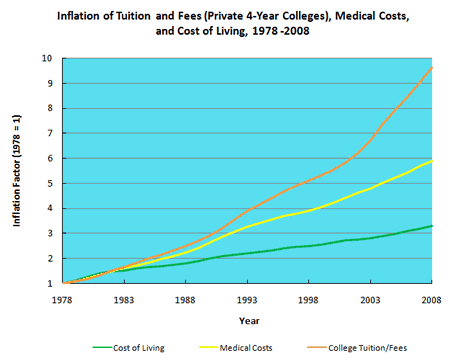
[T]uition has been been increasing annually (7.88%) at more than three times the rate of inflation (2.37%) since 1978.
Carpe Diem
You can't attribute the fantastic increase in college tuition to special education.
Or to unions, for that matter.
This has got to be a big part of it:
The Bankruptcy Abuse Prevention and Consumer Protection Act was enacted in 2005 to include private student loans as one of the 10 debts that can't be forgiven.
Robert Siegel talks with Stephen Burd, senior research fellow in the Education Policy Program at the New America Foundation, who says federal loans had long been included in this list, but private loans were included in 2005 because lenders had been reluctant to take on the risk of student loans.
Now that lenders have no risk, Burd says, student loans have become a very lucrative business.
2005 Law Made Student Loans More Lucrative
algebra I and optics...
Solve for x, given k = x + 1/x and that k is fixed.
This is a reduced and massively rearranged derivation of the lens equation, when the separation distance between an image and object is known, and the focal length of a lens known and fixed at a single value. x = do / di. (Or due to symmetry, it could just as well be the other way round.)
Mathematica kindly pointed out (as it solved the equation for me) that you could write it this way:
k = x + x-1
which resembles a quadratic equation, oooh. kinda. In real life you already know every k (= S/f -2) determines two solutions from experiment, but I was trying to decide how symmetric the ratios theoretically were.
Algebraic equation solvers tell me the solution has approximately the same form as quadratic roots, taking the form p +/- sqrt(q). Kinda. The general solution is x = 0.5 [ k +/- sqrt(k2 -4)]
Unlike most quadratics though, there is a gaping asymptote, and the function y=k rapidly changes from -inf to +inf as x passes from -c to c, where c is a number arbitrarily close to zero. When x is large, k is approximately x; when x is small, k is approximately 1/x.
I puzzle in my head how to solve it algebraically on paper -- this college student who has (up to this point) taken Calc III, linear algebra, and the mess of multiple equilibrium scenarios that tricky chemistry professors throw at you. How do you algebraically solve "inverse-order" polynomials? I mean, this equation should be simple to solve, right?
schoolbook simplification
a. Between 1860 and 1991, American publishers produced readers for the same grade at widely divergent LEX levels (e.g., in 1968, first grade readers were available between -68 and -31).
b. The most difficult readers were generally published before 1918. By modern standards, Professor McGuffy’s pre- and post- Civil War readers were very difficult.
c. After World War I, mean reader LEX levels for all grades were generally simplified.
d. After World War II, mean levels of readers for all grades but third became even simpler. These were the books used by the Baby Boomers and successive cohorts.
e. School publishers in Great Britain did not simplify heir first grade readers after World War II, implying that there was no compelling educational reason for American publishers to further simplify their readers.
f. Today’s mean sixth, seventh, and eighth grade readers are simpler than fifth grade readers were before World War II.
g. Sentences were also shortened, from about 20 words before World War II to about 14 words now in Grades 4—8.
h. Texts for grade x + 1 are typically more difficult (lexically) than those for grade x. When the early readers in a series are simplified by a publisher, so too (generally) are the readers for later grades.
American readers were rewritten after World War II for many reasons: to modernize their content and graphics; to incorporate principles from research in education, psychology and linguistics; to emphasize new kinds of social relations; and to respond to television, which was fast becoming an unprecedented rival for students’ attention. Those considerations required that readers be changed but not that they be simplified. Chall (1967) described the justifications given at the time for simplifying schoolbooks; they were to increase their accessibility for students and raise the level of reading success.
The extent of this simplification is notable. Apart from one extraordinarily simple text (LEX = -75), most first graders in the Baby Boom era used readers whose LEX levels were between -53 and -65; that is, on average, first grade readers were 12 LEX units less difficult than the readers used by their parents and grandparents between World Wars I and II and 15 LEX less difficult than the texts used by students in the same grade in Britian — where the students were a year younger in age. Since the empirical range for LEX is about 140 units, a 12 LEX simplification represents 9% of the empirical range. Workbooks are also designed by the same publisher as the readers and are used in conjunction with them. Given the workbooks’ format, we cannot measure their LEX levels. It is unlikely the publishers would make the workbooks harder than their own reader for the same grade level.
In simplifying the readers’ patterns of word choice, the publishers also shortened sentence length (Figure 5). From the fourth grade on, the average sentence length was contracted by about 6 words — this is the equivalent of dropping one to two clauses from every sentence. This reduced the students’ experience in working out the meanings of more complex sentences.
Widespread objections from teachers and parents, and media publicity over the simplified, often dull, Dick, Jane, and Spot-like readers, caused most publishers to acknowledge that they had oversimplified their first and second grade readers. In the 1963 —1991 era, the mean LEX levels for those grades was restored to pre-Worid War II levels — and without ill effects. While they made those early texts harder, the publishers made the fourth, fifth, sixth, seventh, and eighth grade readers even easier — to the point where these are now at their lowest level in American history.
Schoolbook Simplification and Its Relation to the Decline in SAT-Verbal Scores
Donald P. Hayes, Loreen T. Wolfer, Michael F. Wolfe
American Educational Research Journal
Summer 1996, Vol. 33, No. 2, pp. 489-508
schoolbook simplification & the 50-point drop in SAT scores
I'm sure I've posted this before, but it bears repeating:

cumulating knowledge deficit...
The 50+ point decline in mean SAT-verbal scores between 1963 and 1979 is widely attributed to changes in the composition of the test-takers. Several inconsistencies in that explanation are identified. That explanation also ignores the pervasive decline In the difficulty of schoolbooks found by analyzing the texts of 800 elementary middle, and high school books published between 1919-1991. When this text simplification series is linked to the SAT verbal series, there is a general fit for the three major periods: before, during, and after the decline. Long-term exposure to simpler texts may induce a cumulating deficit in the breadth and depth of domain-specific knowledge, lowering reading comprehension and verbal achievement. The two time series are so sufficiently linked that the cumulating knowledge deficit hypothesis may be a major explanation for the changes in verbal achievement. Only an experiment can establish whether this is causal, so we describe a simple, low-cost experiment schools can use to test how schoolbook difficulty affects their students’ verbal achievement levels.
Schoolbook Simplification and Its Relation to the Decline in SAT-Verbal Scores
Donald P. Hayes, Loreen T. Wolfer, Michael F. Wolfe
American Educational Research Journal
Summer 1996, Vol. 33, No. 2, pp. 489-508

cumulating knowledge deficit...
junket
The perennial issue of foreign language instruction in the early grades is alive once again in my district. I say "perennial" because, where foreign language instruction in the elementary grades is concerned, administrators are perennially against it while parents and interested bystanders are perennially for it.
The question of Mandarin keeps cropping up, too.
Looking for articles on edu-junkets to China, I found this:
A: The point of junkets is to get junketeers to spend money. There is no free junket.
B: Open Meetings law applies to any gathering of a majority of the board. A special exception for junkets does not exist.
The question of Mandarin keeps cropping up, too.
Looking for articles on edu-junkets to China, I found this:
Top San Francisco schools officials, who will consider expanding Mandarin language programs later this summer, quietly accepted a free trip to China recently to visit schools and meet with government officials who hope to persuade U.S. educators to expand Chinese curriculum.
Interim Superintendent Gwen Chan, five school board members and four principals made the unannounced trip from June 28 to July 4, spending time in Beijing and visiting schools across several provinces.
A staff member from the district's "multilingual programs department" also joined the entourage, which included about 400 schools officials from across the United States.
"This trip is not costing the school district any money," said Chan, whose first job in the district nearly 40 years ago was teaching Mandarin. "It is a goodwill and educational journey to promote Chinese immersion programs."
The Chinese government picked up the tab as part of its efforts to persuade U.S. schools to teach Mandarin, the official language of China.
[snip]
The San Francisco contingent -- including board members Mar, Jill Wynns, Dan Kelly, Norman Yee and Eddie Chin -- said they found the trip inspirational.
"I feel it helps us understand a significant portion of our student body,'' said Mar.
Wynns said there was great value in seeing another society, "especially one from which so many of our students have come.''
The trip included excursions to the Great Wall of China and Tiananmen Square in addition to a speech by the Chinese minister of education in the Great Hall of the People.
Even though five elected school board members traveled together without a public announcement, Wynns said the trip did not violate California's open-meeting law known as the Ralph M. Brown Act because no official business was discussed.
Kelly put an even finer polish on the point:
"You could say it was a junket," he said. "Totally a junket. We did no real work at all."
China trip for top schools officials
- Jill Tucker, Nanette Asimov, Chronicle Staff Writers
Thursday, July 13, 2006
A: The point of junkets is to get junketeers to spend money. There is no free junket.
B: Open Meetings law applies to any gathering of a majority of the board. A special exception for junkets does not exist.
Thursday, September 30, 2010


Tuesday, September 28, 2010
Audacious Idea #2: Placement by mastery, not age
My apologies to Gas Station Without Pumps -- I forgot a direct link to the post Placement by Achievement, which is http://gasstationwithoutpumps.wordpress.com/2010/07/21/placement-by-achievement//
Somehow I got from Megan Golding's audacious idea (see here) to the blog Gas Station Without Pumps's discussion of eliminating age-based grade level instruction in math, and instituting placement by achievement.
Personally I prefer "placement by mastery", but reasonable people may differ.
In another post, GSWP discusses the recent article by Bill Evers and Ze'ev Wurman, advancing the idea that the California state math standards are superior to the proposed Common Core standards. (I believe California adopted the Common Core standards -- if Evers and Wurman are correct, look out, afterschooling! -- but I digress).
GSWP goes on:
Discussions on the Common Core:
Somehow I got from Megan Golding's audacious idea (see here) to the blog Gas Station Without Pumps's discussion of eliminating age-based grade level instruction in math, and instituting placement by achievement.
This approach to placing kids has long been popular with parents of gifted children (though for some reason not with school teachers and administrators). It has gone by many names (subject acceleration, readiness grouping, grouping by ability or skill or mastery, … ). I prefer the name placement by achievement, since we are not accelerating students but letting them move at whatever velocity best suits them, and we can’t measure “readiness” but only what has already been achieved. Ability is not the point, achievement is. I guess that “grouping by mastery” is ok, but “mastery” seems to me a more cumbersome word than “achievement” and “mastering” a subject seems to me appropriate for post-baccalaureate studies.
Personally I prefer "placement by mastery", but reasonable people may differ.
In another post, GSWP discusses the recent article by Bill Evers and Ze'ev Wurman, advancing the idea that the California state math standards are superior to the proposed Common Core standards. (I believe California adopted the Common Core standards -- if Evers and Wurman are correct, look out, afterschooling! -- but I digress).
GSWP goes on:
My opinion is that the whole notion of age-based grade levels is wrong and twiddling with the standards won’t fix that. There is value to having standards that all schools and curricula must meet, but I wish that the standards were not labeled with grade levels. There are students ready for algebra long before 8th grade, and students who are barely ready for it by the end of high school. Having students progress through the standards based on mastery, rather than age, would be greatly helped by not labeling the standards with grade levels.
One specific criticism of the Common Core that Evers and Wurman raise, that there is a big jump at 8th grade because the K–7 standards are too weak to provide sufficient support for the 8th grade algebra standards, is probably a valid one and should certainly be considered by the State Board.
Discussions on the Common Core:
Subscribe to:
Posts (Atom)