kitchen table math, the sequel

Thursday, October 15, 2009

inside the black box

from RedKudu:

Parents who don't know the right questions to ask, or even that there ARE questions to ask are at the mercy of what the schools tell them. Parents are spooked by direct instruction because of what they are told about it by teachers who don't know any better - it's rote repetition, it's drill 'n kill. No wonder, with those labels, it doesn't come across well.

I think I told these stories once before, but they're so recent they're worth retelling.

1. Our new math facilitator at the school divulged to me (reading and English teacher) that her 1st grader's teacher told her they "just don't teach phonics, because it's so wrong." Luckily, she's savvy enough to have been teaching her daughter phonics on the sly.

2. Another math teacher told me his two elementary aged sons, in the same grade with different teachers, are learning different things in reading. One is bringing home sight word lists every night, the other brings home nothing. I told him I disagreed with sight words before phonics because it taught kids to see words as images, rather than units of meaning. You should have seen how wide his eyes got - "I never thought of it that way." He gets it, because the same thing is happening with our high school math students.

This has got to stop.

Mr. Happy goes to Oberlin

at Inside Higher Ed (not for kids)

the natives are restless

How much of this has to do with that asinine Everyday Math? I'm fighting every week with the teachers to keep a calculator out of my kid's hands until she can do arithmetic on her own, something she's eminently capable of doing someday (she's six, for crying out loud). Yes, including long division (not that it's part of the curriculum -- why think for yourself when you can use the outboard brain?) and maybe some introductory algebra. These teachers, who'd stare like deer in headlights if asked to calculate the future value of anything and come out with a number, give me this endless stream of talking-point baloney from the Everyday Math "how to reassure parents who are scared because it's not like the math they remember" book. They don't understand why I'm so stuck on the idea that my daughter should be able to do her own adding, subtracting, dividing, multiplying. AAARGH.

Amy from Iowa

You can vote to "Recommend" your favorite comments on the story. Amy got my vote.

Speaking of Everyday Math, remember this?

Tuesday, October 13, 2009

CSMP

I think our district used this curriculum for a time. I assume this is the same one.

A friend of mine told me that his child had CSMP in 2nd grade. Six students in the class went on to take BC calculus in high school, a very high proportion. (A couple of years ago we had 12 students taking BC calculus out of a class of perhaps 150. In other years I believe we've had as many as 20 students in BC.) There were no more than 23 students altogether in the class, which was not tracked.

parents ageing out

palisadesk is on a roll:
As for parents changing the system -- good luck with that. Bureaucracies, especially large and monopolistic ones, are notoriously impervious to customer complaints. Those in charge know that even the most militant parent will "age out" of the battle in a decade or less, and a new crop of starry-eyed, or simply naive, customers will present themselves.

palisadesk on clueless consultants

How can they do that when they don't seem to be able to think themselves?

This contradiction has variously amused and enraged me, but it seems to be a systemic problem. As a "school in need of improvement" we have had cadres of experts come in purporting to teach us how to teach "higher order thinking skills." It is no exaggeration to say these gurus were so thick they would have been challenged to suggest a way to evacuate a phone booth.

I keep remembering the interesting data point from ETS that those who go on to get graduate degrees in Educational Administration have a mean GRE Verbal of 419 -- meaning a goodly number were well below that. A GRE score of 419 loosely correlates to an IQ of 90.

Not the sharpest knives in the drawer, folks.

speaking of boys

Nine-year-old girls score 7 points higher than boys of the same age in reading, according to long-term trend data for NAEP. For 13-year-olds, the gender gap is 8 points. For 17-year-olds, the gender gap is even wider, 11 points, and has remained about the same since 1971, when the test was first given. In 1971, 17-year-old girls scored 12 points higher than boys that age in reading on NAEP.

University officials attest to those deficiencies sticking to many young men as they age. “Overall, our female students coming in [to the university] are better readers [than male students]," Tracy Fitzsimmons, the president of the university, told conference attendees. “They are better writers.”

Authors Share Tips on Getting Boys to Read
By Mary Ann Zehr
Education Week | July 2, 2009

Judith Kleinfeld says there isn't a literacy gap in home-schooled children.

The Ultimate Productivity Blog

here

per pupil spending in private schools

I'd been meaning to get this posted for a while now:
The report finds that, on average, independent private schools spend $15,000 per pupil, Hebrew schools more than $12,000, and Roman Catholic schools $7,743, based on data from the 2006-07 academic year. U.S. Christian schools identified with one of two major associations, the Association of Christian Schools International and the American Association of Christian Schools, spend $5,727 on average.

Private Schools
Education Week | August 25, 2009

Full report here.


to do

stop the madness, part 2

I often have the feeling that public schools are no place for boys.

Sunday, October 11, 2009

arithmetic versus algebra

Consider the set: {1, 3, 5}
:: If elements of this set can be selectively added together to yield some number q, what is its maximum?
:: Are there any odd values between 1 and qmax that q cannot hold?
:: Are there any even values between 1 and qmax that q cannot hold?

Consider the set: {1 , 3 , 5 , 7 , 9 , 11}
:: What is the maximum of q?
:: What odd values between 1 and qmax can q not hold?
:: What even values between 1 and qmax can q not hold?

Consider the set: {1 , 3 , 5 , 7 , 9 , 11, 13}
:: What is the maximum of q?
:: What odd values between 1 and qmax can q not hold?
:: What even values between 1 and qmax can q not hold?

Consider a finite set of odd numbers, {1, 3, 5, 7 ... n}
:: What is the maximum of q, in terms of n?
:: Find the odd values between 1 and qmax that q cannot hold, in terms of n.
:: Find the even values between 1 and qmax that q cannot hold, in terms of n.

Consider the set: {-6, -4, -2, 1, 3, 5, 7}
:: What is the maximum and minimum of q?
:: What odd values between qmin and qmax can q not hold?
:: What even values between qmin and qmax can q not hold?

Consider a finite set: {-2n, -2(n-1), ... -4, -2, 1, 3, 5 ... 2(n-1)+1, 2n+1 }
:: What is the maximum and minimum of q?
:: What odd values between qmin and qmax can q not hold, in terms of n?
:: What even values between qmin and qmax can q not hold, in terms of n?

One Singaporean's Perspective on Singapore Math

Hello,

I thought some on this blog might be interested in the following article:

http://tinyurl.com/Localview

Notice in the subject heading I wrote "one Singaporean's perspective", since, after all, one individual can't really speak for a whole country, right? ;->

Patsy

Saturday, October 10, 2009

Education Non-Myths

I couldn't resist sharing these maxims from a new blog :
www.incentiveseverywhere.com
whose author I know from a previous book he wrote entitled Power Teaching (it's in the list of books I recommended in a post a few months ago: http://kitchentablemath.blogspot.com/2009/02/recommended-reading-from-palisadesk.html


What follows is from the "Book of Right", the set of assumptions which will produce learning.

1. Although students come from different backgrounds, and some are much easier to teach than others, what education brings to the student is much more important than what the student brings to education.

2. All subjects are hierarchically arranged by logic and there is a sequence of instruction which must be followed by all but the most exceptional of high-performing students.

3. Reinforcement is a very powerful determinant of student achievement. The main reinforcer in education is the improvement the student sees in his skills. Ill-constructed curricula, the kind found in almost every government school, result in a steady diet of failure for most students.

4. Having a system of education which is not a civil servant bureaucracy is a necessary but not a sufficient condition for effective education. You can’t do it with such a bureaucracy, but just because you don’t have a bureaucracy doesn’t mean you can do it.

5. Higher order thinking skills are explicitly taught, not fondly hoped for.

6. Methods of teaching are determined by scientific research, not consensus based on experience and sincere belief.

7. Teachers use a curriculum and lesson plans which have been demonstrated to work best and are not expected to create their own.

8. Psychological assessments are used rarely, but assessment of student progress, which means assessment of the effectiveness of teaching, occurs at least daily.

9. Teachers are taught how to teach in detail rather than being expected to apply vague philosophical maundering.

10. Special education is rarely needed because students are taught well on the first go round.

11. If a student does not learn, the blame is not placed on neurological impairment, but on faulty teaching methods.

12. Self-esteem is not taught because it does not have to be.

13. Students are not given "projects" until component skills have been mastered and rarely thereafter.

14. No attention is paid to individual "learning styles" because these hypothetical entities have no effect on learning.

15. Academic success can be measured by reliable and valid standardized tests, although many of these tests are too simple.

16. Students are expected to perform correctly in spelling, writing, reading, and mathematics and it does not stifle creativity.

17. The precepts of Whole Language are not used to teach reading because these precepts are wrong.

18. Students are not expected to create their own reality because this leads to frustration and slow learning.

19. Students are not expected to learn when it is developmentally appropriate but when they are taught.

20. The concept of multiple intelligences is ignored because it has no positive effect on learning.

21. The teacher is a teacher and not a facilitator.

22. The spiral curriculum is not used because things are taught properly the first time.

23. The customer is the parent and the customer must have the economic power to move his child to another teaching situation when unsatisfied.

24. In private education, the cost of education is known. In public education, the cost can never be known because there is no motivation to tell the truth and every motivation not to.

25. The curriculum must be tested on children and provision must be made for mastery learning. Passage of time or exposure does not guarantee learning.

26. Students are not tortured by "creative problem solving" because this is just another crude IQ test and has no value aside from categorizing students yet again.
http://incentiveseverywhere.com/2009/10/09/education-non-myths/


I'm not sure I agree that "special education will rarely be needed," because I have observed that students with certain exceptionalities (autism, some LDs, some language impairments) need the same effective instruction but can't benefit from it in an inclusive setting, at least not initially. However, I agree with the general case, that much "special education" is simply ineffective general education, watered down in in a smaller group. As Lloyd Dunne (I think) observed, "It's not special, and it's not education."

All students deserve better.

Parents are alike the world over

http://sg.news.yahoo.com/cna/20091010/tap-464-parents-arms-psle-mathematics-pa-231650b.html

Shall we discuss our solutions for the problem included in the above article:

Jim bought some chocolates and gave half of it to Ken. Ken bought some sweets and gave half of it to Jim. Jim ate 12 sweets and Ken ate 18 chocolates. The ratio of Jim’s sweets to chocolates became 1:7 and the ratio of Ken’s sweets to chocolates became 1:4. How many sweets did Ken buy?

Patsy

Friday, October 9, 2009

Thursday, October 8, 2009

6th Grade Math, Arts and Crafts Edition

6th Grade Math
Course 2 Math Project – Trimester 1
due Nov. 5

You will design and draw a simple blueprint for the house.

For a grade of C:

• House contains 5 rooms (kitchen, living room, bathroom, 2 bedrooms)
• Each room is labeled with its use
• On a separate sheet of paper, each room is listed with its correct area and perimeter (including feet or sq. feet)
• Room dimensions are appropriate for the given use
• Project is completed on quarter inch grid paper (1 sheet provided by teacher)
• A scale of ¼ inch = 1 foot is used
• Project is neat
• Project is turned in on time

For a grade above C:

• All requirements for a C are present, and
• Extras, such as color, furniture and appliances, fabric or paint swatches, additional rooms, etc. are included
-------------------------------------

Pre Algebra Course 3 Math Project – Trimester 1 due Nov. 5

Create a math dictionary that contains the following sections and terms:

Section 1: Number Systems
• Real numbers
• Irrational numbers
• Rational numbers
• Integers
• Whole numbers
• Natural (Counting) numbers

In this section include the term, its definition, and 3-5 examples.

Section 2: Rational Number Interpretations
• Part-Whole
• Division
• Measure
• Scalar
• Ratio

In this section include the term, its definition, and a word problem that represents the interpretation.

For a grade of C:

• All required terms, definitions, examples or word problems are present and correct
• Project is neat
• Project is turned in on time

For a grade above C:

• Everything required for a grade of C
• Extras, such as cover, color, illustrations that enhance text, etc.
--------------------

NCTQ report recommends CO adopt Singapore Math

The National Center on Teacher Quality released a report entitled: Race to the top: Colorado may be used to high altitudes but can it compete in Race to the Top?

Commissioned by the Piton Foundation, the Donnell-Kay Foundation, the Colorado Children's Campaign and the Public Education & Business Coalition, the report suggests 7 strategies the state might take while applying for the RTT funds.
  • Strategy 1: Performance management (Teacher Evaluation, Tenure & Dismissal) - Given the tremendous impact teachers have on learning, no strategy a state will take on is likely to have a greater impact on student achievement than one that seeks to maximize teacher and principal performance.
  • Strategy 2: Equitable Distribution of Teachers and Principals - Schools serving children living in poverty are more apt to employ teachers with lower qualifications than schools serving more affluent children.
  • Strategy 3: Induction - CO should develop a statewide system of induction support for new teachers, particularly in its high needs and remote rural schools.
  • Strategy 4: Compensation Reform - CO needs to move away from lockstep salary schedules towards a system that differentiates salary on a number of factors, including teacher effectiveness, the relative difficulty of a school setting and the demand for teachers with particular skills or knowledge.
  • Strategy 5: Teaching in STEM fields: CO should develop a coherent state strategy to address the difficulty school districts face in attracting and retaining sufficient numbers of qualified STEM teachers.
  • Strategy6: Statewide Adoption of an Effective Curriculum: Students achieve when 4 elements are in place: Standards, Curriculum, Teachers & Assessment.
  • Strategy 7: Educator Preparation (Including Alternate Certification) - In spite of countless studies looking at the value of teacher education, we have only been able to learn (apparently) that no single method of teacher preparation yields more effective teachers than another.
I'll be honest, I haven't read through the entire report as yet, however I managed to get through Strategy 6, in which the authors recommend statewide adoption of Singapore Math at the elementary level. The report notes that:
...curriculum has been troublingly absent in conversations about education reform as well as ignored in the indifferent approach some educators take to curricula adoptions.

... the current emphasis on human capital and effective teachers has been at the expense of an equally urgent emphasis on the importance of good curricula.
And when discussing common standards, the report flat-out states:
We would go so far as to say that if the standards were in conflict with the Singapore curriculum, a state ought to consider opting out of the new standards.
Well, you don't hear that everyday!
Read and enjoy
.
(Cross-posted at Singapore Math Source)

I see Socrates

Niki Hayes sends a link:

When we consider constructivist teaching, or a constructivist approach to learning, what comes to mind? For me, I see Socrates standing not in the center, but to the side of his students.

I imagine him pondering their comments and questions, and carefully crafting questions of his own, which he contributes -- selectively. Most importantly, he doesn't lead, but follows the line of questioning of the students.

That's really what it's all about: being an questioner, an investigator side-by-side with your students. That doesn't mean we shouldn't have a solid lesson plan ready to go each day, but we should be ready -- and willing -- for the students to take the class into unchartered waters.

Let me give you an example from my own teaching experience. In an American Literature class I taught a while back, we had made our way through transcendentalism, stopping off at Henry Thoreau. Here, I had a few lessons on civil disobedience planned.

Day one, we watched a video excerpt on Rosa Parks refusing to give up her seat...

[snip]

Then, the students began talking about racial profiling and wouldn't move on.

[snip]

Mostly African-American and Latino, my [11th grade] students began sharing stories of racial profiling from their own lives, and the lives of their families and friends.

One thing leads to another, and 2 weeks later students hand in their culminating projects:

  • "One group made a brochure titled, 'How to Protect Yourself When DWB (Driving While Black/Brown).'"
  • "Another group created a presentation poster on the history and statistics of racial profiling"
  • "[Teacher's] favorite project was an instructional video for police officers on how to build trust with the community."
Letting Go in the Classroom by Rebecca Alber 10/6/09
So I guess the entire class is filled with visual learners.

Funny.

You'd think there'd be a couple of verbal/linguistic types mixed in somewhere.

Guess not.


update:

TerriW leaves this comment:
At what point do you really need to stop calling something an "American Literature" class -- what percentage of the class should be, I dunno, American Lit?

I mean, at a certain point, you have to start calling it "cheese food" instead of cheese...

apps

I mentioned Tuesday that I have not been mentating so well of late.

It's been so bad I had to break out my Time Timer for the past two days running just to figure out when it was going to be time to stop doing whatever I was doing now and start doing whatever I was supposed to be doing do next.

Time Timer worked great. I recommend it.

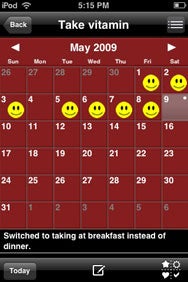
I've also been using two iTouch apps every day, day in and day out: one for diet, another for positive reinforcement. Both are terrific. Fantastically useful and motivating.

I think Karen Pryor would approve.


iAchieve:


Lose It!
Lose It! screen shots
Does This Pencil Skirt Have an App?