

 Posts


"In other words, say you're a parent looking to move to a district with good schools. Could you base a decision in these rankings?"
"Base a decision"? No. Is it of no value? No, but it's all relative. Schools think it's important because it's good PR. Our high school has a reference to it on its home page, and it's only a silver medal!
Over the long run, schools can take advantage of the formula. Anytime you have an extremely important formula that condenses a lot of information down into a single number, it's open to gamesmanship. But, the more that schools play the game, the less useful is the formula. I've seen cases where it's a constant arms race between those who want a formula to reflect reality and those who want to beat the formula.
If a school pushes all students to one AP class or another whether or not they are properly prepared, then that might improve the score, but the education might not be better. Or, it could be a false or local optimum and they completely miss a much larger global optimum that uses a different approach.
Important formulas generally force a trend towards one particular solution. Uncertainties in the formula can hide other solutions that might offer much better results. Instead of reflecting reality, they drive reality.
Think of a formula that tries to represent a topographic map. You want to find the highest point on the map but all you can do is plug in your latitude and longitude into a black box that will give you a height. You keep doing this and try to search for the highest point. If your second point gives a lower height, you turn around and go in the other direction and check the height.
This is called non-linear optimization and I have many books that discuss solutions to this problem. If you know derivative information, you can search faster. If not, you can find slopes numerically.
The problem is that you might find a mountain peak, but it's the shortest peak of the mountain range. Another problem is that the black box might not represent reality very well. There might not be a mountain peak there at all.
Another, more subtle issue is that (due to uncertainty) the very highest peak location is no better than a location that is 10 percent lower. If you think of a long mountain range, it might be much easier to climb to the slightly lower end of the mountain range than it is to climb the other end where the absolute highest point is located. In other words, an easier optimum to a problem (within 10 percent) might be located far, far away.
Rather than push all high school kids onto at least one AP track in high school, the easier approach might be to fix the problems in K-6 before they get large. They won't find this solution if they are focused on a formula that uses only high school data.
Wednesday, February 13, 2008
Steve on high school rankings & non-linear optimization
Steve has left several comments on the U.S. News & Newsweek rankings of high schools. In this one he responds to the question I asked about whether a parent could base a decisions about where to live in the rankings:


Vote for: Which of the following is the most bogus reason for refusing to provide effective instruction to students?
John Wills Lloyd, at the Teach Effectively! blog, has a new Bogus Bowl up. Go and vote.
John is also looking for suggestions for future Bogus Bowl competitions. Help him out. Leave suggestions in the comments.
In this one, we’re examing reasons that educators give for shirking what I’ve sometimes called the “instructional obligation.” It’s your chance to consider alternative rationales for not teaching.The choices are:
If you’re a teacher, you might have heard colleagues advance explanations such as these. Which is the most bogus? If you’re a parent, you may have heard one (or more) of these justifications for your child’s learning problems. Which one drove you the most batty? If you’re an administrator, I hope you haven’t suggested to your faculty that members use any of these.
- That kind of instruction may be good for some students, but it just doesn’t fit my teaching style.
- Nobody can teach students who come from bad homes.
- Students will learn it when they’re ready.
- Some students just have crossed wires in their heads.
John is also looking for suggestions for future Bogus Bowl competitions. Help him out. Leave suggestions in the comments.
Tuesday, February 12, 2008
Ed School Disappointment #2*: Endorsement of "Scotopic Sensitivity"
The instructor in one of my ed school classes announced tonight that Irlen-Meares (scotopic sensitivity) syndrome is real and should be remediated for....
Dang.I'm pretty firmly in the Irlean/Meares/Scotopic Sensitivity skeptic camp, especially as regards the "Incidence studies suggest that 46% of those with identified with reading problems, dyslexia, attention deficit disorder, or learning difficulties suffer from Irlen Syndrome and can be helped by the Irlen
Method" claim.
Since I don't have a bomb-proof handle on the alleged 62 studies published in peer-reviewed journals that show improvement, I'm going to keep my mouth shut for now. However, since the link references a web site, and the said website doesn't provide a link to the "review", I'm still skeptical.
And disappointed. I had thought this instructor pretty tough-minded.*Ed School Disappointment #1 -- the lack of content in the "Intro to the Role" class.
Can the method cause dyslexia?
As I alluded to in my sight word post, I believe the answer is yes, the method used to teach reading can cause dyslexia.
As I said in my sight word post,
Several of my remedial students were supposedly "dyslexic," yet I have not yet found a single "dyslexic" student who learned to read phonetically. However, I find it best not to argue with people who think they have dyslexia--the methods used to remediate someone are the same regardless of how they obtained their dyslexia, and they are more willing to be helped if you do not argue with them. After teaching them for a while, I just mention the fact that all of my "dyslexic" students came from some kind of sight word or whole word background and that, while they probably do exist, I have not yet found a single "dyslexic" student from a low-sight word phonics background.
My dyslexia page goes into more detail about how teaching methods can cause dyslexia, and also explains the nature of sound and how to remediate dyslexia (both organic and method induced.) Here again are some excerpts:
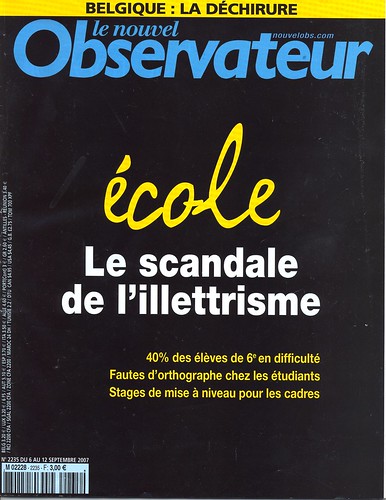
Le scandale de l'illetrrisme (nouvel obs: the scandal of illiteracy)
dyslexie, vraiment? ) (nouvel obs: true dyslexia?)
Comment en est-on arrivé là? (nouvel obs: How did we get here?)
Lucy Calkins on teaching children to write
instructional casualties in America
curriculum casualties: figures
forcing hearing children to learn as deaf children must
Rory: I frickin' hate whole language!
thank you, whole language
As I said in my sight word post,
I give reading grade level tests to all my friends who have children, and through our moves have tested (directly and indirectly) hundreds of children from several different states. In my informal survey, I have found that the more sight words taught in a school, the higher the percentage of children who are reading below grade level.I also found that schools that taught with completly whole word methods fared even worse in my informal assessment. And, the better the phonics program used and the less sight words taught in that phonics program, the better the percentage of students that were reading above grade level. I haven't found a single child taught with A Beka or with whatever phonics program the local Catholic school uses who was not reading above grade level. I thought I had found one student at the local Catholic school who was the exception to that rule but I later found out that she had transferred into the Catholic school from an out of state public school that used whole word teaching methods.
Several of my remedial students were supposedly "dyslexic," yet I have not yet found a single "dyslexic" student who learned to read phonetically. However, I find it best not to argue with people who think they have dyslexia--the methods used to remediate someone are the same regardless of how they obtained their dyslexia, and they are more willing to be helped if you do not argue with them. After teaching them for a while, I just mention the fact that all of my "dyslexic" students came from some kind of sight word or whole word background and that, while they probably do exist, I have not yet found a single "dyslexic" student from a low-sight word phonics background.
My dyslexia page goes into more detail about how teaching methods can cause dyslexia, and also explains the nature of sound and how to remediate dyslexia (both organic and method induced.) Here again are some excerpts:
According to Dr. Robert Myers of the Child Development Institute in his web page about Dyslexia & Reading Problems, "Children who have an average or above IQ and are reading 1 1/2 grades or more below grade level may be dyslexic. True dyslexia affects about 3 to 6 percent of the population yet in some parts of the country up to 50% of the students are not reading at grade level. This means that the reason for most children not reading at grade level is ineffective reading instruction. The dyslexic child often suffers from having a specific learning disability as well as being exposed to ineffective instruction."
Dr. Reid Lyon, in his article "Reading Disabilities: Why Do Some Children Have Difficulty Learning to Read? What Can Be Done About It?" talks about phonics training and the prevention of reading failure through proper training:
On the other hand, the early identification of children at-risk for reading failure coupled with the provision of comprehensive early reading interventions can reduce the percentage of children reading below the basic level in the fourth grade (i.e., 38%) to six percent or less....
These studies strongly suggest that such programs [systematic phonics] if implemented appropriately, could reduce the number of children who fail to learn to read well below the 38 % rate currently observed nationally. [6]
In France, it was proven that schools that taught with phonics produced less dyslexic students than schools that taught with whole word methods. Acording to Geraldine E. Rodgers,
However, the true sight-word method was generally discredited in Europe by the 1970's. Change was brought about by such things as those reported in a 1950 Enfance article. In France, 2% of dyslexic children were discovered in schools that used the phonics approach, but 20% of dyslexic children were discovered in schools that used the global [whole word] approach. [7]
Unfortunately, like us, the French have not learned from their history of education and keep repeating the same kinds of mistakes. According to several people I know, Global [whole word] and "mixed" (I assume the equivilent of "balanced literacy") methods are back in force in France today. This website, Lire-ecrire, is a website promoting the return of syllable-based phonics methods in France and warns of the dangers of Global methods and how to prevent them by teaching syllable-based phonics at home. (At least, that's what I thought from my auto-translation, I could be wrong!)
As I explain in my dyslexia page, I think that Webster's Speller is probably the best method for remediating dyslexic students. Through its focus on spelling, it may also help prevent dyslexia even more than regular phonics methods. If you can write and spell a word correctly, there should be less chance of reversing or confusing it.
There is also a teaching explanation to explain away some of the genetic connection for dyslexia. If your parents can't sound out words and you are taught with whole word methods, your parents can't sound out words for you when you're confused by poor teaching methods which have not clearly and explicitly taught you letter sounds and how to sound out words. I got a tiny bit of phonics in Kindergarten, then whole word methods in first grade. My parents would sound out words for me when I didn't know them. Parents who don't have a clear knowledge of the sounds in words and how to teach with phonics can't do this.
(This lack of explicit, complete phonics instruction left me a good reader but a poor speller. After learning the phonetic spelling rules and the sound/spelling patterns of phonics, I am now a pretty good speller, although not as good of a speller as people I know who were trained with a good phonics program from the beginning.)
..........................Catherine here, diving into Elizabeth's post. Here's the link to Ed's translation of the brief Nouvel Observateur article on the increase in dyslexia amongst French schoolchildren.
Le scandale de l'illetrrisme (nouvel obs: the scandal of illiteracy)
dyslexie, vraiment? ) (nouvel obs: true dyslexia?)
Comment en est-on arrivé là? (nouvel obs: How did we get here?)
Lucy Calkins on teaching children to write
instructional casualties in America
curriculum casualties: figures
forcing hearing children to learn as deaf children must
Rory: I frickin' hate whole language!
thank you, whole language
Sight Words: a root of all reading evil
There are other roots, but sight words are a big one.
I give reading grade level tests to all my friends who have children, and through our moves have tested (directly and indirectly) hundreds of children from several different states. In my informal survey, I have found that the more sight words taught in a school, the higher the percentage of children who are reading below grade level.
The Wikipedia entry for "Dolch Word List" states:
I requested Dolch's "Problems in Reading" through Interlibrary Loan and found that Dolch used 3 existing lists of the most frequent words to develop his list of 220 words. He took words that were common to the Child Study Committe of the International Kindergarten Union (2,596 words), the first 500 words of the Gates list, and the 453 words on the Wheeler and Howell list. He then added in 27 words on only one or two of the lists which he deemed improtant or which completed a group (for example, stop was on all 3 lists, but start wasn't, so start was added to the list.)
The idea that the Dolch sight words are phonetically irregular and therefore must be taught by sight is a commonly believed idea that is just not true. My sight word page explains this, here are some excerpts (but do go read the whole thing, it's pretty short and also has a link to a pdf file arranging the Dolch words by their phonetic patterns.) Better yet, print it out along with copies of the pdf file and give it to everyone you know whose children are being subjected to unnecessary whole word sight word teaching.
Another excerpt from my sight word page, a bit of a table from Laurita's article "Basic Sight Vocabulary--A Help or a Hinderance?": (You'll want to see the full article.)
One of the problems with the way the sight words are taught is that the words are commonly separated alphabetically and across grade levels. For example, "can" is taught in a preprimer list, but "an" in first grade. "Not" is taught at the preprimer level, but students are not expected to be able to learn "got" until third grade. Students are apparently ready for "when," which includes the diagraph wh, by First Grade, but not the phonetically regular and simple "ten" until Third Grade. This method of listing and teaching "sight words" hides their phonetic pattern and reinforces the idea that they cannot be learned phonetically.
68 of the 70 words on the Dolch list do have some degree of phonetic irregularity, but can be easily taught by teaching a few phonics rules. Here are a few examples from my sight word page:
A search for "sight words" on Google produced 1.26 million hits, "Dolch sight words," 41,200. Chances are your school is teaching some.
The Wikipedia entry for "Dolch Word List" states:
The Dolch Word list is a list of frequently used words compiled by Edward William Dolch, Ph.D. The list was originally published in his book "Problems in Reading", the Garrard Press, 1948.
Dolch compiled the list based on children's books of his era. The list contains 220 "service words" that have to be easily recognized in order to achieve reading fluency. The compilation excludes nouns, which comprise a separate 95-word list.
Many of the 220 Dolch words can't be "sounded out" and have to be learned by sight. Hence the alternative term "Sight Words".
I requested Dolch's "Problems in Reading" through Interlibrary Loan and found that Dolch used 3 existing lists of the most frequent words to develop his list of 220 words. He took words that were common to the Child Study Committe of the International Kindergarten Union (2,596 words), the first 500 words of the Gates list, and the 453 words on the Wheeler and Howell list. He then added in 27 words on only one or two of the lists which he deemed improtant or which completed a group (for example, stop was on all 3 lists, but start wasn't, so start was added to the list.)
The idea that the Dolch sight words are phonetically irregular and therefore must be taught by sight is a commonly believed idea that is just not true. My sight word page explains this, here are some excerpts (but do go read the whole thing, it's pretty short and also has a link to a pdf file arranging the Dolch words by their phonetic patterns.) Better yet, print it out along with copies of the pdf file and give it to everyone you know whose children are being subjected to unnecessary whole word sight word teaching.
Of the 220 most commonly taught sight words (called dolch sight words), 150 are completely phonetic and can be easily learned by sound. For the other 70 words, 68 conform to simple patterns of exceptions and can be taught phonetically. Sight words should not be taught at all in a pure phonics program that teaches by sound. They should merely be taught phonetically along with other words.My remedial students who were sight word victims required much retraining, it generally takes a lot of nonsense words to break their guessing habits. The most difficult words to break their guessing habits were those on the Dolch word list which they were exposed to repeatedly. I had one 33 year old female student who never did learn the difference between than, then and them or there and their. She would sound them out for a while and then after a few weeks revert back and randomly guess the wrong one. I eventually got her sounding out most words, but those specific Dolch sight words were too difficult to overcome. I did manage to improve her reading grade level from 3rd grade to 8th grade before I had to move to another state.
Here are some of these 150 phonetic "sight words:"
be, he, me, she, we
an, can, ran
got, hot, not
ate, make, take
see, green, keep, sleep, three
Another excerpt from my sight word page, a bit of a table from Laurita's article "Basic Sight Vocabulary--A Help or a Hinderance?": (You'll want to see the full article.)
This table contains words selected from the Dolch Basic Sight Vocabulary List which have configurational similarity and have the potential to contribute to the development of visual response patterning which is unreliable and confused.
is-in-on-no-an-or
come-came-can
full-fall-fell
he-her-here-where-were
they-then-them-there-their
One of the problems with the way the sight words are taught is that the words are commonly separated alphabetically and across grade levels. For example, "can" is taught in a preprimer list, but "an" in first grade. "Not" is taught at the preprimer level, but students are not expected to be able to learn "got" until third grade. Students are apparently ready for "when," which includes the diagraph wh, by First Grade, but not the phonetically regular and simple "ten" until Third Grade. This method of listing and teaching "sight words" hides their phonetic pattern and reinforces the idea that they cannot be learned phonetically.
68 of the 70 words on the Dolch list do have some degree of phonetic irregularity, but can be easily taught by teaching a few phonics rules. Here are a few examples from my sight word page:
Words with ve at the end. Words in English will not end in v, so words with ve at the end may be either short or long:
give, live, have (Live can be pronounced either long or short depending on its usage.)Words with consonant pair substitutions (z sound for s, v sound for f). If you say each of these sounds, you’ll note that they are very close sounds. They are pronounced with the mouth in the same position, but the first of each pair is voiced and the second is unvoiced.
as, has, is his, use, does, of (does also has the vowel sound mushed to uh)This word has a schwa sound of uh and a consonant pair substitution of z for s:
wasThis word is regular with its long e sound before words beginning with vowels. Before words beginning with consonants, the e sound will mush to the schwa sound of uh:
the (long e in the end, uh sound in the bears)
I have sight-word phobia. I have seen the harm they do to students and have spent countless hours undoing the damage they have done to my remedial students.
I have only taught a single sight word to my daughter. (The word "one." Then, I taught her the word "once" as following its pattern. The other 218 words on the list, I just taught her phonetically along with other words. For the 68 that are slightly irregular, I taught them in groups following that pattern of exception. She learned "eye" on her own somehow, probably as a sight word. It's not on the Dolch word list, but it, like "one," has no phonetic explanation suitable for a 5 year old. There actually are linguistic explanation for both one and eye, they are just very complex.)
Howard Gardner on the liberal arts disciplines
JB: How you educate everybody?
GARDNER: I want people at the end of their education to understand the world in ways that they couldn't have understood it before their education. In speaking of the world I mean the physical world, the biological world, the social world ÷ their own world, their personal world as well as the broader social and cultural terrain. I believe that these are questions that every human being is interested in from a very young age. They're questions which kids ask all the time: who am I, where do I come from, what's this made out of, what's going to happen to me, why do people fight, why do they hate? Is there a higher power?
[snip]These are also the questions that historically have been looked at in religion, philosophy, science. While it's great for people to ask these questions on their own, and to make use of their own experience, it's crazy for people not to take advantage of the other attempts to answer those questions over the millennia. And the disciplines represent to me the most concerted efforts to provide answers to those questions. History tells us where we come from. Biology talks about what it means to be alive. Physics talks about the world of objects, alive or not.
It's important to emphasize the role of disciplines when you're talking about precollegiate education. Some people think the disciplines are irrelevant, and some people think all the interesting work is interdisciplinary so you can kind of jump right into that. I reject both of these claims. Disciplines are what separates us from the barbarians; I don't think you can do interdisciplinary work unless you've done disciplinary work.
A Talk with Howard Gardner
You'll notice that while ed schools everywhere teach Gardner's unsupported theory of multiple intelligences, one hears nary a word about Gardner's belief that high schools should teach the liberal arts disciplines.
extra credit: Interdisciplinary teaming empowers teacher!
help desk - percent change
from Glencoe Algebra, page 163:
I assume that I know how to do these problems, but I'd appreciate an answer check if anyone has the time or inclination. Seeing as how I don't have the answer key.
The fact that I am asking this question on a blog is further evidence of the ineffective pedagogical practices employed by my school district (per pupil funding: $22,000/yr).
C. worked this problem in a homework set a couple of days ago.
Or, rather, he attempted to work this problem.
The next day, the teacher sent around a student monitor to mark down whether the kids had or had not done their homework. I assume everyone got credit for having done the homework, since the kids who haven't done it just write a different date on an old assignment and the student monitor gives them credit.
Then the teacher went over the homework in class.
So.
My child has attempted to do this problem.
He has seen the problem "gone over" in class.
He still can't do the problem -- and until last night, when I had him attempt to do the problem in front of me, he didn't know that he couldn't do the problem. He followed the demonstration in class, or thought he did, and thus felt no need to "seek extra help."
The fact that he was not "proactive in seeking extra help" is viewed by our teachers and administrators alike as a character flaw, a sign of immaturity or both.
It is not viewed as a sign of ineffective teaching.
Where is Galen Alessi when we need him?
46.
China has a population of 1.24 billion in 1997, with a projected increase in population of 22.6% for 2050.
What is the population of China projected to be in 2050?
India has a population of 0.97 billion in 1997, with a projected increase in population of 57.8% for 2050.
What is the population of China projected to be in 2050?
The US has a population of 0.27 billion in 1997, with a projected increase in population of 44.4% for 2050.
What is the population of US projected to be in 2050?
47. Which of these three countries is projected to be the most populous in 2050?
I assume that I know how to do these problems, but I'd appreciate an answer check if anyone has the time or inclination. Seeing as how I don't have the answer key.
The fact that I am asking this question on a blog is further evidence of the ineffective pedagogical practices employed by my school district (per pupil funding: $22,000/yr).
C. worked this problem in a homework set a couple of days ago.
Or, rather, he attempted to work this problem.
The next day, the teacher sent around a student monitor to mark down whether the kids had or had not done their homework. I assume everyone got credit for having done the homework, since the kids who haven't done it just write a different date on an old assignment and the student monitor gives them credit.
Then the teacher went over the homework in class.
So.
My child has attempted to do this problem.
He has seen the problem "gone over" in class.
He still can't do the problem -- and until last night, when I had him attempt to do the problem in front of me, he didn't know that he couldn't do the problem. He followed the demonstration in class, or thought he did, and thus felt no need to "seek extra help."
The fact that he was not "proactive in seeking extra help" is viewed by our teachers and administrators alike as a character flaw, a sign of immaturity or both.
It is not viewed as a sign of ineffective teaching.
Where is Galen Alessi when we need him?
Monday, February 11, 2008
Syllables, Syllables, Syllabary
Teaching phonics with syllables works a lot faster than regular phonics and allows students to read at high grade levels quickly.
and this in second grade:
I believe that teaching syllables is a crucial step missing in most phonics programs today. A Beka divides words by syllables, and every child I've seen taught with this program was reading far above their grade level.
Teaching with syllables, "Johnny" went from reading at the 3rd grade level to reading at the 6th grade level after 6 hours of phonics instruction. (The early version of my online phonics lessons, now 12 hours total instruction.)
Before 1826, children were taught to read with the syllabary. The first part of the syllabary is shown on old hornbooks.
Catherine had success teaching C. with megawords, a series based on syllables.
Children taught with Webster's Speller and the syllabary could read this in first grade:
"Now, if you will try to re-mem-ber what I have told you a-bout these si-lent let-ters, I think you will be able to read ver-y well, in a short time; and I suppose you will be ver-y glad when you are a-ble to read pret-ty stories in books.
The si-lent let-ters which are used in spell-ing ma-ny words are ver-y puz-zling to lit-tle boys and girls, when they are learn-ing to read; but I hope that the good lit-tle boy or girl who is now read-ing this les-son will try ver-y hard to rec-ol-lect how all the words are spelt; and that the teach-er will re-quire ev-e-ry pu-pil to be a-ble to spell ev-e-ry word that is read. By so doing, the pu-pil will learn to read much fast-er, and in a short time hard words will cease to trou-ble him." (from Parker's First Reader, 1851)
and this in second grade:
"All persons, who are not deprived by nature or by accident of something which belongs to them by the gift of God, their Creator, have five senses." (from Parker's National Second Reader, 1869)After teaching my daughter with Webster's, she can read just about anything. She's still 5 (she'll be 6 soon) and can sound out 3 and 4 syllable words she has never seen before. After 4 months of seeing syllables divided like those shown in the 1st grade selection above, she can now divide them on her own. A few months ago, she could read 3 and 4 syllable words only if they were divided for her. You can learn all about how to teach with Webster's and the Syllabary, it's surprisingly easy.
I believe that teaching syllables is a crucial step missing in most phonics programs today. A Beka divides words by syllables, and every child I've seen taught with this program was reading far above their grade level.
Who am I?
I’m a former Air Force statistician who has been promoted to Mom. My husband is still in the Air Force, and we’ve moved 5 times in the last 6 years. We’ve seen a lot of school districts! I’ve been tutoring with phonics since 1994, so have observed the schools everywhere we’ve lived with interest since then. I gave my life to Jesus Christ in 1997.
I wanted to be a volunteer math tutor, but it was not to be. I have tutored a few students in Algebra through the years, but when I signed up to tutor inner-city students in San Antonio, the Air Force moved us to another city. This large city had no math tutoring programs, only a volunteer literacy organization. I signed up—I had always liked to read. I figured I could try that for a while.
The local literacy organization used whole word methods and language experience stories, and made this seem exciting and like the best thing since sliced bread. They raved about the wonders of teaching this way. I bought it and was excited to teach my student to read. After a month of tutoring, she had learned 3 words, and there seemed to be no pattern to her progress or lack thereof. I called my dad, a public school teacher and a very smart man. He said, "teach her phonics."
All I could find at the time (This was 1994, the internet had just barely started, and bookstores were not selling any phonics products) was an old teacher's copy of Hay and Wingo's Reading With Phonics. It seemed too juvenile to me, so I made up my own lessons from the concepts in it, starting with 2 and 3 syllable words from the first lesson. I later found she didn't mind working from 1st grade texts as long as she was learning, but I didn't know that at the time, and I'm glad I decided to make my own lessons. (By the way, she learned more in her first lesson than in that month of sight words, and I made a few mistakes with sounds at the beginning, I myself had a limited phonics background and had just picked up reading after being taught a few letter sounds. I did not, however, pick up spelling, although I have always been a prolific reader. My spelling improved after tutoring with phonics and learning the associated spelling rules and syllable division rules.)
With small children and frequent moves, I could no longer teach many students to read. I put all my phonics lessons online a little over 3 years ago while pregnant with our second child—a difficult pregnancy, the online work was accomplished only through God’s strength, I had no strength of my own.
About a year ago I added spelling lessons. They teach spelling rules, syllable division rules, and everything you need to know to teach someone to read with phonics.
Shortly after starting my website, I “met” Don Potter. He had similar experiences tutoring remedial students, but had taught even more students than I had and also had insight into what they were doing in the public schools. He has a great website with a lot of phonics information. He also convinced me of the power and utility of the MWIA, a test to determine if someone has been harmed by too many sight words.
About 2 years ago, I also “met” Geraldine Rodgers. Her book “The Case for The Prosecution” is an eye opener. Even better is her “History of Beginning Reading,” available in e-book format for $8.95 from Author House.
While I had always used syllables and spelling in my lessons, reading Rodgers’ works made me even more convinced of their importance, and led me to teach my daughter using syllables and spelling with Webster’s Blue-Blacked Speller. The results have been amazing, to say the least. I’ll leave that for another post.
a science of teaching
Allison left this comment on the Troublemaker post, re: the war of ideas:
Snider says we need "a science of teaching," and she's right.
Now that I've discovered Precision Teaching I realize we already have one; we're just not using it. Nor are we sufficiently developing it. (Snider says, for instance, that we really don't know, yet, how to teach critical thinking.)
I majored in psychology in college, and of course studied behaviorism as part of the major. When Jimmy was diagnosed with autism I learned more behaviorism and used the principles fairly effectively with him. (I would have used them very effectively if I'd learned and practiced more. Behavioral analysis with autistic kids is a major undertaking, and it's long past time for me to refresh my skills. Andrew needs managing.)
In the past 3 or 4 years, dealing with C., I've let my home-grown knowledge and practice of behavioral principles lapse. I became much more focused on cognitive science, which was my area of interest in college.
That was a mistake. My focus, now, is Precision Teaching in particular and learning theory - especially Pryor's work on positive reinforcement - in general.
I've seen big changes around here in just the few weeks since reading Don't Shoot the Dog.
When it comes to Precision Teaching, Americans haven't reached the level of a war of ideas yet. No one's even heard of it.
I'm going to start bugging people around here about Precision Teaching.
Myths and Misconceptions about Teaching: What Really Goes on Inside the Classroom by Viki Snider
A Comparison of Teacher Attitudes and Beliefs about issues Across Conventional and Direct Instructional Schools Vicki Snider and Rebecca Schumitsch (full article here)
This "war of ideas" really is where it's at.I'm midway through Vicki Snider's book.
I'm in the Twin Cities, MN. Well, specifically, I'm in St. Paul, but the available educational system I'd consider taking my kid to is well over half of the greater Twin Cities metro.
There are over a hundred schools here available to a parent of grammar school or middle schools aged student. There are over two dozen high school options available. The public school system allows you to attend any public school which has space--you lottery in for the most wanted ones, of course, but usually, people get what they want. We also have charter schools. We have magnet schools. We have DOZENS of Catholic schools and at least a dozen other religious schools. We have private non religious schools. And we've got homeschoolers. Tuition ranges from 0-22k for each and every possible grade, preK to 12. I mean, from the outside, this is a mecca of educational opportunities!
And yet everywhere I go, I meet parents desperate to start new schools, pulling their kids out of schools, switching between private, public, and homeschooling mid year, and parents organizing to try and change their schools.
From the outside, it looks like madness: how can NONE of these schools fit the bill? how come NO ONE can find something that works for their kids? If parents just want what works, what is the problem? [ed.: Just like having 5 gazillion cable channels with nothing to watch! Sorry. Couldn't resist.]
For all of these so called choices, the answer is: for the grammar schools: no one here has a school that is excellent academically with a reasonable price point (and the unreasonable price points aren't always better academically either), and some of them still have (regardless of their religious ed or claim of religious culture) terrible problems with bullying, fights, and social problems in the classroom. For the high schools, almost none of them are excellent in all academic subjects. I've yet to hear ANYONE tell me of any high school that was excellent in science here, even though several offer IB and AP courses. I've yet to hear anyone say they have even moderately decent science in the grammar or middle schools, and that includes a magnet school.
Parents keep moving their kids around trying to find something that works for them, but they don't seem to get any traction. That's because, on some level, most of these parents still don't have a way to wage the war of ideas. All they can do it opt in or opt out, and hope something is close enough to work for them.
The ones who start a charter school or a private school are waging a different war--and sometimes, they fail too, because they still don't know how to HIRE people with ideas that work. While my homeschooling and charter schooling friends know about Saxon Math and Core Knowledge, none of them have heard of Direct Instruction or Precision Teaching. They are always reinventing wheels trying to find a way to hire faculty that won't make their school have the same problems as every other school they've got around them.
The war of ideas matters. More than anything else, because without it, we lose the way to communicate what it is we really want
Snider says we need "a science of teaching," and she's right.
Now that I've discovered Precision Teaching I realize we already have one; we're just not using it. Nor are we sufficiently developing it. (Snider says, for instance, that we really don't know, yet, how to teach critical thinking.)
I majored in psychology in college, and of course studied behaviorism as part of the major. When Jimmy was diagnosed with autism I learned more behaviorism and used the principles fairly effectively with him. (I would have used them very effectively if I'd learned and practiced more. Behavioral analysis with autistic kids is a major undertaking, and it's long past time for me to refresh my skills. Andrew needs managing.)
In the past 3 or 4 years, dealing with C., I've let my home-grown knowledge and practice of behavioral principles lapse. I became much more focused on cognitive science, which was my area of interest in college.
That was a mistake. My focus, now, is Precision Teaching in particular and learning theory - especially Pryor's work on positive reinforcement - in general.
I've seen big changes around here in just the few weeks since reading Don't Shoot the Dog.
When it comes to Precision Teaching, Americans haven't reached the level of a war of ideas yet. No one's even heard of it.
I'm going to start bugging people around here about Precision Teaching.
Myths and Misconceptions about Teaching: What Really Goes on Inside the Classroom by Viki Snider
A Comparison of Teacher Attitudes and Beliefs about issues Across Conventional and Direct Instructional Schools Vicki Snider and Rebecca Schumitsch (full article here)
Sunday, February 10, 2008
differentiated instruction in action
C's math class has graduated from Glencoe Algebra to Glencoe Geometry, thank God.
I say "Thank God" because last fall my neighbor managed to track down a Teacher Wraparound Edition of Glencoe Geometry, which she's loaned to me.
I do not have a Teacher Wrapround Edition for Glencoe Algebra. I've been working without a net. In order to check C's homework — which I have to do because here in Irvington Union Free School District (per pupil funding: $22,000) teachers stop collecting and correcting homework around grade 3 — I have to work every homework set myself, check my answers against C's, then figure out which one of us is wrong when the answers don't agree, and, finally, after all that is out of the way & my book deadline has receded further into the distance, have C. re-do the problem(s) in question if he's the one who got them wrong.
I have to do all this because the school refuses to supply answers to kids or their parents.
All the answers are belong to us.
For geometry, I have the answers. (The answers, they are belong to me.)
Boy, does that save time.
I work the problems quickly and efficiently, then I check my answers in the book.
If an answer is wrong, I re-do quickly and efficiently. I can afford to be quick and efficient, because I have the answers.
"speed and accuracy": the KUMON mantra. Have I mentioned the fact that KUMON provides the parent with the answer key? The parent quickly checks her children's work, then has them re-do problems they missed.
Without the answer key, I work problems painstakingly, doubting myself at every turn, sometimes re-working because I think maybe the answer could be wrong. From time to time an answer will come out the same wrong-seeming way 3, 4 times in a row, so that's more time, and in the end I still suffer doubt.
Having to work every problem without an answer key is a huge waste of time. A FWOT, actually. As Carolyn used to say.
So glad the paid professionals who teach my kid don't have to do it.
differentiated instruction 'round Glencoe way
Back on topic. The topic being: differentiated instruction.
I think a lot of us have wondered what differentiated instruction actually is when it's taking place inside the black box.
Sure, sure, I know the concept: if you have 20 students in a class, they are taught in 20 different ways. That is the concept here in Irvington, anyway, or so I gather from the Principal's Message in the Main Street School newsletter.
But what does that look like?
What might those 20 different instructional ways be on any given day?
Tonight, looking up the answers in my neighbor's Glencoe Geometry Teacher Wrapround Edition, I noticed that the book includes, in each Lesson, a "Daily Intervention" labeled "Differentiated Instruction."
Here is the Differentiated Instruction for Lesson 1.4 Angles Measures:
Daily Intervention Number 2: Inferential Thinking Activity
I am going to infer from the above that:
update from redkudu:
That clears things up.
redkudu had mentioned this earlier and I didn't know what she meant.
She's absolutely right.
These are engagement strategies, pure and simple -- although they are labeled with the type of learner the "strategy" is supposed to address (auditory/musical; ELL; etc.)
What a mess.
update 2-13-2008: Steve H analyzes the US News & Newsweek rankings of high schools in the Comments thread.
woo hoo, Friday edition
differentiated instruction in action
can you FOIL the answers?
the Gambill method
I say "Thank God" because last fall my neighbor managed to track down a Teacher Wraparound Edition of Glencoe Geometry, which she's loaned to me.
I do not have a Teacher Wrapround Edition for Glencoe Algebra. I've been working without a net. In order to check C's homework — which I have to do because here in Irvington Union Free School District (per pupil funding: $22,000) teachers stop collecting and correcting homework around grade 3 — I have to work every homework set myself, check my answers against C's, then figure out which one of us is wrong when the answers don't agree, and, finally, after all that is out of the way & my book deadline has receded further into the distance, have C. re-do the problem(s) in question if he's the one who got them wrong.
I have to do all this because the school refuses to supply answers to kids or their parents.
All the answers are belong to us.
For geometry, I have the answers. (The answers, they are belong to me.)
Boy, does that save time.
I work the problems quickly and efficiently, then I check my answers in the book.
If an answer is wrong, I re-do quickly and efficiently. I can afford to be quick and efficient, because I have the answers.
"speed and accuracy": the KUMON mantra. Have I mentioned the fact that KUMON provides the parent with the answer key? The parent quickly checks her children's work, then has them re-do problems they missed.
Without the answer key, I work problems painstakingly, doubting myself at every turn, sometimes re-working because I think maybe the answer could be wrong. From time to time an answer will come out the same wrong-seeming way 3, 4 times in a row, so that's more time, and in the end I still suffer doubt.
Having to work every problem without an answer key is a huge waste of time. A FWOT, actually. As Carolyn used to say.
So glad the paid professionals who teach my kid don't have to do it.
differentiated instruction 'round Glencoe way
Back on topic. The topic being: differentiated instruction.
I think a lot of us have wondered what differentiated instruction actually is when it's taking place inside the black box.
Sure, sure, I know the concept: if you have 20 students in a class, they are taught in 20 different ways. That is the concept here in Irvington, anyway, or so I gather from the Principal's Message in the Main Street School newsletter.
But what does that look like?
What might those 20 different instructional ways be on any given day?
Tonight, looking up the answers in my neighbor's Glencoe Geometry Teacher Wrapround Edition, I noticed that the book includes, in each Lesson, a "Daily Intervention" labeled "Differentiated Instruction."
Here is the Differentiated Instruction for Lesson 1.4 Angles Measures:
Auditory/Musical A metronome is a tool used to keep a constant tempo in music. It is composed of a pendulum that swings back and forth at varying speeds. The fulcrum of the pendulum acts as a vertex of the angle through which the pendulum swings. Demonstrate this by holding two pens at an angle in one hand and tapping another pen between the first two, creating a series of "ticks."
source: Glencoe Geometry Teacher Wraparound Edition
North Carolina Edition, p. 30
ISBN 0078601789
Daily Intervention Number 2: Inferential Thinking Activity
I am going to infer from the above that:
- it is normal for a high school geometry teacher not to know what a metronome is, what it looks like, or how it works
- a differentiated instruction activity is likely to command the attention of all 20 or 30 students in the room, seeing as how it involves the teacher performing a noisy classroom demonstration
- a differentiated instruction activity accompanying a lesson on angle measures doesn't have to have anything to do with angle measures, necessarily
update from redkudu:
This is not a differentiated strategy. It is an engagement strategy. This is what I talk about when I say there is such little knowledge about the difference between the two.
That clears things up.
redkudu had mentioned this earlier and I didn't know what she meant.
She's absolutely right.
These are engagement strategies, pure and simple -- although they are labeled with the type of learner the "strategy" is supposed to address (auditory/musical; ELL; etc.)
What a mess.
update 2-13-2008: Steve H analyzes the US News & Newsweek rankings of high schools in the Comments thread.
woo hoo, Friday edition
differentiated instruction in action
can you FOIL the answers?
the Gambill method
Troublemaker
from Chester Finn's new book:
I'm going to have to get the book.
Probably Al Shanker's book, too.
tattoo this to your forehead
Not to be grandiose about it, but what we do here at ktm-2 -- what the whole crew of bloggers and web sites linked to on the sidebar do -- is important.
The war of ideas needs boots on the ground, and we're the boots.
Governor Lamar Alexander's "Better Schools Program" was presented to the Tennessee legislature in January 1983 as the centerpiece of his second-term agenda. It had multiple elements, of which the boldest and most contentious was a "career ladder" for teachers--in effect, a merit pay plan.I was thrilled to be a member of the governor's brain trust, batting out memos, drafts, talking points, explanations, and questions-and-answers on my Vanderbilt typewriter, and joining innumerable meetings at the statehouse and executive mansion. I also relished introducing Lamar to Al Shanker--we lunched at the Baltimore airport during a day trip via state plane--who responded with interest to the governor's "master teacher" plan, wrote supportively about it in his New York Times column, and invited Alexander to address the AFT convention later that year.
After much arm-twisting, compromising and revising, legislators agreed to key parts of the "Better Schools Program," including the contentious career ladder. Lamar thus won his spurs as an "education governor," among the first such. But neither of us fully appreciated the rubber-band-like nature of k-12 policy and how it yearns to snap back into its previous shape as soon as the tension eases. Once Alexander's term ended, the Tennessee Education Association and its allies began to "revise," "improve," "make fairer," and generally erode the performance-pay scheme and other prickly parts of his plan.
Any lasting policy change in education, I was coming to realize, must include a vigorous "war of ideas" because the broader political culture either subscribes to obsolete beliefs or has delegated responsibility to a priesthood that stubbornly clings to them. Just as important, however, is Alexander-style political leadership--astute, brave, goal driven, results oriented, and relentless. Yet even with those assets in place, a leader's boldest reforms are apt to prove transitory once he/she leaves the scene and the establishment strikes back.
I'm going to have to get the book.
Probably Al Shanker's book, too.
tattoo this to your forehead
Any lasting policy change in education, I was coming to realize, must include a vigorous "war of ideas" because the broader political culture either subscribes to obsolete beliefs or has delegated responsibility to a priesthood that stubbornly clings to them.
Not to be grandiose about it, but what we do here at ktm-2 -- what the whole crew of bloggers and web sites linked to on the sidebar do -- is important.
The war of ideas needs boots on the ground, and we're the boots.
help desk - how to study geometry
If you've got a minute, which you don't, let us know what you think of these Amazon reviewers' advice on how to study geometry.
Thanks!
Thanks!
Saturday, February 9, 2008
Schaum's outlines
from Allison --
If I'm remembering correctly, Allison went to Cal Tech. (Is that right?)
update: wrong
Allison attended MIT.
I'm becoming a loyal customer of Schaum's today.
Ever hear of Schaum's Outlines?
Have they gone the way of the dodo? Why did Barron's replace them--were they bought out, or is it name recognition?
I made it through college because of Schaum's Outlines. They just had problem after problem after problem, plus all solutions, so you could just do the problems over and over and over until you got it.
Friends of mine from S. Korea and India say all of their math and science college courses were taught with Schaum's as the textbooks.
If I'm remembering correctly, Allison went to Cal Tech. (Is that right?)
update: wrong
Allison attended MIT.
I'm becoming a loyal customer of Schaum's today.
how to bypass high school
an email from my sister:
I'm trying to figure out how this might work here in New York state where we don't have an independent study option that I know of. I should see whether we have any kind of proficiency-ing out option.
What I also don't know is whether kids can take the Regents exams on their own. As far as I can tell, your school district controls the tests - but that can't be, right? Homeschooled kids would have to be able to take Regents.
I wonder if Chris' guidance counselor knows.
Speaking of just sending C. to community college and being done with it...as you know that's what we are doing with M. out here in California. She's halfway through her first year of high school and hates it. The solution: we will homeschool her through one of the zillions of charter schools until she turns 16. [ed. note: My sister isn't talking about homeschooling as the rest of us know it. I believe the CA term is "independent schools." I'll check. Better yet, I'll get her to explain!]
What the home schooled high school kid does is enroll in the local community college. During what would be her 10th grade year, she will be working on UC general education requirements. JCs are designed to meet needs of very basic learners on up, so high school kids can complete the necessary pre-reqs (tranlation: high school level classes) needed should they not test into the college level class.
Now there's a bit more to this. At 16, M. will proficiency out of high school. A proficiency is a bad thing if that's all you plan to do as it ranks below the GED. Essentially, to pass, all a student needs is a pulse. Why proficiency out? If he proficiencies out of high school, the youth is free to enroll full time in college (prior to proficiencying out of high school, students are limited to 11 units a semester; plus you do have to play some games with the charter school that get tedious).
Now, why this plan?
First of all, you avoid high school craziness.
Second, you avoid all the stress of AP, SAT testing, etc. You see, what parents don't realize, or seem to disbelieve despite admissions officers stating this fact, is that transfer students do not submit high school transcripts. All that matters is your college record along with any unique entry requirements in the school/major of choice.
Third, if you've got a mature kid, they get a jump on college. At 18 when Michelle's friends are graduating from high school, she will be ready to transfer into the UC system as a junior.
Fourth, it's a huge money saver. CC classes are $12 a unit (and for homeschool students that fee is waived; plus the homeschool charter pays for many of the college textbooks). Additionally, we'll save $27,000 a year (tuition/housing at UCLA) for the two years Michelle attends the local CC fulfilling the general education requirements she would have had to take during her first two years at UCLA.
Fifth, admissions officers at the universities will tell you it's easier to get accepted as a transfer than a freshman.
I tell you, this is a huge discovery. I asked the admissions officer at our CC why tons of high school kids weren't flocking in and her exact words were, "It's because their parents can't wrap their heads around the concept." She said she will tell parents what I just spelled out here and they don't believe her. Parents are that engrained in the belief that their kids must suffer through high school and take those AP classes.
Classic example: Michelle's dear friend is going to enroll in a $37,000 a year boarding school in the Bay Area as a 10th grader. He hates high school and figures this will solve his problems and be his ticket into college.
Of course, our plan isn't for everyone. You do need a level of emotional maturity that some kids don't have. But, it really should be an option seriously considered.
I'm trying to figure out how this might work here in New York state where we don't have an independent study option that I know of. I should see whether we have any kind of proficiency-ing out option.
What I also don't know is whether kids can take the Regents exams on their own. As far as I can tell, your school district controls the tests - but that can't be, right? Homeschooled kids would have to be able to take Regents.
I wonder if Chris' guidance counselor knows.
Friday, February 8, 2008
Learning & The Brain Conference in SF, Next in
I have come back from the Learning and the Brain conference every day with noble intentions of transcribing my posts into meaningful summaries of what I have heard and what I have learned....only to fall asleep over the computer. As I am now, and it is only 8:45.
If you are interested in the intersection of cognitive neuroscience and education, you might want to join the International Mind, Brain, and Education Society:
The next Learning and the Brain conference is April 26-29 , 2008, in Cambridge, MA, which is more focused on brain plasticity and adult learning. Go check it out.The mission of the International Mind, Brain, and Education Society (IMBES) is to facilitate cross-cultural collaboration in biology, education and the cognitive and developmental sciences. Science and practice will benefit from rich, bi-directional interaction. As research contributes to usable knowledge for education, practice can help to define promising research directions and contribute to the refinement of testable hypotheses. The Society invites researchers and practitioners at all levels of education to explore the questions and proposed solutions that emerge at the intersection of mind, brain and education. We seek to create environments where ideas are welcomed and at the same time critically and rigorously examined.
The Society’s principal goal is to foster dynamic relations between neuroscience, genetics, cognitive science, development, and education so that each field benefits from and influences work in the others, including questions asked, phenomena addressed, and methods employed.
making every possible mistake
I'm a new soul.
I came to this strange world hoping I could learn a bit ‘bout how to give and take.
But since I came here…..felt the joy and the fear.....finding myself making every possible mistake.
la-la-la-la-la-la-la-la...
I'm a young soul in this very strange world hoping I could learn a bit ‘bout what is true and fake.
But why all this hate?
Try to communicate.
Finding trust and love is not always easy to make.
la-la-la-la-la-la-la-la...
This is a happy end.
'course you don't understand.
Everything you have done......
why's everything so wrong?
This is a happy end.
Come and give me your hand.
I'll take you far away.
[Refrain]:
I'm a new soul I came to this strange world hoping I could learn a bit ‘bout how to give and take. But since I came here…..felt the joy and the fear…..finding myself making every possible mistake.
la-la-la-la-la-la-la-la...
la-la-la-la-la-la-la-la-la-la....
I am moved by this song.
Given that it's the number 1 download on iTunes, that's me and everyone else, I guess.
woo hoo! (Friday edition)
C. earned 36 out of 34 points on his math quiz this week.
A+
Sure takes the sting out of the 79 he got on his midterm a couple of weeks back. (Can you say "mixed review"?)*
This week's test included the following problems:
Seven months ago, in July, C. had no idea how to figure a 10% discount. Five months ago he began this school year with a D- on his first math test.
C+ first quarter grade.
B- second quarter.
More recently: scattered As on quizzes.
Now this.
He's going to make it.
Knock on wood.
tutors and more tutors
I keep hearing about tutors. Lots of kids in the class, it seems, are being tutored. More and more as the year goes along, I gather. C. says one of his pals "has a whole brigade of tutors."
Swell.
This week I learn that at least 2 of the kids are being tutored by other math teachers in the school.
Hiring a math teacher in the school to tutor your child is definitely a good idea, because a math teacher from the school comes to tutoring sessions equipped with:
As C. said when he mentioned the teacher-tutors of Irvington, "It's sort of like insider trading."
Yes, it is, son.
Poor C. He has no one but his mother to help, and I don't have any of these things. No syllabus. No scope and sequence. No answer key. And certainly no aforeknowledge of what's going to be on the test. **
It's not that I haven't asked for these things. I have. I've asked. I've asked repeatedly.
I don't have them.
Because I don't have any of these things, and because math teachers here in Irvington ($22,000 per pupil funding) don't collect or correct math homework, I have had to work every homework set myself so that I could correct C's homework.
I finished Homework #73 during the Super Bowl.
After I complete each assignment, C. and I compare notes, figure out which one of us got the wrong answer when our answers differ, and then re-do the problems we missed.
My situation reminds me of Ginger Rogers.
She did everything Fred Astaire did, but she did it backwards and wearing heels.
* more on this subject anon
** It's possible the other kids' teacher-tutors don't have aforeknowledge of what's going to be on the test, either. But how would I know?
can you FOIL the answers?
woo hoo, Friday edition
differentiated instruction in action
A+
Sure takes the sting out of the 79 he got on his midterm a couple of weeks back. (Can you say "mixed review"?)*
This week's test included the following problems:
One year ago, the average price of a h ome computer system was $1500. Today, the average price is $1100. By what percent has the average cost of a home computer system decreased?
and
Lauren bought organic crackers for $4 after receiving a 25% discount., What was the original price of the crackers?
Seven months ago, in July, C. had no idea how to figure a 10% discount. Five months ago he began this school year with a D- on his first math test.
C+ first quarter grade.
B- second quarter.
More recently: scattered As on quizzes.
Now this.
He's going to make it.
Knock on wood.
tutors and more tutors
I keep hearing about tutors. Lots of kids in the class, it seems, are being tutored. More and more as the year goes along, I gather. C. says one of his pals "has a whole brigade of tutors."
Swell.
This week I learn that at least 2 of the kids are being tutored by other math teachers in the school.
Hiring a math teacher in the school to tutor your child is definitely a good idea, because a math teacher from the school comes to tutoring sessions equipped with:
- class syllabus
- course scope and sequence
- teacher’s edition of the textbook
- answer key
- solution manual
- supplemental Glencoe practice workbooks and answer keys aligned to Glencoe Algebra textbook
- attendance at department meetings; access to informal conversations amongst colleagues, etc.
- knowledge of material to be covered on upcoming quizzes and tests
As C. said when he mentioned the teacher-tutors of Irvington, "It's sort of like insider trading."
Yes, it is, son.
Poor C. He has no one but his mother to help, and I don't have any of these things. No syllabus. No scope and sequence. No answer key. And certainly no aforeknowledge of what's going to be on the test. **
It's not that I haven't asked for these things. I have. I've asked. I've asked repeatedly.
I don't have them.
Because I don't have any of these things, and because math teachers here in Irvington ($22,000 per pupil funding) don't collect or correct math homework, I have had to work every homework set myself so that I could correct C's homework.
I finished Homework #73 during the Super Bowl.
After I complete each assignment, C. and I compare notes, figure out which one of us got the wrong answer when our answers differ, and then re-do the problems we missed.
My situation reminds me of Ginger Rogers.
She did everything Fred Astaire did, but she did it backwards and wearing heels.
* more on this subject anon
** It's possible the other kids' teacher-tutors don't have aforeknowledge of what's going to be on the test, either. But how would I know?
can you FOIL the answers?
woo hoo, Friday edition
differentiated instruction in action
code of silence, part 2
more on why parents don't criticize their schools:
from Molly:
from Tex:
Steve H on the same subject:
concerned parent:
I love it!
Excellent.
homeschooling in the D.C. area:
That is very encouraging to hear.
from Molly:
I have 2 in public school and 1 who now homeschools.
Once I pulled out of the neighborhood school, I suddenly started hearing all sorts of misgivings from other parents. It was as if they felt it was "safe" to talk to me about how they really felt about the school after I made my feelings public. Parents are concerned, but think that everyone else is happy with the school so they must be wrong.
from Tex:
Many people see their own kids as the problem, NOT the school. That attitude was enormously appealing to me. However, when I began to see the nonsense that sometimes passes as teaching, I changed my tune and started to consider that the school was not holding up their end of the bargain. I began to call them on it, and their response has been to do nothing differently. And, to sometimes ignore me.and:
Sense of futility.
People who don't have kids in the schools need to get involved.
I absolutely agree. Unfortunately, I think people who don’t have kids in the schools usually cannot know the problems as well as the parents with school kids. They’re not as motivated and they view it as someone else’s problem. Of course, their protestations are often discounted by the powers that be and by the other parents.
Steve H on the same subject:
Many of the best advocates for change did have kids in the public schools. They got fed up and went elsewhere. Now they wash their hands of the problem.
Twenty to twenty-five percent of the kids in our town go to other schools. Some of the parents worked very hard to get the public schools to change or offer alternatives. They wouldn't. Now, these parents are accused of wanting an "elite" education and dismissed out-of-hand. The schools know that this is not true.
They just want to do what they want to do, and they try to focus all arguments on money. They would do more, but they just don't have the money.
concerned parent:
Of course, I know of a few people who do. We are, of course, the exception. People move here for the schools. It would never cross their minds that homeschooling would be an option-- a very good option, in fact.
Strangely enough, my daughter is promoting the value of homeschooling whenever she can. She has friends begging their parents to homeschool them. When parents hear all the interesting things my daughter has to say, how eloquently and coherently she can present her ideas, and that she is not socially dwarfed by being educated at home, whatever stereotypes they may have had about homeschooling are challenged.
In some way, this may open up a dialogue between parents are their own children about what is going on in school and what they are learning (or not learning). It just may cause parents to take pause and re-evaluate what's happening in our schools with a more critical eye.
I love it!
Excellent.
homeschooling in the D.C. area:
In the Washington, D.C., area, which is probably just as affluent as that of the above poster, homeschooling is very popular, attracting people of diverse educational philosophies. Many of the posters on this blog would be candidates for homeschooling. My wife and I homeschool our two daughters.
That is very encouraging to hear.
Wednesday, February 6, 2008
another student taking ownership of his learning
more from Amazon.com:
Why have teachers at all?
Just buy the kids a bunch of Barron's test prep books and tell them when and where.
a student taking ownership of his learning
another student taking ownership of his learning
Barron's Regents Exams and Answers : Earth Science is one of the most valuable tools in studying for the New York state regents exam in Earth Science. It has many of the past regents to practice from, answers explained, and tips for when you take the regents. In the answers explained section it will tell you why the answer is right and even why other answers are wrong! I got a 95 on the regents with the help of this book. If you are taking Earth Science I would highly recommend that you get this book.
Why have teachers at all?
Just buy the kids a bunch of Barron's test prep books and tell them when and where.
a student taking ownership of his learning
another student taking ownership of his learning
a student taking ownership of his learning
from Amazon.com:
Sold.
a student taking ownership of his learning
another student taking ownership of his learning
I reccomend that the best way for studying for the regents is taking practice tests after practice tests. You soon to being to basically memorize the questions on it. I got a 98 on the regents and tauight myself the whole course.
Sold.
a student taking ownership of his learning
another student taking ownership of his learning
book club - Don't Shoot the Dog - money for grades
I've finished Don't Shoot the Dog - amazing.
Life-altering.
And, best of all: will get a 13-year old to do math with his mother!
Have been trying to steal time to write posts about the book, and then for some reason was inspired to compose what should have been a first post here as a Comment on Ken's blog instead.
subject: "extinguishing" a behavior you don't like by putting the behavior on cue.
Code of silence?
In a comment that Catherine pulled out, I suggested that it's practically taboo for people to talk critically about the school their children attend. (Obviously that's not the case at KTMII, but this group is the exception to the rule.)
The question is - why?
Why is it that people are so accustomed to talking openly about every service they receive - cable, air travel, house painting, phone service, retail, etc. - except for public education?
If you have a problem with most services, you complain to the service provider, and you're not afraid to talk with other people about your experiences. But that doesn't happen in education. Again, why?
Is it a sense of futility? Are people afraid that their children will be punished somehow because their parents are rabble-rousers? Do people feel outmatched - on the wrong side of "the expert advantage"? Is it because people don't have any hard proof on which to base their arguments? Is it just because that's how it is - there's community pressure to hold your tongue? Or is it something else?
Why?
Non-linear Rubric Grading
After two semesters, here are the results of 4 tests and 1 quiz.
29/35 = 83% - A rubric grade of 3
39/45 = 87% - A rubric grade of 3
11/12 = 92% - A rubric grade of 4
31/33 = 94% - A rubric grade of 4
41/42 = 98% - A rubric grade of 5
All of the questions were simple problems that were either right or wrong. There was no partial credit.
The teachers say that a 3 is supposed to be "Meeting Expectations", as defined by the state, but clearly, an 87% is much better than that. Many kids think a 3 is a 'C'. A 4 is clearly an A, and a 5 is an A+, although one teacher said that a 5 is really more than an A+. You have to show "critical thinking" that goes beyond the assignment definition. So, to get a 5, you have to do more than what they tell you to do, but they won't tell you what that is. They added the 5 in the last few years. I guess that's their solution to giving more to the capable students ... but it's up to them to figure out what that is. The other benefit of this is that if students don't get 5's, then it's not the school's fault, and parents can't complain that they aren't doing enough. Adding 5's didn't mean that teachers had to do an ounce more work.
If kids don't master the material when they are young, then it's a developmentally appropriate issue. When kids do poorly when they get older, then they aren't taking responsibility for their own learning. It's a no-lose situation for them. That's why they like Everyday Math. No expectations of mastery when they are young and then flunk them when they struggle with the Math Boxes in sixth grade.
Tuesday, February 5, 2008
Smileyface

Monday, February 4, 2008
Fun with decimal conversion
I am tutoring a supersmart, high-SES seventh grader, and his class is converting repeating decimals to fractions using algebra. This is in a Chicago public school in a "gentrified" neighborhood.
Now, I have been happily converting repeating decimals of the type 0.3333..., 0.6666..., 0.232323... and 0.753753753... for a while using algebra. I was initially thrown when the decimals he was given for homework were of the type 0.244444..., 0.3020202... and 0.4213213213. I hadn't encountered those before.
I thought some KTM readers might enjoy trying their hands on those.
your worst nightmare
Walk into one of those churches on a typical Sunday morning, and you will find only a few, startling islands of brown or blond hair amid a sea of gray. Almost 20 percent of the population is over the age of 65.
[snip]
The former Midlakes Middle School, which sits in neighboring Phelps, has transmogrified into “Vienna Gardens,” a private independent-living facility where my grandmother now lives. The bones of the schoolhouse are still clearly visible under the carpet and overstuffed couches that line the halls; the residents take their meals in the cavernous former gymnasium.
source:
No Country for Old Men
by Megan McArdle
"The Baby Boomers’ retirement will change the texture of society in ways we’ve scarcely begun to contemplate. A dispatch from America’s coming silver age."
Clearly we need a living will-type document people can use to inform their adult children they do not wish to live in a former middle school no matter how demented they may be.
what Brett would do with $1,000,000
I just remembered that I had not included my own answer to the question.
I would divvy it up into piles of $200,000 each so I could sustain my work for five years. I would identify a smallish district (10-20 schools) and begin a long-term, community-wide campaign to engage parents as customers of public education.
For some reason, talking about public education in anything less than uncritical terms has become taboo - which is ridiculous. It's our money and our kids - they exist to serve their communities.
Remind parents that they have an eminent right to demand accountability, performance, and responsiveness. With a five-year funded effort, you should be able to influence public opinion and ultimately the local elections process. Once you have a community and school board full of people with a consumer mentality, you'll see the public start to take the reins again of this public service.
Verrrry interesting.
Brett's right; speaking ill of one's school is taboo, or close to. The idea of putting some resources into engaging parents as customers rather than fundraisers and loyal fans -- yup. I'm on board for that one.
Steve H on schools and assumptions
. . . . This relates to a main theme I have been pushing for years; education based on individuals rather than statistics. I can understand that the government wants to improve averages (statistics), but this comes at the expense of individual educational opportunities. As long as education is based on statistics, the affluent will provide the needed opportunities and the poor will get the baseline.... It's nice that psychologists will add some real science to the debate, but it's not the solution.
Years ago, I had a discussion with a member of our school committee who really liked the idea of IEP's for all students. I thought it odd at the time because she was a major proponent of mixed-ability, child-centered learning. I guess she thought schools could have it both ways. Differentiated Learning sounds nice, but most schools use it as cover for their fundamental belief in mixed-ability learning. As I mentioned long ago, our school started calling it Differentiated Learning instead of Differentiated Instruction because the teachers don't instruct and they want the kids to take responsibility for their learning.
How can psychologists set a baseline for instruction when schools do not believe in instruction? Will it be a baseline for instruction just to meet NCLB? [ed.: the answer is yes]
What's missing from this discussion are parents and their opinions of what constitutes a good education for their individual children. I emphasize the word opinions because this is not the domain of ed school graduates or psychologists, who now seem to be playing the statistical baseline game.
I would rather see psychologists stick with the individual. I'd rather see psychologists define what is an expected learning level for individual children. But what I would really like to see is schools assuming that all kids can get into Harvard (no matter what a psychologist says), not that all kids can get over the minimal NCLB requirements, or what they call "all kids can learn."
I may have to tattoo this onto my forehead.
My own district, which includes parents who attended Harvard themselves, scorns the very idea that a parent might wish his child to follow in his footsteps.
"Don't push your child."
"Every child has his place."
"Parents need to let go."
"Let your child self-advocate."
etc.
Richard Elmore posts coming right up.
The rich really are different from you and me. Rich school districts, too.
in Times Square
C. says there will be pandemonium at the middle school today.
.............
jeez
I think these Times Square revelers better do a group reflection.
Sunday, February 3, 2008
on a certain arrogance, part 2
A couple of years ago I posted this passage from Siegfried Engelmann's The War Against the Schools’ Academic Child Abuse summarizing Galen Alessi's classic study of school psychologists:
I didn't post the full passage, however, which I re-read last night. The full passage has to do with arrogance. Seeing as how Concerned has raised the subject, I thought I'd chime in:
I hadn't thought about the arrogance this betrays.
100% infallibility!
The schools involved in this study have never, in 5000 cases of school failure, been at fault. Perfection has been achieved.
Years ago, when C. was first in school, I noticed that our district never admitted error. Ever. Not admitting error was a principle.
Very often, though, when a problem was brought to someone's attention, the school would publicly deny it but then privately fix it. I always thought that was fine. The school was responsive in its way.
Today, given what we've seen in the middle school, I've changed my view. Schools need formal, public mechanisms for identifying error, admitting error, and working with parents and students to remediate errors in teaching, curriculum, and/or administration.
I think I've mentioned my friend who sends her children to a private school down south a ways. The school gives the kids standardized tests 4 times a year, then meets with parents to go over the results. If a student has fallen behind in an area the school tells his parents why they believe this has occurred.
This means telling parents whether or not other students have been having the same problem.
If a child is the only one having a problem (this will be a true statement as opposed to the non-true statement that is routinely made or implied to parents in public schools), the school says so and tells the child's parents what steps the school is taking to bring him or her back up to speed. I remember one spring my friend's older child had lagged in usage of personal pronouns. This was a bright and capable child, so the school gave the family a packet of worksheets for their child to do over the summer. They said that was all it would take, and that was all it took.
If all of the kids, or a large portion of them, have fallen off the track in a particular area the school says so and explains what they are doing to bring everyone back up to speed.
All schools should function this way.
If a student is having a problem the school should:
That is not what happens in public schools.
Instead, in public schools the child develops a problem and the teacher grades his work accordingly. Parents find out when the report card comes home. If the district sends out Interim Reports parents can get the bad news sooner instead of later.
And that is that.
If the parents care to contact the teacher or the school, fine. If not, that's fine, too.
In either case, the solution will be Extra Help, which the child and/or the parent will be responsible for "seeking."
If Extra Help doesn't work, there's nothing more to say.
Galen Alessi on the odds
I know the answer to that!
Extra Help.
.............................
Until schools agree to connect teaching with achievement -- inputs with outputs -- and to do so publicly, matters will not improve.
I didn't post the full passage, however, which I re-read last night. The full passage has to do with arrogance. Seeing as how Concerned has raised the subject, I thought I'd chime in:
Diagnosis Diagnosed: A Systemic Reaction, Professional School Psychology, 3 (2), 145-151
Galen Alessi wrote an article in 1988 in which he diagnosed diagnosis. He asked 50 school psychologists to indicate how many cases they referred during the year. The average was about 100 per psychologist; so the group provided information on about 5000 kids. Alessi next tried to determine the different causes of the kid's learning problems. How many of the kids had the learning problem because of inappropriate curriculum? How many had learning problems because of poor teaching, or because of school administration problems? How many kids had problems because of home problems, or because there was some defect in the kid?
The percentages came out something like this:
- The curriculum caused 0% of the referred problems:
- The teaching practices caused 0% of the referred problems;
- The school administration caused 0% of the referred problems;
- The home environment caused 10-20% of the referred problems;
- The child caused 100% of the referred problems.
The results tend to leave little doubt about whether the school psychologists work for the schools or the children. It further leaves no doubt that the sorting machine is alive and well. Consider the presumed infallibility of the schools suggested by this outcome. Not one of 5000 failures is presumed to be caused by school practices.
[snip]
The arrogance of many administrators is not apparent in their personality. They may appear thoughtful, concerned, and open to suggestions. Their arrogance is in their decisions and their actions. Their actions reflect a fundamental lack of important values. Galen Alessi alluded to the problem with school psychologists: “Mere logic and research data will not change the role of school psychology, because the problem is not one of science but of values.”
Source: War Against the Schools’ Academic Child Abuse by Siegfried Engelmann, page 65-6
I hadn't thought about the arrogance this betrays.
100% infallibility!
The schools involved in this study have never, in 5000 cases of school failure, been at fault. Perfection has been achieved.
Years ago, when C. was first in school, I noticed that our district never admitted error. Ever. Not admitting error was a principle.
Very often, though, when a problem was brought to someone's attention, the school would publicly deny it but then privately fix it. I always thought that was fine. The school was responsive in its way.
Today, given what we've seen in the middle school, I've changed my view. Schools need formal, public mechanisms for identifying error, admitting error, and working with parents and students to remediate errors in teaching, curriculum, and/or administration.
I think I've mentioned my friend who sends her children to a private school down south a ways. The school gives the kids standardized tests 4 times a year, then meets with parents to go over the results. If a student has fallen behind in an area the school tells his parents why they believe this has occurred.
This means telling parents whether or not other students have been having the same problem.
If a child is the only one having a problem (this will be a true statement as opposed to the non-true statement that is routinely made or implied to parents in public schools), the school says so and tells the child's parents what steps the school is taking to bring him or her back up to speed. I remember one spring my friend's older child had lagged in usage of personal pronouns. This was a bright and capable child, so the school gave the family a packet of worksheets for their child to do over the summer. They said that was all it would take, and that was all it took.
If all of the kids, or a large portion of them, have fallen off the track in a particular area the school says so and explains what they are doing to bring everyone back up to speed.
All schools should function this way.
If a student is having a problem the school should:
- know the child is having a problem
- remediate the problem at once
- analyze the situation to see why the problem developed
That is not what happens in public schools.
Instead, in public schools the child develops a problem and the teacher grades his work accordingly. Parents find out when the report card comes home. If the district sends out Interim Reports parents can get the bad news sooner instead of later.
And that is that.
If the parents care to contact the teacher or the school, fine. If not, that's fine, too.
In either case, the solution will be Extra Help, which the child and/or the parent will be responsible for "seeking."
If Extra Help doesn't work, there's nothing more to say.
Galen Alessi on the odds
First, the psychologists were asked whether all agreed that each of the just-mentioned, five factors may play a primary role in a given school learning or behavior problem. They almost always agreed. Next, they were asked for the number of cases each had examined in the past year to determine the source of learning problems. The answer was usually about 120. Using 100 as a round number, multiplied by the group size of 50, yields about 5,000 cases studied by the group in the past year.Wait!
At the next step, the group was asked for the number of psychological reports written that concluded that the referred problem was due primarily to curriculum factors. The answer was usually none. All cases out of 5,000 examined confirmed that their schools somehow had been fortunate enough to have adopted only the most effective basal curricula.
When asked for the number of reports that concluded that the referred problem was due primarily to inappropriate teaching practices, the answer also was none. All cases out of 5,000 examined proved that their districts had been fortunate enough to have hired only the most skilled, dedicated, and best prepared teachers in the land.
When asked how many reports concluded that the referred problem was due primarily to school administrative factors, the answer again was none. All cases out of 5,000 examined demonstrated that their districts had hired and retained only the nation's very best and brightest school administrators.
When asked how many reports concluded that parent and home factors were primarily responsible for the referred problem, the answer ranged from 500 to 1,000 (10% to 20%). These positive findings indicated that we were finally getting close to the source of educational problems in their schools. Some children just don't have parents who are smart, competent, or properly motivated to help their children do well in school.
Finally, I asked how many reports concluded that child factors were primarily responsible for the referred problem. The answer was 100%. These 5,000 positive findings uncovered the true weak link in the educational process in these districts: the children themselves. If only these districts had better functioning children with a few more supportive parents, there would be no educational difficulties.
As an addendum, I offered informal data collected in local Individual Educational Planning Committee (IEPC) meetings that suggest that family factors are invoked most often when the parent does not attend the meeting or if the parent is involved in a way deemed inappropriate by the school staff. Otherwise, child factors alone seem to carry the explanatory burden for school learning and behavior problems.
One does not need complex statistical analyses to know that these results are significant beyond the .0000001 level. The set of all cases studied by these school psychologists comprises a needs assessment for their districts. And, the results indicate clearly no need to improve curricula, teaching practices, nor school administrative practices and management. The only needs involve somehow improving the stock of children enrolled in the system, and some of their parents. But, it is equally unclear how school psychologists can help resolve this kind of problem. School psychologists seem to define school problems in ways that cannot be resolved.
I know the answer to that!
Extra Help.
.............................
Until schools agree to connect teaching with achievement -- inputs with outputs -- and to do so publicly, matters will not improve.
weird synchroniticy
I suppose synchronicity is always a little weird, but this is especially so.
I'm working on my chapter on chickens, and had just written these words:
Then I hit Google because I couldn't remember which president Earl Butz served under and discovered this headline:
creepy
I'm working on my chapter on chickens, and had just written these words:
This reminds me of a talk I heard Earl Butz, who was the Secretary of Agriculture XXXX
Then I hit Google because I couldn't remember which president Earl Butz served under and discovered this headline:
Earl Butz, Ex-US Agriculture, Dies at 98 (Upate1) - 38 minutes ago
creepy
Subscribe to:
Posts (Atom)