kitchen table math, the sequel

Tuesday, June 29, 2010

Khan Academy

Westchester Laura put me onto the Khan Academy - wow.

Apparently Salman Khan has been working on his been working on his website full-time since September 2009, but I'm just hearing tell.

Here he is on the question of how he knows the Khan Academy is effective:
My background is in math, computer science, and investment management, so I think you can imagine that no one is more obsessed with data and analytics than me. The chart to the right is provided by YouTube. It can be used to determine if and/or when viewers' attention falls off at a certain point of a video. I can then go back and try to identify (and possibly fix) what happened at that point in the video. This next chart shows the average (black line) progress of a cohort of 30 rising 8th graders on the Khan Academy software over a 6-week period. The horizontal axis is "days working on the site" and the vertical axis is "modules completed." The green lines show one standard deviation above and below the mean. This chart exemplifies both the level of data we are capturing and also highlights the importance of individualized, self-paced instruction and real-time assessment. The purple line shows a student who may have been deemed "slow" by traditional assessments because she was more than one standard deviation below the class average after working on the site for a few days. The reality is that she just needed more time ramping up on negative numbers than the other students in the cohort. Once she was given the chance to become proficient on that concept, she raced forward and ended up being one of the top students in the cohort.

More than the data, however, it is the anecdotal evidence from users that has convinced me to quit my job and make this the focus of my life. I receive hundreds of letter and comments a week. Many are simply notes of strong appreciation, but several reach the level of being genuinely inspiring. Here is a letter I received from a YouTube user in September 2009 (I bolded some of the text):

Mr. Khan,

No teacher has ever done me any good--this may sound harsh but I mean it quite literally. I was force fed medication to keep me from talking and chastised for not speaking out when called on. Where I am from blacks are not welcomed with open arms into schools--my mother and her sisters had to go to a small shack two hours from home when they went to school. About five years ago my family collected enough money to move from where i was born, so that I could have a chance at having an education and living a real life. But without a real mastery of elementary math I was slow to progress.

I am now in college and learning more than I ever have in my life. But an inadequate math background has been holding me back. I found the Kahn Academy in June of 2009, right after I completed Math 141 ( a college algebra course). I have spent the entire summer on your youtube page. And I just wanted to thank you for everything you are doing. You are a Godsend. Last week I tested for a math placement exam and I am now in Honors Math 200. No question was answered incorrectly. My placement test holder was so impressed by the breadth of my knowledge of math that he said I should be in Linear algebra.

Mr. Khan, I can say without any doubt that you have changed my life and the lives of everyone in my family.

I wish you and the Khan Academy the best of luck,

How did you get started?

My uncle's family visited me in Boston after my wedding in the summer of 2004. At some point during the trip, my Aunt told me that her daughter (my cousin) was having trouble with "unit conversion" which was not allowing her to be placed in the more advanced math track for 7th grade. Nadia was clearly a very bright girl, so I made a deal with her. I'd remotely tutor her for an hour after work as long as she was willing to do any extra work I gave her.

I began remotely tutoring Nadia in August of 2004. She was in New Orleans--where I also grew up-- so we used a telephone to talk and Yahoo Doodle as a shared notepad. Nadia ended up catching up and getting ahead of her class so I started tutoring her brothers, Arman and Ali, as well. Eventually, word got around and I was remotely tutoring and handful of cousins and family friends. Scheduling around my work, their soccer practice, and the different time zones became a little ridiculous, so I started to make YouTube videos for them to watch in their own time, at their own pace.

It didn't take long to see that other students (including adult learners) were hungry for videos like these so I kept going!

Even before I made the videos, I started writing simple Javascript problem generators so that my cousins would never run out of practice problems. I wanted to know when and how they were doing the problems, so I added a database to track usage. 70 modules and 10,000 lines of code later (much of which has made the software adaptive) , it has morphed into the adaptive math program on our site.

How did you have the time to do this while working full-time?

My wife was doing her residency--in internal medicine-- from 2005 to 2008, so there were many nights/weekends where she was working and I would have felt guilty doing anything less productive. I also try to watch very little television. On top of that, I was working at an investment fund that had me working 5am to 2pm (we were working East Coat hours from California) so my afternoons were free (although I did go to bed at 9).

How are you funding/making money off of this?

I quit my day job as of September 2009 to work on this full-time and was digging into my savings until recently. In May, some generous individuals have given large enough gifts for me to take a salary for the time being. I could be aggressive with advertising on the site, but I don't want to do that until I have to. I am speaking to some foundations that might enable Khan Academy to get to the next level. If you know of potential partner foundations who would agree that there is no better way to educate and enlighten the world, they shouldn't hesitate to email me (sal 'at' khanacademy 'dot' org) :)

Khan Academy is a IRS-recognized 501c3 not-for-profit organization. My goal is to make it self-sustaining in the next five years.

Are you interested in turning this into a business? Maybe with some VC funding?

I've been approached several times, but it just didn't feel right. When I'm 80, I want to feel that I helped give access to a world-class education to billions of students around the world. Sounds a lot better than starting a business that educates some subset of the developed world that can pay $19.95/month and eventually selling it to some text book company or something. I already have a beautiful wife, a hilarious son, two hondas and a decent house. What else does a man need?

With that said, if you are a social venture capitalist and are looking to deploy capital with the highest possible social return per dollar invested, we should talk. I think you'll find that there is no more measurable, scalable and high impact way to educate the world.

Did you do all of the videos?

As of today (6/10/2010), yes. All 1400+ videos have been made by me. Volunteers have begun to translate the videos into other languages. Here is the Khan Academy en espanol. Hope to have other channels in the not-too-far-off future!

What topics do you plan to cover?

My goal is to cover everything. Yes, everything! Most of k-12 math has already been done (although I do need to make 20 or 30 more elementary math videos). My goal really is to keep making videos until the day I die (which will hopefully not be for at least another 50 or 60 years). Should give me time to make several tens of thousands of videos in pretty much every subject.

What is the long-term goal for the Khan Academy?

I see Khan Academy becoming the world's first free, world-class virtual school where anyone can learn anything--for free.

The videos are just part of the vision. We hope to build out the adaptive software to cover all the topics that the videos cover. We also intend to develop simulation games to give more nuanced and applied understanding of concepts.

SAT prep, too
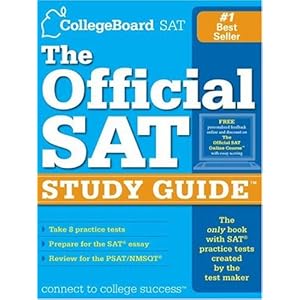
We have done all 8 math practice tests (432 problems) in "The Official SAT Study Guide" by the College Board (which you should buy) in the 100+ videos below.

We recommend that you buy the book and take at least one practice test (3 math sections) per week during each of the 8 weeks prior to the exam. In the earlier weeks, you should focus on comprehending and working on every problem. In the second four weeks, you should focus on speed and eliminating careless mistakes (although you should still try to do any problems that you didn't get to). After grading each of your exams, watch the corresponding video below.

If you have the self-discipline to take the practice tests, review your problems and watch the videos, we think you will be as prepared as anyone. You should view these videos as your on-demand personal tutor.

If you need to review (or learn) underlying mathematical concepts covered on the SAT, we have over 800 videos on general math topics in our video library.

SAT Preparation

I just watched the solution to question 17 on page 412 and had a major duh moment.

Which is exactly what I should be having -- but am not having with the SAT prep books, which frequently make simple problems seem more complex, at least to me.

SAFMEDS how to

SAFMEDS on the Web
Guidelines and Considerations for SAFMEDS
by John W. Eshleman, Ed.D.


Am not yet a user of SAFMEDS, but I will be.

Meanwhile, good news on the SAT prep front: after 2 weeks of study I appear to have added 50 points to my score, and I've got C. working and progressing, too. More anon.

SAT scores flash: C. earned a 780 on his SAT II World History test, which likely means he missed only 1 question on the test.

His percentile?

94th - ! Six percent of the test takers got every single question correct.

(C. is going into his junior year.)

Monday, June 28, 2010

Sen. Robert Byrd; in memorium

Sen. Robert Byrd passed away this morning at the age of 92. I remember listening to many of his speeches on the closed circuit TV that was always on when I did my stint on the Hill in 2002. Yes, many of his speeches droned on and on, and covered topics often as mundane as how his wife made the best cranberry sauce he ever tasted. But he also was known for fiery rhetoric and a sharp wit that more than made up for his ramblings.

I'm a bit biased, but in my estimation, his finest oratorial work was his speech on "Rainforest Math", given on June 9, 1997, and can be found in the Congressional Record. Following is an excerpt. I strongly encourage you to "read the whole thing" as they say in blog land. May he rest in peace:

I have recently obtained a copy of the same strange textbook—this is it, as I have already indicated—and I have to go a step further and call it whacko algebra.

This textbook written by a conglomerate of authors lists 5 so-called ‘‘algebra authors,’’ but it boasts 20 ‘‘other series authors’’ and 4 ‘‘multicultural reviewers.’’ We are talking about algebra now. Why we need multicultural review of an algebra textbook is a question which I would like to hear someone answer, and the fact that there are 4 times as many ‘‘other series authors’’ as ‘‘algebra authors’’ in this book made me suspect that this really was not an algebra textbook at all.

A quick look at the page entitled, ‘‘Getting Started’’ with the sub heading, ‘‘What Do You Think,’’ quickly confirmed my suspicions about the quirky fuzziness of this new-new approach to mathematics. Let me quote from that opening page.

“In the twenty-first century, computers will do a lot of the work that people used to do. Even in today’s workplace, there is little need for someone to add up daily invoices or compute sales tax. Engineers and scientists already use computer programs to do calculations and solve equations. “

What kind of a message is sent by that brilliant opening salvo? It hardly impresses upon the student the importance of mastering the basics of mathematics or encourages them to dig in and prepare for the difficult work it takes to be a first-rate student in math. Rather it seems to say, ‘‘Don’t worry about all of this math stuff too much. Computers will do all that work for us in a few years anyway.’’

Can you imagine such a goofy passage in a Japanese math textbook? I ask what happens if the computer breaks down or if we forget and leave the pocket calculator at home? It appears that we may be on the verge of producing a generation of students who cannot do a simple mathematical equation in their heads, or with a pencil, or even balance a checkbook.

The ‘‘Getting Started’’ portion of the text goes on to extol the virtues of teamwork, to explain how to get to know other students and to ask how teamwork plays a role in conserving natural resources. What, I ask—what in heaven’s name does this have to do with algebra? I took algebra instead of Latin when I was in high school. I never had this razzle-dazzle confusing stuff. Page 5 of this same wondrous tome begins with a heading written in Spanish, English, and Portuguese, a map of South America and an indication of which language is spoken where. Pythagorus would have been scratching his head by this time, and I confess, so was I.

This odd amalgam of math, geography and language masquerading as an algebra textbook goes on to intersperse each chapter with helpful comments and photos of children named Taktuk, Esteban, and Minh. Although I don’t know what happened to Dick and Jane, I do understand now why there are four multicultural reviewers for this book. However, I still don’t quite grasp the necessity for political correctness in an algebra textbook. Nor do I understand the inclusion of the United Nations Universal Declaration of Human Rights in three languages, a section on the language of Algebra which defines such mathematically significant phrases as, ‘‘the lion’s share,’’ the ‘‘boondocks,’’ and ‘‘not worth his salt.’’

By the time we get around to defining an algebraic expression we are on page 107. But it isn’t long before we are off that boring topic to an illuminating testimony by Dave Sanfilippo, a driver with the United Parcel Service. Sanfilippo tells us that he ‘‘didn’t do well in high school mathematics ’’ but that he is doing well at his job now because he enters ‘‘information on a pocket computer’’—hardly inspirational stuff for a kid struggling with algebra.

From there we hurry on to lectures on endangered species, a discussion of air pollution, facts about the Dogon people of West Africa, chili recipes and a discussion of varieties of hot peppers— no wonder our pages are having difficulty containing themselves. They are almost in stitches—what role zoos should play in today’s society, and the dubious art of making shape images of animals on a bedroom wall, only reaching a discussion of the Pythagorean
Theorem on page 502. By this time I was thoroughly dazed and unsure of whether I was looking at a science book, a language book, a sociology book or a geography book. In fact, of
course, that is the crux of the problem.

I was looking at all of the above. This textbook tries to be all things to all students in all subjects and the result is a mush of multiculturalism, environmental and political correctness, and various disjointed discussions on a multitude of topics which certainly is bound to confuse the students trying to learn and the teachers trying to teach from such unfocused nonsense. It is not just nonsense, it is unfocused nonsense, which is even worse. Mathematics is about rules, memorized procedures and methodical thinking.

We do memorize the multiplication tables, don’t we? Else how will one know that nine 8s are 72 and that eight 9s are 72. This new-new mush-mush math will never produce quality engineers or mathematicians who can compete for jobs in the global market place. In Palo Alto, CA, public school math students plummeted from the 86th percentile to the 56th in the first year of new-new math teaching. This awful textbook obviously fails to do in 812 pages what comparable Japanese textbooks do so well in 200. The average standardized math score in Japan is 80. In the United States it is 52.


Sunday, June 27, 2010

help is on its way


Help I'm Teaching Middle School Science
by C. Jill Swango


"A great guide to the practical aspect of teaching inquiry-based middle school science."

Home Algebra I Round-Up

Maria Miller of Math Mammoth and Homeschoolmath.net has recently posted her overview of homeschool algebra I options.

I found it to be a nice overview, though I wish she would have touched on Singapore's New Elementary Math series. (No one ever seems to talk about that, it's like Singapore drops off the face of the earth after 6th grade. Is that because they're not as good, or because they're not as friendly to use in a home setting, or ... ? But I digress.) I'll definitely start looking into Art of Problem Solving Introduction to Algebra.

Even though Algebra I is still a way off in my particular family, I'm always on the lookout for what's coming down the pike for my kids. Gotta know what the bridge is supposed to look like when you're done if you're going to build it right.

Saturday, June 26, 2010

student evaluations & college calculus at the USAFA

In primary and secondary education, measures of teacher quality are often based on contemporaneous student performance on standardized achievement tests. In the postsecondary environment, scores on student evaluations of professors are typically used to measure teaching quality. We possess unique data that allow us to measure relative student performance in mandatory follow‐on classes. We compare metrics that capture these three different notions of instructional quality and present evidence that professors who excel at promoting contemporaneous student achievement teach in ways that improve their student evaluations but harm the follow‐on achievement of their students in more advanced classes.

[snip]

[O]ur study uses a unique panel data set from the United States Air Force Academy (USAFA) in which students are randomly assigned to professors over a wide variety of standardized core courses. The random assignment of students to professors, along with a vast amount of data on both professors and students, allows us to examine how professor quality affects student achievement free from the usual problems of self-selection. Furthermore, performance in USAFA core courses is a consistent measure of student achievement because faculty members teaching the same course use an identical syllabus and give the same exams during a common testing period.5 Finally, USAFA students are required to take and are randomly assigned to numerous follow-on courses in mathematics, humanities, basic sciences, and engineering. Performance in these mandatory follow-on courses is arguably a more persistent measurement of student learning. Thus, a distinct advantage of our data is that even if a student has a particularly poor introductory course professor, he or she still is required to take the follow-on related curriculum.6

[snip]

Our findings show that introductory calculus professors significantly affect student achievement in both the contemporaneous course being taught and the follow-on related curriculum. However, these methodologies yield very different conclusions regarding which professors are measured as high quality, depending on the outcome of interest used. We find that less experienced and less qualified professors produce students who perform significantly better in the contemporaneous course being taught, whereas more experienced and highly qualified professors produce students who perform better in the follow-on related curriculum.

[snip]

Results show that there are statistically significant and sizable differences in student achievement across introductory course professors in both contemporaneous and follow-on course achievement. However, our results indicate that professors who excel at promoting contemporaneous student achievement, on average, harm the subsequent performance of their students in more advanced classes. Academic rank, teaching experience, and terminal degree status of professors are negatively correlated with contemporaneous value-added but positively correlated with follow-on course value-added. Hence, students of less experienced instructors who do not possess a doctorate perform significantly better in the contemporaneous course but perform worse in the follow-on related curriculum.

Student evaluations are positively correlated with contemporaneous professor value-added and negatively correlated with follow-on student achievement. That is, students appear to reward higher grades in the introductory course but punish professors who increase deep learning (introductory course professor value-added in follow-on courses). Since many U.S. colleges and universities use student evaluations as a measurement of teaching quality for academic promotion and tenure decisions, this latter finding draws into question the value and accuracy
of this practice.

These findings have broad implications for how students should be assessed and teacher quality measured. Similar to elementary and secondary school teachers, who often have advance knowledge of assessment content in high-stakes testing systems, all professors teaching a given course at USAFA have an advance copy of the exam before it is given. Hence, educators in both settings must choose how much time to allocate to tasks that have great value for raising current scores but may have little value for lasting knowledge. Using our various measures of quality to rank-order professors leads to profoundly different results. As an illustration, the introductory calculus professor in our sample who ranks dead last in deep learning ranks sixth and seventh best in student evaluations and contemporaneous value-added, respectively. These findings support recent research by Barlevy and Neal (2009), who propose an incentive pay scheme that links teacher compensation to the ranks of their students within appropriately defined comparison sets and requires that new assessments consisting of entirely new questions be given at each testing date. The use of new questions eliminates incentives for teachers to coach students concerning the answers to specific questions on previous assessments.

[snip]

Students at USAFA are high achievers, with average math and verbal Scholastic Aptitude Test (SAT) scores at the 88th and 85th percentiles of the nationwide SAT distribution.8 Students are drawn from each congressional district in the United States by a highly competitive process, ensuring geographic diversity. According to the National Center for Education Statistics, 14 percent of applicants were admitted to USAFA in 2007. Approximately 17 percent of the sample is female, 5 percent is black, 7 percent is Hispanic, and 6 percent is Asian. Twenty-six percent are recruited athletes, and 20 percent attended a military preparatory school. Seven percent of students at USAFA have a parent who graduated from a service academy and 17 percent have a parent who previously served in the military.

[snip]

These findings have broad implications for how students should be assessed and teacher quality measured. Similar to elementary and secondary school teachers, who often have advance knowledge of assessment content in high-stakes testing systems, all professors teaching a given course at USAFA have an advance copy of the exam before it is given. Hence, educators in both settings must choose how much time to allocate to tasks that have great value for raising current scores but may have little value for lasting knowledge.

Does Professor Quality Matter? Evidence from Random Assignment of Students to Professors
Scott E. Carrell
University of California, Davis and National Bureau of Economic Research
James E. West
U.S. Air Force Academy


=======

6 For example, students of particularly bad Calculus I instructors must still take Calculus II and six engineering courses, even if they decide to be a humanities major.

fyi

SAT percentiles

Friday, June 25, 2010

running with the big dogs

from Work Hard. Be Nice. by Jay Mathews:
One popular slogan irritated [Harriet Ball]: “All children can learn.” That was not the right message, she thought. It ought to be “All children will learn.” The word “can” was too passive. It meant the child was capable. That was not enough. There was a big difference between capability and achievement. Many educators thought it was up to their students and their parents to summon the motivation to use their God-given talents. Ball took her responsibilities more seriously. She brought this up every time she saw the slogan: “Uh-uh, I don’t want no ‘can,’” she said. “All of us will learn. I will learn from the kids. They will learn from me. Ain’t no ‘can.’ We will all learn.”
p.37

Thursday, June 24, 2010

Did you celebrate National SAT Day?

Because according to this new SAT blog by Sol Lederman it was yesterday, June 23rd. He quotes Wikipedia:
The first administration of the SAT occurred on June 23, 1926, when it was known as the Scholastic Aptitude Test.[19][20] This test, prepared by a committee headed by Princeton psychologist Carl Campbell Brigham, had sections of definitions, arithmetic, classification, artificial language, antonyms, number series, analogies, logical inference, and paragraph reading. It was administered to over 8,000 students at over 300 test centers. Men composed 60% of the test-takers. Slightly over a quarter of males and females applied to Yale University and Smith College.[20] The test was paced rather quickly, test-takers being given only a little over 90 minutes to answer 315 questions.[19]
I'm guessing that there were no SAT tutors then.

the nativity gap, part 2

from Erin Johnson:

The 2007 TIMSS does break out the US results by race. In 4th grade the US Asian subgroup performs only slightly less than the top Asian countries but by 8th grade the US Asian subgroup performs significantly lower.

4th grade US Asians: 582
4th grade Singapore: 593

8th grade US Asians: 549
8th grade Singapore: 599

Highlights from TIMSS (pdf file)

Note that the math scores of Singapore stay the same from 4th to 8th grade, but the US Asian subpopulation (as well as the entire student population) declines.

If math performance was purely an IQ phenom, we would expect that those 4th and 8th grade levels would be comparable, but this is not the case.

Also, there is evidence from Whitehurst that math curricula does matter. So it is not inconceivable that differences between math in Asia vs the US might account for performance differences.

Anecdotally, having used Singapore math it is easy for me to see why Asian math programs would be significantly better at enabling kids to learn math.

severely fragmented knowledge

Looking through the SAT prep posts, I found this problem that, just 12 days ago, I couldn't begin to do.
If 20 percent of x equals 80 percent of y, which of the following expresses y in terms of x?

(A) y = 16% of x
(B) y = 25% of x
(C) y = 60% of x
(D) y = 100% of x
(E) y = 400% of x

The Official SAT Study Guide 2006
ISBN-13: 978-0874477184
p. 550

Today it seems simple and obvious.

This is a classic case of inflexible knowledge. I've practiced solving many, many literal equations over the past few years, a skill I learned and practiced in high school, too. I had no trouble doing it then, and I've had no trouble doing it now.

So, in theory, I 'know' how to do this problem.

And yet when I encountered a literal equation involving percent, I was mystified.

What fresh hell is this?


from cranberry:
Funny, I didn't need to set up a formal equation for this. If 20% of x = 80% of y, y must be four times as small as x. Thus, 25% of x.
That's the kind of thing years of doing bar models does for you.

Not that cranberry has spent years drawing bar models.

the nativity gap in a nutshell


[I]mmigrant students actually do better if they begin their American education in high school rather than in elementary or middle school.

Foreign-Born Students New to N.Y. Outshine Native Born
by Sarah Garland
New York Sun
February 11, 2008 Edition

the nativity gap

the nativity gap

from Bostonian:
Where is the evidence, adjusting for race, that American math curricula are worse than those used in Asia?

William Schmidt, director of the U.S. national Research Center for the Third International Mathematics and Science Study, is the person to read on this subject:

The Role of Curriculum
A Coherent Curriculum: The Case of Mathematics (pdf file)

and see:
The Sequence of Mathematics Topics in Top-Achieving Countries (pdf file)


nativity gap

This Stiefel, Schwartz, and Conger study, while not an analysis of curriculum, supports Schmidt's argument:

Do Immigrants Differ from Migrants? Disentangling the Impact of Mobility on High School Completion and Performance
Leanna Stiefel, Amy Ellen Schwartz, and Dylan Conger

from the New York Sun's story:
Foreign-born newcomers to New York City's public schools are performing better than native-born newcomers, a New York University study shows.

The working paper by NYU education researchers titled "Do Immigrants Differ From Migrants?" has also deflated any notions that immigrant students tend to do worse in American schools the older they are when they arrive. On the contrary, the findings demonstrated that immigrant students actually do better if they begin their American education in high school rather than in elementary or middle school.

[snip]

Ms. Schwartz, speaking at an NYU symposium last week, said she and her colleagues had hypothesized that immigrant students "who come late are the ones who are really disadvantaged," guessing that their lack of language skills, the stress of moving to a new country, and institutional differences between the schools they came from and the New York schools might hurt their graduation rate and performance on tests.

Instead, they found that the foreign born "just do remarkably better," Ms. Schwartz said.

Foreign-Born Students New to N.Y. Outshine Native Born
by Sarah Garland
New York Sun
February 11, 2008 Edition

Here is Andrew Wolf's take:
Immigrant children outperform some native-born children in New York schools, my colleague Sarah Garland reported the other day. Indeed, it seems the longer newly-arrived children attend our schools, the worse they do. These conclusions come from a new study, "Do Immigrants Differ From Migrants?"

"The foreign born are whizzing by the native born at every level," one of the researchers, Amy Ellen Schwartz, said.

[snip]

If one drives past the Bronx High School of Science any given school day morning, one will encounter a seemingly endless caravan of yellow school buses. Most of these buses come from Queens, the borough known for its immigrant population. Sixty percent of those recently offered a spot at Bronx Science as a result of their test scores come from Queens, as are 40% of the new freshmen at Stuyvesant. It [sic] it turns out that a good number of these commuter students are recent immigrants, why do the city's specialized high schools seem to have such a disproportionate number of newly arrived students?

Whizzing By
BY ANDREW WOLF
March 3, 2008
I miss the Sun.

Wednesday, June 23, 2010

more from Wu

from Allison:
Going forward from what Catherine posted, Wu argues that most of what teachers know about fractions, and teach to their students, is wrong in the sense that it is unsupported by what the students have previously been taught.

Wu makes clear that you must be ruthless with your self when teaching. You must not allow yourself to use any concept you've not explicitly given your students. And almost all textbooks violate this rule in almost every lesson on fractions.

Nearly all textbooks avoid defining a fraction. Since they aren't defined, they don't define how you operate on fractions in terms of any real definition. Beyond that, when they do introduce operations on fractions, the books don't define operations in terms of what students know either. They teach rules without ever teaching where the rules come from. Their "explanations" invoke properties no one taught the students, but are just asserted. That means logically, their explanations are wrong, as you can't prove a statement by assuming the statement true.

For example, how does one justify multiplication of fractions? (I'll answer how later, but for now, discuss amongst yourselves.)

Yes, you can learn to use the rule properly without understanding where it is from, but you'll only go so far, and more, you will mistrust your teachers and mistrust math. Math will seem to be an endless series of magical statements with no relationship, and sooner or later, you'll run out of time/space/effort for keeping track of them. Properly understood, math is coherent, because every new step you take follows from the ones before.

a likely story

I'm sorry.

I have to say it.

I didn't buy the grew apart after 40 years of marriage business for one second.

question: Why exactly did we all have to read earnest accounts of 'gray divorce' & suchlike for a solid week?

Off-topic, I know.

we begin

Definition of a Fraction

Recall that a number is a point on the number line (§5 of Chapter 1). This chapter deals with a special collection of numbers called fractions, which are usually denoted by m/n, where m and n are whole numbers and n ≠ 0. We begin by defining what fractions are, i.e., specifying which of the points on the number line are fractions. The definition will be both clear and simple. If you find it strange that we are making a point of giving a definition of fractions, it is because this is something thousands (if not hundreds of thousands) of teachers have been trying to get at for a long time. Most school textbooks and professional development materials do not bother to give a definition at all. A few better ones at least try, and typically what you would find is the following:

Three distinct meanings of fractions — part-whole, quotient, and ratio — are found in most elementary mathematics programs.

[snip]

Such an explanation is unsatisfactory for several reasons. To say that something you try to get to know is three things simultaneously strains one’s credulity. For instance, if I tell you I have discovered a substance that is as hard as steel, as light as air, and as transparent as glass, would you believe it? Another reason for objection is that a fraction is being explained in terms of a “ratio”, but most people don’t know what a ratio is.2 In addition, while we are used to the idea of a division a ÷ b where a is a multiple of b (see §3.4 of Chapter 1), we are not sure yet of what 2 ÷ 3 means. So to use this to explain the meaning of 2/3 does not seem to make sense. Finally, we anticipate that fractions would be added, subtracted, multiplied and divided, and it is not clear how one goes about adding, subtracting, multiplying and dividing a part-whole, or a quotient, or a ratio.

This is why we opt for a definition that is both simple and clear.

Chapter 2: Fractions (Draft)
(pdf file)
H. Wu
Department of Mathematics #3840
University of California, Berkeley
Berkeley, CA 94720-3840

Tuesday, June 22, 2010

"KIPP schools routinely outscore many that serve middle-class"

Report finds KIPP students outscore public school peers

Again.

I remember, 5 years ago, when I first started telling people KIPP kids were twice as likely to take algebra in the 8th grade and pass Regents as our kids.

Now here it is, 2010, and I'm still telling people KIPP kids are twice as likely to take algebra in the 8th grade and pass Regents as our kids.

Same deal with Scarsdale. Last winter our Interim Director of Curriculum reported that 80% of Scarsdale students take algebra in 8th grade.

Then she added: "We're not Scarsdale. We certainly don't have the resources of Scarsdale."

'We're not Scarsdale' explained why we can't have 80% of our kids taking algebra in 8th grade. If we were Scarsdale, we could, but we're not Scarsdale so we can't.

A parent in the audience logged onto the internet, pulled the data, and reported back to the board before the night was out that in fact Irvington has exactly the same per pupil dollar spending on instructional programming as Scarsdale, so: check.

But no matter.

Tonight the board will undoubtedly approve funding to enable our Interim Director of Curriculum and a generous contingent of teachers to devote a week or two this summer to rejiggering Trailblazers in consultation with a math person from up Bedford way. Bedford School District seems to be the last Trailblazers site in the county apart from Irvington (Scarsdale adopted Singapore Math 2 years ago), so obviously we Irvington taxpayers need to pay them, too.

Check back in 2015.

nice work if you can get it

$60 - $80K

$83 million

from Saxon Math Warrior:
It was one thing for John Saxon to take on the mathematics education establishment. It was another for him to take on a special interest group whose followers were bankrolled by the federal government. With $83 million in federal tax dollars being pumped into the math education reformists’ camps during the 1990’s, any entrepreneur not in the chosen circle, who opposed reform math methods, and who was publishing his own math textbooks would have to battle more than their high-dollar funding. He would have to challenge the political ideology that guided all their decisions regarding America’s math program.

Monday, June 21, 2010

msmi 2010 Followup

msmi 2010: Institute on Fractions is now history. YAY!

I'll leave Catherine and any others to talk about their take on it. I'll have some future posts on what I think are the biggest lessons parents and teachers need to help their students understand fractions, but this is just a roundup.

In the course of 5 days, we covered: definition of a fraction, equivalent fractions, decimals, addition, subtraction, multiplication, division, decimals again, and percent. We had more to do, but we couldn't get to it.

Based on the reaction of the teachers, it was a success. I have NEVER had a class of students where so many students worked so hard. No matter what their background, everyone tried to do the problems. Their effort meant that as the week went on, the students were more engaged and more knowledgeable. The teachers also built up their camaraderie with each other.

Based on their personal comments to me and the anonymous survey I gave at the end, their overall impression was quite high. Several teachers told me that this course was the first time anyone had ever explained how to think about fractions. One told me it was "a revelation" to them, another told me this was the first time they'd see a way to visualize multiplication of fractions. Most responded to our survey saying that this material had changed how they would teach permanently. Several teachers had a different kind of revelation, too: that other people in other schools/cities/states knew and felt as they did. They were connecting the dots not only on fractions, but on the state of math education.

Not that everything was perfect. I was terribly out of practice for being a teacher--bad board technique, bad handwriting, bad short hand in my own thoughts and words, instead of being clear, specific and slow.

I made several errors in sizing up my audience too. I assumed that since I had told the principals what to expect, that they had told their teachers. I assumed that teachers, given a pointer to a web site that had, e.g. Wu's CV on it, would have read such.

The biggest complaint was that it was too much material/days too long, and not enough worked out examples. One solution to the latter is to strongly encourage the teachers to read the textbook a day ahead of time. But part of that is the nature of the beast: there is an enormous deficit of knowledge to overcome. Elementary math teachers didn't go into that field because of their stength in fractions. The breadth of math inexperience-experience even for teachers of the same grade was very large, yet being math experienced didn't quite help, because while those teachers probably followed Wu's proofs more easily, applying his ideas to actual math problems was still a new universe to them, and their skill was sometimes a hindrance, because he was asking them to think an entirely different way than they were used to.

Lastly, I'm thrilled to have met all the people involved. Wu is a delight to work with/for, and I'd do this again with him wherever we can. He was personable and charming as well as brilliant. His wife was just as delightful. CassyT, KTMer, is an exemplary woman. She's a brilliant teacher and student of human nature, and her insights into teachers saved me countless mistakes. She shared her expertise with me in countless ways, and the whole thing would have fallen apart if not for her.

So, where to go from here? First, more Wu institutes! Let's bring MSMI to your locale! Second, the really big thing is to help teachers turn what they learned here into changes in their school. That's no small undertaking. I'll talk about that more in the next post. Last, more documents for everyone: condensing of Wu for parents and teachers. I'm sure you'll see work product of that around here shortly...

more than one way to solve it

paraphrasing Wu at msmi2010:
The idea that there is always more than one way to solve it is propaganda. Sometimes you're lucky to have one way.

question: what is the opposite of fuzzy?

answer: SAT math

54 questions, 70 minutes, many working parts

no time to 'think'

no time for 'many ways to solve it'

to score well on the SAT, you need to use the fastest method, and you need to know what the fastest method is about 5 seconds after you start reading the problem

if not sooner

talk and chalk

from Have Technology and Multitasking Rewired How Students Learn? by Dan Willingham
When you encounter a new technology, try to think in abstract terms about what the technology permits that was not possible in the past. It’s also worth considering what, if anything, the technology prevents or makes inconvenient. For example, compared with a chalkboard, an overhead projector allows a teacher to (1) prepare materials in advance, (2) present a lot of information simultaneously, and (3) present photocopied diagrams or figures. These are clear advantages. However, there are also disadvantages. For instance, James Stigler and James Hiebert noted that American teachers mostly use overhead projectors when teaching mathematics, but Japanese teachers use chalkboards.33 Why? Because Japanese teachers prefer to maintain a running history of the lesson. They don’t erase a problem or an explanation after putting it on the board. It remains, and the teacher will likely refer to it later in the lesson, to refresh students’ memories or contrast it with a new concept. That’s inconvenient at best with an overhead projector.

33 James W. Stigler and James Hiebert, The Teaching Gap (New York: Free Press, 1999).

Having managed to follow most of Wu's lectures, I am a huge fan of this method - and a huge non-fan of the PowerPoint now-you-see-it, now-you-don't approach to teaching.

limits of working memory
working memory posts

Saxon Math Warrior

from Education News:
John Saxon was hated by the math education establishment from the time he published his first algebra book in 1981. He still is, 14 years after his death in 1996. A West Point graduate with three engineering degrees, he declared war on those he blamed for creating the “disaster in American math education.” He insisted that math leaders had overseen this debacle and there was no personal accountability being demanded for the results of their radical ideology.

In John Saxon’s Story, a genius of common sense in math education, readers learn about his battles, his strong and colorful personality, and how his historically-based traditional math program made him, much to his surprise, a multimillionaire. This was in spite of high-powered and politically-connected math leaders’ efforts to destroy him.

The author, Nakonia (Niki) Hayes, is a retired math teacher and principal who used the Saxon program. She says she wrote the biography because John Saxon made a valuable and positive impact on thousands of American children. Go to Saxon Math Warrior for more information about how to order this original biography.

wow!

MSMI2010 was amazing.

Amazing!

Still collecting my thoughts - will post - but in the meantime, Niki Hayes' John Saxon bio is out!
My copy arrived in the mail last week.

The brain hurts most when being expanded...

Professor Wu at the beginning of MSMI2010 ...


...and at the end of MSMI2010.


That's the result of 40 hours of extreme fraction action.

Notice how giddy and hard working the attendees are after 5 days!

Better sign up now for next year's institute on Geometry.

Saturday, June 19, 2010

NJ adopts Common Core Standards

From an email I received from The NJ Coalition for World-Class Math:
Dear Group:
 
Well, it's over.
 
Yesterday, the NJ State Board of Education adopted the Common Core Standards in Math and English-Language Arts yesterday.  They never offered the public a chance to provide testimony on the final standards prior to adoption.
More info here:


Where Have All The Portfolios Gone

Now that my son is finishing 8th grade and heading to high school, I'm still waiting to get back all of his work hidden away in portfolios. They are educational black holes. Is some student work (good and bad) kept as examples without telling students? Do some teachers use the work in reports or their own class work without telling the kids? I know it won't do us much good now, but it would be nice to get the work back. I wrote to our school long ago about how hiding work in portfolios does not help parents and kids, but I never heard a word back.

Saturday, June 12, 2010

Allison on SAT prep

I would teach anyone taking the SAT that they should *know the strategy* to answer the question by the time they've finished reading it, or they should move on and go back to it later.

The goal of SAT prep and math courses, generally, should be to study enough math that nearly all of the problems are that immediately clear to you--you know by the time you've finished reading them how you're going to solve them.

21st century

SMART Boards & SMART Tables, too


Senior Bertrand Ngampa gives a presentation on an interactive whiteboard at W.T. Woodson High. (Dayna Smith/Post)

'Math Strategies for Women'

from Gruber's Complete SAT Math Workbook:
These are questions that women found significantly more difficult than men did. However, after learning the strategies in this book, women scored just as high as men on these sections.

1. Carol has twice as many books a Beverly has. After Carol gives Beverly 5 books, she still has 10 more books than Beverly has. How many books did Carol originally have?

2. 5_2 x 9 = 5,2_8 (missing digits are different)

3. If s equals 1/2 percent of t, what percent of s is t?
I find this passage kind of charming: a remnant from a more innocent time. And I'm sure he's right. I'm sure these are problems Betty Draper would have struggled with.

Meanwhile, Gruber doesn't seem to have noticed the presence of algebra 2 on the new exam. If Betty's having trouble managing a simple story problem, she's really going to blow a gasket when somebody asks her to solve an inequality involving absolute value.

Education: Preparing Americans

I'm concerned that WEAK Common Core Math Standards
(especially regarding "authentic" Algebra 2) will diminish our students' preparedness to achieve their personal goals.

Here's why..


Adelman, C. 1999. Answers in the Tool Box: Academic Intensity, Attendance Patterns, and Bachelor's Degree Attainment.
Washington, DC: U.S. Department of Education.

In the "selected findings" section, you'll find:
"Of all pre-college curricula, the highest level of mathematics one studies in secondary school has the strongest continuing influence on bachelor's degree completion. Finishing a course beyond the level of Algebra 2 (for example, trigonometry or pre-calculus) more than doubles the odds that a student who enters postsecondary education will complete a bachelor's degree"


The Toolbox Revisited "Reiterations" [p. 108]

First, there was a story about curriculum, the content of schooling, that was compelling in its secondary school dimensions in the original Tool Box, and is even more compelling now on both secondary and postsecondary stages. What you study, how much of it, how deeply, and how intensely has a great deal to do with degree completion.

Second, this curriculum story, joined by nuances of attendance patterns that turn out to have significant leverage, continues into higher education.


It’s not merely getting beyond Algebra 2 in high school any more: The world demands advanced quantitative literacy, and no matter what a student’s postsecondary field of study—from occupationally-oriented programs through traditional liberal arts— more than a ceremonial visit to college-level mathematics is called for.

The Toolbox Revisited: Paths to Degree Completion from High School Through College

Friday, June 11, 2010

boys & girls & SAT math

here

I've only skimmed the post, but I don't see a passage where he controls for the higher number of boys dropping out of high school.

I got a book today that has a page dedicated to the specific problems girls have trouble with - pretty funny. (He could be right for all I know. However, I'm having lots of trouble with SAT math but none whatsoever with the problems the author cites.)

I'll post tomorrow.

"SAT work"

a 2008 blog

hours and hours

from Susan S:
The worst part about the hours and hours of project making and coloring is the neglect of basic skills that will be needed for high school.

Somewhere around the end of 7th grade, I realized my son could barely hold a pencil or pen for more than a couple of sentences. There was no flow to his writing. It was just torture for him. I thought I was done with afterschooling only to realize we had to start all over and get him caught up.

Even in a class like social studies, he was expected to write a couple of things in a notebook, but then illustrate the page. Of course, he'd been typing since the 4th grade, so he'd forgotten cursive. But it wasn't just cursive he had forgotten. He was even unsure of certain letters in block form.

When I would receive his middle school journal at the end of the year I would notice basic words misspelled consistently, thus searing the wrong spelling into his brain. It was a nightmare to go through all of that and get him straight.

It took a good 4-5 weeks of writing summaries, bios, etc. every other day just to get him to form the letters automatically and quickly and without fatigue.

I have no idea why they do this. I do sense that they get pressure from upstairs to have a certain amount of project work. I imagine if they didn't have extended response and essays on the state tests, they'd probably not have them write at all.

Like math facts, they believe that these things just take care of themselves.

the brick problem


The pattern shown above is composed of rectangles. This pattern is used repeatedly to completely cover a rectangular region 12L units long and 10L units wide. How many rectangles of dimension L by W are needed?

answer choices:
A) 30
B) 36
C) 100
D) 150
E) 180

solution here and here

The Official SAT Study Guide

standard celeration charts

I'm thinking it's time I finally figured out Celeration Charts.
ABSTRACT

Combining Pavlov’s (1960/1927) use of frequency as a standard unit in the measurement of scientific phenomena and Skinner’s (1938) use of frequency, free operant behavior, and the cumulative recorder with his knowledge of engineering and interest in navigation, Lindsley brought to psychology and education the most powerful and scientific use of measurement applied to human behavior. In 1965, he developed what was first called the Standard Behavior Chart, now more accurately described as a family of Standard Celeration Chart —standard measurement charts for human behavior in daily, weekly, monthly, and yearly time periods. This paper provides an overview of these four types of Standard Celeration Charts.

Since 1967, educators and others have used the Standard Behavior Chart (now called the Standard Celeration Chart) to observe human behavior and improve learning. The people behaving have ranged from fetuses to those in their 80s (Calkin, 1983; Cobane & Keenan, 2002; Edwards & Edwards, 1970). Some behaviors counted have included all day counts of fetal movement (Calkin, 1983), positive and negative feelings about self (Cobane & Keenan, 2002; Kostewicz, Kubina, & Cooper, 2000; Kubina, Haertel, & Cooper, 1994), as well as the more usual 1-minute timings of academic behaviors such as Hear Say question then answer (Zambolin, Fabrizio, & Isley, 2004), See Write math facts (Stromberg & Chappell, 1990), Think Say and Think Write American government facts (using 1-minute, 2-minute, and 5-minute timings) (Ellis, 1980), Write words (Albrecht, 1981), and See Say parts of a microscope or skeleton (Miller & Calkin 1980).

[snip]

Using the Standard Celeration Chart makes two critical elements apparent. First, behavior grows by multiplying, not by adding. If Janel wants to improve her learning, she knows that to grow from one to two is to double and is identical to growing from 50 to 100, not from 50 to 51. When she wants to learn something new or change a behavior or feeling, she wants change by doubling, not by adding or deleting one at a time. If Abigail says 35 Russian conversation words in one minute (to which no Russian will listen for long!) and grows by adding one a day, it will take 215 days, or 31 weeks, to reach fluent speech. If she learns by doubling each week, she can get from 35 words per minute to 250 in 50 days, or seven weeks. If Gemma is a slow reader and reads 62 words a minute at grade level and wants to read 200 words per minute, does her teacher want her to grow by adding or multiplying? If Alan has 100 suicide thoughts a day, does he want to reduce them by one or two per day or by ÷5.0 per week?

Secondly, the chart makes us look at not only the frequency of a person’s performance, but also at the growth of learning across time, (i.e., the celeration). Within the first five years of using the chart, several of its powerful elements became increasingly apparent. Frequency is performance: It tells what happened during one time period, but by itself it tells little about learning. To see whether performance accelerates or decelerates, we need to measure it across time. Since 1971, we have called this change in learning celeration.1 Acceleration indicates an increase in the growth of change of the frequency, in the learning of the behavior. Deceleration indicates a decrease in the learning of the behavior.

Frequency is the count per minute: the number of times Steve does independent or dependent actions per hour; the number of pieces of science equipment Greg names correctly and incorrectly in one minute; the number of words Chris reads correctly and incorrectly per minute; the number of pleasant and unpleasant self-thoughts Angie has per day. These behaviors show performance. Celeration is the count per minute per week. It shows change in performance, or learning across time. We measure celeration, (i.e., learning) by the week, or, if using larger time measures, changes by the month, year, or decade. Celeration: Steve’s actions per hour, each day, per week; Greg’s pieces of science equipment he points to and says per minute, each day, per week; Chris’s words read per minute, each day, per week; Angie’s thoughts about self per minute all day, each day, per week.

PRECISION TEACHING: THE STANDARD CELERATION CHARTS
ABIGAIL B. CALKIN, PH.D.
PRIVATE PRACTICE
THE BEHAVIOR ANALYST TODAY VOLUME NUMBER 6, ISSUE NUMBER 4, 2005

SAFMEDS

One of the DI-list folks wrote a post about learning Italian using SAFMEDS.

S- Say
A- All
F- Fast
M- Minute
E- Each
D- Day
S- Shuffled

SAFMEDS and celeration charts at University of North Texas.

And: applied behavior analysis SAFMEDS. Just in case.

Allison explains absolute value inequalities

Catherine: also, I have completely forgotten how to set up and solve a simple inequality involving absolute value

Allison: You need to think about what it means.

The absolute value of any number equal to or greater than 0 is itself. x-->x

The abs value of any number less than 0 is the number*-1, or the number with its sign dropped: x --> -x.

So break down the inequality you see into other inequalities.

|x| - 2 > 3

means
|x| > 5:

allowable positive values of x satisfy
x > 5

allowable negative values of x satisfy
-x > 5

you "solve" this by switching sides (do you know why you're allowed to do that?)
and that becomes
x < -5

Now, you do |x - 3| < 5 in a similar way. To make yourself less confused, write (x-3) = y
and work on
|y| < 5

Then after you've got that into equations without the abs value, sub back in the x-3.

time

Time is our most valuable nonrenewable resource, and if we want to treat it with respect, we need to set priorities.

Albert-László Barabási
Bursts
Dutton, 310 pages, $26.95

Hurry Up and Wait

redkudu on

from Redkudu:
The assigning of art projects is just lazy grading, as far as I'm concerned. You can spot-check for the required elements without the need to analyze whether the student has mastered the material. Plus, it all looks good when admin stops by and they see all this "student engagement" thrown up all over the walls.

At our school, no matter what class they visit, students inevitably have to create a poster about themselves containing descriptive words and pictures. Most of them end up being on the inappropriate side because students are given few guidelines of what to say about themselves, so they generally try to reinforce the more shallow exterior facade they would *like* to represent to their peers. (We live in a tough area.)

Last year one of my students asked if we were going to do an "All About Me" poster project. I said no, and asked if she minded.

She said no. "I'm really tired of having to tell people about myself."
This reminds me of a friend's son who, assigned another memoir in 8th grade, told his mom, "I'm running out of memories."

honors English

from Lisa:
For honors English dd had to create a Beowulf cereal box, complete with list of ingredients and prize inside. Crazy! I suggested they read the whole work instead. The teacher was unimpressed by my suggestion. Thank you Katharine for pointing this out to folks who don't have kids in the PS system.
Raising a Left-Brain Child in a Right-Brain World: Strategies for Helping Bright, Quirky, Socially Awkward Children to Thrive at Home and at School
by Katharine Beals

lgm on school board elections

Also take in to account that a large minority of potential voters are employees of the school district and that the union is actively ensuring that particular candidates be put up for election. An independent candidate has a lot of work to do to counteract the organization and get out the vote in my area.
This is one of the main reasons why we have mayoral control of the schools, right?

projects we have known and loved

from Barry Garelick:
Not only is the tissue box assignment real, but elsewhere in her book Katharine talks about how in language classes, kids have to make posters about their family. My daughter had to do a family tree chart with photos for her Spanish class. The teacher lost the poster, and called my daughter at home to ask her to do another one, and said it was important for her grade. (!!) My daughter, who didn't like the assignment to begin with was infuriated to have to do it again, and all because the teacher had lost the first one. The sadder aspect of all this is parents get drawn in to the "this project is worth a lot of points for your grade" type thinking, and are afraid to make waves by telling the teacher that the student is NOT going to do this; please give an alternative assignment.

For English class in 8th grade, the teacher gave the students a choice of projects for Lord of the Flies. One was a standard book report. Others included designing a T shirt about the book. My daughter hated the alternatives and chose writing the book report. And she is not fond of writing!

I'm reading Katharine's book right now and have nothing but praise for it. I am going to recommend it to several teachers I know at George Mason's ed school. I really think it should be required reading.

Googlemaster on the German tissue box

re: the German tissue box assignment:
That's awful! I can't decide whether I would refuse to turn one in or create one with variations of "Dies ist die dümmste Idee überhaupt" all over it.

help desk

If 20 percent of x equals 80 percent of y, which of the following expresses y in terms of x?

(A) y = 16% of x
(B) y = 25% of x
(C) y = 60% of x
(D) y = 100% of x
(E) y = 400% of x

The Official SAT Study Guide 2006
p. 550

I absolutely cannot do this question, and I don't know why.

Thursday, June 10, 2010

cranberry on how politics work

There's nothing wrong with public debate about the manner in which a town or city chooses to spend the majority of its budget.

Those who want to change public schools for the better are forced to use the bottom-up process. The internet makes this much more effective, as it's no longer possible for administrators to placate the discontented with different answers for different people. When parents can compare the answers they received online, with parents in other grades, it's no longer possible for school system insiders to "manage the message."
This is something I don't think I've ever posted, here or on the Forum: there were unnamed others who co-founded the Forum with me, one of whom gave me the "theory of the listserv." Which had to do with the fact that whenever a parent approached the administration about a problem, she was told, "Your child is the only one having a problem."

And/or: "You are the only parent complaining."

Once parents began posting on a public listserv, this parent said to me, "They'll know that we know that they know."

Miscommunication and distrust arise when people notice that they've been told different things, and when committees are thanked for their input, are patted on the head, and then the committees must watch their recommendations put on a shelf and ignored.

A top-down solution would need the superintendent's support. The choice of a superintendent falls to the school board. The only way to influence the school board is to influence its composition. The only way to influence its composition is to convince enough voters of the necessity for change. That process is bottom-up. It always has been. The internet has made it easier to reach and organize voters.
Right!

Outside grass-root politics, there is no way to induce a wealthy public school to provide direct instruction in synthetic phonics and "traditional" math. At least, none that I've seen or experienced. Public schools aren't collaborative, and they don't see parents as valued customers or clients. They do what they do.

So democratic politics is the only avenue to reform, but one difficulty is that affluent public schools (perhaps all public schools?) see themselves as existing outside the political realm; dissent is illegitimate. Heck, affluent public schools, at least in my experience, see school boards as illegitimate. I've spent the past year listening to our administrators mock, disrespect, and even denounce the most independent member of the board, a woman who ran on a reform platform and won.

More from cranberry:

I should add that by the time any school reform efforts bear fruit, the original malcontents' children have left the system, either by graduating or changing to private schools.
Exactly.

This is everywhere the case, including in the youth sports organizations, I'm told. The powers that be wait for the troublemakers to age out of the system.

That is an anomaly in my town, where more than a few people whose children have graduated are politically engaged in reform efforts. Another anomaly: voters whose primary concern is extremely high school taxes and spending are allied with voters whose primary concern is student achievement. For some voters, those two concerns are different faces of the same problem: they are convinced that too much spending on the wrong things lowers academic quality.

It's not a perfect process, by any means. I think in most years, school administrators tend to get what they want. People who don't have children in the system only start paying attention when money gets tight.

The state and federal government also get involved. At present, our state is proposing to drop standards which are thought to be the best in the nation for standards which have not yet been set (and thus, can't be compared.) I'd love to be able to act in a top-down way on this. As a single citizen, though, it's just not possible.

Without political organization, parents don't have a voice.

revolution

"A revolution takes time to settle in." ~Lanza del Vasto

(thanks to Concerned CT Parent)

Engineering Project Lifecycle

1) Enthusiasm
2) Disillusionment
3) Panic
4) Search for the Guilty
5) Punishing the Innocent
6) Rewarding those not involved

(thanks to Mark Roulo)

sequence

First they ignore you,
then they ridicule you,
then they fight you,
then you win.

-Ghandi

(thanks to Mark Roulo)

national standards

Jay Greene:
But perhaps the strongest objection to national standards that we have repeated at JPGB (here, here, and here) is that even if the current set of proposed national standards is an improvement for some states (and less good than others), there is strong reason to fear that people opposed to sensible, rigorous standards will gain control over the newly created national standards infrastructure and be in a position to impose their nonsense on everyone. Remember that teacher unions, ed schools, and other opponents of tough standards that might expose the shortcomings of schools and teachers are much better organized and politically powerful than anyone else in education politics. Over time they will gain control of the machinery of national standards even if they do not control it now.

National Standards Nonsense Redux

And Neal McCluskey:
....Which brings us to a whole different layer of policy making, one major media wade into even less often than legislating: writing regulations. How many stories have you read, or watched on TV news, about the writing of regulations for implementing anything, education or otherwise? I’d imagine precious few, yet this is where often vaguely written statutes are transformed into on-the-ground operations. It’s also where the special interests are almost always represented — after all, they’re the ones who will be regulated — but average taxpayers and citizens? Don’t go looking for them.

Plowing Through the Defenses of National Education Standards

Until parents have a union - an organized presence, inside the political arena, as parents - national standards are going to be controlled by the organized entities that control things now: ed schools and teacher unions.

I'm pretty sure.

college grads & jobs

at the Wall Street Journal

reading comprehension at OILF

pill bugs vs. beavers

SAT prep

I'm going to take the SAT, and I want to score a 700 on math, minimum.

Any suggestions?

I love anti Nerd's advice re: Math Workbook for the New SAT (Barron's Math Workbook for the Sat I) 3rd Edition.
I've taken my SATs May of 2003, and October 2003. I scored 740 for May SAT and achieved 780 for October SAT. This book is one of the best books for mathematics. It depends on how well you use this book. Anyways, I'll tell how i used this book.

First week: I bought the book, went over the concepts, structures, tricks, strategies, one of 10 REAL SATs practice exam to know what score i would rank, read through beginning stuff.

Second week: Starting this week, I work on chapter 3, which deals with arithmetic skills and concepts. There are 8 lessons in chapter 3. I did 2 lessons a day starting Monday, and then Friday, I relax and review the lessons I've practiced. When you study, you must MASTER the concepts. Knowing the concept does not help.

Third week: There are 7 lessons in Chapter 4 which deals with Algebra. I do two lessons a day, for 4th day, when I only do 1 lesson, I work on my weaknesses in Chapter 4. Then 5th day, I review and study. When review, review lessons from previous chapters so that you won't forget.

Fourth week: There are 5 lessons in Chapter 5. I work 2 lessons a day, and then I review and study as usual.

Fifth week: Chapter 6 deals with Geometry, which was one of my weaknesses. So I decided to learn 1 lesson a day since there are 8 lessons and SAT strongly emphasizes a lot on geometry. So fifth week, I've done 4 lessons, one lesson each day. 5th day, I reviewed.

Sixth week: I've continued and finish last 4 lessons and reviewed as well

Seventh week: I went back to my routine plan and studied two lessons a day, and then reviewed.

Eighth week: I worked on Chapter 8, last chapter before practice exams. 5 lessons, study.

9th week: Then after I've studied these chapters, I go over and review all the problems, questions, concepts from previous chapters. I review chapters 3-5.

10th week: Same as 9th week but I reviewed chapters 6-8.

11th and 12th week. I took practice exams to familiar myself with the exams. After you see the score you've got, go to problems and check to see if you made a mistake because you weren't careful enough. Then assume that it's correct and check your score again. For instance, You got 630 on practice exam but if you didn't make stupid mistakes, what could you have gotten?, 650? 700?

From this point, you're pretty much set for SAT Math. Note that I'm one of the biggest slacker with horrible English skills who's from Korea and still get high score. I am NOT a genius or some nerd. I received grades of Bs and Cs in mathematic courses in past and if I can pull this off, you can. This is a 3 month plan I've made beginning of junior year.

My parents told me that cramming does not work and that I should space out studying to learn more effectively. I am a fan of Bruce Lee and he has stated long time ago that "I fear not the man who has practiced 10,000 kicks once, but I fear the man who has practiced one kick 10,000 times." This means that you shouldn't assume you know the concept just because you've solved few easy problems. You should apply the concept as many times as you can and do them properly.

People say "practice makes perfect". It does not. PERFECT practice ALMOST makes perfect. You'll never get your goals to be perfect if you don't practice it properly and people make mistakes once in a while, so nobody is perfect.

In Psychology, It shows that spaced practice and overlearning helps for studies because overlearning and spaced practice puts your learning to long-term memory where it wont' decay for a long time.

When I say review and stdy everytime, it means, know the concept really well and master them by applying them as much as possible to every problems. When i say two lessons, it means, solve every problems in those lessons. I've also used Kaplan Math Workbook for practice problems to strengthen my concepts. I've studied previous chapters When I was studying chapters 4/5/6/7/8 to prevent my brain from forgetting.

I used this method to tutor students also as well. It worked for my studnets. I've raised most students' scores. My best student raised his score from 580 to 720, then he quit learning from me after 3 months, learned on his own from knowing this method for 2 months, and achieved 800. Student getting higher than a teacher? If I can do this, anyone can.

left-brained children in a right-brained world

Ed and I and our new school board member went to the Yale Club last night to hear Katharine talk about her book: Raising a Left-Brain Child in a Right-Brain World. A wonderful night, but the children's stories were sad -- which we hadn't expected. We expected to feel our customary exasperation; we hadn't expected to feel sad.

Here is Josh:
"I hate school," Josh announces. It's a Monday night in late September, the beginning of Josh's fourth week at one of the best middle schools the city has to offer, a math and science magnet that attracts the strongest teachers in the district, a school that his parents had set their sights on for years.

Ben, Josh's dad, looks up from the computer. "What do you mean?" They're both at the dining room table, which doubles as an after-dinner work space.

"I hate school," Josh repeats, raising his voice and thwacking a yellow foler against the table.

If Josh has said this before, it's never been with such vehemence.

"Please explain," Ben says.

"Take a look at the projects they just assigned us." Josh scoots the folder across the table.

Ben takes it and peers inside.

"There's a sheet for each subject," Josh says. "Take a look."

Ben pulls out several sheets and pages through: "Design a Playground," "Decorate a Tissue Box," Construct a Diorama."

"That's a lot of art homework," remarks Ben. "What about your other subjects."

"Dad, that's the point," yells Josh. "These are for my other subjects."

"Which ones?" Ben pages back through. Everywhere the same phrases keep popping up: "Be colorful." "Be creative."

"All of them. "Math, English, German . . . The tissue box is for German."

Ben looks again: "Decorate a box of tissues with German words, drawings, etc. Pick the vocabulary from chapters 1 or 2, and use those words to decorate your box of tissues. Put the number of the chapter you've chosen on your box also."

"You've got to be kidding."

Ben turns to the next page: "Construct a diorama illustrating the climactic scene of your novel."

"That's for English," Josh says. "The playground's for math. That last sheet is for science." He reaches for the folder, pulls out one more page, and hands it to Ben: "Write a three-page paper tha includes a description of a movie, television show, or a book that involves a scientific conept, a summary of the scientific concept, and an explanation of the relationship between the actual concept and how it is used in the movie, television show, or book."

Ben and his wife enrolled Josh at the math and science magnet not only because their son excels in math and science but because he's never been that motivated about writing, and is even less inspired by the arts-and-crafts activities that dominated his elementary school classes. This school, they thought, would finally give him a break. Instead, it turns out, Josh now gets to take this nonsense home as homework. Assaulted by a mental image of him bent over a shoebox, scowling and clenching his jaw as he glues in a carboard cutout of a Billy Pilgrim stick figure, Ben wonders how they could have been so wrong about the schoo. And how could the faculty of this math and science magnet be so wrongheaded?

pp. 86-87

The German tissue box assignment is real.

"practice each skill in isolation"

How to Survive Your College Math Class:
There is an overall pattern to learning mathematics. It applies to the structure of entire courses and it applies as well to your mastery of each of the skills you learn. You will recognize it as well if you have ever learned to play a sport or a musical instrument.

1. Practice each individual skill in isolation, under controlled circumstances, until you can do it easily and with con fidence.

2. Integrate the individual skills into sequences. Practice until you can chain skills together with di fferent variations, easily and with con fidence.

3. Practice in a realistic context, until you can deal with complete real world problems easily and with confi dence.

4. Go forth and solve real problems.

If you apply the suggestions here and make e ective use of the resources available to you (books, instructor, classmates), you are likely to suddenly find yourself doing mathematics, and maybe even liking it.

How to Survive Your College Math Class
(and Take Home Something of Value)
Matthew Saltzman and Marie Coffin
Department of Mathematical Sciences
Clemson University
Draft: August 25, 1998
There are few practices more frowned upon in public schools these days than teaching skills "in isolation." Hence: project based learning. Ed says if it were up to the schools, we wouldn't have subjects. We'd just have Subject.

Don't laugh.

They already tried it in Holland.

completing the square

off-topic:

What is the speaker's accent? (video)

what is logarithm, mommy?

This site looks like it might be good....

Mathematics and Statistics Help (MASH)
University of Sheffield

Professor of Economics Asks...

Are You Smarter Than a Fifth Grader?
Self-identified liberals and Democrats do badly on questions of basic economics. Wall Street Journal Opinion

Daniel Klein is a professor of economics at George Mason University. This op-ed is based on an article published in the May 2010 issue of the journal he edits, Econ Journal Watch, a project sponsored by the American Institute for Economic Research.

The article is available HERE

Tuesday, June 8, 2010

Playland

Yesterday C. and I went to Playland for their annual developmental disabilities day, also known as our annual Playland fudge day. Just inside the entrance, there's a fudge stand that sells the best fudge I've ever consumed, and C. and I binge on the stuff once a year.*

The price is $3 per piece, or buy 4 pieces & get one free.

I told the young person behind the counter that I wanted 15 pieces, and she began methodically filling up the boxes. Methodically .... and .... slowly. At some point in this process, possibly thinking I could speed things along, I said, "So that's $36, right?"

And she said "No." She didn't seem to be exactly sure how much 15 pieces would be, but she didn't think it was going to be $36.

I said, "You get 1 free with each 4, right?"

"Yes."

"So I'm paying for 12 pieces and getting 3 pieces free."

She looked confused. I went over it again, but she still didn't think $36 sounded right.

Finally I said, "I want to buy 3 boxes of fudge, with 4 pieces in each box and 1 extra free piece," and that did the trick. Twelve dollars a box.

I don't think she knew how to work backwards from "15 pieces of fudge" to 12 pieces of fudge at $3/each + 3 extra free pieces.

Meanwhile, here are the "mathematical practices" required by the new Common Core standards (pdf file) for Kindergarten:
1. Make sense of problems and persevere in solving them.
2. Reason abstractly and quantitatively.
3. Construct viable arguments and critique the reasoning of others.
4. Model with mathematics.
5. Use appropriate tools strategically.
6. Attend to precision.
7. Look for and make use of structure.

* Have I mentioned the fact that I've de-veganed myself? Well, I have.

exercise & better grades

Vigorous Exercise Linked With Better Grades

Just staring at this headline is making me feel guilty.

Time to corral the dogs & go for a run.

Sunday, June 6, 2010

the most fun part

I love the Corner Office series.

Here is Jen-Hsun Huang, president and chief executive of Nvidia, on the origins of his ability to 'fail forward':
When I was in high school, nothing gave me greater joy than computer games. It was part of how I grew up. Maybe it’s because I grew up in the video game era, but I’ve never beaten myself up about mistakes. When I try something and it doesn’t turn out, I go back and try it again.

Most of the time when you’re playing a game, you’re losing. You lose and lose and lose until you beat it. That’s kind of how the game works, right? It’s feedback. And then eventually you beat it.

As it turns out, the most fun parts of a game are when you’re losing. When you finally beat it there’s a moment of euphoria but then it’s over. Maybe it’s because I grew up in that generation, I have the ability to take chances, which leads to the ability to innovate and try new things. Those are important life lessons that came along.

I’m Prepared for Adversity. I Waited Tables.
Published: June 4, 2010
interview by Adam Bryant