kitchen table math, the sequel

Monday, March 12, 2007

falling into 7ths

at the instructivist

This is so brilliant I have to post the whole thing:

One morning as I was walking my kids up to school, the sidewalk ended and we fell into the Sevenths dimension and I actually believed the following:

All my child will ever need to know about sevenths is that they are a little bit bigger than eighths, and a little bit smaller than sixths.

It is not my job to teach my child.

It is my job to support my child's learning.

My child should never be bored in class.

My child isn't just wandering around his classroom chatting with classmates, he's a kinesthetic learner with high verbal intelligence.

Children don't mindlessly copy from each other in small groups; they richly create meaning in conversation with their peers.

My child will discover efficient mathematical algorithms on his own in a way that makes sense to him.

Learning by rote is bad.

If my child hasn't memorized his basic addition facts in first grade, he'll have another chance in second grade.

If my child hasn't memorized his basic addition facts in second grade, he'll have another chance in third grade.

I should drill my child on his basic addition facts at home in order to support the conceptual learning that takes place at school.

If my child hasn't memorized his multiplication facts in third grade, he'll have another chance in fourth grade.

If my child hasn't memorized his multiplication facts in fourth grade, he'll have another chance in fifth grade.

I should drill my child on his multiplication facts at home in order to support the conceptual learning that takes place at school.

I should be more active in the PTA.

I should buy more gift wrap.

I should go to a school board meeting and see real decisions being made.

I should feel guilty questioning the curriculum even if I have a college degree in the field of interest.

A 25 year-old teacher is a licensed professional who is fully qualified to teach my child.

Children should write about math a lot.

Teachers will lovingly read everything my child writes because, as teachers, they look forward to creating an authentic portfolio that assesses my child's true mathematical learnings across thematic units.

My child's teacher will be so proud of him when he graduates from high school that we should planning on buying her a ticket for the commencement ceremony so she can sit with us.

I finally woke up in a cold sweat from this nightmare and asked myself, does anyone actually believe those things? The answer is a resounding yes. Every parent of every kindergartener I have ever met, myself included.

Ken on Madison's reading scores

Ken's series of posts on the Times article are going to be invaluable to parents attempting to persuade their districts to use SBRR reading programs (scientifically based reading research).

His latest is short and sweet, which makes it especially useful.

The Times article on Madison's success with balanced literacy has the story wrong.


in a nutshell:
  • The TIMES article concerns a group of Madison schools eligible for two million dollars in Reading First funding on condition that they chose an SBRR reading curriculum (SBRR curricula systematically teach phonemic awareness and phonics).*
  • The Madison schools under discussion chose to forego the two million dollars in federal funding for which they were eligible because they wished to carry on using a balanced literacy program. (Best source on balanced literacy versus SBRR programs is Louisa Moats' Whole-Language High Jinx.)
  • According to figures provided by Madison to the TIMES, balanced literacy has been successful in raising reading scores.
  • That turns out to be false. Yes, scores are up on Wisconsin's test. Scores on NAEP, however, are flat. Now it appears that the schools in question are in fact underperforming Madison's other schools.
  • My understanding of Moats' paper is that all children are equally at risk for reading difficulty: "[Reading scientists] have established that most students will learn to read adequately (though not necessarily well) regardless of the instructional methods they’re subjected to in school. But they’ve also found that fully 40 percent of children are less fortunate. For them, explicit instruction (including phonics) is necessary if they are to ever become capable readers. These findings are true across race, socioeconomic status, and family background."
The reading wars are still with us, and the stakes are high.


where did whole language come from?

This is another entry under the always worse than you think heading:

In 1837, Horace Mann, a lawyer and Secretary of the Massachusetts Board of Education, proposed to the Boston School Masters the adoption of a "new method" of reading that began with the memorization of whole words rather than just learning the letter sounds and blending them into words. His "new method" was based on the work of Thomas A. Gallaudet, who had developed a way to teach deaf children to read. Since deaf children had no ability to "sound out" letters, syllables, or words, the constant repetition of "sight" words from a controlled vocabulary seemed to be the most efficient way to teach them to read.

Adapting the work of Gallaudet, Horace Mann and his wife Mary developed a reading program that applied the same principles to students who had no hearing impairment. His method was tried for about six years in the Boston schools, and then soundly rejected by the Boston School Masters in 1844. Samuel Stillwell Greene, then principal of the Phillips Grammar School in Boston, expressed the views of the Boston School Masters, and the following excerpt from his essay is as relevant today as it was in 1844:

"Education is a great concern; it has often been tampered with by vain theorists; it has suffered much from the stupid folly and the delusive wisdom of its treacherous friends; and we hardly know which have injured it most. Our conviction is, that it has much more to hope from the collected wisdom and common prudence of the community, than from the suggestions of the individual. Locke injured it by his theories, and so did Rousseau, and so did Milton. All their plans were too splendid to be true. It is to be advanced by conceptions, neither soaring above the clouds, nor groveling on the earth, -- but by those plain, gradual, productive, common-sense improvements, which use may encourage and experience suggest. We are in favor of advancement, provided it be towards usefulness. . . . We love the secretary, but we hate his theories. They stand in the way of substantial education. It is impossible for a sound mind not to hate them."

The establishment of the normal school to train teachers at the same time Horace Mann was promoting the "new method" was not coincidental because these institutions became the vehicle by which to continue promoting the "new method." With the help of John Dewey at the University of Chicago, Arthur Gates at Columbia Teachers College, and the growing network of normal schools springing up around the country, direct, intensive, systematic phonics was debunked in favor of the whole word "look and say" way of teaching reading, with no research to support it.


So there you have it.

Whole language has its origins in reading instruction for the deaf.

Of course!

The deaf!

Let's teach hearing children the same way we teach deaf children.

Why not?


is Susan J around?

Susan has done a great deal of volunteer work with education of the blind, and I'm thinking she'll know the answer to this question.

I have a memory that deafness is an enormous obstacle to education....I'm thinking that deaf children suffer deficits in reading comprehension and understanding of abstract material--but I don't know this, and I don't want to be saying it on a blog if I'm wrong. (I'm going to strike this post, as a matter of fact as soon as I find out I am wrong.)

Susan, if you're around, do you know something about this?

Does anyone?

Obviously I'm thinking that it is the height of folly to adopt a method of reading instruction for typical children that teachers of the deaf have had to use by necessity.

I would think that in any case, but if it's true that reading comprehension suffers as a result of deafness, that makes the history even worse.

Another question for Susan: I also think I've read that blindness is not a terrible handicap for reading comprehension.

Is that correct?

Or have I got that wrong?


from Susan J

Many deaf children fail to acquire language at a young age. (Let's restrict this to deaf children who don't have any vision problems.) This is because even the tiniest babies need to experience language and -- if they are deaf -- sign language is the only option. Unfortunately, deaf children with hearing parents may not be sufficiently exposed to sign language either because the parents don't learn it or they mistakenly believe that if they don't use sign language, the child will learn to lip read better.

American Sign Language (ASL) is its own language; it isn't English. So my guess is that learning to read English is for a child who knows ASL rather like learning a foreign language.

However if the child has missed the window for his or her brain to acquire any language, they may have lifelong deficits.

As for blind children who don't have any other disabilities, they don't seem to have any unusual reading comprehension problems. Obviously the mechanics of reading braille with your fingers is different from visual reading and it helps if the student's braille teacher is well-trained.

I'm thinking that Oliver Sacks' book (Seeing Voices) may discuss this.

fyi, one of the most riveting books I've ever read about language and disability is Susan Schaller's A Man without Words.


As to Horace Mann, I think it's safe to say that, at a minimum, a form of reading instruction based in the techniques of teachers working with deaf children is stupid folly and delusive wisdom, both.

Ken on Madison's reading scores
cued speech and literacy
forcing hearing children to learn as deaf children must
how to make a point


_________________


* I believe that wealthy schools aren't eligible for Reading First funding, but take that with a grain of salt.

greatest hits, part 2


from the department of summer re-runs

Sketchys

note: This "Sketchy" is supposed to be animated, but the animation doesn't seem to be working well on Blogger.

The original is here.

Sunday, March 11, 2007

Direct Instruction reading programs

I've been reading the DI listserv, and wanted to get these programs logged some place where I can find them:

funnix.com (apparently a "sequel" to Teach Your Child to Read in 100 Easy Lessons)
I have used both 100 Easy Lessons and Funnix with dozens of children...Recently, Funnix.com has developed and marketed a Mastery Assessment book to help determine that a child has really mastered the previous 10 lessons. The book contains remedial lessons to implement if a child is not at mastery on each test. It has really been helpful to me this year.


Reading for All Learners
...another "program" worth honorable mention is Alan Hofmeister's series of Little Books in the Reading for All Learners series. the author is from U of O & mentions zig in his credits of his earlier preceeding reading series which predates the little books. very inexpensive excellent phonics series. i can't personally attest to its remediation capabilities like i can to funnix/Horizons & RM. but it is a very sequential program with strict mastery criteria posted at the bottom of each page, and there is an online placement test. each book is doene in correct sequence.


headsprout

Singapore Math placement guide


source:
Placement Guide
Placement tests

scope and sequence

ready for math!

look it's a decimal!

despair

So this morning I finished taking the Singapore Math end-of-5th-grade placement test. (pdf file)

It took me an hour to do the last two problems:

14. A motorist traveled from Town A to Town B. After traveling 1/3 of the distance for the journey at an average speed of 45 km/h, he continued to travel another 480 km to reach Town B. If his average speed for the entire journey was 54 km/h, what was his average speed for the last 2/3 of the distance? (answer: 60 km/h)

15. A car and a truck were traveling to Town Q at constant average speeds. The car overtook the truck when they were 420 km from Town Q. The car arrived at Town Q at 6:30 p.m. while the van was still 120 km away from Town Q. The van arrived at Town Q at 8:30 p.m. What was the average speed of the car? (answer: 84 km/h)

If I hadn't had the answers I would never have gotten the first problem right. I thought I should be able to set it up as a simple averageing problem:

(45 + 2r)/3 = 54

I did manage to work the problem correctly after an endless struggle. But I still don't (really) understand why a simple averaging of rates doesn't work, apart from a vague comprehension that I haven't "accounted for time."

The second one wasn't quite so taxing, but it was depressing nonetheless. I spent quite awhile trying to figure out exactly what I needed to compare to what -- I went down several wrong paths before suddenly realizing that I was missing the figure of 300 km.

Maybe I'll be smarter when I finally get some antibiotics.

I'm not holding my breath. (Coughing, yes. Holding my breath, no.)

If I had the energy I would now be panicking about whether I need to try to put C. back in the Singapore Math books.....actually, I would be alternating between panic and despair. He's only gotten through the first 20 lessons in Saxon Algebra 1/2; teaching a separate coherent curriculum around here is not happening, and is not going to happen.

It takes constant energy and vigilance to get him to do anything other than the work he's assigned at school, and his school assignments aren't teaching him what he needs to know.

AND -- I'm just about done wailing here -- winter illness and 7th grade wiliness have conspired to prevent C. from completing his fancy test prep book. The book has 49 lessons plus 6 "Progress Checks." The state test starts tomorrow and he's completed just 41 lessons and 2 Progress Checks.

He spent a good week or maybe two being too sick to work; then once he was better I was too sick to force him to work.

Now he's off at Stew Leonard's with his dad and I'm going to nap. When he gets back he's doing at least two more lessons; I've already told him he's probably going to have to read the others whether he does any of the problems or not.

I'm just not seeing how we get from here to calculus ---- or even from here to algebra 2.


department of corrections

This is the end of 5th grade test (pdf file).

The test linked to above is the test given at the end of 6A.


update: forty-two & david on distance-rate-time problems


from forty-two:
It helped me with problem 14 to remind myself that you don't need algebra to solve it. When I looked at it strictly arithmetically, it became a lot easier than it was at first look.

My thinking went like this:
Total distance = 480km / (2/3) = 720 km
Total time = 720km * 54km/hr = 13 1/3 hr
time for first 1/3 = (720km/3) * 45km/hr = 5 1/3 hr
time for last 2/3 = 13 1/3 hr - 5 1/3 hr = 8 hr
rate for last 2/3 = 480km / 8hr = 60 km/h

Honestly, I feel dumb, but I'm not sure WHY simple rate averaging doesn't work either. I know it doesn't, because I've beaten my head against enough rate problems to have first-hand experience with the many wrong ways to solve them, but I don't have a concrete reason WHY. I'll have to do some research.


david:
In order to take the average of two speeds, you need equal times, not equal distances.

For example, if I drive at 60 mph for one hour, then I drive at 50 mph for one hour, then my average speed is 55 mph. But if I drive at 60 mph for one mile, then I drive at 50 mph for one mile, then my average speed is less than 55 mph, because I spent more time at the slower speed.

For problem #14, you can use averages, provided that you express the rates as hours per kilometer. The equation is

(1/3)(1/45) + (2/3)(1/x) = 1/54

The idea is to put the unit of distance in the denominator, so we can take averages on the basis of equal distances instead of equal times. (I hope my explanation isn't too unclear.)


I'm going to read these explanations through a few times.

This is one of those cases where doing lots of these problems will inevitably lead to my experiencing these principles as obvious and natural.

procedural fluency preceding conceptual understanding

Happens a lot, I find.

_____________

state test coming right up (2006)
throwing money at the problem
more stuff only teachers can buy
help desk 1
state test coming right up (2007)
help desk 2
my life and welcome to it
inflammatory
canadianteacher.com
progress report
despair
28 out of 30

all the answers are belong to us
email to the math chair
second request
teacher's manual
it would be unusual

timeline 1980-1990

N., a parent working on her education degree and substitute teaching in her district, looked up the section on direct instruction versus discovery in her educational psych textbook:

....This is the seventh edition (2003) so [Robert Slavin] has been writing this for awhile. Here's a quote from the forward that really is a good example of why teachers are so confused:

"The field of educational psychology and the practice of education have changed a great deal in recent years, and I have tried to reflect those changes in this edition. Only a few years ago, direct instruction and related teacher effectiveness research were dominant in educational psychology. Then discovery learning, portfolio and performance assessments, and other humanistic strategies returned. Now, emphasis on "back to the basics" is returning, which requires teachers more than ever to plan outcomes and teach purposefully, qualities that I emphasize in this edition as intentional teaching. In the first and second editions of this text [1986 & 1988], I said that we shouldn't entirely discard discovery learning and humanistic methods despite the popularity, then of direct instruction. In the next editions, I made just the opposite pleas: that we shouldn't completely discard direct instruction [3rd edition: 1991] despite the popularity of active, student-centered teaching and constructivist methods of instruction. No matter what their philosophical orientations, experienced teachers know that they must be proficient in a wide range of methods and must use them with intentionality."

Good lord! I had no idea. Sounds a lot like the fashion world, doesn't it? By the way, his first and second editions were 1986 and 1988. The "next editions" were '91, '94, '97.

You know what a truly effective teacher is? A person who can wade through all of this gobbledy-gook and still be able to teach well. I think some teachers get so entrenched in one philosophy or another that they can't see whether there students are learning or not.*

A couple of things.

First of all ---- dang.

We missed out on the direct instruction moment.

Second of all ---- dang again. Assuming a back to basics movement is actually occurring inside ed schools, hard to imagine given what we're hearing from Barry, my district isn't going to catch up to it until Christopher has graduated.

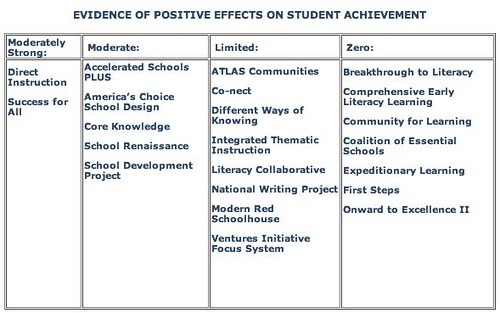
Robert Slavin, btw, is the creator of Success for All, one of two school-wide programs (the other being Engelmann's Direct Instruction) with moderately strong evidence of success according to a study from the now-defunct Comprehensive School Reform Center.


source:
Not all reforms are created equal
American Educator
March/April 2006
full-color chart available as pdf file

_____________

*N. wrote this post for Linda Moran's beyond TERC.

what's an educationist?

In the Comments section, Tex says:

"I had not noticed the use of the word “educationists” before. After looking it up, I learned it is a real word. Showing my ignorance, I guess."

Since "educationist" is a term I use a lot, I feel compelled to say a few things about it.

The word exists, but I use it as a term of art. For one thing, I can't bring myself to utter the word "educator". There is something about that word that repels me. Probably because educators are often infused with ed school ideology and don't do a lot of educating. Ed school ideology is antithetical to education.

Educationist then becomes the somewhat disparaging term taking the place of educator. It's my shorthand designation for "educators" who subscribe to all the ed school mumbo-jumbo, theories, beliefs, fads and practices that I consider inimical to real education.

For example, if an "educator" says or believes the following among other things, he would qualify as an educationist: (with thanks to Prof. Plum, a/k/a Martin Kozloff and his Fads and Flapdoodle vs. Serious Instruction.

“Be guided by the following ideas: child-centered and student-centered, holistic, natural, authentic, learning styles, multiple intelligence, brain-based instruction, developmentally appropriate practices, best practices, etc.”

“You can’t transmit knowledge. Students must construct knowledge. Therefore, most learning and instruction should be in the form of inquiry and discovery.”

“You should develop your own materials. You should NOT use commercial materials because (1) one size does NOT fit all; and (2) commercial materials rob you of creativity.”

This list can be extended considerably. You can add whole language (pea is pumpkin), fuzzy math to the mix.

Saturday, March 10, 2007

speaking of Bill Gates

I hadn't actually read the 8th grade math test in the TIMES when I posted the jpg of the sample problems.

Now I have.

It's worth posting in full:

March 7, 2007

An 8th-Grade Test, 180 Degrees From Easy

By DAVID M. HERSZENHORN

With butterflies in their stomachs, New York State’s schoolchildren sit down this week and next for their annual mathematics tests, given in grades three through eight.

The eighth-grade exam, to be given next Tuesday and Wednesday, is an important measure of academic achievement, showing whether students have sufficiently mastered the material to move on to more advanced work in high school. Students entering ninth grade far below proficiency in math and English are at grave risk of dropping out.

The state’s math standards require eighth graders to develop an array of problem solving skills, to recognize reasoning and proof as fundamental aspects of the subject, and to communicate their mathematical thinking clearly. Eighth-grade math includes a range of algebra and geometry skills.

Below are questions from last year’s exam. On that test, 53.9 percent of students statewide scored at or above grade level. Some of the worst scores were in the state’s largest cities, with 17 percent scoring proficiently in Buffalo and 38.9 percent in New York City. In relatively wealthy school districts, 82 percent scored at or above grade level.

The entire exam and tests in other grades can be found on the New York State Education Department Web site: nysedregents.org/testing/mathei/06exams/home.htm.

Can you do eighth-grade math? Good luck.

Reading this back-to-back with the p-for-pumpkin extravaganza foisted upon us by the TIMES this week, I despair.

What is the matter with these people?

butterflies in their stomachs?

an array of problem solving skills?

algebra and geometry?

Those poor children must be petrified.

So I guess testing is the problem.

Not the fact that a 1st grader now entering the month of March thinks the word "pea" might be "pumpkin."

Nor the fact that journalism is one of the last remaining majors on Earth that does not require the most elementary knowledge of math or statistics.


addendum

No sign of butterflies in these parts.


double-take

Eightteen percent of students in wealthy districts score below proficient??

.

Bill Gates testifies before Senate Committee

Bill Gates testified before the Senate Health, Education, Labor and Pensions Committee on March 3, 2007, addressing competitiveness in the 21st century: Written testimony is here.

Aside from his usual plea for more technology in the classrooms, there is this interesting paragraph in his written testimony:

"Our current expectations for what our students should learn in school were set fifty years ago to meet the needs of an economy based on manufacturing and agriculture. We now have an economy based on knowledge and technology. Despite the best efforts of many committed educators and administrators, our high schools have simply failed to adapt to this change. As any parent knows, however, our children have not – they are fully immersed in digital culture."

First of all, his chronology is off. Fifty years ago was 1957 and the US was very much interested in advancing its technology expertise, particularly after October 4 of that year when the Soviet Union announced the successful launch of Sputnik. Putting aside that major gaffe, does he think that high schools using IMP and other attrocities that pass for math (and which are being used in his home state) are really doing the job? And to be "immersed in digital culture" doesn't one still need to master basic algebra? And more importantly, if one doesn't have the sound mathematical foundation in K-8, all the graphing calculators and lap tops in the world will not make students technologically savvy--in terms of being able to solve mathematical problems as opposed to being a software user.

But it doesn't matter. He's Bill Gates. And when he talks, people listen; even more than when E.F. Hutton used to speak. He points to the declining number of science and engineering degrees in the U.S. and goes for the easy answer: smaller schools and more technology in the classrooms.

Yeah, like that's really been helping so far.

And of course, we need national math and science standards. Senator Dodd and Congressman Ehlers have introduced identical bills calling for these. The bills are endorsed by NEA and NCTM. And probably Bill Gates.

Oh, and one more thing. He's pushing for upping the limits on H1-B visas. We shouldn't be so parochial he says. Gee, I wonder why he suggested that!

this article is the schnizzell

D-Ed Reckoning: Schemo gets pwned

D-Ed, performs a smackdown on a NYT article about Madison, Wi schools.

To complicated to explain, except it involves deception, statistics, nation standards, more deception, lying, and deception.

Curious aren't you?

Barry on Singapore Math

The Singapore books do not go into what passes for data analysis and probability. I have the Singapore books and they are carefully structured and sequenced. Students have a very good grounding in fractions, adding, subtracting, multiplying and dividing, decimals, percents, ratios, some principles of geometry, and are given very good problem solving techniques using a device known as "bar modeling" which serves as a stalking horse to algebra. Algebraic manipulations are given in the sixth grade, but in the book I have they do not extend it to solving equations. Singapore teaches each topic area to mastery and then builds upon it. I've used it with my daughter and a friend of hers and had very good results. Others on this list have had similar experiences.

Barry Garelick

bonus post!

.

Friday, March 9, 2007

Singapore vs New York


The state math tests are given next week, and the TIMES has a story on it.

They've titled it, "An 8th Grade Test, 180 Degrees from Easy."

That is so wrong.

This test is not 180 degrees from easy.

This test is 180 degrees from easy. (pdf file)

memorization, knowledge, concepts

Linda Moran has written an amazing post destined to become a Greatest Hit.

Which comes first, knowledge or concepts?

I'd been a star student in college, known as the student who "blew the curve." I was destined for greatness. But once in the real corporate world, something brewing since kindergarten now became an obvious gaping hole. I couldn't learn because I couldn't memorize.

A corporate environment is a chaotic one, run by a strange mix of schedules and crises. I'd suddenly become owner of a program that controlled printers--a program I had neither designed nor written myself. My first task was to debug the failure of the printers owned by Bowling Green State University. Their new printers were printing backwards. I was supposed to find out what was wrong, and fix that part of the program.

At school I learned that memorization has little place in logic and higher order thinking skills. Perhaps it's hard to believe there were such schools back in the sixties and seventies, but my district was ahead of its time and considered progressive. I learned I must always understand the concept, and that memorization is useless.

Now here I was with names and acronyms thrown at me. I didn't' know what a printer driver was, or what OEM meant, or heck, even where Bowling Green State University was, but there was no time to learn now. Those printers were printing critical documents backwards.

Everyone knew a little piece of the operating system, and they all told me whatever they knew. But it didn't hang together. I couldn't make sense of all the strange words. I panicked. I couldn't think of how to begin. I thought I had to understand everything first. I became anxious and depressed, and ended up in the corporate counselor's office.


Read on for the "dangling sky hooks" advice.

Perfect.

help desk: translations


Christopher had his first assignment on translations last night. This was on rotations.

Ed asked me this morning why this is part of the curriculum --- where does it lead?

I don't know the answer!

working with rotations (Regents prep)


from David:

Besides being useful in sketching graphs of functions, transformations lead to the concept of symmetry, which is one of the great unifying ideas in mathematics.

[Catherine here: yes, symmetry is always taught as part of these lessons]


from Steve H:

A translation (simple move) is different than a rotation about some center point. Each is a type of transformation. There are more transformations, like mirroring and scaling. At this stage (and age), they might not seem so important and I can't really see the point, but transformations (using matrices) are very important in geometric modeling and computer graphics.

In looking at the Regents prep, my reaction was why did they have to make a very simple concept so difficult? Actually, it was the notation and terminology that made it so difficult.

In 2 dimensions, it's really simple. A point on the graph paper is defined by two numbers; an X (horizontal) distance from the origin, and a Y (vertical) distance from the origin. A translation gives you two values, one to add to (or subtract from) the X-value of a point, and one to add to (or subtract from) the Y-value of the point. If you don't let the notation throw you, it's very simple.

Rotation transformations require trig, but I have seen problems that require students to do the rotation graphically before they ever get to trig. Simple rotations are always about the origin. You can have rotations about other points, but that really requires a series of concatenated transformations.

I agree with instructivist. They can say that they are teaching transformations, but it's really just graphics arts manipulation. Maybe the student can learn to be a user of a program like Corel Draw, but they can't become the programmer who has to understand, create, and concatenate transformation matrices together. Then they have to know how to apply the transform to a series of points that define a 2- or 3-dimensional geometric model fast enough to allow for dynamic dragging (translation) or rotation on a computer screen.

Schools need to focus on algebra and trig. They need to move right along and keep their eye on the goal. They shouldn't waste time on the formal notation of transformations before they do the real math. Real math, please, not descriptive math. They need to teach the kids to become the programmer and not the user.


from rudbeckia hirta:

This is part of the study of the four rigid symmetries of the plane. You should also be seeing "reflections" and "glide reflections" at some point.

I love this topic because it helps build connections between algebra and geometry and also introduces some of the ideas of analytic geometry. These tranformations can also be studied from a purely algebraic point of view.

Eventually this will be used when studying functions. In order to be able to quickly manipulate functions without a graphing calculator, students need to be familiar with transformations and symmetry.

It's good stuff -- if done well.


Thanks, everyone!

Thursday, March 8, 2007

what do parents want?

Parents everywhere should send this article from the New York State School Board Association website to their school boards and administration.

Why did your budget get defeated?
Intel finalist from Long Island finds clues
On Board Online • Volume 8 • No. 4 • February 26, 2007

By Sheila Carmody
Senior Writer

When the Plainedge school district’s budget failed to pass in 2005, Kaitlin Duncan, 17, decided to produce a case study to find out why residents of her Nassau County community opposed the spending plan.

The study, which resulted in Duncan being named a finalist in the 2007 Intel Science Talent Search, revealed some surprising results, including:

  • Non-parents were more likely to approve budgets than parents.
  • Voters were not influenced by the previous year’s budget referendum outcome.
  • Having a winning football team didn’t influence voters.

Rising test scores, offering full-day kindergarten and Advanced Placement participation rates played more significant roles in voter approval of school spending plans than anything else, according to the Plainedge High School senior’s research.

Duncan asked 318 Plainedge voters who responded to an Internet survey how they would vote on 10 fictional school district budgets. Each of the 10 districts varied by tax rate, test scores, Advanced Placement participation, football record, extracurricular activities, the type of kindergarten program offered and the number of private schools in the area.

Each scenario also included programs targeted for cuts in the event of a failed budget. Survey respondents rated each scenario with a number from 0 to 100, with 0 representing strong opposition for the budget and 100 representing strong support.

Duncan collected demographic data such as voter age, education level, length of residency and number of children in school. She found demographically similar respondents didn’t necessarily vote the same way.

She concluded that budgets have a better chance of winning approval if school boards gather data on what programs residents consider the most important and customize budgets to give those programs priority.

Traditionally, when school districts develop their budgets they listen to people who attend meetings or find other ways to be vocal, said Plainedge Superintendent John Richman. For instance, residents who support athletics tend to speak loudly around budget time, he said. But there’s a silent majority out there that has to be considered, he added.

“We cannot provide everything for everybody,” Richman said. “You have to be better informed when you make decisions about the school budget.”

NYSSBA Executive Director Timothy G. Kremer said Duncan’s study holds lessons for all school boards. “Kaitlin’s findings remind us how important it is for school boards to be in tune with constituents’ spending priorities,” he said. He noted that NYSSBA provides expertise on surveying through its AdvisorySolutions consulting service.

in a nutshell
  • budgets have a better chance of winning approval if school boards gather data on what programs residents consider the most important
  • school boards listen to the people who are the most vocal
  • school districts have a silent majority & they vote, too
  • rising test scores
  • offering full-day kindergarten
  • Advanced Placement participation rates
It's amazing how accurately this reflects my own experience, with the possible exception of the finding that boards listen to people who are the most vocal.

I'd say that here in Irvington even highly vocal parents have had a fairly difficult time being heard. I also believe this has begun to change since the bond defeat, so I wouldn't be surprised to see this principle now to become true here.

It's absolutely the case that a "silent majority" defeated the bond.

The one really successful intervention I recall happened a few years ago when the super wanted to increase class size. The Board meeting was mobbed by furious parents & class size remained small.

I don't know the history of people's efforts to get the athletic fields repaired & built, but I gather that prior to the fields bond finally being put to a vote parents who were working on it experienced a fair amount of frustration (before and, now, after the vote, of course).

What's powerful about this list is the glaring reality effect: people don't want to pay for stuff they never wanted in the first place.

Every time I've ever looked at our Strategic Plan (scroll down) I've instantly felt violently unhappy about my taxes. Differentiated instruction, portfolio "implementation," data analysis, 3-year Technology Plan, character education ---- it's an ed school dream: everything you've ever wanted your district to buy you, wrapped up under the Christmas tree waiting for you.

I don't want to pay for it.

What do I want to pay for?

Increased achievement for all students at all levels of ability.

Which is pretty much what this high school senior found.

new career path

I find this article quite depressing.

Something like this happened to me at Dartmouth.

I broke up with my boyfriend, who was the editor of the newspaper.

So he published an entire fake edition of the paper featuring a photo of me and a news story in which I announced that I was pregnant and didn't know who the father was.

Since it was on paper, the whole thing disappeared as soon as everyone took out the trash.

If the internet had existed then, it would probably still be out there.


new career path

The trend has even spawned a new service, ReputationDefender, whose mission is to search for damaging content online and destroy it on behalf of clients.

This story makes me feel that knowing how to hack websites may be a new basic skill.

Our School out in paper!

Our School by Joanne Jacobs!

It's here!

Wonderful book.

Reading Mastery

I was just reading D-Ed Reckoning (question: is reading D-Ed Reckoning good for my mental health?) when I realized I need to get up a link to Ken's posts on Engelmann's Reading Mastery program.

Here they are:
  • Lesson 68 (December 3rd grade for students who begin reading in 1st grade -- but could be used as early as December 2nd grade)

lgm on preparing for calculus

lgm left a terrifically helpful resource on preparing for calculus:

To prepare mathematically, he needs to be ready for calculus.

This canadian site has a booklet "preparing for university calculus" that gives an idea of the math he should be comfortable with before trying calculus as well as good tips on handling a college math course: Preparing for University Calculus

This site has test prep questions: Online Math Tests Homepage

Thanks!

Potential Engineer Needs Math Advice

I've recently returned from spending almost 3 weeks in New York City helping out a relative. I did get to do a few interesting things, including going to several of my favorite art museums. At one of the museums I met an unusually friendly, articulate, charming, and seemingly intelligent college student who has a part-time job handing out and collecting the headsets used for audio tours. He wasn't getting much business and when I returned my headset, we got to talking. I asked him what he was studying and he told me that his dream is to be an automotive engineer and to "save the world" by helping to clean up the environment.

I told him that the very best advice I could give him was to take all the mathematics he could because math is crucial to any type of engineering or science. That's when he told me that he was struggling with his college algebra and trigonometry class although he'd managed to pull down an A- the previous semester, when he had a different professor, by working very hard.

I tried to explain a bit to him what might have happened to his prior math instruction (which I think was in NY since he mentioned the Regents exams) and suggested that he sit down and talk about math with some older people (I said "older than his parents") who are good at math. I told him that math isn't all that hard, that he's likely just missing a few key concepts, and that someone who understands math could probably spot his difficulties and set him straight. In the end he gave me his email address so I could send him more
information.

I haven't written to him yet; can anyone think of anything that might help him?

how much math ...

... do you need to know to pass California's High School Exit Exam (CAHSEE)?

Less than seven years worth.

Let's do the math.

It shouldn't take more than six years to cover all of elementary math to the algebra level.

Of course, as we know, many students fail to learn much of what's taught during these early years.

Here's a list of topics that the typical low performer fails to learn during these six years in the typical math class:

The typical student is weak in basic math facts (like, 13–7 and 6 x 8). The student has a very poor understanding of fractions and what they are. For these students, fractions are “less than one.” The students have no scheme of how fractions relate to division and to whole numbers. Students are weak on multiplying fractions, weaker on adding or subtracting fractions that have the same denominator, and incapable of adding or subtracting fractions with unlike denominators (4/9 + 1/6).

These students do not understand how to find the perimeter or the area of figures. They can’t figure out the circumference or area of circles. They are often able to work division problems that divide by a single-digit number, but can’t work problems that divide by a two-digit number. The students know virtually nothing about the coordinate system, and nothing about analyzing lines on the coordinate system (their slope; where they intersect the Y axis), or constructing lines from equations.

These topics need to be remediated. In addition, the CAHSEE contains a few algebra-like topics not typically taught in elementary math like:

Many items on the test require students to solve sophisticated word problems. The tests have problems that require knowledge of algebraic principles (3r + 7 = r – 2), problems that assume knowledge of scientific notation (What is the scientific notation for .002591?), and problems that assume knowledge about geometry (What’s the volume of concrete needed to form the illustrated stairway?).

So, the typical low-performing seventh grader requires extensive remediation in arithmetic and needs to learn a few post-arithmetic topics. The question is: how long does all this take to teach? In many schools, the answer is, unfortunately: forever. Starting late this spring, it shouldn't take more than one school year with the new DI Algebra course.

It's been three years in the making and went through three complete field tests and subsequent revisions. According to Engelmann:

A large majority of students who completed only the first 2/3 of the program passed the math exit exam for California.

I'm not sure how the CAHSEE compares to other state exams and NAEP, but I do know that most of them have very little post arithmetic content. If they are anything like the CAHSEE, they only contain about seven years of math content and that's pretty sad.

Wednesday, March 7, 2007

middle schools behaving badly

here

also here

The difference between elite schools and regular schools

In public schools, science fair projects are done by the kids parents.

In elite schools, the science fair projects are done by the kids teachers and by university professors.

Intel Competition Is Where Science Rules and Research Is the Key - New York Times
The contest [The Intel formerly known as the Westinghouse], which began in 1941, has been monopolized by New York schools because it had its roots in a local science fair and a cluster of New York personalities. Bronx Science and Stuyvesant eventually figured out the magical formula: Teach your kids to do research; don’t just offer cookbook experiments. Pair them with mentors at hospitals and universities, perhaps working on a small piece of the mentor’s puzzle, so the projects are more than garage-built contraptions. Assign high school teachers as enforcers to help students through rough patches and make sure they meet deadlines.
...
Ashley Bahnken, working with a mentor at the University of Texas, tried to prove through a survey of 177 college students that first-born children tend to make friends with other first-born or only children.
...
This year, Forrest Anderson studied a way to use physical therapy to reduce falls by patients with Parkinson’s disease, learning how to analyze data with mentors at the University of Florida and at Columbia University’s Teachers College. He said a biology teacher, Allison Wheeler, “edited these papers a hundred times to find holes in the research.”

I'm a steamroller, baby

I am loving this guy!

So here's the Spitzer agenda:

  • charter schools
  • support for children in private schools
  • value-added assessment

Works for me.


character ed & open enrollment committees

fyi, here is this week's email to the principal, various supers, and Board.

These things are getting to be like a serialized novel. You know, like Charles Dickens only not literature.


back on topic: If you have thoughts about the open enrollment committee concept, I'd like to hear. This is an idea Ed and I have talked about for years, going back to the school meltdown we experienced at an autism charter school.


Hi Joe (and c.) ---

Can we think about putting together a parent/professional committee to vet the posters and slogans being displayed at the middle school?

You’re probably not aware that more than a few parents objected to the violence against women posters that were displayed in the school last semester. (“Every 15 seconds a woman is struck by her partner.”)

Boys were standing around counting down 15 seconds and then shouting BOOM!

I presume that girls were listening to this.

This means we’ve told children as young as 11 years of age that some men physically assault women with whom they are having sexual relations.

(And we can’t teach algebra in the 8th grade?? Sorry. I couldn’t resist.)

Now we’ve got an enormous display in the foyer featuring celebrities and their parents who “drank and drugged too much” ---- at a minimum this is an incredibly crude way of describing the situation of living with a parent who is struggling with substance abuse.

Leaving aside the needs of students and their families, this isn’t good for the school.

District personnel need to reach out to parents. The Board is already doing so, but it can’t be the Board’s job alone.

Starting with an open-enrollment committee on character education seems “win-win” to me.

Such a committee would give parents a say in the posters and information distributed to their children; it would help the school prevent mistakes via a more thorough vetting process; and, as is the case with any committee, it would distribute the blame when mistakes are made.

I don’t say this to be cynical. It’s important to recognize that where character education is concerned mistakes will be made. Character involves values and morals; there’s no way around it. And character education, when undertaken by a public institution, is risky business.

A committee constructed along these lines might work:

  • open enrollment; invite anyone who is interested to join (I would consider opening it to the entire community, not just to parents, as I believe Dr. Matusiak may have done with the wellness committee – perhaps get some older folks with wisdom to share involved)
  • ask for parents who are professionals in the realm of child and adolescent psychiatry and psychology to join, but don’t limit it to professionals – invite everyone – we have an extremely large number of highly competent, hardworking full-time parents in Irvington/Tarrytown whose expertise as parents is seldom recognized or sought
  • establish a waiting list if a large number of parents apply
  • set term limits for committee members
  • publish the names of parents who are serving along with an email address at which they can be reached
  • publish minutes, etc.

An open and transparent Committee on Character Education wouldn’t have to be a time-consuming or difficult undertaking, and it would earn the school and the district good will.

Given the fact that the majority of parents appear to support character education in the abstract, but then object to the specifics, there probably isn’t a huge potential for downside.

Even if a Committee on Character Education were to create unforeseen difficulties, that in itself would be useful information to have. Character education isn’t a core mission of the school; better to have parents and school personnel working out their problems in a non-essential realm.

It’s a thought.

Catherine J.

It's definitely time for the school to involve parents in character ed issues and decisions.

I mentioned on the old site that a couple of years back the high school split the town in two as a result of a gay tolerance assembly. The speaker apparently had a website telling teenagers that their sexual identities weren't set and advising them to experiment with homosexuality to find out if they might be gay. So I'm told.

Naturally I missed out on the whole thing, either because I'm friendless or oblivious or both.

(Since I'm not friendless, we'll have to go with oblivious.)

Anyway, even though I missed out on the whole thing, I heard about it afterwards and it was awful. This is a very small town. The high school elected to host an assembly guaranteed to stir up massive conflict amongst the citizens, and I don't think anyone said he was sorry, either. As far as I can tell it was another case of the school doing whatever it wanted to do and the town paying the bill.

Like the man said.

Now we've got wife-beating and drinking, drugging parents festooning the middle school walls.

It's time for parents to come in from out of the cold.

First Grade Probability


My first grader brought home this worksheet today that she completed in class.

"If we spin the arrow 10 times, I think:

green red yellow

will come up the most."

My daughter circled red. I asked why she picked red. "I like red."

As far as she was concerned that was the end of the matter. Since she still had no idea that she was wrong, or that liking a color wasn't the best basis for making a prediction, I have to assume that they didn't spend a lot of time being instructed on probability. But they did spend a good portion of time spinning the spinner and noting their results.

So I have two issues: 1 -- a lot of time spent, without instruction, resulting in kids reaching incorrect conclusions; 2 -- she will be doing this exact same problem for the next five years. My fifth grader is still spinning spinners, they just have more colors.

I believe Catherine has noted before the arrogance with which the schools waste our children's time. They have spent almost no time on the fundamental building blocks that lead to success in math. In first grade, almost 3/4 of the way through the year, they are adding numbers up through 3, and not regularly.

Tuesday, March 6, 2007

strike!


"The constitutional right of parents to raise their children does not include the right to restrict what a public school may teach their children," Wolf unambiguously wrote in dismissing a suit by two Lexington couples who objected to lessons the local elementary school was teaching their children. "Under the Constitution public schools are entitled to teach anything that is reasonably related to the goals of preparing students to become engaged and productive citizens in our democracy."

Entitled to teach anything. That means, the judge ruled, that parents have no authority to veto elements of a public-school curriculum they dislike. They have no right to be notified before those elements are presented in class. And the Constitution does not entitle them to opt their children out of such classes when the subject comes up.

A call for separation of school and state
Jeff Jacoby


We ought to draw up a list of what rights a child attending public school actually does have.

He has a right to attend school for X number of years and X number of days per year.

He and his parents have a right to see his records.

He has some rights to privacy (I believe that is FISA law. Rudbeckia knows.)

He has some rights to testing, I believe. For instance, I think you can request an IQ test and the school must do it. (Barry will know. UPDATE: I'm online with my sister -- she says no; school doesn't have to test. I'll qualify that: if he looks like he may have special needs he has a right to be tested to see if he "qualifies for services.")

I believe students now have a right not to be struck by teachers.

I think that may be it.


update 3-7-2007

Lynn G has discovered more rights!

By state law, we have the right to be informed when pesticides are being applied to the playground.

Also, there is the right to be told that the teacher is "not highly qualified." But this threshhold is so low it is meaningless.


Keep 'em coming, folks!

If you know or have heard rumor of a parent right, let us know!

assigned reading hell

I am in hell.

I have hundreds and hundreds and hundreds of pages on animal stereotypies to read, annotate, commit to memory, and then write something coherent about.

Fortunately, Ken just sent an email saying that the last chapter of Zig's book (which I have yet to tackle, and for good reason)* has material on animals.

So I'm going to take a break and see what Zig has to say.

But first!

Funny story.

Probably most of you have never heard Temple's voice, which you kind of have to have done to "get" this.

The other morning Temple called excitedly to tell me that she'd met a vet in Ohio who specializes in parrot behavior problems. Parrots have a huge number of behavior problems, so I'm sure business is booming.

Temple was excited because the vet had managed to cure an African grey of feather-picking.

That is exciting, because African greys are bloody geniuses and they're neurotic as hell, or can be.

I came out of Animals in Translation convinced that birds are probably as smart as we are or smarter, and greys appear to be the smartest of all. Anyone who can persuade a grey to give up neurotic, driven, obsessive behavior has got my vote.

While Temple was telling me all about the vet and the bird and the feather-picking cure, she mentioned in passing that the vet had rescued the bird from a bird shop and, when she put the bird in a cage to transport it to a college classroom, the parrot had asked anxiously, "Going to the airport?"

The bird had been taken to a lot of airports in his life, Temple said, and going to the airport always meant something bad. So he wanted to know if they were going to the airport now.

When Temple is excited about something she is the least distractible human on earth. So she didn't hear me when I said, "The bird talks? English? This bird is asking people questions?"

"So the vet put him in the cage," Temple said, "and she drove him to the campus."

"Temple. This bird is talking English? Is that what you're telling me? This parrot is asking people questions? Autistic people don't ask questions, and this bird does ask questions?"**

"She drove him to the campus-----"

"Temple! Did this bird ask a complete stranger whether she was driving him to the airport?"

silence

"Well, yeah. The bird didn't like going to the airport."

"Did this bird ask a question? Autistic people can't ask questions; asking questions is an advanced linguistic skill. You're saying this bird asks questions?"

more silence

"Well I guess I should have asked something about his language," Temple said finally. "I was focusing on his feather-picking."


are you happy

Around the time that Carolyn and I first began writing Kitchen Table Math I was asked to coauthor a book about an African grey who could speak English. I met the bird and his owner and spent the day.

From what the owner said and had recorded in voluminous notes, the bird was talking. No question. He was speaking English. He had even made grammatical errors in tense: "He flyed."

The bird had been told all about me, about how I might help him write his book. (The owner said it was the bird who wanted to write a book).

The bird didn't show off his language while everyone was there (two agents, one editor, me, the owner).

He didn't show off his language after everyone had left but me, either.

He was stressed by all the attention; he didn't want to be crowded. I think that's standard for greys.

So I tried to follow his lead. I did everything the owner asked, too.

The bird had been giving me sidelong glances all afternoon, but at the end of the day he was still keeping his distance. On the other hand, he was keeping a look-out on me and my doings, which I hoped was a good sign.

Around 5, his owner pulled out a scrapbook she'd kept on his life. I sat on the sofa across from the bird's cage studying it. The bird watched.

The owner took me through all the photos. I ooed and ahhhed. The bird watched.

At some point, for some reason, I looked up at him.

He looked straight at me and said, "Are you happy, bird?"

He meant did I like him.

Was I happy with the bird?

Then he flew across the room and landed on the arm of the sofa where I was sitting and spent some time beside me.

A skeptic would argue that the owner had taught him to say, "Are you happy, bird?"

But she hadn't. Are you happy, bird? was nothing like the language she used with him. I'd spent a day with them; I'd read her manuscript; I'd seen an hour of tape of the two of them interacting. I knew her language.

It was the bird talking. The language was his.

And he was asking me a question.

A question about my feelings about him.

Anytime you have a chance to meet an African grey, you must take it. Don't get too close, and don't stand too tall. Just sit down, smile, and say hi. The bird will tell you what to do: how close to come, when to make eye contact, whether it's OK to put your finger on the cage.

Spend some time in the presence of an alien intelligence.

__________________

* The reason being that it's likely to get me even more cranked up than I already am.

**(Obviously high-functioning autistic people ask questions. But I can count on one hand the number of questions Jimmy has asked. People like Jimmy "request and protest." They use their language to ask for stuff, and say no to stuff.)

Speaking of Steve's books

There's also this one:

Eat What You Want and Die Like a Man: The World\'s Unhealthiest Cookbook

Monday, March 5, 2007

Education Quotes

"If a mind is a terrible thing to waste, the educational establishment is guilty of incomprehensible waste." S. Engelmann

If you haven't read all of The Outrage of Project Follow Through: 5 Million Failed Kids Later, please go do it now. It should be required reading for anyone even remotely associated with education.

Technorati

Technorati Profile

Is this our Steve H?


Book DescriptionDate: Fri, 11 Mar 2005 18:38:09 +0000 (GMT)
To: honbarrsedd4za@yahoo.co.inPROPOSAL FOR URGENT ASSISTANCE Dear Sir: I must solicit your confidence in this transaction. I am a high placed official with the Department of Finance Affairs in Lagos, Nigeria. I and two other colleagues are in need of a silent foreign partner whose bank account we can use to transfer the sum of $18,000,000. This are monies left by a barrister who died tragically in a plane crash last year...

Sound familiar? Congratulations. You have been selected to become a mugu, an expression African con artists use to describe the targets of their e-mail scams. But they drew a bead on the wrong guy when they started spamming Steve H. Graham. Like many Internet users, Graham eventually got tired of receiving mugu mail and decided to fire back at his wannabe swindlers.

Armed with a scathing sense of humor, Graham quickly turned the tables on his tormenters--with side-splittingly hilarious results. Whether he's referring to his fictional lawyer Biff Wellington, complaining about the injury he received while milking a lactating sloth, or offering the Preparation H helpline as his phone number, Graham--using aliases such as Wile E. Coyote, Barney Rubble, and Herman Munster--offers proof that spamming the spammers is the best revenge.

Patterns, probabilities and data analysis

There has been some discussion of this in comments, but I felt that it deserved more attention. The question has come up as to why many math texts, curricula , state standards etc emphasize patterns, probability and data analysis.

With respect to "patterns", someone got the idea in his/her head that algebra was about patterns. Maybe they said math was about patterns. It doesn't matter. In any case, it all reminds me of a twelve-year-old's version of Paradise. They seem to think that giving students exercises in which they are given a pattern like x=1, y=2; x=2,y=4; x=3, y=6. and asked to find the "next term" lays the groundwork for future understanding of functions. Well, it doesn't, really. It may lead students to believe that any pattern they can see must be it. So in the above pattern, the student comes up with "Oh, the rule is y = 2x, so the next term is 8." Well, what if I told you the next term is 14? It could be if y = 2x + (x-1)(x-2)(x-3). Actually, some people who advocate this approach have recognized this, and instruct teachers to watch for students who give "one" answer to the problem, illustrating "convergent thinking" and watch for students who give many answers to the problem, illustrating "divergent thinking". What this has to do with teaching about functions is another matter. But why teach about functions when life doesn't lend itself to functions, bringing us to our next topic: Data anlysis and probability.

Everyone knows that life is messy and that life's problems frequently don't lend themselves to "nice" solutions that are in algebra texts like Dolciani. Besides, students are bored learning the algebra that will be necessary to succeed in college science and engineering courses. So let's turn math into an empirical science. That way, expressing ideas in mathematically precise fashion need not ever be a concern.

The issue of why so much emphasis on data analysis and probability came up at the November meeting of the National Math Advisory Panel. Vern Williams questioned a member of the College Board why there was so much emphasis. Here is the exchange:

"WILLIAMS: Maybe one reason why students need more advanced courses to become successful in college is because so many things have been taken out of the basic courses because of the addition of topics like data analysis. I can't understand why data analysis would be a part of a geometry course. American students are extremely weak in geometry. In many cases, that is the only proof-based course, or at least it used to be a proof-based course, that students get. So, of all places, why would data analysis be included in geometry?

"DR. MANASTER: That's a very hard question to answer. We share your concern about mathematical reasoning and proofs being more apparent in geometry than in any other subject. This is a major concern of mine and has been for at least 10 years. I think that the only answer I can give here is that what we put into the geometry course was largely probability, for which there are geometric models. It still isn't traditional geometry by any means. But we tried to have a progression of treatments of data analysis throughout the curriculum."

In other words, "we found a way to make it fit, and whenever we can make data analysis and probability fit into any aspect of math, we make sure that is done." Which doesn't answer Vern Williams initial question but these guys apparently get paid big bucks to not answer the public questions, just like our teachers in "constructivist math" classrooms (pardon the expression for those of you who insist on maintaining that constructivism doesn't exist) do not answer students' questions.

Any questions? If so, please direct them to Tyrrell Flawn, Executive Director National Math Advisory Panel: Tyrrell.Flawn@ed.gov

Sunday, March 4, 2007

I am uncertain

Back in 5th grade, on his TONYSS test, Christopher scored exceptionally well on "uncertainty."

I had no idea what "uncertainty" could possibly mean.

He was a mess on measurement, a near-genius on uncertainty.

No one at the school could tell me what either scale measured.

Now I know.

"Uncertainty" means "probability and statistics," which, in NY state, means a) counting stuff and b) constructing bar graphs to show the totals.

to wit:

Students use ideas of uncertainty to illustrate that mathematics involves more than exactness when dealing with everyday situations.

This must be one reason for the crowding out of algebra by probability-and-statistics.

Probability-and-statistics means there's no one right answer!

Needless to say Fordham takes a dim view:

The classification scheme of the performance indicators, according to the Key Ideas, compromises the quality of New York’s standards. Too much emphasis is placed on patterns, probability, and data analysis. The sixth Key Idea, “Uncertainty,”... is misleading and a poor choice of category for performance indicators. It mistakenly associates ambiguities inherent in choosing mathematical models for “everyday situations” with mathematics itself.

Andrew

So today Andrew has been Googling:

  • Hugo Chavez
  • BMWs

That can't be good.


Doug Sundseth's number lines


pdf files here

fraction number lines


Becky says she used the number line recommended by Hung Hsi Wu before teaching common denominators and equivalent fractions to her kids.

I don't know what Wu's fraction number line looks like, whether it's a classic line or a stacked set of lines like the one at the link above.

EAI Education sells the Decimal and Fraction Number line pictured. It looks a little confusing to me, but it may make more sense when you can actually hold it.

coming soon to a district near you --

.


.

progress report

State tests coming up on March 12, and I've managed to haul C's tuchus through 36 of 49 lessons in his Test Prep book, plus 2 of 6 "Progress Checks."

I've managed to do this in spite of the fact that he's in the middle of his annual winter health collapse. He's missed at least a week of school (or are we up to two? I've lost track.)

This week the kids took the CTBS test for placement in Earth Science; he missed that. No idea whether they'll give it again.

He gets so sick each and every winter I'm beginning to wonder how he's going to get through high school.

Can you afford to be flat on your back for at least two weeks every winter?

Two weeks may not even be right; it may be more like 3 or even 4.

And we still haven't hit rotavirus season. That will eat up another week or two come spring.

In any case, 36 of 49 lessons. This is good!

It's easy to see why "Uncertainty" has become the all-star math subject these days: it's far easier than any of the standard math kids used to learn, standard math being arithmetic, algebra, and geometry.

Christopher was planning to refuse to do any lessons today at all on grounds that he's still sick (true, but we're running out of time). Finally he agreed to do a couple of lessons in the statistics uncertainty section.

That took him about two minutes.

So the lessons on circles, volume, formulas, etc. all remain to be tackled.


test prep query

My test prep query is: why do we have these books?

Christopher hasn't been assigned a single lesson in the book. Not one.

Ms. K had the kids do a couple of the lessons in class, the ones on subjects she hadn't otherwise covered. And that was it.

I don't know whether the other classes are being assigned practice lessons. Judging from what C's friends tell him, I gather they're not.

I have no idea what 6th & 8th grades are doing. I'd be surprised if they're doing something 7th grade isn't doing, but you never know.

As far as I can tell, the idea for requiring parents to purchase these books was that....parents would then use the books? Is that it?

Parents would use the books, but would not be provided the answer key so they could check their kids' answers?

I think this may call for an email to the math chair.

So far I'm the only person I know who is using the book.

I'm not only using the book, I've ordered the books for 6th & 8th grades, too, along with their respective answer keys.

Christopher's going to be doing all 3 of them.

_____________

state test coming right up (2006)
throwing money at the problem
more stuff only teachers can buy
help desk 1
state test coming right up (2007)
help desk 2
my life and welcome to it
inflammatory
canadianteacher.com
progress report
despair
28 out of 30

all the answers are belong to us
email to the math chair
second request
teacher's manual
it would be unusual

CONSTRUCTING GOOD, TELLING BAD.


THE SEVEN COMMANDMENTS

1. Whoever tells their truths to small children is the enemy.
2. Whoever lets small children construct their own truths is a friend.
3. No teacher shall use a red pen.
4. No teacher shall write on a blackboard.
5. No teacher shall give out gold stars.
6. No teacher shall deconstruct the narrative of any other teacher.
7. All teachers are equal.

revised 3/05/07

my life and welcome to it

So Thursday I went to school to pick Christopher up from the nurse's office & discovered, in the foyer, an immense display with photo copies of 6 celebrites taped on:

Clay Aiken
Mary J. Blige
Shaquille O’neal
Charlie Sheen
Drew Barrymore
Eminem

The photos surround a manila file folder on the cover of which is pasted a question:

“What do these celebrities have in common?”

Open the file folder & you find:

“They all grew up in a home with a parent who drank or drugged too much.

Ever think you are the only one with a parent who drinks or drugs too much? I bet these celebrities thought they were the only ones, too.

Come see your student assistant counselor, Ms. Fernandez. Get it off your chest and feel better in Room H220.”


trouble in Norway, part 2

The TIMSS Norway report (pdf file), showing severe decline in Norwegian students' performance in math and science after Norway adopted sweeping constructivist reforms in 1997, makes explicit the connection between construcitivsm and "taking responsibility for one's own learning":

The new pupil role poses greater demands upon the pupils’ self regulation of learning. The results from PISA showed a relatively stronger connection between the degree of self regulation and one’s performance in mathematics in Norway than compared to other countries. In schools where this is, to a greater degree, left to the pupils own initiative, it is not a surprise to find such a connection. In TIMSS 2003 we have seen weak tendencies towards a stronger connection between pupils’ background and their performance in school as compared to 1995. The project based work and responsibility for their own learning can favor the pupils that have more attention from their parents. Possibly, parents with a higher education are more able to support their children in school. [ed.: what does it look like when parents with higher education "support" their children in school? would that be similar to parents reteaching content and hiring tutors?]

Our middle school is rife with talk of students "taking responsibility for their own learning" or, alternatively, "taking ownership of their own learning." We have math teachers who actually tell parents that their goal is to get 6th graders to "take ownership of their own learning."

I hadn't realized this notion was part and parcel of constructivism.

The result of an educational philosophy that relies upon 12 year olds taking responsibility for their own learning is predictable. Your basic twelve year old can't take responsibility for his own learning. That's why we have schools run by adults.

If a twelve year old can't take responsibility for his own learning, and the school won't take responsibility, that job falls to the parent.

Some parents -- college-educated parents living in two-parent families primarily -- are better-equipped to handle this job than others.

The post-it note


When we moved to New Jersey back in 1993, one of my first decorating endeavors was to write a "watch out for" list on a post-it note, then stick it on one of my kitchen cabinet doors. Over time, it needed scotch tape.

Yes, that's my decorating style. You should see the rest of my house (sigh). I guess you could say I'm a practical gal. Function over form. But that's another story.

The post-it listed growing trends in our nation's schools. At the time I had only two kids, and they were two and one, but I've always been a bit of a forward thinker.

It was a brief list; after all, it had to fit on a post-it. But it said things like, politically correct historical facts, whole language, and a few other things I've forgotten.

There was one other item on that list. It said in bold letters constructivism.

That post-it stayed up for about six years--until I'd seen the word enough times that I couldn't possibly forget. (Yes, my brain is that small.)

Actually, for a while I thought constructivism wasn't in my school. At kindergarten enrollment, nobody announced "We have constructivism here." At Back to School Night, it was never mentioned. No memos came home about it.

I realize now that our school district (and maybe everybody's) doesn't announce philosophy or methodology or even curriculum to parents at all. It's none of our business.

Slowly, over time though, I saw constructivism's effects. No need to go into them here.

So here I was, more aware than most parents, and only because I had an education degree, and yet it still took me several years to realize that my school was saturated in constructivist thinking.

And it wasn't confirmed or admitted to me until 2006, when the principal, with whom I was conducting a frustrating dialogue about TERC Investigations, said to me, "Well, you know, Linda, we've always been a constructivist school."

Had I not put that post-it on the cupboard in 1993, I would likely still not have put two and two together (pardon the math pun.)