

 Posts


The high-school part of [ed. American NCTM 1989, I think is being referred to]“standards” contains a list of topics to increase attention, where the first place is given to “the use of real-world problems to motivate and apply theory” (p. 126). What is a “real-world problem”?
Browsing through “standards”, I found quite a few statements about these mysterious critters. On p. 76 (middle-school part) it is said:
“The nonroutine problem situations envisioned in these standards are much broader in scope and substance than isolated puzzle problems. They are also very different from traditional word problems, which provide contexts for using particular formulas or algorithms but do not offer opportunities for true problem solving.”
What? What did they say about traditional word problems? What a nonsence! With their narrow experience the authors pretend to set standards! Are they aware of the rich resourses of excellent traditional word problems around the world? Let us read further:
“Real-world problems are not ready-made exercises with easily processed procedures and numbers. Situations that allow students to experience problems with “messy” numbers or too much or not enough informations or that have multiple solutions, each with different consequences, will better prepare them to solve problems they are likely to encounter in their daily lives”.
Pay attention that the author uses future tense. This means that he or she has never actually used such problems in teaching and never observed influence of this usage on his or her students’ daily lives. He or she has not even invented such problems because he or she does not present any of them. Nevertheless, he or she is quite sure that these hypothetized problems will benefit students. What a self-assurance!
After such a pompous promise it would be very appropriate to give several examples of these magic problems. Indeed, we find a problem on the same page, just below the quoted statement. Here it is:
Problem 48: Maria used her calculator to explore this problem: Select five digits to form a two-digit and a three-digit number so that their product is the largest possible. Then find the arrangement that gives the smallest product.
This is a good problem, although rather difficult for regular school because having guessed the answer, Maria needs to prove it. But the author never mentions the necessity of proof. What does the author expect of calculator’s usage here? It can help to do the multiplications, but it cannot help to prove. It seems that the author expects Maria to try several cases, to choose that one which provides the greatest product and to declare that it is the answer. But what if the right choice never happened to come to her mind? This is very bad pedagogics. Also let us notice that Maria is expected only to “explore” this problem rather than to solve it. According to my vision, exploration is the first stage towards a complete solution. Do the authors expect Maria ever to attain a complete solution? Do they want children to solve problems or just to tamper for a while?
But let us return to our main concern: so-called “real-world problems”. Notice that this problem has none of the qualities attributed to these mysterious critters on the same page: there is neither too much nor not enough information and there are no multiple solutions, each with different consequences.
One colleague noticed that the book still contains some problems described on page 76. Indeed, there are, but in another document. Here is one of them:
Problem 49: You have 10 items to purchase at a grocery store. Six people are waiting in the express lane (10 items or fewer). Lane 1 has one person waiting, and lane 3 has two people waiting. The other lanes are closed. What check-out line should you join?
I have never read any report about usage of this problem. Also I have never read any solution of this problem. Irresponsibility again!
What about problems with too much or not enough informations, they attract much attention in Europe lately, but European scolars want children to treat them critically and in many cases to refuse to solve them! Take for example that famous problem, after which Stella Baruk named her book [Baruk]. In the late seventies, the following problem was given to 97 second and third graders of primary school in France:
Problem 50: There are 26 sheep and 10 goats on a ship. How old is the captain? [Baruk], p. 25
76 children (out of 97) presented a numerical answer obtained by tampering with the given numbers. For instance, they might add the numbers and declare that the captain was 36 years old. Educators of several European countries (France, Germany, Switzerland, Poland) are very preoccupied by the fact that children “solve” unsolvable problems. The European educators would be very pleased if children refused to solve such problems with a comment like “It cannot be solved”. The European educators are quite right. But the same is true of what the “Standards” call “real-world problems”.
The most sound reaction to the problem 49 is “I don’t know”. But what a grade will an American student get after that?
Friday, December 11, 2009
From Russia with love: real wor[l]d problems
A friend of mine discovered this paper, Word Problems in Russia and America, by Andrei Toom. Quite a find. A long read, but worth it if you need any moral support in your personal fight against fuzzy math. Here is an excerpt:


Thursday, December 10, 2009
TIMSS Advanced 2008 International Release
Hi,
The data were released yesterday in Norway: http://timss.bc.edu/timss_advanced/ir-release.html
Too bad the U.S. didn't participate.
Patsy
The data were released yesterday in Norway: http://timss.bc.edu/timss_
Too bad the U.S. didn't participate.
Patsy
Ideologically-motivated intellectual gatekeepers
What Climategate and Discovery/Constructivist math have in common.
I like it. This will be widely distributed to our local educators.
Perhaps I should picket like this Climategate picketer (I have no idea who he is) at the entrance to NCAR (National Center for Atmospheric Research) in Boulder.
Imagine, that could be me!
Change title to "Discovery Math Protest Longmont, Colorado Day 1
Narrow intellectual gatekeeping is omnipresent in academia. Want to know why the government wastes hundreds of millions of dollars on math and science programs that never seem to improve the test scores of American students?[3] Part of the reason for this is that today’s K-12 educators—unlike educators in other high-scoring countries of the world—refuse to acknowledge evidence that memorization plays an important role in mastering mathematics. Any proposed program that supports memorization is deemed to be against “creativity” by today’s intellectual gatekeepers in K-12 education, including those behind the Math and Science Partnerships. As one NSF program director told me: “We hear about success stories with practice and repetition-based programs like Kumon Mathematics. But I’ll be frank with you—you’ll never get anything like that funded. We don’t believe in it.” Instead the intellectual leadership in education encourages enormously expensive pimping programs that put America even further behind the international learning curve.
I like it. This will be widely distributed to our local educators.
Perhaps I should picket like this Climategate picketer (I have no idea who he is) at the entrance to NCAR (National Center for Atmospheric Research) in Boulder.
Imagine, that could be me!
Change title to "Discovery Math Protest Longmont, Colorado Day 1
Wednesday, December 9, 2009
Testing Shows Improvement in Shoe Tying
Recent testing has shown improvement in shoe tying by fourth and eighth graders over the past two years, although the growth has been stagnant in some districts. Urban school activists, however, can be encouraged by the statistical improvement in areas with populations of 250,000 or more. This continues an upward trend that started 6 years ago when this testing began.
Urban districts still face enormous issues of poverty and large numbers of English language learners. Forty-eight percent of 4th graders tested nationwide were eligible for free or reduced-price lunches. In spite of the improvements, many still point to the problem of the large shoe tying gap and the lack of properly trained teachers in urban areas.
Still others claim that they are testing the wrong things. "Kids don't want to tie their shoes", said Sarah Sandala. "The other kids would make fun of them if they did." She said she knows that the skill is important to get ahead in the world, but many kids might just decide to wear loafers. However, those in charge of the testing emphasized that some districts are willing to be held to high standards. "I think we are now safely walking on the right path.", said Dan Foote, chairman of the testing board.
Tuesday, December 8, 2009
Late, but unique opportunity
Hello,
I apologize for sending this message at such a late date. It is directed toward those flexible individuals in the DC area. ;->
There will be a workshop on fractions presented in DC by one of only two mathematics master teachers in Singapore on Friday, 11 December from 1 - 4:30pm. There are a few spaces available. If you are interested and able to participate, please email me: pwangiverson@gmail.com
Again, my apologies for the late notification.
Patsy
Saturday, December 5, 2009
letter to the editor, part 2
11/30/2009
To the editor:
On November 24 I attended a school board meeting at which Renay Sadis, principal of Dows Lane Elementary School,* gave a presentation she had rehearsed before superintendent Kathleen Matusiak earlier in the week.
Ms. Sadis’ report to the board did not mention student achievement. Focused entirely on “new initiatives” at the school, Ms. Sadis’ remarks were so empty of substance that one board member called her presentation a “commercial.”
During the time allotted to the audience for questions and comments, I asked the following questions:
How many remedial reading teachers does Dows Lane have on staff?
Answer: 3
How many general education students need remedial reading instruction?
Answer: Ms. Sadis did not know.
How many special education students - students with Individualized Education Plans - are enrolled in Dows Lane?
Answer: Ms. Sadis did not know.
How many of our students would score “Advanced” in reading on the National Assessment of Educational Progress (NAEP), the federal test known as “The Nation’s Report Card”?
Answer: Ms. Sadis had not heard of NAEP.
Finally, and most importantly, what are our plans to reduce the number of students who need remedial reading instruction?
Ms. Sadis, who last year commanded a salary of $165,000, had no answer.
I’d like to suggest that, going forward, the district consider recruiting teachers and administrators who have worked in successful charter schools here or in states where charter schools have been founded to teach high-SES student populations. A charter school is simply a public school with accountability and a tight budget; no one who has worked in a charter school would show up at a school board meeting not knowing how many struggling readers are in her school.
Educators who have come up through the ranks of the charter school movement have a different philosophy from those who, like Ms. Sadis and Superintendent Matusiak, have worked exclusively in traditional public schools. Where traditional public schools focus on compliance with state and federal mandates, charter school teachers and administrators concentrate on performance. Charter school educators are committed to the success of the individual child.
That is for the long-term, of course. In the short-term, I would like to suggest that the Board require administrators to devote themselves — and their presentations — to student achievement.
Catherine Johnson
The Rivertowns Enterprise
Friday, December 4, 2009
p 21
* enrollment: 493; district per pupil spending: $28,291.
Friday, December 4, 2009
Teaching How Science Works, by Steven Novella MD at Neurologica Blog
Dr. Novella discusses particular curricula, and then makes an observation based on his childrens' experience.
Another way in which a good sounding idea for science education has been poorly executed on average is the introduction of hands-on science. Ideas are supposed to be learned through doing experiments. However, textbook quality is generally quite low, and when executed by the average science teacher the experiments become mindless tasks, rather than learning experiences.
I have two daughters going through public school education in a relatively wealthy county in CT (so a better than average school system) and I have not been impressed one bit with the science education they are getting. Here is an example – recently my elder daughter had to conduct an experiment on lifesavers. OK, this is a bit silly, but I have no problem using a common object as the subject of the experiment, as long as the process is educational. The students had to test various aspects of the lifesavers – for example, does the color affect the time it takes to dissolve in water.
The execution of this “experiment” was simply pointless. They performed a single trial, with a single data point on each color, and obtained worthless results that could not reasonably confirm or deny any hypothesis. By my personal assessment, my daughter learned absolutely nothing from this exercise, and afterwards complained that she was becoming bored with science.
Thursday, December 3, 2009
Evidence in Education
As I've visited this blog over the past year or so, I've learned a lot about different viewpoints regarding education. It's been enlightening to say the least.
One thing has struck me lately: There is almost no reference to evidence when education is discussed. When I'm speaking about evidence, I'm talking about trials with the following characteristics:
1. The whole curriculum is tested, not just elements. Too often, we hear about curricula based on "research". Unfortunately, individual program elements, even if they are based on good science, don't translate into effective programs. For a curriculum to work, *all* the elements must work together to provide a positive result.
2. Many classrooms. I once spoke with an administrator about the need for evidence. His response was "well, there are just too many elements in a classroom to figure out what is working and what isn't." This is true if you're talking about a single classroom .. . we don't know if its the classroom teacher, those particular students, or some other factor. However, if we involve multiple classrooms at multiple schools, we start to get somewhere, as random factors start to cancel each other out. While this is expensive, curriculum developers, like drug manufacturers, should bear the burden of testing their curriculum *before* they introduce it to classrooms.
3. Beginning and end points. Often, medical researchers will talk about "end points" in a study. This refers to end outcomes that they are going to measure. In academia, this means 3rd party tests that make sure students know the material. These tests should be administered at a minimum before and after the "treatment" (i.e., the curriculum in question). To make sure the curriculum developer is dealing honestly, multiple 3rd party tests should be used, to make sure curriculum developers aren't gaming the trial by using tests that favor their curricula, and so outside parties can figure out which measure they trust if results are vastly different.
4. Controls. In medical trials, one group will get a placebo while the other gets the medicine. This doesn't apply directly, but curriculum developers can simply let schools either implement whatever curriculum they like, or they can stipulate a specific curriculum they'd like to test theirs against. Since the curriculum developers are claiming that their curriculum is better, then it should handily beat the other curricula, and this should show up in greater net achievement in beginning vs. end testing no matter what other curricula is chosen. If the chosen curricula can't achieve this result on the average, then the curriculum just isn't better.
This approach could change the whole game. One could imagine, for example, an FDA-like body for curricula. Publishers would have to submit their testing results to prove efficacy before the curriculum would be used in schools. So rather than testing the "treatment" on the next generation of children (e.g., whole language in CA in 1987), curricula would be tested *before* kids are subjected to them.
Nonjudgmental arenas for discovery
I'd love to know who the education writer is at the Onion.
If you feel yourself getting ill, just remember, the article is satire. It's supposed to be humorous.
"At Montessori, we believe dentistry is more than just the medical practice of treating tooth and gum disorders," school director Dr. Howard Bundt told reporters Tuesday. "It's about fostering creativity. It's about promoting self-expression and individuality. It's about looking at a decayed and rotten nerve pulp and drawing your own unique conclusions."
"In fact, here at Montessori, dentistry is whatever our students want it to be," Bundt continued.
If you feel yourself getting ill, just remember, the article is satire. It's supposed to be humorous.
Wednesday, December 2, 2009
Precision Teaching In A Fuzzy World
Ever since I wrote the post "Do You Only Get What You Measure", I've been thinking about the impact of precision teaching and measurement as detailed in the links provided by PalisadesK . OT, but I would like to see an entire post sometime on where PalisadesK gets the time to find this stuff. If you're reading this, let me just interject here that you are an amazing resource, sort of like the Wikipedia of education without the half truths. Kudos!
Anyway, I've struggled with why such a common sense, obvious truth (precision measurement and teaching) seems to hit such disproportionate resistance to any such implementation by the education establishment. I'm so old that I have all sorts of ancient oblique anecdotes to sift through, and as I sifted through my old warehouse of stories, it hit me. I've been through this exact scenario before. I just never recognized the connection.
In the late seventies I was a test engineer for a computer company. In those days testing was pretty much an end of the line event. Hundreds of people built stuff, then threw it over the wall to a test system that found defectives and fixed them before shipping to customers. I'm over simplifying of course because there were always interim tests of subunits, but the important point to this discussion is that testing was, culturally at least, a post manufacturing event. Defects were intentionally passed on to others to resolve.
As products grew more sophisticated it became more and more difficult to build a high percentage of good units on your first try and the hypocrisy of passing on defectives became a problem. Eventually, most of what was built in its first pass was in fact bad. Simple probability worked against us as circuits went from tens of thousands of components to tens of millions of components. The cost of test machines skyrocketed to over ten million dollars a copy and the programming costs to bring one of these beasts on line soared along with the purchase price. A point was reached where it was physically impossible to test-in goodness as a post build event.
The forces of stasis in this culture were huge. Entire buildings had been erected to sustain this post test culture but in private enterprise stress causes change. You change or die without a monopoly position. In order to address this increasing complexity, testing evolved from a post build culture to one that was integrated into manufacturing. Instead of testing products after they were assembled you tested people, parts, machines, and processes before and during the process of putting them together. We found that if you perfected the front end you didn't have to test on the back end (as much) and ultimately some products had such high yields that if they were found (at some final system check) to be bad, this was such an infrequent event that it was economically unsound to fix them. Test engineering went from 'find and fix' to 'find and prevent'. This was an enormous paradigm shift that took a decade to complete.
In education we have a very analogous paradigm shift to work through if we want to get to precision teaching.
Today, we have a 'post build' culture. Kids are tested after being 'built' to see if they've gotten it or not. Where this process gets dicey is when it bumps up against the physical infrastructure of the ordinary school. Schools are a collection of rooms. There are 1st grade rooms and 2nd grade rooms and on and on. There are 1st grade teachers and 2nd grade teachers. There are 1st grade students and 2nd grade students. You get the idea. The infrastructure is entirely designed as a sequential set of processes in an assembly line with the kids passing though the system like little computer parts .
Once you understand this locked in, sequential infrastructure it's easy to see why you can't teach with precision. Teaching with precision creates 'rejects'. It creates students with identified deficiencies that need to be fixed. The most effective (for the status quo) testing system in this infrastructure is one that leaves deficiencies in a fuzzier state, otherwise how can you justify passing the 'part' down the line to the next assembly station. Only fuzzy measurement can possibly support this sequential structure. This is exactly like the old computer manufacturing. It knowingly passed defects down the line to the next step in the process. In this culture you don't hang a sign on the defective parts telling the world you just built junk. You just don't mention it.
Precision teaching would blow up this infrastructure!
Precision teaching tests to find out what to do next, not to produce a grade. So if you want to measure and teach with precision, the implication is that you must also build an infrastructure that is responsive to what you learn in your measurement. To navigate a paradigm shift from today's post test culture to a pre test culture, a culture where testing is designed as a prerequisite screen for 'the next step', the infrastructure has to have components equipped with a finer edge than the blunt sword of grade levels, teachers in rooms, and monolithic curricula.
The challenge for precision teaching is to devise an infrastructure to support it. If you do the testing right and uncover lots of little defects that need to be remedied before passing on the 'parts', then you need a structure that has a great variety of paths that can accommodate what you uncover with your precision. Instead of a sequential set of processes you need a web of processes that can provide for all the twists and turns that are the inevitable detritus of human interactions.
I'm convinced that precision teaching can not happen without fundamental change to the infrastructure and it is fear of this fundamental change which creates the illogical resistance to precision measurement and thus precision teaching . It's far easier to pretend that Johnny can add and pass him on, than to prove he can't and then have to do something about it.
"Practical Differentiation Strategies in Math"
I recently had the opportunity to attend an professional development seminar for elementary school math teachers. The topic was Practical Differentiation Strategies in Math.
It was a dinner-and-talk event. Several schools sent several teachers, and occasionally an administrator, to socialize and the listen to a 90 minute presentation. There were somewhere around 3 dozen people in attendance.
The talk was given by Liz Stamson, a math specialist with Math Solutions. You can see a related set of slides for a talk by her here. Those slides are for the webinar at this link to differentiation.
Stamson's talk was more specifically geared to engaging the math teachers. She spent most of her time talking about creating lesson plans and assignments that met the goals of differentiated instruction.
Stamson's talk assumed the full-inclusion classroom. She began the talk by saying that teachers were already needing to address students that could have vastly different "entry points" into the math curriculum. No mention was made of whether this was good or bad, whether grouping by ability was a help or hindrance. Full inclusion was a fact for teachers, not a point of argument.
Given that, she said, differentiation (that was the phrase, not differentiated instruction) was a way to help teachers engage all of their students. She stressed that differentiation could occur in content, process, and product. Her main ideas in how to differentiate content were to create "open tasks": questions that didn't have set answers, but had a multitude of answers. For example:
"what is the perimeter of a rectangle with length 10 and width 3", is a "closed" task. It has one answer. Such closed tasks, with one solution, and no critical thinking, does not lend itself to a differentiated classroom.
Instead, she promoted "open tasks" and "choice." What she meant by "open tasks" were problems that don't have one answer. By "choice" she meant allow the students to choose which problems on a problem set they must do. For example, instead of asking the above perimeter question, one could ask "describe a rectangle whose perimeter is 20." Such a task "opens" the problem to more creative thinking, allowing the more advanced students to find their own solutions (or to find a set of solutions), while still allowing the minimally skilled students to contribute. She said she'd offered the following "assignment" to her students, she said : "Do all the problems whose answers are even." This promotes critical thinking, she said, as they must investigate all of the problems to learn which ones fit the criteria.
She illustrated an open task with the "Which Does Not Belong" problem.
She gave the following sets:
2, 5, 6, 10
9, 16, 25, 43
cat, hat, bat, that
She asked the teachers to "work" the following problems. Teachers were seated together by grade (rather than by school), and were asked to collaborate. For each set, remove one item. Find a rule by which all of the remaining elements belong to the set, but the removed one does not. Repeat for all items.
The teachers gave a variety of answers.
Someone said that with the 2 removed, the remaining numbers' words were in alphabetical order. One said that with the 5 removed, the remaining numbers could all be written by 3 letter words. Another said all the remaining numbers were even. With the 10 removed, the remaining numbers were single digits said someone. With the 6 removed, the numbers formed a set of divisors of 10 (or alternately formed the number sentence 2 * 5 = 10.)
Ms. Stamson used this variety of answers to illustrate her point: all answers were valuable, no one had to get the "wrong" answer, even if some students didn't see immediately what the others did. This was practical differentiation--the more complicated patterns were found by the more advanced students, the less in depth by the students with less skills, but all could satisfy the assignment. The later grades could use factors, fractions, or other mathematical terms more appropriate to their lessons, while the younger grades could do this assignment with words or pictures if necessary.
She encouraged the teachers to create their own sets during this talk, stopping for several minutes.
Differentiation of process and product seemed to mean giving out different problems/homework/quizzes to different children. She advocated designing assessments/quizzes with several problems whose values were weighted, and requiring the student to complete a certain total value of problems, but allowing the students to pick which to do. The simplest problems were worth 1 point, say, and the hardest 10, and 15 points were needed for completion of the assignment. She suggested that such choice allowed all student to build confidence. She said also that it allowed a teacher to be "surprised" by a student who did difficult problems when the teacher expected to only do the easiest problems (as well as surprised when a good student did only the easiest). She also offered that the best students would challenge themselves and do all of the problems, so this provided a way to meet their needs for more or harder work.
When a teacher asked whether such choices were really practical, she admitted that such assignments might not be practical for daily practice, but suggested simply offering different students different problems. "Do you actually suggest assigning different problems to each student?" one teacher asked. Yes, she said: just hand out a worksheet, and highlight problems 3,4, and 7 for one child, and 1, 8, 9 for another. "If the culture of your classroom celebrates differences, then it's natural. We are all different, so of course we all have different strengths, and we all do different practice problems."
I could not tell from my vantage point, seated with a few lower grade teachers, if the room generally viewed the talk favorably. I assume the answer was yes, as who would attend such an evening if they were not already so inclined? The teachers at my table were quite dutiful at doing her assignments to us during dinner, and took very seriously everything she was saying. There were few questions from the audience, though. I couldn't tell, but perhaps that's just the style of talk, or the general behavior of a Minnesotan audience.
What is new with the science on math disabilities?
Wednesday, December 02, 2009
Atypical numerical cognition, dyscalculia, math LD: Special issue of Cognitive Development

Article titles and abstracts are available at Kevin McGrew's excellent IQ's Corner blog.
-----------
Joe Elliot on dyslexia:
"Contrary to claims of ‘miracle cures’, there is no sound, widely-accepted body of scientific work that has shown that there exists any particular teaching approach more appropriate for ‘dyslexic’ children than for other poor readers."
I am in agreement with Elliot.
I wonder if the same will be found to be true for dyscalculia and kids who struggle with math.
Tuesday, December 1, 2009
"deep shift in the makeup of unions"
in the Times:
Economix: Union Members Getting More Educated
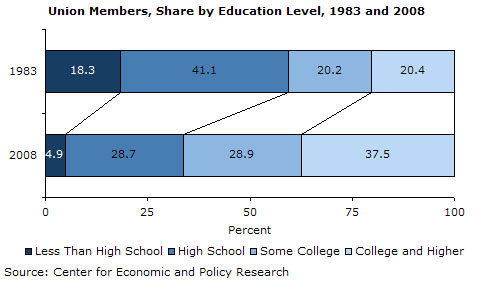
The 2002 Census shows that "more than one-quarter" of adults hold a college degree.
Amongst union members, that figure is 37.5%.
A study has found that just one in 10 union members is in manufacturing, while women account for more than 45 percent of the unionized work force.
The study, by the Center for Economic Policy Research, a Washington-based group, found that union membership is far less blue-collar and factory-based than in labor’s heyday, when the United Automobile Workers and the United Steelworkers dominated.
[snip]
About 48.9 percent of union members are in the public sector, up from 34 percent in 1983. About 61 percent of unionized women are in the public sector, compared to 38 percent for men.
[snip]
The study found that 38 percent of union members had a four-year college degree or more, up from 20 percent in 1983. Just under half of female union members (49.4 percent) have at least a four-year degree, compared with 27.7 percent for male union members.
[snip]
The percentage of men in unions has dropped sharply, to 14.5 percent in 2008, from 27.7 percent in 1983, while the percentage for women dropped more slowly, to 13 percent last year, from 18 percent in 1983. For the work force over all, the percentage of workers in unions dropped to 12.4 percent last year, from 20.1 percent in 1983.
Economix: Union Members Getting More Educated
The 2002 Census shows that "more than one-quarter" of adults hold a college degree.
Amongst union members, that figure is 37.5%.
Monday, November 30, 2009
Do You Only Get What You Measure
I attended an interesting faculty meeting today. These are once a month affairs where we are tasked to work on a continuing project. The current project was for each grade level team to analyze our state test data and report out on any significant findings along with ideas on what we might do to mitigate any adverse findings.
Math was the first topic. Turns out (no surprise here, we've been doing this since the seas parted) number sense is a big deal. It's the highest percentage test item and also where we do the poorest.
When the elementary teachers made their presentations they described their efforts in this very area of arithmetical calculation, number sense stuff. Since I'm pretty frustrated with my kids' lack of ability in this domain, my ears were perked. They work really hard on this. I know this from personal observation. But, there was one omission.
Someone asked how many kids leave third grade knowing how to add. Crickets! It's not measured.
I posed a question about what is meant by 'knowing how to add'. Crickets! There is no criteria.
Then I was asked what I meant by asking that. My response had to do with objective measurement vs. subjective measurement. Crickets! Nobody has objective measures.
Here's what the consensus answer was (I'm paraphrasing). "We have a pretty good idea what most of our kids can do when they leave us." There you have the big omission. We have a completely fuzzy string of descriptors all wrapped up in one sentence; pretty good, most of, and can do. Not only is there no objective measurement taking place, there isn't even an awareness of what one should look like.
Suddenly the scales dropped from the eyes of this grasshopper. We're getting what we measure! Subjective measures lead to subjective results. We aren't asking for kids to know facts. We're asking kids to get answers and it's perfectly OK if they do this with fingers, toes, and mystical incantations to math gods. We even meet the, by God, state standards with this fuzz as they ask for no more.
I'm of the school that says if you can't measure it then it doesn't exist. Have we reached a point that it is culturally unacceptable to do anything that isn't fuzzy? Am I working in a measurement resistant culture? To me, with my background, uncovering fuzziness is just an indicator that I need to do more work to expunge the fuzz. To my colleagues it seems like fuzziness is not a clue, it's an objective.
Please, just disabuse me of this if you think I've just had too much coffee, but I think it would be really interesting to find out if there has ever been a correlation study in education to see if it's true that "You get what you measure." From this anecdote it sure seems to have some truth to it.
Thursday, November 26, 2009
In The House of Mirrors; It depends
Is the goal of public education social or academic? Think you know the answer don't you?
Don't get your child's schooling methods in front of a judge. The answer just may fool you.
Read about a 10 year old, home schooled girl, acknowledged to be at or above her grade level being forced to attend public school. Put down that turkey sandwich and get back to it...
Don't get your child's schooling methods in front of a judge. The answer just may fool you.
Read about a 10 year old, home schooled girl, acknowledged to be at or above her grade level being forced to attend public school. Put down that turkey sandwich and get back to it...
Wednesday, November 25, 2009
help desk - duties & responsibilities of elected officials
I need a good source explaining the duties & responsibilities of elected officials, as well as the responsibilities of an informed citizenry in a representative democracy.
I need this for me, but anything good written for high school age or above would be fine.
More later - and thanks!
I need this for me, but anything good written for high school age or above would be fine.
More later - and thanks!

help desk - usage & mechanics
C's ACT PLAN scores came back. He's at the 96th percentile in reading, 79th in usage/mechanics.
C. taught himself to read in Kindergarten. One day we were meeting with his Kindergarten teacher, being told that he was at risk for dyslexia because his handwriting was so bad (true: bad handwriting is a flag); two weeks later he was reading. On his own.
By the end of the following summer he was years above grade level in reading comprehension, and he stayed there.* Never once was he assigned a book at his reading level, not until he went to Hogwarts. He's a sophomore now, reading The Scarlett Letter.
Too bad he didn't teach himself mechanics & usage.
Or handwriting. His handwriting is still lousy, in spite of my brief efforts to remediate his handwriting** before I had to devote full-time to reteaching math.
Speaking of math, he's at the 79th percentile on that.
Basically, he's at the top of the country in the subject he taught himself, 20 points lower in the subjects handled by his school.
He's got his own personal Achievement Gap.
help desk
So what do you think?
I need a workbook/textbook to start drilling usage & mechanics. For math, I'm thinking a daily dose of ALEKS.
Which reminds me: I have to finish up my ALEKS geometry course and then get back to Algebra 1, the course with 333 individual topics.
Any advice?
* Whether he would have stayed there without MegaWords, I can't say.
* Handwriting Now by Barbara Getty - terrific
Monday, November 23, 2009
Michelle Rhee in the Journal
HOW TO LEAD: I often get in trouble for saying this, but I actually think it's true—that collaboration and consensus-building and all those things are, quite frankly, overrated. None of you CEOs run your companies by committee. So why should we run a school district by committee? The bottom line is that in order to run an effective organization, you need one leader who has a very clear vision for what needs to happen and the authority to make that happen.
FIRING EMPLOYEES: We had to conduct a reduction in force of about 500 employees in the district. And that included about 250 or so teachers. We made the decision that we were going to conduct the [layoffs] by quality, not by seniority. It caused this firestorm.
From a managerial standpoint, it would make no sense to do a layoff by seniority only. In a school district that is struggling as hard as ours is, we have to be able to look at the quality and the value that different employees are adding.
MONEY FOR NOTHING: We spend more money per child in this city than almost any other urban jurisdiction in the country, and our results are at the absolute bottom. So it goes against the idea that you have to put more money into education and that's how you're going to fix it.
It comes down to two basic things about why we spend so much money and the results aren't as good. First is a complete and utter lack of accountability in this system. And the second is a lack of political courage on the part of most of the people who are running cities and school districts.
We have a system in which you can have been teaching for 25, 30 years. Every year, you could actually take your children backward—not just not improve their learning as much as you should, but your kids can move backward in your classroom every year—and you will continue to have a job. You will continue to get your step raise. You will continue to get your negotiated union increases. Where else can that happen, except in public education? So that lack of accountability is a significant problem.
And then on the courage part, I think that when you're talking about making the difficult decisions that are necessary in this climate—closing schools, firing teachers, removing principals, et cetera—those are the things that make most politicians run for the hills because it makes your phone ring off the hook and people are saying oh, don't close this school, don't fire this person.
OUT-OF-CONTROL SPENDING: When I came on board, people told me to find out where the money is going, and so I sent people out. One of my assistants came back to me and said, "Did you know that we spend $80 million a year in this city transporting a few thousand kids to special-education placements across the city?" And I did the quick back-of-the-envelope math and it turned out to be $18,000 per kid, per year.
And I thought, that's crazy. I said, well, I don't know anything about running bus routes, but I'm pretty sure I can do it for cheaper than $18,000. With $18,000 a year, you could buy the kid a Saturn the first year and a driver for the Saturn every year after that!
So I said, this is going to be a good one. We save the money; we're more efficient; we push the money down to the classroom. And what people said was, no, you can't do that because for decades, the district had done such a poor job of transporting these kids to their placements that now it's under a court order.
There's a court-appointed special master who now runs the bus system, and he's allowed to spend as much money as he wants to as long as he gets the kids to school on time. All we can do is pay the bill. We have no ability to control costs. It's an insane system that's been set up over time because of the dysfunction of the school district.
VOUCHERS AND CHARTER SCHOOLS: We have a very strong choice dynamic in this city. About a third of the school-age children go to charter schools. We have the traditional public schools, and then we also have about 2,000 kids who attend private schools through the use of vouchers. We call it the tri-sector approach. I think it works extraordinarily well.
Laying the Groundwork
November 23, 2009
WSJ
The Latest Silver Bullet
Read this after pouring yourself a stiff drink!
Get set to compose your very own autoethnography and be sure to discuss America as an oppressive hellhole: racist, sexist and homophobic.
Are they putting something in all those Minnesota lakes???
Get set to compose your very own autoethnography and be sure to discuss America as an oppressive hellhole: racist, sexist and homophobic.
Are they putting something in all those Minnesota lakes???
from the annals of...
We review the growing literature on health numeracy, the ability to understand and use numerical information, and its relation to cognition, health behaviors, and medical outcomes. Despite the surfeit of health information from commercial and noncommercial sources, national and international surveys show that many people lack basic numerical skills that are essential to maintain their health and make informed medical decisions. Low numeracy distorts perceptions of risks and benefits of screening, reduces medication compliance, impedes access to treatments, impairs risk communication (limiting prevention efforts among the most vulnerable), and, based on the scant research conducted on outcomes, appears to adversely affect medical outcomes. Low numeracy is also associated with greater susceptibility to extraneous factors (i.e., factors that do not change the objective numerical information). That is, low numeracy increases susceptibility to effects of mood or how information is presented (e.g., as frequencies vs. percentages) and to biases in judgment and decision making (e.g., framing and ratio bias effects). Much of this research is not grounded in empirically supported theories of numeracy or mathematical cognition, which are crucial for designing evidence-based policies and interventions that are effective in reducing risk and improving medical decision making. To address this gap, we outline four theoretical approaches (psychophysical, computational, standard dual-process, and fuzzy trace theory), review their implications for numeracy, and point to avenues for future research.
How Numeracy Influences Risk Comprehension and Medical Decision Making
by:
Valerie F. Reyna | Cornell University
Wendy L. Nelson and Paul K. Han | National Cancer Institute, Bethesda, Maryland
Nathan F. Dieckmann | Decision Research, Eugene, Oregon; and University of Oregon
Psychological Bulletin | 2009, Vol. 135, No. 6, 943–973
in a nutshell:
Despite the surfeit of health information from commercial and noncommercial sources, national and international surveys show that many people lack basic numerical skills that are essential to maintain their health and make informed medical decisions.
Saturday, November 21, 2009
Rubric Rant
My son brought home his first quarter report card yesterday. It contains 61 rubric grades covering two different scales, 1-5 and 5-10. The numbers are virtually meaningless. Much of his homework and all of his tests never come home. They are put in his portfolio to be presented to us in our December school meeting. This is the one he is supposed to lead and explain how he will try to be a better student. My head is going to explode.
The 1 - 5 rubrics are for academics (as opposed to effort) and are non-linear. A '3' is like a 'B', but some teachers really don't like to give out 4's or 5's. Some teachers seem to use a sort of differentiated grading technique where they hope that a low grade will get kids to work harder. Even my son commented on it. "The grades always start out low in the first quarter."
I would like to ask teachers to show me where each number came from. For example, in social studies, he gets a rubric grade for "Analysis and Connections". I want to see the homework and tests and how the teacher figures out this score. I can't imagine that any teacher likes rubric grading. There are a lot of numbers, but less information. I want to see the raw data (homework and tests) and see how those grades translate into the numbers on the report card. When we ask our son about what the numbers mean, he has no clue. At best, we can track whether the numbers go up or down, but that won't give us any indication as to why that is happening.
Do they really think this is a good feedback loop? We don't know what's going on in class, the homework and tests don't come home, and the quarterly grades have a heavy dose of subjectivity. Even if we did see a number that looked particularly bad, why on earth would they wait until the end of the quarter to let us know?
Friday, November 20, 2009
Mathematics 6 out of print?
Does anyone know what's going on?
I've sent an email query.
I was just telling a friend to get Mathematics 6 for her son --
"Russian Math" at ktm-1.
I've sent an email query.
I was just telling a friend to get Mathematics 6 for her son --
"Russian Math" at ktm-1.
Learning vs Teaching: Part I
Many educators, parents and others in the educational debate continue to focus on the question "How do children learn?". We can see this in references to fMRIs showing how some people process information in different parts of the brain, and in discussions about learning styles.
This question, while interesting, leads down a blind alley when we're trying to educate children because it assumes some teaching environment that we know nothing about, or at least haven't quantified.
The more useful question when we're trying to educate is "What are the most effective ways to teach?". This question is helpful because it can be answered using applied science: we can try different methods for teaching and determine, based on our observations and data that we collect, which methods work and which don't.
The applied science method was used to develop Direct Instruction (DI). When Zig Engelmann developed DI, he tried many approaches to teaching. When methods didn't work in his field research, he tried other methods. By assuming "if they aren't learning, then we aren't teaching" he was open to finding novel ways of instructing children (e.g., ability grouping, teaching one concept at a time, focusing on flawless communications) that were proven superior in Follow Through.
And Precision Teaching is applied science for individual students. It tells the learner and instructor if the chosen teaching method is working.
And here's the crux of the issue: As parents, I believe it's critical that we keep any debate with educators focused on the proven effectiveness of educational methods, not on a particular child's learning styles or other issues.
What say ye?? Do you think this matters? Are we doing a good enough job in this area?
Thursday, November 19, 2009
advice for curriculum committees everywhere
We've got so much going on here in town (posts t/k) that I'm only dimly aware of what is or is not happening at state & federal levels .... so I was surprised to discover this Daily News editorial yesterday while paging through looking at whatever it was I was looking at post-tennis lesson, no less.
I assume this is what they're referring to.
I would dearly love to see different teacher training programs (I'm guessing most teachers would dearly love to see different teacher training programs), and I think David Steiner is the person to do that.
But why does Kendall Hunt get off scot-free?
Or Heinemann?
Shouldn't these folks have to show a value-added value or two?
I guess this is a policy question, really. Targeting teacher-ed programs seems like a good idea to me. At least, it's a reasonably novel idea -- and I think that, historically speaking, a reform effort directed at medical schools may have had an enormous effect (yes?)
Data is good; value-added is good. In my view.
But targeting teacher ed programs and pushing through value-added measurements without reference to New York state's vendor-driven curricula is a different matter.
Have I ever mentioned my rule of thumb for school districts buying curricula?
Buy whatever homeschoolers are buying.
I assume this is what they're referring to.
The Regents are authorizing the development of a performance-based approach to teacher certification and inviting – on a trial basis – new entities to prepare teachers for certification. As part of this new approach, the Regents will support the development of new performance-based assessments for teacher certification (including the eventual use of value-added assessment as a component of professional certification), will develop new methods to recruit and retain teachers for high needs schools in subject shortage areas and will allow additional content knowledge demonstrations for prospective teachers to bring new talent into the teaching field.I'm interested to hear from teachers on this.
I would dearly love to see different teacher training programs (I'm guessing most teachers would dearly love to see different teacher training programs), and I think David Steiner is the person to do that.
But why does Kendall Hunt get off scot-free?
Or Heinemann?
Shouldn't these folks have to show a value-added value or two?
I guess this is a policy question, really. Targeting teacher-ed programs seems like a good idea to me. At least, it's a reasonably novel idea -- and I think that, historically speaking, a reform effort directed at medical schools may have had an enormous effect (yes?)
Data is good; value-added is good. In my view.
But targeting teacher ed programs and pushing through value-added measurements without reference to New York state's vendor-driven curricula is a different matter.
Have I ever mentioned my rule of thumb for school districts buying curricula?
Buy whatever homeschoolers are buying.
Wednesday, November 18, 2009
This Thursday: "Raising a Left-Brain Child" book talk in Boston
(Tomorrow!)...specifically in Waltham, north of Boston, at Back Pages Books.
We'll discuss concerns and anecdotes about Reform Math, social classrooms, projects and "personal reflections," and grades, as well as strategies for parents and teachers.
Please spread the word to parents and teachers of shy, unsocial, analytical, academically gifted, math-inclined, science-inclined, and/or autistic spectrum children.
UPDATE: EVENT CANCELED!
Fire-induced flooding hit the bookstore while the owner was away for a family emergency, which my publicist only found out about today because she herself is out sick.
Tuesday, November 17, 2009
A parent discovers what passes for education in her daughter's HS.
Alaskan Blogger Michelle Mitchell of Scribbit wrote about a conversation between herself & her daughter: No Child Left Behind. Because They ALL Need to be Watching Television at School.
I checked with my son, the IB freshman. He claims to watch "3 movies or tv videos a week, max".
The comments are pretty interesting, from teachers who agree & homeschool their OWN children to teachers who take Mitchell to task for implying they have a "cake" job.
Here's hoping that revolt against lousy instruction goes viral for all subjects.
"How many movies do you watch a week?"
She thought a bit, counting up on her fingers and trying to remember. "Oh--I don't know--five or six, maybe more. We watch t.v. pretty much every day in at least one class and any time we have a sub they put in movies or something. We watch stuff like Mythbusters a lot and call it chemistry."
I checked with my son, the IB freshman. He claims to watch "3 movies or tv videos a week, max".
The comments are pretty interesting, from teachers who agree & homeschool their OWN children to teachers who take Mitchell to task for implying they have a "cake" job.
Here's hoping that revolt against lousy instruction goes viral for all subjects.
Monday, November 16, 2009
Everyday Math author defends his program against Katharine Beals
In today's Philadelphia Inquirer Letters to the Editor, excerpted here:
Katharine Beals' article on the use of "reform math" with students with autism contains many misperceptions about Everyday Mathematics that, as the program's coauthor, I want to clarify ("The 'reform math' problem," last Monday).
Everyday Mathematics was designed for general education students, but it has been effective in special education, including with students with autism.
Beals' claim that students spend large chunks of time working in unsupervised groups is untrue. A teacher supervises student group work at all times. While some assignments are "open-ended and language-intensive," many are not. A balanced curriculum needs simple exercises to build basic skills, as well as more difficult problems.
Beals writes that students "lose points for failing to cooperate in groups, explain their answers, and comprehend language-intensive problems." While decisions about how to grade students are made at the local level, many people believe it's reasonable to require students to work cooperatively, explain their work, and understand word problems.
Everyday Mathematics is not just a "sequence of themes," but a carefully organized sequence of lessons resulting in mastery of a specific set of goals. Its approach is well supported by research, the authors' experience, and decades of classroom experience.
Naturally, accommodations for teaching children with autism must be made, and that's what professionals always do. As with any tool, Everyday Mathematics must be used with professional judgment.
Andy Isaacs
Chicago
Sunday, November 15, 2009
Make a Teacher Crazy
A recurring theme here is the interaction between parents and their schools and teachers. As a teacher who has parent conferences coming up this week I've been giving this some thought for selfish reasons but in so doing I've had a flash that it makes sense to toss around here. Here's the flash.
As consumers, parents have no idea what they are 'buying', i.e. there is no objective measure of what a 1st quarter, 2nd grade or 3rd quarter 7th grade (pick your own quarter and grade if you like) student should be able to do. Hell, truth be told, I'm not sure I know what a student should do either. You wouldn't go to the store to buy a dozen eggs without insisting on a definition of 'dozen'. Yet, with our kids we've created a mushy narrative for what we define as learning goals that leaves us talking around each other.
Here's what I mean. Below, I've extracted the Massachusetts standards that are relevant for addition. Before you read them, understand that you are looking at a spiraling standard and also, gulp, know that these are highly regarded in the educational establishment and have even been touted as a model for national standards. Also, ignore the creeping growth of the standard as it incorporates division and multiplication goals. Just focus on addition. Read them carefully and then be prepared for a quiz...
Grade 2:
Know addition facts (addends to ten) and related subtraction facts, and use them to solve problems.
Grade 3:
Add and subtract(up to four-digit numbers) and multiply (up to two-digit numbers by a one-digit number) accurately and use them to solve problems.
Grade 4:
Add and subtract (up to five-digit numbers) and multiply (up to three digits by two digits) accurately and efficiently.
Grade 5:
Accurately and efficiently add, subtract, multiply whole numbers and positive decimals. Divide, whole numbers using double digit divisors with and without remainders
Grade 6:
Accurately and efficiently add, subtract, multiply, and divide (with double-digit divisors) whole numbers and positive decimals.
Here's the quiz.
1. For any grade of your choice, what speed should be used as a proxy for efficiency?
2. For any grade of your choice, what is the definition of accuracy?
3. For grade one, should students be accurate or efficient?
4. Why are grade 3 students required to be accurate but not efficient?
5. Are manipulatives, pictures, or fingers allowed in any grade to achieve the goals?
6. Are calculators or tables allowed in any grade?
What's your grade? Could you even answer the questions? This is mush and I submit that a sixth grade student whose addition facts come from his fingers is meeting these standards provided he consistently gets correct answers and doesn't use up a lot of paper to achieve a result.
Of course neither parents or teachers are going to change these standards. But, here's a thought to put some pressure on this part of the education puzzle. When you go to a conference, go with one simple question, "What should my student be capable of doing right now?"
This should provide a wonderful jumping off point for a more meaningful discussion than the standard fare. "Johnny's doing quite well" won't cut it, will it? When you get an answer, drill down and insist upon accuracy and efficiency parameters that pin down the objective goals. Don't settle for subjective answers. Find out how fast he should be doing things. Find out what the acceptable error rate is. Inquire as to the remediation Johnny is getting if he is not meeting the objective measures. Be ready for heavy spin. I'd be really interested to know what you get for answers.
And BTW, I really hope none of my parents are reading this right now because I'd have to make up stuff to answer this kind of interrogator and that wouldn't be pretty.
Barney adopts a healthy new eating style
Yesterday, Ed and I were experimenting with our groovy new, life-extending Vita Mix blender when we noticed Andrew systematically emptying the refrigerator of vegetables. We did what we often do: ordered him to Stop and then, after spending a few seconds discussing the mystery that is Andrew (deciding in this case that Andrew must be collecting vegetables because he wanted to watch us blend stuff he wouldn't drink on a bet), went back to what we were doing and forgot all about Andrew, who had by this time left the kitchen. Out of sight, out of mind.
Andrew has never eaten a fresh vegetable in his life. He ate baby food vegetables when he was little, but when he stopped eating baby food he stopped eating vegetables. He doesn't eat fruit, either. Or noodles or rice or eggs or Chinese or Japanese food or hot dogs or hamburgers, and so on. In short, Andrew has an eating disorder. Two eating disorders: his autistic eating disorder (eating disorders seem to be common in autism) and his feeding-tube-as-a-preemie eating disorder (not sure whether doctors believe such a thing exists, but I do).
The reason we have a groovy new, life-extending blender, in case you're wondering, is that my sisters and brother and I have been scared straight by my mom's heart failure,* and my brother's scheme for not getting diabetes and also not getting heart failure was to buy a commercial-strength blender that makes commercial-strength smoothies and the best potato soup my California sister says she's ever eaten.
That ought to do it.
After I'd spent about 60 seconds considering the life-extending properties of the Vita Mix, I realized that the person in the household who really needs a life-extending commercial-strength blender is Andrew. For years I've been worried about his horrifically poor diet, and I've hatched various schemes to try to force some vegetable juice down him, none of which got off the ground. Andrew will have no truck with V8 juice.
But a commercial blender -- wow. Suddenly I could see a way to start small and work up. Start with something Andrew likes (grocery store apple juice), combine it with a tiny bit of something he doesn't like (any form of actual fruit) and have him drink it the same way he drinks pink antibiotics when he has to. Not willingly, but he gets it down.
Then I had a second brainstorm: positive reinforcement!
the plan: Blend half a box of apple juice in the Vita Mix and show Andrew that the other half is still inside the box, unadulterated & correct, waiting to be his once he swallows the blend.
It worked!
Andrew has now eaten (well, drunk) the first 7 grapes of his entire life. Also the first 3 slices of banana.
It's a miracle.
So back to yesterday afternoon. As I say, we forgot about Andrew and went back to what we were doing, which was figuring out how to make commercial-quality smoothies in the privacy of our own home.
A little later in the day I went upstairs to Andrew's room and found a brand new Barney tableau: vegan Barney.
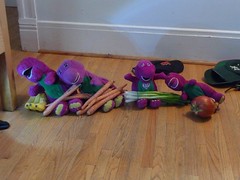
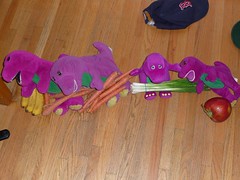
Somebody's going to have to tell Andrew tyrannosaurus rex was not a herbivore.
* update 7/3/2011: My mom didn't have heart failure as we learned much later.
Andrew has never eaten a fresh vegetable in his life. He ate baby food vegetables when he was little, but when he stopped eating baby food he stopped eating vegetables. He doesn't eat fruit, either. Or noodles or rice or eggs or Chinese or Japanese food or hot dogs or hamburgers, and so on. In short, Andrew has an eating disorder. Two eating disorders: his autistic eating disorder (eating disorders seem to be common in autism) and his feeding-tube-as-a-preemie eating disorder (not sure whether doctors believe such a thing exists, but I do).
The reason we have a groovy new, life-extending blender, in case you're wondering, is that my sisters and brother and I have been scared straight by my mom's heart failure,* and my brother's scheme for not getting diabetes and also not getting heart failure was to buy a commercial-strength blender that makes commercial-strength smoothies and the best potato soup my California sister says she's ever eaten.
That ought to do it.
After I'd spent about 60 seconds considering the life-extending properties of the Vita Mix, I realized that the person in the household who really needs a life-extending commercial-strength blender is Andrew. For years I've been worried about his horrifically poor diet, and I've hatched various schemes to try to force some vegetable juice down him, none of which got off the ground. Andrew will have no truck with V8 juice.
But a commercial blender -- wow. Suddenly I could see a way to start small and work up. Start with something Andrew likes (grocery store apple juice), combine it with a tiny bit of something he doesn't like (any form of actual fruit) and have him drink it the same way he drinks pink antibiotics when he has to. Not willingly, but he gets it down.
Then I had a second brainstorm: positive reinforcement!
the plan: Blend half a box of apple juice in the Vita Mix and show Andrew that the other half is still inside the box, unadulterated & correct, waiting to be his once he swallows the blend.
It worked!
Andrew has now eaten (well, drunk) the first 7 grapes of his entire life. Also the first 3 slices of banana.
It's a miracle.
So back to yesterday afternoon. As I say, we forgot about Andrew and went back to what we were doing, which was figuring out how to make commercial-quality smoothies in the privacy of our own home.
A little later in the day I went upstairs to Andrew's room and found a brand new Barney tableau: vegan Barney.
Somebody's going to have to tell Andrew tyrannosaurus rex was not a herbivore.
* update 7/3/2011: My mom didn't have heart failure as we learned much later.
Saturday, November 14, 2009
Friday, November 13, 2009
The Revolt Against Lousy Math Instruction May Just Go Viral
This example was just posted at BoingBoing, a large group blog, at this post.
Do You Understand My First-Grade Child's Homework?
The blogger asks
Go add to the BoingBoing comment fun, if you like.

(I have another question -- homework for six-year-olds? I'm ok with requesting reading at home, but that's it. Period. The end.)
Do You Understand My First-Grade Child's Homework?
The blogger asks
My six-year-old told me she doesn't understand her homework. After studying it for 15 minutes, I *think* I understand what she's supposed to do, but I'd like a second opinion.Is it from Everyday Math?
Go add to the BoingBoing comment fun, if you like.

(I have another question -- homework for six-year-olds? I'm ok with requesting reading at home, but that's it. Period. The end.)
Speaking of the spiral...
...my problems of the week this week show the spiraling vs. the linear approach within chapters called "Addition and Subtraction" in the 2nd grade Everyday Math vs. Singapore Math curricula.
Thursday, November 12, 2009
Report shows many freshmen from city HS fail at basic algebra
City University of New York freshman apparently have an algebra problem.
Welcome to the fight Professor Stanley.
P.S. You really should get out more!
Basic algebra involving fractions and decimals stumped a group of City University of New York freshmen - suggesting city schools aren't preparing them, a CUNY report shows.
"These results are shocking," said City College Prof. Stanley Ocken, who co-wrote the report on CUNY kids' skills. "They show that a disturbing proportion of New York City high school graduates lack basic skills."
Welcome to the fight Professor Stanley.
P.S. You really should get out more!
Tuesday, November 10, 2009
onward & upward
$28,354 per pupil
I learned how to figure percent increase from Saxon Math.
In case you were wondering.
I learned how to figure percent increase from Saxon Math.
In case you were wondering.
IB World History Test
My 9th grade son was working on his home enjoyment.
"Mom!", he shouted, "Come look at the test I have to take". I think he just likes to get me riled up.
(Click to enlarge)

Contrast this paper with this one, making the rounds of the internet: Are you smarter than a 1954 8th grader?
I think I may still have some glitter laying around.
"Mom!", he shouted, "Come look at the test I have to take". I think he just likes to get me riled up.
(Click to enlarge)

Contrast this paper with this one, making the rounds of the internet: Are you smarter than a 1954 8th grader?
I think I may still have some glitter laying around.
Chron: too many students going to college?
The push for defining a better K-12 education for our individual children should properly value what comes after. What is our goal?
The Chronicle of Higher Ed asks here whether too many students are going to college, and what the point is. Lots of answers. To the question who should and who shouldn't go to college, here are a couple of answers:
Vedder and Caplan are econ professors.
My favorite response, though comes from Charles Murray. Of course, you knew that I agreed with him already.
Would that more professors admitted what they saw in their own college students. Read the whole thing.
One issue missed, though, by all of the responses, is the extent to which college is for assortative mating. As long as that's the way to produce good grandchildren, parents will still pay for their kids to go to college, regardless of what appears nonsensical from a career standpoint.
The Chronicle of Higher Ed asks here whether too many students are going to college, and what the point is. Lots of answers. To the question who should and who shouldn't go to college, here are a couple of answers:
Richard K. Vedder: A large subset of our population should not go to college, or at least not at public expense. The number of new jobs requiring a college degree is now less than the number of young adults graduating from universities, so more and more graduates are filling jobs for which they are academically overqualified.
Bryan Caplan: There are two ways to read this question. One is: "Who gets a good financial and/or personal return from college?" My answer: people in the top 25 percent of academic ability who also have the work ethic to actually finish college. The other way to read this is: "For whom is college attendance socially beneficial?" My answer: no more than 5 percent of high-school graduates, because college is mostly what economists call a "signaling game." Most college courses teach few useful job skills; their main function is to signal to employers that students are smart, hard-working, and conformist. The upshot: Going to college is a lot like standing up at a concert to see better. Selfishly speaking, it works, but from a social point of view, we shouldn't encourage it.
Vedder and Caplan are econ professors.
My favorite response, though comes from Charles Murray. Of course, you knew that I agreed with him already.
Murray: We have a moral obligation to destroy the current role of the B.A. in American life. It has become an emblem of first-class citizenship for no good reason.
Would that more professors admitted what they saw in their own college students. Read the whole thing.
One issue missed, though, by all of the responses, is the extent to which college is for assortative mating. As long as that's the way to produce good grandchildren, parents will still pay for their kids to go to college, regardless of what appears nonsensical from a career standpoint.
Monday, November 9, 2009
Op-Ed in the Philadelphia Inquirer on autistic spectrum students and Reform Math
Here!
For all the talking points that Reform Math proponents deploy in response to the general criticisms, I haven't yet seen any talking points that respond to concerns about children on the autistic spectrum. Has anyone else?
Since it's well-documented--and generally agreed--that AS children require structure, direct instruction, and discrete tasks, and that many of them have the potential to excel in math, and since the education establishment's purported missions include (1) mainstreaming and (2) catering to different learning needs, I believe this is a fruitful message to keep plugging.
Sunday, November 8, 2009
the Ed diet
off-topic
I was talking to my tennis teacher yesterday about Ed.
My tennis teacher is a big Italian guy who is frequently trying to lose 30 pounds. Since I am frequently trying to lose 5 pounds, we talk about food and weight a lot.
For the past month I've been keeping him apprised of my efforts to become a 'vegan.'1
The latest news: Ed, who has no interest in becoming a vegan, has lost weight. Three pounds, possibly 4.2 He has lost weight entirely because he is married to a woman who is interested in becoming a vegan. Which is annoying because Ed was already extremely thin; Ed was already so thin he is borderline too thin for my tastes. Now he's thinner.
Meanwhile, in the midst of the Ed transformation, the Times ran an article on the Calerie study, a project looking at people who reduce their daily calories by 25 percent for two years.
For me, the most amazing finding of the study is the fact that its subjects have actually managed to remain in the study. That is the revelation, not the fantastic drops in cholesterol and blood pressure, etc. Although I've lost weight a number of times over the years, I'm not sure I've ever stuck to a reduced-calorie diet for more than a few days in a row; the notion of living on a restricted-calorie diet for two years is inconceivable.
But the Calerie people have done it, and apparently we know the secret of their success: they all switched to low-energy density foods. Vegetables, fruits, and soup: 3
Ed, on the other hand, loves fruit.
Yesterday Ed mentioned that he keeps a bag of apples on his desk at work. A bag. He snacks on apples all day long; he eats at least 4 apples a day, he said.
I had no idea.
Something else I didn't know: since age 22 he's been eating soup for lunch.
Every day.
And apples. Four apples, at least. Every day.
I didn't know.
He basically invented the Volumetrics diet when he graduated college & didn't think to mention it to anyone he happened to be married to who might be trying to lose weight.
So I was telling my tennis teacher about the Ed diet. Soup and apples, I said. The Ed diet. We should all try it.
My tennis teacher said I should write it up, and now I have.
__________________
1 How I dislike that word! Who came up with it? And why? Do we know?
2 I've lost 5, but I've been trying.
3 Barbara Rolls is always cited for her work on low-energy density foods & satiety.
4 I do like Twinkies.
I was talking to my tennis teacher yesterday about Ed.
My tennis teacher is a big Italian guy who is frequently trying to lose 30 pounds. Since I am frequently trying to lose 5 pounds, we talk about food and weight a lot.
For the past month I've been keeping him apprised of my efforts to become a 'vegan.'1
The latest news: Ed, who has no interest in becoming a vegan, has lost weight. Three pounds, possibly 4.2 He has lost weight entirely because he is married to a woman who is interested in becoming a vegan. Which is annoying because Ed was already extremely thin; Ed was already so thin he is borderline too thin for my tastes. Now he's thinner.
Meanwhile, in the midst of the Ed transformation, the Times ran an article on the Calerie study, a project looking at people who reduce their daily calories by 25 percent for two years.
For me, the most amazing finding of the study is the fact that its subjects have actually managed to remain in the study. That is the revelation, not the fantastic drops in cholesterol and blood pressure, etc. Although I've lost weight a number of times over the years, I'm not sure I've ever stuck to a reduced-calorie diet for more than a few days in a row; the notion of living on a restricted-calorie diet for two years is inconceivable.
But the Calerie people have done it, and apparently we know the secret of their success: they all switched to low-energy density foods. Vegetables, fruits, and soup: 3
Apples are superb in this regard. At the medical centers running Calerie, you see a lot of people walking around eating apples. Even subjects who disliked apples have discovered that calorie restriction, which generally has the effect of making food taste better, has given them a surprising desire for the fruit.I don't happen to like apples, particularly. Or fruit, generally.4 I so lack a taste for fruit that I have to set a formal goal of consuming 4 fruits a day & keep a running tally to hit the mark. Even then, likely as not I won't make it.
[snip]
When I asked Susan Roberts, who runs the Tufts study, if there was a danger in Americans trying calorie restriction on their own, without a dedicated team of medical experts offering advice, she suggested that there are built-in safety mechanisms. Roberts said she didn’t think anyone would be successful by reducing portion size. “If you don’t change your diet to a high-satiety diet, you will be hungry, and you will fail,” she told me. A high-satiety diet, she said, was bound to be a healthful diet with a lot of vegetables, fruits and insoluble fiber — the kind found in some breakfast cereals, like Fiber One — that her research indicates has a unique effect in helping calorie-restriction subjects feel fuller, probably because they activate certain receptors in the lower intestine. Roberts added, “If people are doing this on their own and succeeding, well, I’d be surprised if they’re eating a lot of Hostess Twinkies.”
Ed, on the other hand, loves fruit.
Yesterday Ed mentioned that he keeps a bag of apples on his desk at work. A bag. He snacks on apples all day long; he eats at least 4 apples a day, he said.
I had no idea.
Something else I didn't know: since age 22 he's been eating soup for lunch.
Every day.
And apples. Four apples, at least. Every day.
I didn't know.
He basically invented the Volumetrics diet when he graduated college & didn't think to mention it to anyone he happened to be married to who might be trying to lose weight.
So I was telling my tennis teacher about the Ed diet. Soup and apples, I said. The Ed diet. We should all try it.
My tennis teacher said I should write it up, and now I have.
__________________
1 How I dislike that word! Who came up with it? And why? Do we know?
2 I've lost 5, but I've been trying.
3 Barbara Rolls is always cited for her work on low-energy density foods & satiety.
4 I do like Twinkies.
merrily we roll along
Has anyone else noticed the fact that, at some point during the past 5 years, school districts seem to have stopped adopting curricula and implementing programs and started rolling out initiatives?
Why is that, do you think?
Why is that, do you think?
Singapore Math pilot in New Milford: SPED students ahead of general ed students
Steve H's question - whether any of us knows a district that has replaced Everyday Math, TERC, Trailblazers, etc. with Singapore or Saxon - has prompted me finally to post the material I saved on New Milford, CT's 2006 pilot program comparing Everyday Math, Saxon Math, and Singapore Math. (I can email copies of the various reports produced by the district cijohn @ verizon.net.)
My favorite line from the Pilot summary:
A recommendation from the assistant superintendent that the district not adopt the curriculum that produced the best results:
Parents and other bystanders often assume that schools are interested in 'what works' but repeatedly fail to come up with what works because of fads. A school adopts the latest fad, the latest fad fails inside the classroom, and the school moves on to the next fad. Which also fails to work inside the classroom.
The 'pendulum' idea -- an educational pendulum swings back and forth from one extreme to the other -- is a variant of this idea.
In my experience, neither of these accounts captures what goes on inside the black box. Not that I know what goes on inside the black box. Still, I know enough to state as fact that public schools don't generally 'evaluate' success one way or the other. Every new initiative that is rolled out is assumed to be good and successful right up to the moment the next initiative comes along 3 years later, according to plan, and is also assumed to be good and successful.
In some ways, the New Milford pilot program is the ur-example of public school indifference to results. In New Milford's case, the district actually did evaluate three programs, found one program in particular to be startlingly successful -- and then decided not to adopt that program.
Westchester County
Here in Westchester, Scarsdale & Dobbs Ferry have adopted Singapore Math, and BOCES is sponsoring Singapore Math workshops (pdf file). I believe my town will adopt Singapore Math within the next couple of years, too, though we'll see.
Whether or not Singapore Math in Westchester will bear a close resemblance to Singapore Math in Singapore remains to be seen.
My favorite line from the Pilot summary:
The pace of [Singapore Math] ... is quicker than anything we do and quicker even than our curriculum calls for. As a result, some sped students actually perform AHEAD of their non-special education peers in successfully handling content -- almost by definition becoming non-sped students!The result of New Milford's admirable -- and unusual -- commitment to piloting a math curriculum before buying it?
Memorandum
April 10, 2006
Pilot Summary
page 3
A recommendation from the assistant superintendent that the district not adopt the curriculum that produced the best results:
The recommendation regarding the mathematic materials to be used to deliver
New Milford’s mathematics curriculum is as follows:
The district would use the following mathematic materials:
Kindergarten - Saxon Mathematics
• Grade One – Saxon Mathematics
• Grade Two – Saxon Mathematics
• Grade Three – Saxon Mathematics and Everyday Math (all classes)
• Grade Four – Saxon mathematics 1/3 – 2/5 of classes
- Everyday Mathematics 2/3 - 3/5 of classes
• Grade Five – Saxon mathematics 1/3 – 2/5 of classes
- Everyday Mathematics 2/3 - 3/5 of classes
• Grade Six – Saxon mathematics 1/3 – 2/5 of classes
- Everyday Mathematics 2/3 - 3/5 of classes
TO: Dr. JeanAnn C. Paddyfote, Superintendent
Members of the Board of Education
FROM: Thomas A. Mulvihill, Assistant Superintendent
DATE: April 10, 2006
SUBJECT: Recommendation Regarding Math Materials K-6
p. 1
Parents and other bystanders often assume that schools are interested in 'what works' but repeatedly fail to come up with what works because of fads. A school adopts the latest fad, the latest fad fails inside the classroom, and the school moves on to the next fad. Which also fails to work inside the classroom.
The 'pendulum' idea -- an educational pendulum swings back and forth from one extreme to the other -- is a variant of this idea.
In my experience, neither of these accounts captures what goes on inside the black box. Not that I know what goes on inside the black box. Still, I know enough to state as fact that public schools don't generally 'evaluate' success one way or the other. Every new initiative that is rolled out is assumed to be good and successful right up to the moment the next initiative comes along 3 years later, according to plan, and is also assumed to be good and successful.
In some ways, the New Milford pilot program is the ur-example of public school indifference to results. In New Milford's case, the district actually did evaluate three programs, found one program in particular to be startlingly successful -- and then decided not to adopt that program.
Westchester County
Here in Westchester, Scarsdale & Dobbs Ferry have adopted Singapore Math, and BOCES is sponsoring Singapore Math workshops (pdf file). I believe my town will adopt Singapore Math within the next couple of years, too, though we'll see.
Whether or not Singapore Math in Westchester will bear a close resemblance to Singapore Math in Singapore remains to be seen.
Saturday, November 7, 2009
why the financial system collapsed
Calvin Trillin is one of my favorite writers --- I'm adding this essay to my file of 'models for writing.'
Wall Street Smarts
Wall Street Smarts
"Russia's Conquering Zeros"
Terrific article in the Wall Street Journal today:

It may be no accident that, while some of the best American mathematical minds worked to solve one of the century's hardest problems—the Poincaré Conjecture—it was a Russian mathematician working in Russia who, early in this decade, finally triumphed.
Decades before, in the Soviet Union, math placed a premium on logic and consistency in a culture that thrived on rhetoric and fear; it required highly specialized knowledge to understand; and, worst of all, mathematics lay claim to singular and knowable truths—when the regime had staked its own legitimacy on its own singular truth. All this made mathematicians suspect. Still, math escaped the purges, show trials and rule by decree that decimated other Soviet sciences.
Three factors saved math. First, Russian math happened to be uncommonly strong right when it might have suffered the most, in the 1930s. Second, math proved too obscure for the sort of meddling Joseph Stalin most liked to exercise: It was simply too difficult to ignite a passionate debate about something as inaccessible as the objective nature of natural numbers (although just such a campaign was attempted). And third, at a critical moment math proved immensely useful to the state.
Three weeks after Nazi Germany invaded the Soviet Union in June 1941, the Soviet air force had been bombed out of existence. The Russian military set about retrofitting civilian airplanes for use as bombers. The problem was, the civilian airplanes were much slower than the military ones, rendering moot everything the military knew about aim.
What was needed was a small army of mathematicians to recalculate speeds and distances to let the air force hit its targets.
The greatest Russian mathematician of the 20th century, Andrei Kolmogorov, led a classroom of students, armed with adding machines, in recalculating the Red Army's bombing and artillery tables. Then he set about creating a new system of statistical control and prediction for the Soviet military.
Following the war, the Soviets invested heavily in high-tech military research, building over 40 cities where scientists and mathematicians worked in secret. The urgency of the mobilization recalled the Manhattan Project—only much bigger and lasting much longer. Estimates of the number of people engaged in the Soviet arms effort in the second half of the century range up to 12 million people, with a couple million of them employed by military-research institutions.
These jobs spelled nearly total scientific isolation: For defense employees, any contact with foreigners would be considered treasonous rather than simply suspect. In addition, research towns provided comfortably cloistered social environments but no possibility for outside intellectual contact. The Soviet Union managed to hide some of its best mathematical minds away in plain sight.
In the years following Stalin's death in 1953, the Iron Curtain began to open a tiny crack—not quite enough to facilitate much-needed conversation with non-Soviet mathematicians but enough to show off some of Soviet mathematics' proudest achievements.
By the 1970s, a Soviet math establishment had taken shape. A totalitarian system within a totalitarian system, it provided its members not only with work and money but also with apartments, food, and transportation. It determined where they lived and when, where, and how they traveled for work or pleasure. To those in the fold, it was a controlling and strict but caring mother: Her children were undeniably privileged.
Even for members of the math establishment, though, there were always too few good apartments, too many people wanting to travel to a conference. So it was a vicious, back-stabbing little world, shaped by intrigue, denunciations and unfair competition.
[snip]Math not only held out the promise of intellectual work without state interference (if also without its support) but also something found nowhere else in late-Soviet society: a knowable singular truth. "If I had been free to choose any profession, I would have become a literary critic," says Georgii Shabat, a well-known Moscow mathematician. "But I wanted to work, not spend my life fighting the censors." The search for that truth could take long years—but in the late Soviet Union, time seemed to stand still.
When it all collapsed, the state stopped investing in math and holding its mathematicians hostage. It's hard to say which of these two factors did more to send Russian mathematicians to the West, primarily the U.S., but leave they did, in what was probably one of the biggest outflows of brainpower the world has ever known. Even the older Mr. Gelfand moved to the U.S. and taught at Rutgers University for nearly 20 years, almost until his death in October at the age of 96. The flow is probably unstoppable by now: A promising graduate student in Moscow or St. Petersburg, unable to find a suitable academic adviser at home, is most likely to follow the trail to the U.S.
But the math culture they find in America, while less back-stabbing than that of the Soviet math establishment, is far from the meritocratic ideal that Russia's unofficial math world had taught them to expect. American math culture has intellectual rigor but also suffers from allegations of favoritism, small-time competitiveness, occasional plagiarism scandals, as well as the usual tenure battles, funding pressures and administrative chores that characterize American academic life. This culture offers the kinds of opportunities for professional communication that a Soviet mathematician could hardly have dreamed of, but it doesn't foster the sort of luxurious, timeless creative work that was typical of the Soviet math counterculture.
For example, the American model may not be able to produce a breakthrough like the proof of the Poincaré Conjecture, carried out by the St. Petersburg mathematician Grigory Perelman.
Mr. Perelman came to the United States as a young postdoctoral student in the early 1990s and immediately decided that America was math heaven; he wrote home demanding that his mother and his younger sister, a budding mathematician, move here. But three years later, when his postdoc hiatus was over and he was faced with the pressures of securing an academic position, he returned home, disillusioned.
In St. Petersburg he went on the (admittedly modest) payroll of the math research institute, where he showed up infrequently and generally kept to himself for almost seven years, one of the greatest mathematical discoveries of at least the last hundred years. It's all but impossible to imagine an American institution that could have provided Mr. Perelman with this kind of near-solitary existence, free of teaching and publishing obligations.
After posting his proof on the Web, Mr. Perelman traveled to the U.S. in the spring of 2003, to lecture at a couple of East Coast universities. He was immediately showered with offers of professorial appointments and research money, and, by all accounts, he found these offers gravely insulting, as he believes the monetization of achievement is the ultimate insult to mathematics. So profound was his disappointment with the rewards he was offered that, I believe, it contributed a great deal to his subsequent decision to quit mathematics altogether, along with the people who practice it. (He now lives with his mother on the outskirts of St. Petersburg.)
A child of the Soviet math counterculture, he still held a singular truth to be self-evident: Math as it ought to be practiced, math as the ultimate flight of the imagination, is something money can't buy.
Russia's Conquering Zeros
by Masha Gessen
author of Perfect Rigor: A Genius and the Mathematical Breakthrough of the Century
Has Anyone Shown the Way?
Does anyone know of any example of a town or district that has replaced Everyday Math (or TERC, etc.) with something like Singapore Math or Saxon Math? Are there any examples where the schools offer a choice? Are there any schools that went directly to somthing like Singapore Math? Are these full-inclusion schools? Is there any model for change?
It's hard to believe that any change could happen in our full-inclusion town. I've talked in the past how I came to the realization that when push comes to shove, schools will admit that Singapore Math is stronger in all ways, but the schools have to teach all kids. ("Everyday Math is better for our mix of students.") Since they won't separate or track, they pretend that differentiated instruction will solve the problem. It doesn't. They know it doesn't, but they don't have any acceptable solution. They continue to focus on small relative changes in test scores, point to the few students who do well, and don't dare ask their parents why that is the case.
Has any town tried to quantify how much help their best students get at home? I thought there was one town (in NJ?) that sent out a questionnaire about this. What happened there? Why should schools try to find out if there is a problem for which they have no solution? When our son was in a private school that used Everyday Math, it seemed like it was normal and good for families to provide whatever support that was needed. We paid a lot of money, but our home support was not less.
Is there any hope?
Wednesday, November 4, 2009
In A Nutshell
In the course of my daily procrastination, I clicked through to this Inside Higher Ed piece on affirmative action. I'll save the debate on racial preferences for later, but this particular comment caught my eye:
The educationists are living in a completely different universe from the rest of us.
as an education professor, my goal isn't to teach the students who all score the highest on the SAT. perhaps Roger and "Common Sense" posters want that, but i find that having a diverse class helps me teach my curriculum far more effectively. we are required by our accrediting body to prepare teachers to teach in a heterogeneous world and having a homogeneous student body runs counter to our goals. i can try and prepare my students to teach in an inner city school but it's far more effective if a student actually attended this school who can share her experiences and give that extra rationale for the classroom management or learning strategies i am teaching. the same can be said for having students who attended a private Christian school or a school in a rural setting, etc. -- the diverse student body helps the curriculum i teach and that value is lost if a university goes on test scores alone.
The educationists are living in a completely different universe from the rest of us.
Subscribe to:
Posts (Atom)