kitchen table math, the sequel

Friday, February 10, 2012

dysteachia

In a well-publicized paper that addressed why some students were not learning to read, Reid Lyon (2001) concluded that children from disadvantaged backgrounds where early childhood education was not available failed to read because they did not receive effective instruction in the early grades. Many of these children then required special education services to make up for this early failure in reading instruction, which were by and large instruction in phonics as the means of decoding. Some of these students had no specific learning disability other than lack of access to effective instruction. These findings are significant because a similar dynamic is at play in math education: the effective treatment for many students who would otherwise be labeled learning disabled is also the effective preventative measure.
Mathematics Education: Being Outwitted by Stupidity by Barry Garelick
The effective treatment for many students who would otherwise be labeled learning disabled is also the effective preventative measure.

and see Galen Alessi's classic: Diagnosis Diagnosed

habit, part 1

I keep mentioning my Eternal Basal Ganglia project...the one that never, ever gets done. (It's close! I swear!)

One of the issues I've been struggling with is the question of how people develop good habits as opposed to bad habits. More to the point, how would one go about developing a good habit on purpose?

Which, of course, raises the question of what, exactly, a habit is.

Answering that question has turned out to be more difficult than I expected. We all know a habit when we see one, and we all have numerous habits of our own, some of which we're trying to "break." But when you try to reverse-engineer the concept, it gets slippery.

I think Piers Steel's terrific book, The Procrastination Equation: How to Stop Putting Things Off and Start Getting Things Done, has helped me finally make the jump from "What is a habit?" to "What would I need to do if I wanted to create a habit on purpose?"

More later.

Thursday, February 9, 2012

technologeeeeee!


Six-year-old Maria shows how to learn Spanish on a mobile phone to German Chancellor Angela Merkel, right, and then-Spanish Prime Minister Jose Luis Rodriguez Zapatero, left, at a technology fair in Hanover, Germany, in 2010.—Focke Strangmann/AP-File
Europe Seen Leading the Way in Hand-Held ComputingBy Ian Quillen | Education Week
Quick! Somebody get that little girl a node chair.

global shmobal

Still trying to persuade my district to adopt college readiness as a goal.

A couple of years ago, when our then-superintendent was writing her second Strategic Plan, I lobbied the administration to include the words "college preparation" on the Plan. No dice.

Our high school's publicly stated philosophy: "It's better to be happy than to get into a selective college." When I say "publicly stated," I mean publicly stated: the high school principal says these words publicly. It's more important to be happy than to get into a selective college. Last spring, one of the two candidates for school board - the candidate we did not support - quoted the h.s. principal at the candidates' forum. The candidate said he'd spoken to the principal of the high school, and the principal had told him it's more important for students to be happy than to get into a good college "no matter how much parents obsess over it."

He won in a landslide.

Westchester school districts aren't too interested in college readiness, and there's no pressure on them to change.

The Procrastination Equation

the equation:

Motivation = E x V/I x D

E = Expectancy: your level of confidence (but not over-confidence) you'll actually get whatever you're trying to do done
V = Value: how much you value getting whatever you're trying to do done
I = Impulsiveness: (no explanation required)
D = Delay: length of time before you realize the reward/goal/etc. - people "irrationally find present costs more salient than future costs"

The book is fantastic. Briliant. Amazing.

More anon.

The Procrastination Equation.

The Procrastination Equation at Science Daily.

Wednesday, February 8, 2012

What Philadelphia 5th graders should know how to do

I recently came into possession of one the Philadelphia School District Parent Teacher Brochures, which breaks down the goals that each Philadelphia School District student should be able to meet by the end of each grade level.  Since I'm homeschooling my 5th grade daughter, I was particularly interested in the goals for fifth grade. And I was shocked, shocked, to find myself more baffled than enlightened after reading through these goals.

The language arts goals are all about process, purposes, and genres, with a developmentally inappropriate assignment thrown in in the form of a research project:
•Continue to build a reading, writing and speaking vocabulary
•Read to learn new information
•Read a wide range of stories, books and magazines for enjoyment
•Understand a problem or conflict in stories or books and talk or write about an appropriate solution
•Make connections between stories and texts that they have read and the world around them
•Tell and/ or write a summary that gives the main idea of what they read and the most important details or events
•Complete a research project including a written report
•Write stories with several paragraphs
•Write poems, plays, and reports
Not a word about specific reading skills (vocabulary level, sentence complexity, making deductions and bridging inferences within the context of the text) or writing skills (grammar and punctuation, sentence construction, paragraph construction).

As for the math goals, most are vague ("compute" and "find the relationships"), easy (locating numbers on a number line; comparing numbers; sorting shapes), and emphasize verbal explanations over mathematical performance. Four out of the 13 goals are about data and probability. Here the developmentally inappropriate goal (especially given what isn't covered here) involves algebra:
• Compute and find the relationships using whole numbers, fractions, and decimals
• Locate positive and negative numbers on a number line (integers)
• Explain to you what prime numbers, factors, multiples and compositie numbers mean
• Compare numbers (equal to, greater than, and less than)
• Collect, organize, display, and analyze data in a variety of ways
• Find mean (average), median (middle number), mode (most frequent) and range (difference between largest and smallest) of data
• Predict or determine all possible combinations and outcomes, such as, "How many outfits can be created with six shirts and eight pants?"
• Calculate the chance of a simple event happening
• Use a variety of methods to solve for unknown quantities in simple one-step algebra equations (solve for x)
• Sort polygons according to their properties and angles, such as triangles, rhombi, and parallelograms
• Define and compare perimeter (distance around) and area (amount covered inside) of shapes
• Understand properties of a circle
• Explain how they solved a math problem in their own words.
Not a word about which computation skills the child should develop, what sorts of numbers, fractions, and decimals the child should be able to do computations on (perhaps only the "friendly" fractions and decimals), and what level of computational fluency the child should have. Not a word about multiplication tables, long division, repeating decimals, ratios and percents, and multi-step word problems.

Turning to science, only one substantive topic is mentioned (solar energy) and goals pertaining to it remain vague ("build an understanding;" "recognize"). Most the goals pertain to process rather than achievement, many of them involving developmentally inappropriate activities that wrongly assume that children can function as little scientists:
• Develop skills that will emphasize the five senses while doing science
• Use prior knowledge when making observations
• Make predictions and hypotheses based on observations
• Design investigations with a control and one or two variables
• Gather, organize and display data independently
• Build an understanding of how solar energy is transferred
• Recognize that the sun is the main source of energy for people and they use it in various ways
• Design and conduct experiments with variables. Students should be able to explain cause and effect
• Study the relationship in an ecosystem that shows the relationship of an organism to its environment
• Conduct hands-on investigations to discover and understand their world
• Record observations in science notebooks
It would seem that, "goals" aside, the Philadelphia Schools are avoiding any commitment to help your 5th grader increase his or her vocabulary, reading level, sentence construction skills, or computational fluency with "unfriendly" numbers; or learn any scientific content other than a few vague propositions about solar energy.

(Cross-posted at Out In Left Field).

Tuesday, February 7, 2012

Merit Aid for Parents

Catherine has kindly offered me the keys to make the occasional post here at KTM. My kids are too young to have issues with math education yet, so I will probably stick to posts about college admissions, which has been a big topic lately. I thought I'd start with a primer on merit aid.

Merit aid is probably the least well-understood piece of financial aid. The entire way that colleges figure out what you will pay is purposely vague anyway. It is based on a sense that a college that costs a lot is perceived to have a high value, while lowering tuition makes a school seem like it is lower in quality. I’m not kidding here – a few years ago, a consultant recommended that to raise our enrollment, we raise our price by 10K per year and raise average financial aid per student by 9.5K. They figured that would actually attract more students by making us look high quality and generous with aid.

The cost of college is adjustable – an institution won’t tell you the real cost until after you have been accepted and they see your FAFSA (which is basically the information on your tax return – imagine if a car dealer asked for that information before you started negotiating!) Most schools have a discount rate, which is the ratio of the real cost to the sticker price, but the published discount rate isn’t meaningful. Instead, the discount rate is different for every student.

So what should a parent understand about this process? First, the largest non-need based scholarships are grouped together as merit aid. You never apply for merit aid specifically. Instead, you are considered for merit aid as part of the admissions process. For the most part, privates give more merit aid as part of so-called enrollment management, though as Catherine noticed, state schools are also starting to compete with merit aid, especially for out of state applicants. Enrollment management is the process of getting a class of students with the desired statistics (grades/scores) that can pay the bills. So a student who is in the bottom 25% of the admitted students will be asked to pay full fare (or full fare minus any federal or other need-based financial aid, but that’s another topic). The admissions and financial aid folks know this person is probably excited to be admitted at all, so will make it work. Another student in the top 10%, on the other hand, has other options and is likely to get a better package with some kind of scholarship.

To some extent, every college wants the same students, but some schools give more merit aid than others. The Ivies and the top liberal arts colleges, which admit ~10% of their applicants, don’t give much merit aid. They don’t have to – even their top 25% applicants are excited to get the admissions letter and they can fill a strong class without discounting tuition.

There is a book out there that discusses all this in more detail, called The Financial Aid Handbook: Getting the education you want for a price you can afford.

If you go to the Amazon link and search inside the book for merit aid, you can get the main points. The Amazon site also lets you look at their list of sixty schools that give a significant amount of merit aid. You will notice that the 75% verbal/math SAT score for most of these schools is 1300-1400. So a student with 650+ SATs and solid grades can potentially score some good deals, although not at schools anyone has necessarily heard of! Also, the 25%/75% SAT numbers are public (although as the CMC scandal shows they may not be totally accurate.) You can see an example here, and find many others at collegeapps.about.com

The final thing parents and students should know is that, within a tier of institutions, you can bargain with financial aid. If Oberlin gives you a better package than Macalester, it is worth seeing if Macalester will match or beat it. However, Yale will not be impressed by an offer from Oberlin, but would try to match or beat an offer from Harvard or Princeton.

Friday, February 3, 2012

Google shmoogle

In the Times:
Silicon Valley may be booming again, but times are still tough for the 200 out-of-work professionals who crowd into Sunnyvale’s City Hall every Thursday morning.

Most of them hold advanced degrees in engineering and have more than a decade of experience in the technology sector. They fill all of the seats in the City Council chamber and spill out into the aisles.

They are members of Pro Match, a government-financed support group and “interactive career resource center” for educated older workers who have suddenly, and usually involuntarily, found themselves on the job market. Most have been out of work for months.

[snip]

While Web-based companies like Facebook and Google are scouring the world for new talent to hire, older technology workers often find that their skills are no longer valued.

[snip]

Hiring managers at the Bay Area’s fastest-growing technology companies were blunt. Seth Williams, a director of staffing at Google, said his firm was looking for candidates who are “passionate” and “truly have a desire to change the world.”

Brendan Browne, who heads hiring at the professional networking site LinkedIn, said his firm wanted every new hire to be entrepreneurial. Mr. Browne said that approximately 25 percent of LinkedIn’s new hires came from the company’s recruitment efforts at colleges and universities.

Lori Goler, the head of human resources and recruiting efforts at Facebook, said her company was looking for the “college student who built a company on the side, or an iPhone app over the weekend.” The company also hires more-experienced workers, if “they are results-focused and can deliver again.”

Regardless of age, Ms. Goler said, “We ask: Are they going to get to do what they love to do for fun at work?”

Some observers say much of this language is just code for age discrimination. They point to the case of Brian Reid, a 52-year-old manager who was fired by Google in 2004 — nine days before the company announced plans to go public — after his supervisors, including the company’s vice president for engineering operations, allegedly called him a poor “cultural fit,” an “old guy” and a “fuddy-duddy” with ideas “too old to matter.”

Mr. Reid sued Google for age discrimination and said that his unvested stock options would have been worth at least $45 million if he had stayed there.

Google denied the charges and asked that the suit be dismissed, calling such remarks “stray comments.” But the California Supreme Court ruled that the claims, if true, would constitute discrimination. The case was resolved out of court “to the mutual satisfaction of all parties,” said Lori Ochaltree, Mr. Reid’s lawyer, who declined to say how much the settlement was.

A Google spokesman declined to comment on the case or the amount of the settlement.

In an interview, Norman S. Matloff, a professor at the University of California, Davis, who has studied hiring patterns in the technology sector, said workers over 35 regularly face discrimination by technology companies.

Kris Stadelman, director of NOVA, the local work force investment board, which released a survey of human resource directors at 251 Bay Area technology companies last July, said that in her experience, candidates began to be screened out once they reached 40.

“Especially in social media, cloud computing and mobile apps, if you’re over 40 you’re perceived to be over the hill,” Ms. Stadelman said.

Old Techies Never Die; They Just Can’t Get Hired as an Industry Moves OnBy AARON GLANTZ
I've never liked Google.

Now I don't like LinkedIn or Facebook, either.

Hmmph.

Aloha from the Help Desk

In my email queue this week:
Did you forget your Connect username or password? Please visit the link http://connect.edu/ and click on “Forgot your password” to look up your username and password.

Have you been locked out of your Connect Account because of too many failed login attempts? Please contact the Help Desk at xxx-xxx-xxxx or helpdesk@edu to unlock your account.

Have you forgotten your Outlook Email Password or need to reset it? Please visit http://www.edu/pass
More evidence that Something Happened in 1985, bouncing me and mine off our home planet and onto the planet we're on now, the one where Salman Khan is the man you summon to help you spice up your presentations and the Usability Profession never got invented.

'If the price of something rises a lot, people look for substitutes'

With regards to colleges, consumers typically have believed that there are no good substitutes ...
Things are changing, but it's debatable how quickly change willl occur.  The search for alternatives is leading to other entities offering credentials for much less than the $30,000-$60,000 per year that colleges charge.  New agreements between Burck Smith’s StraighterLine, the Education Testing Service (ETS), and the Council on Aid to Education (CAE) to offer online competency tests have just been announced.
Students can tell employers, “I did very well on the CLA and iSkills test, strong predictors of future positive work performance,” and, implicitly “you can hire me for less than you pay college graduates who score less well on these tests.”
More at Cost of College

Related:
M.I.T. adds credentialing to its online course program
Higher education is a prisoner’s dilemma

Monday, January 30, 2012

Stop me if you've heard this one

In Waterloo, Iowa, Investigations in Number, Data and Space, is being used and getting rave reviews, according to this article.


Here's a quote taken right from the article. Stop me if you've heard it before:

"Administrators describe the curriculum, published by Pearson Education, as providing rich, problem-based, student-centered lessons that foster inquiry and develop critical thinking skills. They believe the result of developing those skills will be increasing student achievement."

Saturday, January 28, 2012

the ridiculous debate over charter schools

http://www.ajc.com/news/fulton-school-board-denies-1266177.html

A Georgia school board denies a charter renewal request by an award-winning charter school in a 7-0 unanimous decision.

http://www.washingtonpost.com/local/education/fairfax-teacher-proposes-charter-school/2012/01/18/gIQAHTsS9P_story.html

"Virginia law gives local school boards authority to approve or deny a charter proposal. Charter advocates say the system creates a difficult hurdle because local boards are often loath to help create direct competition." 


Some comments on the Washington Post's facebook:

That's CRAP!!! That wouldn't be fair to the kids who are not high-performance....

Charter Schools STEAL educational advantages from the students left behind. Disgusting! Public schools should not allow a caste system for students...
Sounds like reinventing the wheel. Why not FIX the schools that need it instead


How curious, because most charter schools I know have admission by lottery. Of course, higher-achieving students might be more wont to apply to a charter school, causing a statistical bias. Is the argument against charter schools really, "they'll draw the brighter students away?" Because of course the brighter lower-income students who can't afford private school should be FORCED to stay imprisoned, and cooped-up.

College Goal Sunday helps students obtain financial aid

College Goal Sunday is a program dedicated to assisting students and families in accessing financial aid for college.  Events are held nationwide where students can go to:
  • Get free on-site professional assistance filling out the FAFSA (Free Application for Federal Student Aid) form.
  • Talk to financial aid professionals about financial aid resources and how to apply.
  • Get information regarding state-wide student services, admission requirements, and more!
Check out their website to find a location near you.  Act quickly because you must pre-register and some sites are very popular.  I will be at the New Rochelle College Goal Sunday on February 12, but it has filled up and is no longer accepting registrations.  Yonkers is nearby and still has open slots.

ALSO:  Don't wait too long to request financial aid

(Cross-posted at Cost of College)

afterschooling circa 1910

YOUNG Thomas Jones came home from school with sad and solemn air;
He did not kiss his mother’s cheek nor pull his sister’s hair;
He hungered not for apples, and he spoke in dismal tones;
‘T was very clear misfortune drear had happened Thomas Jones.

“My precious child,” his mother cried, “what, what is troubling you?
You ‘re hurt–you ‘re ill–you ‘ve failed in school! Oh, tell us what to do!”
Then Thomas Jones made answer in a dull, despairing way:
“I ‘ve got to write an essay on ‘The Indian To-day.’”

His tallest sister ran to him, compassion in her eye;
His smallest sister pitied him–nor knew the reason why;
And all that happy family forsook its work and play
To hunt up information on “The Indian To-day.”

They read of Hiawatha and of sad Ramona’s woe–
You found encyclopedias where’er they chanced to go.
They bought a set of Cooper, and they searched it through and through,
While Thomas Jones sat mournfully and told them what to do.

For three whole days the library was like a moving-van.
“Is Mr. Jones,” each caller asked, “a literary man?”
And day by day more pitiful became young Thomas’ plight,
Because, alas! the more he read, the more he could not write.

“Write what you know,” his mother begged (she stirred not from his side).
“I do not know one single thing!”that wretched child replied.
“Oh, help me, won’t you ? Don’t you care?” Then when assistance came,
“Don’t tell me–don’t! It is n’t fair!”he pleaded just the same.

The night before the fateful day was quite the worst of all.
Black care upon the house of Jones descended like a pall.
All pleasure paled, all comfort failed, and laughter seemed a sin;
For “Oh, to-morrow,” Thomas wailed, “it must be handed in!”

When, lo! the voice of Great-aunt Jones came sternly through the door:
“I cannot stand this state of things one single minute more!
The training of a fractious child is plainly not my mission;
But–Thomas Jones, go straight upstairs and write that composition!”

And Thomas Jones went straight upstairs, and sat him down alone,
And–though I grant a stranger thing was surely never known–
In two short hours he returned serenely to display
Six neatly written pages on “The Indian To-day”!

His teacher read them to the class, and smiled a well-pleased smile;
She praised the simple language and the calmly flowing style;
“For while,” she said, “he does not rise to any lofty height,
‘T is wonderful how easily young Thomas Jones can write.”
I need a maiden aunt.

poem posted by historian Zachary M. Shreg at his terrific site 

Katharine Beals in the Times

Wonderful letter:
Excluding the higher functioning [autistic] children [from the autism diagnosis] means that schools will have to do more to make regular classrooms hospitable to them without the early intervention based accommodations mandated by the Individuals With Disabilities Education Act. 

In particular, teachers will have to stop requiring children to work in groups, share personal reflections and do organizationally demanding interdisciplinary projects — all of which are challenging for the sort of child who, rightly or wrongly, has sometimes received a diagnosis of mild autism/Asperger. 

The new American Reform Math is also problematic for this population, since it waters down the actual math and teaches it less systematically. 

KATHARINE BEALS
Philadelphia, Jan. 23, 2012 

The writer is a lecturer at the University of Pennsylvania Graduate School of Education and the author of “Raising a Left-Brain Child in a Right-Brain World.”

Thursday, January 26, 2012

Common Core PARCC Test?

Our state is part of a 24 state group that will use the Partnership for Assessment of Readiness for College and Career (PARCC) tests that are (will be) tied to the Common Core Standards (CCSS). There was a big article about it in our local newspaper. It is a step up from NCLB, but it's still "one size fits all". Schools will still be able to get away with using curricula like Everyday Math.

The claim that:

"Students who will know if they are on track to graduate ready for college and careers"

is more true than for our old NCLB test, but it says little about being ready for STEM careers. You can meet CCSS standards and still have career doors close.

The interesting thing I see is that it's a 24 state group working on a common test. It seems that we are moving towards a national curriculum and test. This should provide better data to compare states and towns. Our state will have to compete with others. The way it is now, our NCLB tests can only be compared with two other states using the same test. However, they have to (once again) restart the collection of longitudinal data.

I haven't seen sample tests, so I might change my mind.

Monday, January 23, 2012

Why students have to memorize things

re: Larry Summers' claim that "in a world where the entire Library of Congress will soon be accessible on a mobile device..., factual mastery will become less and less important":

Larry Summers is wrong.

Factual mastery has not and will not become less important, for the simple reason that it is not possible to think about something stored on Google.

While you are thinking about something, that something has to be lodged inside working memory, not Google.

Biology does not work the way Larry Summers thinks it works.

Working memory

If I ask you to multiply 36 by 3 inside your head, working memory is what you use to do it.

Working memory (WM) does three things:
  1. Holds the problem -- "multiply 36 by 3" -- in consciousness 
  2. Retrieves the relevant knowledge from long-term memory (the times tables, in this case)
  3. Performs the calculation
Boiling it down, working memory is:
  1. a form of storage
  2. a search engine 
  3. a "computer" or thinker
"Critical thinking" is accomplished by working memory.

3 to 5

The fact that we can think only about things stored inside working memory leads directly to the need for "factual mastery."

Factual mastery—knowledge stored inside long-term memory—is essential because although long-term memory is vast, working memory is tiny:
...cognitive tasks can be completed only with sufficient ability to hold information as it is processed. The ability to repeat information [you have just heard or read] depends on task [difficulty]... but can be distinguished from a more constant, underlying mechanism: a central memory store limited to 3 to 5 meaningful items in young adults.

The Magical Mystery Four: How Is Working Memory Capacity Limited, and Why? by Nelson Cowan
Working memory can hold three to five items at once. That's it. That's the limit.

Three to five.

I hit this limit all the time trying to write about new topics. The basal ganglia, for instance. For well over a year, I have been endlessly working and re-working a project on the basal ganglia, a subject I knew essentially nothing about going in. Where the basal ganglia were concerned, my long-term memory was a blank slate.

The upshot: I was not able to write about the basal ganglia until I actually learned about the basal ganglia: learned as in committed the material to memory. It didn't matter how many times I looked up basal ganglia on the internet. I looked up the basal ganglia on the internet a lot, as a matter of fact; then I forgot whatever it was I had looked up while I was looking up something else to do with the basal ganglia, after which I'd have to go back and re-look up the first thing all over again.

Try it if you don't believe me.

Here are some terms related to the basal ganglia:

Dorsal striatum
Ventral striatum
Putamen
Nucleus accumbens
Ventral tegmental area
Orbital frontal cortex
Dopamine
Two pathways
OCD
Addiction
Habit
Impulsive
Compulsive
Intuition
Probabilistic learning
Associative learning
Statistical learning
Serotonin
Orbitofrontal cortex
Cortico-striatal circuit

Now supposing I handed you a laptop and asked you to look up each term on Wikipedia, then write a coherent, reasoned 5-paragraph essay on the basal ganglia: what it is and what it does. Just a quick summary organized into 5 coherent paragraphs.

You couldn't do it.

You couldn't do it because every time you wrote about the ventral striatum, the dorsal striatum, and the orbitofrontal cortex, you would forget the VTA and the putamen—and you would forget the VTA and the putamen because your working memory will hold only 3 to 5 things at once. Something has to go.

That's what happened to me when I took the SAT with a calculator I didn't know how to use. Each time I swapped the steps for using the calculator into working memory, my brain swapped the information for the problem I was doing back out of working memory. Then, when I tried to cram the information for the problem back into working memory, the calculator steps got squeezed out again.

I could remember the problem, or I could remember the calculator, but I couldn't remember both at the same time. Too much information, literally.

My calculator fiasco illustrates the reason you need to practice until you learn content and skills to the point of 'automaticity.' (Automaticity is another basal ganglia term, by the way. The basal ganglia are the part of the brain that underpins automaticity.) Once you've learned something so well you don't have to think about it, you free up space in working memory to hold other things.

Thus if you know the times tables "by heart," you don't need to pull "3x6=18" into working memory. Working memory can locate "3x6=18" inside long-term memory and use it without displacing "36x3."

Knowledge stored inside the brain is different from knowledge stored outside the brain

Experts always possess factual mastery of their fields. Always.

The reason experts always possess factual mastery of their fields is that knowledge stored in long-term memory is different from knowledge stored on Google.

Knowledge stored in long-term memory is (or becomes) biologically connected, or "chunked." Thus to an expert on the basal ganglia, ten facts about the basal ganglia are just one or two big facts about the basal ganglia.

Chunking is the magic, because working memory doesn't care about chunk size. Working memory can hold 3 to 5 small and simple items or 3 to 5 large and complex items. Either will do. Chunking gets around the limits on working memory.

Dan Willingham's demonstration of working memory

For a demonstration of the chunking principle, read the list below, then look away and try to remember what you've read:

CN
NFB
ICB
SCI
ANC
AA

How many letters did you recall?

To find out how many letters you would have recalled via prior chunking inside long-term memory, see Daniel Willingham's explanation in "How Knowledge Helps" (American Educator | Spring 2006).

(The answer is all of them.)

You can't Google knowledge chunks

Knowledge chunks can be created only inside the brain, via learning. You can't Google someone else's complex knowledge chunks and swap them into your own working memory. It doesn't work that way. Your own brain has to do the work of chunking, and your brain does that work through the process of learning, bit by bit and step by step.

Which means that the process of storing content in long-term memory is not a simple matter of "memorizing facts" so you can "regurgitate" them later.

Over time, memorization creates the complex knowledge chunks that allow knowledgeable people to engage in complex thought.

Experts think better than novices because experts have factual mastery


To a gratifying degree, I can now think about nearly all 19 items on the basal ganglia list at the same time. I'm still struggling with "putamen" and "ventral tegmental area," but the other 17 are stored in memory: my memory, not Google's. So, for me, those 17 items are no longer 17 separate items, but closer to 2 or 3. When I think about 1 item on the list, I'm thinking about the others.

I reached this point by committing these terms and concepts to memory. As the terms entered my long-term memory, they became biologically connected and chunked. Now that I can think about them at the same time, which means I can write about them, too.

What makes experts expert, to a large degree, is factual mastery of their fields. Factual mastery allows experts to think deeply and well because the content they are thinking about has been biologically connected and chunked inside their brains, and there is no obvious limit to the amount of chunked content working memory can manage so long as knowledge has been chunked into no more than 3 to 5 separate entities.

Factual mastery is required for complex thought.

Which brings me back to Larry Summers.

If our schools are going to ask students to 'think' about material they haven't learned, students are going to be thinking about 3 to 5 small, not-well-elaborated items at a time. Period. Their thinking will be superficial, and the conclusions they reach will be superficial, too.

Which is exactly what we see in Larry Summers' op-ed about education, a field in which he is neither expert nor learned.

AND SEE: 
Superior Memory of Experts and Long-Term Working Memory (LTWM)
Extremely fast learning & extended working memory
The Number and Quality of Representations in Working Memory by Weiwei Zhang and Steven J. Luck
How Knowledge Helps by Daniel T. Willingham American Educator Spring 2006

#whystudentsneedtomemorize

Larry Summers has a really bad idea

In today's Times, Larry Summers weighs in on the question of what college students ought to learn in college.

Larry's answer: not too much, because the entire Library of Congress will soon be accessible on a mobile device with search procedures that are vastly better than any card catalog!

Larry bases his novel and highly original thesis (to wit: "factual mastery will become less and less important") on "what we now understand about how people learn."

(Does Harvard have node chairs, I wonder? Sounds like no.)

OK, I'm going to go look up calculus on the internet. I've always been interested in calculus, so now that I've received a mobile device for Christmas, I'm going to look it up. Then I'm going to collaborate with some friends who also looked up calculus on the internet to figure out what to do about the 21st century global world meltdown.

I'm going to do this because I've noticed that economists use calculus in their collaborative group papers.

[pause]

There is a reason why students must commit content to memory as opposed to looking it up on a mobile device with search procedures that are vastly better than any card catalog.

That reason has to do with working memory.

More anon.

What You (Really) Need to Know by Lawrence A. Summers

update: Why students have to memorize things
and see: Extremely fast learning & extended working memory

AND SEE:
The founder, chair, and CEO of Netflix has a really bad idea
Larry Summers has a really bad idea
Wash U professor on Reed Hastings' really bad idea
Barry Eichengreen has a really bad idea
President Obama has a really bad idea

David Brooks has a really bad idea

David Brooks has a really bad idea, part 2
David Brooks has a really good idea

The Daily has a really bad idea

Sunday, January 22, 2012

Algebra for Parents

My employer, the School of Education and Human Services at Oakland University, is currently considering (at my urging) offering one or more online courses for parents of secondary school-aged children.  Our target audience is homeschooling parents, but others are welcome as well.  We plan to offer, as our pilot offering, "Algebra for Parents".  If that is successful, we would look into expanding to a larger menu of courses.

The main idea behind these classes would be to help parents shore up their content knowledge, with a secondary focus on the pedagogy of home-based education.  These would be not-for-credit courses run through our professional development program; we are framing this as "Professional Development for Homeschool Teachers".

I know that Ed Schools are not very popular on this blog, and PD in math ed has a pretty poor reputation for being superficial and light on content (often, unfortunately, completely deserved).  And I know first-hand that many homeschoolers are skeptical about getting entangled with institutions.  But I have pretty high hopes for this venture.  For one thing, I'll be teaching the course, and I have complete creative control over what gets done.  For another thing, I myself am the parent of five home-educated & unschooled children, all of whom learn quite differently, so you can count on an atmosphere that is open to a wide range of approaches.

All the details of format and pricing are still being worked out, but right now I am thinking that the class will run in six-week sessions.  Each week we will meet once for a single two-hour, real-time webinar (ugh, hate that word), with the rest of the week filled out with individual work and forum discussion.   Figure total involvement at anywhere from 2-6 hours per week, depending on how much you want to engage with the work.

Catherine has given me permission to announce the class here for the purposes of gauging interest.  So please let me know (either in comments, or in private email):  Would you be interested in taking (and paying for) a class like this?  Does the format and focus sound right for you, or are there other things we should consider? 

Saturday, January 21, 2012

Clear as mud

I was just reading one of my favorite "market monetarists," (pdf file) Jose Marcus Nunes, who writes Historinhas. Apparently, the Fed is at last making its move to increase transparency.

The results - charts (pdf file) illustrating such arcana as the appropriate timing of policy firming and the appropriate pacing of policy firming - brought to mind my all-time favorite edu-chart: the strands.

Friday, January 20, 2012

how to free up time for action research

more from authenticeducation:
Action research requires that each individual or team have at least 4 half-days of non-contact time spread across a year, over and above in-service training days like the one we just had together....

Some ideas for creatively freeing up time are provided below:

1. Half the faculty covers for the other half once per month on pre-assigned days; classes double up and/or teachers of “specials” plan large-group activities to free up half the staff.

2. One hour per month of action research/design time, is set aside from currently scheduled faculty/department/team meetings and in-service days.

3. Late start/early release once per month to permit 2 hours of work in teams.

4. Each design team gets 2 hours per week, covered by other teams, administrators & subs.

5. 4 days in the summer becomes part of the contract, to be scheduled by each design group.

6. 2 hours of non-contact time are added to each Monday, traded for 3 days added to end of year.

7. Hire 1 permanent sub per Department/Grade Level for the needed period of time.

8. Reorganize the School Year next year - 1/2 day twice per month should be scheduled with no students; add 5 minutes to other instructional days for the minutes lost.

9. Teachers meet for an extended lunch and resource period or assembly schedule.

10. Providers of special group learning (Project Adventure, National Endowment for the Humanities, etc.) give assemblies to release teachers of one or more grade levels for 3 half-days per year.

11. Hire roving subs for a day to release teams for 90 minutes each.

source: "Now what?" Possible next steps after the workshop
Out with teach, test, and hope for the best.

In with hire a roving sub, shadow a student throughout his day, and keep the momentum going (Word doc).

Peter Meyer on MLK and education

beautiful

Wednesday, January 18, 2012

the new, new thing

When was it school personnel used to talk about what students should "know and be able to do?"

The 90s?

The 80s?

For the last few years, whenever I've thought of it, I've checked my district's documents for the words "knowledge" and/or "know." So far, I haven't found them.

What I have found is lots of references to understanding. Students in my district will understand this, that, and the other.

Occasionally, too, a district document will mention 21st century skills.

Which sets me to wondering...how exactly does one acquire a 21st century skill?

Can you memorize a 21st century skill? (And if you can, would that be kosher?)

Can you practice a 21st century skill until you get really good at it?

And does aptitude for 21st century skills fall on a bell curve?

Can you be gifted in 21st century skills?

Average?

Below average?

Are there specific 21st century skill learning disabilities?

This could be big.

"Now What?"

from Authentic Education:
The workshop is over, and many staff naturally want to know: “What is going to happen next? How will we follow up on our good conversations?” This is of course a key question! So, how will you build upon the day? How will you avoid cynical comments about “This, too, shall pass”? How can you keep the momentum going? How can you show your colleagues that you are serious about long-term, focused, and well-supported renewal?
On the next pages we offer an array of possible actions and approaches for follow-up.
[snip]
Examples of 10 possible ‘next step’ actions: Design/Analyze/Research
1. Design a model unit in teams. Ask staff to commit to a timeline of the design of a unit or unit elements. e.g. try using essential questions next week; have a complete unit by semester’s end, designed and piloted, etc.....
2. Design a model scoring rubric (supported by work samples) that makes “understanding” a clear, prominent, and explicit aim. Have staff use the rubric and work sample models (‘anchors’) to clarify for students that the aim is understanding, not recall.....
3. Design a transfer task for a key Standard (e.g. a complex novel-looking math problem; a document-based question in history; a test of reading strategy and skill on a new piece of non-fiction, etc.). Analyze the Standard carefully: if that’s the Standard, what would count as performance evidence of meeting the Standard? Then, sketch out a task. Design a protocol for administering the task in which students initially receive no hints or scaffold, but can receive hints if they truly need them. Use a graduated-prompted rubric to score the results (4 = needed no hints, 3 = needed 1-2 minor hints or reminders, 2 = needed reminders and hints all along the way, 1 = even with much scaffolding could not produce an adequate response.)
4. Design a Gradual-Release-of-Responsibility unit. Use the 4-step process (I do, you watch; I do, you help; You do, I help; You do, I watch) to design a unit or set of units deliberately aiming at autonomous transfer of student learning. Use a graduated-prompting rubric to score student performance.
5. Analyze model and typical units against UbD design standards. Have teams/departments assess units or lessons using our peer review process against the criteria for “good design” (see the UbD design standards, or use your own). Have teams report out what they learned from studying and self-assessing units against standards.
6. Analyze local assessments. For a targeted time frame, (e.g. the month of November or the next marking period) collect all the assessments given in a building. Then, taking a sample of the assessments (e.g. every 4th assessment item) analyze the type and validity of the assessments. Use credible criteria to rate the assessment (e.g. Bloom’s Taxonomy, Webb’s Depth of Knowledge, the six facets of understanding, state standards, etc.) Make 1-2 specific recommendations for improving the quality of local assessment, based on the findings.
7. Analyze local grading. Examine trends in local teacher grading to identify the validity of grades (given Mission, state standards, critical thinking, understanding, etc.). Compare local grading standards to state performance standards (e.g. state-wide writing, college freshman exam scoring, etc.) – i.e. how predictive are local grades of later important performance? Also, look at cross-teacher consistency by having teachers grade the same student work on their own, then discuss their grading in groups.
8. Analyze results on a common assessment that you design, making sure that the assessment includes higher-order as well as lower-order questions....
9. Research test results: go to your local site or to the Florida FCAT, Massachusetts MCAS, or Pennsylvania PSSA websites to download their released test items with analysis. Study the results – especially the ones in Reading and Mathematics. Note the hardest questions and most common wrong answers. (All test reports in these states show the correct answer and what % of students picked which answer; they also code the purpose of each test question against the key state standard it is assessing)....
10. Research motivation in students. In teams, study a small group of ‘typical’ kids over the course of a day; you might shadow one student each through their day or half-day. In what work are they most motivated and engaged in class - and out of class (sports/computer games/arts)? When are they least motivated? When do students persist with a challenge and when do they quit? What general conclusions can you draw from motivation and engagement about how to make schoolwork less boring? (We have online student surveys you can use, too).
So I guess there's not going to be a lot of time left over after teachers get done with all this to administer a spelling test or two.

Also, if there are teams of grownups at school wanting to 'shadow' my 'typical kid' over the course of a day, I would like to be asked whether that is OK with me.

Then, when I inform the team that shadowing my typical kid over the course of a day is not OK with me, I would like the grownups to return to the classroom and teach.

Monday, January 16, 2012

math and race in Iowa

Among the possible explanations offered for the decline [in ITBS scores] are increased drug use in the mid-60′s, permissiveness, increase in divorces and single family homes, as well as the progressivist trends in education resulting in student-centered and needs-based courses. (See  Protecting Students from Learning for a more extensive discussion of this last item.) Another explanation offered is that the population of test takers starting around that time began to include more minority students, resulting in a dilution effect. That argument fails to explain, however, why the same pattern of declining test scores for the SATs exists for the ITBS and ITED test scores which were not limited only to college bound students. Also significant is the fact that the population of test takers in Iowa, Minnesota and Indiana remained primarily white which has been noted by Bishop (1989) and Murray (1992). Specifically, the U.S. Census of 1950 shows that the population in Iowa was 99.2 percent white, declining by 0.7 percentage points to 98.5 percent white by 1980. Similarly, the populations of Minnesota and Indiana were 99 and 95.5 percent white in 1950, dropping respectively to 98.2 and 92.8 by 1970. (Hobbes, 2002).
Barry Garelick: The Myth About Traditional Math Education
Education News

Nobody Gets Out Unless Everybody Gets Out

Why to oppose Mayoral Academies


While it's true that charter schools form a way to self-select into a more willing group of students, the author's assumption is that those left behind will be less well served. She does not explain why that would happen. Although she argues that separation does help, she does not explain why public schools will not offer the same separation. She does not argue that Achievemnt First does not work. She does not argue that some public school are failing. She offers no solution other than the supporters of Achievement First should be putting their efforts into public schools.

OK. Separate kids by willingness to work hard. Offer them a more rigorous curriculum.

Sunday, January 15, 2012

what is a professional learning community

I would like my school board to hire a superintendent who has headed a district with Professional Learning Communities.

teach, test, and hope for the best

Richard DuFour:
”Typically, teachers teach, test, and hope for the best. [Adlai] Stevenson [High School] teachers established standards of mastery for...common assessments and for each subtest within a common assessment. They set a bar for student performance and then worked to ensure that each student could make it over that bar.”
The Learning-Centered Principal
Richard DuFourMay 2002 | Volume 59 | Number 8 
Beyond Instructional Leadership   Pages 12-15


professional learning communities

is this a clinically-known hypothesis on autism?


when asked about the yelling, humming, hands over ears, etc., the girl in the video explains that it's because of a sensory overload, saying, "we create output to block out input".

Rocketship Schools

Does anyone have any information about a bunch of new charter schools called The Rocketship Schools?

Andy Rotherham gave a rave about it here.

Saturday, January 14, 2012

why Americans need precision teaching: we're hyper

One consequence of the recent expansion of human genetic variability is that a number of culturally relevant SNPs are also local and cross-culturally variable in frequencies. For example, long (e.g., 7-repeat) allelic versions of dopamine receptor gene 4 (DRD4) have been linked to attention deficit hyperactivity disorder and novelty seeking. Importantly, these versions of the gene are quite common among Caucasian Americans, but they are virtually absent among Asians. Chen et al. (1999) hypothesize that long allelic versions of DRD4 provide a selective advantage in new, challenging environments because they are increasingly predominant as a function of the distance by which different ethnic groups immigrated in historic and evolutionary times (for alternative possibilities, see Cochran & Harpending 2009). Findings such as these strongly suggest that to fully understand the origins of cultural differences in psychological processes, genetic processes must be taken into account.
Shinobu Kitayama1 and Ayse K. Uskul. Culture, Mind, and the Brain: Current Evidence and Future Directions. Annu. Rev. Psychol. 2011. 62:419–49.Chen C, Burton M, Greenberger E, Dmitrieva J. 1999. Population migration and the variation of dopamine D4 receptor (DRD4) allele frequencies around the globe. Evol. Hum. Behav. 20:309–24.
Years ago, John Ratey and I argued in Shadow Syndromes that Americans had a higher genetic propensity to have attention deficit hyperactivity disorder, and we were right.

Americans need precision teaching because it's fast, and it's efficient:
Morningside Academy offers a money-back guarantee for progressing 2 years in 1 in the skill of greatest deficit. In twenty-five years, Morningside Academy has returned less than one percent of school-year tuition.
zip

news you can use

27 States Sign on for Digital Learning Day

Celebrations will vary by state.

deathless

We point out simply that not only do U.S. students on average perform better internationally than reported in a myriad of policy papers, but as Boe and Shin demonstrate, the majority of U.S. students (white students) actually rank near the very top on international tests.
Into the Eye of the Storm
October 2007
B. Lindsay Lowell Georgetown University
Hal Salzman The Urban Institute
Right.

That's why my high-IQ, culturally-advantaged, non-hyperactive, W-H-I-T-E, rising-5th grade son placed into the second-semester 3rd grade textbook in Singapore Math back when he was age 9. (placement test here).

In the real world, a gap that big by age 9 does not get smaller.

It gets bigger.


non-poor students doing fine in Princeton

what is the Chinese language?

interesting post at The Economist

momof4 boils it down

on another thread, momof4 writes:
As far as I can tell, the best-performing countries don't expect their kids to discover multiplication, reading or anything else on their own; teachers explicitly teach the material.
Until this moment, I had never thought of it quite this starkly -- but now that I am thinking of it quite this starkly, my sense is that momof4 is probably right.

From time to time high-performing countries seem to decide they need to be more creative, which seems to mean sending teams of teachers to the U.S. to observe our cr**** math curricula,* but these initiatives never seem to last.


*I'm not going to take the time now to track down the links.

More Fourth Grade Slump

Speaking of Memoria Press, my catalog came in a mail a couple of days ago and there was an article in there on the "top ten" reasons you should teach your child Latin. (Preaching to the choir in our case -- the only question here is what grade are we going to start Latin.)

But I read the article, and one part popped out at me:

#1
Latin is the next step after phonics.

We all understand the importance of phonics, the systematic study of the English letters and their sounds. But phonics only covers half of our language, the English half, those good old concrete words that students learn to speak and read first. But then we stop, even though there is another half of English that has a whole new set of root words, spelling, and pronunciation patterns.

English, you see, is a hybrid language, a marriage of two languages—English and Latin. The name English comes from the Angles who, along with the Saxons and other barbarians, invaded Britain after the fall of Rome in the 5th century. English is a Germanic language and, the Germans being barbarians, had mostly concrete, common, everyday words, the words children learn to speak and read first in primary school.

But, beginning in 3rd grade, students start to encounter the Latin half of English. Latin words are bigger, harder, have more syllables, more abstract meanings, and different pronunciation and spelling patterns. How do we teach the Latin half of English in a systematic orderly way like we do phonics? We don’t. But we should. And the only truly systematic way to continue the study of the English language after phonics is to teach Latin—the foundation of the Latin half of English.

the return of Exo!

Synchronicity is real.

Heck, maybe ESP is real.

I can't tell you how many times, now, I've thought "WHERE is so-and-so," so-and-so being a ktm Commenter who hasn't commented in a long time. The next thing I know, I read the site and there s/he is!

Just this week, I was thinking, "I miss Exo."

And presto chango, here is Exo!

must-see TV: Common Core edition

woo hoo!

old wine, new bottle

Wednesday, January 11, 2012

Crazy U - Andrew Ferguson on why he wrote the book

Ferguson:
An editor/friend of mine planted the seed for the book when he asked me to write a magazine article about Katharine Cohen, an extremely successful and extremely expensive private college counselor in Manhattan. I spent a fair amount of time with her and discovered her to be an appealing subject. What really opened my eyes, though, was an information seminar she held one winter evening in suburban Connecticut. Like most parents with kids about to apply to college, I’d heard how the process had descended into Absurdistan. But it wasn’t until I saw the feral squint of parental ambition in the faces of these well-to-do moms and dads that I realized how weirdly competitive and confused the whole thing had become. These people were out for blood -- they were going to do whatever it took, including hire a private counselor for $40,000, to get their little Ashleys and Caitlins into Brown. My own son was a junior in high school at the time, just starting to daydream about college, and I remember thinking, “Yow, this is what we’re up against?”
'Crazy U' by Sam Patulla
Inside Higher Ed

the "China Study" abstract and the soldiers

From time to time, I mention T. Colin Campbell's The China Study: a terrific book. A few minutes ago, I found what I think is probably the main abstract from the published study, so I'm posting the link:

Diet, lifestyle, and the etiology of coronary artery disease: the Cornell China study.
Am J Cardiol. 1998 Nov 26;82(10B):18T-21T.

I went looking for Campbell & Esselstyn after reading Megan McArdle's post arguing that the biggest risk factor for heart disease is age. I'm pretty sure that's not true (as I recall, the biggest risk factor is diet), so I went looking for the incidence of heart disease amongst the Chinese peasants Campbell studied.

While I was at it, I remembered this passage from Esselstyn's book:
Autopsies of soldiers during the Korean and Vietnam Wars showed the effects of America's artery-clogging diet even on the very young. The arteries of Asian soldiers were largely clean, free of fatty deposits. But almost 80 percent of American battlefield casualties showed gross evidence of coronary artery disease--clogging and damage that, had the soldiers lived, would have grown worse with every passing decade. 
I think this passage, more than anything else I've read, was the shocker for me.

Glen on the flood

In a comment on another thread, Glen writes:
SteveH asked: But how about the MITx degree? What's the catch?

The catch is that nobody at MIT (that I know of) is talking about an MITx "degree". These and the new Stanford online classes only give you credit toward a degree if you are an admitted MIT or Stanford student.

Otherwise, the idea is to give you some sort of acknowledgement that is carefully designed to make it clear that it is NOT MIT or Stanford credit. Both institutions are desperate to avoid diluting their own brand equity.

However, these projects often take on lives of their own. Some Stanford students are now complaining that they have to pay $5000 to take the same online class that non-students take for free. No difference at all in the educational experience, assignments, tests, feedback from TAs, etc., but the Stanford student pays a fortune and gets Stanford credentials; the equally-taught non-student gets it for free and gets no Stanford credential. That's an unstable situation, I believe, that may end up like breaching a barrier between two oceans at different levels. I'm looking for a flood to pour through this opening, which might overwhelm the people who are trying to keep these projects under control.

I see them right now as desperate to defend their monopolies but well aware that huge pressures are mounting to change the system. I think they figure, rightly, that if they don't disrupt themselves, someone else will do it to them. They probably don't want to be the venerable Kodaks and Fuji Films of higher ed as the world goes digital.
The final section of Walter Russell Mead's The Ice Cream Party and the Spinach Party is directly relevant.

Crazy U

Heard from Susan S yesterday, who wanted to know if I'd read Crazy U by Andrew Ferguson.

Answer: yes, and I've been meaning to post excerpts forever. The book is fantastic. If you're sending a child to college any time soon, you must read it (along with Barry Seaman's Binge and Tom Wolfe's I Am Charlotte Simmons, neither of which I have had the nerve to crack as yet...)

Susan says I have to get to Crazy U now, so here goes:
The cost of college is the consuming preoccupation for parents, of course, and a major source of the craziness. It's not hard to see why. I graduated from a small liberal arts college in 1978. My annual tuition bill was $5,100. If my school's tuition had tracked inflation, the bill today would be $16,500. Instead it's nearly $40,000--an exponential rise repeated at nearly every school in the country.

But unlike other questions related to college admissions--how do I make my kid write the essay, do we really have to do a tour, who designs these stupid applications, when will it all be over?--how to pay for school is a peculiarly sensitive matter. With the Kitchen People I could start a good thirty- or forty-minute chain rant y asking about the college counselors at their kids' high schools. But when I'd ask about college costs I'd provoke a quick Vesuvius-like first, followed by a slow glide into silence, a lot of foot-shuffling and ceiling glancing, until people drained their cups and wandered off for a refill. Nobody likes to talk about money, especially when you're being reminded you don't have enough of it.

[snip]

But when it came to finance I restricted myself for the most part to College Board and the Department of Education Web sites. I took their directives to be authoritative. (If you can't trust an agency of the federal government, who can you trust?) By the time I was through collecting material about college costs, I had enough documents to make several impressive new stacks in the dining room. There were booklets, worksheets, request forms, disclaimers, power points, suggested guidelines, official guidelines, disclosures, charts, backgrounders, tables, monthly planners, and FAQs beyond number. Usually the sheets showed ranked masses of bullet points with impenetrable headings: "ICR Consent to Disclosure of Tax Information," "Repayment Plan Selection," "DCL GEN-04-04 General Guidance for FRAC Participants," "Fafsa4caster," "Income Based Repayment Selector," and "FFEL Convertible-rate Interest Rates Calculation Sheet." I could concentrate on them for no longer than forty-five seconds at a time. Then I'd look up and hear Patton: "Very difficult, very complicated."

Among those reams of paper many pages were pure salesman-ship--and what the CB and the Education Department were selling was, once again, college itself, the raw idea of it, quite apart from any considerations that might draw a kid to one particular school or another, or heaven forbid toward a future of work and family without higher ed. The message was nmistakable: When it comes to college, you should just go. Don't worry so much about the money. Go. The money--we'll help with the money. Just go. Go, for crying out loud.

One of the first sheets I acquired from the CB, under the section College Costs, set the tone. It offered a little USA Today-like charticle--half chart, half article--headlined "Keep Rising Prices in Perspective."

"Media reports," the sheet said, "can be intimidating. Don't let the sticker prices scare you." Damn lyin' media.

"There's no escaping the fact that college costs are rising," the sheet acknowledged, though I knew that if there were a way of escaping the fact, the College Board would have found it.

"But there is good news," it continued. "There is more than $143 billion in financial aid available." (That number--$143 billion, the pot of gold--was repeated frequently, endlessly, in the documents. The chart that followed showed two columns. On the left was the bad news. On the right was the good news, offered as refutation of the bad, in a box labeled "But did you know that..."

So in the left-hand column we saw that last year tuition rose by 5.9 percent at private schools and 6.4 percent at public schools. "But did you know that..." 56 percent of students enrolled at four-year colleges attend institutions that charge tuition and fees of less than $9,000 per year." Good for them. And the other 44 percent?

On the left, the bad news: "The average surcharge for out-of-state students at public institutions is $10,867."

Then the good: "But did you know that...About two-thirds of all full-time undergraduates students receive grant aid."

On the left: "Students will pay on average from $381 to $408 more than last year on room and board."

"But did you know that...More than $143 billion in financial aid is available to students and their families.

Actually, we did know that, since it had already been printed right there at the top of the page. The rebuttals weren't very effective, if you thought things through. It was small comfort to know that this problem of rising costs was solvable, but only so long as the family agreed to go deeper in debt or accept repeated handouts. Maybe it's good news that $143 billion was available for aid. But isn't it bad news we need the $143 billion in the first place?

"Consider college an investment," the information sheet concluded, its manner calm and reassuring. Then this College Board charticle quoted a study from the College Board that said people who earned a degree from a college, schools such as those that make up the College Board, earn 60 percent more than workers with only a high school degree--adding up to $800,000 over a lifetime.

"Whatever sacrifices you and your child make for his or her college education in the short term are more than repaid in the long term."

I'd noticed something interesting about these communications from the higher-ed establishment. The only time they spoke of higher education in business terms, weighing costs and benefits, was in the middle of a come-on to parents and students, most of whom were presumably comfortable with seeing life in terms of commercial transactions. Otherwise the literature treated higher ed as a spiritual realm, filled with mystery and magic, immune from the worldly pressures of costs and benefits."

The cultlike disingenuousness of it was galling. Much of the stuff I'd accumulated from the College Board was thinly disguised propaganda of this kind--prettied up in numbers, but just as self-serving as anything you'd expect from a business lobby.

"Don't let the sticker price scare you," the next sheet said, ramming the message home. "Financial aid often makes up the difference between what you can afford to pay and what college costs." And just so you don't forget: "Education loans are also an appropriate way for families to pay for college."
more t/k

Tuesday, January 10, 2012

more more middle class....

re: re: We all want to be 'middle class' and Speaking of the middle class

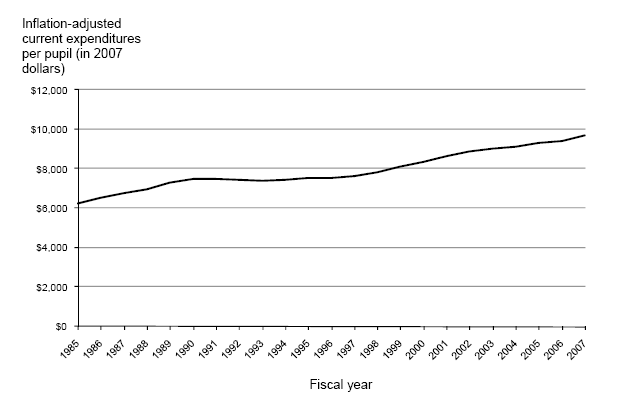
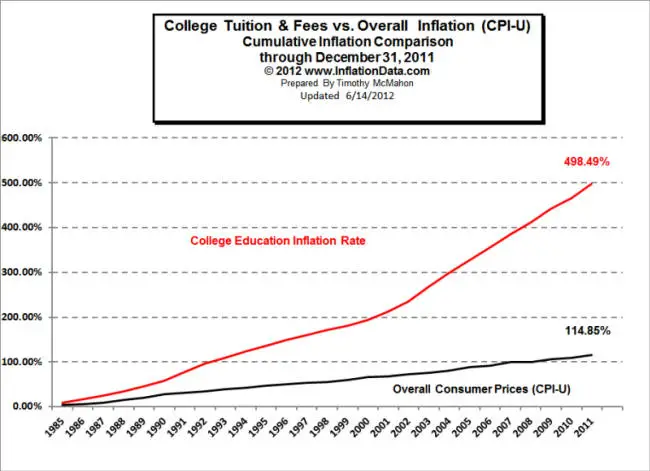
As part of not getting my stride back today, and inspired by my success at finally locating an income chart that includes medical benefits, I tracked down inflation charts on:

public education spending (and here)
college spending
health care spending

Gadzooks.

Good thing apparel prices have been falling or we'd all be walking around naked. Walking around naked or, alternatively, walking around fully clothed with a whopper of a student apparel loan to pay off.


And while we're on the topic of mind-boggling and rising prices for the big stuff, as opposed to reasonable and falling prices for the little stuff, why do I have to keep hearing about housing bubbles when the really huge bubbles seem to be tuition and health care?

speaking of the middle class

re: Grace's post "We all want to be middle class" (and other posts on this subject)

I finally found an income chart that includes medical benefits:

Concerned About Income Stagnation? Blame Rising Health Insurance Costs 
(I haven't fact-checked the chart.)

Every time I see articles about stagnating wages, I want to know whether benefits are or are not part of wages. Assuming benefits are not included in most estimates of wages, and assuming this chart is accurate, what we see is health insurance eating up what would have been a nice, steady series of raises.

Good thing we can all buy cheap electronics from China--!