kitchen table math, the sequel

Thursday, April 24, 2008

chunking

[P]ractice changes the way a task is perceived. A chess master, for example, can look at a game in progress for a few seconds and then perfectly reconstruct that same position on a blank chessboard. That’s not because chess masters have great memories (they don’t have the same knack when faced with a random arrangement of pieces) but because hours and hours of chess playing have enabled them to do what psychologists call “chunking.” Chunking is based on the fact that we store familiar sequences—like our telephone number or our bank-machine password—in long-term memory as a single unit, or chunk. If I told you a number you’d never heard before, though, you would be able to store it only in short-term memory, one digit at a time, and if I asked you to repeat it back to me you might be able to remember only a few of those digits—maybe the first two or the last three. By contrast, when the chess masters see the board from a real game, they are able to break the board down into a handful of chunks—two or three clusters of pieces in positions that they have encountered before.

In “The Game of Our Lives,” a classic account of the 1980-81 season of the Edmonton Oilers hockey team, Peter Gzowski argues that one of the principal explanations for the particular genius of Wayne Gretzky was that he was hockey’s greatest chunker. Gretzky, who holds nearly every scoring record in professional hockey, baffled many observers because he seemed to reverse the normal laws of hockey. Most great offensive players prefer to keep the rest of the action on the ice behind them—to try to make the act of scoring be just about themselves and the goalie. Gretzky liked to keep the action in front of him. He would set up by the side of the rink, or behind the opposing team’s net, so that the eleven other players on the ice were in full view, and then slide the perfect pass to the perfect spot. He made hockey look easy, even as he was playing in a way that made it more complicated. Gzowski says that Gretzky could do that because, like master chess players, he wasn’t seeing all eleven other players individually; he was see ing only chunks. Here is Gzowski’s conclusion after talking to Gretzky about a game he once played against the Montreal Canadiens.... :
What Gretzky perceives on a hockey rink is, in a curious way, more simple than what a less accomplished player perceives. He sees not so much a set of moving players as a number of situations. . . . Moving in on the Montreal blueline, as he was able to recall while he watched a videotape of himself, he was aware of the position of all the other players on the ice. The pattern they formed was, to him, one fact, and he reacted to that fact. When he sends a pass to what to the rest of us appears an empty space on the ice, and when a teammate magically appears in that space to collect the puck, he has in reality simply summoned up from his bank account of knowledge the fact that in a particular situation, someone is likely to be in a particular spot, and if he is not there now he will be there presently.

The Physical Genius
by Malcolm Gladwell


This is what Carolyn meant when she talked about math being a seamless whole. (I think.)

can you FOIL the answers? part 2

answer: yes

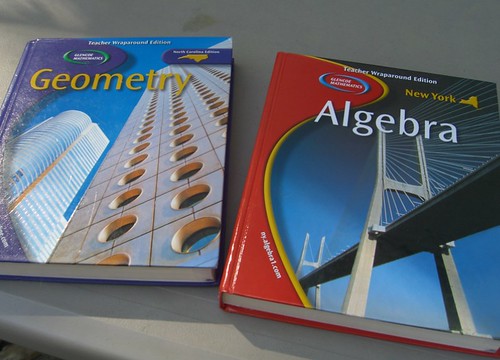
Teacher Editions of textbooks are subject to Freedom of Information Law requests, and my district has now provided me with the Teacher Wraparound Editions for Glencoe Geometry (New York) and Glencoe Algebra (New York).


ISBN numbers:
Glencoe Algebra New York (full title)
ISBN: 0-07-873316-2 0078733162 Student Edition
ISBN: 0-07-873317-0 0078733170 Teacher Wraparound Edition

Glencoe Geometry New York (full title)
ISBN: 0-07-873320-0 0078733200 Student Edition
ISBN: 0-07-873321-9 0078733219 Teacher Wraparound Edition

The North Carolina Teacher Wraparound Edition of Glencoe Geometry is identical to the New York edition:
ISBN: 0-07-860178-9 Teacher Wraparound Edition North Carolina


Feedback is essential to learning. Period. If your child's school does not collect and correct homework or perform formative assessment, it's up to you.

If it's up to you to collect and correct homework and remediate gaps, then you are going to need the Teacher Wraparound Edition. Freedom of Information Law requires that your district provide it to you when asked.


Teacher Wraparound Editions for Glencoe Algebra & Geometry, New York

On the picnic table.


state test coming right up (2006)
throwing money at the problem
more stuff only teachers can buy
help desk 1
state test coming right up (2007)
help desk 2
my life and welcome to it
canadianteacher.com
progress report
despair
28 out of 30

all the answers are belong to us
email to the math chair
second request
teacher's manual
it would be unusual
inflammatory
2 weeks off

can you FOIL the answers?
can you FOIL the answers? part 2

Bill Ayers is not a “professor of English”

In fact, he is a tenured Distinguished Professor of Education at the University of Illinois, Chicago.

I haven’t heard if Obama has corrected himself on this. However, this is what I'm interested in:

The more pressing issue is not the damage done by the Weather Underground 40 years ago, but the far greater harm inflicted on the nation’s schoolchildren by the political and educational movement in which Ayers plays a leading role today.

[...]


Instead of planting bombs in public buildings, Ayers now works to indoctrinate America’s future teachers in the revolutionary cause, urging them to pass on the lessons to their public school students.

[…]

Ayers’s influence on what is taught in the nation’s public schools is likely to grow in the future. Last month, he was elected vice president for curriculum of the 25,000-member American Educational Research Association (AERA), the nation’s largest organization of education-school professors and researchers. Ayers won the election handily, and there is no doubt that his fellow education professors knew whom they were voting for. In the short biographical statement distributed to prospective voters beforehand, Ayers listed among his scholarly books Fugitive Days, an unapologetic memoir about his ten years in the Weather Underground. The book includes dramatic accounts of how he bombed the Pentagon and other public buildings.

Sol Stern in the City Journal

Maybe the media should be questioning Obama and McCain about their views on Ayers in this influential position. Some readers might believe doing so would be a demonstration of “gotcha” politics, but I really would like to hear their answers.

Wednesday, April 23, 2008

bullying stats

I seem to be on various edu-p.r. lists these days, which is interesting. Today's "Media Advisory," from "The National School Boards Association's Council of Urban Boards of Education," contains this result from a survey of "10,270 parents in 112 urban schools from 17 states":
Bullying continues to be an issue at school. Little more than half of the parents surveyed felt that teachers had the ability to stop bullying, with close to 30 percent not sure if this was possible. More than 25 percent of parents have spoken to an administrator about bullying. Parents with students in the middle grades (6-8) were the largest group (nearly 11 percent) to report that their child was bullied during the school day at least once per month.
I'd love to know what figures you'd see in a survey of suburban, parochial, & private school parents.

something else I didn't know

For $43, the College Board will send you a copy of the test you took, your original answer sheet and a breakdown of correct and incorrect answers — providing a useful way to assess your weak spots, as well as to find a score-sheet mistake or some terrible injustice.

Appealing a Test Score

help! help!

A couple of weeks ago I downloaded a report on schools that had successfully raised the achievement of their students.

What was interesting about this report was that it included charts showing that as black students' scores rose, white students' scores rose, too. I was planning to do a screen grab of the charts....and now, instead of posting a screen grab, I'm spending hours of my life doing Spotlight & Google searches.

Any idea what report I'm talking about?

(And, yes, I have come to a sorry pass. If anyone should know what I'm talking about, it should be me. You would think.)

palisadesk on Ruby Payne & poverty

I wanted to get this comment from palisadesk up front:

I found Ruby Payne’s Framework book and articles to be worthy of discussion and very thought provoking, but also to be taken with a large dose of sodium chloride. Two egregious errors that infuse her work are overgeneralizing and reifying abstractions. She speaks of “children in poverty” and “people in poverty” as if poverty is a singular entity with clearly defined boundaries and a shared ecosystem. This is simply not the case.

There’s a big difference between, say, multi-generational urban poverty and the poverty of new immigrant families. There’s a big difference between rural poverty and urban poverty – even a big difference between the way the rural poor in agricultural communities see the world, and the way the non-urban poor in mountainous or northern communities view things. “Poverty” looks different in these varying situations, too.

Her over-simplistic characterization of a “culture of poverty” can be insidious. She has some important insights, but her overgeneralizing weakens their power and does indeed lead to the kind of stereotyping she deplores.

The viewpoints she represents as characteristic of "poverty" are amalgams at best. Even in an urban, low-income school community, we see “subcultures” where there is a strong future-time orientation, an emphasis on effort and achievement, minimal reliance on physical force to settle disagreements, etc. Different cultures exist within the larger group which Payne characterizes as “people in poverty.” Poverty is not a place, and it is (thankfully) often a temporary condition for families.

I had many insights while reading her book, and so am disappointed I can’t heartily recommend it because it goes well beyond available data and tends to perpetuate generalizations about groups of people. Her point about resources available to kids is extremely well-taken, however. I was in one school where the classrooms had no books, pencils, paper – nothing. The library was a joke (nothing new since 1954). Sure, we could teach kids how to read by writing words on the (battered and cracked) chalkboard, and photocopying stories from the public library, but really, nothing the teacher could do would compensate for the fact that there was NO way for the students to practice the skills taught and their environment – including their school environment – militated against it. There are schools like this in every large metropolitan area, I’m willing to bet. Schools where rats scurry around and buckets catch rainwater from leaking ceilings.

It doesn’t need to be an either/or situation – the precision teaching motto, “do both” is good advice here. We should endeavor both to provide the needed supports outside of school (medical care, decent housing, recreational opportunities etc.) for children and also concentrate on what we offer them in school in terms of solid instruction that will help them determine their own destiny. As things stand, schooling tends to widen the gap, rather than narrow it. We have not really come to grips with this.

My understanding of the situation is that our schools are widening the gap. True of black and, I assume, Hispanic children compared to white peers; true of white children compared to their peers in Europe and Asia.

you mean watching TV isn't school?

from the HSLDA:

A Georgia Home School Legal Defense Association member family recently received an unexpected visit from a social worker. The social worker explained that he had received an anonymous tip alleging that the family was not educating their children, allowing them instead to watch videos all day. The family did not allow the social worker into their home, but did allow the social worker to meet their children out on the front porch, at which time the children voluntarily showed the social worker their daily schoolwork.

I laughed when I saw this because I'd just talked to a friend of mine who subs a lot:
I used to be nervous every time I went in to sub. I'd get there early so I could read the lesson plan. But now, I don't know how long it's been since I've seen a lesson plan. I'll look at the teacher's lesson book and see "Work on projects" written in on Monday with an arrow going across the other 4 days. Or I'll see "Watch movie."

And let us not forget Richard Elmore:
My favorite story, which is now increasingly confirmed by the aggregate analysis of block scheduling*—the current structural reform du jour of secondary education—involves a high school social studies teacher I interviewed recently. I asked him, “So what do you think of block scheduling?” He said, “It’s the best thing that’s ever happened in my teaching career.” I asked, “Why?” And he said, “Now we can show the whole movie.”

The Limits of “Change”

So....say you've got a high school biology teacher who's having his students draw and color pictures of animals and organelles during class time.

Can you get a social worker to make a surprise visit?


* Our middle school has an identified need for block scheduling.

Tuesday, April 22, 2008

Math in the late 1800's

Don Potter sent me a link to an interesting 1879 math book in Google Books, "Graded Work in Arithmetic" by S. W. Baird. It has an interesting visual method of showing fractions similar to how they're depicted in Math-U-See. (The unexpected results of web searches, when "Graded Work in Arithmetic" comes up under a search for "phonics charts." There are, of course, ads for phonics charts, McGuffey Readers, and some other books and visual aids at the end of the book.)

Looking through "Graded Work in Arithmetic" prompted me to look up Baird's "American Mental Arithmetic," which was even more interesting. His explanation of fractions for this book used a different method than his 2nd grade book and showed a number line explanation along the lines of Wu.

Also, his preface had the following statement (page 3 in the book, page 5 in google book pages)
"Many who have broken the habit, in adding, of saying "6 and 8 are 14 and 6 are 20," are still saying in subtracting, "6 from 10 leaves 4" ; in multiplying, "9 times 8 are 72, and 4 are 76" ; and in dividing, "12 [divided by sign] 5 = 2 and 2 remaining." Special stress is laid upon the improtance, in performing operations, of dropping all unnecessary words, since the mind reaches results much more rapidly without them."
Interestingly, Don Potter has told me in the past that his father could multiply with lightning quickness and would always say "five 3's are 15" instead of today's common "five times 3 equals 15." I've only taught Mary a few multiplication facts, but I try to follow the two 5's are 10 pattern when teaching her in case there is something to this...I figure it can't hurt and could be helpful. I still teach what the equals sign is and what it means, but I always have her say the shorter are instead of equals when reciting addition and multiplication facts out loud. (Are may also be less abstract than equals as well as shorter.)

Bailey also states,
"Percentage is taught without rules or formulae, and without the use of the terms base, amount, and difference, although one page is devoted to the after the subject has been completed. The student comes to see clearly that the various exercises in percentage do not need special rules, but are familiar cases slightly modified since the symbol "%" is used instead of hundredths. Interest is taught by the 6% mehtod and by the modification of this method in general use among bankers."
His concluding sentence of the preface is,
"Let it be remembered, that he who relies upon thousands of special rules is but a pygmy beside the giant who can apply a score of general principles to millions of particulars."
Perhaps we're the pygmies today for throwing all this out with the bathwater without trying to figure out if there were reasons for some of the things that were taught and some of the methods that were used to teach in the past.

data-driven loops & noise

more from anonymous on data-driven instruction:

There are two kinds of data loops in play. The first, I'll call loop 1. The second I'll call loop 2.

Loop 1 is the "We've measured your school's performance and found it lacking" loop. This is aggregated data that has been massaged to produce your AYP (measure of Adequate Yearly Progress, Mass. MCAS). From this measure, schools are to produce a School Improvement Plan (SIP) which is basically goal setting sans concomitant resources to actually effect a change. Since the SIP is a dead end, that particular loop looks more like a croquet wicket. It's not a loop at all.

Loop 2 is the "Your last year's students failed MCAS" loop which is given to teachers about 5 months after the students in question have left your embrace. Usually this is aggregated also, at least in my school it was handed to us on a printout. I had granularity down to the question but not down to the student.

Somewhere in this measurement system is precise, standard by standard knowledge of each student's current (actually 5 month old) ability. We don't get that.

The real problem is that loop 1 should be used for "oh my, I think we need a remediation here" and it is used for "oh my, time to reset the goal posts." If loop 1 is not used to drive some kind of structural change, then anything you learn (and you can't learn much) in loop 2 becomes a 'nice to know' kind of thing but it doesn't fix Johnny's inability to add.

Data not acted upon is noise and old data is rancid.

Call me crazy, but I don't see the problem here.

This school should just tell all its struggling students to Seek Extra Help.

Then, when the struggling students don't Seek Extra Help, or do Seek Extra Help but Extra Help doesn't Help, they should tell the parents, "If your child doesn't come in for Extra Help, there's nothing I can do."*

That's what my school does.

It works, too.


* direct quote

more fun with numbers
data-driven instruction redux
data-driven loops & noise

Bill Gates on U.S. high schools (the good ones, too)

Bill Gates, the founder of Microsoft, offered a brutal critique of the nation’s high schools a few years ago, describing them as “obsolete” and saying, “When I compare our high schools with what I see when I’m traveling abroad, I am terrified for our work force of tomorrow.”

Said Mr. Gates: “By obsolete, I don’t just mean that they are broken, flawed or underfunded, though a case could be made for every one of those points. By obsolete, I mean our high schools — even when they’re working as designed — cannot teach all our students what they need to know today.”

Clueless in America

Bleg: how to assess math skills?

Do any of you have any insight/experience/pointers to finding reasonable assessment materials for a entire class of students?

I'm involved in helping a startup school, and while this isn't the biggest issue right now, sooner or later, it should be. The students will be in 9th grade in the fall, and we guess that they will have some pretty wide ranging math backgrounds. (Some were homeschooled; some were in parochial school; some were in public school. Some used Saxon, others hadn't heard of it, etc.) The school is little, of course, since it's just starting, so everyone would like it if magically, all of the kids were at the same grade/skill level (and could be put in one class.) Most will supposedly have had algebra 1, but could we really assume that means something? How will we know how strong their general arithmetic, fractions, etc. skills are?

So I've been looking to see what's available for free, and what's available for purchase in terms of assessment materials. Worst case, I'd design my own tests, but I'm concerned that my naivete will lead to big gaps in what I should have been querying, or lead me to incorrect conclusions about what they know/don't know because I wrote a poor test.

Ideally for ease and simplicity, the test would be standardized, instead of someone interviewing each student, but does anyone have experience with interaction based assessment as well? Where should I start?

Mental Math link

I spent the morning with my new friend Angela McIver, who evaluates the math skills of middle-schoolers and older children. I saw some fascinating videos of children struggling through basic math problems in ways that suggested huge gaps in their elementary school instruction.

Angela is a big proponent of mental math, which Reform Math programs not only marginalize, but, in insisting on explained answers, actually mark children off for. Among other things, mental math forces you towards maximally efficient strategies, with all the mathematical insights this entails.

She recently searched the Internet for mental math activities, and just sent me a good link.

Why Memorize the Math Facts?

This is from Hoagies' Gifted Pages, and was written by Aimee Yermish, Educational Consultant

Why Memorize Math Facts?


I think there's a basic problem here that we as the parents of gifted children must come to terms with. Not all useful learning is intrinsically interesting. Our kids have a right not to be bored in that they should not be held down, but they do not have a right not to be bored such that they have a right to skip anything that isn't fun to learn. Math facts are boring. Absolutely. But that doesn't mean that our precious children who don't tolerate boredom well shouldn't have to learn them. We have to teach our kids the difference between being bored because you are being taught something you have already mastered and being bored because the work is intrinsically boring but still important. We can turn our fertile brains towards making the practice fun and interesting, if we don't tolerate boredom well, but we don't get to just declare ourselves to be so brilliant that no one should ever make us do anything we don't feel like doing.
From AutoSkill, a provider of software (not an endorsement -- haven't yet looked into the products)

Why Automaticity in Math Facts?


The notion is that the mental effort involved in figuring our facts tends to disrupt thinking about the problems in which the facts are being used. Some of the argument of this information-processing dilemma was developed by analogy to reading, where difficulty with the process of simply decoding the words has the effect of disrupting comprehension of the message. Gersten and Chard illuminated the analogy between reading and math rather explicitly:

"Researchers explored the devastating effects of the lack of automaticity in several ways. Essentially they argued that the human mind has a limited capacity to process information, and if too much energy goes into figuring out what 9 plus 8 equals, little is left over to understand the concepts underlying multi-digit subtraction, long division, or complex multiplication (1999, p.21)."...Practice is required to develop automaticity with math facts.

"The importance of drill on components [such as math facts] is that the drilled material may become sufficiently over-learned to free up cognitive resources and attention. These cognitive resources may then be allocated to other aspects of performance, such as more complex operations like carrying and borrowing, and to self-monitoring and control (Goldman & Pellegrino, 1986. 134)."

I have a new academic therapy client, a delightful 4th grade boy on the spectrum. For various reasons, he missed a lot of 1st and 2nd grade. Academically, arithmetic is his weakest link. As nearly as I can determine, the only math facts he has to automaticity are adding and subtracting 0, 1, and 2 for even numbers, and multiplying by 1 and 2 for even numbers. Everything else requires him to actually do the calculation in his head or worse yet, his fingers. Calculation--> frustration--> anxiety--> decreased cognitive ability--> frustration--> anxiety--> decreased cognitive ability ...

I have three challenges: convincing him that putting the work in to getting to automaticity is going to be worth it, finding the methods that work most efficiently for him (flash cards aren't it), and keeping his anxiety low enough that he can learn.

Any and all suggests for the three challenges gratefully accepted.

Mead Flex NoteBinders


I love these things.

They cost an arm and a leg ($13 each) so I'm racking up credit card debt ordering "NoteBinders" for my next book project, for math notes, for Earth Science Regents test review materials (we need a huge amount of Earth Science Regents review around these parts, I'm sorry to say), for edu-articles printed out from the web, cognitive science articles, the Hake Writing Program (which comes in looseleaf pages), and God knows what else.

(You'll need a labeler if you're going to have lots of NoteBinders lying around the place.)

What's cool about the NoteBinder is that it's a cross between a notebook and a binder. You can open it up and lay the pages flat or fold the cover all the way back, as you can a spiral notebook; you can also move pages around & insert tabbed dividers as you can in a 3-ring binder.

drawbacks: The NoteBinders are a bit time-consuming and awkward to use because each ring has to be opened and closed individually. Also, since the rings are made of flexible plastic it's difficult-to-impossible to insert a big wad of new pages in one fell swoop as you can with metal rings.

I can't tell if NoteBinders would work for kids. My best guess is: "not really." One of the reviews on epinion says they're good for middle school kids; a couple of other reviews say the rings break inside a backpack.* Before spending $13 on one of these babies for a middle-school aged child, I would take a look at Andromeda's advice for organizing a middle school child's school work. I suspect she would nix these.

I'm thinking these might be useful for organizing study materials a student is going to review at home. (If teachers have thoughts - let us know. Teachers & parents, too.)

I can't tell whether NoteBinders would hold up well under high school or college use.

They're incredibly helpful for me, which is about all I can say.

The only place I've found to buy them so far is Office Depot.


* I may have located the single sturdiest 3-ring binder on the market: the Wilson Jones Active-Use Locking Round Ring Binder. The covers are indestructible; haven't tested out the rings themselves yet. Found them at Office Depot. Here it is in midnight blue. Not cheap ($9.89) but not as bad as the NoteBinder.


Mead Flex NoteBinders at Office Depot
epinion reviews of NoteBinder
Andromeda on organization and the middle school child
Write the Other Way

data-driven instruction redux

a comment on data-driven instruction left by Anonymous:

Don't even get me started on this one! I'm in a district that places heavy emphasis on being "data driven". In spite of this emphasis, teachers don't have access to much of the data. They are either lacking hardware, privileges, or timeliness to make it accessible and relevant. This is all before we get to the training issues.

Worse, let's say your data tells you that Johnny is in the sixth grade and can't add, there is no system in place to do anything about it. Sure, you can try to get him to stay late for help or you can differentiate in class (at the expense of what he's supposed to be current with). But, there is no way (especially with 50% of your kids in this condition) to get Johnny remediated.

As long as curriculum fills every inch of available space, teachers aren't going to use objective data to replace subjective data when neither can be used as a force for change.


Interesting.

Tell us more if you get a chance.

And thanks!


more fun with numbers
data-driven instruction redux
data-driven loops & noise

Monday, April 21, 2008

more fun with numbers

In our non-degree professional development programs at Harvard University, I have taken to routinely asking the assembled administrators and teachers how many of them have taken a basic course on educational measurement. In an audience of 50 to 100 participants, the usual count is two or three. These people are usually “ringers”—they are typically assistant superintendents for measurement and evaluation. That is, they run the testing operation in their school systems. Now, imagine what the state of health care would be if practicing physicians didn’t know how to read EKGs, EEGs or chest x-rays, didn’t know how to interpret a basic blood analyses, or didn’t know anything about the test-retest reliability of these simple diagnostic measures. Imagine what it would be like if your basic family practitioner in a health maintenance organization didn’t know how to interpret a piece of current medical research questioning the validity of the standard test for colo-rectal cancer. Imagine what it would be like to be a practitioner in a health care organization in which every piece of evidence required for patient care came from a standard test of morbidity and mortality administered once a year in the organization. The organization you are imagining is a school system.

Leadership as the Practice of Improvement (pdf fie)
Richard F. Elmore

This probably accounts for the existence of books with titles like: Getting Excited about Data Second Edition: Combining People, Passion, and Proof to Maximize Student Achievement by Edie L. Holcomb.

This text is actually written in language that educators can understand, even if they aren't especially data-savy. The guidelines for incorporating data for school improvement are actually practical and easy to replicate. A great guide for joining the data-driven school improvement movement!
5 stars

In theory, my district is using data to inform instruction. We have a data warehouse.

Thus far, however, the data is apparently showing that all learning problems in the gen-ed population can be attributed to student failure to Seek Extra Help. Either that, or Weak Inferential Thinking.

Which is pretty much what all learning problems were attributed to before we had a data warehouse as far as I know.


more fun with numbers
data-driven instruction redux
data-driven loops & noise

The Race between Education and Technology - book review

book review:

What accounts for rising inequality [of income]? Some pundits are tempted to look inside the Beltway for a cause, but the case is hard to make. Government policy makers do not have the tools to exert such a strong influence over pretax earnings, even if they wanted to do so.

Also, the trend toward increasing inequality has been fairly steady, despite changing political winds. The income share of the richest families increased substantially both during Ronald Reagan’s eight years in office and during Bill Clinton’s.

The best diagnosis so far comes from two of my Harvard colleagues, Claudia Goldin and Lawrence F. Katz, in their forthcoming book “The Race Between Education and Technology” (Harvard University Press). Professor Goldin is an economic historian, and Professor Katz is a labor economist who briefly worked in the Clinton administration. Their bottom line: “the sharp rise in inequality was largely due to an educational slowdown.”

According to Professors Goldin and Katz, for the past century technological progress has been a steady force not only increasing average living standards, but also increasing the demand for skilled workers relative to unskilled workers. Skilled workers are needed to apply and manage new technologies, while less skilled workers are more likely to become obsolete.

For much of the 20th century, however, skill-biased technological change was outpaced by advances in educational attainment. In other words, while technological progress increased the demand for skilled workers, our educational system increased the supply of them even faster. As a result, skilled workers did not benefit disproportionately from economic growth.

But recently things have changed. Over the last several decades, technology has kept up its pace, while educational advancement has slowed down. The numbers are striking. The cohort of workers born in 1950 had an average of 4.67 more years of schooling than the cohort born in 1900, representing an increase of 0.93 year in each decade. By contrast, the cohort born in 1975 had only 0.74 more years of schooling than that born in 1950, an increase of only 0.30 year a decade.

Because growth in the supply of skilled workers has slowed, their wages have grown relative to those of the unskilled. This shows up in the estimates of the financial return to education made by Professors Goldin and Katz. In 1980, each year of college raised a person’s wage by 7.6 percent. In 2005, each year of college yielded an additional 12.9 percent. The rate of return from each year of graduate school has risen even more — from 7.3 to 14.2 percent.

The Wealth Trajectory: Rewards for the Few
By N. GREGORY MANKIW

I've been assuming that something like this was the case for the last four years. Sounds like this book is going to nail it down, or come close.


Steve Levitt summarizes The Race in 2 sentences
Jimmy graduates

The anemic response of skill investment to skill premium growth
The declining American high school graduation rate: Evidence, sources, and consequences
Pushy parents raise more successful kids

The Race Between Education and Technology book review
The Race Between Ed & Tech: excerpt & TOC & SAT scores & public loss of confidence in the schools
The Race Between Ed & Tech: the Great Compression
the Great Compression, part 2
ED in '08: America's schools
comments on Knowledge Schools
the future
the stick kids from mud island
educated workers and technology diffusion
declining value of college degree
Goldin, Katz and fans
best article thus far: Chronicle of Higher Education on The Race
Tyler Cowan on The Race (NY Times)
happiness inequality down...
an example of lagging technology diffusion in the U.S.

the Times reviews The Race, finally
IQ, college, and 2008 election
Bloomington High School & "path dependency"
the election debate that should have been

LooLoo


How did I come by this, you ask?

  • first stop: Wall Street Journal, under new management;
  • 2nd stop: "The Blogger Mom, In Your Face," (Lots of businesses get hate mail, but few owners react the way Heather Armstrong does. She prints out nasty emails, puts them in her driveway and drives over them with her car. "That's the attitude I have," she says, "and it's made my life a thousand percent better.")
  • and from there to dooce.com, et voilà.


These days, reading the Journal, I feel a bit like the shy kid on the first day of preschool:

Randy Bothwell, a police detective in Chester, Pa., considered and rejected a number of ways to rid his yard of bamboo: salt, an exorcism, shooting it with his service revolver. When he asked for advice at a local garden center, he says, they "laughed hysterically."

So Mr. Bothwell whacked the stand with a machete. It grew back. He bought a pickax and tried digging up the roots, a process that traced a 30-foot arc across his once-pristine lawn. One month and two broken shovels later, he rented a Bobcat minibulldozer and a big metal trash bin, acquired 14 gallons of poison and bought 24 cubic yards of dirt to fill the resulting hole. Total approximate cost: $1,500.

One year later, a single shoot appeared. "It gave me ... the final salute." Mr. Bothwell says. "I was like, 'Mother of God.' "

Call the Pandas: Bamboo Engulfs Defenseless Yards
by Matthew Rose


As fun as that sounds, I find myself thinking that what I'd like to do is just stand here by the cubbyholes and watch the other kids for the next six or seven months or so.

I don't know why.

Sunday, April 20, 2008

John McWhorter on "oral culture" and the direct quesstion

Have only skimmed Liz's post on Ruby Payne, on Ruby Payne, but it prompted me finally to get this passage from a John McWhorter column up. I had no idea -- none -- that "oral culture" was linguistically different from whatever culture it is I live in:
One wonders whether people .... truly understand what barriers poor kids face to learning how to read in a truly functional way. In countless American communities, flyers are routinely full of major misspellings, more than a few are only fitfully comfortable with e-mail, and few read newspapers above the tabloid level. Life is fundamentally oral.

Students from places like this — which include Appalachia and the rural white South as much as black and brown inner cities — get next to no reinforcement from home life in acquiring comfort with the written word. Eternally dismal reading scores make it clear that a school day ending at 3 p.m. is not alleviating the problem. We have become sadly familiar with every second black 8th grader reading below basic level.

Reading is not the only cultural hurdle. In black culture, for example, the direct question is not as central to normal communication as it is in mainstream culture (consult, for example, Shirley Brice Heath's "Ways With Words"). For kids from this kind of setting, getting comfortable with being asked point-blank "When was the Declaration of Independence written?" and answering clearly and directly takes work. Many black people of working-class or poor background mention how ticklish this kind of interaction felt when they first went to a decent school.

Direct questions as regular interaction are largely an epiphenomenon of the printed page. Most humans on earth lead fundamentally oral lives in the linguistic sense, and need to adjust to direct questions. Middle class American kids inhale them at the kitchen table. Poor kids learn how to deal with them in school, and it takes practice.

One objection is that supposedly, in the old days even poor kids just sat down in school and learned what they needed to know. But the grandparents who recount this were among the sliver of poor kids who even made it through school. A century ago, only 14% of native-born American kids even made it to high school, and more to the point, only 2% of Italian and Polish immigrant kids did.

Here is Betty Smith in "A Tree Grows in Brooklyn" on what poor children's schools were really like one hundred years ago this year:

"Brutalizing is the only adjective for the public schools of that district around 1908 and 1909. Child psychology had not been heard of in Williamsburg in those days. ... Few teachers had the true vocation for their work. They taught because it was one of the few jobs open to them; because they had a long summer vacation; because they got a pension when they retired."

Few children stayed around in places like this any longer than necessary. Today, however, even low-skill service jobs require a basic comfort with the written word. A school day that ends at 3 p.m., in the America that we live in, isn't enough to give that to people from bookless homes whose parents are unsure how to make the system work for their kids.

Fighting Words in Education Crowds
John McWhorter February 28, 2008
NY Sun
It never crossed my mind to think of "direct questions" as anything other than utterly natural and universal.

Saturday, April 19, 2008

Ruby Payne: Nine strategies help raise the achievement of students living in poverty

Educational Leadership, April 2008, | Volume 65 | Number 7
Poverty and Learning Pages 48-52

Students from families with little formal education often learn rules about how to speak, behave, and acquire knowledge that conflict with how learning happens in school. They also often come to school with less background knowledge and fewer family supports. Formal schooling, therefore, may present challenges to students living in poverty. Teachers need to recognize these challenges and help students overcome them. In my work consulting with schools that serve a large population of students living in poverty, I have found nine interventions particularly helpful in raising achievement for low-income students.

1. Build Relationships of Respect
2. Make Beginning Learning Relational (Collaborative)
3. Teach Students to Speak in Formal Register ("academic language")
4. Assess Each Student's Resources
5. Teach the Hidden Rules of School
6. Monitor Progress and Plan Interventions
7. Translate the Concrete into the Abstract
8. Teach Students How to Ask Questions
9. Forge Relationships with Parents

More detail:
Update:
(a) the following has been misread by more than one commenter. As I understand Payne's work, the point of the "Assess Each Student's Resources" strategy is for the teacher to
examine, not assume, the extent of the student's resources in each of the eight domains. Let us take the "physical health" domain--a teacher may assume that the child's vision is excellent, because the child doesn't wear glasses, when in fact, the child's vision is poor and has never been evaluated.

(b) the "spiritual domain". Not to my preferences. However, let us take a non-trivial example: in the United States, a high-school student who had never even heard of Adam and Eve, the Garden of Eden, Cain and Abel, Abraham and his son, Moses, or any of the New Testament stories will struggle in both history and literature classes.

4. Assess Each Student's Resources

School success, as it's currently defined, requires a huge amount of resources that schools don't necessarily provide. Teachers need to be aware that many students identified as "at risk" lack these outside resources. Interventions that require students to draw on resources they do not possess will not work. For example, many students in households characterized by generational poverty have a very limited support system. If such a student isn't completing homework, telling that student's parent, who is working two jobs, to make sure the student does his or her homework isn't going to be effective. But if the school provides a time and place before school, after school, or during lunch for the student to complete homework, that intervention will be more successful.

  • Financial: Money to purchase goods and services.
  • Emotional: The ability to control emotional responses, particularly to negative situations, without engaging in self-destructive behavior. This internal resource shows itself through stamina, perseverance, and good decision making.
  • Mental: The mental abilities and acquired skills (such as reading, writing, and computing) needed for daily life.
  • Spiritual: Some belief in a divine purpose and guidance.
  • Physical: Good physical health and mobility.
  • Support systems: Friends, family, and resource people who are available in times of need.
  • Relationships and role models: Frequent contact with adults who are appropriate role models, who nurture the child, and who do not engage in self-destructive behavior.
  • Knowledge of unspoken rules: Knowing the unspoken norms and habits of a group.
5. Teach the Hidden Rules of School

People need to know different rules and behaviors to survive in different environments. The actions and attitudes that help a student learn and thrive in a low-income community often clash with those that help one get ahead in school. For example, when adult family members have little formal schooling, the student's environment may be unpredictable. Having reactive skills might be particularly important. These skills may be counterproductive in school, where a learner must plan ahead, rather than react, to succeed. If laughter is often used to lessen conflict in a student's community, that student may laugh when being disciplined. Such behavior is considered disrespectful in school and may anger teachers and administrators....

The simple way to deal with this clash of norms is to teach students two sets of rules. I frequently say to students

You don't use the same set of rules in basketball that you use in football. It's the same with school and other parts of your life. The rules in school are different from the rules out of school. So let's make a list of the rules in school so we're sure we know them.

8. Teach Students How to Ask Questions

When you have asked a student what part of a lesson he or she didn't understand, have you heard the reply, "All of it"? This response may indicate that the student has trouble formulating a specific question.

Questions are a principal tool to gain access to information, and knowing how to ask questions yields a huge payoff in achievement (Marzano, 2007). In their research on reading, Palincsar and Brown (1984) found that students who couldn't ask good questions had many academic struggles.

To teach students how to ask questions, I assign pairs of students to read a text and compose multiple-choice questions about it. I give them sentence stems, such as "When ___________ happened, why did __________ do ___________?" Students develop questions using the stems, then come up with four answers to each question, only one of which they consider correct and one of which has to be funny.


I highly recommend that you read the whole article. Of course, the Nine Strategies are also useful in all classrooms.


update - Catherine here, parachuting into Liz' post. (I hope she won't mind.)

Just thought I'd put in a link to the Times article on Payne along with a link to my follow-up on oral cultures and direct questions.

The NMP recognizes giftedness -- Part 1


(Cross-posted from After The Math Panel, a blog originating from Ridgewood, New Jersey which analyzes the findings of the Presidential National Math Panel.)

Gifted. It's a simple word that evokes strong reactions. But what is it?

According to the National Association for Gifted Children, it's hard to pin down:

National Association for Gifted Children:

The quick response is that there is, as yet, no universally agreed upon answer to this question. Giftedness, intelligence, and talent are fluid concepts and may look different in different contexts and cultures. Even within schools you will find a range of personal beliefs about the word "gifted," which has become a term with multiple meanings and much nuance.

NAGC does not subscribe to any one theory of the nature of human abilities or their origins. We assert that there are children who demonstrate high performance, or who have the potential to do so, and that we have a responsibility to provide optimal educational experiences for talents to flourish in as many children as possible, for the benefit of the individual and the community.


So, giftedness is hard to define, hard to test, has many philosophies and contexts. Add to that our current culture of keeping everyone label-free, plus a valid concern with assigning unlimited potential to all, and strong parental feelings about their own child's abilities, and it's a slippery slope at best.

Then why do well-established organizations such as the NAGC and our local Gifted Child Society of Northern New Jersey exist?

The short answer is because it's important, and throwing the baby out with the bathwater will not solve the problem. Better to address the issue, stated above: "We assert that there are children who demonstrate high performance, or who have the potential to do so, and that we have a responsibility to provide optimal educational experiences for talents to flourish in as many children as possible..."

Don't our schools do that? comes the question. No, they don't. When you consider that public school must meet certain minimum standards, must cater to the middle, and is designed not for individuals but for groups, you can see where kids with high potential, intense interest, or unusual ability will fall through the cracks.

In their defense, many schools do better than ever today to individualize instruction. But alas, even in the best schools, some kids methodically learn to be underachievers. When you consider that our best and brightest are needed to compete in a global economy, this is a terrible fact to face.

Thankfully, for the purposes of this blog, we can at least restrict our concerns to that of mathematical giftedness. But even that is a quagmire.

The National Math Panel's view of giftedness cannot be covered in one day. This topic will stretch out over a few entries.

Suffice it for today to say that despite our era of political correctness, and all the difficulties outlined above, the National Math Panel--a government entity--has done the bold thing, and set giftedness back on the map. Mathematical giftedness must be really, really important.

That in itself is something for our public schools to chew on. So much for certain public school teachers lecturing the kids that there is "no such thing as giftedness." That must stop immediately.


~~~~~~~~~~~~~~~~~~~~~~~~~~~~~~~~~~~~~~~~~~~~~~~~~~~~~~


Friday, April 18, 2008

reason, beauty, and errors of pragmatism

Much of the written history of Catholic schooling focuses on how its institutions developed in interaction with a politically dominant Protestant America. In some cases, Catholics directly imitated public initiative, often shaping schools out of a desire to accommodate. Sometimes, however, they took a different course in sharp rejection of the dominant culture. The debate over high school curriculum in the first quarter of this century exemplifies this dynamic.

At the beginning of the twentieth century, Catholic secondary schooling, like public secondary schooling, was limited to a relatively small percentage of the population. As opportunities for Catholic secondary schooling expanded, a more comprehensive educational philosophy, with an expanded life studies curriculum, was increasingly espoused as an alternative to the academic curriculum found in the older boys' preparatory schools and girls' academies.

In considering a new high school curriculum, Catholics were responding to movements in the larger society. The Cardinal Principles of Secondary Education, published in 1918 by the National Education Association (NEA) conceived of the high school as a more universal institution with a different, more vocational, emphasis. Although some Catholic high schools embraced the philosophy of the Cardinal Principles, this bulwark of the contemporary comprehensive public high school was eventually rejected by Catholics owing to the interaction of several forces.

Much of the vigorous debate among Catholics [hark! did I just read the words "vigorous debate"?] about the purposes and methods of their high schools was played out in the proceedings of the National Catholic Educational Association. In the spirit of pragmatism, voices were raised in favor of eliminating Greek from the curriculum, reducing the amount of Latin, and adding commercial and vocational courses. Considerable discussion ensued about the merits of the classics and about the need for more industrial training to better prepare future workers.

The reaction against these pragmatic voices was vigorous and forceful. Critics argued that the classics were the languages of Western civilization. Their study had moral and aesthetic value; they provided intellectual discipline and encouraged inventiveness.* The overwhelming response from NCEA members was that the study of classical humanism served every student well.

This rejection of life studies and vocationalism was predicated on fundamental philosophical premises. Developing the student's ability to reason was a central tenet of Catholic educational philosophy, beginning with the Ratio Studiorum and further affirmed in Neoscholastic thought...Such intellectual development was deemed necessary in order to grasp fully the established understandings about person, society, and God. Although universal secondary education had expanded the base of people to be educated, the purpose of education should not change. Practical education deviated too far from the central moral aims of schooling.

Institutional status and social class dynamics were also at work in the debate. The NCEA had grown out of the Association of Catholic Colleges of the United States, and these institutions of higher education exerted a major influence on Catholic secondary education through the 1920s. The colleges maintained close relationships with the boys' preparatory schools and girls' academies and tended to deprecate the weak academic programs in parochial and diocesan high schools. The latter schools were determined to prove their worth before the Catholic educational elite: the higher educational institutions. To secure such recognition and respect, diocesan schools increasingly put the college-preparatory curriculum first, with life studies offerings becoming ancillary. Catholic colleges themselves added to this pressure in 191 by instituting strict academic admissions requirements, including 16 credits in specific academic subjects.

The value of education as a vehicle for social mobility was also increasingly apparent to both Catholic educators and immigrant parents. This idea was raised in early discussions of the Association of Catholic Colleges, as leaders "cried out that Catholic youth should not be the 'hewers of wood and drawers of water,' but should be prepared for the professions or mercantile pursuits." The classical curriculum was the curriculum for the attainment of status. Catholic educators were urged to point out to parents the greater earning power of students who finished high school. An academic education in high school and then college paved the way for social position, the professions, and Catholic leadership in society.

Last, Rome placed its seal of approval on a conservative educational philosophy in 1929 in a statement by Pius XI, Divini Illius Magistri (On the Christian Education of Youth). Arguing that true education is directed toward the ultimate ends, Pius XI cautioned against errors of pragmatism in the curriculum. The Church was a conserver of humanity's cultural heritage.** Though supporting efforts to discern what is of worth in modern systems, Pius XI cautioned against "hastily abandoning the old, which the experience of centuries had found expedient and profitable." Two important features were signaled out and affirmed by the Pope: the teaching of Latin and single-sex rather than coeducational schooling.

Although Catholics made some accommodation to the philosophy of the Cardinal Principles, they never moved as far or as firmly in that direction as did the public schools. The end result was to reaffirm the position articulated at the third Baltimore Council in 1884: "The beauty of truth, the refining and elevating influences of knowledge, are meant for all, and she [the Church] wishes them to be brought within the reach of all. Knowledge enlarges our capacity both for self-improvement and for promoting the welfare of our fellow men; and in so noble a work the Church wishes every had to be busy." Catholicism's uneasy relationship to secular society thus continued. Much but not all of the modern world could be embraced by Catholic liberals. Practical concerns would increasingly enter its debates and be given their due, but ultimate principles could never be compromised.

Catholic Schools and the Common Good by Anthony S. Bryk, Valerie E. Lee, & Peter B. Holland
p. 30-31

The Church was a conserver of humanity's cultural heritage.
reason

beauty

errors of pragmatism

It is inconceivable that a public school would speak of conserving humanity's cultural heritage. When I read this passage, I think I should forget about the public schools and put my energies into figuring out how I can help save urban Catholic schools.


* Howard Gardner agrees.

I would like to overthrow dissension


Didn't Toqueville call this kind of thing the tyrrany of the majority?

I believe he did.

This woman's election is bad news for Ridgewood. Ms. Goodman, like most of us, does not know the first thing about the "overthrow of dissension," the first thing being: only a totalitarian state can overthrow dissension. (I know this because I happen to be married to a historian.)

A simple dictatorship, of the kind enjoyed by school boards and school superintendents, won't do. A simple dictatorship, of the kind enjoyed by school boards and school superintendents, breeds dissension.

oh good

Ed is back from his run.

Ed speaking: Supporting a constructivist superintendent's reform agenda won't overthrow dissent. Supporting a constructivist superintendent's reform agenda will provoke dissent. If a school board member wishes to overthrow dissent, she will have to support policies to which everyone agrees. Or else move to Irvington, where dissent is frowned upon.

Thursday, April 17, 2008

Lost in Time


Here is Oliver Sacks' article about Clive Wearing in The New Yorker: The Abyss.

In March of 1985, Clive Wearing, an eminent English musician and musicologist in his mid-forties, was struck by a brain infection—a herpes encephalitis—affecting especially the parts of his brain concerned with memory. He was left with a memory span of only seconds—the most devastating case of amnesia ever recorded. New events and experiences were effaced almost instantly. As his wife, Deborah, wrote in her 2005 memoir, “Forever Today”:

His ability to perceive what he saw and heard was unimpaired. But he did not seem to be able to retain any impression of anything for more than a blink. Indeed, if he did blink, his eyelids parted to reveal a new scene. The view before the blink was utterly forgotten. Each blink, each glance away and back, brought him an entirely new view. I tried to imagine how it was for him. . . . Something akin to a film with bad continuity, the glass half empty, then full, the cigarette suddenly longer, the actor’s hair now tousled, now smooth. But this was real life, a room changing in ways that were physically impossible.

In addition to this inability to preserve new memories, Clive had a retrograde amnesia, a deletion of virtually his entire past.

When he was filmed in 1986 for Jonathan Miller’s extraordinary documentary “Prisoner of Consciousness,” Clive showed a desperate aloneness, fear, and bewilderment. He was acutely, continually, agonizingly conscious that something bizarre, something awful, was the matter. His constantly repeated complaint, however, was not of a faulty memory but of being deprived, in some uncanny and terrible way, of all experience, deprived of consciousness and life itself. As Deborah wrote:

It was as if every waking moment was the first waking moment. Clive was under the constant impression that he had just emerged from unconsciousness because he had no evidence in his own mind of ever being awake before. . . . “I haven’t heard anything, seen anything, touched anything, smelled anything,” he would say. “It’s like being dead.”

Desperate to hold on to something, to gain some purchase, Clive started to keep a journal, first on scraps of paper, then in a notebook. But his journal entries consisted, essentially, of the statements “I am awake” or “I am conscious,” entered again and again every few minutes. He would write: “2:10 P.M: This time properly awake. . . . 2:14 P.M: this time finally awake. . . . 2:35 P.M: this time completely awake,” along with negations of these statements: “At 9:40 P.M. I awoke for the first time, despite my previous claims.” This in turn was crossed out, followed by “I was fully conscious at 10:35 P.M., and awake for the first time in many, many weeks.” This in turn was cancelled out by the next entry.

[snip]

Clive’s loquacity, his almost compulsive need to talk and keep conversations going, served to maintain a precarious platform, and when he came to a stop the abyss was there, waiting to engulf him. This, indeed, is what happened when we went to a supermarket and he and I got separated briefly from Deborah. He suddenly exclaimed, “I’m conscious now . . . . Never saw a human being before . . . for thirty years . . . . It’s like death!” He looked very angry and distressed. Deborah said the staff calls these grim monologues his “deads”—they make a note of how many he has in a day or a week and gauge his state of mind by their number.

[snip]

Back in his room, I spotted the two volumes of Bach’s “Forty-eight Preludes and Fugues” on top of the piano and asked Clive if he would play one of them. He said that he had never played any of them before, but then he began to play Prelude 9 in E Major and said, “I remember this one.” He remembers almost nothing unless he is actually doing it; then it may come to him. He inserted a tiny, charming improvisation at one point, and did a sort of Chico Marx ending, with a huge downward scale. With his great musicality and his playfulness, he can easily improvise, joke, play with any piece of music.

His eye fell on the book about cathedrals, and he talked about cathedral bells—did I know how many combinations there could be with eight bells? “Eight by seven by six by five by four by three by two by one,” he rattled off. “Factorial eight.” And then, without pause: “That’s forty thousand.” (I worked it out, laboriously: it is 40,320.)

Wednesday, April 16, 2008

My Kind of Town...

In animal news a cougar was just killed about 2.5 miles away from my apartment building.


View Larger Map

Question:

If George can run at a maximum velocity of 6 mph for about 10 minutes before collapsing into an exhausted heap, and an adult cougar can sprint up to 30 mph, how much of a running head start does George need to avoid becoming cat food? Answers may be expressed in units of either time or distance.

Monday, April 14, 2008

Fractions: An Example

We're up to 5 in our series of posts fleshing out the material written by Hung Hsi Wu in Critical Concepts for Understanding Fractions. See also Part I ,Part II, Part III, and Part IV.


Here, we go to a concrete example of all of the elements we've discussed: definitions of fractions, use of the number line, equivalent fractions, and some simple operations on fractions--comparing fractions and addition of fractions.

We consider Decimal Fractions. Decimal Fractions are a particular kind of fractions: fractions whose denominator is a power of 10: 10, 100, 1000, or any number represented by 10^n, where (for simplicity) n is a non negative integer.

here are some examples: 1489/100, 24/100000, 58900/10000

Decimal fractions have another convenient representation: as numbers that can be abbreviated into decimals: 14.89, 0.00024, 5.8900

Specifically, the above are finite decimals, though they are usually referred to simply as decimals. The number of digits to the right of the decimal point tells us the number of zeros in the denominator: 2 in 1489/100, 5 in 24/100000, 4 in 58900/10000. In this form, the convention is that zeros are added to the left of numbers as necessary to indicate the number of zeros in the denominator: in the case of 24/100000, we added three zeros to the left of 24: .00024.

The example 5.8900 shows that our decimal convention is not enough for explaining that we can remove the trailing zeros to the right of our number and decimal point. to show that, we need to invoke equivalent fractions:

for all whole numbers k, m, and n, where n and k are non-zero,
m/n = km/kn.


In this case, we can show that 5.8900 is the same as 5.89 by going back to the fraction form:

5.8900 = 58900/10000 = (589 * 100)/(100 * 100) = 589/100 = 5.89


This invocation of equivalent fractions works for in general, so any number of trailing zeros on the right can be shown to be equivalent to their absences:
12.700000 = 12.7 = 12.70 = .... etc.

After equivalent fractions, we moved on to comparing of fractions. Here, we show how to compare decimals.

Example: given 0.0082 and 0.013, which is bigger? We can compare these decimals easily by first converting them to fractions, giving them common denominators, and then comparing the numerators.

Converting to fractions, we see that we are comparing 82/10000 and 13/1000. To compare fractions, we then invoke again the rule that any two fractions may be represented by the same denominator:

m/n = ml/nl and k/l = nk/nl.


If m = 13 and n = 1000, then l = 10, and we have 13/1000 = 130/10000.Now we can compare 82/10000 and 130/10000 by comparing numerators. 130 is larger, so .013 > .0082.


Now, we move onto an application of fraction addition: to understand the algorithm for adding decimal fractions.

Example: 4.0451 + 7.28

Looking at our example and recalling what we know about fractions, the decimal fractions are just short hand for these numbers as fractions: 4.0451 = 40451/10000, and 7.28 = 728/100. We can then add them as we add any fractions, by giving them the same denominator. In this case, we call m = 728 and n = 100. If l = 100, then ml = 72800 and nl = 10000. Now, adding the whole numbers is the same as adding the numerator: we add

40451/10000 + 72800/10000 = (40451 + 72800)/10000 = (113251)/10000.

This leads us to an algorithm for adding decimals is:
1. line up the numbers by their decimal point
2. add the numbers just as you would "normal" whole numbers
3. put the decimal point in the number, based on where it "lined up" with the decimals in the additions.

When we line up the numbers by their decimal points, we are essentially rewriting the two decimals so they have the same number of digits to the right of the decimal point. This is the same as giving both of the decimal fractions the same denominator.

Then, we add the numbers, just as we would add the numerators.

Then, we determine the appropriate location of the decimal point just as we do by convention: we count the number of zeros in the denominator, and place the decimal point so that the number of digits to the right of the point matches the number of zeros in the denominator: 11.3251.

The point here is to stress that decimal fractions are really just fractions, and that we know how to perform elementary operations on fractions just as we do on whole numbers. Everything we understood about how to manipulate whole numbers on the number line mapped to fractions on the number line, and decimals are just a convenient notation for a certain type of fraction. The point is to underline how similar the processes are.

We'll get into more complications, like multiplication of decimals, later, after we advance a bit more with fractions themselves. Onto understanding fractions as division, then to multiplication and division operations!

memorize this!

At Out in Left Field.

water rope

Yesterday Andrew wrote “I want water” on his Dynamo.

Ed got him a bottle of water.

That wasn't what he meant, so he wrote “I want water rope.”

He wanted Ed to squirt him with the hose.

.......................

Andrew's speech therapist tells me he desperately needs to learn grammar, which she is working on.

Here at home, assuming the demo lessons pan out, I'm probably going to use a program I stumbled across just two weeks ago: GrammarTrainer.

If you spend some time on the web site you might spot something interesting.


smarter than your average bear

last of the Mohicans

Earl Smith of Colby College:

You may have read of the death of Marie Smith Jones, the last native fluent speaker of Eyak, once used along the Copper River in south Alaska. The notice set me to wonder if perhaps the day is not far off when we will be informed of the demise of the last known defender of the King’s English.

When that day comes, we might read in the New York Times (by then undoubtedly a weekly) an obituary that reads something like this:

PIORIA, Ill. – Harvey “Picky” Stickler, the last stout defender of proper English usage, has died. Many will remember him as an inveterate writer of letters to the editors of many now defunct large daily newspapers, carping about misspellings and violations of arcane grammar rules. He had recently turned his attention toward the Internet and its blog writers, a task that caused his health to deteriorate rapidly. He was 92 and discouraged.

His daughter and lone survivor, Lucy, had been estranged from her father for several years. “He wasn’t nicknamed ‘Picky’ for nothing,” she said from her home in Boston. “When I lived with him he was always, like, well, you know, correcting me. After my daughter was born, her and I just moved out.”


the project method redux
It is common belief that the decline of the language is the fault of the facility of the computer. This is not true... proper English usage first began to slide long ago when educators replaced old-fashioned English courses (boring topics like parts of speech and punctuation) with courses called Language Arts.

I made this discovery one evening several years ago when I found my daughter, a student in secondary school, wrestling with our young Golden Retriever named Colby (for Colby College of course) on the kitchen floor. She explained she was making a Plaster of Paris cast of one of the dog’s paws. The kitchen was a mess. The dog was not amused. “What for?” I said. “For Language Arts,” she said.

Which reminds me. It's getting to be time for our second annual Worst School Project awards.

Taking entries now.

the Harvard Education School

Harvard Education School is kind enough to offer, on its website, an insight into the research interests of its faculty. Their centers for research include: “The Center on the Developing Child; Change Leadership Group; Chartering Practice Project; Civil Rights Project; Collaborative on Academic Careers in Higher Education; Dynamic Development Laboratory; Everyday Antiracism Working Group; the GoodWork Project; Harvard Family Research Project; Language Diversity & Literacy Development Research Group; National Center for the Study of Adult Learning and Literacy (NCSALL); NICHD Study of Early Child Care & Youth Development; Project IF; Project on the Next Generation of Teachers; Project Zero; Projects in Language Development; Project for Policy Innovation in Education; Public Education Leadership Project (PELP); and Understanding the Roots of Tolerance and Prejudice.”

The mission of some may be less clear. The “GoodWork Project” explains that: “The GoodWork® Project is a large scale effort to identify individuals and institutions that exemplify good work—work that is excellent in quality, socially responsible, and meaningful to its practitioners—and to determine how best to increase the incidence of good work in our society.” There is no indication that they are interested in good academic homework. Project IF is about “Inventing the Future.”

[snip]

Perhaps academic schoolwork has comes to seem mundane, banal—really beneath them—so they decide to give their attention to “higher” concerns like multiple intelligences, child care, everyday antiracism, inventing the future, and "dynamic development." To some, it may appear that many of these topics might better be studied in a school of social work or in a graduate department of psychology, but if Harvard Education School feels that academics are not that important for teachers and students in the schools, they have to do research on something, I suppose, and to me it seems that what has occurred as a result might be called the psychologyzation of an education school.

Now, if our public school students were already doing splendidly in academic work, perhaps there would be a need to look beyond plain academics as a subject of study, but my impression is that this is not yet the case in the United States.

I think it would be great if Harvard Education School, and others, would, until our students are more proficient academically, spend more time working on ways to teach academics and to encourage our students to do academic work in the schools. Then, when our students are doing a lot better in academics, the Ed Schools can go back to roaming around in social justice, everyday antiracism, child development, inventing the future, and all the other subjects to which they are now devoting themselves.

Will Fitzhugh at School Information System
The Concord Review

Sunday, April 13, 2008

Bleg: rules about school overcrowding ?

I am posting a bleg because maybe KTM readers know people who know the answer, or know how to find out the answers.

Short version, wherever you are: do you know what the law says in your city/state/district when your neighborhood school is over capacity? Does the school district have the legal right to move your child to any school they see fit? What recourse, if any, do you have, to keep your child in your neighborhood school? Can they be sued to expand? Sued for denying your kid a space there? What are the rules? I'd hate to be in the position where I mortgaged my future to buy a house in a specific district/neighborhood, thereby preventing me from affording private school, only to find out my kid can't go there after all.

Someone I'm close to is in that position. They recently moved their family to a house in Los Angeles because it was specifically within a certain LAUSD school's neighborhood, and they wanted to send their child to that school. The school is Fairburn Avenue Elementary. The child in question will be starting kindergarten in the fall.

That school has been crowded recently. Last year, they added an additional K class, but still did not accommodate the numbers, and an entire class were moved to another school. This year, the school has decided not to bother. Their argument? They can't accommodate them in the higher grades (2nd, 3rd... the school goes up to 5th) in those facilities anyway. BTW, LAUSD recently decided that classroom size matters, so no k-3 will have more than 20 students. look how well that's working!

Here was the statement by the school:
"LAUSD will allow 300 students in K through 3 and due to the large class sizes for next years 2nd and 3rd grade classes, we will have only 3 K classes next year. That means only 60 Kindergarten students. They will be admitted first come first serve so if you have incoming Kindergarteners next year, please show up on the first Monday in May to pick up the paperwork to enroll your children.... If more than 60 children enroll in Kindergarten, Warner is projected to be able to take up to 16 of the latest to enroll. Any kids enrolling beyond those 16 will be accommodated at another, not yet decided upon, school."

how nice. so, is this common? Is this well known when it does occur? How often do parents find themselves in this kind of predicament? And is there anything that can be done about it?

Fighting Back Against "The World Is Soooo Dangerous Now": Free Range Kids

Lenore Skenazy let her son Izzy make his own way home from Bloomingdale's in New York City a couple of weeks ago, and wrote about the experience in the New York Sun. It was a man-bites-dog story, as Izzy is only nine--. Lenore wrote another column for the Huffington Post:

Last week I wrote a column for my newspaper, The New York Sun, titled, "Why I Let My 9-Year-Old Ride The Subway." It basically said that I let him do this because he wanted to take a trip solo, he knew how to read the map, and I had every confidence that he could find his way home.

Two days later, said son and I found ourselves on the Today Show, MSNBC and FoxNews, trying to convince anchor after anchor after anchor that:

1) This was not a crazy idea - as they could see from the fact the kid was sitting there, grinning. And

2) I am not a crazy mom, as they could see from...

Well, that's the point. Not all of them could see. The mere fact that I'd let my son out of my sight made me seem nuts to more than a few people, who wondered why didn't I follow him, or keep checking in with a cell phone, or wait until he was 34 and balding before I let him go out on his own.

Skenazy is looking to give her son "a longer leash."

But here's what I've learned from all the folks who don't want to do that, and send bile-filled notes instead: For some reason we live in a society that sees little difference between letting a child frolic in the front yard and letting a child frolic in front of a firing squad. It's impossible for people to calculate the difference between real and remote risks.

So she's started a blog, Free Range Kids, to counter the coddling and hypervigilance -- even countering the helicopter parenting phenomenon.

At Free Range, we believe in safe kids. We believe in helmets, car seats and safety belts. We do NOT believe that every time school age children go outside, they need a security detail.

Go and tell your story of raising Free Range Kids.

(will be cross-posted at I Speak of Dreams)