kitchen table math, the sequel

Thursday, April 24, 2008

how many professors in schools of education?

I've been thinking about the 25,000 members of AERA. What proportion of the country's education professors does this represent?

Here's The Education Schools Project on the number of ed schools:

The country has more than 1,200 schools, colleges and departments of education, covering a spectrum of nonprofit and for-profit programs, undergraduate and graduate.

And here's Frederick Hess on the importance of AERA to the field:

...many schools and departments of education treat AERA presentations as significant evidence of academic accomplishment when it comes to awarding tenure, pay raises, and research support... I have observed or been contacted as part of more than a few tenure or hiring cases where AERA presentations were deemed credible evidence of scholarly activity. So, in the current climate, these presentations have real value in the academy.

I wonder how elections work at AERA.

I also wonder whether AERA sees itself as a proponent of critical pedagogy.


Pedagogy of the Oppressed by Pablo Freire
Teachers College research at AERA

what do critical pedagogues think of fuzzy math?

I don't know what they think.

After reading Tex's post about William Ayers and his new post as vice president for curriculum at AERA, I figured I'd like to know, AERA being the association for education research in this country and all.

So I took a look at his blog. I still don't know, but I fear the worst:

Classrooms and schools for democracy and freedom recognize each student as an entire universe, each capable of becoming an author, artist, and activist in his or her own life—teachers in these classrooms assume that every student is an unruly spark of meaning-making energy on a voyage of discovery and surprise. And the best teachers are themselves unruly sparks, also on a voyage, also awakening to the new and moving and in solidarity with, not in service to their students.


That doesn't sound good. Plus he's got a link to Gerald Bracey. Which is a sign.

AERA has 25,000 members?

And these 25,000 members think a practitioner of critical pedagogy should be in charge of curriculum?

Couldn't he be in charge of something else?

Like the social context of education, maybe?

On the other hand, William Ayers may be more open to the concept of kids being in some way exposed to an "academic curriculum" than his predecessor in the post:

By the early 1970s, my local high school had adopted many of the nation’s post-Sputnik educational reforms. In addition to tracking (a legacy of still earlier times), academics were proclaimed the order of the day. Our national security rested on our ability to compete with the Russians, and therefore as adolescents we were told to learn more math, science, and foreign languages. By and large, my upper-middle classmates rose to the occasion. For reasons I still do not entirely grasp, they found a highly academic curriculum interesting and compelling. They were motivated. They were organized. They had binders for every class. They knew how to take tests. They did their homework. They excelled--and I did not.

Yet, I am writing today as a modestly successful academic.


I dunno.

On balance, I prefer Dave. At least he writes well. And he looks like fun.

chunking

[P]ractice changes the way a task is perceived. A chess master, for example, can look at a game in progress for a few seconds and then perfectly reconstruct that same position on a blank chessboard. That’s not because chess masters have great memories (they don’t have the same knack when faced with a random arrangement of pieces) but because hours and hours of chess playing have enabled them to do what psychologists call “chunking.” Chunking is based on the fact that we store familiar sequences—like our telephone number or our bank-machine password—in long-term memory as a single unit, or chunk. If I told you a number you’d never heard before, though, you would be able to store it only in short-term memory, one digit at a time, and if I asked you to repeat it back to me you might be able to remember only a few of those digits—maybe the first two or the last three. By contrast, when the chess masters see the board from a real game, they are able to break the board down into a handful of chunks—two or three clusters of pieces in positions that they have encountered before.

In “The Game of Our Lives,” a classic account of the 1980-81 season of the Edmonton Oilers hockey team, Peter Gzowski argues that one of the principal explanations for the particular genius of Wayne Gretzky was that he was hockey’s greatest chunker. Gretzky, who holds nearly every scoring record in professional hockey, baffled many observers because he seemed to reverse the normal laws of hockey. Most great offensive players prefer to keep the rest of the action on the ice behind them—to try to make the act of scoring be just about themselves and the goalie. Gretzky liked to keep the action in front of him. He would set up by the side of the rink, or behind the opposing team’s net, so that the eleven other players on the ice were in full view, and then slide the perfect pass to the perfect spot. He made hockey look easy, even as he was playing in a way that made it more complicated. Gzowski says that Gretzky could do that because, like master chess players, he wasn’t seeing all eleven other players individually; he was see ing only chunks. Here is Gzowski’s conclusion after talking to Gretzky about a game he once played against the Montreal Canadiens.... :
What Gretzky perceives on a hockey rink is, in a curious way, more simple than what a less accomplished player perceives. He sees not so much a set of moving players as a number of situations. . . . Moving in on the Montreal blueline, as he was able to recall while he watched a videotape of himself, he was aware of the position of all the other players on the ice. The pattern they formed was, to him, one fact, and he reacted to that fact. When he sends a pass to what to the rest of us appears an empty space on the ice, and when a teammate magically appears in that space to collect the puck, he has in reality simply summoned up from his bank account of knowledge the fact that in a particular situation, someone is likely to be in a particular spot, and if he is not there now he will be there presently.

The Physical Genius
by Malcolm Gladwell


This is what Carolyn meant when she talked about math being a seamless whole. (I think.)

can you FOIL the answers? part 2

answer: yes

Teacher Editions of textbooks are subject to Freedom of Information Law requests, and my district has now provided me with the Teacher Wraparound Editions for Glencoe Geometry (New York) and Glencoe Algebra (New York).


ISBN numbers:
Glencoe Algebra New York (full title)
ISBN: 0-07-873316-2 0078733162 Student Edition
ISBN: 0-07-873317-0 0078733170 Teacher Wraparound Edition

Glencoe Geometry New York (full title)
ISBN: 0-07-873320-0 0078733200 Student Edition
ISBN: 0-07-873321-9 0078733219 Teacher Wraparound Edition

The North Carolina Teacher Wraparound Edition of Glencoe Geometry is identical to the New York edition:
ISBN: 0-07-860178-9 Teacher Wraparound Edition North Carolina


Feedback is essential to learning. Period. If your child's school does not collect and correct homework or perform formative assessment, it's up to you.

If it's up to you to collect and correct homework and remediate gaps, then you are going to need the Teacher Wraparound Edition. Freedom of Information Law requires that your district provide it to you when asked.


Teacher Wraparound Editions for Glencoe Algebra & Geometry, New York

On the picnic table.


state test coming right up (2006)
throwing money at the problem
more stuff only teachers can buy
help desk 1
state test coming right up (2007)
help desk 2
my life and welcome to it
canadianteacher.com
progress report
despair
28 out of 30

all the answers are belong to us
email to the math chair
second request
teacher's manual
it would be unusual
inflammatory
2 weeks off

can you FOIL the answers?
can you FOIL the answers? part 2

Bill Ayers is not a “professor of English”

In fact, he is a tenured Distinguished Professor of Education at the University of Illinois, Chicago.

I haven’t heard if Obama has corrected himself on this. However, this is what I'm interested in:

The more pressing issue is not the damage done by the Weather Underground 40 years ago, but the far greater harm inflicted on the nation’s schoolchildren by the political and educational movement in which Ayers plays a leading role today.

[...]


Instead of planting bombs in public buildings, Ayers now works to indoctrinate America’s future teachers in the revolutionary cause, urging them to pass on the lessons to their public school students.

[…]

Ayers’s influence on what is taught in the nation’s public schools is likely to grow in the future. Last month, he was elected vice president for curriculum of the 25,000-member American Educational Research Association (AERA), the nation’s largest organization of education-school professors and researchers. Ayers won the election handily, and there is no doubt that his fellow education professors knew whom they were voting for. In the short biographical statement distributed to prospective voters beforehand, Ayers listed among his scholarly books Fugitive Days, an unapologetic memoir about his ten years in the Weather Underground. The book includes dramatic accounts of how he bombed the Pentagon and other public buildings.

Sol Stern in the City Journal

Maybe the media should be questioning Obama and McCain about their views on Ayers in this influential position. Some readers might believe doing so would be a demonstration of “gotcha” politics, but I really would like to hear their answers.

Wednesday, April 23, 2008

bullying stats

I seem to be on various edu-p.r. lists these days, which is interesting. Today's "Media Advisory," from "The National School Boards Association's Council of Urban Boards of Education," contains this result from a survey of "10,270 parents in 112 urban schools from 17 states":
Bullying continues to be an issue at school. Little more than half of the parents surveyed felt that teachers had the ability to stop bullying, with close to 30 percent not sure if this was possible. More than 25 percent of parents have spoken to an administrator about bullying. Parents with students in the middle grades (6-8) were the largest group (nearly 11 percent) to report that their child was bullied during the school day at least once per month.
I'd love to know what figures you'd see in a survey of suburban, parochial, & private school parents.

something else I didn't know

For $43, the College Board will send you a copy of the test you took, your original answer sheet and a breakdown of correct and incorrect answers — providing a useful way to assess your weak spots, as well as to find a score-sheet mistake or some terrible injustice.

Appealing a Test Score

help! help!

A couple of weeks ago I downloaded a report on schools that had successfully raised the achievement of their students.

What was interesting about this report was that it included charts showing that as black students' scores rose, white students' scores rose, too. I was planning to do a screen grab of the charts....and now, instead of posting a screen grab, I'm spending hours of my life doing Spotlight & Google searches.

Any idea what report I'm talking about?

(And, yes, I have come to a sorry pass. If anyone should know what I'm talking about, it should be me. You would think.)

palisadesk on Ruby Payne & poverty

I wanted to get this comment from palisadesk up front:

I found Ruby Payne’s Framework book and articles to be worthy of discussion and very thought provoking, but also to be taken with a large dose of sodium chloride. Two egregious errors that infuse her work are overgeneralizing and reifying abstractions. She speaks of “children in poverty” and “people in poverty” as if poverty is a singular entity with clearly defined boundaries and a shared ecosystem. This is simply not the case.

There’s a big difference between, say, multi-generational urban poverty and the poverty of new immigrant families. There’s a big difference between rural poverty and urban poverty – even a big difference between the way the rural poor in agricultural communities see the world, and the way the non-urban poor in mountainous or northern communities view things. “Poverty” looks different in these varying situations, too.

Her over-simplistic characterization of a “culture of poverty” can be insidious. She has some important insights, but her overgeneralizing weakens their power and does indeed lead to the kind of stereotyping she deplores.

The viewpoints she represents as characteristic of "poverty" are amalgams at best. Even in an urban, low-income school community, we see “subcultures” where there is a strong future-time orientation, an emphasis on effort and achievement, minimal reliance on physical force to settle disagreements, etc. Different cultures exist within the larger group which Payne characterizes as “people in poverty.” Poverty is not a place, and it is (thankfully) often a temporary condition for families.

I had many insights while reading her book, and so am disappointed I can’t heartily recommend it because it goes well beyond available data and tends to perpetuate generalizations about groups of people. Her point about resources available to kids is extremely well-taken, however. I was in one school where the classrooms had no books, pencils, paper – nothing. The library was a joke (nothing new since 1954). Sure, we could teach kids how to read by writing words on the (battered and cracked) chalkboard, and photocopying stories from the public library, but really, nothing the teacher could do would compensate for the fact that there was NO way for the students to practice the skills taught and their environment – including their school environment – militated against it. There are schools like this in every large metropolitan area, I’m willing to bet. Schools where rats scurry around and buckets catch rainwater from leaking ceilings.

It doesn’t need to be an either/or situation – the precision teaching motto, “do both” is good advice here. We should endeavor both to provide the needed supports outside of school (medical care, decent housing, recreational opportunities etc.) for children and also concentrate on what we offer them in school in terms of solid instruction that will help them determine their own destiny. As things stand, schooling tends to widen the gap, rather than narrow it. We have not really come to grips with this.

My understanding of the situation is that our schools are widening the gap. True of black and, I assume, Hispanic children compared to white peers; true of white children compared to their peers in Europe and Asia.

you mean watching TV isn't school?

from the HSLDA:

A Georgia Home School Legal Defense Association member family recently received an unexpected visit from a social worker. The social worker explained that he had received an anonymous tip alleging that the family was not educating their children, allowing them instead to watch videos all day. The family did not allow the social worker into their home, but did allow the social worker to meet their children out on the front porch, at which time the children voluntarily showed the social worker their daily schoolwork.

I laughed when I saw this because I'd just talked to a friend of mine who subs a lot:
I used to be nervous every time I went in to sub. I'd get there early so I could read the lesson plan. But now, I don't know how long it's been since I've seen a lesson plan. I'll look at the teacher's lesson book and see "Work on projects" written in on Monday with an arrow going across the other 4 days. Or I'll see "Watch movie."

And let us not forget Richard Elmore:
My favorite story, which is now increasingly confirmed by the aggregate analysis of block scheduling*—the current structural reform du jour of secondary education—involves a high school social studies teacher I interviewed recently. I asked him, “So what do you think of block scheduling?” He said, “It’s the best thing that’s ever happened in my teaching career.” I asked, “Why?” And he said, “Now we can show the whole movie.”

The Limits of “Change”

So....say you've got a high school biology teacher who's having his students draw and color pictures of animals and organelles during class time.

Can you get a social worker to make a surprise visit?


* Our middle school has an identified need for block scheduling.

Tuesday, April 22, 2008

Math in the late 1800's

Don Potter sent me a link to an interesting 1879 math book in Google Books, "Graded Work in Arithmetic" by S. W. Baird. It has an interesting visual method of showing fractions similar to how they're depicted in Math-U-See. (The unexpected results of web searches, when "Graded Work in Arithmetic" comes up under a search for "phonics charts." There are, of course, ads for phonics charts, McGuffey Readers, and some other books and visual aids at the end of the book.)

Looking through "Graded Work in Arithmetic" prompted me to look up Baird's "American Mental Arithmetic," which was even more interesting. His explanation of fractions for this book used a different method than his 2nd grade book and showed a number line explanation along the lines of Wu.

Also, his preface had the following statement (page 3 in the book, page 5 in google book pages)
"Many who have broken the habit, in adding, of saying "6 and 8 are 14 and 6 are 20," are still saying in subtracting, "6 from 10 leaves 4" ; in multiplying, "9 times 8 are 72, and 4 are 76" ; and in dividing, "12 [divided by sign] 5 = 2 and 2 remaining." Special stress is laid upon the improtance, in performing operations, of dropping all unnecessary words, since the mind reaches results much more rapidly without them."
Interestingly, Don Potter has told me in the past that his father could multiply with lightning quickness and would always say "five 3's are 15" instead of today's common "five times 3 equals 15." I've only taught Mary a few multiplication facts, but I try to follow the two 5's are 10 pattern when teaching her in case there is something to this...I figure it can't hurt and could be helpful. I still teach what the equals sign is and what it means, but I always have her say the shorter are instead of equals when reciting addition and multiplication facts out loud. (Are may also be less abstract than equals as well as shorter.)

Bailey also states,
"Percentage is taught without rules or formulae, and without the use of the terms base, amount, and difference, although one page is devoted to the after the subject has been completed. The student comes to see clearly that the various exercises in percentage do not need special rules, but are familiar cases slightly modified since the symbol "%" is used instead of hundredths. Interest is taught by the 6% mehtod and by the modification of this method in general use among bankers."
His concluding sentence of the preface is,
"Let it be remembered, that he who relies upon thousands of special rules is but a pygmy beside the giant who can apply a score of general principles to millions of particulars."
Perhaps we're the pygmies today for throwing all this out with the bathwater without trying to figure out if there were reasons for some of the things that were taught and some of the methods that were used to teach in the past.

data-driven loops & noise

more from anonymous on data-driven instruction:

There are two kinds of data loops in play. The first, I'll call loop 1. The second I'll call loop 2.

Loop 1 is the "We've measured your school's performance and found it lacking" loop. This is aggregated data that has been massaged to produce your AYP (measure of Adequate Yearly Progress, Mass. MCAS). From this measure, schools are to produce a School Improvement Plan (SIP) which is basically goal setting sans concomitant resources to actually effect a change. Since the SIP is a dead end, that particular loop looks more like a croquet wicket. It's not a loop at all.

Loop 2 is the "Your last year's students failed MCAS" loop which is given to teachers about 5 months after the students in question have left your embrace. Usually this is aggregated also, at least in my school it was handed to us on a printout. I had granularity down to the question but not down to the student.

Somewhere in this measurement system is precise, standard by standard knowledge of each student's current (actually 5 month old) ability. We don't get that.

The real problem is that loop 1 should be used for "oh my, I think we need a remediation here" and it is used for "oh my, time to reset the goal posts." If loop 1 is not used to drive some kind of structural change, then anything you learn (and you can't learn much) in loop 2 becomes a 'nice to know' kind of thing but it doesn't fix Johnny's inability to add.

Data not acted upon is noise and old data is rancid.

Call me crazy, but I don't see the problem here.

This school should just tell all its struggling students to Seek Extra Help.

Then, when the struggling students don't Seek Extra Help, or do Seek Extra Help but Extra Help doesn't Help, they should tell the parents, "If your child doesn't come in for Extra Help, there's nothing I can do."*

That's what my school does.

It works, too.


* direct quote

more fun with numbers
data-driven instruction redux
data-driven loops & noise

Bill Gates on U.S. high schools (the good ones, too)

Bill Gates, the founder of Microsoft, offered a brutal critique of the nation’s high schools a few years ago, describing them as “obsolete” and saying, “When I compare our high schools with what I see when I’m traveling abroad, I am terrified for our work force of tomorrow.”

Said Mr. Gates: “By obsolete, I don’t just mean that they are broken, flawed or underfunded, though a case could be made for every one of those points. By obsolete, I mean our high schools — even when they’re working as designed — cannot teach all our students what they need to know today.”

Clueless in America

Bleg: how to assess math skills?

Do any of you have any insight/experience/pointers to finding reasonable assessment materials for a entire class of students?

I'm involved in helping a startup school, and while this isn't the biggest issue right now, sooner or later, it should be. The students will be in 9th grade in the fall, and we guess that they will have some pretty wide ranging math backgrounds. (Some were homeschooled; some were in parochial school; some were in public school. Some used Saxon, others hadn't heard of it, etc.) The school is little, of course, since it's just starting, so everyone would like it if magically, all of the kids were at the same grade/skill level (and could be put in one class.) Most will supposedly have had algebra 1, but could we really assume that means something? How will we know how strong their general arithmetic, fractions, etc. skills are?

So I've been looking to see what's available for free, and what's available for purchase in terms of assessment materials. Worst case, I'd design my own tests, but I'm concerned that my naivete will lead to big gaps in what I should have been querying, or lead me to incorrect conclusions about what they know/don't know because I wrote a poor test.

Ideally for ease and simplicity, the test would be standardized, instead of someone interviewing each student, but does anyone have experience with interaction based assessment as well? Where should I start?

Mental Math link

I spent the morning with my new friend Angela McIver, who evaluates the math skills of middle-schoolers and older children. I saw some fascinating videos of children struggling through basic math problems in ways that suggested huge gaps in their elementary school instruction.

Angela is a big proponent of mental math, which Reform Math programs not only marginalize, but, in insisting on explained answers, actually mark children off for. Among other things, mental math forces you towards maximally efficient strategies, with all the mathematical insights this entails.

She recently searched the Internet for mental math activities, and just sent me a good link.

Why Memorize the Math Facts?

This is from Hoagies' Gifted Pages, and was written by Aimee Yermish, Educational Consultant

Why Memorize Math Facts?


I think there's a basic problem here that we as the parents of gifted children must come to terms with. Not all useful learning is intrinsically interesting. Our kids have a right not to be bored in that they should not be held down, but they do not have a right not to be bored such that they have a right to skip anything that isn't fun to learn. Math facts are boring. Absolutely. But that doesn't mean that our precious children who don't tolerate boredom well shouldn't have to learn them. We have to teach our kids the difference between being bored because you are being taught something you have already mastered and being bored because the work is intrinsically boring but still important. We can turn our fertile brains towards making the practice fun and interesting, if we don't tolerate boredom well, but we don't get to just declare ourselves to be so brilliant that no one should ever make us do anything we don't feel like doing.
From AutoSkill, a provider of software (not an endorsement -- haven't yet looked into the products)

Why Automaticity in Math Facts?


The notion is that the mental effort involved in figuring our facts tends to disrupt thinking about the problems in which the facts are being used. Some of the argument of this information-processing dilemma was developed by analogy to reading, where difficulty with the process of simply decoding the words has the effect of disrupting comprehension of the message. Gersten and Chard illuminated the analogy between reading and math rather explicitly:

"Researchers explored the devastating effects of the lack of automaticity in several ways. Essentially they argued that the human mind has a limited capacity to process information, and if too much energy goes into figuring out what 9 plus 8 equals, little is left over to understand the concepts underlying multi-digit subtraction, long division, or complex multiplication (1999, p.21)."...Practice is required to develop automaticity with math facts.

"The importance of drill on components [such as math facts] is that the drilled material may become sufficiently over-learned to free up cognitive resources and attention. These cognitive resources may then be allocated to other aspects of performance, such as more complex operations like carrying and borrowing, and to self-monitoring and control (Goldman & Pellegrino, 1986. 134)."

I have a new academic therapy client, a delightful 4th grade boy on the spectrum. For various reasons, he missed a lot of 1st and 2nd grade. Academically, arithmetic is his weakest link. As nearly as I can determine, the only math facts he has to automaticity are adding and subtracting 0, 1, and 2 for even numbers, and multiplying by 1 and 2 for even numbers. Everything else requires him to actually do the calculation in his head or worse yet, his fingers. Calculation--> frustration--> anxiety--> decreased cognitive ability--> frustration--> anxiety--> decreased cognitive ability ...

I have three challenges: convincing him that putting the work in to getting to automaticity is going to be worth it, finding the methods that work most efficiently for him (flash cards aren't it), and keeping his anxiety low enough that he can learn.

Any and all suggests for the three challenges gratefully accepted.

Mead Flex NoteBinders


I love these things.

They cost an arm and a leg ($13 each) so I'm racking up credit card debt ordering "NoteBinders" for my next book project, for math notes, for Earth Science Regents test review materials (we need a huge amount of Earth Science Regents review around these parts, I'm sorry to say), for edu-articles printed out from the web, cognitive science articles, the Hake Writing Program (which comes in looseleaf pages), and God knows what else.

(You'll need a labeler if you're going to have lots of NoteBinders lying around the place.)

What's cool about the NoteBinder is that it's a cross between a notebook and a binder. You can open it up and lay the pages flat or fold the cover all the way back, as you can a spiral notebook; you can also move pages around & insert tabbed dividers as you can in a 3-ring binder.

drawbacks: The NoteBinders are a bit time-consuming and awkward to use because each ring has to be opened and closed individually. Also, since the rings are made of flexible plastic it's difficult-to-impossible to insert a big wad of new pages in one fell swoop as you can with metal rings.

I can't tell if NoteBinders would work for kids. My best guess is: "not really." One of the reviews on epinion says they're good for middle school kids; a couple of other reviews say the rings break inside a backpack.* Before spending $13 on one of these babies for a middle-school aged child, I would take a look at Andromeda's advice for organizing a middle school child's school work. I suspect she would nix these.

I'm thinking these might be useful for organizing study materials a student is going to review at home. (If teachers have thoughts - let us know. Teachers & parents, too.)

I can't tell whether NoteBinders would hold up well under high school or college use.

They're incredibly helpful for me, which is about all I can say.

The only place I've found to buy them so far is Office Depot.


* I may have located the single sturdiest 3-ring binder on the market: the Wilson Jones Active-Use Locking Round Ring Binder. The covers are indestructible; haven't tested out the rings themselves yet. Found them at Office Depot. Here it is in midnight blue. Not cheap ($9.89) but not as bad as the NoteBinder.


Mead Flex NoteBinders at Office Depot
epinion reviews of NoteBinder
Andromeda on organization and the middle school child
Write the Other Way

data-driven instruction redux

a comment on data-driven instruction left by Anonymous:

Don't even get me started on this one! I'm in a district that places heavy emphasis on being "data driven". In spite of this emphasis, teachers don't have access to much of the data. They are either lacking hardware, privileges, or timeliness to make it accessible and relevant. This is all before we get to the training issues.

Worse, let's say your data tells you that Johnny is in the sixth grade and can't add, there is no system in place to do anything about it. Sure, you can try to get him to stay late for help or you can differentiate in class (at the expense of what he's supposed to be current with). But, there is no way (especially with 50% of your kids in this condition) to get Johnny remediated.

As long as curriculum fills every inch of available space, teachers aren't going to use objective data to replace subjective data when neither can be used as a force for change.


Interesting.

Tell us more if you get a chance.

And thanks!


more fun with numbers
data-driven instruction redux
data-driven loops & noise

Monday, April 21, 2008

more fun with numbers

In our non-degree professional development programs at Harvard University, I have taken to routinely asking the assembled administrators and teachers how many of them have taken a basic course on educational measurement. In an audience of 50 to 100 participants, the usual count is two or three. These people are usually “ringers”—they are typically assistant superintendents for measurement and evaluation. That is, they run the testing operation in their school systems. Now, imagine what the state of health care would be if practicing physicians didn’t know how to read EKGs, EEGs or chest x-rays, didn’t know how to interpret a basic blood analyses, or didn’t know anything about the test-retest reliability of these simple diagnostic measures. Imagine what it would be like if your basic family practitioner in a health maintenance organization didn’t know how to interpret a piece of current medical research questioning the validity of the standard test for colo-rectal cancer. Imagine what it would be like to be a practitioner in a health care organization in which every piece of evidence required for patient care came from a standard test of morbidity and mortality administered once a year in the organization. The organization you are imagining is a school system.

Leadership as the Practice of Improvement (pdf fie)
Richard F. Elmore

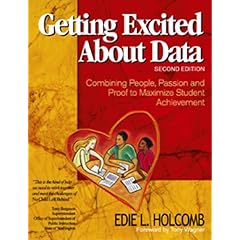
This probably accounts for the existence of books with titles like: Getting Excited about Data Second Edition: Combining People, Passion, and Proof to Maximize Student Achievement by Edie L. Holcomb.

This text is actually written in language that educators can understand, even if they aren't especially data-savy. The guidelines for incorporating data for school improvement are actually practical and easy to replicate. A great guide for joining the data-driven school improvement movement!
5 stars

In theory, my district is using data to inform instruction. We have a data warehouse.

Thus far, however, the data is apparently showing that all learning problems in the gen-ed population can be attributed to student failure to Seek Extra Help. Either that, or Weak Inferential Thinking.

Which is pretty much what all learning problems were attributed to before we had a data warehouse as far as I know.


more fun with numbers
data-driven instruction redux
data-driven loops & noise

The Race between Education and Technology - book review

book review:

What accounts for rising inequality [of income]? Some pundits are tempted to look inside the Beltway for a cause, but the case is hard to make. Government policy makers do not have the tools to exert such a strong influence over pretax earnings, even if they wanted to do so.

Also, the trend toward increasing inequality has been fairly steady, despite changing political winds. The income share of the richest families increased substantially both during Ronald Reagan’s eight years in office and during Bill Clinton’s.

The best diagnosis so far comes from two of my Harvard colleagues, Claudia Goldin and Lawrence F. Katz, in their forthcoming book “The Race Between Education and Technology” (Harvard University Press). Professor Goldin is an economic historian, and Professor Katz is a labor economist who briefly worked in the Clinton administration. Their bottom line: “the sharp rise in inequality was largely due to an educational slowdown.”

According to Professors Goldin and Katz, for the past century technological progress has been a steady force not only increasing average living standards, but also increasing the demand for skilled workers relative to unskilled workers. Skilled workers are needed to apply and manage new technologies, while less skilled workers are more likely to become obsolete.

For much of the 20th century, however, skill-biased technological change was outpaced by advances in educational attainment. In other words, while technological progress increased the demand for skilled workers, our educational system increased the supply of them even faster. As a result, skilled workers did not benefit disproportionately from economic growth.

But recently things have changed. Over the last several decades, technology has kept up its pace, while educational advancement has slowed down. The numbers are striking. The cohort of workers born in 1950 had an average of 4.67 more years of schooling than the cohort born in 1900, representing an increase of 0.93 year in each decade. By contrast, the cohort born in 1975 had only 0.74 more years of schooling than that born in 1950, an increase of only 0.30 year a decade.

Because growth in the supply of skilled workers has slowed, their wages have grown relative to those of the unskilled. This shows up in the estimates of the financial return to education made by Professors Goldin and Katz. In 1980, each year of college raised a person’s wage by 7.6 percent. In 2005, each year of college yielded an additional 12.9 percent. The rate of return from each year of graduate school has risen even more — from 7.3 to 14.2 percent.

The Wealth Trajectory: Rewards for the Few
By N. GREGORY MANKIW

I've been assuming that something like this was the case for the last four years. Sounds like this book is going to nail it down, or come close.


Steve Levitt summarizes The Race in 2 sentences
Jimmy graduates

The anemic response of skill investment to skill premium growth
The declining American high school graduation rate: Evidence, sources, and consequences
Pushy parents raise more successful kids

The Race Between Education and Technology book review
The Race Between Ed & Tech: excerpt & TOC & SAT scores & public loss of confidence in the schools
The Race Between Ed & Tech: the Great Compression
the Great Compression, part 2
ED in '08: America's schools
comments on Knowledge Schools
the future
the stick kids from mud island
educated workers and technology diffusion
declining value of college degree
Goldin, Katz and fans
best article thus far: Chronicle of Higher Education on The Race
Tyler Cowan on The Race (NY Times)
happiness inequality down...
an example of lagging technology diffusion in the U.S.

the Times reviews The Race, finally
IQ, college, and 2008 election
Bloomington High School & "path dependency"
the election debate that should have been