kitchen table math, the sequel

Saturday, December 1, 2007

"Teachers Swamp a Parley on Preschool"

from the Sun:

At least 10 Upper East Side nursery schools are closing their doors today to make time for a conference on an Italian teaching philosophy that is challenging American methods.

Nearly 900 people will crowd the 92nd Street Y to learn about Reggio Emilia — named after the small Italian town, population 140,000, where the approach was developed and that is known for its fine wines and parmigianas — and hundreds more are scheduled to tune in to the 92nd Street Y's first major Internet broadcast of a conference.

Unlike many foreign countries, Italy does not outscore America on standardized tests (its children score about the same), but its approach to teaching 4- and 5-year-olds has captivated educators across this country. They say the philosophy elicits more from the young children than ever seemed possible.

Reggio eschews traditional lesson plans and instead encourages 4- and 5-year-olds to develop their own projects.

About 500 Americans visit Reggio schools in Italy every year to marvel at these projects, and a traveling exhibit of the projects has been making its way across the country. The U.S. liaison to the nonprofit Reggio Children group that organizes the exhibit, Lella Gandini, said interest appears to have grown "immensely" in the past several years, especially in New York.

The director of All Souls School on the Upper East Side, Jean Mandelbaum, one of the school directors who allowed children to skip a day so staff could attend the conference, said that when she first visited Reggio she was astonished to see the quality of work produced by the schools' method. "It looks like they're geniuses, but they're not geniuses. These Italian kids who are wonderful are no more wonderful than our American kids," she said.

By giving children more time to do longer projects and allowing them to dictate their own curriculum, the Reggio method brings out the best in them, she said. At her school, she said, children have created a life-size penguin; several robots, and a model of the 79th Street cross-town bus — all through their own ingenuity. Through the process, teachers make sure to pass on certain skills. They also push students to revisit projects, making them months-long endeavors rather than the fancy of just a few hours.

"The idea is not to just splash something off and bring it home to mommy. Rather, most of the work is considered work in progress," she said.

etc.

Oh yes. Yet another "challenge" to American teaching methods. Nobody here in America has ever heard of the project method.

It's hopeless.

We're all going to have to band together and start charter schools to teach the liberal arts disciplines via direct instruction. We'll hire Siegfried Engelmann and the precision teaching folks to oversee.

We'll also recruit a disciplinary specialist or two to see to it we're teaching the actual disicplines as they exist in the real world, not the fantasy interdisciplinary world of the American ed school.

When it comes to the liberal arts disciplines, the "real world" is the world of the professors and researchers who produce the knowledge our schools are supposed to teach.


the liberal arts disciplines:

  • mathematics
  • English
  • science
  • philosophy
  • history
  • foreign languages
  • music
  • art

Ed says many colleges include the social sciences as a liberal arts discipline.

Ed speaking:

Each discipline has a corresponding set of skills that emerge from the discipline. In mathematics you have quantitative reasoning; in science you have the scientific method; in history you have historical analysis. Some form of competency in writing is usually attached to English.

Ed thinks it's important to have the disciplines "first" and the skills second, because it's too easy to get into "interdisciplinary mush" when it's the other way around. If your requirement is "social scientific reasoning" as opposed to history, then a student can take a smorgasbord of courses in anthropology, sociology, etc, without taking a history course, thus missing a fundamental discipline in the liberal arts canon.

Ed again:

There's no question there are social scientists who would disagree with this, but it's not for nothing that public and private schools both require history not social science. That's true because most people see history as a fundamental liberal arts discipline. Most people also make the rightful assumption that every citizen needs to know something about the history of his own country to exercise his citizenship rights effectively. The social studies movement agreed with this premise, but got rid of the study of history and kept the study of citizenship.

Friday, November 30, 2007

Rubric Burn

My wife and I just got back from our 15 minute parent-teacher meeting. We might have seemed rude, but we couldn't chitchat. We dived right into our biggest concern - making sure that our son gets the rubric before working on the assignment, knowing the exact due date, and getting the results and grade back in a timely fashion so that we can go over them with our son. These things haven't been happening. Many assignments don't have rubrics. Our son can take some of the blame, but there needs to be a process that is designed to make it easy for us parents. They expect involved parents, but they have to give us the tools.

The big issue was about rubrics for individual assignments and for overall grades. Our rubrics go from 1 - 5. I don't think anyone gets a 1 and kids only get 5s if, well, I don't know why and his teacher couldn't really explain when or why. I told her that 5s seem to something like an A+. She said it was more than that. The kids have to show how their assignment is somehow related or integrated with other subjects in an abstract way. Of course, the school doesn't teach them about this or show them how to do this. Some rubrics do tell the students what they have to do to get a 5, but there is always the proviso that there has to be something more. What that more is, they never say. I told the teacher that kids want to get 5s but they aren't taught how. She really didn't have much to say other than (in so many words) "That's the point".

A 3 indicates that the student is meeting state expectations. I told her that I have seen the state expectations and tests and consider a 3 to be a 'C' grade. She seemed surprised to hear me say that. I'm not sure why. A 2 grade indicated (in a very broad sense) that there is a problem that needs to be fixed. A 2 is a 'D' grade.

That leaves the 4 grade to cover the range of 'B' to 'A'. Some teachers have suggested that rubrics are just another form of grading like A, B, C, and D. They aren't. They are non-linear and very poorly defined. Kids struggle to get 5s because they think that it's an 'A'. My son can't always explain why he gets a 3, 4, or 5 on an assignment or test. Grades are supposed to give students some sort of feedback to help them with future assignments. This is not happening.

Even math tests are translated into rubric grades of 1 - 5. My son hasn't had enough graded assignments for me to plot rubric grade against percent correct on his tests. I'm betting that the relationship is nonlinear. The math teacher doesn't allow the test to go home. It has to go into their portfolio and stay at school. Don't they think these things through? I'd like to give them a rubric.

Thursday, November 29, 2007

New Elementary Algebra

I think I'm going to take tonight off and spend my time raiding the Comments for new posts.

from Myrtle:

I've only recently discovered this feature on Google. For example, I've been using this book for supplemental word problems in Algebra:

New Elementary Algebra (1879)

Word problems start on page 139 and go on and on and on.

and:

Fifty Famous Stories Retold for free in Google Books


I've spent my share of time pouring over Google Books these past few weeks. Sometimes they decide I've abused my privileges & they cut me off.


a farmer and his sheep

A farmer has in his pasture 63 head of cattle, consisting of cows, calves and sheep. There are twice as many calves as cows, and twice as many sheep as calves; how many has he of each sort?

Ans. 9 cows; 18 calves; 36 sheep.
New Elementary Algebra

p. 139

logarithms shmogarithms

When I get my life back, I am going to conquer logarithms.

Thanks to Myrtle (lots of cool stuff at Myrtle's blog - I need to get out more), I have two sources outside my Saxon/Dolciani/Foerster stash here:

nominally high performing, part 2 ...

Mindless Math Mutterings posts the passage from Richard Elmore that has given me a formal term for the kind of affluent school district William Sanders calls slide and glide:

nominally high performing

One of the huge fallacies of performance-based accountability systems is the misconception that nominally low-performing schools don't know what they are doing and that nominally high-performing schools have something to teach them.

[snip]

Most high-performing schools in our highly segregated society have gotten there not by knowing a great deal about instructional practice or improvement but by getting and holding on to students in high socioeconomic groups. The practice in most nominally high-performing schools is emphatically not about improvement but about maintenance of a certain level of confidence with the surrounding community. When I speak about improvement with people in these schools, they often look at me as if it had nothing to do with them. Most of the knowledge about improvement is in the schools where improvement is occurring, and most of those schools are, by definition, schools with a history of low performance.

A Plea for Strong Practice
Richard Elmore

The funny thing is that inside a high-performing district everyone "knows" the schools are high-performing because of the families. The families know it; the school knows it. It's an open secret.

But while people know this, they don't ask what value the school is adding to what the students brought with them to school. Instead the schools is assumed to be high-performing because the students are high-performing (and student performance is never seen in comparison to private or international schools).

Can't remember whether I've mentioned our middle school principal's Back-to-School-Night skit performed in the fall of 2006 a few short weeks after he'd taken his position here.

It was a skit inspired by No Child Left Behind.

"I don't like No Child Left Behind," he said. "But it does have one good idea, which is evaluating the quality of your school. It's a good idea to evaluate the quality of your school. So I'm going to tell you the 4 characteristics that determine the quality of a school."

Off to the side were standing 4 middle school girls holding poster boards flat against their legs.

"The first characteristic in evaluating the quality of your school," the principal said, "is the school."

Girl number 1 turned her poster over revealing characteristic number 1: School.

"But if you're putting it all on the school," the principal continued, "that's too much."

In retrospect, that was the moment I should have started sending away for applications to Catholic schools. That I didn't see this at the time can probably be attributed to the fact that I was curious to discover what other characteristic one could use to evaluate the quality of one's school besides the quality of the school.

"The second characteristic you can use to evaluate the quality of your school," the principal said, "is the quality of the students."

The second girl from the left turned her poster board over.

Students

"The third characteristic is quality of the parents."

Poster board: Parents

"The fourth characteristic is quality of the community."

Community

"You have a quality community," the principal said. "I've been driving around your town admiring all the nice lawns with the beautiful grass. In my old school, one day I was walking a student home and there were some boys standing in the street and one of them said, 'Principal, do you want to buy some drugs?'"

And there we left it. Proof positive that we have a high-quality middle school because we have high-quality students, high-quality parents, and a high-quality community.

All of which it is possible to determine by the quality of our lawns.

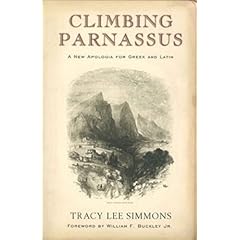
Climbing Mt. Parnassus


I had never heard of this book until Myrtle left this comment:

Tracy Lee Simmons "Climbing Parnassus" is even more divergent. It traces the history of classical education throughout the centuries and chronologically speaking should be read before Diane Ravitch's "A Century of Failed School Reforms" which picks up about in 1900 where Simmons leaves off.

The difference between Simmons and Wise Bauer is that Simmons gives you the "whys" of classical education and Wise-Bauer gives the "hows." I would summarize her hows as being for non-expert parents. Her area of expertise is writing and English, not physics and math and while her recommendations in those areas certainly won't send anyone into an educational death spiral, they also aren't nearly as clever and insightful as what she has to say about English, composition, history, and foreign language.


and here is an excerpt from Well-Trained Mind: left by Concerned Parent:

The Parrot Years:

Houses rest on foundations. Journalists gather all the facts before writing their stories; scientists accumulate data before forming theories; violinists and dancers and defensive tackles rely on muscle memory, stored in their bodies by hours of drill.

A classical education requires a student to collect, memorize, and categorize information. Although this process continues through all twelve grades, the first four grades are the most intensive for fact collecting.

This isn't a fashionable approach to early education. Much classroom time and energy has been spent in an effort to give children every possible opportunity to express what's inside them. There's nothing wrong with self-expression but when self-expression pushes the accumulation of knowledge offstage, something's out of balance.

Young children are described as sponges because they soak up knowledge. But there's another side to the metaphor. Squeeze a dry sponge, and nothing comes out. First the sponge has to be filled.

[snip]

So the key to the first stage of the trivium is content, content, content. In history, science, literature, and, to a lesser extent, art and music, the child should be accumulating masses of information: stories of people and wars; names of rivers, cities, mountains, and oceans; scientific names, properties of matter, classifications; plots, characters, and descriptions. The young writer should be memorizing the nuts and bolts of language-- parts of speech, parts of a sentence, vocabulary roots. The young mathematician should be preparing for higher math by mastering the basic math facts."


If you haven't noticed yet, Amazon has a dandy new rotating-books carousel feature that lets you scroll through all the other related books people who purchased the book you're looking at purchased. What a fantastic research shortcut. If I know a book is good -- or, more importantly, that it's considered good by the experts whose work I'm writing about* --- I can instantly learn what other books are in its category.

I found Animals in Translation in the carousel for The Psychology of Learning and Behavior by Barry Schwartz, which is causing me to contemplate purchasing it just to find out what the connection is specifically.

Back to Mt. Parnassus; the carousel there has one book I own and like very much: The Laurel Wreath and Harp: Poetry and Dictation for the Classical Curriculum.

Another 3 I'm interested in:


* make that trying to write about

School performance info - your predictions?

I wanted to share information on an interesting experiment going on in Sumner County, Tennessee, and solicit predictions.

One of my clients, an organization called the Education Consumers Foundation, has been doing a lot of work with value-added data in Tennessee. (For those unfamiliar with value-added, it basically allows you to isolate and measure schools' contribution to student learning, regardless of the socioeconomic, etc. characteristics of their students.) Tennessee has the most advanced value-added system in the country and has been collecting data since the early 90s, so there's a rich pool of good data available from the state here.

While Tennessee offers great information on the performance of its elementary and middle schools, we've found that almost no one is aware of this data or understands what it means. So we've launched a pilot initiative to see what happens once parents and other community members are given this information.

Last Monday, we sent a package of information to every household in Sumner County - 55,300 pieces in all - containing an introductory letter and a brochure with school-by-school information on their value-added performance rankings, TCAP proficiency rates, and free/reduced lunch rates (a proxy for poverty). I've posted these materials in PDF format: you can download the letter here and the brochure here.

IMHO, I think this is powerful stuff, but we're just at the very beginning stage of the pilot. I'd like to think it's going to make a huge impact, but it's entirely possible that it will be ignored.

I'd love to hear thoughts on this initiative from other KTM folks, and your predictions for what will happen in Sumner County. Will the community at large ignore this? Is it likely to create a significant conversation in the community? Will people push their local schools to improve?

Essentially - is this the path to real school improvement, or is this mailing going to fall on deaf ears?

If anyone's interested, I'll share updates as we go along - as I mentioned, the mailing just dropped last week, so it will take a while for this to all play out.

(For clear and complete disclosure purposes, I'll repeat that ECF is a client, but I don't feel any conflict of interest in posting about this initiative - they're a nonprofit group and have nothing to gain from this. If there are any issues, I'll trust in Catherine to remove this post.)

Wednesday, November 28, 2007

brute memorization

Terrific post from Instructivist on the subject of memory and memorization.

This is something I've struggled with: how to distinguish "brute memorization" (my term for it) from "natural memorization" or, in instructivist's phrase, "thoughtful memorization."

Constructivist philosophy defines the word "memorization" as most folks do: the student sits down with a set of flash cards and commits material to memory.

I assume (don't know) that the flash card approach is essential in some realms: foreign language courses, law school, med school.....yes?

But "brute memorization," generally speaking, probably isn't the best way to go about acquiring knowledge, and is not the method a knowledge-focused curriculum like Saxon Math employs.

Unfortunately, we don't have a term for the kind of memorization Saxon Math induces.

Saxon Math produces memorization via spaced repetition, which is, I believe, the way everyday life produces memorization.

Here is my sense of the way in which natural memorization works:

  • content to be committed to memory is broken into the smallest meaningful units
  • the smallness of the units allows each unit to be held in working memory (or consciousness) in its entirety

  • in time the units being practiced naturally enter long-term memory

This seems to be the way most material enters long-term memory in the day to day. One repeatedly encounters and/or practices an idea or skill until one simply "has it."

Example.

I'm going to guess that quite a few ktm readers and commenters now possess a usable or at least semi-usable definition of the term working memory.

Did you acquire this by sitting down with a flash card and rotememorizing it?

No.

You acquired a usable knowledge of working memory by repeatedly encountering the term in posts and comments until you remembered it.

This process is natural, and it is inevitable. Memory is a core function of the brain; people who don't remember things have brain disorders. Bad ones.

Constructivist antipathy to memory and remembering is quite perverse -- it is unnatural, as a matter of fact -- but it is consistent with constructivist antipathy to knowledge.

The brain naturally acquires knowledge. Yes, I know the brain does not naturally acquire knowledge of algebra absent a good textbook and teacher ( ! )

However, if you have a good textbook and/or teacher it is entirely natural to acquire knowledge of algebra whether you give a damn about algebra or not. As a matter of fact, it's entirely natural to acquire some knowledge of algebra even with a mediocre textbook and a so-so teacher. Repeated practice causes us to remember what we've practiced, period.

If you don't want students acquiring knowledge, you're going to have to oppose memory and memorization.

.....................................

As to direct memorization and its place in formal education or in any training program, my sense is that it is often the fastest route to remembering. From time to time Saxon will tell the student, "Memorize this." His meaning is always: You're going to need this, you're going to use this, just go ahead and memorize it.

Direct memorization is a shortcut.

I think.

.....................................

hmmm...

Direct memorization
probably isn't a bad term for the kind of simple, straightforward, put-it-on-a-flashcard-and-practice-it memorization constructivists call "rote."

Anchoragegifted’s Weblog

Anchoragegifted’s Weblog

Last night I ran across the Anchorage School Districts Gifted Blog. It's a great idea for communication, but I hope to see it updated a bit more.

I posted a comment asking for more information, so hopefully I can spur some debate.

Update: sorry, I had meant to post this to my site, but selected the wrong blog. And yes I know I haven't been very active... blame it on the move to Alaska.

Tuesday, November 27, 2007

homeschooling is good

Now, keeping in mind that I’m a second grade teacher and that MY American History teacher taught in the EXACT same manner as above and I don’t remember a THING about American History, here’s a proposed list of assignments that I would have liked to have seen on the board.

* Who lived in pre-colonial America? Choose one people to read up on, create an artifact relevant to these people and be prepared for show-and-tell.

a teacher's reaction to a high school history class in which assigned textbook chapters had been written on the board

I've come to the conclusion that today's educators are anti-book. [update: this is way too sweeping and cranky. Cranky is bad. So is sweeping. Obviously, "today's educators" do not speak as one. And, as Dr. Stipes points out, it would no doubt be equally correct to assert that today's students are anti-book. So I take it back. I may have to stick with the claim that "today's educators administrators" are pro-SMART Board, however. Because I'm cranky.]

Pro-technology, anti-book.

Take my district (please!) The high school and middle school share a brand-new, two-story, Barnes-and-Noble-esque library that has very few books. The library has so few books, I'm told, that this year the school removed shelves to make the absence of books less glaring.

Parents at the 4-5 school are raising money to buy books for the library there.

High school kids come home and tell their parents the reason they're not reading more books in Honors English is that there aren't enough books to go around. (Teacher says it's not so, but if teacher is correct, why aren't the kids reading more books?)

And we've all heard tell of textbook shortages. Some of us have experienced textbook shortages firsthand (Spanish books that couldn't come home with kids because there weren't enough to go around in the case I know of.)

Occasionally people send emails concerning the book situation to the school board. The school board responds saying the book shortage has been addressed and we have all the books we're supposed to have.

Technically that may be true, though I have heard two stories of textbooks not showing up until, in one case, 2 months into the year; not until mid-year in the other. The students made-do with packets until the real books showed up.

Why would that be?

If we have all the books we're supposed to have, shouldn't we also have them when we're supposed to have them?

So we seem to be experiencing a degree of mystery where books are concerned.

There is no mystery when it comes to technology. We have vast heaping quantities of technology; we have rooms bursting at the seams with technology. We have computer labs (where middle school students can access at least one X-rated web site, I'm told); we have music labs; we have SMART Boards up the ying yang.

How many SMART Boards is that you ask?

Forty five.

The district's goal for last school year was the purchase and installation of 45 new SMART Boards and we met that goal.

No word on number of books purchased or read.

more fun with WAC

re: If WAC sweeps the country as I fear it may, we'll have our public schools producing kids who hate writing as much as they hate math, Concerned Parent has this to report:


I have anecdotal evidence for that, and then some. The scenario you describe was happening to A. She was developing acute writing phobia by fourth grade. This extremely verbal, well read, talkative child would have almost nothing to say when presented with a writing assignment or prompt. She would virtually shut down. Her confidence was almost completely eroded. Having a clear road map has been life altering. She's actually relishing her writing assignments and no longer goes around saying "I'm a terrible writer." This is where we were not too long ago. What's most amazing is how quickly things have turned around.

[snip]
Last year in fourth grade there were mostly shoebox type "writing" projects dispersed through the year. There was one big writing project about a U.S. state that was to be done completely at school which ended up a total disaster. The rest were really psuedo-writing with it becoming more of a presentation that didn't really require structured writing (she dressed up and acted out the characters of Sacagawea and Elizabeth Blackwell.)
It got more serious around testing time in the spring when everything was in preparation for the CMTs. It got to the point that this child, who reads and comprehends at about a twelth grade level, was having breakdowns over short answer response questions at the fourth grade level. This shouldn't have happened, but it did.

There were no traditional book reports and I rarely saw drafts going through any type of editing process. There just didn't appear to be a method for teaching writing going on at all. She was overwhelmed and really began to hate anything having to do with writing.
I agree that remediation with the right methods can make a world of difference in a short amount of time, particularly if the child is a good reader. Having a process puts it all together and it just sort of "clicks".

This jibes with Vicky's and Susan's experience.

I'm going to have to go into the writing remediation biz: go into it or invent it. Either one.


the process

David Klein's AP/IB grades changed by Fordham

This is distressing news.

Based on my own n of 1, I'm sure David's original grades were correct. C's camp counselor last summer, who is attending Rensselaer Polytechnic, told me the IB math sequence he'd taken in high school was a joke. He didn't learn much calculus, but he did write a "research" paper. Looked some stuff up and slapped it together.

I wish to heck I knew what I did with my notes on the conversation. He gave me a rundown of the many topics IB didn't mention while students were busy slapping together low-quality papers.

If I run across them, I'll post.

A few years ago I checked out the IB web site. The lower grades IB curriculum was entirely constructivist, which made me think the upper-grades curriculum couldn't be far behind.

.............................

It was a lot of fun having C. in camp with a math-brain counselor. The counselor would tell him things like, "I don't like to read and write papers. I just like to do math." This was an utterly novel concept to C, who quoted it to me verbatim on a number of occasions.

Barry's letter to the NY Sun

Will get the Sun story on Texas rejecting Everyday Math (subscription required, I presume) posted at some point (horse chapter takes precedence). The Sun carried the story as front-page, banner-headline news. The word "fuzzy" appeared in the subhead.

In the meantime, here is Barry's letter to the Sun:

I am very happy to see that the New York Sun ran a front-page story about Texas' challenge of Everyday Math [Front Page, "Texas Challenges City on Math," November 20, 2007].

To my knowledge, the New York Sun is one of the few papers in the country that has covered this development. Given that Everyday Math commands a 20% market share of textbooks for K–6, Texas' decision is an important one.

The Everyday Math program does not cover math well and certainly does not pursue mastery of the material as other programs do such as Saxon, or Singapore's math program.

By placing this story on the front page, the New York Sun has done a great service and perhaps the story will be viewed as a long overdue wake up call to the educational damage such dangerously lacking programs have caused to our children.

BARRY GARELICK
National Advisor
NYC HOLD
McLean, Va.

This letter is a hoot:

Kudos for covering the important story of the Texas Board of Education rejecting Everyday Math, Grade 3 for its schools [Front Page, "Texas Challenges City on Math," November 20, 2007].

I have lived through Everyday Math with three children who are now in high school and beyond.

In my community, students flock in huge numbers to Kumon Math or other tutoring services because of the deficiencies in Everyday Math. Everyday Math and other Reform Math or Standards Based Math curricula have done a woeful job of preparing students with a sound math education.

Students who are taught by these curricula are typically calculator-dependent, and unable to perform basic math functions because they are deemphasized.

Greater emphasis must be placed on making math fun and expecting the students to discover how to solve math problems on their own. This topic needs more exposure across the country if we are to produce well-educated students capable of competing in our global world. Thanks for drawing attention to it.

MARGUERITE BLISS
St. Louis, Mo.


Gee.

Students don't get to discover stuff in Everyday Math and it isn't fun.

Who knew?


I'm a big fan of the Sun.

Today's banner headline:


Talks are set on ending battle of Iraq
Quiet Announcement Signals Start of U.S., Iraq Parley

And so the Battle of Iraq is to be brought to an end, in T.S. Eliot's phrase, "not with a bang but a whimper."

With the eyes of the world focused on the Middle East peace talks in Annapolis, Md., President Bush's war tsar, Lieutenant General Douglas Lute, quietly announced that the American and Iraqi governments will start talks early next year to bring about an end to the allied occupation by the close of Mr. Bush's presidency.


Meanwhile, over at the Times, we've got:

Seeking a Mideast Path, Bush Offers a Nudge and After a Rough Start, Spitzer Rethinks His Ways.

This reminds me of another Times episode years ago when we were living in L.A. We subscribed to both Timeses: the NY Times & the LA Times.

The annual AIDS conference was on and both papers were covering the proceedings on the front page.

Early on, possibly on the first day of coverage, the LA Times reported that there had been a breakthrough in AIDS treatment. My memory (not fact-checked) is that one of the presenters had reported on 6 HIV positive patients he'd treated, not one of whom had progressed to AIDS.* They were reporting a miracle. To this day, I remember sitting at the table, pouring over this story, wondering if it could possibly be true.

What did the NY Times have to say about the 6 patients?

Nothing.

The TIMES had a story on insurance discrimination against people with AIDS or some such.

I was horrified. How could the LA Times be reporting the first effective treatment for AIDS (and back then it was AIDS) and the NY Times have nothing? That had to mean the LA Times was wrong, I thought.

Next day, same thing. The LA Times had a second story on the new treatment for AIDS; the NY Times had another dreary prejudice-against-gays or AIDS-in-Africa boilerplate feature, the kind of AIDS story they'd been running for years and could write in their sleep.

By then I was getting nervous for the LA Times. I was thinking they had to have gotten the story wrong and were going to be Humiliated on the World Stage. (I had only a foggy notion of how newspaper journalism worked.)

I wish I could remember now how long it took the New York Times to pick up on the treatment story. I think they finally figured it out on Day 4. Meanwhile I was getting up every morning and grabbing both papers to see which world we were living in.

Were we living in a new world, the world in which AIDS would become HIV?

Or were we still living in the old world, the world of the epidemic?

The answer was that we were living in the new world and the New York Times had missed it.


* I'm pretty sure the presenter was David Ho.

Monday, November 26, 2007

Kendall/Hunt values your feedback!


They must have seen me coming.

it is important that Trailblazers is not put down

Scarsdale to try new elementary math programs
by Carrie Gilpin

In an effort to "see what's out there,” Scarsdale is trying out four math programs in 30 K-5 classrooms this year, according to assistant superintendent Paul Folkemer, and will settle on one of them, or remain with the existing program, Trailblazers, by spring. A few teachers at Scarsdale Middle School will also participate in the pilot math program.

"We have been very happy with Trailblazers and it has served us well for 10 years, but change is healthy and we want to see what is out there," said Math Committee chairman Nancy Pavia.

“The process is energizing, and puts the subject area on the front burner," said Folkemer. "It is good for us, and at the end, we could come out of this staying where we are with Trailblazers."

Implementing any new program next fall would also be "a budget issue," said Folkemer. "We don't want to get ahead of ourselves, but we won't be able to make any decision until a draft of the budget is completed. We will go in under the assumption that we have the funds to move forward by fall."

Each of the 30 volunteer teachers will test two of the four programs, substituting units of Trailblazers for similar units of one of the test programs. The district is awaiting materials and will begin the first of the pilot program trials at the end of this month, said Pavia.

Pavia said the timing of the pilot is excellent since Trailblazers' second edition is out and needs to be purchased by the district. or a different program purchased.

"This has been very thoughtfully done," she said, stressing there is broad representation of teachers within all five elementary schools and in all six levels from K-5.

A few teachers in middle school will also participate in the pilot. "Increasingly, we have been trying to invite them into conversations with us about elementary school math," said Folkemer.

Some teachers involved in the pilot program announced it to parents at the elementary schools' open houses. Folkemer said he is scheduled to give a report on the pilot program, as well as other district initiatives, to the Scarsdale Board of Education on Tuesday, Oct. 9, during the board's regular business meeting at 8 p.m. The board will meet that night at Edgewood School.

Pavia said parents would see different materials coming home in their child's backpack during the year, and that nothing would be sent home for homework that hasn't already been covered in class.

Will pilot program math students be confused? "I don't think so at all," Pavia said. "The methodology is slightly different but that shouldn't make it confusing. If parents have questions, of course they should address them with the teacher," said Pavia, stressing that naturally it will not be "perfect."

Both Pavia and Folkemer said it would not be possible to test out a new math program without actually teaching it to students.

Pavia said teachers have been discussing a change in program for several years. They considered many possible programs and came up with the following four: Everyday Mathematics, a program from the University of Chicago; Think Math!; Scott Foresman"s Investigations; and Singapore Math. The programs all have slightly different approaches and the National Council of Teachers of Math has endorsed the first three.

“Singapore Math is the one that is slightly out of the box. It is very rigorous and is written by the Ministry of Education there. It is structured slightly differently and has many positive aspects,” said Pavia.

Folkemer said that many teachers “really like” Trailblazers, a program felt by many parents to be heavily language-based.

“Any program we use must have a balance of a strong skill base with conceptual and problem-solving elements,” said Folkemer.

“Language is all around us, and mathematics requires language. But to calculate accurately is critical. Algorithms and fact work is just as important,” Pavia said.

Trailblazers functions on a "spiral” method, where a unit of say, fractions, is touched upon, then students move to another topic, and then com around to fractions again.

“Math by its nature is a spiral, but Trailblazers is a very tight spiral. The programs we are looking at are not quite as structured. Whatever program we use, we will modify it to match it with our own curriculum,” said Pavia.

Folkemer said a presidential commission on math teaching led the NCTM to come up with a list of “Curriculum Focal Points”—important math topics for each grade level, pre-K through grade 8. Focal points are areas of emphasis that serve as organizing structures for curriculum design and instruction at and across grade levels.

“When we Trailblazers years ago, we adopted it as our curriculum,” said Folkemer. “Now, we have written our own math curriculum and any program we use will be modified to fit within our curriculum.

So why does the district need to purchase any program if it has written its own curriculum?

Pavia said it would not be a good idea to teach math without a purchased program. “Teachers are generalists. I’ve always had a program, which is critical for consistency among the schools. It is a foundation upon which we will build and teach our own curriculum,” she said.

“I think it is important that Trailblazers is not ‘put down,’” said Pavia “Change is forward movement and we are looking and learning if there is a better way to teach math,” said Pavia.

Scarsdale Inquirer 10-5-2007

Kerrigan & test prep

Speaking of test prep, Kerrigan is superb test prep for the essay portion of a standardized test. Amazing.

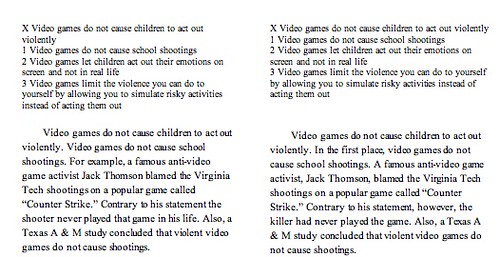
C. wrote two practice test essays yesterday using the X-1-2-3 set-up for both. The first was pretty bad, but he improved dramatically on the second.

Bonus points: X-1-2-3 results in mini-essays that can be easily typed up and edited by the parent/teacher, like so:


C's version is on the left; our lightly edited version is on the right. Ed says it helps tremendously to see your work edited and I think he's right.

I wonder whether a teacher would find it faster and easier to edit student's mini-essays rather than comment on them? (Teachers could copy-edit/revise just one paragraph or one aspect of the essay, etc.....)


C's X-1-2-3 sentences

X People who rescue animals from bad conditions are heroes.
1. They give animals a second chance at a good life.
2. They punish people who are cruel to animals.
3. They provide people with a new pet to love.

X Video games do not cause children to act out violently.
1. Video games do not cause school shootings.
2. Video games let children act out their emotions on screen and not in real life.
3. Video games limit the violence you can do to yourself by allowing you to simulate risky activities instead of acting them out.

truc

Some of you will remember back when we coached C., then age 10 I think, to answer all open-ended math questions with the words:

I used a strategy of guess and check and then I looked for a pattern.


Yesterday we were frantically trying to teach C. how to write in time for him to take the ISEE test next Saturday, and we came up with two sure-fire trucs:

  • The final paragraph should being with the word "Finally."
  • The concluding sentence or paragraph should begin with the words "For all of these reasons."

It works.

Singapore Math approved for use in CA

wow

This is news.

model method

I came across what may be a terrific web site for non-math majors trying to teach the Singapore Math curriculum the other day:

Teach Kids Math Using the Model Method

I could have used this site when I first started working through Challenging Word Problems Book 3 lo these many years ago. My knowledge of arithmetic was so fragmented at the time that I didn't immediately perceive the various "genres" of bar models. Each problem I solved seemed almost to call for a whole brand-new, never-before-seen bar model. (Not quite, but close enough.)

I needed a map of the world.

One of the blinding revelations that came to me via bar models was the reason for the word "difference" as in the expression: "Find the difference." It had simply never occurred to me that subtraction was two things (scroll down - may need to hit refresh a couple of times):

  • how much is left when you take away "X"?
  • what is the difference between two numbers?
The great thing about the "Teach Kids Math" site is that it lists "Comparison" on a separate button on the sidebar. You can take one look at that page and realize: nobody ever mentioned "comparison" back when I was in school.

I'm not so crazy about the way they draw the comparison model, though. In all of the Singapore books I've seen, they've drawn the comparison model the way I did (though the bars aren't "stacked" the way I stacked them...don't know why I did that.)

I'll probably have C. take a look at the site.

Saturday, November 24, 2007

Christmas books


hmmmm.....

Looking at this list, I don't necessarily see joy and euphoria breaking out Christmas morn' when folks open up their dog-eared Amazon Marketplace copies of War of the Worlds and Deluxe Transitive Vampire.

I will have to do better.


* question: Do I have the nerve to wrap this up and give it to C. for Christmas?

Some Horses

Lynn G put me onto Thomas McGuane's book Some Horses.

A wonderful book. Perfect! Whether you know anything about horses or not.


coming right up:

books I'm getting people for Christmas

3 categories:

  • books they'll like
  • books they won't like but ought to
  • books they might or might not like, but I'll read them if they don't

It's a family tradition.

Wednesday, November 21, 2007

being horizontal

John Perry has a fancy web site!

I am not left-handed, but I have another less well-known situational handicap. I am a horizontal organizer in a world set up for vertical organizers.

The main mark of a vertical organizer is the ability to make use of filing cabinets. These people use filing cabinets to store materials in that they intend to use just an hour or a day or a week later. When they need that stuff again, they reach into the filing cabinet, pull out the folder and resume working on it.

It probably seems pretty silly to the vertical organized reader for me to be going on and on about how filing cabinets are used, but I think the horizontal organizers may never have actually realized how the other half lives and may find this account completely incredible, so let me go on for a minute.

Yesterday I was working on a letter to the Palo Alto Medical Clinic explaining why my bill is screwed up and I don't owe them as much money as they think I do. It's pretty complicated stuff, and I didn't finish by the time I had to leave. A vertical organizer would have scooped this stuff up, and put it in a file to retrieve later. Had I done this, there would be a bare spot on my desk. These bare spots are the mark of vertical organizers. They are a dead give away.

Now of course that is not what I did at all. I left the letter on the desk, with the materials spread out. Actually, it is not exactly on the desk, because some other ongoing projects were already be spread there; the letter and supporting documents are on top of half-graded papers, half-written lectures, half-read brochures and the like.

The fact is, I am a horizontal organizer. I like all the things I am working on spread out on a surface in front of me, where they can beckon me to continue working on them. When I put something in a file, I never see it again. The problem isn't that I can't find it (although that has happened), but that I don't look. I am constitutionally incapable of opening a filing cabinet and fishing out a half-finished project to resume working on it. I do use filing cabinets. They are for a) storing finished things that one plans never to look at again and b) putting things that one would feel bad about throwing away but has no intention of reading.

A Plea for the Horizontally Organized
Be sure to check out the designer credit in the lower left hand corner.


I am a horizontal type, too, the only difference between me and John Perry being: I am not organized. I'm just horizontal. My stuff is, I mean.

lion love

Anthem


Be sure to watch to the end.

You aren't going to be able to do that dry-eyed.

Tuesday, November 20, 2007

NEA weighs in on Who Wants to be an Engineer?

The NEA has always been quite helpful in providing parents with guidance on how to teach their children what isn't being taught in school, so I was delighted to see that they are offering online brochures on a number of topics.

Parent guides on a number of topics, including helping your child with math are available here.

I was particularly impressed with the guide on what children need to know to become engineers.

Here are some excerpts:

"What do kids do in a technology class?
They think about and solve problems like:
• Cleaning a polluted lake or river
• Creating an invention to solve a household problem
• Designing and building a habitat for a unique
situation
Second-graders might design and make a home for
their favorite bug. They would draw a plan (complete
with measurements) and use boxes and other
materials to build the home. They would have to think
creatively about how to keep the bug in the house,
how to provide water and food, and how to make
sure the home was the right size for their pet."

Silly me; I thought for sure they would need to learn something about bugs in their science classes. But, after all, we’re talking about future engineers here. Mere facts are of no use in the modern day classroom.

"Fifth-graders might design and make their own paper
airplanes. They would test them to see which ones
flew the furthest or the highest and then revise the
design to see if they could make a better paper
airplane. They would use mathematics, learn aviation
science, and practice reading and writing skills
throughout the design process."

Just curious; what type of mathematics would they be using other than measuring the distances? Also, any clue about how “aviation science” would be used? I don’t think I have to ask about reading and writing skills used throughout this activity. Writing: How I Feel About Today’s Assignment. Reading: Various essays about paper airplanes in a rascist world.

"Eleventh-graders might investigate the idea of
growing plants in a hydroponic system (without soil).
They would design, build, and test the system. They
would study the effect of this type of growing on the
environment and figure out whether this system was
more cost effective than growing plants in soil. They
would become engineers!"

Yes, it’s axiomatic that when students design, build and test hydroponic systems, they grow up to become engineers. No one really knows why, but there is a flurry of “action research” taking place in our classrooms to find out.

Wait. There’s more!

"When those juniors in high school study
hydroponics, they think creatively about ending
hunger and about how to grow food in places where
the soil is not ready for planting."

RIGHT. Of course, how to get the water to deserts is part of another class. Creative thinking is the order of the day here.

What content should I expect my child
to be learning?
What students should know and be able to do
is identified in standards developed by the
National Science Foundation (NSF) and NASA–
Standards for Technological Literacy: Content for the
Study of Technology. Standards for K–12 were formally
reviewed by the National Academy of Engineering,
the National Research Council, and the technology
teaching community.
The standards address content for K–12. Content is
integrated into thematic units at the elementary
levels, while course titles at the middle and high
school levels may include:
• Exploring Technology
• Innovation and Engineering Design, Technological
Systems
• Engineering Design Fundamentals
• Inventions/Innovations
The standards also address medical, agricultural and
related bio-technologies, energy and power,
information and communication, transportation,
manufacturing, and construction topics."

Yep. No need for math, biology, chemistry or physics. Just get them up to speed on technology and engineering design. It’s gonna be a beautiful world!

Monday, November 19, 2007

help desk: how to teach the factoring of trinomials?

I'm having trouble reteaching trinomial factoring to C.

He's now "got it," but I don't think he's "got" the fact that we are "unmultiplying" -- or that we're using the distributive property when we do these two steps:

3x(2x+1)+1(2x+1)
(3x+1)(2x+1)

I've found over the past couple of years that sheer repetition "naturalizes" a procedure in my mind, which feels like comprehension. But when I returned to the procedure for factoring a trinomial in which the coefficient of the squared term was greater than 1, I had forgotten how to do it -- and I couldn't figure out how to do it.

In other words, I didn't understand what I was doing well enough to reconstruct the procedure myself.

Here's the part that keeps stumping me.

6x^2+7x+2

solution:
6x2=12
factors 3 & 4 add to 7
therefore:

6x^2+3x+4x+2
3x(2x+1)+2(x+1)
(3x+2)(2x+1)

I'm going to sound dumb, but I am having trouble grasping why the factors of 12 work as the addends of 7.

I guess I have two questions:
  • what is the best way to show that the final step above is a use of the distributive property?
  • factors and addends - HELP!
I should add that this year's class continues to go pretty well. I'm doing no preteaching at all, I don't always have to reteach, and the reteaching I do have to do happens because of the pace of the course, not because concepts haven't been explained and demonstrated well in class.

"Reteaching" this year tends to mean "reminding" and "reviewing."


again with the answer keys

This weekend C's teacher sent home 4 pages of review problems to practice before taking today's test.

Fantastic!

On Saturday I realized he hadn't sent the answer key. [update 11-25-07: Teacher says he got the worksheets at a workshop - oy - and the workshop didn't supply the answer sheets. My tax dollars at work.] So I spent my weekend staring at a guillotine deadline (official publishing industry terminology) for my book and factoring trinomials on my son's review sheet so he can figure out whether he's actually doing the problems correctly.

Needless to say he was doing many of them incorrectly on Saturday. Some of his mistakes were "careless errors"; some were missing a step-type errors.

Both errors require marking and redoing, or at least analysis of what went wrong.

Speaking of which, C. is beginning to want to analyze his sequence of steps instead of simply starting over again. I think that's good, right? Often he'll say, "I see what I did wrong." Of course, he can't do this if he doesn't know he got the answer wrong.

Marking careless errors is particularly important in the case of trinomial factoring, I think, because along with learning how to factor a trinomial you need to learn how to check your answer mentally if possible. (Which I'm pretty sure C. has not learned...)

In the case of trinomials, students could check their answers by multiplying the factors they've ended up with, but I don't think they've been told to do that; they definitely haven't been given homework requiring them to do it. I managed not to figure this out until late last night, sad to say.

Still.

We need the answer key.

I will never understand this place.


on beyond help with homework

Meanwhile, the course is now beyond most parents' ability to "help with homework." Ed took engineering calculus at Princeton and has no memory of how to factor trinomials. Plus I find the textbook, Glencoe Algebra, to be mystifying in most instances. It's not like Saxon or Foerster or Dolciani, textbooks a parent can use to teach or reteach himself the lessons his child has been taught at school.

If I find it mystifying it's a cinch other parents will, too. Not to mention the students themselves.

(Btw, my experience thus far has been that Foerster is incredible when it comes to a parent having to rapidly "teach" herself a concept she's never before seen in her life so she can (re)teach it to her child in time for the test.)

So.....what is the thinking here?

By the time most students reach 5th grade math, their parents are no longer able to "help with homework." (The math teacher/tutor I know told me: "I get the call in 5th grade.")

How are the kids supposed to learn algebra?


Can you FOIL the answers?

Saturday, November 17, 2007

let's not and say we did

Dear Visitors,

As you browse through this site, reading the text and looking at the images of students busy learning and interacting, it should become evident that the Trevor program strives to engage students in activity-based learning. Encountering new information in this environment, students are at the beginning of their journey as life-long learners. The Trevor faculty and administration design programs that keep students moving forward, absorbed in every moment. Whether they are learning about the value of sharing or sharing their interpretations of a Shakespeare sonnet, they are actively discussing, writing, drawing, communicating, asking questions and embracing each new opportunity. At Trevor, teachers ask questions and hesitate to provide easy answers. They design experiences, environments and the means by which students may take ownership of their own knowledge, and answer questions for themselves. Students learn how to learn.

We hope that these pages can shed some light on our very comprehensive and exciting programs.


30,000 bucks a year for activity-based learning.

I think not.


bonus points for technology!

An important element in support of these curricular and learning goals is the presence of sophisticated technology....With growing awareness of the educational power of the Internet and information technology, teachers are incorporating more of its content into their curriculum in every subject area. Every High School faculty member has a laptop computer, thus enabling students and teachers to broaden their communications beyond the classroom and Common Room.

Trevor Day School


High-Tech Heretic by Clifford Stoll

clicker training for officemates

The Office - The Jim Trains Dwight

Posted Feb 06, 2007

Using Pavlov's teaching theory, Jim teaches Dwight to want mints.


Cat chapter finished.

Horse chapter commenced.

My editor said last week, "You've hit your stride." Ed said, "No, you've hit your sprint."

resolution: I am reforming my work habits.

I feel confident I can do this because between the last book and this one I reformed half my work habits. So it can be done.

Next time I'm reforming the other half.

...........................

Clicker training is going to be one of those life-altering discoveries, I'm thinking. Andrew needs clicker training pronto, and I'm trying to figure out whether I could use it to teach C. how to factor trinomials in the form of ax^2+bx+c. Seriously. I'm pretty sure this is possible.

I wonder if you can clicker train yourself.

Friday, November 16, 2007

A young writer's work in progress

Just when I was wondering if my daughter's writing program was taking her somewhere, it all came together in Lesson 11, Writing a Complete Essay. When she got to Lesson 12, Evaluating Your Essay, I was feeling pretty good about choosing Grammar & Writing 6 by Curtis and Hake.

In Lesson 10, she was provided with the thesis statement "I can do things to make the world a better place." After brainstorming for supporting ideas, she finally put it all together in Lesson 11 and by Lesson 12 had come up with the following:


Even though I may be only nine years old, I can make a big difference in this world. There are small things I do that will make the world a better place.

One important thing I do is protect natural habitats. I do not feed wild animals because it disrupts the balance of nature. I pick up my trash and sometimes even clean up other people’s litter. I also try not to disrupt the order of natural habitats by using paths instead of trampling over plant life when I am outside.

When I am inside, there are certain things that I do to conserve natural resources. I turn off lights when I do not need them. I make sure I turn off the faucets when I am finished using them. One other thing I do is keep my showers brief so that I do not waste water.

Recycling is yet another important way to care for our environment because it saves trees, water, energy, and landfill space. I carefully sort out items that can be recycled and place them in a special bin. I try to find new uses for things instead of buying something new. Finally, I use recycled paper and biodegradable products whenever possible.

When all is said and done, taking care of our planet is a huge responsibility but I am able to do things that make the world a better place. I can protect natural habitats, conserve natural resources, and care for our environment by recycling. If I can make a big difference by making small changes, maybe you can too.
This is a huge milestone for my very reluctant writer. She is extremely bright and very verbal, but she doesn't consider herself a writer. This process guided her through each step of the writing process in a way that makes sense. She doesn't just know that she's supposed to write an introductory sentence, topic sentence, supporting statement, etc., she knows what this means. She also understands the importance of transitions, sequence, and the level of detail that come into play in writing an essay. Hake has unraveled the mystery of writing by providing her with an easy to follow recipe. As far as I can see, it's working quite well so far.

I particularly liked the fact that even after Lesson 11 when the essay was quite good, in Lesson 12 she was asked to go back and evaluate her writing critically because writing is always a "work in progress." Mary Hake reminds the young writer "The knowledge that writing is a process should guide your thinking throughout the construction of an essay." She then goes on to prompt the writer with questions which help the self-evaluation process move along.

As a disclaimer, I have to say that I don't believe the writing component would work as well without the grammar, dictation and journaling exercises. There is a sequence to the lessons and we have been following the suggested schedule. My daughter also consistently outlines and summarizes information in her world history lessons and this has fine-tuned her writing further. Book reports on classic literature are part of her studies as well. Nevertheless, I don't believe she would have been able to write such a logical, clear and well-thought out essay pre-Hake Grammar & Writing.

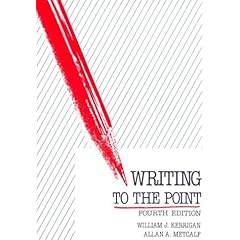
My next task as her teacher, is to finish reading Writing to the Point by Kerrigan. From what I understand so far of Kerrigan's approach to teaching writing, it seems to fit in very well to the Hake approach to teaching a much younger writer.

Who knew that learning to write could be so logical and presented so very clearly.

Grammar and Writing
Christie Curtis & Mary Hake

Fair Use for Public School Teachers

Cross-posted on matthewktabor.com.

fair use in the classroom


A month ago I wrote about a Florida A&M University law professor's decision to use questions out of a test-prep guide for a significant portion of the final exam. In Using Test Questions from Prep Guides - Ethical, Legal? I said:
"Reproducing questions from review books happens frequently in New York. We have state-issued curricula for most all high school subjects with a statewide final exam. Barron’s publishes review books for these state exams and it is very common for teachers to make unit tests from questions taken directly from the review books. No one really complains [other than that it suggests a classroom teacher is “teaching to the test”], but I find it highly unprofessional and unnecessary at the post-secondary and especially at the law school level."

I wanted to elaborate a bit on the rules by which New York State teachers - and those nationwide - must abide when using someone else's material.

There are four basic conditions to meet fair use requirements [from the House Judiciary Subcommittee]:

1. Brevity - a single poem, passage, short story, etc. is used;

2. Spontaneity - the material is included close to the time when the material is used;

3. Cumulative use - "generally no more than nine occasions per teacher per term"

4. Notice of use - credit to the author must be given with year of publication and appropriate copyright symbol.

Brevity. The intent of fair use is, generally, grounded in brevity. Teachers [and anyone creating instructional content] depends on passages, illustrations and small pieces of work to develop curriculum. Most K-12 teachers don't have a problem here.

Spontaneity. I find this a bit troubling. How many times have we chided students for leaving their work until the last minute? But if you're a teacher in New York, go for it - your use of copyrighted material is fair if you put yourself in a position that necessitates a shortcut.

Cumulative use. I've got to admit, I'm a bit puzzled by 9 uses as a threshold - it seems arbitrary, though I doubt this is ever policed. How one could use the same material 10+ times in a term and still profess that one is advancing a student's course of study at a reasonable pace is beyond me.

Notice of use. This is where teachers usually stumble - they just don't bother to credit the original authors. But satisfying point #4 is easy provided that you're committed to respecting the intellectual property of others. Author's name, the larger source, publication date, copyright symbol - the end.

I don't expect teachers or anyone else to document ad nauseum every bit of intellectual property they decide to use [it's faddish in the ed-tech community to cite image sources to the nth degree on blogs, something which I don't bother to do unless it's real intellectual property/art]. But showing the most basic respect for another's work by labeling it properly is a necessity - it shows our students that their future work will be credited and that their teacher is a competent scholar.

Browse a detailed summary of Basic Books, Inc. v. Kinko's Graphics Corp. if you're so inclined. And if you can't be bothered, at least take those four baby steps that fair use requires. It isn't hard.

from short term memory to working memory

This is a terrific short summary of the transition from short term memory, the concept I was taught in college, to today's notion of working memory.

I don't know whether this is the best account of how this idea has evolved, but it does coincide with the changes I've seen over the years.

I heart Clippy

I may be the only person on the planet who liked Clippy. (scroll down)

I wonder if my computer would go sprong if I installed the Clippy applet.

Also, I have no idea how to lock my computer. Good thing I don't work in an office. Of course, if Andrew carries on the way he's been carrying on, any day now he'll start goating people's computers.

That will be the last straw.


finding the basic principle


What about teachers? Were there teachers who were pretty important to you?

Nora Ephron: Yes. I had a couple of great, great teachers. The teacher who changed my life was my journalism teacher, whose name was Charles Simms. I always tell this story. I love it. I had already decided that I was going to be a journalist. I didn't know why exactly, except that I had seen a lot of Superman comics. Lois Lane and all of those major literary characters like that, but Mr. Simms got up the first day of class, and he went to the blackboard, and he wrote "Who, what, where, why, when, and how," which are the six things that have to be in the lead of any newspaper story. Then he did what most journalism teachers do, which is that he dictated a set of facts to us, and then we were all meant to write the lead that was supposed to have "who, what, where, why, when, and how" in it.

He dictated a set of facts that went something like, "The principal of Beverly Hills High School announced today that the faculty of the high school will travel to Sacramento, Thursday, for a colloquium in new teaching methods. Speaking there will be Margaret Mead, the anthropologist, and two other people." So we all sat down at our typewriters, and we all kind of inverted that and wrote, "Margaret Mead and X and Y will address the faculty in Sacramento, Thursday, at a colloquium on new teaching methods, the principal announced today." Something like that. We were very proud of ourselves, and we gave it to Mr. Simms, and he just riffled through them and tore them into tiny bits and threw them in the trash, and he said, "The lead to this story is: There will be no school Thursday!" and it was this great epiphany moment for me. It was this, "Oh my God, it is about the point! It is about figuring out what the point is." And I just fell in love with journalism at that moment.

I just fell in love with the idea that underneath, if you sifted through enough facts, you could get to the point, and you had to get to the point. You could not miss the point. That would be bad. So he really kind of gave that little shift of mind a major push. I just fell in love with solving the puzzle, figuring out what it was, what was the story, what was the truth of the story.

interview, Nora Ephron

Ed told me that when his first wife was learning to do radio journalism her boss kept telling her she was "backing into the story." Ed remembers being fascinated by that: backing into the story.

Print journalists call it burying the lede.

She would go into the radio booth and read the text she'd written; then the guy would tear it apart.

Temple has a wonderful way of talking about not backing into stories and not burying the lede and such. She calls what she learned to do in college find the basic principle. Temple figured this out on her own. She would have a mass of facts, figures, and concepts she had to master for a course and her working memory was too limited to hold more than a couple of them at the time, so she had to find a work-around.

Her workaround was to find the basic principle, the one idea from which all the other ideas flowed logically. Then that one idea would work as a cue, helping her to remember all the other ideas.

Of course, everyone's working memory is severely limited. The idea used to be that working memory could hold "the magical number 7 plus or minus 2" items. But these days people are saying the magical number is closer to 3 or 4.

I don't think Temple's working memory is any more limited than a typical person's; I think the real problem is that her working memory is slower. She told me once that the reason she can't do mental math is that if she's adding 12 to 29, say, by the time she's able to close the 9+2 "window" in her mind's eye (another term for working memory), she's forgotten 10+20. If she does manage to retrieve 10 + 20, she's forgotten 2+9, carry 1.

I back into my story all the time. Then some editor will tell me to fix it and I do. This has happened enough times that these days, after finishing a draft, I try to figure out how much introductory stuff has to go. It's not easy.

It's gotten easier since I discovered William J. Kerrigan's Writing to the Point. Which reminds me. I have to scan some more of Kerrigan's book and get it posted.

Judging by the essay Concerned Parent's 9-year old daughter just wrote, I'd say Hake's Grammar and Writing the closest thing we've got in print to Kerrigan. Hake wrote the Saxon Math books 5/4 through 8/7, then decided to write a "Saxon Grammar," too.


The Magical Number 4 in Short Term Memory: A Reconsideration of Mental Storage Capacity
by Nelson Cowan, 2001


William J. Kerrigan and Allan A. Metcalf
Paperback: 192 pages
Publisher: Harcourt; 4th Ed edition (January 1987)
Language: English
ISBN-10: 015598313X
ISBN-13: 978-0155983137


Thursday, November 15, 2007

NCLB, ESL and Long Division

From US News & World Report http://www.usnews.com/articles/education/2007/11/02/english-as-a-second-language.html

The fifth graders are learning division in small groups in the Fairfax County, Va., classroom, but Carolina, a girl from El Salvador who speaks broken English, is having a bit of a hard time. She has figured out that 162 divided by 12 equals 13 with a remainder of 6, but she can't come up with a story to write that shows she understands the problem. "No entiendo," she whispers to her friends. I don't understand.

She's struggling, not because she doesn't know the math, but because she can't come up with a story. This is so wrong-headed on so many levels, not the least of which is what it is doing to this girl's confidence in her own mathematical abilities, which could (in another time and place) prove to be exceptional.

Grammar

Tuesday after class, I met Martha. She's retired, in her 60s, she's a tutor, and she's misplaced (to say the least). I'm glad she's volunteering, but she has no experience teaching ESL, and she has no idea what she's doing (which she readily admitted). I suggested that she move to the literacy program for native English speakers.

Anyway, Martha wanted tips, and she veered into grammar, and then into "We should go back to teaching Latin so people will learn grammar." We had a long discussion about this. There's no point reproducing it here, but if you're interested, my abbreviated
response is here.

Now, I have about 20 more essays to read and comment on.

Newsflash – Middle-schoolers hate math homework

For Catherine, and all the other afterschoolers out there:

A national Raytheon survey found that 84 percent of middle school students would rather clean their rooms, eat vegetables, take out the garbage and to go to the dentist than do their math homework.

From Discovering the magic of math

Wednesday, November 14, 2007

Tuesday, November 13, 2007

Embarrassing

I just love it when the directions for grammar exercises -- written by university English faculty, and posted on university servers -- are themselves ungrammatical. See here, specifically the second clause of the second sentence.

Sigh.

Monday, November 12, 2007

Sundseth on fractions

This is funny.

I was Googling images of fraction multiplication and I found this. (Look down towards the middle.) The funny thing is, Doug didn't make that drawing. That's Carolyn's.

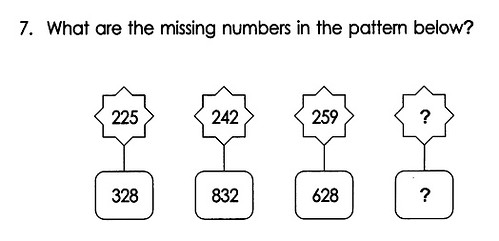
help desk - number pattern


source:
Primary Mathematics Intensive Practice 3A, U.S. Edition
p. 8


I absolutely cannot see what comes after 628.

Having looked the answer up in the back of the book, I absolutely cannot see why 862 should come after 628.

I hate number patterns.

Sunday, November 11, 2007

string theory is me

Andrew is downstairs watching a show on string theory on C's computer.

Last night he was watching something on relativity.

Andrew still can't talk; can't do math (that I know of); doesn't appear to read much beyond the basics.

But he's watching string theory.

Of course, maybe that makes sense. I can talk, do (some) math, and read way beyond the basics, but when it some to string theory, I have no clue. Maybe unlike Andrew I'm spending too much mental energy on all that other stuff to have anything left over for physics.

my dream school

Academics

The Browning School is known for being small, structured, and focused. Classwork and assignments are framed around relatively short timelines, with clear, consistent, expectations. The atmosphere is one of adults in charge, teacher directed- child focused. The curriculum is a medley of constantly evolving research and material as well as traditional programs that have always been a part of the Browning experience. The faculty work together to create an interdisciplinary course load that reinforces and builds upon a sequential academic experience.


Mission Statement

Founded in 1888 as a college preparatory school for boys, The Browning School continues its commitment to the goals of John A. Browning: the pursuit of academic excellence and a lifelong love of learning, the belief in the dignity of the individual, the development of personal integrity and responsibility to the broader community.

The Browning boy develops amid these values: the Browning alumnus is a good citizen, sensitive to the needs of others, respectful of divergent yet informed opinions.

He is, in the best sense of the word, a gentleman.


The Head of the Upper School was a journalist.

The Browning School

help desk

I'm in the thick of my cat chapter, and I'm stumped.

What would laterally compressed canines be? I'm assuming this phrase means canines that are squooshed together in some way -- that is, there's a smaller gap between the two canines in a cat than in a dog -- but I don't know.

Cats are preeminently adapted to be predators. They have laterally compressed canines, rooted in mechanoreceptors, that hold food and permit them to dislocate the vertebrae of prey in one bite.

Clinical Behavioral Medicine for Small Animals
Karen Overall
St. Louis: Mosby, 1997
page 55

I'm not managing to visualize this at all.

Overall's book is fantastic, btw. Expensive and fantastic.

The other marvelous book I've found is Dennis C. Turner & Patrick Bateson's The Domestic Cat: The biology of its behaviour. The subtitle is a bit misleading, because the book has far more to say about behaviour than biology, making it far more interesting than you would imagine from the title. You can look at the book on Google (previous link); here's the Cambridge Press page.

Last and also least if you're trying to write a book about animal welfare, We Are the Cat is pure pleasure. Brilliant writing.